

石油与天然气地质 ›› 2025, Vol. 46 ›› Issue (4): 1267-1280.doi: 10.11743/ogg20250416
鲍李银1,2( ), 庞雄奇1,2(), 邹亮3, 陈宏飞1,2,3, 林昊1,2, 张婷1,2, 沈彬1,2, 王凯4, 王睿5
收稿日期:2025-05-08
修回日期:2025-07-14
出版日期:2025-08-30
发布日期:2025-09-06
通讯作者:
庞雄奇
E-mail:995959069@qq.com;pangxq@cup.edu.cn
第一作者简介:鲍李银(1998—),男,博士研究生,油气藏形成机制与分布规律。E-mail:995959069@qq.com。
基金项目:
Liyin BAO1,2(), Xiongqi PANG1,2(), Liang ZOU3, Hongfei CHEN1,2,3, Hao LIN1,2, Ting ZHANG1,2, Bin SHEN1,2, Kai WANG4, Rui WANG5
Received:2025-05-08
Revised:2025-07-14
Online:2025-08-30
Published:2025-09-06
Contact:
Xiongqi PANG
E-mail:995959069@qq.com;pangxq@cup.edu.cn
摘要:
准噶尔盆地玛湖凹陷二叠系风城组全油气系统包含常规油气藏、致密油气藏和页岩油气藏,其形成与分布受多动力场耦合作用的控制。通过统计分析和地质剖析等手段,系统研究了风城组3类油气藏的动力边界和运移动力贡献差异。基于1 024块常规与非常规储层样品的物性测试、1 235组高压压汞实验和1 630块样品的热解分析开展研究,建立了孔隙度、渗透率和最大孔喉半径随埋深变化的定量关系模型,明确了浮力成藏下限(BHAD)、油气成藏底限(HADL)和源岩供烃底限(ASDL)的临界参数。BHAD对应埋深4 290.86 m(孔隙度8%,渗透率1 × 10⁻³ μm2,最大孔喉半径0.800 μm),HADL对应埋深约8 000.00 m(孔隙度2%,最大孔喉半径0.025 μm),ASDL对应埋深约10 000.00 m。通过“四分法”定量评价浮力、非浮力(毛细管压力差)、构造应力和流体溶蚀作用的贡献量,明确了常规油气藏(BHAD之上)油气运移动力以浮力主导,主要分布在凹陷边缘的三角洲平原相中。非常规油气藏(BHAD之下)油气运移动力以毛细管压力差和生排烃动力为主,主要分布在斜坡过渡带和凹陷中心,以三角洲前缘和浅湖-半深湖亚相为主。通过建立孔隙度-渗透率-埋深定量模型与“四分法”动力贡献量评价,深化了全油气系统成藏动力学理论,为准噶尔盆地及类似区域的常规-非常规油气资源协同勘探与高效开发提供了科学支撑。
中图分类号:

图1
准噶尔盆地玛湖凹陷综合地质概况a. 玛湖凹陷构造特征;b. 玛湖凹陷二叠系综合柱状图"


图2
玛湖凹陷风城组浮力成藏下限对应的孔隙度(a)、渗透率(b)和最大孔喉半径(c)频率分布直方图(n为样本个数。)"

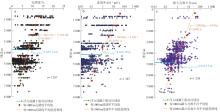
图3
玛湖凹陷风城组浮力成藏下限对应物性参数图版a. 孔隙度随埋深变化;b.渗透率随埋深变化;c. 最大孔喉半径随埋深变化(n为样本个数;D为埋深。)"


图4
玛湖凹陷风城组油气成藏底限确定图版a. 孔隙度随埋深变化;b.含油饱和度随埋深变化;c.平均日产能随埋深变化;d.油层占比随埋深变化(n为样本个数;n井为井点个数。)"


图5
玛湖凹陷风城组源岩供烃底限确定图版a.S1/TOC随埋深变化;b.(S1+ S2)/TOC随埋深变化(ASDL为源岩供烃底限;D为埋深;Ro为镜质体反射率;n为样本个数。)"


图6
玛湖凹陷二叠系全油气系统常规-非常规油气藏序列分布a.常规-非常规油气藏剖面示意图;b.油、气藏数量占比条形图(C为石炭系;P1 j为佳木河组;P1 f为风城组;P2x为夏子街组;P2w为下乌尔禾组;P3w为上乌尔禾组;T1b为百口泉组;T2k为克拉玛依组;T3b为白碱滩组;BHAD为浮力成藏下限;HADL为油气成藏底限;ASDL为源岩供烃底限;n为样本个数。)"


图7
玛湖凹陷风城组常规油气藏物性特征(a)与不同动力相对贡献量评价(b)(Ⅰ为浮力;Ⅱ1为应力改造;Ⅱ2为流体改造;Ⅲ为非浮力。)"


图8
玛湖凹陷风城组油气藏油气运移动力随埋深变化特征a1—a4. 分别为埋深 ≤ 1 000,1 000 ~ 2 000,2 000 ~ 3 000和3 000 ~ 4 000 m层段孔隙度-渗透率关系(n为样本个数);b.不同埋深不同类型油藏占比条形图(BHAD为浮力成藏下限;Ⅰ为浮力;Ⅱ1为应力改造孔隙度-渗透率关系;Ⅱ2为流体改造;Ⅲ为非浮力。)"


图9
玛湖凹陷风城组致密油气藏物性特征(a)与不同动力相对贡献量评价(b)(n为样本个数;BHAD为浮力成藏下限;Ⅰ为浮力;Ⅱ1为应力改造;Ⅱ2为流体改造;Ⅲ为非浮力。)"


图10
玛湖凹陷风城组页岩油气藏物性特征(a)与不同动力相对贡献量评价(b)(n为样本个数;BHAD为浮力成藏下限;Ⅰ为浮力;Ⅱ1为应力改造;Ⅱ2为流体改造;Ⅲ为非浮力。)"


图11
玛湖凹陷风城组储层内、外毛细管力差与产能相关性a.非储层最大孔喉半径随埋深变化关系;b.储层外/内毛细管力比率随埋深变化关系及控产特征;c.储层外/内毛细管力比率与日产油量相关性(n为样本个数。)"


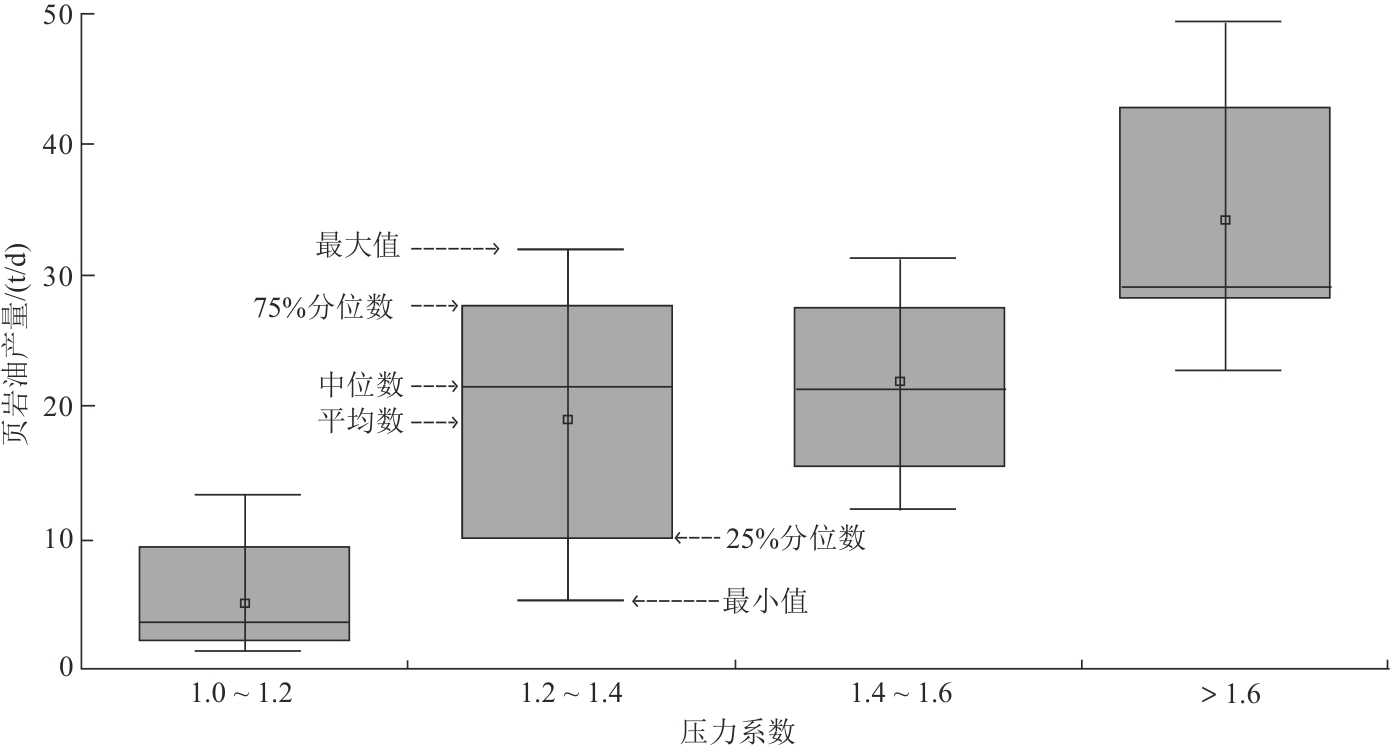
图12
玛湖凹陷风城组压力系数与页岩油直井产量关系箱形图"
| [1] | 贾承造, 王祖纲, 姜林, 等. 中国页岩油勘探开发研究进展与科学技术问题[J]. 世界石油工业, 2024, 31(4): 1-11, 13. |
| JIA Chengzao, WANG Zugang, JIANG Lin, et al. Progress and key scientific and technological problems of shale oil exploration and development in China[J]. World Petroleum Industry, 2024, 31(4): 1-11, 13. | |
| [2] | 郭旭升, 马晓潇, 黎茂稳, 等. 陆相页岩油富集机理探讨[J]. 石油与天然气地质, 2023, 44(6): 1333-1349. |
| GUO Xusheng, MA Xiaoxiao, LI Maowen, et al. Mechanisms for lacustrine shale oil enrichment in Chinese sedimentary basins[J]. Oil & Gas Geology, 2023, 44(6): 1333-1349. | |
| [3] | 孙龙德, 王小军, 冯子辉, 等. 松辽盆地古龙页岩纳米孔缝形成机制与页岩油富集特征[J]. 石油与天然气地质, 2023, 44(6): 1350-1365. |
| SUN Longde, WANG Xiaojun, FENG Zihui, et al. Formation mechanisms of nano-scale pores/fissures and shale oil enrichment characteristics for Gulong shale, Songliao Basin[J]. Oil & Gas Geology, 2023, 44(6): 1350-1365. | |
| [4] | 赵文智, 胡素云, 侯连华, 等. 中国陆相页岩油类型、资源潜力及与致密油的边界[J]. 石油勘探与开发, 2020, 47(1): 1-10. |
| ZHAO Wenzhi, HU Suyun, HOU Lianhua, et al. Types and resource potential of continental shale oil in China and its boundary with tight oil[J]. Petroleum Exploration and Development, 2020, 47(1): 1-10. | |
| [5] | 钱兴坤, 陆如泉, 罗良才, 等. 2023年国内外油气行业发展及2024年展望[J]. 国际石油经济, 2024, 32(2): 1-13. |
| QIAN Xingkun, LU Ruquan, LUO Liangcai, et al. Global oil and gas industry in 2023 and outlook for 2024[J]. International Petroleum Economics, 2024, 32(2): 1-13. | |
| [6] | 贾承造, 庞雄奇, 宋岩. 全油气系统理论基本原理[J]. 石油勘探与开发, 2024, 51(4): 679-691. |
| JIA Chengzao, PANG Xiongqi, SONG Yan. Basic principles of the whole petroleum system[J]. Petroleum Exploration and Development, 2024, 51(4): 679-691. | |
| [7] | 文龙, 张本健, 金值民, 等. 四川盆地陆相全油气系统成藏序列与勘探领域[J]. 石油勘探与开发, 2024, 51(5): 997-1007. |
| WEN Long, ZHANG Benjian, JIN Zhimin, et al. Accumulation sequence and exploration domain of continental whole petroleum system in Sichuan Basin, SW China[J]. Petroleum Exploration and Development, 2024, 51(5): 997-1007. | |
| [8] | 李国欣, 贾承造, 赵群, 等. 煤岩气成藏机理与煤系全油气系统[J]. 石油勘探与开发, 2025, 52(1): 29-43. |
| LI Guoxin, JIA Chengzao, ZHAO Qun, et al. Coal-rock gas accumulation mechanism and the whole petroleum system of coal measures[J]. Petroleum Exploration and Development, 2025, 52(1): 29-43. | |
| [9] | 支东明, 李建忠, 杨帆, 等. 准噶尔盆地吉木萨尔凹陷二叠系全油气系统地质特征与勘探开发实践[J]. 中国石油勘探, 2023, 28(4): 14-23. |
| ZHI Dongming, LI Jianzhong, YANG Fan, et al. Geological characteristics and exploration and development practice of the Permian full oil and gas system in Jimsar Sag, Junggar Basin[J]. China Petroleum Exploration, 2023, 28(4): 14-23. | |
| [10] | 孙耀玺, 庞雄奇, 成湘, 等. 复杂叠合盆地油气动力场划分及其与勘探的关系——以塔西南坳陷为例[J]. 断块油气田, 2025, 32(2): 185-192. |
| SUN Yaoxi, PANG Xiongqi, CHENG Xiang, et al. Division of hydrocarbon dynamic field in complex superimposed basins and its relationship with exploration: A case study of southwest Tarim Depression[J]. Fault-Block Oil & Gas Field, 2025, 32(2): 185-192. | |
| [11] | 何文军, 唐勇, 郭旭光, 等. 准噶尔盆地玛湖凹陷常规-非常规全油气系统成藏模式研究[J]. 新疆地质, 2023, 41(): 67. |
| HE Wenjun, TANG Yong, GUO Xuguang, et al. Research of accumulation models of conventional and unconventional hydrocarbons in Mahu sag, Junggar Basin[J]. Xinjiang Geology, 2023, 41(S1): 67. | |
| [12] | 宋岩, 贾承造, 姜林, 等. 全油气系统内涵与研究思路[J]. 石油勘探与开发, 2024, 51(6): 1199-1210, 1226. |
| SONG Yan, JIA Chengzao, JIANG Lin, et al. Connotation and research strategy of the whole petroleum system[J]. Petroleum Exploration and Development, 2024, 51(6): 1199-1210, 1226. | |
| [13] | 庞雄奇, 罗晓容, 姜振学, 等. 中国典型叠合盆地油气聚散机理与定量模拟[M]. 北京: 科学出版社, 2007. |
| PANG Xiongqi, LUO Xiaorong, JIANG Zhenxue, et al. The mechanism of hydrocarbon accumulation and dissipation and quantitative simulation of the typical superimposed basin in China[M]. Beijing: Science Press, 2007. | |
| [14] | 庞雄奇, 姜振学, 黄捍东, 等. 叠复连续油气藏成因机制、发育模式及分布预测[J]. 石油学报, 2014, 35(5): 795-828. |
| PANG Xiongqi, JIANG Zhenxue, HUANG Handong, et al. Formation mechanisms, distribution models, and prediction of superimposed, continuous hydrocarbon reservoirs[J]. Acta Petrolei Sinica, 2014, 35(5): 795-828. | |
| [15] | PANG Xiongqi, HU Tao, LARTER S, et al. Hydrocarbon accumulation depth limit and implications for potential resources prediction[J]. Gondwana Research, 2022, 103: 389-400. |
| [16] | 贾承造, 庞雄奇, 宋岩. 论非常规油气成藏机理: 油气自封闭作用与分子间作用力[J]. 石油勘探与开发, 2021, 48(3): 437-452. |
| JIA Chengzao, PANG Xiongqi, SONG Yan. The mechanism of unconventional hydrocarbon formation: Hydrocarbon self-containment and intermolecular forces[J]. Petroleum Exploration and Development, 2021, 48(3): 437-452. | |
| [17] | 施砍园, 陈君青, 庞雄奇, 等. 储层矿物润湿性的测量方法综述[J]. 特种油气藏, 2024, 31(2): 1-9. |
| SHI Kanyuan, CHEN Junqing, PANG Xiongqi, et al. A review of methods for measuring the wettability of reservoir minerals[J]. Special Oil & Gas Reservoirs, 2024, 31(2): 1-9. | |
| [18] | PANG Xiongqi, JIA Chengzao, WANG Wenyang, et al. Buoyance-driven hydrocarbon accumulation depth and its implication for unconventional resource prediction[J]. Geoscience Frontiers, 2021, 12(4): 101133. |
| [19] | PANG Xiongqi, JIA Chengzao, ZHANG Kun, et al. The dead line for oil and gas and implication for fossil resource prediction[J]. Earth System Science Data, 2020, 12(1): 577-590. |
| [20] | 周立明, 庞雄奇, 武鲁亚, 等. 准噶尔盆地西北缘深层油气成藏底限及其判别[J]. 石油学报, 2015, 36(): 169-175, 193. |
| ZHOU Liming, PANG Xiongqi, WU Luya, et al. Bottom boundary of deep hydrocarbon accumulation in northwestern margin of Junggar Basin and its identification[J]. Acta Petrolei Sinica, 2015, 36(S2): 169-175, 193. | |
| [21] | 游婷婷, 庞雄奇, 李洪博, 等. 惠州凹陷流体动力场研究方法及应用[J]. 特种油气藏, 2023, 30(2): 86-94. |
| YOU Tingting, PANG Xiongqi, LI Hongbo, et al. Research methods and applications of hydrodynamic field in Huizhou Sag[J]. Special Oil & Gas Reservoirs, 2023, 30(2): 86-94. | |
| [22] | WANG Wenyang, PANG Xiongqi, CHEN Zhangxin, et al. Improved methods for determining effective sandstone reservoirs and evaluating hydrocarbon enrichment in petroliferous basins[J]. Applied Energy, 2020, 261: 114457. |
| [23] | 万玲, 孙岩, 魏国齐. 确定储集层物性参数下限的一种新方法及其应用——以鄂尔多斯盆地中部气田为例[J]. 沉积学报, 1999, 17(3): 454-457. |
| WAN Ling, SUN Yan, WEI Guoqi. A new method used to determine the lower limit of the petrophysical parameters for reservoir and its application: A case study on Zhongbu Gas Field in Ordos Basin[J]. Acta Sedimentologica Sinica, 1999, 17(3): 454-457. | |
| [24] | 郑定业. 深层碳酸盐岩浮力成藏下限、主控因素及演化特征[D]. 北京: 中国石油大学(北京), 2022. |
| ZHENG Dingye. Buoyancy-driven hydrocarbon accumulation depth, main controlling factors and evolutionary characteristics in deep carbonate reservoirs[D]. Beijing: China University of Petroleum (Beijing), 2022. | |
| [25] | 刘昭婷. 南堡凹陷不同区带浮力成藏下限的差异及影响因素分析[D]. 北京: 中国石油大学(北京), 2018. |
| LIU Zhaoting. Differences and influencing factors of the buoyance controlling reservoir limitation in different zones of Nanpu Sag[D]. Beijing: China University of Petroleum (Beijing), 2018. | |
| [26] | 邹才能, 张光亚, 陶士振, 等. 全球油气勘探领域地质特征、重大发现及非常规石油地质[J]. 石油勘探与开发, 2010, 37(2): 129-145. |
| ZOU Caineng, ZHANG Guangya, TAO Shizhen, et al. Geological features, major discoveries and unconventional petroleum geology in the global petroleum exploration[J]. Petroleum Exploration and Development, 2010, 37(2): 129-145. | |
| [27] | OUGIER-SIMONIN A, RENARD F, BOEHM C, et al. Microfracturing and microporosity in shales[J]. Earth-Science Reviews, 2016, 162: 198-226. |
| [28] | 张志杰, 袁选俊, 汪梦诗, 等. 准噶尔盆地玛湖凹陷二叠系风城组碱湖沉积特征与古环境演化[J]. 石油勘探与开发, 2018, 45(6): 972-984. |
| ZHANG Zhijie, YUAN Xuanjun, WANG Mengshi, et al. Alkaline-lacustrine deposition and paleoenvironmental evolution in Permian Fengcheng Formation at the Mahu Sag, Junggar Basin, NW China[J]. Petroleum Exploration and Development, 2018, 45(6): 972-984. | |
| [29] | 邹才能, 张国生, 杨智, 等. 非常规油气概念、特征、潜力及技术——兼论非常规油气地质学[J]. 石油勘探与开发, 2013, 40(4): 385-399, 454. |
| ZOU Caineng, ZHANG Guosheng, YANG Zhi, et al. Geological concepts, characteristics, resource potential and key techniques of unconventional hydrocarbon: On unconventional petroleum geology[J]. Petroleum Exploration and Development, 2013, 40(4): 385-399, 454. | |
| [30] | 庞雄奇, 贾承造, 郭秋麟, 等. 全油气系统理论用于常规和非常规油气资源评价的盆地模拟技术原理及应用[J]. 石油学报, 2023, 44(9): 1417-1433. |
| PANG Xiongqi, JIA Chengzao, GUO Qiulin, et al. Principle and application of basin modeling technology for evaluation of conventional and unconventional oil-gas resource based on whole petroleum system theory[J]. Acta Petrolei Sinica, 2023, 44(9): 1417-1433. | |
| [31] | 白雪峰, 陆加敏, 李军辉, 等. 松辽盆地北部全油气系统成藏模式与勘探潜力[J]. 大庆石油地质与开发, 2024, 223(3): 49-61. |
| BAI Xufeng, LU Jiamin, LI Junhui, et al. Hydrocarbon accumulation patterns and exploration potential of whole petroleum systems in northern Songliao Basin[J]. 2024, 223(3): 49-61. | |
| [32] | 何昌松, 王秉乾, 魏双宝, 等. 准噶尔盆地石钱滩凹陷石钱滩组地质特征及油气勘探[J]. 新疆石油地质, 2024, 45(6): 642-649. |
| HE Changsong, WANG Bingqian, WEI Shuangbao, et al. Geological Characteristics and Petroleum Exploration of Shiqiantan Formation in Shiqiantan Sag, Junggar Basin[J]. Xinjiang Petroleum Geology, 2024, 45(6): 642-649. | |
| [33] | 庞雄奇, 姜振学, 黄捍东, 等. 叠复连续油气藏成因机制、发育模式及分布预测[J]. 石油学报, 2014, 35(5): 795-828. |
| PANG Xiongqi, JIANG Zhenxue, HUANG Handong, et al. Formation mechanisms, distribution models, and prediction of superimposed, continuous hydrocarbon reservoirs[J]. Acta Petrolei Sinica, 2014, 35(5): 795-828. | |
| [34] | PANG Bo, PANG Xiongqi, LI Caijun, et al. A novel method for quantitatively identifying driving forces and evaluating their contributions to oil and gas accumulation[J]. Geoscience Frontiers, 2024, 15(4): 101801. |
| [35] | 韩剑发, 苏洲, 陈利新, 等. 塔里木盆地台盆区走滑断裂控储控藏作用及勘探潜力[J]. 石油学报, 2019, 40(11): 1296-1310. |
| HAN Jianfa, SU Zhou, CHEN Lixin, et al. Reservoir-controlling and accumulation-controlling of strike-slip faults and exploration potential in the platform of Tarim Basin[J]. Acta Petrolei Sinica, 2019, 40(11): 1296-1310. | |
| [36] | ZHANG Chaojun, JIA Chengzao, LI Benliang, et al. Ancient karsts and hydrocarbon accumulation in the middle and western parts of the North Tarim uplift, NW China[J]. Petroleum Exploration and Development, 2010, 37(3): 263-269. |
| [37] | WHITE I C. The geology of natural gas[J]. Science, 1885, 5(125): 521-522. |
| [38] | 鲍李银, 孙盼科, 陈永辉, 等. 陆相页岩油纹层型、夹层型储层孔隙结构特征及其约束下的流体可动性差异——以吉木萨尔凹陷芦草沟组页岩油储层为例[J]. 石油科学通报, 2024, 9(6): 866-884. |
| BAO Liyin, SUN Panke, CHEN Yonghui, et al. Characteristics of pore structure and fluid mobility differences under constraints of continental shale laminar and interbedded reservoirs: A case study of the Lucaogou Formation shale reservoir in the Jimusar Depression[J]. Petroleum Science Bulletin, 2024, 9(6): 866-884. | |
| [39] | 赵文智, 刘伟, 卞从胜, 等. 保存条件对陆相中高熟页岩油富集与流动性保持的作用[J]. 石油勘探与开发, 2025, 52(1): 1-14. |
| ZHAO Wenzhi, LIU Wei, BIAN Congsheng, et al. Role of preservation conditions on enrichment and fluidity maintenance of medium to high maturity lacustrine shale oil[J]. Petroleum Exploration and Development, 2025, 52(1): 1-14. |
| [1] | 贾承造, 庞雄奇, 宋岩, 崔新璇, 胡耀, 徐帜, 姜林, 蒲庭玉, 姜福杰, 沈彬. 全油气系统的4种基本类型及其资源开发领域[J]. 石油与天然气地质, 2025, 46(4): 1019-1038. |
| [2] | 庞雄奇, 崔新璇, 贾承造, 鲍李银, 李才俊, 黎茂稳, 徐帜, 肖惠译, 郑定业, 金玉洁, 施砍园, 张思佳. 全油气系统理论在实用中面临的几个问题与解决方法[J]. 石油与天然气地质, 2025, 46(4): 1039-1054. |
| [3] | 刘可禹, 张思佳, 刘建良, 赵振丞, 金玉洁, 张婷, 林昊. 全油气系统:油气地质学研究新方向和油气勘探新范式[J]. 石油与天然气地质, 2025, 46(4): 1055-1070. |
| [4] | 陈君青, 贾承造, 姜林, 庞宏, 火勋港, 陈冬霞, 施砍园, 胡涛, 杨晓斌, 冉钧. 全油气系统非常规油气成藏过程中自封闭作用的主要类型与定量表征[J]. 石油与天然气地质, 2025, 46(4): 1071-1091. |
| [5] | 肖惠译, 庞雄奇, 李才俊, 胡涛, 徐帜, 林孝飞, 胡耀, 王雷, 崔新璇, 施砍园, 蒲庭玉, 鲍李银. 全油气系统形成演化过程中常规与非常规油气藏转化机制及模式[J]. 石油与天然气地质, 2025, 46(4): 1092-1106. |
| [6] | 施砍园, 庞雄奇, 陈君青, 陈掌星, 王雷, 蒲庭玉, 鲍李银, 惠沙沙, 肖惠译, 崔新璇. 全油气系统中储层润湿性与界面张力等关键参数变化特征及其分子动力学模拟[J]. 石油与天然气地质, 2025, 46(4): 1107-1122. |
| [7] | 庞宏, 刘国勇, 贾承造, 姜福杰, 姜林, 王建伟, 马学峰, 陈迪, 陈君青. 陆相断陷盆地全油气系统成藏动力场特征与有序分布模式——以渤海湾盆地南堡凹陷为例[J]. 石油与天然气地质, 2025, 46(4): 1136-1151. |
| [8] | 徐田武, 李素梅, 陈湘飞, 马学峰, 邓硕, 张莹莹. 渤海湾盆地东濮凹陷全油气系统特征及其成藏模式[J]. 石油与天然气地质, 2025, 46(4): 1152-1168. |
| [9] | 胡涛, 熊智明, 肖惠译, 徐田武, 徐云龙, 李素梅, 姜福杰, 黎茂稳, 姜林. 断陷湖盆全油气系统油气藏有序分布特征及差异富集机制——以渤海湾盆地东濮凹陷古近系沙河街组为例[J]. 石油与天然气地质, 2025, 46(4): 1169-1182. |
| [10] | 李素梅, 刘佳, 马学峰, 庞秋菊, 赵知非. 渤海湾盆地辽河坳陷西部凹陷全油气系统特征与勘探潜力[J]. 石油与天然气地质, 2025, 46(4): 1183-1199. |
| [11] | 周能武, 初众, 卢双舫, 张鹏飞, 王民, 林子智, 王军杰, 姜新雨, 刘阳, 陈国辉, 李文镖. 致密气与页岩气耦合成藏机制及其定量评价——以松辽盆地徐家围子断陷白垩系沙河子组为例[J]. 石油与天然气地质, 2025, 46(4): 1200-1214. |
| [12] | 陈冬霞, 王翘楚, 熊亮, 王小娟, 杨映涛, 雷文智, 张玲, 潘珂, 庞宏. 川西—川中地区陆相层系全油气系统常规和非常规有效储层成因机制与分类评价[J]. 石油与天然气地质, 2025, 46(4): 1215-1232. |
| [13] | 康逊, 谭静强, 胡文瑄, 靳军, 胡瑞璞, 曹剑. 准噶尔盆地玛湖凹陷全油气系统成储机制差异性[J]. 石油与天然气地质, 2025, 46(4): 1250-1266. |
| [14] | 胡耀, 贾承造, 庞雄奇, 宋永, 何文军, 陈宏飞, 鲍李银, 陈玮岩, 赵文, 肖惠译, 李才俊, 徐帜. 远源型致密油气藏运聚动力与成藏模式——以准噶尔盆地玛湖凹陷三叠系百口泉组砂砾岩油藏为例[J]. 石油与天然气地质, 2025, 46(4): 1281-1298. |
| [15] | 曹鹏, 赵振丞, 庞雄奇, 李才俊, 庞宏, 林会喜, 杨海军, 马奎友, 张思佳. 塔里木盆地台盆区下古生界全油气系统碳酸盐岩油气藏改造特征与成因模式[J]. 石油与天然气地质, 2025, 46(4): 1299-1315. |
| 阅读次数 | ||||||
|
全文 |
|
|||||
|
摘要 |
|
|||||
