

石油与天然气地质 ›› 2025, Vol. 46 ›› Issue (5): 1731-1744.doi: 10.11743/ogg20250521
• 方法技术 • 上一篇
王超1,2( ), 付晓飞1,2, 靳叶军2,3, 孟令东2,3(), 陈显学4, 张天广4, 石海东1,5
收稿日期:2025-01-04
修回日期:2025-03-31
出版日期:2025-10-30
发布日期:2025-10-29
通讯作者:
孟令东
E-mail:wzy3753@163.com;lingdong.Meng@hotmai.com
第一作者简介:王超(1995—),男,讲师,断层带结构、封闭性与稳定性。E‑mail: wzy3753@163.com。
基金项目:
Chao WANG1,2(), Xiaofei FU1,2, Yejun JIN2,3, Lingdong MENG2,3(), Xianxue CHEN4, Tianguang ZHANG4, Haidong SHI1,5
Received:2025-01-04
Revised:2025-03-31
Online:2025-10-30
Published:2025-10-29
Contact:
Lingdong MENG
E-mail:wzy3753@163.com;lingdong.Meng@hotmai.com
摘要:
储气库的安全运行对保证稳定供气、发挥储气库季节调峰和能源战略储备具有重要意义。储气库内断层的稳定性是评价其安全运行的关键因素。开展储气库断层稳定性评价,确定断层失稳临界压力非常必要。研究表明:传统的断层稳定性评价方法将断层摩擦系数视为定值,这种方法在实际应用中高估了断层的稳定性。基于黏土矿物对摩擦强度的弱化机理,研究不同类型黏土矿物与摩擦系数的关系,用理论计算与摩擦强度实验标定的方法,建立了适用于研究区的断层摩擦强度非均质性定量表征模型,提高了雷61储气库相关断层稳定性评价方法的科学性和准确性。评价结果对比表明,用传统断层稳定性评价方法,所有断层在当前应力场下均表现出较高的稳定性,最小活化压力为20.04 MPa;采用改进的断层稳定性评价方法,尽管断层尚未发生活化,但最小活化压力已经降至16.68 MPa,较传统方法降低了3.36 MPa。
中图分类号:
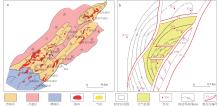
图1
辽河盆地雷61储气库构造位置(a)和圈闭断层发育特征(b)"

表1
辽河盆地雷61储气库断层要素统计"
| 断层编号 | 断层走向 | 断层倾向 | 断层倾角/(°) | 断层性质 | 断距/m | 断层延伸长度/km |
|---|---|---|---|---|---|---|
| F1 | 北东向 | 南东向 | 65.1 | 正断层 | 700~1 000 | 5.4 |
| F2 | 北东向 | 南东向 | 55.5 | 正断层 | 35~120 | 2.5 |
| F3 | 北东向 | 北西向 | 59.3 | 正断层 | 25~75 | 3.1 |
| F4 | 东西向 | 北向 | 58.6 | 正断层 | 15~70 | 1.1 |
| F5 | 东西向 | 南向 | 38.4 | 正断层 | 15~40 | 0.5 |
| F6 | 东西向 | 南向 | 35.8 | 正断层 | 15~35 | 0.5 |

图2
辽河盆地雷61储气库第二轮注气期储层压力变化"
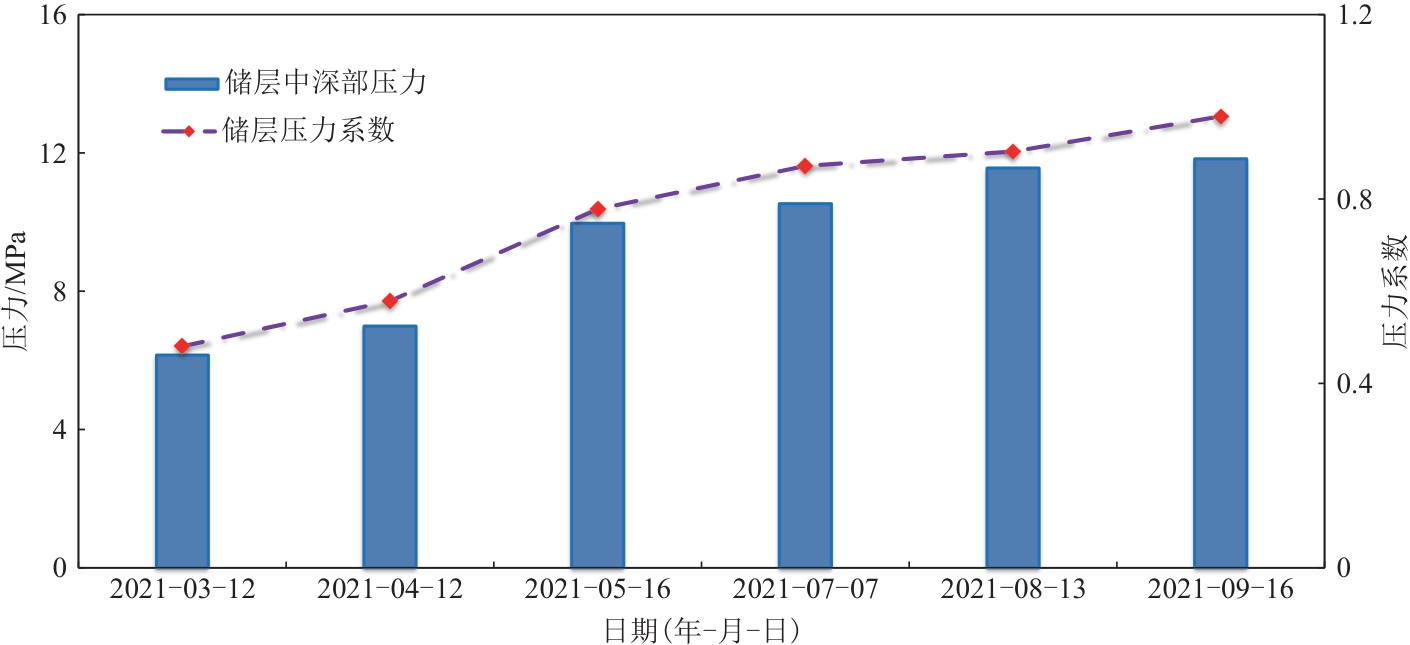

图3
断层稳定性评价原理(a)和断层面有效正应力计算模式图(b)(σv. 垂向主应力; σv′. 垂向有效主应力;σHmax. 最大水平主应力; σHmax′. 最大水平有效主应力; σhmin. 最小水平主应力; σhmin′. 最小水平有效主应力; Δp. 附加流体压力; pR. 活化压力; α. 最大主应力与断面法向夹角; β. 中间主应力与断面法向夹角; γ. 最小主应力与断面法向夹角。)"


图4
临界压力扰动评价方法(a)和断层封闭性分析技术评价方法模式图(b)σ.断面有效正应力;σv.垂向有效主应力;σHmax.最大水平有效主应力;σhmin.最小水平有效主应力;Δp.附加流体压力;τ.断层所受剪应力;μ.断层摩擦系数;C.内聚力"
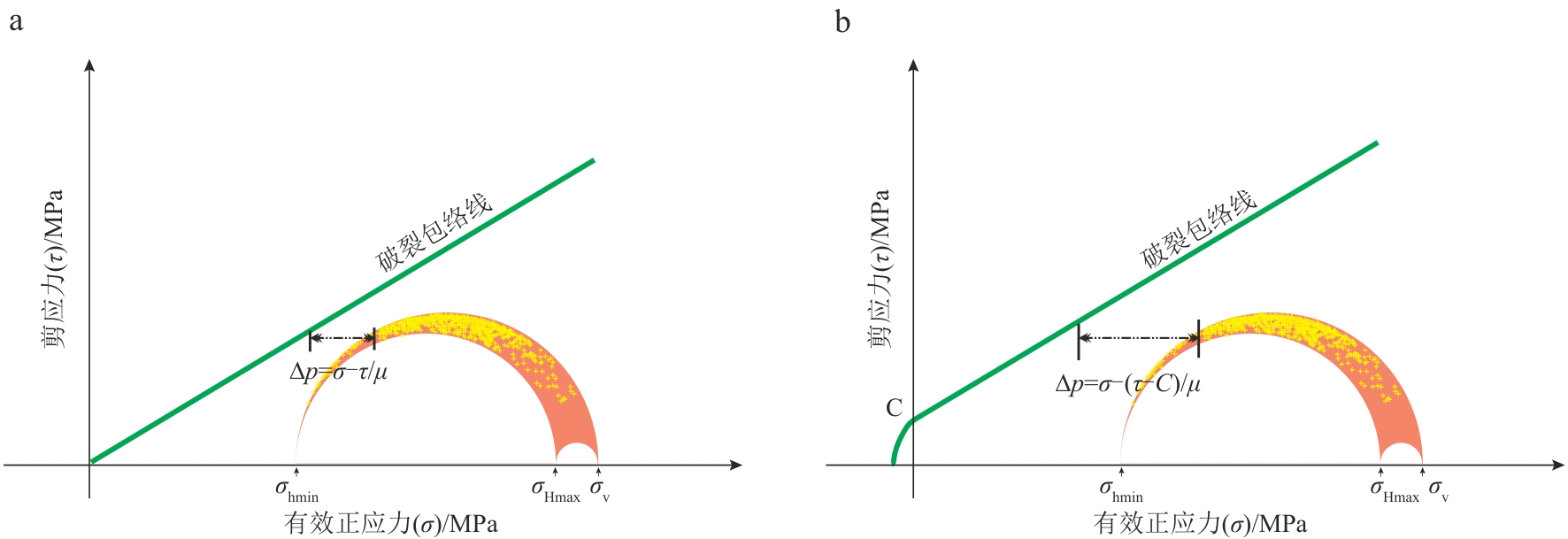

图5
辽河盆地雷61储气库地应力解释成果图a. 雷61-2井地层密度与深度变化关系;b. 雷61储气库应力与深度关系;c. 最大水平主应力方位玫瑰花图"

表2
辽河盆地雷61-6井X射线衍射(XRD)黏土矿物分析测试数据"
| 样品编号 | 深度/m | 黏土矿物组分占比/% | 伊/蒙混层比/% | |||
|---|---|---|---|---|---|---|
| 伊/蒙混层 | 伊利石 | 高岭石 | 绿泥石 | |||
| 1 | 1 341.1 | 42 | 29 | 15 | 14 | 73 |
| 2 | 1 346.0 | 48 | 23 | 15 | 14 | 79 |
| 3 | 1 347.8 | 57 | 23 | 10 | 10 | 71 |
| 4 | 1 348.7 | 58 | 22 | 10 | 10 | 71 |
| 5 | 1 349.6 | 62 | 23 | 8 | 7 | 76 |
| 6 | 1 354.4 | 40 | 33 | 14 | 13 | 56 |
| 7 | 1 356.0 | 75 | 15 | 5 | 5 | 86 |
| 8 | 1 357.0 | 71 | 16 | 6 | 7 | 86 |
| 9 | 1 358.6 | 65 | 21 | 7 | 7 | 88 |
| 10 | 1 368.0 | 71 | 13 | 8 | 8 | 90 |
| 11 | 1 371.0 | 82 | 7 | 6 | 5 | 96 |
| 12 | 1 372.7 | 72 | 18 | 5 | 5 | 95 |
| 13 | 1 381.9 | 77 | 10 | 7 | 6 | 94 |
| 14 | 1 384.9 | 80 | 9 | 6 | 5 | 96 |
| 15 | 1 391.8 | 61 | 23 | 8 | 8 | 68 |
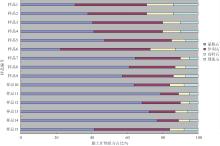
图6
辽河盆地雷61-6井泥岩矿物X射线衍射(XRD)分析测试结果"
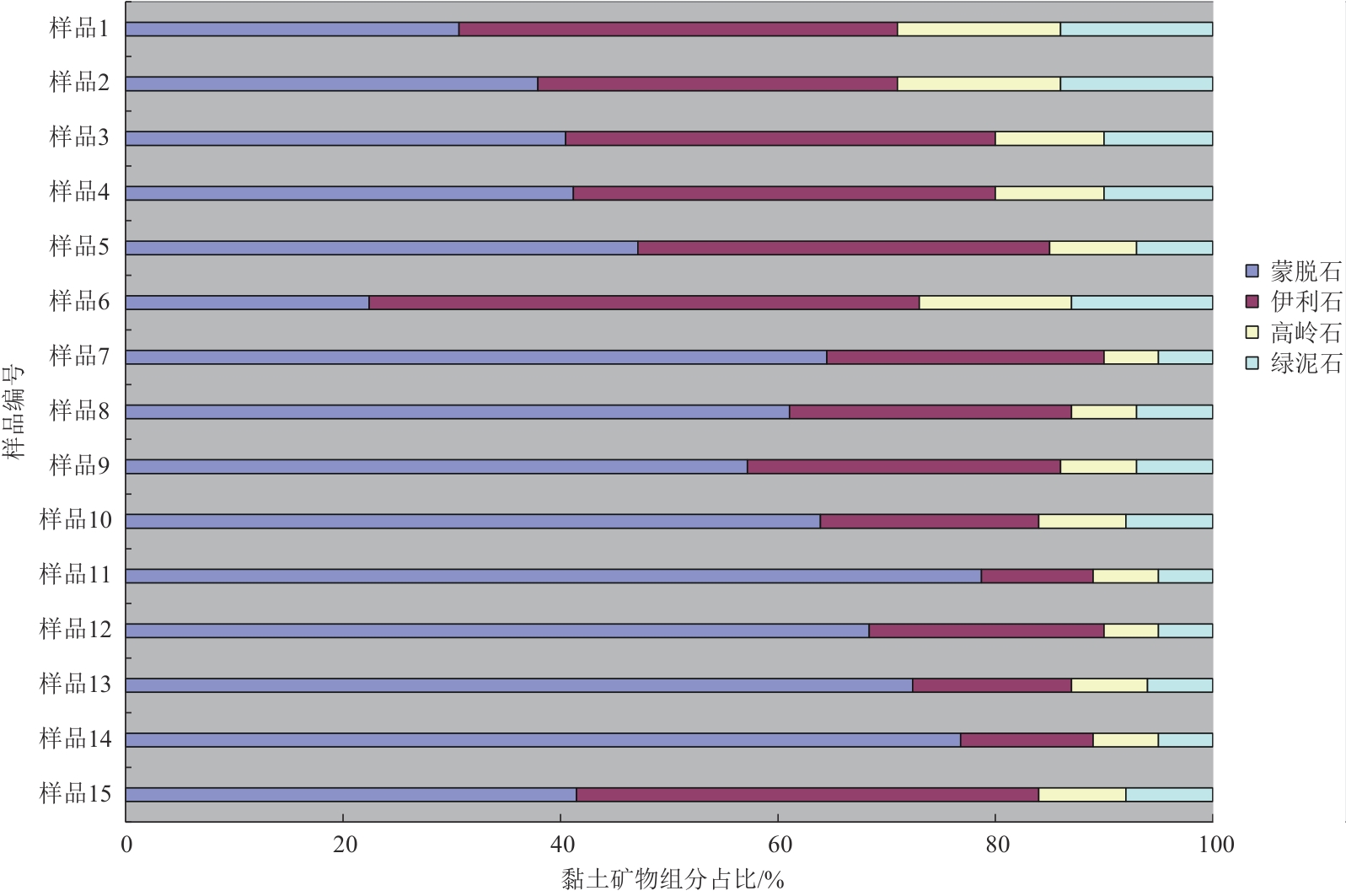
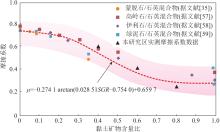
图7
不同类型黏土矿物含量与摩擦系数关系散点图"

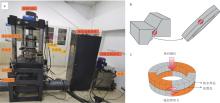
图8
高压-低速环形剪切实验设备(a)和实验模型图(b,c)"

表3
环形剪切物理模拟实验样品配比"
| 实验序号 | 样品质量/g | 黏土矿物组分含量/g | 石英含量/g | 泥质含量/% | 有效正应力/MPa | 旋转角度/(°) | |||
|---|---|---|---|---|---|---|---|---|---|
| 蒙脱石 | 伊利石 | 高岭石 | 绿泥石 | ||||||
| 1 | 100.0 | 21.4 | 11.8 | 3.5 | 3.3 | 60.0 | 40.0 | 10.0 | 90 |
| 2 | 100.0 | 32.2 | 17.6 | 5.2 | 5.0 | 40.0 | 60.0 | 10.0 | 90 |
| 3 | 100.0 | 42.9 | 23.5 | 7.0 | 6.6 | 20.0 | 80.0 | 10.0 | 90 |
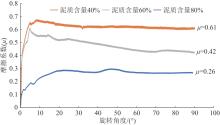
图9
断层泥含量与摩擦系数实验测试结果关系(已将该实验结果投点至图7)"
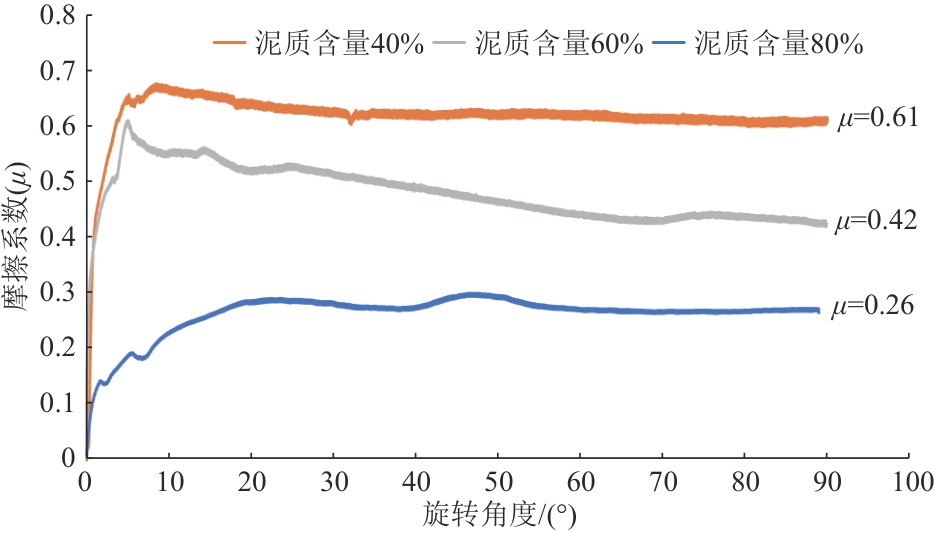
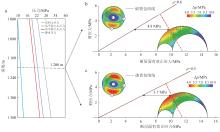
图10
辽河盆地雷61区块F1断层在不同摩擦系数下的断层稳定性莫尔圆及赤平投影图a. 地应力与深度线性关系;b.摩擦系数为0.6时断层稳定性莫尔圆及赤平投影图;c. 摩擦系数为0.5时断层稳定性莫尔圆及赤平投影图(δv.垂向有效主应力;δh.最小水平有效主应力;δH.最大水平有效主应力;μ.断层摩擦系数;Δp.附加流体压力。)"


图11
辽河盆地雷61区块F1断层面泥质含量(a)与摩擦系数分布特征(b)"


图12
考虑摩擦系数非均质性(a)与摩擦系数为0.6(b)的辽河盆地雷61区块F1断层活化压力评价结果"


图13
考虑摩擦系数非均质性(a)与摩擦系数为0.6(b)的辽河盆地雷61储气库各断层(F1—F6)活化压力三维评价结果"

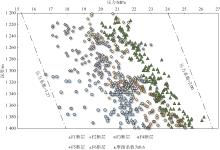
图14
辽河盆地雷61储气库各断层活化压力数据统计及运行压力上限厘定评价图"
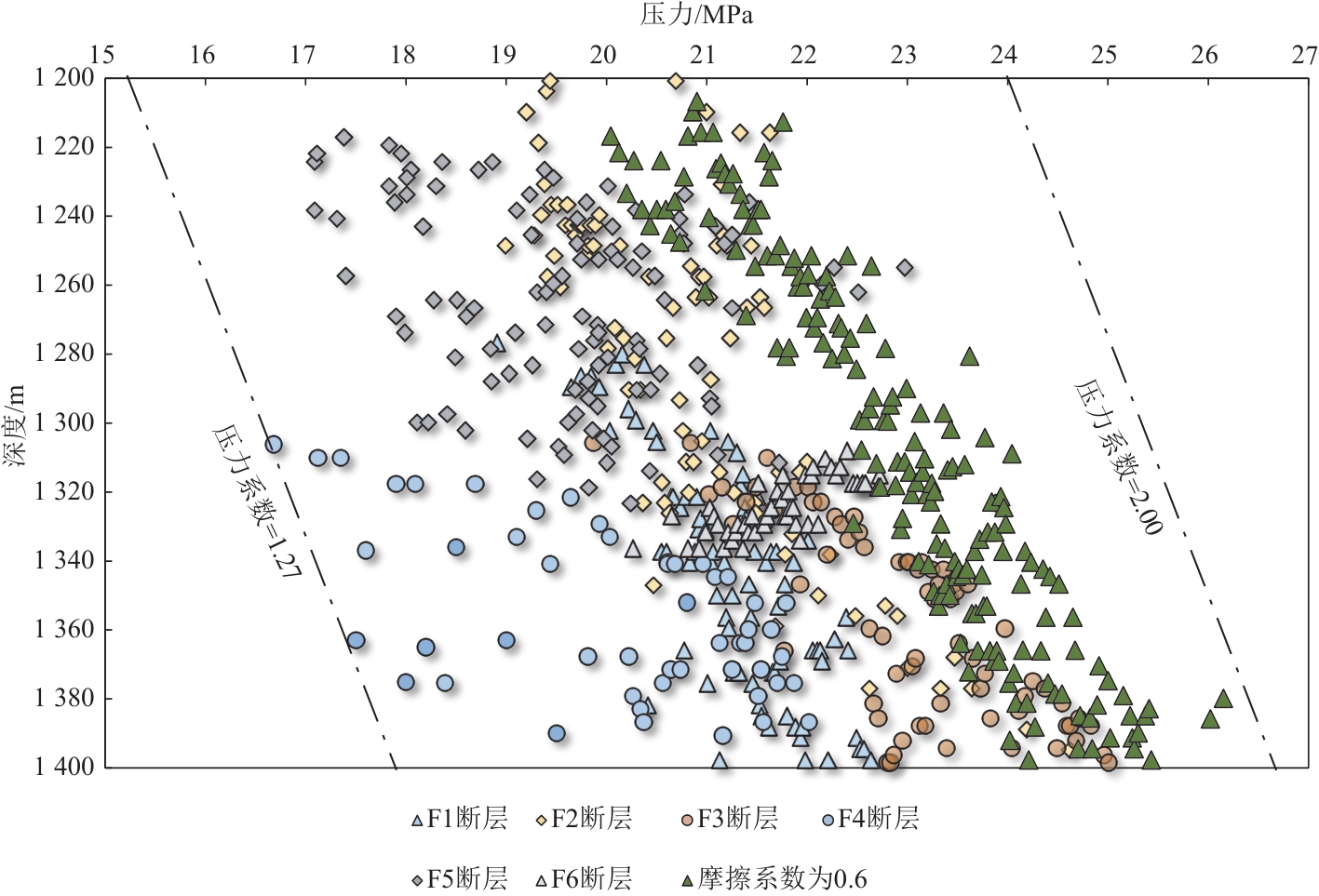

图15
辽河盆地雷61储气库各断层(F1—F6)最小活化压力值及地层压力系数变化范围厘定"

| [1] | 王者超, 李崴, 刘杰, 等. 地下储气库发展现状与安全事故原因综述[J]. 隧道与地下工程灾害防治, 2019, 1(2): 49-58. |
| WANG Zhechao, LI Wai, LIU Jie, et al. A review on state-of-the-art of underground gas storage and causes of typical accidents[J]. Hazard Control in Tunnelling and Underground Engineering, 2019, 1(2): 49-58. | |
| [2] | 糜利栋, 曾大乾, 李遵照, 等. 中国石化地下储气库智能化建设进展及展望[J]. 世界石油工业, 2023, 30(6): 88-95. |
| MI Lidong, ZENG Daqian, LI Zunzhao, et al. Progress and prospect of intelligent of Sinopec underground gas storage[J]. World Petroleum Industry, 2023, 30(6): 88-95. | |
| [3] | 糜利栋, 曾大乾, 刘华, 等. 天然气地下储气库智能化建设关键技术及其发展趋势[J]. 石油与天然气地质, 2024, 45(2): 581-592. |
| MI Lidong, ZENG Daqian, LIU Hua, et al. Key technologies and development trends for intelligent construction of underground gas storage facilities[J]. Oil & Gas Geology, 2024, 45(2): 581-592. | |
| [4] | 朱子恒, 任众鑫, 王照周, 等. 苏北盆地刘庄储气库密封性评价研究[J]. 油气藏评价与开发, 2024, 14(5): 805-813. |
| ZHU Ziheng, REN Zhongxin, WANG Zhaozhou, et al. Sealing evaluation of Liuzhuang UGS in Subei Basin[J]. Petroleum Reservoir Evaluation and Development, 2024, 14(5): 805-813. | |
| [5] | SADKHAN R A, AL-MUDHAFAR W J. Key aspects of underground hydrogen storage in depleted hydrocarbon reservoirs and saline aquifers: A review and understanding[J]. Energy Geoscience, 2024, 5(4): 100339. |
| [6] | 杨军伟, 贾善坡, 付晓飞, 等. 异常高压枯竭气藏型储气库地质体四维地质力学分析——以西南X储气库为例[J]. 岩石力学与工程学报, 2023, 42(): 4189-4203. |
| YANG Junwei, JIA Shanpo, FU Xiaofei, et al. 4D geomechanical analysis of geological bodies in abnormally high pressure exhausted gas storage: A case study of Southwest X gas storage[J]. Chinese Journal of Rock Mechanics and Engineering, 2023, 42(S2): 4189-4203. | |
| [7] | FOULGER G R, WILSON M P, GLUYAS J G, et al. Global review of human-induced earthquakes[J]. Earth-Science Reviews, 2018, 178: 438-514. |
| [8] | ADUSHKIN V V. Tectonic earthquakes of anthropogenic origin[J]. Izvestiya-Physics of the Solid Earth, 2016, 52(2): 173-194. |
| [9] | WILSON M P, FOULGER G R, GLUYAS J G, et al. HiQuake: The human-induced earthquake database[J]. Seismological Research Letters, 2017, 88(6): 1560-1565. |
| [10] | National Research Council. Induced seismicity potential in energy technologies[M]. Washington, D.C.: National Academies Press, 2013: 23-32. |
| [11] | MORRIS A P, FERRILL D A. The importance of the effective intermediate principal stress (σ′2) to fault slip patterns[J]. Journal of Structural Geology, 2009, 31(9): 950-959. |
| [12] | MORRIS A P, FERRILL D A, MCGINNIS R N. Using fault displacement and slip tendency to estimate stress states[J]. Journal of Structural Geology, 2016, 83: 60-72. |
| [13] | 靳叶军. 油气安全开采中断层稳定性评价[D]. 大庆: 东北石油大学, 2017. |
| JIN Yejun. The evaluation of fault stability in the process of oil and gas safety exploitation[D]. Daqing: Northeast Petroleum University, 2017. | |
| [14] | COLLETTINI C, NIEMEIJER A, VITI C, et al. Fault zone fabric and fault weakness[J]. Nature, 2009, 462(7275): 907-910. |
| [15] | JIN Yejun, MENG Lingdong, Dingyou LYU, et al. Risk assessment of fault reactivation considering the heterogeneity of friction strength in the BZ34-2 Oilfield, Huanghekou Sag, Bohai Bay Basin, China[J]. Petroleum Science, 2023, 20(5): 2695-2708. |
| [16] | 陈昌, 邱楠生, 高荣锦, 等. 渤海湾盆地辽河坳陷西部冷家——雷家地区中-深层超压成因及其对油气成藏的影响[J]. 石油与天然气地质, 2024, 45(1): 130-141. |
| CHEN Chang, QIU Nansheng, GAO Rongjin, et al. Overpressure in moderately deep to deep strata in the Lengjia-Leijia area, western Liaohe Depression, Bohai Bay Basin: Origin and effects on hydrocarbon accumulation[J]. Oil & Gas Geology, 2024, 45(1): 130-141. | |
| [17] | 杜晓峰, 庞小军, 黄晓波, 等. 辽西凹陷北部古近系沙河街组二段源-汇系统及其对滩坝砂体的控制[J]. 石油与天然气地质, 2023, 44(3): 662-674. |
| DU Xiaofeng, PANG Xiaojun, HUANG Xiaobo, et al. Characteristics of the source-to-sink system for the Paleogene Sha 2 Member of northern Liaoxi Sag, offshore Bohai Bay Basin and its control on beach bar sands[J]. Oil & Gas Geology, 2023, 44(3): 662-674. | |
| [18] | 郭泽萍. 雷61块改建地下储气库之圈闭有效性评价研究[J]. 石化技术, 2018, 25(12): 86. |
| GUO Zeping. Study on trap effectiveness evaluation of reconstructing underground gas storage in block Lei 61[J]. Petrochemical Industry Technology, 2018, 25(12): 86. | |
| [19] | HUBBERT M K, RUBEY W W. Role of fluid pressure in mechanics of overthrust faulting: I. Mechanics of fluid-filled porous solids and its application to overthrust faulting[J]. GSA Bulletin, 1959, 70(2): 115-166. |
| [20] | ZOBACK M D. Reservoir geomechanics[M]. Cambridge: Cambridge University Press, 2007: 127-139. |
| [21] | 孟令东. 断层相关圈闭油气安全开采与天然气埋存风险性评价[D]. 大庆: 东北石油大学, 2015. |
| MENG Lingdong. Risk evaluation for safety of hydrocarbon exploitation and geologic storage of natural gas in fault realated traps[D]. Daqing: Northeast Petroleum University, 2015. | |
| [22] | IKARI M J, SAFFER D M, MARONE C. Frictional and hydrologic properties of clay-rich fault gouge[J]. Journal of Geophysical Research: Solid Earth, 2009, 114(B5): B05409. |
| [23] | MORRIS A, FERRILL D A, HENDERSON D B. Slip-tendency analysis and fault reactivation[J]. Geology, 1996, 24(3): 275-278. |
| [24] | FERRILL D A, WINTERLE J, WITTMEYER G, et al. Stressed rock strains groundwater at Yucca Mountain, Nevada[J]. GSA Today, 1999, 9(5): 1-8. |
| [25] | CASTILLO D A, BISHOP D J, DONALDSON I, et al. Trap integrity in the lam in aria high-Nancar trough region, Timor Sea: Prediction of fault seal failure using well-constrained stress tensors and fault surfaces interpreted from 3D seismic[J]. The APPEA Journal, 2000, 40(1): 151-173. |
| [26] | WIPRUT D, ZOBACK M D. Fault reactivation, leakage potential, and hydrocarbon column heights in the northern North SEA[J]. Norwegian Petroleum Society Special Publications, 2002, 11: 203-219. |
| [27] | MILDREN S D, HILLIS R R, LYON P J, et al. Fast: a new technique for geomechanical assessment of the risk of reactivation-related breach of fault seals[M]//BOULT P, KALDI J. Evaluating Fault and Cap Rock Seals. Tulsa: American Association of Petroleum Geologists, 2005: 73-85. |
| [28] | TAGHIPOUR M, GHAFOORI M, LASHKARIPOUR G R, et al. A geomechanical evaluation of fault reactivation using analytical methods and numerical simulation[J]. Rock Mechanics and Rock Engineering, 2021, 54(2): 695-719. |
| [29] | MENG Lingdong, FU Xiaofei, LV Yanfang, et al. Risking fault reactivation induced by gas injection into depleted reservoirs based on the heterogeneity of geomechanical properties of fault zones[J]. Petroleum Geoscience, 2017, 23(1): 29-38. |
| [30] | JIN Yejun, FAN Caiwei, FU Xiaofei, et al. Risk analysis of natural hydraulic fracturing in an overpressured basin with mud diapirs: A case study from the Yinggehai Basin, South China Sea[J]. Journal of Petroleum Science and Engineering, 2021, 196: 107621. |
| [31] | BYERLEE J. Friction of rocks[J]. Pure and Applied Geophysics, 1978, 116(4): 615-626. |
| [32] | COLLETTINI C, SIBSON R H. Normal faults, normal friction?[J]. Geology, 2001, 29(10): 927-930. |
| [33] | WILLIAMS J D O, GENT C M A, FELLGETT M W, et al. Impact of in situ stress and fault reactivation on seal integrity in the East Irish Sea Basin, UK[J]. Marine and Petroleum Geology, 2018, 92: 685-696. |
| [34] | TAKAHASHI M, MIZOGUCHI K, KITAMURA K, et al. Effects of clay content on the frictional strength and fluid transport property of faults[J]. Journal of Geophysical Research: Solid Earth, 2007, 112(B8): B08206. |
| [35] | TEMBE S, LOCKNER D A, WONG T F. Effect of clay content and mineralogy on frictional sliding behavior of simulated gouges: Binary and ternary mixtures of quartz, illite, and montmorillonite[J]. Journal of Geophysical Research: Solid Earth, 2010, 115(B3): B03416. |
| [36] | BROWN K M, KOPF A, UNDERWOOD M B, et al. Compositional and fluid pressure controls on the state of stress on the Nankai subduction thrust: A weak plate boundary[J]. Earth and Planetary Science Letters, 2003, 214(3/4): 589-603. |
| [37] | LOGAN J M, RAUENZAHN K A. Frictional dependence of gouge mixtures of quartz and montmorillonite on velocity, composition and fabric[J]. Tectonophysics, 1987, 144(1/3): 87-108. |
| [38] | ROLANDONE F, BÜRGMANN R, AGNEW D C, et al. Aseismic slip and fault-normal strain along the central creeping section of the San Andreas fault[J]. Geophysical Research Letters, 2008, 35(14): L14305. |
| [39] | SIBSON R H, XIE G Y. Dip range for intracontinental reverse fault ruptures: Truth not stranger than friction?[J]. Bulletin of the Seismological Society of America, 1998, 88(4): 1014-1022. |
| [40] | PLUMB R A. Influence of composition and texture on the failure properties of clastic rocks[C]//Rock Mechanics in Petroleum Engineering, Delft, 1994. Richardson: Society of Petroleum Engineers, 1994: SPE-28022-MS. |
| [41] | 靳叶军, 范彩伟, 王雯娟, 等. 底辟和非底辟区天然水力破裂对天然气成藏的意义——以莺歌海盆地为例[J]. 中国矿业大学学报, 2022, 51(5): 964-977. |
| JIN Yejun, FAN Caiwei, WANG Wenjuan, et al. Risk of natural hydraulic fracturing in diapir and non-diapirareas of Yinggehai Basin and its significance for gas accumulation[J]. Journal of China University of Mining & Technology, 2022, 51(5): 964-977. | |
| [42] | COLLETTINI C, VITI C, SMITH S A F, et al. Development of interconnected talc networks and weakening of continental low-angle normal faults[J]. Geology, 2009, 37(6): 567-570. |
| [43] | BONESS N L, ZOBACK M D. A multiscale study of the mechanisms controlling shear velocity anisotropy in the San Andreas Fault Observatory at Depth[J]. Geophysics, 2006, 71(5): F131-F146. |
| [44] | SCHOLZ C H. The strength of the San Andreas Fault: A critical analysis[M]//ABERCROMBIE R, MCGARR A, DI TORO G, et al. Earthquakes: Radiated Energy and the Physics of Faulting. Washington, D.C.: American Geophysical Union, 2006, 170: 301-311. |
| [45] | CARPENTER B M, MARONE C, SAFFER D M. Weakness of the San Andreas Fault revealed by samples from the active fault zone[J]. Nature Geoscience, 2011, 4(4): 251-254. |
| [46] | MCGARR A, GAY N C. State of stress in the earth’s crust[J]. Annual Review of Earth and Planetary Sciences, 1978, 6: 405-436. |
| [47] | KAREN M, KEVIN M F, CHRIS M. Influence of grain characteristics on the friction of granular shear zones[J]. Journal of Geophysical Research: Solid Earth, 2002, 107(B10): ECV 4-1-ECV 4-9. |
| [48] | 闫萍, 靳叶军, 袁雪花, 等. 储气库运行上限压力的确定方法及在板中北储气库的应用[J]. 特种油气藏, 2024, 31(4): 81-88. |
| YAN Ping, JIN Yejun, YUAN Xuehua, et al. Method of determining the upper limit pressure of gas storage operation and its application in the Banzhongbei gas storage[J]. Special Oil & Gas Reservoirs, 2024, 31(4): 81-88. | |
| [49] | BROCHER T M. Empirical relations between elastic wavespeeds and density in the earth’s crust[J]. Bulletin of the Seismological Society of America, 2005, 95(6): 2081-2092. |
| [50] | WHITE A J, TRAUGOTT M O, SWARBRICK R E. The use of leak-off tests as means of predicting minimum in-situ stress[J]. Petroleum Geoscience, 2002, 8(2): 189-193. |
| [51] | GAARENSTROOM L, TROMP R A J, DE JONG M C, et al. Overpressures in the Central North Sea: Implications for trap integrity and drilling safety[J]. Geological Society, London, Petroleum Geology Conference Series, 1993, 4(1): 1305-1313. |
| [52] | 张明明, 李大奇, 范翔宇. 破碎地层井壁坍塌压力及井周失稳区域研究[J]. 断块油气田, 2024, 31(5): 916-921. |
| ZHANG Mingming, LI Daqi, FAN Xiangyu. Study on wellbore collapse pressure and instability area around wellbore in broken formation[J]. Fault-Block Oil and Gas Field, 2024, 31(5): 916-921. | |
| [53] | 严泽宇, 梁兵, 孙雅雄, 等. 苏北盆地高邮凹陷阜宁组二段深层页岩储层地应力方向及主控因素[J]. 石油实验地质, 2024, 46(6): 1187-1197. |
| YAN Zeyu, LIANG Bing, SUN Yaxiong, et al. In-situ stress orientation and main controlling factors of deep shale reservoirs in the second member of Paleogene Funing Formation in Gaoyou Sag, Subei Basin[J]. Petroleum Geology and Experiment, 2024, 46(6): 1187-1197. | |
| [54] | 丁文龙, 李云涛, 韩俊, 等. 碳酸盐岩储层高精度构造应力场模拟与裂缝多参数分布预测方法及其应用[J]. 石油与天然气地质, 2024, 45(3): 827-851. |
| DING Wenlong, LI Yuntao, HAN Jun, et al. Methods for high-precision tectonic stress field simulation and multi-parameter prediction of fracture distribution for carbonate reservoirs and their application[J]. Oil & Gas Geology, 2024, 45(3): 827-851. | |
| [55] | YIELDING G. Shale gouge ratio-calibration by geohistory[M]//KOESTLER A G, HUNSDALE R. Norwegian Petroleum Society Special Publications: Volume 11: Hydrocarbon Seal Quantification. Amsterdam: Elsevier, 2002: 1-15. |
| [56] | FANG Yi, ELSWORTH D, WANG Chaoyi, et al. Frictional stability-permeability relationships for fractures in shales[J]. Journal of Geophysical Research: Solid Earth, 2017, 122(3): 1760-1776. |
| [57] | CRAWFORD B R, FAULKNER D R, RUTTER E H. Strength, porosity, and permeability development during hydrostatic and shear loading of synthetic quartz-clay fault gouge[J]. Journal of Geophysical Research: Solid Earth, 2008, 113(B3): B03207. |
| [58] | VERBERNE B A, HE Changrong, SPIERS C J. Frictional properties of sedimentary rocks and natural fault gouge from the Longmen Shan Fault Zone, Sichuan, China[J]. Bulletin of the Seismological Society of America, 2010, 100(5B): 2767-2790. |
| [59] | SHIMAMOTO T, LOGAN J M. Effects of simulated clay gouges on the sliding behavior of Tennessee sandston[J]. Tectonophysics, 1981, 75(3/4): 243-255. |
| [60] | ANTHONY J L, MARONE C. Influence of particle characteristics on granular friction[J]. Journal of Geophysical Research: Solid Earth, 2005, 110(B8): 1-14. |
| [61] | 余博文, 孟令东, 靳叶军. 油气区断层带摩擦强度研究进展[J]. 地球物理学进展, 2021, 36(2): 696-705. |
| YU Bowen, MENG Lingdong, JIN Yejun. Research progress in the frictional strength of fault zone in oil and gas field[J]. Progress in Geophysics, 2021, 36(2): 696-705. | |
| [62] | JIANG Mingming, JIN Yejun, FU Xiaofei, et al. The development of cataclastic bands in high-porosity sandstones: Insights from ring shear experiments[J]. Journal of Structural Geology, 2023, 175: 104952. |
| [63] | MOORE D E, LOCKNER D A. Talc friction in the temperature range 25°-400℃: Relevance for fault-zone weakening[J]. Tectonophysics, 2008, 449(1/4): 120-132. |
| [64] | TORABI A, BRAATHEN A, CUISIAT F, et al. Shear zones in porous sand: Insights from ring-shear experiments and naturally deformed sandstones[J]. Tectonophysics, 2007, 437(1/4): 37-50. |
| [65] | BEHNSEN J, FAULKNER D R. The effect of mineralogy and effective normal stress on frictional strength of sheet silicates[J]. Journal of Structural Geology, 2012, 42: 49-61. |
| [66] | 娄瑞, 孙永河, 张中巧. 渤海湾盆地渤南低凸起西段低角度正断层分段生长特征及其油气地质意义[J]. 石油与天然气地质, 2024, 45(3): 710-721. |
| LOU Rui, SUN Yonghe, ZHANG Zhongqiao. Segmented growth of low-angle normal faults in the western Bonan swell, Bohai Bay Basin and its petroleum geological significance[J]. Oil & Gas Geology, 2024, 45(3): 710-721. | |
| [67] | 丁文龙, 刘天顺, 曹自成, 等. 断裂封闭性研究现状及发展趋势[J]. 石油实验地质, 2024, 46(4): 647-663. |
| DING Wenlong, LIU Tianshun, CAO Zicheng, et al. Current research status and development trends of fault sealing[J]. Petroleum Geology and Experiment, 2024, 46(4): 647-663. |
| [1] | 王光付, 李凤霞, 王海波, 周彤, 张亚雄, 王濡岳, 李宁, 陈昱辛, 熊晓菲. 四川盆地不同类型页岩气压裂难点和对策[J]. 石油与天然气地质, 2023, 44(6): 1378-1392. |
| [2] | 刘国平, 董少群, 李洪楠, 彭仕宓, 管聪, 毛哲. 辽河盆地西部凹陷古潜山天然裂缝特征及其影响因素[J]. 石油与天然气地质, 2020, 41(3): 525-533. |
| [3] | 孙昂, 黄玉龙, 李军, 冯玉辉, 王建飞, 王璞珺. 辽河盆地东部凹陷渐新统辉绿岩:特征、识别与成藏规律[J]. 石油与天然气地质, 2016, 37(3): 372-380. |
| [4] | 刘斐. 辽河盆地中央凸起南部海外河地区构造演化特征[J]. 石油与天然气地质, 2011, 32(2): 259-264,301. |
| [5] | 孟卫工. 辽河盆地滩海地区东营组沉积特征与演化[J]. 石油与天然气地质, 2010, 31(5): 567-575. |
| [6] | 陈振岩, 吴文柱. 辽河盆地东部凹陷幕式成藏特征[J]. 石油与天然气地质, 2003, 24(1): 32-35. |
| [7] | 唐清山, 柴利文, 黄太明, 高振中, 旷红伟, 佟彦明, 刘成鑫. 高升油田高81块储层特征与含油气潜能[J]. 石油与天然气地质, 2002, 23(3): 269-273. |
| [8] | 张春明, 赵红静, 梅博文, 陈梅, 肖乾华, 吴铁生. 微生物降解对原油中咔唑类化合物的影响[J]. 石油与天然气地质, 1999, 20(4): 341-343,348. |
| [9] | 陈昭年. 辽河盆地东部凸起古生界埋藏类型与油气[J]. 石油与天然气地质, 1997, 18(2): 140-144. |
| [10] | 漆家福, 陈发景. 辽东湾-下辽河裂陷盆地的构造样式[J]. 石油与天然气地质, 1992, 13(3): 272-283. |
| 阅读次数 | ||||||
|
全文 |
|
|||||
|
摘要 |
|
|||||
