

石油与天然气地质 ›› 2025, Vol. 46 ›› Issue (5): 1367-1391.doi: 10.11743/ogg20250501
赵靖舟1,2( ), 高振东3, 孟选刚3, 吴伟涛1,2, 白玉彬1,2, 曹磊1,2, 赵子龙1,2
收稿日期:2025-08-01
修回日期:2025-09-16
出版日期:2025-10-30
发布日期:2025-10-29
第一作者简介:赵靖舟(1962—),男,教授,油气成藏与非常规油气地质学。E‑mail: jzzhao@xsyu.edu.cn。
基金项目:
Jingzhou ZHAO1,2(), Zhendong GAO3, Xuangang MENG3, Weitao WU1,2, Yubin BAI1,2, Lei CAO1,2, Zilong ZHAO1,2
Received:2025-08-01
Revised:2025-09-16
Online:2025-10-30
Published:2025-10-29
摘要:
鄂尔多斯盆地陕北定边—吴起—志丹—甘泉—富县一带延长组下组合(长7—长10油层组)是近年来延长油田重点勘探的地区和层系。通过对125口井、共计约2 115 m长的岩心观察,结合400余口井的粒度资料及系统的测井相分析,研究发现:①研究区长7—长9油层组广泛发育重力流沉积,并以砂质碎屑流沉积为主,其次为浊流沉积。②长7—长9油层组重力流沉积储层、烃源岩和封盖条件等均十分优越,致密油勘探潜力大,预测石油地质资源量约25 × 108 t。③源-储-封组合类型是控制研究区长7—长9油层组致密油成藏和富集的主要因素,并将研究区源-储-封组合划分为4类11种,其中源夹储型和源上储下型最为有利。④建立了适用于鄂尔多斯盆地延长组烃源岩特征的烃源岩评价新标准,研究区长7—长9油层组三套烃源岩均为优质烃源岩,以长7油层组为最好,其次为长9油层组和长8油层组烃源岩。⑤提出了基于油井产量分级、富集指数及其地质控制因素分析的甜点评价方法。⑥中国油气勘探范式正在发生重要转变,勘探对象由浅水沉积向深水重力流沉积的转变,是拗陷型湖盆油气勘探的重要趋势之一。⑦拗陷型湖盆重力流沉积成藏条件优越,特别是砂质碎屑流沉积砂体规模大、物性好,含油性优于浊流沉积,且资源潜力大,应作为深水重力流沉积石油勘探开发的主要目标。
中图分类号:

图1
鄂尔多斯盆地构造单元划分及延长组综合柱状图a. 盆地构造区划及研究区位置(据文献[33]修改);b. 研究区地层和油层柱状图"

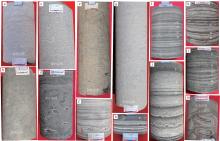
图2
鄂尔多斯盆地定边—富县地区延长组长7—长9油层组重力流沉积岩心照片a. 定边,DT3332井,长9油层组,块状砂岩,埋深2 468.92 m;b 吴起,Z128井,长8油层组,块状砂岩,埋深2 305.29 m;c. 甘泉,X130井,长7油层组,块状砂岩,埋深1 398.87 m;d. 富县,FX191井,长7油层组,漂浮泥砾,埋深1 568.10 m;e. 富县,L271井,长8油层组,块状砂岩,埋深1 861.80 m;f. 甘泉,H70井,长8油层组,鲍马序列,埋深1 337.09 m;g. 志丹,YJ603井,长8油层组,块状层理,埋深1 869.72 m;h. 定边,DT3 703井,长8油层组,火焰状构造,埋深2 499.80 m;i. 吴起,ZC130井,长7油层组,鲍马序列,埋深2 074.37 m;j. 定边,DT48 040井,长7油层组,火焰状构造,埋深2 427.53 m;k. 志丹,YJ358井,长7油层组,韵律层理,埋深1 728.10 m;l. 富县,L230井,长7油层组,鲍马序列,埋深1 789.68 m;m. 富县,L241井,长7油层组,包卷层理,埋深1 560.70 m(A,B,C,D和E分别为鲍马序列的底部递变层理段、下平行纹层段、沙纹层理段、上平行纹层段和泥岩段。)"

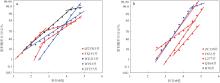
图3
鄂尔多斯盆地定边—富县地区长7—长9油层组砂质碎屑流(a)和浊流(b)沉积粒度累积概率曲线特征"

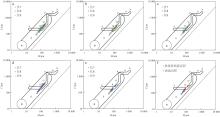
图4
鄂尔多斯盆地定边—富县地区长7—长9油层组重力流沉积C-M图a—e.分别为定边、吴起、志丹、甘泉和富县地区重力流沉积C-M图;f.富县地区砂质碎屑流和浊流沉积对比NO段.滚动搬运;OP段.滚动搬运为主,有悬浮搬运;PQ段.悬浮搬运为主,少量滚动搬运;QR段.递变悬浮沉积;RS段.均匀悬浮沉积;Ⅰ区.牵引流沉积;Ⅱ区.浊流沉积;Ⅲ区.静水悬浮沉积;C.粒度累积概率曲线上颗粒含量1%处对应的粒径;M.粒度累积概率曲线上颗粒含量50%处对应的粒径"


图5
鄂尔多斯盆地定边—富县地区长7—长9油层组沉积相a. 长91油层亚组;b. 长81油层亚组;c. 长71油层亚组"

表1
鄂尔多斯盆地定边—富县地区长7油层组砂岩储层物性统计"
| 地区 | 层位 | 孔隙度/% | 渗透率/(10-3 μm2) | ||||||||
|---|---|---|---|---|---|---|---|---|---|---|---|
| 样品个数 | 最小值 | 最大值 | 平均值 | 中位值 | 样品个数 | 最小值 | 最大值 | 平均值 | 中位值 | ||
| 定边 | 长7 | 308 | 0.60 | 24.70 | 6.70 | 6.30 | 286 | 0.03 | 35.78 | 0.70 | 0.27 |
| 吴起 | 长7 | 377 | 0.70 | 17.80 | 7.00 | 6.80 | 336 | 0.02 | 49.39 | 0.80 | 0.25 |
| 志丹 | 长7 | 673 | 0.57 | 20.20 | 7.82 | 7.80 | 628 | 0.01 | 23.38 | 0.53 | 0.30 |
| 甘泉 | 长7 | 396 | 0.65 | 21.90 | 7.50 | 7.25 | 374 | 0.02 | 66.20 | 0.59 | 0.26 |
| 富县 | 长7 | 1 843 | 0.80 | 22.50 | 8.40 | 8.20 | 1 687 | 0.01 | 84.44 | 0.45 | 0.35 |
| 全区 | 长71 | 2 270 | 0.60 | 22.50 | 8.27 | 8.10 | 2 097 | 0.01 | 84.44 | 0.61 | 0.26 |
| 长72 | 990 | 0.57 | 24.73 | 7.50 | 7.20 | 906 | 0.01 | 66.20 | 0.49 | 0.26 | |
| 长73 | 337 | 0.70 | 20.20 | 6.70 | 6.60 | 308 | 0.02 | 24.75 | 0.49 | 0.22 | |
| 长7 | 3 597 | 0.57 | 24.73 | 7.90 | 7.80 | 3 311 | 0.01 | 84.44 | 0.57 | 0.26 | |
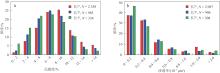
图6
鄂尔多斯盆地定边—富县地区长7油层组砂岩储层孔隙度(a)和渗透率(b)频率分布直方图"

表2
鄂尔多斯盆地定边—富县地区长8油层组砂岩储层物性统计"
| 地区 | 孔隙度/% | 渗透率/(10-3 μm2) | 样品个数 | ||||||
|---|---|---|---|---|---|---|---|---|---|
| 最小值 | 最大值 | 平均值 | 中位值 | 最小值 | 最大值 | 平均值 | 中位值 | ||
| 定边 | 2.0 | 13.5 | 6.5 | 6.2 | 0.04 | 9.43 | 0.44 | 0.27 | 372 |
| 吴起 | 0.5 | 12.8 | 6.4 | 6.5 | 0.01 | 2.24 | 0.22 | 0.14 | 104 |
| 志丹 | 0.9 | 16.9 | 7.8 | 8.4 | 0.02 | 21.90 | 0.45 | 0.27 | 765 |
| 甘泉 | 0.5 | 14.5 | 7.2 | 7.0 | 0.01 | 101.43 | 0.52 | 0.12 | 765 |
| 富县 | 0.7 | 22.7 | 8.0 | 8.0 | 0.01 | 3.28 | 0.29 | 0.21 | 700 |
表3
鄂尔多斯盆地定边—富县地区长9油层组砂岩储层物性统计"
| 地区 | 孔隙度/% | 渗透率/(10-3 μm2) | 样品个数 | ||||||
|---|---|---|---|---|---|---|---|---|---|
| 最小值 | 最大值 | 平均值 | 中位值 | 最小值 | 最大值 | 平均值 | 中位值 | ||
| 定边 | 2.0 | 17.4 | 9.2 | 9.1 | 0.03 | 68.89 | 2.33 | 0.64 | 750 |
| 吴起 | 0.2 | 13.4 | 8.0 | 7.4 | 0.01 | 9.25 | 0.45 | 0.26 | 159 |
| 志丹 | 0.4 | 13.4 | 6.2 | 6.5 | 0.02 | 60.91 | 0.46 | 0.18 | 547 |
| 富县 | 0.8 | 14.6 | 5.5 | 4.9 | 0.01 | 1.63 | 0.15 | 0.11 | 150 |
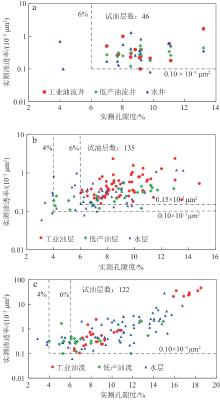
图7
鄂尔多斯盆地定边—富县地区长7(a)、长8(b)和长9(c)油层组储层物性与试油结果对比"

表4
鄂尔多斯盆地定边—富县地区长7—长9油层组砂质碎屑流与浊流沉积砂岩物性及含油饱和度对比"
| 参数 | 孔隙度/% | 渗透率/(10-3μm2) | 原始含油饱和度/% | |||
|---|---|---|---|---|---|---|
| 砂质碎屑流沉积 | 浊流沉积 | 砂质碎屑流沉积 | 浊流沉积 | 砂质碎屑流沉积 | 浊流沉积 | |
| 最大值 | 22.7 | 13.8 | 5.99 | 5.95 | 87.88 | 84.6 |
| 最小值 | 1.5 | 0.8 | 0.05 | 0.02 | 6.97 | 2.7 |
| 平均值 | 8.6 | 5.8 | 0.60 | 0.37 | 58.40 | 43.0 |
| 中位值 | 8.4 | 5.6 | 0.34 | 0.23 | 60.30 | 44.0 |
| 样品个数 | 404 | 304 | 404 | 304 | 311 | 216 |

图8
鄂尔多斯盆地定边—富县地区长7(a)、长8(b)和长9(c)油层组砂质碎屑流与浊流沉积储层物性对比"

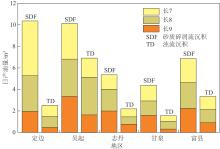
图9
鄂尔多斯盆地定边—富县地区长7—长9油层组砂质碎屑流与浊流沉积砂岩试油产量对比"

表5
鄂尔多斯盆地三叠系延长组泥质烃源岩评价标准"
| 烃源岩等级 | TOC/% | (S1 + S2)/(mg/g) |
|---|---|---|
| 非烃源岩 | < 0.5 | < 0.5 |
| 差烃源岩 | 0.5 ~ 1.0 | 0.5 ~ 1.5 |
| 中等烃源岩 | 1.0 ~ 2.0 | 1.5 ~ 4.0 |
| 好烃源岩 | 2.0 ~ 4.0 | 4.0 ~ 10.0 |
| 很好烃源岩 | 4.0 ~ 6.0 | 10.0 ~ 18.0 |
| 极好烃源岩 | > 6.0 | > 18.0 |
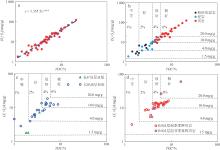
图10
鄂尔多斯盆地定边—富县地区长7—长9油层组烃源岩评价图a. 长7烃源岩TOC与S1 + S2关系拟合图;b. 长7烃源岩评价图版;c. 长8烃源岩评价图版;d. 长9烃源岩评价图版"

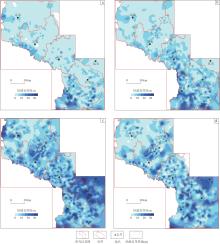
图11
鄂尔多斯盆地定边—富县地区长8-长9油层组烃源岩(泥岩+页岩)分布等值线图a. 长81油层亚组;b. 长82油层亚组;c. 长91油层亚组;d. 长92油层亚组"

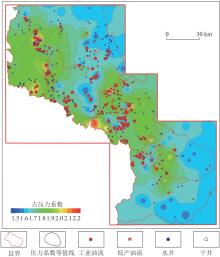
图12
鄂尔多斯盆地定边—富县地区长7油层组烃源岩古压力系数与长91油层亚组试油结果对比"

表6
鄂尔多斯盆地定边—富县地区长7—长9油层组源-储-封组合分类及其在延长组下组合中的分布"
| 类 | 种 | 分布层位 |
|---|---|---|
| 源夹储型(A) | 源夹储厚层型(A1) | 长81、长82油层亚组 |
| 源夹储薄层型(A2) | 长73油层亚组 | |
| 源上储下型(B) | 源上储下直接型(B1) | 长81、长91油层亚组 |
| 源上储下近源型(B2) | 长8、长9油层组 | |
| 源上储下远源型(B3) | 长92油层亚组 | |
| 源下储上型(C) | 源下储上直接型(C1) | 长72、长82油层亚组 |
| 源下储上近源型(C2) | 长72油层亚组、长8油层组 | |
| 源下储上远源型(C3) | 长71油层亚组 | |
| 源-储侧接型(D) | 源-储同层侧接型(D1) | 长9—长7油层组 |
| 源上储下侧接型(D2) | 长92油层亚组、长10油层组 | |
| 源下储上侧接型(D3) | 长71油层亚组 |

图13
鄂尔多斯盆地定边—富县地区长7—长9油层组源-储-封组合分类剖面示意图(图中字母代表源-储-封组合类型,详见表6。)"

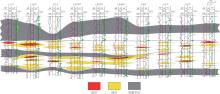
图14
鄂尔多斯盆地富县—甘泉地区长7—长9油层组源-储-封组合分布连井对比剖面"

表7
鄂尔多斯盆地定边—富县地区长7—长9油层组石油地质资源量评价结果"
| 层位 | 含油面积/km2 | 资源量/(104 t) | 可采资源量/(104 t) |
|---|---|---|---|
| 合计 | 10 005.9 | 250 540.0 | 30 064.8 |
| 长7 | 5 235.4 | 116 940.0 | 14 032.8 |
| 长8 | 3 731.1 | 101 233.5 | 12 148.0 |
| 长9 | 1 039.4 | 32 366.5 | 3 884.0 |
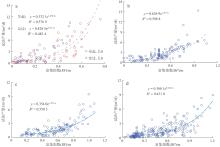
图15
鄂尔多斯盆地定边—富县地区不同区块长8油层组试油产量与富集指数关系a. 吴起与定边地区;b. 志丹地区;c. 甘泉地区;d. 富县地区"

表8
鄂尔多斯盆地定边—富县地区长8油层组产量分级与对应富集指数界限"
| 地区 | 中产量/(m3/d) | 中产量富集指数/m | 高产量/(m3/d) | 高产量富集指数/m | 特高产量/(m3/d) | 特高产量富集指数/m |
|---|---|---|---|---|---|---|
| 定边 | 2.5 ~ 5.0 | 0.37 | 5.0 ~ 8.0 | 0.51 | > 8.0 | 0.61 |
| 吴起 | 2.5 ~ 5.0 | 0.41 | 5.0 ~ 8.0 | 0.56 | > 8.0 | 0.65 |
| 志丹 | 1.0 ~ 2.0 | 0.19 | 2.0 ~ 4.0 | 0.47 | > 4.0 | 0.75 |
| 甘泉 | 1.0 ~ 2.0 | 0.38 | 2.0 ~ 4.0 | 0.64 | > 4.0 | 0.89 |
| 富县 | 1.0 ~ 2.0 | 0.32 | 2.0 ~ 4.0 | 0.56 | > 4.0 | 0.79 |
| [1] | KUENEN P H, MIGLIORINI C I. Turbidity currents as a cause of graded bedding[J]. The Journal of Geology, 1950, 58(2): 91-127. |
| [2] | BOUMA A H. Sedimentology of some flysch deposits: A graphic approach to facies interpretation[M]. Amsterdam: Elsevier, 1962: 1-168. |
| [3] | MIDDLETON G V, HAMPTON M A. Sediment gravity flows: Mechanics of flow and deposition[M]//MIDDLETON G V, BOUMA A H. Turbidites and Deep-Water Sedimentation: Short Course Lecture Notes, Part I. California: Los Angeles, 1973: 1-38. |
| [4] | LOWE D R. Sediment gravity flows: Their classification and some problems of application to natural flows and deposits[M]//DOYLE L J, PILKEY O H. Geology of Continental Slopes. Tulsa: SEPM Society for Sedimentary Geology, 1979: 75-82. |
| [5] | LOWE D R. Sediment gravity flows; II, Depositional models with special reference to the deposits of high-density turbidity currents[J]. Journal of Sedimentary Petrology, 1982, 52(1): 279-297. |
| [6] | SHANMUGAM G. High-density turbidity currents; are they sandy debris flows?[J]. Journal of Sedimentary Research, 1996, 66(1): 2-10. |
| [7] | 邹才能, 赵政璋, 杨华, 等. 陆相湖盆深水砂质碎屑流成因机制与分布特征——以鄂尔多斯盆地为例[J]. 沉积学报, 2009, 27(6): 1065-1075. |
| ZOU Caineng, ZHAO Zhengzhang, YANG Hua, et al. Genetic mechanism and distribution of sandy debris flows in terrestrial lacustrine basin[J]. Acta Sedimentologica Sinica, 2009, 27(6): 1065-1075. | |
| [8] | 李相博, 刘化清, 完颜容, 等. 鄂尔多斯盆地三叠系延长组砂质碎屑流储集体的首次发现[J]. 岩性油气藏, 2009, 21(4): 19-21. |
| LI Xiangbo, LIU Huaqing, WANYAN Rong, et al. First discovery of the sandy debris flow from the Triassic Yanchang Formation, Ordos Basin[J]. Lithologic Reservoirs, 2009, 21(4): 19-21. | |
| [9] | 杨仁超, 金之钧, 孙冬胜, 等. 鄂尔多斯晚三叠世湖盆异重流沉积新发现[J]. 沉积学报, 2015, 33(1): 10-20. |
| YANG Renchao, JIN Zhijun, SUN Dongsheng, et al. Discovery of hyperpycnal flow deposits in the Late Triassic lacustrine Ordos Basin[J]. Acta Sedimentologica Sinica, 2015, 33(1): 10-20. | |
| [10] | 罗顺社, 吕奇奇, 付金华, 等. 鄂尔多斯盆地延长组长7段沉积期深水重力流沉积特征及物理模拟实验[M]. 北京: 石油工业出版社, 2021: 1-144. |
| LUO Shunshe, Qiqi LYU, FU Jinhua, et al. Sedimentary characteristics and physical simulation experiments of deep-water gravity flow in Chang 7 Member of Yanchang Formation, Ordos Basin[M]. Beijing: Petroleum Industry Press, 2021: 1-144. | |
| [11] | 操应长, 杨田, 王艳忠. 陆相湖盆深水重力流沉积作用[M]. 青岛: 中国石油大学出版社, 2021: 1-249. |
| CAO Yingchang, YANG Tian, WANG Yanzhong. Deep-water gravity-flow deposition in lacustrine basin[M]. Qingdao: China University of Petroleum Press, 2021: 1-249. | |
| [12] | 李相博, 刘化清, 杨田, 等. 深水重力流沉积与油气成藏[M]. 北京: 石油工业出版社, 2022: 1-190. |
| LI Xiangbo, LIU Huaqing, YANG Tian, et al. Deep-water gravity flow and petroleum accumulation[M]. Beijing: Petroleum Industry Press, 2022: 1-190. | |
| [13] | 宋明水, 李存磊, 张金亮. 湖盆深水重力流沉积机理与沉积相模式[M]. 北京: 科学出版社, 2023: 1-157. |
| SONG Mingshui, LI Cunlei, ZHANG Jinliang. Mechanism and model for deep-water gravity-flow deposition in lacustrine basins[M]. Beijing: Science Press, 2023: 1-157. | |
| [14] | 李克勤. 陕甘宁盆地晚三叠世的三角洲[J]. 沉积学报, 1986, 4(1): 86-95. |
| LI Keqin. Later Triassic deltas in Shanxi-Gansu-Ningxia Basin[J]. Acta Sedimentologica Sinica, 1986, 4(1): 86-95. | |
| [15] | 梅志超, 彭荣华, 杨华, 等. 陕北上三叠统延长组含油砂体的沉积环境[J]. 石油与天然气地质, 1988, 9(3): 261-267, 326. |
| MEI Zhichao, PENG Ronghua, YANG Hua, et al. Sedimentary environment of the oil-bearing sand bodies in the Upper Triassic Yanchang Formation of Northern Shaanxi[J]. Oil & Gas Geology, 1988, 9(3): 261-267, 326. | |
| [16] | 李文厚, 庞军刚, 曹红霞, 等. 鄂尔多斯盆地晚三叠世延长期沉积体系及岩相古地理演化[J]. 西北大学学报(自然科学版), 2009, 39(3): 501-506. |
| LI Wenhou, PANG Jungang, CAO Hongxia, et al. Depositional system and paleogeographic evolution of the late Triassic Yanchang Stage in Ordos Basin[J]. Journal of Northwest University (Natural Science Edition), 2009, 39(3): 501-506. | |
| [17] | 李克勤. 最佳成油配置及低渗油层找油[J]. 石油勘探与开发, 1985, 12(4): 21-27. |
| LI Keqin. Optimum combination of oil generation, migration and accumulation and its role in the formation of tight oil reservoirs[J]. Petroleum Exploration and Development, 1985, 12(4): 21-27. | |
| [18] | 长庆油田石油地质志编写组. 中国石油地质志-卷十二-长庆油田[M]. 北京: 石油工业出版社, 1992: 1-490. |
| Changqing Oilfield Petroleum Geology Compilation Team. Petroleum geology records of China-Vol. 12-Changqing Oilfield[M]. Beijing: Petroleum Industry Press, 1992: 1-490. | |
| [19] | 杨俊杰. 鄂尔多斯盆地构造演化与油气分布规律[M]. 北京: 石油工业出版社, 2002: 1-228. |
| YANG Junjie. Tectonic evolution and oil-gas reservoirs distribution in Ordos Basin[M]. Beijing: Petroleum Industry Press, 2002: 1-228. | |
| [20] | 何自新. 鄂尔多斯盆地演化与油气[M]. 北京: 石油工业出版社, 2003: 1-390. |
| HE Zixin. Evolution and petroleum resources of the Ordos Basin[M]. Beijing: Petroleum Industry Press, 2003: 1-390. | |
| [21] | 杨华, 付金华, 喻建. 陕北地区大型三角洲油藏富集规律及勘探技术应用[J]. 石油学报, 2003, 24(3): 6-10. |
| YANG Hua, FU Jinhua, YU Jian. Oil reservoir enrichment patterns of large delta systems and application of exploration techniques in Shanbei area[J]. Acta Petrolei Sinica, 2003, 24(3): 6-10. | |
| [22] | 杨华, 刘显阳, 张才利, 等. 鄂尔多斯盆地三叠系延长组低渗透岩性油藏主控因素及其分布规律[J]. 岩性油气藏, 2007, 19(3): 1-6. |
| YANG Hua, LIU Xianyang, ZHANG Caili, et al. The main controlling factors and distribution of low permeability lithologic reservoirs of Triassic Yanchang Formation in Ordos Basin[J]. Lithologic Reservoirs, 2007, 19(3): 1-6. | |
| [23] | 赵靖舟, 白玉彬, 曹青, 等. 鄂尔多斯盆地准连续型低渗透-致密砂岩大油田成藏模式[J]. 石油与天然气地质, 2012, 33(6): 811-827. |
| ZHAO Jingzhou, BAI Yubin, CAO Qing, et al. Quasi-continuous hydrocarbon accumulation: A new pattern for large tight sand oilfields in the Ordos Basin[J]. Oil & Gas Geology, 2012, 33(6): 811-827. | |
| [24] | 赵靖舟, 付金华, 曹青, 等. 致密油气成藏理论与评价技术[M]. 北京: 石油工业出版社, 2017: 1-538. |
| ZHAO Jingzhou, FU Jinhua, CAO Qing, et al. Tight oil and gas accumulation and evaluation: geological theories and geophysical technologies[M]. Beijing: Petroleum Industry Press, 2017: 1-538. | |
| [25] | 付金华, 李士祥, 刘显阳. 鄂尔多斯盆地石油勘探地质理论与实践[J]. 天然气地球科学, 2013, 24(6): 1091-1101. |
| FU Jinhua, LI Shixiang, LIU Xianyang. Geological theory and practice of petroleum exploration in the Ordos Basin[J]. Natural Gas Geoscience, 2013, 24(6): 1091-1101. | |
| [26] | 付锁堂, 付金华, 牛小兵, 等. 庆城油田成藏条件及勘探开发关键技术[J]. 石油学报, 2020, 41(7): 777-795. |
| FU Suotang, FU Jinhua, NIU Xiaobing, et al. Accumulation conditions and key exploration and development technologies in Qingcheng Oilfield[J]. Acta Petrolei Sinica, 2020, 41(7): 777-795. | |
| [27] | 张抗. 鄂尔多斯断块构造和资源[M]. 西安: 陕西科学技术出版社, 1989: 1-394. |
| ZHANG Kang. Tectonics and resources of Ordos fault- block[M]. Xi'an: Shaanxi Science and Technology Press, 1989: 1-394. | |
| [28] | 赵重远, 刘池洋. 华北克拉通沉积盆地形成与演化及其油气赋存[M]. 西安: 西北大学出版社, 1990: 1-189. |
| ZHAO Chongyuan, LIU Chiyang. Formation of sedimentary basins and hydrocarbon occurrence in the North China Craton[M]. Xi’an: Northwestern University Press, 1990: 1-189. | |
| [29] | 张国伟, 郭安林, 董云鹏, 等. 关于秦岭造山带[J]. 地质力学学报, 2019, 25(5): 746-768. |
| ZHANG Guowei, GUO Anlin, DONG Yunpeng, et al. Rethinking of the Qinling orogen[J]. Journal of Geomechanics, 2019, 25(5): 746-768. | |
| [30] | 刘池洋, 赵红格, 桂小军, 等. 鄂尔多斯盆地演化-改造的时空坐标及其成藏(矿)响应[J]. 地质学报, 2006, 80(5): 617-638. |
| LIU Chiyang, ZHAO Hongge, GUI Xiaojun, et al. Space-time coordinate of the evolution and reformation and mineralization response in Ordos Basin[J]. Acta Geologica Sinica, 2006, 80(5): 617-638. | |
| [31] | 李文厚, 刘溪, 张倩, 等. 鄂尔多斯盆地中晚三叠世延长期沉积演化[J]. 西北大学学报(自然科学版), 2019, 49(4): 605-621. |
| LI Wenhou, LIU Xi, ZHANG Qian, et al. Deposition evolution of Middle-Late Triassic Yanchang Formation in Ordos Basin[J]. Journal of Northwest University (Natural Science Edition), 2019, 49(4): 605-621. | |
| [32] | 刘化清, 李相博, 陈启林, 等. 鄂尔多斯盆地延长组若干石油地质问题分析[M]. 北京: 科学出版社, 2013: 1-169. |
| LIU Huaqing, LI Xiangbo, CHEN Qilin, et al. Analysis of some petroleum geological issues of Yanchang Formation in Ordos Basin[M]. Beijing: Science Press, 2013: 1-169. | |
| [33] | 刘显阳, 郭雯, 刘江艳, 等. 鄂尔多斯盆地湖盆中部长73亚段深水砂质沉积特征及勘探前景[J]. 地球科学, 2023, 48(1): 279-292. |
| LIU Xianyang, GUO Wen, LIU Jiangyan, et al. Characteristics and exploration prospects of deep-water sandstone reservoir of Chang 73 sub-member, Ordos Basin[J]. Earth Science, 2023, 48(1): 279-292. | |
| [34] | 杨华, 李士祥, 刘显阳. 鄂尔多斯盆地致密油、页岩油特征及资源潜力[J]. 石油学报, 2013, 34(1): 1-11. |
| YANG Hua, LI Shixiang, LIU Xianyang. Characteristics and resource prospects of tight oil and shale oil in Ordos Basin[J]. Acta Petrolei Sinica, 2013, 34(1): 1-11. | |
| [35] | 付金华, 郭正权, 邓秀芹. 鄂尔多斯盆地西南地区上三叠统延长组沉积相及石油地质意义[J]. 古地理学报, 2005, 7(1): 34-44. |
| FU Jinhua, GUO Zhengquan, DENG Xiuqin. Sedimentary facies of the Yanchang Formation of Upper Triassic and petroleum geological implication in southwestern Ordos Basin[J]. Journal of Palaeogeography (Chinese Edition), 2005, 7(1): 34-44. | |
| [36] | 陈全红, 李文厚, 郭艳琴, 等. 鄂尔多斯盆地南部延长组浊积岩体系及油气勘探意义[J]. 地质学报, 2006, 80(5): 656-663. |
| CHEN Quanhong, LI Wenhou, GUO Yanqin, et al. Turbidite systems and the significance of petroleum exploration of Yanchang Formation in the southern Ordos Basin[J]. Acta Geologica Sinica, 2006, 80(5): 656-663. | |
| [37] | 卢龙飞, 史基安, 蔡进功, 等. 鄂尔多斯盆地西峰油田三叠系延长组浊流沉积及成因模式[J]. 地球学报, 2006, 27(4): 303-309. |
| LU Longfei, SHI Ji’an, CAI Jingong, et al. Triassic turbidity current deposit and genetic model of Yanchang Formation of Xifeng Oilfield, Ordos Basin[J]. Acta Geoscientica Sinica, 2006, 27(4): 303-309. | |
| [38] | 郑荣才, 文华国, 韩永林, 等. 鄂尔多斯盆地白豹地区长6油层组湖底滑塌浊积扇沉积特征及其研究意义[J]. 成都理工大学学报(自然科学版), 2006, 33(6): 566-575. |
| ZHENG Rongcai, WEN Huaguo, HAN Yonglin, et al. Discovery and significance of sublacustrine slump turbidite fans in Chang 6 oil-bearing formation of Baibao region in Ordos Basin, China[J]. Journal of Chengdu University of Technology(Science & Technology Edition), 2006, 33(6): 566-575. | |
| [39] | 夏青松, 田景春. 鄂尔多斯盆地西南部上三叠统长6油层组湖底扇特征[J]. 古地理学报, 2007, 9(1): 33-43. |
| XIA Qingsong, TIAN Jingchun. Sedimentary characteristics of sublacustrine fan of the interval 6 of Yanchang Formation of Upper Triassic in southwestern Ordos Basin[J]. Journal of Palaeogeography, 2007, 9(1): 33-43. | |
| [40] | 傅强, 吕苗苗, 刘永斗. 鄂尔多斯盆地晚三叠世湖盆浊积岩发育特征及地质意义[J]. 沉积学报, 2008, 26(2): 186-192. |
| FU Qiang, Miaomiao LYU, LIU Yongdou. Developmental characteristics of turbidite and its implication on petroleum geology in Late-Triassic Ordos Basin[J]. Acta Sedimentologica Sinica, 2008, 26(2): 186-192. | |
| [41] | 赵俊兴, 李凤杰, 申晓莉, 等. 鄂尔多斯盆地南部长6和长7油层浊流事件的沉积特征及发育模式[J]. 石油学报, 2008, 29(3): 389-394. |
| ZHAO Junxing, LI Fengjie, SHEN Xiaoli, et al. Sedimentary characteristics and development pattern of turbidity event of Chang 6 and Chang 7 oil reservoirs in the southern Ordos Basin[J]. Acta Petrolei Sinica, 2008, 29(3): 389-394. | |
| [42] | 袁珍, 李文厚, 范萌萌, 等. 深水块状砂岩沉积特征及其成因机制探讨: 以鄂尔多斯盆地东南缘上三叠统长6油层组为例[J]. 地质科技情报, 2011, 30(4): 43-49. |
| YUAN Zhen, LI Wenhou, FAN Mengmeng, et al. Genetic mechanism and sedimentary features of deep water massive sandstone: A case study of the Upper Triassic sandstones of Chang 6 Formation in the southeast of Ordos Basin[J]. Geological Science and Technology Information, 2011, 30(4): 43-49. | |
| [43] | 陈飞, 胡光义, 孙立春, 等. 鄂尔多斯盆地富县地区上三叠统延长组砂质碎屑流沉积特征及其油气勘探意义[J]. 沉积学报, 2012, 30(6): 1042-1052. |
| CHEN Fei, HU Guangyi, SUN Lichun, et al. Sedimentary characteristics and the significance of petroleum exploration of sandy debris flows of Yanchang Formation of the Upper Triassic, Fuxian area, Ordos Basin[J]. Acta Sedimentologica Sinica, 2012, 30(6): 1042-1052. | |
| [44] | 尚婷, 陈刚, 李文厚, 等. 鄂尔多斯盆地富黄探区延长组浊流沉积与油气聚集关系[J]. 西北大学学报(自然科学版), 2013, 43(1): 81-88. |
| SHANG Ting, CHEN Gang, LI Wenhou, et al. Turbidity current deposit and its relation to the hydrocarbon accumulation of Yanchang Formation in Fuhuang exploration area, Ordos Basin[J]. Journal of Northwest University(Natural Science Edition), 2013, 43(1): 81-88. | |
| [45] | 李克永, 熊山, 牛斌莉, 等. 鄂尔多斯盆地南部上三叠统重力流沉积的主控因素[J]. 西北大学学报(自然科学版), 2018, 48(4): 603-610. |
| LI Keyong, XIONG Shan, NIU Binli, et al. The main controlling factors of gravity flow of the Upper Triassic in the southern Ordos Basin[J]. Journal of Northwest University(Natural Science Edition), 2018, 48(4): 603-610. | |
| [46] | 尹虎, 屈红军, 孙晓晗, 等. 鄂尔多斯盆地东南部三叠系长7油层组深水沉积特征及演化规律[J]. 岩性油气藏, 2024, 36(5): 145-155. |
| YIN Hu, QU Hongjun, SUN Xiaohan, et al. Characteristics of deep-water deposits and evolution law of Triassic Chang 7 reservoir in southeastern Ordos Basin[J]. Lithologic Reservoirs, 2024, 36(5): 145-155. | |
| [47] | 张军, 白玉彬, 闫新智, 等. 鄂尔多斯盆地富县地区长7段深水重力流沉积及勘探意义[J/OL]. 沉积学报: 1-21[2025-05-29]. . |
| ZHANG Jun, BAI Yubin, YAN Xinzhi, et al. Deep-water gravity flow sedimentation and exploration significance of Chang 7 member in Fuxian area, Ordos Basin[J/OL]. Acta Sedimentologica Sinica: 1-21[2025-05-29]. . | |
| [48] | 张龙飞, 白玉彬, 闫新智, 等. 吴起—定边地区延长组长7段深水沉积特征及沉积模式[J]. 西安石油大学学报(自然科学版), 2025, 40(3): 12-25. |
| ZHANG Longfei, BAI Yubin, YAN Xinzhi, et al. Deep-water sedimentary characteristics and sedimentary model of Chang 7 member of Yanchang Formation in Wuqi-Dingbian area[J]. Journal of Xi’an Shiyou University(Natural Science Edition), 2025, 40(3): 12-25. | |
| [49] | 陈安宁, 韩永林, 杨飏, 等. 鄂尔多斯盆地三叠系延长统成藏地质特征及油藏类型[C]//长庆油田勘探开发研究院编. 鄂尔多斯盆地油气勘探开发论文集( 1990-2000). 北京: 石油工业出版社, 2000: 33-46. |
| CHEN Anning, HAN Yonglin, YANG Yang, et al. Geological characteristics of hydrocarbon accumulation and reservoir types in the Triassic Yanchang Formation, Ordos Basin[C]//Research Institute of Exploration and Development, Changqing Oilfield. Collected Works on Petroleum Exploration and Development in the Ordos Basin ( 1990-2000). Beijing: Petroleum Industry Press, 2000: 33-46. | |
| [50] | POSTMA G, NEMEC W, KLEINSPEHN K L. Large floating clasts in turbidites: A mechanism for their emplacement[J]. Sedimentary Geology, 1988, 58(1): 47-61. |
| [51] | 鲜本忠, 万锦峰, 董艳蕾, 等. 湖相深水块状砂岩特征、成因及发育模式——以南堡凹陷东营组为例[J]. 岩石学报, 2013, 29(9): 3287-3299. |
| XIAN Benzhong, WAN Jinfeng, DONG Yanlei, et al. Sedimentary characteristics, origin and model of lacustrine deep-water massive sandstone: An example from Dongying Formation in Nanpu depression[J]. Acta Petrologica Sinica, 2013, 29(9): 3287-3299. | |
| [52] | 孙宁亮, 钟建华, 王书宝, 等. 鄂尔多斯盆地南部三叠系延长组深水重力流沉积特征及其石油地质意义[J]. 古地理学报, 2017, 19(2): 299-314. |
| SUN Ningliang, ZHONG Jianhua, WANG Shubao, et al. Sedimentary characteristics and petroleum geologic significance of deep-water gravity flow of the Triassic Yanchang Formation in southern Ordos Basin[J]. Journal of Palaeogeography(Chinese Edition), 2017, 19(2): 299-314. | |
| [53] | SHANMUGAM G. 50 years of the turbidite paradigm (1950s—1990s): Deep-water processes and facies models—a critical perspective[J]. Marine and Petroleum Geology, 2000, 17(2): 285-342. |
| [54] | SHANMUGAM G. Ten turbidite myths[J]. Earth-Science Reviews, 2002, 58(3/4): 311-341. |
| [55] | 朱筱敏. 沉积岩石学[M]. 5版. 北京: 石油工业出版社, 2020: 66-82. |
| ZHU Xiaomin. Sedimentary petrology[M]. 5th ed. Beijing: Petroleum Industry Press, 2020: 66-82. | |
| [56] | 杨哲翰, 刘江艳, 吕奇奇, 等. 古地貌恢复及其对重力流沉积砂体的控制作用: 以鄂尔多斯盆地三叠系延长组长73亚段为例[J]. 地质科技通报, 2023, 42(2): 146-158. |
| YANG Zhehan, LIU Jiangyan, Qiqi LYU, et al. Paleogeomorphological restoration and its control on gravity flow sand bodies: A case study of the Chang 73 submember of the Triassic Yanchang Formation in the Ordos Basin[J]. Bulletin of Geological Science and Technology, 2023, 42(2): 146-158. | |
| [57] | 傅强, 李益. 鄂尔多斯盆地晚三叠世延长组长6期湖盆坡折带特征及其地质意义[J]. 沉积学报, 2010, 28(2): 294-298. |
| FU Qiang, LI Yi. Characteristics of slope breaks and its implication on petroleum geology in Yanchang Formation Chang 6 (Late-Triassic) of Ordos Basin[J]. Acta Sedimentologica Sinica, 2010, 28(2): 294-298. | |
| [58] | 曹磊, 闫新智, 吴伟涛, 等. 鄂尔多斯盆地陕北地区长8与长9油层组烃源岩地球化学特征、分布及页岩油资源潜力[J]. 石油与天然气地质, 2025,46(5):1410-1429.. |
| CAO Lei, YAN Xinzhi, WU Weitao, et al. Geochemical characteristics, distribution, and shale oil resource potential of hydrocarbon source rocks in the Chang 8 and Chang 9 members of the Shanbei area, Ordos Basin[J]. Oil & Gas Geology, 2025,46(5):1410-1429.. | |
| [59] | 付金华, 李士祥, 郭芪恒, 等. 鄂尔多斯盆地陆相页岩油富集条件及有利区优选[J]. 石油学报, 2022, 43(12): 1702-1716. |
| FU Jinhua, LI Shixiang, GUO Qiheng, et al. Enrichment conditions and favorable area optimization of continental shale oil in Ordos Basin[J]. Acta Petrolei Sinica, 2022, 43(12): 1702-1716. | |
| [60] | 国家能源局. 烃源岩地球化学评价方法: [S]. 北京: 石油工业出版社, 2019: 1-6. |
| National Energy Administration. Geochemical method for source rock evaluation: [S]. Beijing: Petroleum Industry Press, 2019: 1-6. | |
| [61] | 李德生. 中国含油气盆地的构造类型[J]. 石油学报, 1982, 3(3): 1-12. |
| LI Desheng. Tectonic types of petroliferous basins in China[J]. Acta Petrolei Sinica, 1982, 3(3): 1-12. | |
| [62] | 吴崇筠, 薛叔浩. 中国含油气盆地沉积学[M]. 北京: 石油工业出版社, 1992: 1-484. |
| WU Chongjun, XUE Shuhao. Sedimentology of China petroliferous basins[M]. Beijing: Petroleum Industry Press, 1992: 1-484. | |
| [63] | 贾承造, 庞雄奇, 宋岩. 全油气系统理论基本原理[J]. 石油勘探与开发, 2024, 51(4): 679-691. |
| JIA Chengzao, PANG Xiongqi, SONG Yan. Basic principles of the whole petroleum system[J]. Petroleum Exploration and Development, 2024, 51(4): 679-691. | |
| [64] | 贾承造, 姜林, 赵文. 全油气系统中的致密油气: 成藏机理、富集规律与资源前景[J]. 石油学报, 2025, 46(1): 1-16, 47. |
| JIA Chengzao, JIANG Lin, ZHAO Wen. Tight oil and gas in whole petroleum system: Accumulation mechanism, enrichment regularity, and resource prospect[J]. Acta Petrolei Sinica, 2025, 46(1): 1-16, 47. | |
| [65] | 贾承造, 庞雄奇, 宋岩, 等. 全油气系统的4种基本类型及其资源开发领域[J]. 石油与天然气地质, 2025, 46(4): 1019-1038. |
| JIA Chengzao, PANG Xiongqi, SONG Yan, et al. Four basic types of whole petroleum systems and their major plays[J]. Oil & Gas Geology, 2025, 46(4): 1019-1038. | |
| [66] | 刘可禹, 张思佳, 刘建良, 等. 全油气系统: 油气地质学研究新方向和油气勘探新范式[J]. 石油与天然气地质, 2025, 46(4): 1055-1070. |
| LIU Keyu, ZHANG Sijia, LIU Jianliang, et al. The whole petroleum system: An emerging direction for petroleum geology and an innovative paradigm for oil and gas exploration[J]. Oil & Gas Geology, 2025, 46(4): 1055-1070. | |
| [67] | ZHAO Jingzhou, LI Jun, WU Weitao, et al. The petroleum system: A new classification scheme based on reservoir qualities[J]. Petroleum Science, 2019, 16(2): 229-251. |
| [68] | 杜锦霞. 松辽盆地北部青山口组重力流特征研究及其地质意义[J]. 沉积学报, 2015, 33(2): 385-393. |
| DU Jinxia. Characteristics of gravity flow sediment and its geologic significance in Northern Songliao Basin[J]. Acta Sedimentologica Sinica, 2015, 33(2): 385-393. | |
| [69] | 潘树新, 刘化清, ZAVALA C, 等. 大型坳陷湖盆异重流成因的水道—湖底扇系统——以松辽盆地白垩系嫩江组一段为例[J]. 石油勘探与开发, 2017, 44(6): 860-870. |
| PAN Shuxin, LIU Huaqing, ZAVALA C, et al. Sublacustrine hyperpycnal channel-fan system in a large depression basin: A case study of Nen 1 Member, Cretaceous Nenjiang Formation in the Songliao Basin, NE China[J]. Petroleum Exploration and Development, 2017, 44(6): 860-870. | |
| [70] | 李文厚, 魏红红, 邵磊, 等. 西北地区湖相浊流沉积[J]. 西北大学学报(自然科学版), 2001, 31(1): 57-62. |
| LI Wenhou, WEI Honghong, SHAO Lei, et al. Turbidity current deposits of lake facies in northwestern China[J]. Journal of Northwest University(Natural Science Edition), 2001, 31(1): 57-62. | |
| [71] | 冯有良, 杨智, 张洪, 等. 咸化湖盆细粒重力流沉积特征及其页岩油勘探意义——以准噶尔盆地玛湖凹陷风城组为例[J]. 地质学报, 2023, 97(3): 839-863. |
| FENG Youliang, YANG Zhi, ZHANG Hong, et al. Fine-grained gravity flow sedimentary features and their petroleum significance within saline lacustrine basins: A case study of the Fengcheng Formation in Mahu Depression, Junggar Basin, China[J]. Acta Geologica Sinica, 2023, 97(3): 839-863. | |
| [72] | 李相博, 付金华, 陈启林, 等. 砂质碎屑流概念及其在鄂尔多斯盆地延长组深水沉积研究中的应用[J]. 地球科学进展, 2011, 26(3): 286-294. |
| LI Xiangbo, FU Jinhua, CHEN Qilin, et al. The concept of sandy debris flow and its application in the Yanchang Formation deep water sedimentation of the Ordos Basin[J]. Advances in Earth Science, 2011, 26(3): 286-294. | |
| [73] | 吕奇奇, 辛红刚, 王林, 等. 鄂尔多斯盆地宁县地区三叠系延长组7段湖盆细粒重力流沉积类型、特征及模式[J]. 古地理学报, 2023, 25(4): 823-840. |
| Qiqi LYU, XIN Honggang, WANG Lin, et al. Sedimentary types, characteristics and model of lacustrine fine-grained gravity flow in the Member 7 of Trassic Yanchang Formation in Ningxian area, Ordos Basin[J]. Journal of Palaeogeography, 2023, 25(4): 823-840. | |
| [74] | 王岚, 王秀娟, 李文厚, 等. 陆相坳陷湖盆深水重力流沉积类型、模式及控制因素分析——以鄂尔多斯盆地延长组长7段为例[J]. 西北大学学报(自然科学版), 2024, 54(6): 1091-1103. |
| WANG Lan, WANG Xiujuan, LI Wenhou, et al. Analysis of sedimentary types, patterns, and controlling factors of deep-water gravity flow in terrestrial depression lake basins: Takeing Chang 7 member of Yanchang Formation of Ordos Basin as an example[J]. Journal of Northwest University (Natural Science Edition), 2024, 54(6): 1091-1103. | |
| [75] | 刘策, 于炳松, 蒋锐, 等. 湖盆重力流沉积特征及模式: 以鄂尔多斯盆地及滦平盆地为例[J]. 地质科技情报, 2017, 36(5): 133-142. |
| LIU Ce, YU Bingsong, JIANG Rui, et al. Sedimentary feature and mode of gravity flow in lacustrine basin: Example from Ordos Basin and Luanping Basin[J]. Geological Science and Technology Information, 2017, 36(5): 133-142. | |
| [76] | 陶士振, 袁选俊, 侯连华, 等. 中国岩性油气藏区带类型、地质特征与勘探领域[J]. 石油勘探与开发, 2016, 43(6): 863-872, 939. |
| TAO Shizhen, YUAN Xuanjun, HOU Lianhua, et al. Play types, geologic characteristics and exploration domains of lithological reservoirs in China[J]. Petroleum Exploration and Development, 2016, 43(6): 863-872, 939. | |
| [77] | 赵靖舟, 李军, 曹青, 等. 论致密大油气田成藏模式[J]. 石油与天然气地质, 2013, 34(5): 573-583. |
| ZHAO Jingzhou, LI Jun, CAO Qing, et al. Hydrocarbon accumulation patterns of large tight oil and gas fields[J]. Oil & Gas Geology, 2013, 34(5): 573-583. | |
| [78] | 陶士振, 胡素云, 王建, 等. 中国陆相致密油形成条件、富集规律与资源潜力[J]. 石油学报, 2023, 44(8): 1222-1239. |
| TAO Shizhen, HU Suyun, WANG Jian, et al. Forming conditions, enrichment regularities and resource potentials of continental tight oil in China[J]. Acta Petrolei Sinica, 2023, 44(8): 1222-1239. | |
| [79] | 赵喆, 白斌, 刘畅, 等. 中国石油陆上中-高成熟度页岩油勘探现状、进展与未来思考[J]. 石油与天然气地质, 2024, 45(2): 327-340. |
| ZHAO Zhe, BAI Bin, LIU Chang, et al. Current status, advances, and prospects of CNPC’s exploration of onshore moderately to highly mature shale oil reservoirs[J]. Oil & Gas Geology, 2024, 45(2): 327-340. |
| [1] | 吴伟涛, 李天宇, 闫新智, 周凯, 殷露, 曹磊. 鄂尔多斯盆地定边—富县地区延长组长8油层组致密油富集因素与富集模式[J]. 石油与天然气地质, 2025, 46(5): 1392-1409. |
| [2] | 曹磊, 闫新智, 李辉, 吴伟涛, 白玉彬, 赵子龙. 鄂尔多斯盆地陕北地区延长组长8与长9油层组烃源岩分布与地球化学特征及页岩油资源潜力评价[J]. 石油与天然气地质, 2025, 46(5): 1410-1429. |
| [3] | 耳闯, 关宏博, 刘伟, 程妮, 白洁, 胡崇. 陆源物质输入对有机质类型的影响——以鄂尔多斯盆地三叠系延长组长73油层亚组页岩为例[J]. 石油与天然气地质, 2025, 46(5): 1430-1445. |
| [4] | 张军, 白玉彬, 张海, 赵靖舟, 徐宁. 鄂尔多斯盆地富县地区三叠系延长组长7油层组深水重力流致密砂岩成因与分布[J]. 石油与天然气地质, 2025, 46(5): 1446-1465. |
| [5] | 陈伟涛, 赵靖舟, 高振东, 李哲, 孟选刚, 闫新智, 董旭. 鄂尔多斯盆地志丹地区延长组长7—长9油层组深水重力流沉积特征及含油性[J]. 石油与天然气地质, 2025, 46(5): 1466-1484. |
| [6] | 李晓龙, 白玉彬, 陈珊珊, 张刚, 王聪娥. 三角洲与重力流砂体构型特征及其对油藏分布的控制——以鄂尔多斯盆地甘泉地区三叠系延长组长7油层组为例[J]. 石油与天然气地质, 2025, 46(5): 1485-1503. |
| [7] | 王琳茜, 赵靖舟, 高振东, 魏繁荣, 周世琪, 孟选刚, 闫新智, 徐宁. 深水重力流沉积类型及含油性对比——以鄂尔多斯盆地富县地区三叠系延长组长7—长9油层组为例[J]. 石油与天然气地质, 2025, 46(5): 1504-1521. |
| [8] | 吴吉泽, 李华, 何幼斌, 姜纯伟, 何一鸣, 姚凤南, 张显坤. 鄂尔多斯盆地西缘奥陶系樱桃沟组等深流-重力流交互作用沉积特征及形成机理[J]. 石油与天然气地质, 2025, 46(5): 1522-1535. |
| [9] | 张一帆, 葸克来, 操应长, 张博, 王秀娟, 尤源, 马文忠, 王雨轩, 孙琦慧. 鄂尔多斯盆地三叠系延长组长73油层亚组页岩岩相及页岩油差异赋存与微观运聚特征[J]. 石油与天然气地质, 2025, 46(5): 1536-1553. |
| [10] | 张佳琦, 赵靖舟, 曹磊, 叶卿元. 鄂尔多斯盆地三叠系延长组长8-长9油层组泥页岩储层孔隙和微裂缝发育特征与页岩油勘探前景[J]. 石油与天然气地质, 2025, 46(5): 1554-1581. |
| [11] | 徐泽阳, 李军, 吴涛, 党佳城, 赵子龙. 准噶尔盆地腹部差异剥蚀区侏罗系低饱和致密油藏压力分布预测及成因分析[J]. 石油与天然气地质, 2025, 46(5): 1614-1629. |
| [12] | 牛小兵, 樊建明, 张超, 任奕霖, 何右安, 常睿, 成良丙. 鄂尔多斯盆地庆城页岩油提高采收率实践及探索[J]. 石油与天然气地质, 2025, 46(5): 1664-1681. |
| [13] | 刁豪, 闫新智, 赵靖舟, 马荣. 鄂尔多斯盆地吴起地区三叠系延长组长6 —长9油层组高自然伽马值砂岩特征及成因[J]. 石油与天然气地质, 2025, 46(5): 1700-1716. |
| [14] | 沈卫民, 赵靖舟, 赵美丽. 低渗透-致密储层分类评价方法——以鄂尔多斯盆地三叠系延长组下组合为例[J]. 石油与天然气地质, 2025, 46(5): 1717-1730. |
| [15] | 徐田武, 李素梅, 陈湘飞, 马学峰, 邓硕, 张莹莹. 渤海湾盆地东濮凹陷全油气系统特征及其成藏模式[J]. 石油与天然气地质, 2025, 46(4): 1152-1168. |
| 阅读次数 | ||||||
|
全文 |
|
|||||
|
摘要 |
|
|||||
