

石油与天然气地质 ›› 2025, Vol. 46 ›› Issue (5): 1536-1553.doi: 10.11743/ogg20250510
• 油气地质 • 上一篇
张一帆1( ), 葸克来1,2, 操应长1,2, 张博3, 王秀娟4, 尤源4, 马文忠4, 王雨轩1, 孙琦慧1
收稿日期:2025-04-11
修回日期:2025-09-06
出版日期:2025-10-30
发布日期:2025-10-29
第一作者简介:张一帆(1997—),女,博士研究生,页岩油气。E-mail: 870436231@qq.com。
基金项目:
Yifan ZHANG1(), Kelai XI1,2, Yingchang CAO1,2, Bo ZHANG3, Xiujuan WANG4, Yuan YOU4, Wenzhong MA4, Yuxuan WANG1, Qihui SUN1
Received:2025-04-11
Revised:2025-09-06
Online:2025-10-30
Published:2025-10-29
摘要:
页岩纹层类型、储集空间类型及页岩油赋存状态是影响页岩油微观运聚的主要因素。以鄂尔多斯盆地三叠系延长组长73油层亚组页岩为研究对象,综合应用薄片及电镜观察、地化参数、矿物参数自动定量分析(AMICS)、氮气吸附、高压压汞、二维核磁共振、激光共聚焦等定性和定量的分析手段,对页岩纹层和页岩微观孔隙进行划分,明确页岩油赋存状态及分布特征,进而讨论页岩油的微观运聚过程。研究结果表明:①长73油层亚组页岩主要发育4种纹层类型(富有机质纹层、富凝灰质纹层、粉砂级长英质纹层和黏土纹层)和3种纹层组合(“富有机质+粉砂级长英质”纹层组合、“富有机质+富凝灰质”纹层组合和块状泥岩);②不同纹层孔隙类型和含量差异显著,粉砂级长英质纹层面孔率平均值为6.59%,长石溶孔发育,富凝灰质纹层面孔率平均值为3.50%,主要发育晶间孔,部分发育微裂缝;③结合纹层有机质特征和孔-缝配置细划长73油层亚组页岩岩相,分别为“富有机质+富凝灰质”页岩岩相(Ⅰ型与Ⅱ型)和“富有机质+粉砂级长英质”页岩岩相(Ⅲ型),Ⅰ型与Ⅱ型主要区别于裂缝发育程度;④Ⅰ型中页岩油可动性强,含油性一般,页岩油运聚发生于厚层Ⅰ型内部;Ⅱ型和Ⅲ型可动性一般,Ⅲ型含油性好,在垂向接触时有利于页岩油由Ⅱ型向Ⅲ型运移。本研究通过划分页岩纹层类型,精细刻画不同纹层的储集空间,阐明了页岩油差异赋存规律,明确了页岩油在页岩岩相间的运聚特征,为揭示页岩油微运聚机理奠定基础。
中图分类号:
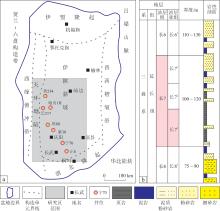
图1
鄂尔多斯盆地构造位置(a)及长7油层组地层综合柱状图(b)[34-35]"


图2
鄂尔多斯盆地长73油层亚组页岩中4类纹层特征镜下照片a.宁70井,埋深1 711.95 m,普通薄片,单偏光;b. 宁70井,埋深1 719.07 m,普通薄片,单偏光;c. 宁70井,埋深1 715.85 m,荧光薄片,扫描电镜;d.对应c图同视域AMICS分析结果;e,f. 宁70井,埋深1 720.70 m,普通薄片,单偏光; g. 宁70井,埋深1 719.20 m,荧光薄片,扫描电镜;h. 对应g图同视域AMICS分析结果;i. 宁70井,埋深1 711.65 m,普通薄片,单偏光;j. 宁70井,埋深1 711.80 m,普通薄片,单偏光;k. 宁70井,埋深1 712.32 m,荧光薄片,扫描电镜;l.对应k图同视域AMICS分析结果;m. 黄234井,埋深2 441.79 m,普通薄片,单偏光;n. 黄234井,埋深2 423.98 m,普通薄片,单偏光;o. 黄234井,埋深2 423.98 m,荧光薄片,扫描电镜;p.对应o图同视域AMICS分析结果"


图3
鄂尔多斯盆地长73油层亚组页岩中不同类型纹层的有机地球化学特征图版a.页岩含油性判识图版;b.有机质丰度分级评价判识图版;c.有机质类型判识图版TOC.总有机碳含量;S1.游离烃含量;S2.裂解烃含量;Tmax.最高热解峰温;HI.氢指数"

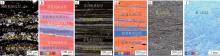
图4
鄂尔多斯盆地长73油层亚组页岩中不同纹层组合特征a. 宁70井,埋深1 719.20 m,“富有机质+粉砂级长英质”纹层组合,普通薄片;b. 宁70井,埋深1 720.95 m “富有机质+粉砂级长英质”纹层组合,微区XRF中Al, Si, K, Fe和S元素叠加图像,;c. 宁70井,埋深1 711.80 m,“富有机质+富凝灰质”纹层组合,普通薄片;d. 宁70井,埋深1 711.80 m,“富有机质+富凝灰质”纹层组合,微区XRF中Al, Si, V, Fe和S元素叠加图像;e. 黄234井,埋深2 423.98 m,块状泥岩,普通薄片;f. 塬页1H井,埋深2 640.32 m,块状泥岩,微区XRF中Al, Ca和Fe元素叠加图像"


图5
鄂尔多斯盆地长73油层亚组不同类型页岩纹层的孔隙类型及特征a. 宁70井,埋深1 720.70 m,粉砂级长英质纹层大拼图件,表征孔隙类型及分布特征,扫描电镜照片;b,c. 宁70井,埋深1 720.70 m,粉砂级长英质纹层不同孔隙类型镜下特征,扫描电镜照片;d.粉砂级长英质纹层孔径分布特征;e.粉砂级长英质纹层各类孔隙占比饼状图;f. 塬页1H井,埋深2 637.92 m,富凝灰质纹层大拼图件,表征孔隙类型及分布特征,扫描电镜照片;g,h. 塬页1H井,埋深2 637.92 m,富凝灰质纹层不同孔隙类型镜下特征,扫描电镜照片;i.富凝灰质纹层孔径分布特征;j.富凝灰质纹层各类孔隙占比饼状图;k. 蔡30井,埋深1 959.48 m,富有机质纹层大拼图件,表征孔隙类型及分布特征,扫描电镜照片;l,m. 蔡30井,埋深1 959.48 m,富有机质纹层不同孔隙类型镜下特征,扫描电镜照片;n.富有机质纹层孔径分布特征;o.富有机质纹层各类孔隙占比饼状图(d,i,n图中的三角形代表孔径平均值,左、右长方形分别代表孔径最小值和最大值。)"

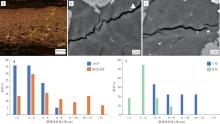
图6
鄂尔多斯盆地长73油层亚组页岩中富凝灰质纹层的微裂缝特征a. 塬页1H井,埋深2 642.00 m,微裂缝,单偏光,普通薄片显微照片;b,c. 巴217井,埋深2 800.80 m,单条微裂缝,扫描电镜照片;d.不同井井微裂缝线密度频率分布直方图;e.不同类型富凝灰质纹层微裂缝线密度频率分布直方图"

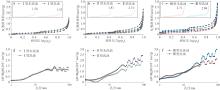
图7
鄂尔多斯盆地长73油层亚组不同岩相中N2吸附特征a.塬页1H井,埋深2 630.86 m,Ⅰ型页岩岩相气体吸附-脱附曲线;b. 正8井,埋深1 280.60 m,Ⅱ型页岩岩相气体吸附-脱附曲线;c. 正8井,埋深1 278.86 m,Ⅲ型页岩岩相气体吸附-脱附曲线;d. Ⅰ型页岩岩相孔径分布特征;e. Ⅱ型页岩岩相孔径分布特征;f. Ⅲ型页岩岩相孔径分布特征(a—c图方框内数值为最大氮气吸附体积。)"


图8
鄂尔多斯盆地长73油层亚组不同岩相中高压压汞曲线(a—c)及孔径分布特征(d—f)a. 塬页1H井,埋深2 630.86 m,Ⅰ型页岩岩相;b. 正8井,埋深1 280.60 m,Ⅱ型页岩岩相;c. 正8井,埋深1 278.86 m,Ⅲ型页岩岩相;d. Ⅰ型页岩岩相孔径分布特征;e. Ⅱ型页岩岩相孔径分布特征;f. Ⅲ型页岩岩相孔径分布特征(a—c图中,1 psi = 6.895 × 10⁻³ MPa。)"

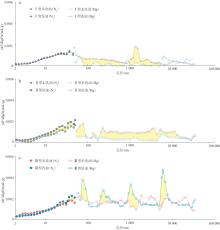
图9
鄂尔多斯盆地长73油层亚组不同岩相中全孔径分布曲线及孔隙体积增长表征a. 塬页1H井,埋深2 630.86 m,Ⅰ类页岩岩相;b. 正8井,埋深1 280.60 m,Ⅱ类页岩岩相;c. 正8井,埋深1 278.86 m,Ⅲ类页岩岩相(a—c图中黄色填充部分代表样品洗油前、后孔隙体积增量的差值。)"

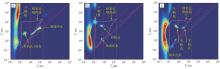
图10
鄂尔多斯盆地长73油层亚组不同岩相中核磁共振T1-T2谱分布特征a. 塬页1H井,埋深2 629.85 m,Ⅰ类页岩岩相;b. 正8井,埋深1 280.00 m,Ⅱ类页岩岩相;c. 珠80井,埋深2 262.50 m,Ⅲ类页岩岩相"
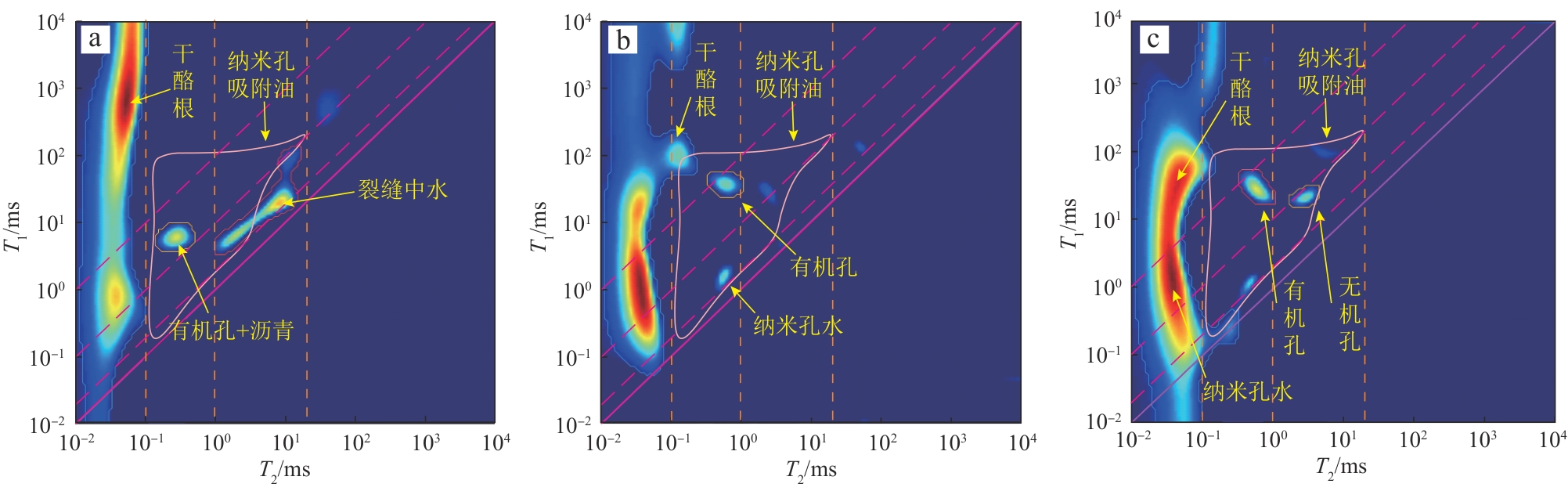
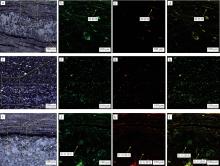
图11
鄂尔多斯盆地长73油层亚组不同岩相中滞留油激光共聚焦观察镜下照片a. 塬页1H井,埋深2 630.86 m,Ⅰ类页岩岩相反射光镜下特征;b—d.分别为a图视域中黄色框区域滞留油轻质成分、重质成分和整体分布;e. 正8井,埋深1 280.60 m,Ⅱ类页岩岩相反射光镜下特征;f—h.分别为e图视域中黄色框区域滞留油轻质成分、重质成分和整体分布;i. 正8井,埋深1 278.86 m,Ⅲ类页岩岩相反射光镜下特征;j—l.分别为i图视域中黄色框区域滞留油轻质成分、重质成分和整体分布"

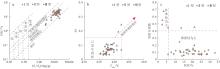
图12
鄂尔多斯盆地长73油层亚组不同岩相中页岩油微运移地球化学参数判识图版a. S1+S2-TOC交汇图;b. Tmax-PI交汇图;c.轻组分指数-TOC交汇图S1. 热解游离烃量;S2. 热解裂解烃量;TOC. 总有机碳含量; Tmax. 最高热解峰温;PI. 烃产率指数,PI =S1/ (S1+S2)"
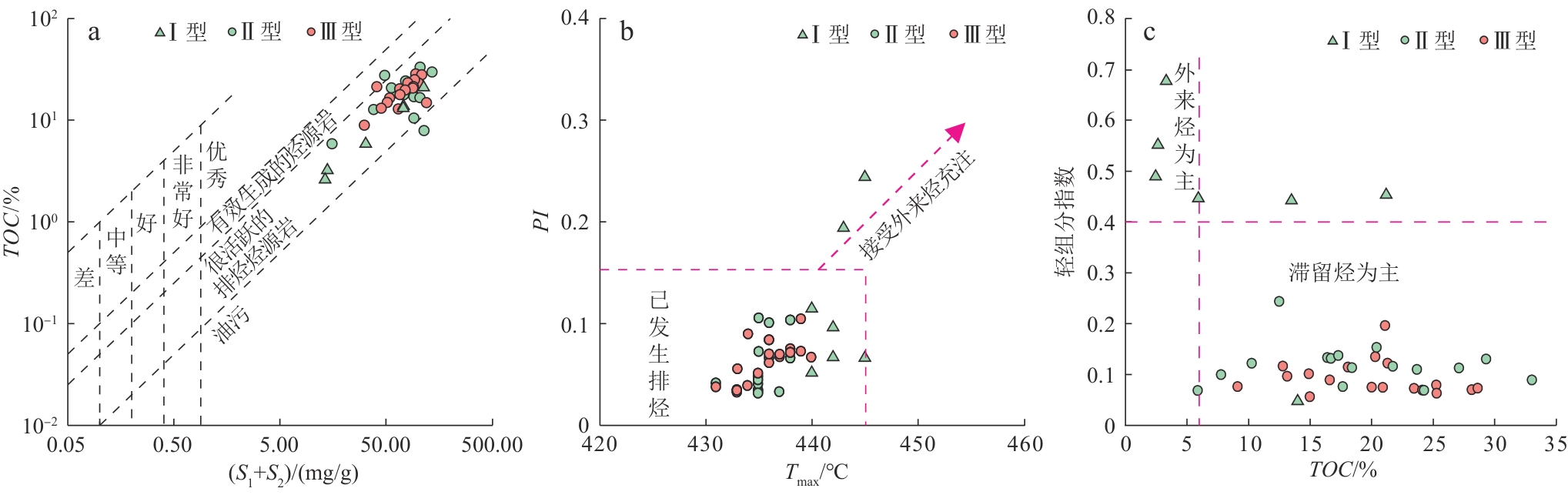
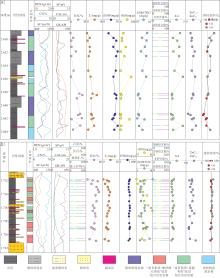
图13
鄂尔多斯盆地长73油层亚组页岩纹层组合间页岩油微运移单井综合剖面a. 塬页1H井;b. 宁70井TOC. 总有机碳含量;S1. 热解游离烃量;EOM. 可抽提有机质含量;OSI. 含油饱和度指数,OSI = S1/ TOC × 100;EOM/TOC. 可抽提有机质转化率;S/A.饱和烃/芳香烃含量比值;∑nC21-/∑nC22+.轻烃组分与重烃组分的相对丰度比"

| [1] | 赵文智, 朱如凯, 张婧雅, 等. 中国陆相页岩油类型、勘探开发现状与发展趋势[J]. 中国石油勘探, 2023, 28(4): 1-13. |
| ZHAO Wenzhi, ZHU Rukai, ZHANG Jingya, et al. Classification, exploration and development status and development trend of continental shale oil in China[J]. China Petroleum Exploration, 2023, 28(4): 1-13. | |
| [2] | 郭旭升, 马晓潇, 黎茂稳, 等. 陆相页岩油富集机理探讨[J]. 石油与天然气地质, 2023, 44(6): 1333-1349. |
| GUO Xusheng, MA Xiaoxiao, LI Maowen, et al. Mechanisms for lacustrine shale oil enrichment in Chinese sedimentary basins[J]. Oil & Gas Geology, 2023, 44(6): 1333-1349. | |
| [3] | 金之钧, 张谦, 朱如凯, 等. 中国陆相页岩油分类及其意义[J]. 石油与天然气地质, 2023, 44(4): 801-819. |
| JIN Zhijun, ZHANG Qian, ZHU Rukai, et al. Classification of lacustrine shale oil reservoirs in China and its significance[J]. Oil & Gas Geology, 2023, 44(4): 801-819. | |
| [4] | HINNOV L A. Cyclostratigraphy and its revolutionizing applications in the earth and planetary sciences[J]. GSA Bulletin, 2013, 125(11/12): 1703-1734. |
| [5] | LIN Miruo, XI Kelai, CAO Yingchang, et al. Palaeoenvironmental changes in the Late Triassic lacustrine facies of the Ordos Basin of Northwest China were driven by multistage volcanic activity: Implications for the understanding the Carnian Pluvial Event[J]. Palaeogeography, Palaeoclimatology, Palaeoecology, 2024, 637: 112012. |
| [6] | LOUCKS R G, REED R M, RUPPEL S C, et al. Spectrum of pore types and networks in mudrocks and a descriptive classification for matrix-related mudrock pores[J]. AAPG Bulletin, 2012, 96(6): 1071-1098. |
| [7] | 熊敏, 陈雷, 陈鑫, 等. 海相页岩纹层特征、成因机理及其页岩气意义[J]. 中南大学学报(自然科学版), 2022, 53(9): 3490-3508. |
| XIONG Min, CHEN Lei, CHEN Xin, et al. Characteristics, genetic mechanism of marine shale laminae and its significance of shale gas accumulation[J]. Journal of Central South University (Science and Technology), 2022, 53(9): 3490-3508. | |
| [8] | 刘忠宝, 刘光祥, 胡宗全, 等. 陆相页岩层系岩相类型、组合特征及其油气勘探意义——以四川盆地中下侏罗统为例[J]. 天然气工业, 2019, 39(12): 10-21. |
| LIU Zhongbao, LIU Guangxiang, HU Zongquan, et al. Lithofacies types and assemblage features of continental shale strata and their significance for shale gas exploration: A case study of the Middle and Lower Jurassic strata in the Sichuan Basin[J]. Natural Gas Industry, 2019, 39(12): 10-21. | |
| [9] | ZHANG Yuanyuan, XI Kelai, CAO Yingchang, et al. The application of machine learning under supervision in identification of shale lamina combination types—A case study of Chang 73 sub-member organic-rich shales in the Triassic Yanchang Formation, Ordos Basin, NW China[J]. Petroleum Science, 2021, 18(6): 1619-1629. |
| [10] | 李森, 朱如凯, 崔景伟, 等. 鄂尔多斯盆地长7段细粒沉积岩特征与古环境——以铜川地区瑶页1井为例[J]. 沉积学报, 2020, 38(3): 554-570. |
| LI Sen, ZHU Rukai, CUI Jingwei, et al. Sedimentary characteristics of fine-grained sedimentary rock and paleo-environment of Chang 7 member in the Ordos Basin: A case study from Well Yaoye 1 in Tongchuan[J]. Acta Sedimentologica Sinica, 2020, 38(3): 554-570. | |
| [11] | 刘群, 袁选俊, 林森虎, 等. 鄂尔多斯盆地延长组湖相黏土岩分类和沉积环境探讨[J]. 沉积学报, 2014, 32(6): 1016-1025. |
| LIU Qun, YUAN Xuanjun, LIN Senhu, et al. The classification of lacustrine mudrock and research on its’ depositional environment[J]. Acta Sedimentologica Sinica, 2014, 32(6): 1016-1025. | |
| [12] | JARVIE D M, HILL R J, RUBLE T E, et al. Unconventional shale-gas systems: The Mississippian Barnett Shale of north-central Texas as one model for thermogenic shale-gas assessment[J]. AAPG Bulletin, 2007, 91(4): 475-499. |
| [13] | APLIN A C, MACQUAKER J H S. Mudstone diversity: Origin and implications for source, seal, and reservoir properties in petroleum systems[J]. AAPG Bulletin, 2011, 95(12): 2031-2059. |
| [14] | ZOU C N, YANG Z, TAO S Z, et al. Continuous hydrocarbon accumulation over a large area as a distinguishing characteristic of unconventional petroleum: The Ordos Basin, North-Central China[J]. Earth-Science Reviews, 2013, 126: 358-369. |
| [15] | 王幸蒙, 熊亮, 赵勇, 等. 基于核磁共振技术的页岩孔隙结构定量表征[J]. 海相油气地质, 2024, 29(2): 197-206. |
| WANG Xingmeng, XIONG Liang, ZHAO Yong, et al. Quantitative characterization of shale pore structure based on nuclear magnetic resonance[J]. Marine Origin Petroleum Geology, 2024, 29(2): 197-206. | |
| [16] | YANG Feng, NING Zhengfu, WANG Qing, et al. Pore structure characteristics of Lower Silurian shales in the southern Sichuan Basin, China: Insights to pore development and gas storage mechanism[J]. International Journal of Coal Geology, 2016, 156: 12-24. |
| [17] | 王民, 关莹, 李传明, 等. 济阳坳陷沙河街组湖相页岩储层孔隙定性描述及全孔径定量评价[J]. 石油与天然气地质, 2018, 39(6): 1107-1119. |
| WANG Min, GUAN Ying, LI Chuanming, et al. Qualitative description and full-pore-size quantitative evaluation of pores in lacustrine shale reservoir of Shahejie Formation, Jiyang Depression[J]. Oil & Gas Geology, 2018, 39(6): 1107-1119. | |
| [18] | 胡涛, 姜福杰, 庞雄奇, 等. 页岩油微运移识别、评价及其石油地质意义[J]. 石油勘探与开发, 2024, 51(1): 114-126. |
| HU Tao, JIANG Fujie, PANG Xiongqi, et al. Identification and evaluation of shale oil micro-migration and its petroleum geological significance[J]. Petroleum Exploration and Development, 2024, 51(1): 114-126. | |
| [19] | 文杰, 徐尚, 苟启洋, 等. 页岩油微运移研究进展及意义[J]. 地质科技通报, 2024, 43(4): 1-14. |
| WEN Jie, XU Shang, GOU Qiyang, et al. Research status and significance of shale oil micromigration[J]. Bulletin of Geological Science and Technology, 2024, 43(4): 1-14. | |
| [20] | JARVIE D M. Shale resource systems for oil and gas: Part 2—Shale-oil resource systems[M]//BREYER J A. Shale Reservoirs—Giant Resources for the 21st Century. Tulsa: American Association of Petroleum Geologists, 2012: 89-119. |
| [21] | 刘惠民, 包友书, 黎茂稳, 等. 页岩油富集可动性地球化学评价参数探讨——以威利斯顿盆地Bakken组和渤海湾盆地济阳坳陷古近系沙河街组页岩为例[J]. 石油与天然气地质, 2024, 45(3): 622-636. |
| LIU Huimin, BAO Youshu, LI Maowen, et al. Geochemical parameters for evaluating shale oil enrichment and mobility: A case study of shales in the Bakken Formation, Williston Basin and the Shahejie Formation, Jiyang Depression[J]. Oil & Gas Geology, 2024, 45(3): 622-636. | |
| [22] | 潘松圻, 郭秋雷, 邹才能, 等. 页岩型与粉砂岩型 “页岩油系统” 甜点段判识——以鄂尔多斯盆地长7段为例[J]. 中国科学:地球科学, 2023, 53(7): 1663-1678. |
| PAN Songqi, GUO Qiulei, ZOU Caineng, et al. Identification of sweet spots in shale-type and siltstone-type “shale oil systems”: A case study of the Chang 7 member in Ordos Basin[J]. Science China Earth Sciences, 2023, 53(7): 1663-1678. | |
| [23] | 葸克来, 李克, 操应长, 等. 鄂尔多斯盆地三叠系延长组长73亚段富有机质页岩纹层组合与页岩油富集模式[J]. 石油勘探与开发, 2020, 47(6): 1244-1255. |
| XI Kelai, LI Ke, CAO Yingchang, et al. Laminae combination and shale oil enrichment patterns of Chang 73 sub-member organic-rich shales in the Triassic Yanchang Formation, Ordos Basin, NW China[J]. Petroleum Exploration and Development, 2020, 47(6): 1244-1255. | |
| [24] | HAN Yuanjia, MAHLSTEDT N, HORSFIELD B. The Barnett Shale: Compositional fractionation associated with intraformational petroleum migration, retention, and expulsion[J]. AAPG Bulletin, 2015, 99(12): 2173-2202. |
| [25] | 余光展, 王健, 吴楠, 等. 鄂尔多斯盆地志靖—安塞地区延长组7段致密砂岩微观孔隙结构评价[J]. 吉林大学学报(地球科学版), 2024, 54(1): 83-95. |
| YU Guangzhan, WANG Jian, WU Nan, et al. Micropore structure evaluation of Chang 7 tight sandstone in Zhijing-Ansai area, Ordos Basin[J]. Journal of Jilin University (Earth Science Edition), 2024, 54(1): 83-95. | |
| [26] | YANG Hua, NIU Xiaobing, XU Liming, et al. Exploration potential of shale oil in Chang7 Member, Upper Triassic Yanchang Formation, Ordos Basin, NW China[J]. Petroleum Exploration and Development, 2016, 43(4): 560-569. |
| [27] | 钟红利, 卓自敏, 张凤奇, 等. 鄂尔多斯盆地甘泉地区长7页岩油储层非均质性及其控油规律[J]. 特种油气藏, 2023, 30(4): 10-18. |
| ZHONG Hongli, ZHUO Zimin, ZHANG Fengqi, et al. Heterogeneity of Chang 7 shale oil reservoir and its oil control law in Ganquan area, Ordos Basin[J]. Special Oil & Gas Reservoirs, 2023, 30(4): 10-18. | |
| [28] | 王峰, 田景春, 范立勇, 等. 鄂尔多斯盆地三叠系延长组沉积充填演化及其对印支构造运动的响应[J]. 天然气地球科学, 2010, 21(6): 882-889. |
| WANG Feng, TIAN Jingchun, FAN Liyong, et al. Evolution of sedimentary fillings in Triassic Yanchang Formation and its response to Indosinian movement in Ordos Basin[J]. Natural Gas Geoscience, 2010, 21(6): 882-889. | |
| [29] | 付金华, 罗顺社, 牛小兵, 等. 鄂尔多斯盆地陇东地区长7段沟道型重力流沉积特征研究[J]. 矿物岩石地球化学通报, 2015, 34(1): 29-37, 1. |
| FU Jinhua, LUO Shunshe, NIU Xiaobing, et al. Sedimentary characteristics of channel type gravity flow of the member 7 of Yanchang Formation in the Longdong area, Ordos Basin[J]. Bulletin of Mineralogy, Petrology and Geochemistry, 2015, 34(1): 29-37, 1. | |
| [30] | 林森虎, 袁选俊, 杨智. 陆相页岩与泥岩特征对比及其意义——以鄂尔多斯盆地延长组7段为例[J]. 石油与天然气地质, 2017, 38(3): 517-523. |
| LIN Senhu, YUAN Xuanjun, YANG Zhi. Comparative study on lacustrine shale and mudstone and its significance: A case from the 7th member of Yanchang Formation in the Ordos Basin[J]. Oil & Gas Geology, 2017, 38(3): 517-523. | |
| [31] | 付金华, 牛小兵, 淡卫东, 等. 鄂尔多斯盆地中生界延长组长7段页岩油地质特征及勘探开发进展[J]. 中国石油勘探, 2019, 24(5): 601-614. |
| FU Jinhua, NIU Xiaobing, DAN Weidong, et al. The geological characteristics and the progress on exploration and development of shale oil in Chang7 Member of Mesozoic Yanchang Formation, Ordos Basin[J]. China Petroleum Exploration, 2019, 24(5): 601-614. | |
| [32] | 张文正, 杨华, 杨伟伟, 等. 鄂尔多斯盆地延长组长7湖相页岩油地质特征评价[J]. 地球化学, 2015, 44(5): 505-515. |
| ZHANG Wenzheng, YANG Hua, YANG Weiwei, et al. Assessment of geological characteristics of lacustrine shale oil reservoir in Chang7 member of Yanchang Formation, Ordos Basin[J]. Geochimica, 2015, 44(5): 505-515. | |
| [33] | 袁伟, 柳广弟, 徐黎明, 等. 鄂尔多斯盆地延长组7段有机质富集主控因素[J]. 石油与天然气地质, 2019, 40(2): 326-334. |
| YUAN Wei, LIU Guangdi, XU Liming, et al. Main controlling factors for organic matter enrichment in Chang 7 member of the Yanchang Formation, Ordos Basin[J]. Oil & Gas Geology, 2019, 40(2): 326-334. | |
| [34] | 师良, 范柏江, 李忠厚, 等. 鄂尔多斯盆地中部三叠系延长组7段烃组分的运移分异作用[J]. 石油与天然气地质, 2024, 45(1): 157-168. DOI:10. 11743/ogg20240111 . |
| SHI Liang, FAN Bojiang, LI Zhonghou, et al. Migration differentiation of hydrocarbon components in the 7th member of the Triassic Yanchang Formation, central Ordos Basin[J]. Oil & Gas Geology, 2024, 45(1): 157-168. DOI:10. 11743/ogg20240111 . | |
| [35] | 何建华, 丁文龙, 付景龙, 等. 页岩微观孔隙成因类型研究[J]. 岩性油气藏, 2014, 26(5): 30-35. |
| HE Jianhua, DING Wenlong, FU Jinglong, et al. Study on genetic type of micropore in shale reservoir[J]. Lithologic Reservoirs, 2014, 26(5): 30-35. | |
| [36] | 周志军, 张国青, 崔春雪, 等. 不同岩性页岩油储集空间及物性特征[J]. 特种油气藏, 2023, 30(5): 42-49. |
| ZHOU Zhijun, ZHANG Guoqing, CUI Chunxue, et al. Reservoir space and physical characteristics of shale oil with different lithologies[J]. Special Oil & Gas Reservoirs, 2023, 30(5): 42-49. | |
| [37] | WANG Yang, LIU Luofu, CHENG Hongfei. Gas adsorption characterization of pore structure of organic-rich shale: Insights into contribution of organic matter to shale pore network[J]. Natural Resources Research, 2021, 30(3): 2377-2395. |
| [38] | 宋泽章, 阿比德·阿不拉, 吕明阳, 等. 氮气吸附滞后回环定量分析及其在孔隙结构表征中的指示意义——以鄂尔多斯盆地上三叠统延长组7段为例[J]. 石油与天然气地质, 2023, 44(2): 495-509. |
| SONG Zezhang, ABIDE Abula, Mingyang LYU, et al. Quantitative analysis of nitrogen adsorption hysteresis loop and its indicative significance to pore structure characterization: A case study on the Upper Triassic Chang 7 Member, Ordos Basin[J]. Oil & Gas Geology, 2023, 44(2): 495-509. | |
| [39] | 周军平, 范茂琳, 鲜学福, 等. 页岩气吸附量校正及其吸附性影响因素[J]. 煤炭科学技术, 2022, 50(2): 154-162. |
| ZHOU Junping, FAN Maolin, XIAN Xuefu, et al. Correction calculation of shale gas absolute adsorption capacity and its influencing factors analysis[J]. Coal Science and Technology, 2022, 50(2): 154-162. | |
| [40] | 朱越, 伍顺伟, 邓玉森, 等. 玛湖凹陷风城组储集层孔喉结构及流体赋存特征[J]. 新疆石油地质, 2024, 45(3): 286-295. |
| ZHU Yue, WU Shunwei, DENG Yusen, et al. Pore throat structures and fluid occurrences of reservoirs in Fengcheng Formation, Mahu Sag[J]. Xinjiang Petroleum Geology, 2024, 45(3): 286-295. | |
| [41] | KAUSIK R, FELLAH K, RYLANDER E, et al. NMR relaxometry in shale and implications for logging[J]. Petrophysics, 2016, 57(4): 339-350. |
| [42] | ZHANG Pengfei, LU Shuangfang, LI Junqian, et al. 1D and 2D nuclear magnetic resonance (NMR) relaxation behaviors of protons in clay, kerogen and oil-bearing shale rocks[J]. Marine and Petroleum Geology, 2020, 114: 104210. |
| [43] | 张冬梅, 张延延, 郭隽菁, 等. 基于岩石热解参数图版的烃源岩内部排烃效率计算方法[J]. 石油实验地质, 2021, 43(3): 532-539. |
| ZHANG Dongmei, ZHANG Yanyan, GUO Juanjing, et al. A calculation method for the efficiency of hydrocarbon expulsion based on parameter-diagram of source rock pyrolysis[J]. Petroleum Geology and Experiment, 2021, 43(3): 532-539. | |
| [44] | 冯家乐, 杨升宇, 胡钦红, 等. 沧东凹陷孔二段页岩生排烃效率及对含油性的影响[J]. 中国石油大学学报(自然科学版), 2024, 48(2): 45-56. |
| FENG Jiale, YANG Shengyu, HU Qinhong, et al. Hydrocarbon generation and expulsion efficiency and influence on oil bearing property of shale in the second member of Paleogene Kongdian Formation in Cangdong Sag[J]. Journal of China University of Petroleum (Edition of Natural Science), 2024, 48(2): 45-56. | |
| [45] | PAN Changchun, GENG Ansong, LIAO Zewen, et al. Geochemical characterization of free versus asphaltene-sorbed hydrocarbons in crude oils: Implications for migration-related compositional fractionations[J]. Marine and Petroleum Geology, 2002, 19(5): 619-632. |
| [1] | 赵靖舟, 高振东, 孟选刚, 吴伟涛, 白玉彬, 曹磊, 赵子龙. 鄂尔多斯盆地陕北地区三叠系延长组长7—长9油层组重力流沉积致密油富集条件与勘探潜力——兼论拗陷型湖盆的石油勘探范式[J]. 石油与天然气地质, 2025, 46(5): 1367-1391. |
| [2] | 吴伟涛, 李天宇, 闫新智, 周凯, 殷露, 曹磊. 鄂尔多斯盆地定边—富县地区延长组长8油层组致密油富集因素与富集模式[J]. 石油与天然气地质, 2025, 46(5): 1392-1409. |
| [3] | 曹磊, 闫新智, 李辉, 吴伟涛, 白玉彬, 赵子龙. 鄂尔多斯盆地陕北地区延长组长8与长9油层组烃源岩分布与地球化学特征及页岩油资源潜力评价[J]. 石油与天然气地质, 2025, 46(5): 1410-1429. |
| [4] | 耳闯, 关宏博, 刘伟, 程妮, 白洁, 胡崇. 陆源物质输入对有机质类型的影响——以鄂尔多斯盆地三叠系延长组长73油层亚组页岩为例[J]. 石油与天然气地质, 2025, 46(5): 1430-1445. |
| [5] | 张军, 白玉彬, 张海, 赵靖舟, 徐宁. 鄂尔多斯盆地富县地区三叠系延长组长7油层组深水重力流致密砂岩成因与分布[J]. 石油与天然气地质, 2025, 46(5): 1446-1465. |
| [6] | 陈伟涛, 赵靖舟, 高振东, 李哲, 孟选刚, 闫新智, 董旭. 鄂尔多斯盆地志丹地区延长组长7—长9油层组深水重力流沉积特征及含油性[J]. 石油与天然气地质, 2025, 46(5): 1466-1484. |
| [7] | 李晓龙, 白玉彬, 陈珊珊, 张刚, 王聪娥. 三角洲与重力流砂体构型特征及其对油藏分布的控制——以鄂尔多斯盆地甘泉地区三叠系延长组长7油层组为例[J]. 石油与天然气地质, 2025, 46(5): 1485-1503. |
| [8] | 王琳茜, 赵靖舟, 高振东, 魏繁荣, 周世琪, 孟选刚, 闫新智, 徐宁. 深水重力流沉积类型及含油性对比——以鄂尔多斯盆地富县地区三叠系延长组长7—长9油层组为例[J]. 石油与天然气地质, 2025, 46(5): 1504-1521. |
| [9] | 吴吉泽, 李华, 何幼斌, 姜纯伟, 何一鸣, 姚凤南, 张显坤. 鄂尔多斯盆地西缘奥陶系樱桃沟组等深流-重力流交互作用沉积特征及形成机理[J]. 石油与天然气地质, 2025, 46(5): 1522-1535. |
| [10] | 杨海风, 王飞龙, 胡安文, 关超, 滑彦岐. 渤海湾盆地页岩油勘探现状、进展及展望[J]. 石油与天然气地质, 2025, 46(4): 1123-1135. |
| [11] | 徐田武, 李素梅, 陈湘飞, 马学峰, 邓硕, 张莹莹. 渤海湾盆地东濮凹陷全油气系统特征及其成藏模式[J]. 石油与天然气地质, 2025, 46(4): 1152-1168. |
| [12] | 陈冬霞, 王翘楚, 熊亮, 王小娟, 杨映涛, 雷文智, 张玲, 潘珂, 庞宏. 川西—川中地区陆相层系全油气系统常规和非常规有效储层成因机制与分类评价[J]. 石油与天然气地质, 2025, 46(4): 1215-1232. |
| [13] | 丁蓉, 庞雄奇, 贾承造, 熊先钺, 邓泽, 田文广, 蒲庭玉, 王飞宇, 林浩, 陈雨萱. 鄂尔多斯盆地石炭纪—二叠纪煤系全油气系统天然气成藏特征与有序分布模式[J]. 石油与天然气地质, 2025, 46(4): 1333-1348. |
| [14] | 施振生, 周天琪, 汪鹏飞. 细粒沉积中内源组分的类型、分布及页岩油气甜点意义[J]. 石油与天然气地质, 2025, 46(3): 759-776. |
| [15] | 李军亮, 王民, 秦峰, 王勇, 魏晓亮, 孟伟, 沈安超, 宋兆京, 余昌琦, 李俊乾, 刘嘉祺. 陆相富碳酸盐页岩纹层组合对页岩油富集的控制作用——以渤海湾盆地济阳坳陷古近系沙河街组页岩为例[J]. 石油与天然气地质, 2025, 46(2): 392-406. |
| 阅读次数 | ||||||
|
全文 |
|
|||||
|
摘要 |
|
|||||
