

石油与天然气地质 ›› 2025, Vol. 46 ›› Issue (5): 1630-1645.doi: 10.11743/ogg20250515
• 油气地质 • 上一篇
刘明洁1( ), 刘恒宇2, 肖尧3, 宋林珂3, 曹脊翔3, 李唐律3, 王锦西3, 梁晨1
收稿日期:2025-03-28
修回日期:2025-09-08
出版日期:2025-10-30
发布日期:2025-10-29
第一作者简介:刘明洁(1985—),男,博士,副教授,储层地质学、油气成藏机理与富集规律。E‑mail: mjliu@swpu.edu.cn。
基金项目:
Mingjie LIU1(), Hengyu LIU2, Yao XIAO3, Linke SONG3, Jixiang CAO3, Tanglyu LI3, Jinxi WANG3, Chen LIANG1
Received:2025-03-28
Revised:2025-09-08
Online:2025-10-30
Published:2025-10-29
摘要:
为明确川中地区侏罗系沙溪庙组远源型致密砂岩气差异富集规律,基于气源断层解释、砂体刻画与成藏期古构造恢复,分析了沙溪庙组成藏期与现今断层-砂体配置关系,明确了成藏期至今断层-砂体配置演化模式及分布规律,进而结合现今产气井分布特征探讨了该演化模式对天然气差异富集的影响。研究结果表明:沙溪庙组断层-砂体配置关系存在断层与近水平砂体对接(①类)、断层与倾向一致的缓倾角砂体对接(②类)以及断层与倾向相反的缓倾角砂体对接(③类)3类;成藏期至今断层-砂体配置演化模式分为继承型(Ⅰ型,其中成藏期与现今均呈③类,即Ⅰ1型;均呈①类,即Ⅰ2型)、调整型(Ⅱ型,成藏期呈①类,演化至现今呈③类)和反转型(Ⅲ型,即成藏期呈③类、演化至现今呈②类)。这3种断层-砂体配置演化模式对天然气富集可产生不同影响:Ⅰ1继承型演化模式导致天然气主要在断层上盘富集并继承保存至今,气井多表现为高产和中产;断层下盘仅聚集少量天然气并继承保存至今,气井多表现为低产。Ⅰ2继承型演化模式导致天然气主要在断层两盘聚集并继承保存至今,断层两盘气井多表现为中产和低产。调整型演化模式导致天然气在断层两盘聚集并调整改造至今,其中上盘经调整可进一步聚集或富集天然气,气井可表现为高产、中产或低产;断层下盘经调整可使天然气逸散,气井多表现为低产和特低产。反转型演化模式导致天然气在上盘富集并经反转散失至今,而在下盘少量聚集并经反转调整再次聚集至今,断层两盘气井多表现为低产和特低产。川中地区北部金秋区块Ⅰ1继承型演化模式产生的上盘继承保存富集型天然气、调整型演化模式产生的上盘调整改造富集型天然气,可作为下一阶段沙溪庙组远源型致密砂岩气勘探的重点。
中图分类号:
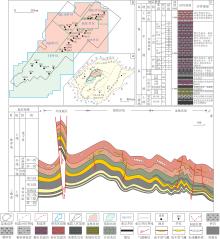
图1
四川盆地构造区划、沙溪庙组综合柱状图及天然气成藏模式a.四川盆地构造区划(据文献[34],有修改)及研究区位置;b.研究区井区及井位分布;c.研究区中侏罗统沙溪庙组综合柱状图;d.研究区沙溪庙组远源致密砂岩气成藏模式(剖面位置见图1a)"


图2
川中地区中侏罗统沙溪庙组气源断层解释剖面(剖面位置见图3)a.断层地震解释剖面;b.断层似然属性剖面T3x1.上三叠统须家河组一段底界;T3x3.上三叠统须家河组三段底界;T3x4.上三叠统须家河组四段底界;T3x5.上三叠统须家河组五段底界;T3x6.上三叠统须家河组六段底界;J1dy.下侏罗统自流井组东岳庙段底界;J1dn.下侏罗统自流井组大安寨段底界;J2s1.中侏罗统沙溪庙组一段底界;J2s2(1).中侏罗统沙溪庙组二段1亚段底界;J2s2(2).中侏罗统沙溪庙组二段2亚段底界;J2s2(3).中侏罗统沙溪庙组二段3亚段底界;J2s2(4).中侏罗统沙溪庙组二段4亚段底界"


图3
川中地区沙溪庙组底界地震反射构造特征"


图4
川中地区沙溪庙组不同砂组、气源断层及产气井叠合图a.1砂组;b.3砂组;c.5砂组;d.6砂组;e.8砂组;f.9砂组"


图5
川中地区沙溪庙组断层-砂体配置类型示意图(图中的地层代号说明见图2。)"


图6
川中地区晚侏罗世成藏期沙溪庙组古地貌"

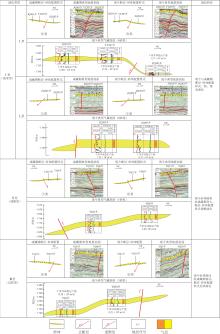
图7
川中地区沙溪庙组不同类型断层-砂体配置演化模式示意图(图中的地层代号说明见图2。)"

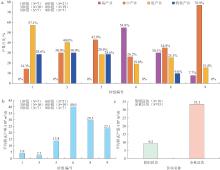
图8
川中地区沙溪庙组气藏测试产量特征统计柱状图a.研究区沙溪庙组不同砂组气藏获气井测试产量分布;b.研究区沙溪庙组不同砂组气藏平均测试产量;c.研究区简阳区块和金秋区块沙溪庙组气藏平均测试产量"

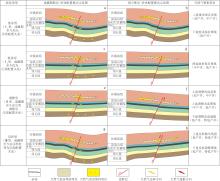
图9
川中地区沙溪庙组断层-砂体配置演化模式与远源型致密砂岩气差异富集关系"

| [1] | 魏国齐, 张福东, 李君, 等. 中国致密砂岩气成藏理论进展[J]. 天然气地球科学, 2016, 27(2): 199-210. |
| WEI Guoqi, ZHANG Fudong, LI Jun, et al. New progress of tight sand gas accumulation theory and favorable exploration zones in China[J]. Natural Gas Geoscience, 2016, 27(2): 199-210. | |
| [2] | 孙龙德, 邹才能, 贾爱林, 等. 中国致密油气发展特征与方向[J]. 石油勘探与开发, 2019, 46(6): 1015-1026. |
| SUN Longde, ZOU Caineng, JIA Ailin, et al. Development characteristics and orientation of tight oil and gas in China[J]. Petroleum Exploration and Development, 2019, 46(6): 1015-1026. | |
| [3] | 曹江骏, 王继平, 张道锋, 等. 深层致密砂岩储层成岩演化对含气性的影响——以鄂尔多斯盆地西南部庆阳气田二叠系山1段为例[J]. 石油与天然气地质, 2024, 45(1): 169-184. |
| CAO Jiangjun, WANG Jiping, ZHANG Daofeng, et al. Effects of diagenetic evolution on gas-bearing properties of deep tight sandstone reservoirs: A case study of reservoirs in the 1st member of the Permian Shanxi Formation in the Qingyang Gas Field, southwestern Ordos Basin[J]. Oil & Gas Geology, 2024, 45(1): 169-184. | |
| [4] | 张道伟, 杨雨. 四川盆地陆相致密砂岩气勘探潜力与发展方向[J]. 天然气工业, 2022, 42(1): 1-11. |
| ZHANG Daowei, YANG Yu. Exploration potential and development direction of continental tight sandstone gas in the Sichuan Basin[J]. Natural Gas Industry, 2022, 42(1): 1-11. | |
| [5] | 李军亮, 王鑫, 王伟庆, 等. 致密砂岩砂-泥结构发育特征及其对储集空间的控制作用——以渤海湾盆地临南洼陷古近系沙河街组三段下亚段为例[J]. 石油与天然气地质, 2023, 44(5): 1173-1187. |
| LI Junliang, WANG Xin, WANG Weiqing, et al. Influence of sand-mud assemblages in tight sandstones on reservoir storage spaces: A case study of the lower submember of the 3rd member of the Paleogene Shahejie Formation in the Linnan sub-sag, Bohai Bay Basin[J]. Oil & Gas Geology, 2023, 44(5): 1173-1187. | |
| [6] | 张道伟. 四川盆地未来十年天然气工业发展展望[J]. 天然气工业, 2021, 41(8): 34-45. |
| ZHANG Daowei. Development prospect of natural gas industry in the Sichuan Basin in the next decade[J]. Natural Gas Industry, 2021, 41(8): 34-45. | |
| [7] | 王茂云, 曾溅辉, 王小娟, 等. 源-储分离型致密砂岩气藏中气水分布控制因素——以四川盆地中部地区沙溪庙组致密砂岩气为例[J]. 石油学报, 2024, 45(8): 1187-1201, 1218. |
| WANG Maoyun, ZENG Jianhui, WANG Xiaojuan, et al. Controlling factors of gas-water distribution in source-reservoir separated tight sandstone gas reservoirs: A case study of Shaximiao Formation tight sandstone gas in central Sichuan Basin[J]. Acta Petrolei Sinica, 2024, 45(8): 1187-1201, 1218. | |
| [8] | 潘辉, 蒋裕强, 朱讯, 等. 河流相致密砂岩气地质甜点评价——以四川盆地川中地区侏罗系沙溪庙组二段1亚段为例[J]. 石油与天然气地质, 2024, 45(2): 471-485. |
| PAN Hui, JIANG Yuqiang, ZHU Xun, et al. Evaluation of geological sweet spots in fluvial tight sandstone gas: A case study of the first submember of the second member of the Jurassic Shaximiao Formation, central Sichuan Basin[J]. Oil & Gas Geology, 2024, 45(2): 471-485. | |
| [9] | 宋林珂, 刘四兵, 曾青高, 等. 四川盆地川中—川西过渡带中侏罗统沙溪庙组致密砂岩相对优质储层成因机制[J]. 吉林大学学报(地球科学版), 2024, 54(2): 371-388. |
| SONG Linke, LIU Sibing, ZENG Qinggao, et al. Genetic mechanism of relatively high-quality reservoirs of middle Jurassic Shaximiao Formation tight sandstone in transition zone between central and western Sichuan Basin[J]. Journal of Jilin University (Earth Science Edition), 2024, 54(2): 371-388. | |
| [10] | 卢晓林, 刘君龙, 王小娟, 等. 四川盆地中部沙溪庙组天然气成因来源与启示[J]. 天然气地球科学, 2025, 36(5): 831-845. |
| LU Xiaolin, LIU Junlong, WANG Xiaojuan, et al. The origin of natural gas and exploration implication in the Shaximiao Formation in the central Sichuan Basin[J]. Natural Gas Geoscience, 2025, 36(5): 831-845. | |
| [11] | 张吉振, 唐友军, 洪海涛, 等. 川中油气区金华地区大安寨段及须五段烃源岩生物标志物特征和生源构成[J]. 长江大学学报(自然科学版), 2021, 18(5): 1-12. |
| ZHANG Jizhen, TANG Youjun, HONG Haitao, et al. Biomarker characteristics and biogenetic composition of source rocks of Da’anzhai member and Xujiahe 5 member in Jinhua area of central Sichuan oil and gas region[J]. Journal of Yangtze University (Natural Science Edition), 2021, 18(5): 1-12. | |
| [12] | 肖富森, 黄东, 张本健, 等. 四川盆地侏罗系沙溪庙组天然气地球化学特征及地质意义[J]. 石油学报, 2019, 40(5): 568-576, 586. |
| XIAO Fusen, HUANG Dong, ZHANG Benjian, et al. Geochemical characteristics and geological significance of natural gas in Jurassic Shaximiao Formation, Sichuan Basin[J]. Acta Petrolei Sinica, 2019, 40(5): 568-576, 586. | |
| [13] | 杨春龙, 谢增业, 李剑, 等. 四川盆地中侏罗统沙溪庙组天然气地球化学特征及成因[J]. 天然气地球科学, 2021, 32(8): 1117-1126. |
| YANG Chunlong, XIE Zengye, LI Jian, et al. Geochemical characteristics and genesis of natural gas in Shaximiao Formation of Middle Jurassic in Sichuan Basin[J]. Natural Gas Geoscience, 2021, 32(8): 1117-1126. | |
| [14] | 杨雨, 谢继容, 曹正林, 等. 四川盆地天府气田沙溪庙组大型致密砂岩气藏形成条件及勘探开发关键技术[J]. 石油学报, 2023, 44(6): 917-932. |
| YANG Yu, XIE Jirong, CAO Zhenglin, et al. Forming conditions and key technologies for exploration and development of large tight sandstone gas reservoirs in Shaximiao Formation, Tianfu gas field of Sichuan Basin[J]. Acta Petrolei Sinica, 2023, 44(6): 917-932. | |
| [15] | 张照录, 王华, 杨红. 含油气盆地的输导体系研究[J]. 石油与天然气地质, 2000, 21(2): 133-135. |
| ZHANG Zhaolu, WANG Hua, YANG Hong. Study on passage system of petroliferous basins[J]. Oil & Gas Geology, 2000, 21(2): 133-135. | |
| [16] | 付广, 薛永超, 付晓飞. 油气运移输导系统及其对成藏的控制[J]. 新疆石油地质, 2001, 22(1): 24-26. |
| FU Guang, XUE Yongchao, FU Xiaofei. On oil-gas migration systems and their control over the formation of reservoir[J]. Xinjiang Petroleum Geology, 2001, 22(1): 24-26. | |
| [17] | 张善文, 王永诗, 石砥石, 等. 网毯式油气成藏体系——以济阳坳陷新近系为例[J]. 石油勘探与开发, 2003, 30(1): 1-10. |
| ZHANG Shanwen, WANG Yongshi, SHI Dishi, et al. Meshwork-carpet type oil and gas pool-forming system-Taking Neogene of Jiyang Depression as an example[J]. Petroleum Exploration and Development, 2003, 30(1): 1-10. | |
| [18] | 周广胜, 彭仕宓, 张秀丽, 等. 中国大中型气田断裂和砂体输导特征对比[J]. 石油勘探与开发, 2007, 34(6): 653-657. |
| ZHOU Guangsheng, PENG Shimi, ZHANG Xiuli, et al. Contrast of transporting characteristics between faults and sandbodies of medium and large gas fields in China[J]. Petroleum Exploration and Development, 2007, 34(6): 653-657. | |
| [19] | 严焕榕, 詹泽东, 李亚晶, 等. 致密砂岩气藏高产富集规律研究——以川西坳陷新场—合兴场须家河组二段气藏为例[J]. 油气藏评价与开发, 2024, 14(4): 541-548, 576. |
| YAN Huanrong, ZHAN Zedong, LI Yajing, et al. High yield enrichment law for tight sandstone gas reservoir: A case study of the second member of Xujiahe Formation gas reservoir in Xinchang-Hexinchang gas field of western Sichuan Depression[J]. Petroleum Reservoir Evaluation and Development, 2024, 14(4): 541-548, 576. | |
| [20] | 刘震, 张善文, 赵阳, 等. 东营凹陷南斜坡输导体系发育特征[J]. 石油勘探与开发, 2003, 30(3): 84-86. |
| LIU Zhen, ZHANG Shanwen, ZHAO Yang, et al. Development of carrying bed systems in the South slope of Dongying Sag[J]. Petroleum Exploration and Development, 2003, 30(3): 84-86. | |
| [21] | 熊伟. 断陷盆地输导体系宏观格架及构成特征——以东营凹陷为例[J]. 石油勘探与开发, 2006, 33(4): 474-478. |
| XIONG Wei. Macroscopic framework and constitution characteristics of the transportation system in down faulted basin—An example from Dongying Sag, Shengli Oilfield[J]. Petroleum Exploration and Development, 2006, 33(4): 474-478. | |
| [22] | 朱筱敏, 刘成林, 曾庆猛, 等. 我国典型天然气藏输导体系研究——以鄂尔多斯盆地苏里格气田为例[J]. 石油与天然气地质, 2005, 26(6): 724-729. |
| ZHU Xiaomin, LIU Chenglin, ZENG Qingmeng, et al. Study of carrier system of typical gas reservoirs in China-taking Sulige Gas Field in Ordos Basin as an example[J]. Oil & Gas Geology, 2005, 26(6): 724-729. | |
| [23] | 付晓飞, 董晶, 吕延防, 等. 海拉尔盆地乌尔逊-贝尔凹陷断裂构造特征及控藏机理[J]. 地质学报, 2012, 86(6): 877-889. |
| FU Xiaofei, DONG Jing, Yanfang LYU, et al. Fault structural characteristics of Wuerxun-Beier Depression in the Hailar Basin and their reservoir-controlling mechanism[J]. Acta Geologica Sinica, 2012, 86(6): 877-889. | |
| [24] | 李运振, 刘震, 赵阳, 等. 济阳坳陷断陷湖盆类型与输导体系发育特征的关系分析[J]. 西安石油大学学报(自然科学版), 2007, 22(4): 47-52. |
| LI Yunzhen, LIU Zhen, ZHAO Yang, et al. Relationship between the characteristics of passage systems and the types of faulted lake basins in Jiyang Depression[J]. Journal of Xi’an Shiyou University (Natural Science Edition), 2007, 22(4): 47-52. | |
| [25] | 宋国奇. 陆相断陷盆地断-拗转换体系与地层超覆油藏 “T-S” 控藏模式——以济阳坳陷第三系为例[J]. 地质学报, 2007, 81(9): 1208-1214. |
| SONG Guoqi. Fault-depression transformation system and “T-S” control reservoir mode of stratigraphic overlap pool——an example from Jiyang Depression[J]. Acta Geologica Sinica, 2007, 81(9): 1208-1214. | |
| [26] | 付晓飞, 王朋岩, 申家年, 等. 简单斜坡油气富集规律——以松辽盆地西部斜坡北段为例[J]. 地质论评, 2006, 52(4): 522-531. |
| FU Xiaofei, WANG Pengyan, SHEN Jianian, et al. Migration and accumulation of oil and gas in a simple slope area: A case study on the western slope of the northern Songliao Basin[J]. Geological Review, 2006, 52(4): 522-531. | |
| [27] | 梁春秀, 魏志平, 李本才, 等. 伊兰-伊通盆地输导体系与油气运聚[J]. 天然气工业, 2002, 22(1): 31-32. |
| LIANG Chunxiu, WEI Zhiping, LI Bencai, et al. Carrying bed systems and oil & gas migration in Yilan-Yitong Basin[J]. Natural Gas Industry, 2002, 22(1): 31-32. | |
| [28] | 赵贤正, 金凤鸣, 李玉帮, 等. 断陷盆地斜坡带类型与油气运聚成藏机制[J]. 石油勘探与开发, 2016, 43(6): 841-849. |
| ZHAO Xianzheng, JIN Fengming, LI Yubang, et al. Slope belt types and hydrocarbon migration and accumulation mechanisms in rift basins[J]. Petroleum Exploration and Development, 2016, 43(6): 841-849. | |
| [29] | 周立宏, 韩国猛, 董越崎, 等. 渤海湾盆地歧口凹陷滨海断鼻断-砂组合模式与油气成藏[J]. 石油勘探与开发, 2019, 46(5): 869-882. |
| ZHOU Lihong, HAN Guomeng, DONG Yueqi, et al. Fault-sand combination modes and hydrocarbon accumulation in Binhai fault nose of Qikou Sag, Bohai Bay Basin, East China[J]. Petroleum Exploration and Development, 2019, 46(5): 869-882. | |
| [30] | 郑超, 邱玉超, 文龙, 等. 川中中台山地区致密砂岩储层层序特征及有利区优选[J]. 特种油气藏, 2024, 31(2): 84-92. |
| ZHENG Chao, QIU Yuchao, WEN Long, et al. Sequence characteristics of dense sandstone reservoirs and favorable zone preference in Zhongtaishan area, central Sichuan[J]. Special Oil & Gas Reservoirs, 2024, 31(2): 84-92. | |
| [31] | 马晓强, 邹婧芸, 祝彦贺. 鄂尔多斯盆地东北缘临兴东区断阶带致密气富集规律研究[J]. 非常规油气, 2023, 10(3): 1-7. |
| MA Xiaoqiang, ZOU Jingyun, ZHU Yanhe. Study on enrichment law of tight gas in the fault step zone of Linxing east block, Northeast margin of Ordos Basin[J]. Unconventional Oil & Gas, 2023, 10(3): 1-7. | |
| [32] | 郭正吾, 邓康龄, 韩永辉, 等. 四川盆地形成与演化[M]. 北京: 地质出版社, 1996. |
| GUO Zhengwu, DENG Kangling, HAN Yonghui, et al. The formation and development of Sichuan Basin[M]. Beijing: Geological Publishing House, 1996. | |
| [33] | 汪泽成, 赵文智, 彭红雨. 四川盆地复合含油气系统特征[J]. 石油勘探与开发, 2002, 29(2): 26-28. |
| WANG Zecheng, ZHAO Wenzhi, PENG Hongyu. Characteristics of multi-source petroleum systems in Sichuan Basin[J]. Petroleum Exploration and Development, 2002, 29(2): 26-28. | |
| [34] | 何登发, 李德生, 张国伟, 等. 四川多旋回叠合盆地的形成与演化[J]. 地质科学, 2011, 46(3): 589-606. |
| HE Dengfa, LI Desheng, ZHANG Guowei, et al. Formation and evolution of multi-cycle superposed Sichuan Basin, China[J]. Chinese Journal of Geology, 2011, 46(3): 589-606. | |
| [35] | 刘树根, 邓宾, 李智武, 等. 盆山结构与油气分布——以四川盆地为例[J]. 岩石学报, 2011, 27(3): 621-635. |
| LIU Shugen, DENG Bin, LI Zhiwu, et al. The texture of sedimentary basin-orogenic belt system and its influence on oil/gas distribution: A case study from Sichuan Basin[J]. Acta Petrologica Sinica, 2011, 27(3): 621-635. | |
| [36] | 韦腾强, 吴长江, 黄亚浩, 等. 流体包裹体拉曼定量技术在致密砂岩气藏研究中的应用——以四川盆地中部侏罗系沙溪庙组为例[J]. 天然气地球科学, 2021, 32(2): 164-173. |
| WEI Tengqiang, WU Changjiang, HUANG Yahao, et al. Application of fluid inclusion Raman quantitative technique to the study of tight sandstone gas reservoirs: Case study of Jurassic Shaximiao Formation in central Sichuan Basin[J]. Natural Gas Geoscience, 2021, 32(2): 164-173. | |
| [37] | 唐大海, 谭秀成, 涂罗乐, 等. 川中-川西过渡带沙溪庙组第二段致密砂岩储层物性控制因素及孔隙演化[J]. 成都理工大学学报(自然科学版), 2020, 47(4): 460-471. |
| TANG Dahai, TAN Xiucheng, TU Luole, et al. Control factors and pore evolution of tight sandstone reservoir of the Second Member of Shaximiao Formation in the transition zone between central and western Sichuan Basin, China[J]. Journal of Chengdu University of Technology (Science & Technology Edition), 2020, 47(4): 460-471. | |
| [38] | 肖富森, 韦腾强, 王小娟, 等. 四川盆地川中—川西地区沙溪庙组层序地层特征[J]. 天然气地球科学, 2020, 31(9): 1216-1224. |
| XIAO Fusen, WEI Tengqiang, WANG Xiaojuan, et al. Research on the sequence stratigraphy of the Shaximiao Formation in Chuanzhong-Chuanxi area, Sichuan Basin[J]. Natural Gas Geoscience, 2020, 31(9): 1216-1224. | |
| [39] | 杨春龙, 苏楠, 芮宇润, 等. 四川盆地中侏罗统沙溪庙组致密气成藏条件及勘探潜力[J]. 中国石油勘探, 2021, 26(6): 98-109. |
| YANG Chunlong, SU Nan, RUI Yurun, et al. Gas accumulation conditions and exploration potential of tight gas reservoir of the Middle Jurassic Shaximiao Formation in Sichuan Basin[J]. China Petroleum Exploration, 2021, 26(6): 98-109. | |
| [40] | 吴小奇, 陈迎宾, 王彦青, 等. 四川盆地川西坳陷成都大气田致密砂岩气地球化学特征[J]. 天然气地球科学, 2021, 32(8): 1107-1116. |
| WU Xiaoqi, CHEN Yingbin, WANG Yanqing, et al. Geochemical characteristics of natural gas in tight sandstone of the Chengdu large gas field, Western Sichuan Depression, Sichuan Basin[J]. Natural Gas Geoscience, 2021, 32(8): 1107-1116. | |
| [41] | 王玲辉, 赵虎, 沈忠民, 等. 四川中江气田沙溪庙组天然气成因类型及气源对比[J]. 成都理工大学学报(自然科学版), 2017, 44(2): 158-163. |
| WANG Linghui, ZHAO Hu, SHEN Zhongmin, et al. Correlation of gas sources and genetic types of natural gas in Jurassic Shaximiao Formation of Zhongjiang Gas Field, Sichuan, China[J]. Journal of Chengdu University of Technology (Science & Technology Edition), 2017, 44(2): 158-163. | |
| [42] | 郭彤楼, 王勇飞, 叶素娟, 等. 四川盆地中江气田成藏条件及勘探开发关键技术[J]. 石油学报, 2022, 43(1): 141-155. |
| GUO Tonglou, WANG Yongfei, YE Sujuan, et al. Accumulation conditions and key technologies for exploration and development of Zhongjiang Gas Field in Sichuan Basin[J]. Acta Petrolei Sinica, 2022, 43(1): 141-155. | |
| [43] | 刘恒宇, 刘明洁, 肖尧, 等. 四川盆地川中地区侏罗系沙溪庙组致密砂岩气差异成藏特征及主控因素[J]. 天然气地球科学, 2024, 35(6): 1014-1030. |
| LIU Hengyu, LIU Mingjie, XIAO Yao, et al. Differential accumulation characteristics and main controlling factors of the Jurassic Shaximiao Formation tight sandstone gas in the central Sichuan Basin[J]. Natural Gas Geoscience, 2024, 35(6): 1014-1030. | |
| [44] | 张本健, 潘珂, 吴长江, 等. 四川盆地金秋气田侏罗系沙溪庙组多期砂组天然气复合成藏机理及模式[J]. 天然气工业, 2022, 42(1): 51-61. |
| ZHANG Benjian, PAN Ke, WU Changjiang, et al. Compound gas accumulation mechanism and model of Jurassic Shaximiao Formation multi-stage sandstone formations in Jinqiu Gas Field of the Sichuan Basin[J]. Natural Gas Industry, 2022, 42(1): 51-61. | |
| [45] | HALE D. Methods to compute fault images, extract fault surfaces, and estimate fault throws from 3D seismic images[J]. Geophysics, 2013, 78(2): O33-O43. |
| [46] | 杨跃明, 王小娟, 陈双玲, 等. 四川盆地中部地区侏罗系沙溪庙组沉积体系演化及砂体发育特征[J]. 天然气工业, 2022, 42(1): 12-24. |
| YANG Yueming, WANG Xiaojuan, CHEN Shuangling, et al. Sedimentary system evolution and sandbody development characteristics of Jurassic Shaximiao Formation in the central Sichuan Basin[J]. Natural Gas Industry, 2022, 42(1): 12-24. | |
| [47] | 马如辉, 王安志. 利用构造恢复原理制作古构造演化图[J]. 天然气工业, 2006, 26(1): 34-36. |
| MA Ruhui, WANG Anzhi. Mapping palaeostructural evolution with tectonic reconstruction theory[J]. Natural Gas Industry, 2006, 26(1): 34-36. | |
| [48] | 久凯, 丁文龙, 李春燕, 等. 含油气盆地古构造恢复方法研究及进展[J]. 岩性油气藏, 2012, 24(1): 13-19. |
| Kai JIU, DING Wenlong, LI Chunyan, et al. Advances of paleostructure restoration methods for petroliferous basin[J]. Northwest Oil & Gas Exploration, 2012, 24(1): 13-19. | |
| [49] | 荆克尧, 陈霞, 金晓辉. 古构造定量恢复的地球物理方法研究及应用[J]. 石油实验地质, 2021, 43(2): 354-359. |
| JING Keyao, CHEN Xia, JIN Xiaohui. Geophysical methods for quantitative resumption of paleo-structures and its application[J]. Petroleum Geology and Experiment, 2021, 43(2): 354-359. | |
| [50] | 李军, 王世谦. 四川盆地平昌—阆中地区侏罗系油气成藏主控因素与勘探对策[J]. 天然气工业, 2010, 30(3): 16-21. |
| LI Jun, WANG Shiqian. The main factors controlling hydrocarbon accumulation in the Jurassic of Pingchang-Langzhong area in the Sichuan Basin and its exploration strategies[J]. Natural Gas Industry, 2010, 30(3): 16-21. | |
| [51] | 张庄, 杨映涛, 朱丽, 等. 成都凹陷中侏罗统沙溪庙组天然气运移机制[J]. 长江大学学报(自然科学版), 2017, 14(7): 1-7. |
| ZHANG Zhuang, YANG Yingtao, ZHU Li, et al. Gas migration mechanism of the Middle Jurassic Shaximiao Formation in Chengdu Sag[J]. Journal of Yangtze University (Natural Science Edition), 2017, 14(7): 1-7. |
| [1] | 胡涛, 熊智明, 肖惠译, 徐田武, 徐云龙, 李素梅, 姜福杰, 黎茂稳, 姜林. 断陷湖盆全油气系统油气藏有序分布特征及差异富集机制——以渤海湾盆地东濮凹陷古近系沙河街组为例[J]. 石油与天然气地质, 2025, 46(4): 1169-1182. |
| [2] | 陈冬霞, 王翘楚, 熊亮, 王小娟, 杨映涛, 雷文智, 张玲, 潘珂, 庞宏. 川西—川中地区陆相层系全油气系统常规和非常规有效储层成因机制与分类评价[J]. 石油与天然气地质, 2025, 46(4): 1215-1232. |
| [3] | 文龙, 罗冰, 张本健, 彭瀚霖, 李文正, 刘一锋, 沈安江, 张玺华, 袁海峰, 胡安平. 川中地区二叠系茅口组深层灰岩基质孔隙发育与保持机理[J]. 石油与天然气地质, 2025, 46(4): 1233-1249. |
| [4] | 谭谦, 袁海锋, 王涛, 马自立, 唐渤钧, 彭秋, 李文杰. 深层白云岩储层溶蚀作用成因及其对储层的影响[J]. 石油与天然气地质, 2025, 46(3): 809-826. |
| [5] | 杨跃明, 王茂云, 吴长江, 曾溅辉, 潘珂, 张欢乐, 王小娟, 陈冬霞, 崔虎旺. 川中地区侏罗系沙溪庙组二段富钙地层水成因及其对天然气运聚的指示意义[J]. 石油与天然气地质, 2025, 46(1): 178-191. |
| [6] | 李明瑞, 史云鹤, 范立勇, 戴贤铎, 荆雪媛, 张沂. 鄂尔多斯盆地上古生界本溪组8#煤岩煤岩气与致密砂岩气主要气藏特征对比[J]. 石油与天然气地质, 2024, 45(6): 1590-1604. |
| [7] | 刘景东, 任成刚, 王小娟, 潘珂, 王少华, 庞小婷, 关旭. 川中地区中侏罗统沙溪庙组断层输导有效性定量评价[J]. 石油与天然气地质, 2024, 45(6): 1705-1719. |
| [8] | 冯潇飞, 赵晓明, 张喜, 葛家旺, 杨长城, 梁岳立, Bouchakour Massine. 川中地区中侏罗世早期天文驱动下的湖平面波动及沉积物分布规律[J]. 石油与天然气地质, 2024, 45(5): 1368-1382. |
| [9] | 潘辉, 蒋裕强, 朱讯, 邓海波, 宋林珂, 王占磊, 李杪, 周亚东, 冯林杰, 袁永亮, 王猛. 河流相致密砂岩气地质甜点评价[J]. 石油与天然气地质, 2024, 45(2): 471-485. |
| [10] | 曾溅辉, 张亚雄, 张在振, 乔俊程, 王茂云, 陈冬霞, 姚泾利, 丁景辰, 熊亮, 刘亚洲, 赵伟波, 任克博. 致密砂岩气藏复杂气-水关系形成和分布主控因素及分布模式[J]. 石油与天然气地质, 2023, 44(5): 1067-1083. |
| [11] | 李斌, 赵星星, 邬光辉, 韩剑发, 关宝珠, 沈春光. 塔里木盆地塔中Ⅱ区奥陶系油气差异富集模式[J]. 石油与天然气地质, 2023, 44(2): 308-320. |
| [12] | 史今雄, 赵向原, 潘仁芳, 曾联波, 朱正平. 川中地区震旦系灯影组碳酸盐岩天然裂缝特征及其对气井产能影响[J]. 石油与天然气地质, 2023, 44(2): 393-405. |
| [13] | 时保宏, 秦馨雨, 张才利, 刘文, 刘刚, 史婵媛, 张雷, 勇子树. 鄂尔多斯盆地姬塬地区延长组6段油藏差异成藏因素[J]. 石油与天然气地质, 2021, 42(5): 1112-1123. |
| [14] | 刘畅, 张道旻, 李超, 路媛媛, 于姗姗, 郭明强. 鄂尔多斯盆地临兴区块上古生界致密砂岩气藏成藏条件及主控因素[J]. 石油与天然气地质, 2021, 42(5): 1146-1158. |
| [15] | 郑和荣, 刘忠群, 徐士林, 刘振峰, 刘君龙, 黄志文, 黄彦庆, 石志良, 武清钊, 范凌霄, 高金慧. 四川盆地中国石化探区须家河组致密砂岩气勘探开发进展与攻关方向[J]. 石油与天然气地质, 2021, 42(4): 765-783. |
| 阅读次数 | ||||||
|
全文 |
|
|||||
|
摘要 |
|
|||||
