

石油与天然气地质 ›› 2025, Vol. 46 ›› Issue (5): 1717-1730.doi: 10.11743/ogg20250520
• 方法技术 • 上一篇
沈卫民1,2,3( ), 赵靖舟1,2(), 赵美丽3
收稿日期:2025-07-02
修回日期:2025-08-27
出版日期:2025-10-30
发布日期:2025-10-29
通讯作者:
赵靖舟
E-mail:2642353946@qq.com;jzzhao@xsyu.edu.cn
第一作者简介:沈卫民(1997—),男,硕士研究生,地质工程。E-mail: 2642353946@qq.com。
基金项目:
Weimin SHEN1,2,3(), Jingzhou ZHAO1,2(), Meili ZHAO3
Received:2025-07-02
Revised:2025-08-27
Online:2025-10-30
Published:2025-10-29
Contact:
Jingzhou ZHAO
E-mail:2642353946@qq.com;jzzhao@xsyu.edu.cn
摘要:
低渗透-致密储层的分类评价是油气勘探开发中亟待解决的难题。传统的方法要么只适用于常规储层,要么对低渗透-致密储层的分类过于简单,从而难以满足低渗透-致密储层勘探开发的实际需要;一些新提出的评价方法虽然应用效果较好,但参数获取难度大,成本高,难于推广。在对研究区储层基本特征进行铸体薄片分析、扫描电镜观察及高压压汞实验等研究的基础上,结合大量数据处理和不同聚类分析方法,建立了基于K均值算法聚类分析的低渗透-致密储层分类评价方法,并借助孔-渗交会图实现了分类界限的数学表征。新建立的分类评价体系具有以下特点和优势:①通过算法驱动突破了传统储层经验分类评价标准的局限性,使分类更加科学。②综合运用反映储层物性和孔隙结构特征的8个主要参数(孔隙度、渗透率、分选系数、中值压力、中值半径、排驱压力、最大进汞饱和度和退汞效率)进行储层分类评价,但最终结果仅用最能反映储层品质、也最易获取的孔隙度和渗透率2个参数来进行表征,从而避免了大多数多参数储层评价参数获取难、不易推广应用的不足。③建立了以数学函数为边界的评价方法,从而克服了传统“一刀切”的简单划分做法。运用该方法对鄂尔多斯盆地定边—富县地区三叠系延长组下组合长7—长9油层组低渗透-致密储层进行了分类评价和有利储层分布区预测,为该地区甜点评价提供了依据。
中图分类号:
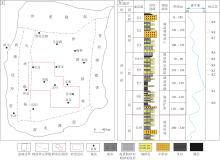
图1
鄂尔多斯盆地定边—富县地区构造位置(a)和延长组综合柱状图(b)(据文献[16]修改)"

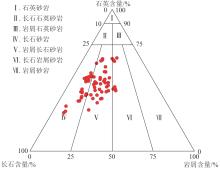
图2
鄂尔多斯盆地甘泉地区长8油层组岩性组成三角图"

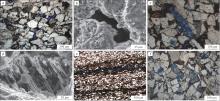
图3
鄂尔多斯盆地甘泉地区储层孔隙类型典型显微照片a.残余粒间孔,B2井,长8油层组,埋深1 162.08 m,铸体薄片;b.残余粒间孔,X81井,长8油层组,埋深1 125.05 m,扫描电镜;c.长石溶蚀,W192井,长8油层组,埋深1 152.83 m,铸体薄片;d.长石溶孔,QT2井,长8油层组,埋深1 444.07 m,扫描电镜;e.裂缝,W200井,长9油层组,埋深1 216.90 m,铸体薄片;f.岩屑溶孔,W193井,长8油层组,埋深998.86 m,铸体薄片"

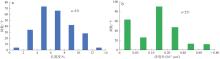
图4
鄂尔多斯盆地甘泉地区长81油层亚组储层孔隙度(a)和渗透率(b)频数分布直方图(n为样品个数。)"
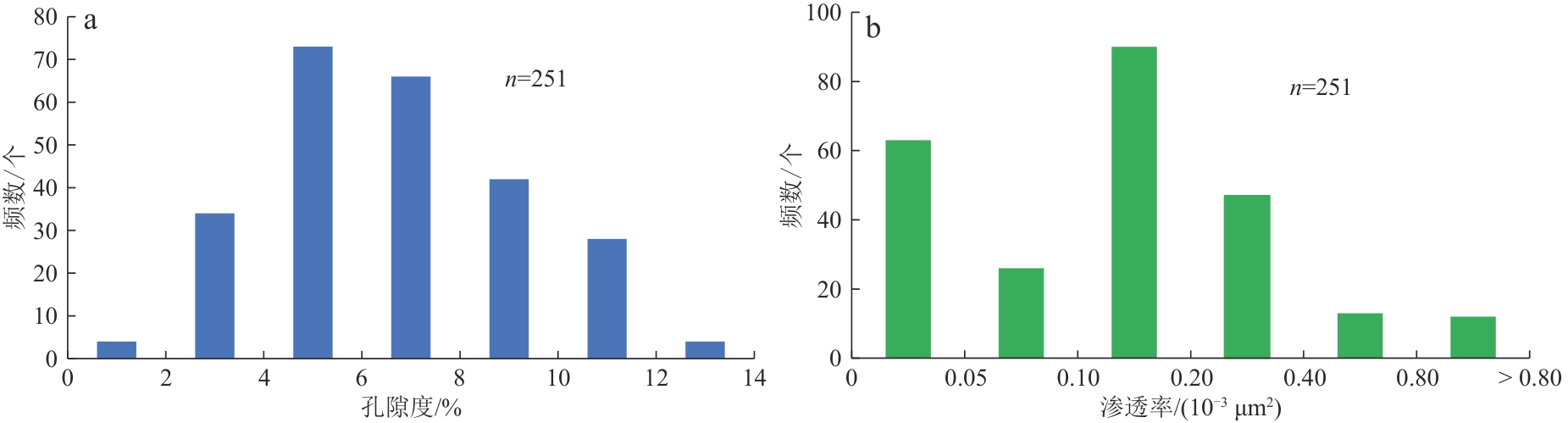
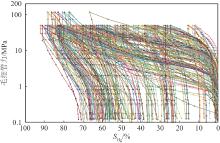
图5
鄂尔多斯盆地甘泉地区长8油层组压汞曲线(SHg为进汞饱和度。图为172条实测压汞曲线的叠合。)"

表1
鄂尔多斯盆地甘泉地区长8油层组储层孔隙结构分类数据"
压汞曲线 类型 | 特征值 | 歪度 | 分选 系数 | 变异 系数 | 中值 压力/MPa | 中值 半径/μm | 排驱 压力/MPa | 最大SHg/% | 退汞 效率/% |
|---|---|---|---|---|---|---|---|---|---|
| Ⅰ类 | 最大值 | 0.5 | 2.6 | 0.3 | 23.8 | 1.5 | 7.6 | 92.2 | 55.2 |
| 最小值 | -3.5 | 0.7 | 0.1 | 0.2 | 0 | 0.1 | 61.0 | 9.6 | |
| 平均值 | -0.4 | 1.3 | 0.1 | 10.7 | 0.1 | 2.8 | 80.3 | 27.0 | |
| Ⅱ类 | 最大值 | -0.3 | 1.8 | 0.1 | 49.0 | 0.1 | 10.2 | 74.2 | 52.1 |
| 最小值 | -4.1 | 0.6 | 0 | 13.9 | 0 | 0.8 | 50.3 | 12.4 | |
| 平均值 | -1.5 | 1.1 | 0.1 | 30.6 | 0 | 4.3 | 61.5 | 26.4 | |
| Ⅲ类 | 最大值 | -0.6 | 1.7 | 0.1 | 0 | 0 | 12.7 | 49.5 | 39.3 |
| 最小值 | -5.7 | 0.5 | 0 | 0 | 0 | 0.9 | 27.3 | 3.7 | |
| 平均值 | -2.6 | 0.9 | 0.1 | 0 | 0 | 6.6 | 38.1 | 26.9 | |
| Ⅳ类 | 最大值 | 0.7 | 1.5 | 0.1 | 0 | 0 | 26.2 | 44.5 | 68.7 |
| 最小值 | -4.3 | 0.2 | 0 | 0 | 0 | 1.2 | 11.5 | 36.9 | |
| 平均值 | -2.7 | 0.7 | 0.1 | 0 | 0 | 11.6 | 21.5 | 45.1 |
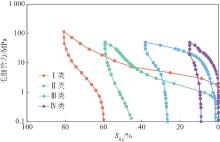
图6
鄂尔多斯盆地甘泉地区长8油层组储层压汞曲线类型(SHg为进汞饱和度。)"

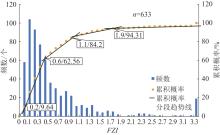
图7
鄂尔多斯盆地定边—富县地区FZI累积概率和频数分布直方图(n为样品个数。FZI为流动单元的地层流动带指数。)"
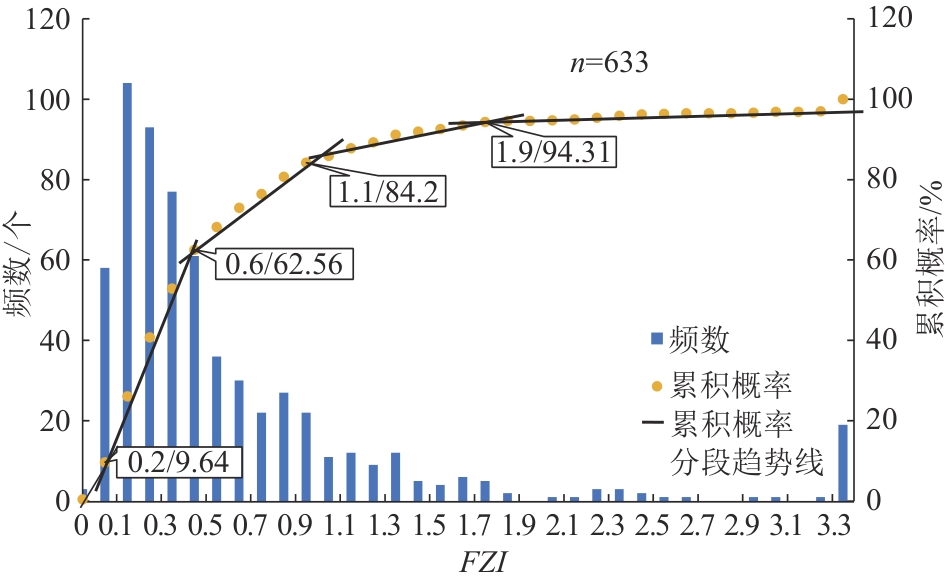
表2
鄂尔多斯盆地定边—富县地区流动单元分类"
| 流动单元类型 | FZI | FZI样本个数 | 孔隙度/% | 渗透率/(10-3 μm2) |
|---|---|---|---|---|
| Ⅰ类 | < 0.2 | 61 | (3.60 ~ 15.00)/10.58 | (0.001 ~ 0.082)/0.044 |
| Ⅱ类 | 0.2 ~ 0.6 | 335 | (2.70 ~ 16.10)/8.53 | (0.006 ~ 1.540)/0.147 |
| Ⅲ类 | 0.6 ~ 1.1 | 137 | (2.20 ~ 13.80)/7.07 | (0.008 ~ 2.761)/0.463 |
| Ⅳ类 | 1.1 ~ 1.9 | 64 | (1.70 ~ 12.50)/5.35 | (0.010 ~ 6.578)/0.573 |
| Ⅴ类 | ≥ 1.9 | 36 | (0.60 ~ 11.40)/3.89 | (0.009 ~ 50.569)/3.394 |
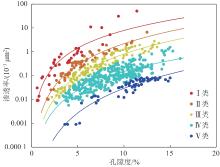
图8
鄂尔多斯盆地定边—富县地区流动单元分类后的孔-渗交会图"
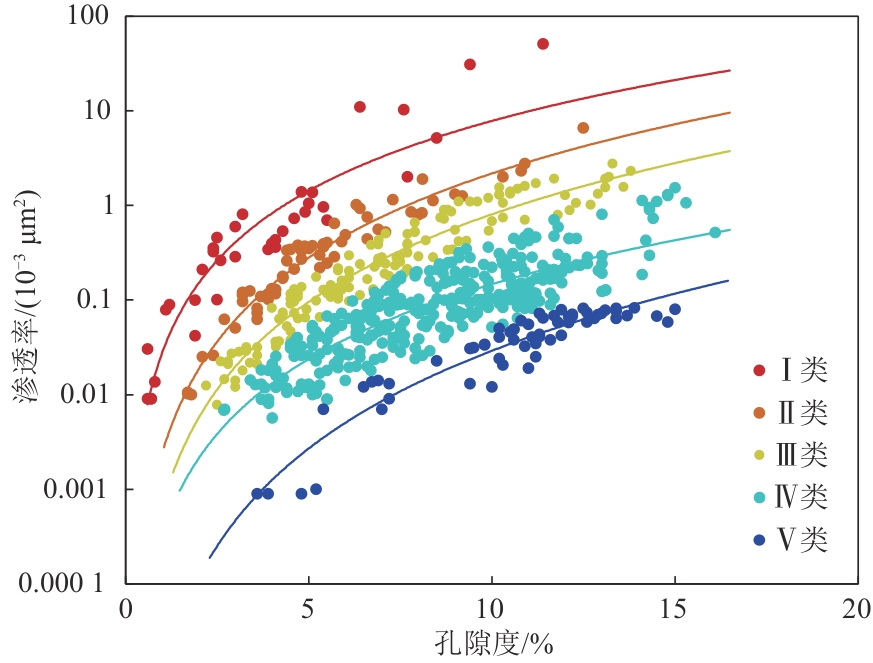
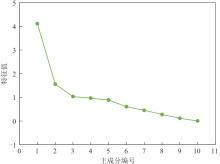
图9
鄂尔多斯盆地定边—富县地区主成分分析碎石图"
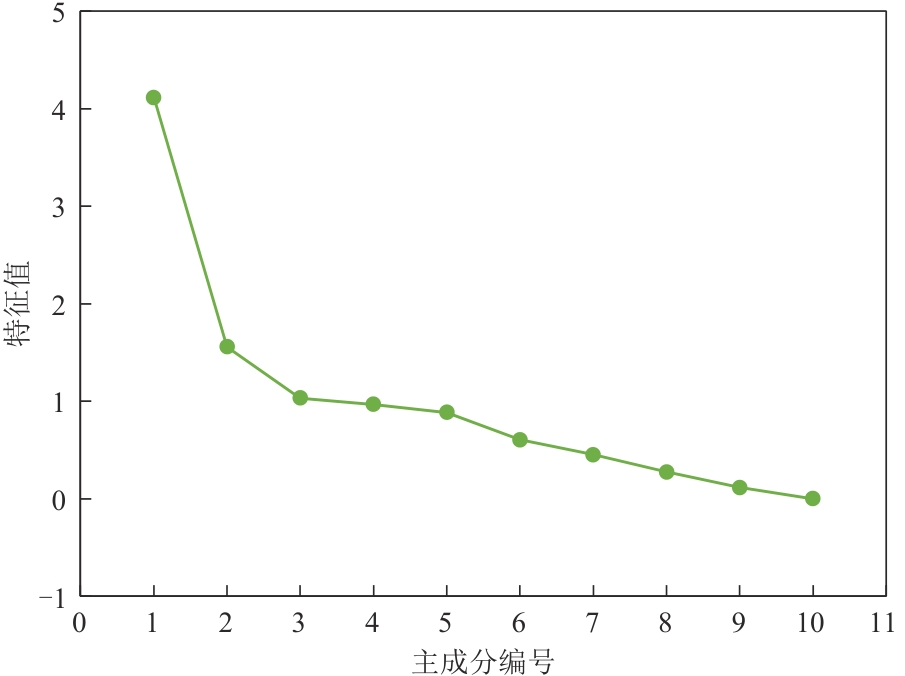
表3
鄂尔多斯盆地定边—富县地区主成分分析的成分矩阵"
| 参数类型 | 主成分编号 | ||||
|---|---|---|---|---|---|
| 1 | 2 | 3 | 4 | 5 | |
| 分选系数 | 0.811 | 0.521 | — | — | — |
| 最大SHg | 0.806 | 0.521 | — | — | — |
| 排驱压力 | -0.751 | — | — | — | — |
| 中值半径 | 0.740 | — | — | — | — |
| 歪度 | 0.672 | — | — | — | — |
| 孔隙度 | 0.584 | -0.523 | — | — | — |
| 变异系数 | 0.557 | — | — | — | — |
| 中值压力 | — | — | 0.727 | — | — |
| 退汞效率 | — | — | — | 0.961 | — |
| 渗透率 | — | — | -0.548 | — | 0.75 |
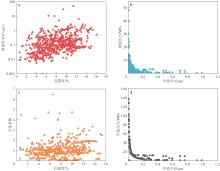
图10
鄂尔多斯盆地定边—富县地区去除异常值的分析参数交会图a. 孔隙度与渗透率交会图;b. 中值半径与排驱压力交会图;c. 孔隙度与分选系数交会图; d. 中值半径与中值压力交会图"

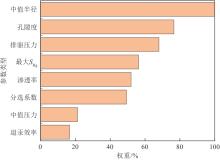
图11
鄂尔多斯盆地定边—富县地区全区二阶聚类权重赋值条形图(SHg为进汞饱和度。)"

表4
鄂尔多斯盆地定边—富县地区影响因素权重判断矩阵"
| 参数类型 | 孔隙度/% | 渗透率/(10-3 μm2) | 分选系数 | 中值压力/MPa | 中值半径/μm | 排驱压力/MPa | 最大SHg/% | 退汞效率/% |
|---|---|---|---|---|---|---|---|---|
| 孔隙度 | 1.00 | 1.54 | 2.0 | 2.0 | 2.0 | 2.0 | 2.0 | 2.0 |
| 渗透率 | 0.65 | 1.00 | 1.3 | 1.3 | 1.3 | 1.3 | 1.3 | 1.3 |
| 分选系数 | 0.50 | 0.77 | 1.0 | 1.0 | 1.0 | 1.0 | 1.0 | 1.0 |
| 中值压力 | 0.50 | 0.77 | 1.0 | 1.0 | 1.0 | 1.0 | 1.0 | 1.0 |
| 中值半径 | 0.50 | 0.77 | 1.0 | 1.0 | 1.0 | 1.0 | 1.0 | 1.0 |
| 排驱压力 | 0.50 | 0.77 | 1.0 | 1.0 | 1.0 | 1.0 | 1.0 | 1.0 |
| 最大SHg | 0.50 | 0.77 | 1.0 | 1.0 | 1.0 | 1.0 | 1.0 | 1.0 |
| 退汞效率 | 0.50 | 0.77 | 1.0 | 1.0 | 1.0 | 1.0 | 1.0 | 1.0 |
表5
鄂尔多斯盆地定边—富县地区长7—长9油层组储层分类数据"
| 储层类型 | 特征值 | 孔隙度/% | 渗透率/(10-3 μm2) | 分选系数 | 中值压力/MPa | 中值半径/μm | 排驱压力/MPa | 最大SHg/% | 退汞效率/% |
|---|---|---|---|---|---|---|---|---|---|
| Ⅰ类 | 最大值 | 16.10 | 6.58 | 2.97 | 10.88 | 0.76 | 2.67 | 90.46 | 56.63 |
| 最小值 | 10.90 | 0.30 | 0.08 | 1.02 | 0.07 | 0.11 | 72.26 | 18.86 | |
| 平均值 | 13.60 | 1.56 | 1.22 | 4.31 | 0.34 | 0.58 | 81.81 | 38.26 | |
| Ⅱ类 | 最大值 | 15.00 | 10.97 | 3.17 | 39.84 | 0.92 | 7.65 | 97.70 | 52.84 |
| 最小值 | 6.40 | 0.06 | 0.05 | 0 | 0 | 0.11 | 42.59 | 0.10 | |
| 平均值 | 11.20 | 0.61 | 1.31 | 10.39 | 0.15 | 2.16 | 78.92 | 31.05 | |
| Ⅲ类 | 最大值 | 11.90 | 1.39 | 6.48 | 136.61 | 0.98 | 24.11 | 99.05 | 55.22 |
| 最小值 | 3.00 | 0.01 | 0.05 | 0 | 0 | 0.12 | 14.96 | 3.66 | |
| 平均值 | 8.00 | 0.16 | 1.09 | 19.15 | 0.06 | 4.37 | 70.92 | 26.20 | |
| Ⅳ类 | 最大值 | 7.20 | 0.45 | 4.73 | 127.64 | 0.16 | 39.84 | 95.87 | 68.71 |
| 最小值 | 2.10 | 0 | 0.08 | 0 | 0 | 0.51 | 11.52 | 3.66 | |
| 平均值 | 4.64 | 0.06 | 1.03 | 20.32 | 0.02 | 7.04 | 51.77 | 27.59 |
表6
鄂尔多斯盆地定边—富县地区Fisher判别法判别函数系数"
| 参数类型 | 分类编号 | |||
|---|---|---|---|---|
| 1 | 2 | 3 | 4 | |
| 孔隙度 | 6.328 | 4.652 | 2.881 | 1.375 |
| 渗透率 | 6.332 | 4.099 | 2.483 | 1.470 |
| 中值半径 | 21.904 | 7.830 | 0.769 | -3.269 |
| 排驱压力/MPa | 0.426 | 0.510 | 0.659 | 0.783 |
| 最大SHg | 0.162 | 0.227 | 0.269 | 0.243 |
| 退汞效率 | 0.445 | 0.375 | 0.322 | 0.356 |
| (常量) | -68.364 | -44.636 | -28.309 | -18.535 |
表7
鄂尔多斯盆地定边—富县地区线性判别法判别函数系数"
| 参数类型 | 分类编号 | |||
|---|---|---|---|---|
| 1 | 2 | 3 | 4 | |
| 孔隙度 | 6.319 | 4.634 | 2.874 | 1.370 |
| 渗透率 | 6.071 | 3.848 | 2.269 | 1.243 |
| 分选系数 | 5.238 | 5.040 | 4.294 | 4.554 |
| 中值压力 | -0.077 | -0.084 | -0.063 | -0.064 |
| 中值半径 | 25.844 | 11.375 | 3.997 | 0.229 |
| 排驱压力 | 0.841 | 0.925 | 0.999 | 1.139 |
| 最大SHg | 0.172 | 0.241 | 0.277 | 0.250 |
| 退汞效率 | 0.512 | 0.440 | 0.377 | 0.415 |
| (常量) | -73.636 | -49.589 | -31.853 | -22.505 |
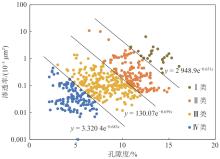
图12
鄂尔多斯盆地定边—富县地区低渗透-致密储层分类评价孔-渗交会图"

图13
鄂尔多斯盆地定边—富县地区全区各类储层物性频数分布直方图a. 孔隙度;b.渗透率(n为样品个数。)"

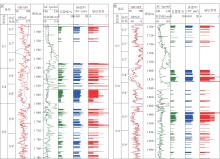
图14
鄂尔多斯盆地定边—富县地区储层分类评价单井剖面a. QT46井;b. LP172井(储层类型为4类,从4到1展示每一类的情况。)"

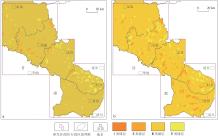
图15
鄂尔多斯盆地定边—富县地区长8油层组储层分类评价平面图a. 长81油层亚组;b. 长82油层亚组"

| [1] | 赵靖舟, 吴少波, 武富礼. 论低渗透储层的分类与评价标准——以鄂尔多斯盆地为例[J]. 岩性油气藏, 2007, 19(3): 28-31, 53. |
| ZHAO Jingzhou, WU Shaobo, WU Fuli. The classification and evaluation criterion of low permeability reservoir: An example from Ordos Basin[J]. Lithologic Reservoirs, 2007, 19(3): 28-31, 53. | |
| [2] | 王建民. 陕北顺宁油田长2~1低渗透砂岩储层综合分类评价[J]. 矿物岩石, 2006, 26(4): 89-94. |
| WANG Jianmin. Synthetically classification and evaluation of Chang 2~1 low permeability sandstone reservoirs in shunning oil field, north of Shaanxi Province[J]. Mineralogy and Petrology, 2006, 26(4): 89-94. | |
| [3] | 闫新智, 吴伟涛, 赵靖舟, 等. 鄂尔多斯盆地中部罗庞塬地区长7储层控油性及有利区评价[J]. 西安石油大学学报(自然科学版), 2024, 39(4): 10-19. |
| YAN Xinzhi, WU Weitao, ZHAO Jingzhou, et al. Study on control factors of oil distribution and favorable areas of Chang 7 in Luopangyuan area, central Ordos Basin[J]. Journal of Xi’an Shiyou University (Natural Science Edition), 2024, 39(4): 10-19. | |
| [4] | 李熙盛. 强非均质性储层构型表征与流动单元智能分类评价[J]. 海洋地质前沿, 2024, 40(9): 28-37. |
| LI Xisheng. Characterization of strongly heterogeneous reservoir architecture and intelligent classification evaluation of flow units[J]. Marine Geology Frontiers, 2024, 40(9): 28-37. | |
| [5] | 崔英敏, 杨江宇, 饶利平, 等. 基于神经网络模型的致密砂岩储层流动单元分类与评价——以鄂尔多斯盆地WQ北部长6油层组为例[J]. 西安石油大学学报(自然科学版), 2024, 39(2): 22-30. |
| CUI Yingmin, YANG Jiangyu, RAO Liping, et al. Classification and evaluation of flow units in tight sandstone reservoirs based on neural network model: A case study of Chang 6 oil reservoir in northern WQ area of Ordos Basin[J]. Journal of Xi’an Shiyou University (Natural Science Edition), 2024, 39(2): 22-30. | |
| [6] | 孔星星, 肖佃师, 蒋恕, 等. 联合高压压汞和核磁共振分类评价致密砂岩储层——以鄂尔多斯盆地临兴区块为例[J]. 天然气工业, 2020, 40(3): 38-47. |
| KONG Xingxing, XIAO Dianshi, JIANG Shu, et al. Application of the combination of high-pressure mercury injection and nuclear magnetic resonance to the classification and evaluation of tight sandstone reservoirs: A case study of the Linxing Block in the Ordos Basin[J]. Natural Gas Industry, 2020, 40(3): 38-47. | |
| [7] | 宋磊, 宁正福, 孙一丹, 等. 联合压汞法表征致密油储层孔隙结构[J]. 石油实验地质, 2017, 39(5): 700-705. |
| SONG Lei, NING Zhengfu, SUN Yidan, et al. Pore structure characterization of tight oil reservoirs by a combined mercury method[J]. Petroleum Geology and Experiment, 2017, 39(5): 700-705. | |
| [8] | 王宏博, 马存飞, 曹铮, 等. 基于岩相的致密砂岩差异成岩作用及其储层物性响应——以准噶尔盆地莫西庄地区下侏罗统三工河组为例[J]. 石油与天然气地质, 2023, 44(4): 976-992. |
| WANG Hongbo, MA Cunfei, CAO Zheng, et al. Differential diagenesis and reservoir physical property responses of tight sandstone based on lithofacies: A case study on the Lower Jurassic Sangonghe Formation in Moxizhuang area, Junggar Basin[J]. Oil & Gas Geology, 2023, 44(4): 976-992. | |
| [9] | 许璟, 葛云锦, 贺永红, 等. 鄂尔多斯盆地延长探区长7油层组泥页岩孔隙结构定量表征与动态演化过程[J]. 石油与天然气地质, 2023, 44(2): 292-307. |
| XU Jing, GE Yunjin, HE Yonghong, et al. Quantitative characterization and dynamic evolution of pore structure in shale reservoirs of Chang 7 oil layer group in Yanchang area, Ordos Basin[J]. Oil & Gas Geology, 2023, 44(2): 292-307. | |
| [10] | 唐海发, 彭仕宓, 赵彦超. 大牛地气田盒2+3段致密砂岩储层微观孔隙结构特征及其分类评价[J]. 矿物岩石, 2006, 26(3): 107-113. |
| TANG Haifa, PENG Shimi, ZHAO Yanchao. Characteristics of pore structure and reservoir evaluation in H2+3 tight gas reservoir, Daniudi Gas Field[J]. Mineralogy and Petrology, 2006, 26(3): 107-113. | |
| [11] | 李海燕, 岳大力, 张秀娟. 苏里格气田低渗透储层微观孔隙结构特征及其分类评价方法[J]. 地学前缘, 2012, 19(2): 133-140. |
| LI Haiyan, YUE Dali, ZHANG Xiujuan. Characteristics of pore structure and reservoir evaluation of low permeability reservoir in Sulige Gas Field[J]. Earth Science Frontiers, 2012, 19(2): 133-140. | |
| [12] | 黄龙, 田景春, 肖玲, 等. 鄂尔多斯盆地富县地区长6砂岩储层特征及评价[J]. 岩性油气藏, 2008, 20(1): 83-88. |
| HUANG Long, TIAN Jingchun, XIAO Ling, et al. Characteristics and evaluation of Chang 6 sandstone reservoir of Upper Triassic in Fuxian area, Ordos Basin[J]. Lithologic Reservoirs, 2008, 20(1): 83-88. | |
| [13] | 曾溅辉, 张亚雄, 张在振, 等. 致密砂岩气藏复杂气-水关系形成和分布主控因素及分布模式[J]. 石油与天然气地质, 2023, 44(5): 1067-1083. |
| ZENG Jianhui, ZHANG Yaxiong, ZHANG Zaizhen, et al. Complex gas-water contacts in tight sandstone gas reservoirs: Distribution pattern and dominant factors controlling their formation and distribution[J]. Oil & Gas Geology, 2023, 44(5): 1067-1083. | |
| [14] | 刘明熹, 宋考平, 郭平, 等. 基于聚类分析的砾岩储层分类方法及应用[J]. 特种油气藏, 2023, 30(6): 16-22. |
| LIU Mingxi, SONG Kaoping, GUO Ping, et al. Classification method and application of conglomerate reservoir based on clustering analysis[J]. Special Oil & Gas Reservoirs, 2023, 30(6): 16-22. | |
| [15] | LIU Junlong, ZHANG Xiangchun. Quantitative characterization of permeability heterogeneity of tight-sand reservoirs using nano-CT technology: A case study of the Yanchang Formation, Ordos Basin[J]. Energy Geoscience, 2025, 6(2): 100388. |
| [16] | 张家强, 李士祥, 李宏伟, 等. 鄂尔多斯盆地延长组7油层组湖盆远端重力流沉积与深水油气勘探——以城页水平井区长73小层为例[J]. 石油学报, 2021, 42(5): 570-587. |
| ZHANG Jiaqiang, LI Shixiang, LI Hongwei, et al. Gravity flow deposits in the distal lacustrine basin of the 7th reservoir group of Yanchang Formation and deepwater oil and gas exploration in Ordos Basin: A case study of Chang 73 sublayer of Chengye horizontal well region[J]. Acta Petrolei Sinica, 2021, 42(5): 570-587. | |
| [17] | LI Qihui, REN Dazhong, WANG Hu, et al. Microscopic characteristics of tight sandstone reservoirs and their effects on the imbibition efficiency of fracturing fluids: A case study of the Linxing area, Ordos Basin[J]. Energy Geoscience, 2024, 5(3): 100302. |
| [18] | AMAEFULE J O, ALTUNBAY M, TIAB D, et al. Enhanced reservoir description: Using core and log data to identify hydraulic (flow) units and predict permeability in uncored intervals/wells[C]//SPE Annual Technical Conference and Exhibition, Houston, 1993. Richardson: Society of Petroleum Engineers, 1993: SPE-26436-MS. |
| [19] | EBANKS W J Jr. Flow unit concept-integrated approach to reservoir description for engineering projects[J]. AAPG Bulletin, 1987, 71(5): 551-552. |
| [20] | 吴胜和, 王仲林. 陆相储层流动单元研究的新思路[J]. 沉积学报, 1999, 17(2): 252-257. |
| WU Shenghe, WANG Zhonglin. A new method of non-marine reservoir flow unit study[J]. Acta Sedimentologica Sinica, 1999, 17(2): 252-257. | |
| [21] | 万琼华, 吴胜和, 陈亮, 等. 基于深水浊积水道构型的流动单元分布规律[J]. 石油与天然气地质, 2015, 36(2): 306-313. |
| WAN Qionghua, WU Shenghe, CHEN Liang, et al. Analysis of flow unit distribution based on architecture of deep-water turbidite channel systems[J]. Oil & Gas Geology, 2015, 36(2): 306-313. | |
| [22] | 李阳. 储层流动单元模式及剩余油分布规律[J]. 石油学报, 2003, 24(3): 52-55. |
| LI Yang. Flow unit mode and remaining oil distribution in reservoir[J]. Acta Petrolei Sinica, 2003, 24(3): 52-55. | |
| [23] | 魏斌, 陈建文, 郑浚茂, 等. 应用储层流动单元研究高含水油田剩余油分布[J]. 地学前缘, 2000, 7(4): 403-410. |
| WEI Bin, CHEN Jianwen, ZHENG Junmao, et al. Utilization of reservoir flow unit to study remaining oil distribution in high water containing oilfield[J]. Earth Science Frontiers, 2000, 7(4): 403-410. | |
| [24] | CANAS J A, MALIK Z A, WU C H. Characterization of flow units in sandstone reservoirs: La Cira Field, Colombia, South America[C]//Permian Basin Oil and Gas Recovery Conference, Midland, 1994. Richardson: Society of Petroleum Engineers, 1994: SPE-27732-MS. |
| [25] | 尹太举, 张昌民, 陈程, 等. 建立储层流动单元模型的新方法[J]. 石油与天然气地质, 1999, 20(2): 170-175. |
| YIN Taiju, ZHANG Changmin, CHEN Cheng, et al. A new method for founding the model of flow unit reservoirs[J]. Oil & Gas Geology, 1999, 20(2): 170-175. | |
| [26] | 彭仕宓, 周恒涛, 李海燕, 等. 分阶段流动单元模型的建立及剩余油预测——以别古庄油田京11断块为例[J]. 石油勘探与开发, 2007, 34(2): 216-221, 251. |
| PENG Shimi, ZHOU Hengtao, LI Haiyan, et al. Phased flow unit model establishment and remaining oil prediction: An example from Jing 11 block in Bieguzhuang Oilfield[J]. Petroleum Exploration and Development, 2007, 34(2): 216-221, 251. | |
| [27] | 彭仕宓, 尹志军, 常学军, 等. 陆相储集层流动单元定量研究新方法[J]. 石油勘探与开发, 2001, 28(5): 68-70. |
| PENG Shimi, YIN Zhijun, CHANG Xuejun, et al. A new quantitative method to study flow unit of non-marine reservoir[J]. Petroleum Exploration and Development, 2001, 28(5): 68-70. | |
| [28] | 陈烨菲, 彭仕宓, 宋桂茹. 流动单元的井间预测及剩余油分布规律研究[J]. 石油学报, 2003, 24(3): 74-77. |
| CHEN Yefei, PENG Shimi, SONG Guiru. Inter-well prediction of flow units and remaining oil distribution[J]. Acta Petrolei Sinica, 2003, 24(3): 74-77. | |
| [29] | 靳彦欣, 林承焰, 赵丽, 等. 关于用FZI划分流动单元的探讨[J]. 石油勘探与开发, 2004, 31(5): 130-132. |
| JIN Yanxin, LIN Chengyan, ZHAO Li, et al. Discussions on FZI methodology in flow unit identification and discrimination[J]. Petroleum Exploration and Development, 2004, 31(5): 130-132. | |
| [30] | JAIN A K. Data clustering: 50 years beyond K-means[J]. Pattern Recognition Letters, 2010, 31(8): 651-666. |
| [31] | 吕明针, 林承焰, 张宪国, 等. 储层流动单元划分方法评价及优选[J]. 岩性油气藏, 2015, 27(1): 74-80, 88. |
| Mingzhen LYU, LIN Chengyan, ZHANG Xianguo, et al. Evaluation and optimization of flow unit division methods[J]. Lithologic Reservoirs, 2015, 27(1): 74-80, 88. |
| [1] | 赵靖舟, 高振东, 孟选刚, 吴伟涛, 白玉彬, 曹磊, 赵子龙. 鄂尔多斯盆地陕北地区三叠系延长组长7—长9油层组重力流沉积致密油富集条件与勘探潜力——兼论拗陷型湖盆的石油勘探范式[J]. 石油与天然气地质, 2025, 46(5): 1367-1391. |
| [2] | 吴伟涛, 李天宇, 闫新智, 周凯, 殷露, 曹磊. 鄂尔多斯盆地定边—富县地区延长组长8油层组致密油富集因素与富集模式[J]. 石油与天然气地质, 2025, 46(5): 1392-1409. |
| [3] | 曹磊, 闫新智, 李辉, 吴伟涛, 白玉彬, 赵子龙. 鄂尔多斯盆地陕北地区延长组长8与长9油层组烃源岩分布与地球化学特征及页岩油资源潜力评价[J]. 石油与天然气地质, 2025, 46(5): 1410-1429. |
| [4] | 耳闯, 关宏博, 刘伟, 程妮, 白洁, 胡崇. 陆源物质输入对有机质类型的影响——以鄂尔多斯盆地三叠系延长组长73油层亚组页岩为例[J]. 石油与天然气地质, 2025, 46(5): 1430-1445. |
| [5] | 张军, 白玉彬, 张海, 赵靖舟, 徐宁. 鄂尔多斯盆地富县地区三叠系延长组长7油层组深水重力流致密砂岩成因与分布[J]. 石油与天然气地质, 2025, 46(5): 1446-1465. |
| [6] | 陈伟涛, 赵靖舟, 高振东, 李哲, 孟选刚, 闫新智, 董旭. 鄂尔多斯盆地志丹地区延长组长7—长9油层组深水重力流沉积特征及含油性[J]. 石油与天然气地质, 2025, 46(5): 1466-1484. |
| [7] | 李晓龙, 白玉彬, 陈珊珊, 张刚, 王聪娥. 三角洲与重力流砂体构型特征及其对油藏分布的控制——以鄂尔多斯盆地甘泉地区三叠系延长组长7油层组为例[J]. 石油与天然气地质, 2025, 46(5): 1485-1503. |
| [8] | 王琳茜, 赵靖舟, 高振东, 魏繁荣, 周世琪, 孟选刚, 闫新智, 徐宁. 深水重力流沉积类型及含油性对比——以鄂尔多斯盆地富县地区三叠系延长组长7—长9油层组为例[J]. 石油与天然气地质, 2025, 46(5): 1504-1521. |
| [9] | 吴吉泽, 李华, 何幼斌, 姜纯伟, 何一鸣, 姚凤南, 张显坤. 鄂尔多斯盆地西缘奥陶系樱桃沟组等深流-重力流交互作用沉积特征及形成机理[J]. 石油与天然气地质, 2025, 46(5): 1522-1535. |
| [10] | 张一帆, 葸克来, 操应长, 张博, 王秀娟, 尤源, 马文忠, 王雨轩, 孙琦慧. 鄂尔多斯盆地三叠系延长组长73油层亚组页岩岩相及页岩油差异赋存与微观运聚特征[J]. 石油与天然气地质, 2025, 46(5): 1536-1553. |
| [11] | 张佳琦, 赵靖舟, 曹磊, 叶卿元. 鄂尔多斯盆地三叠系延长组长8-长9油层组泥页岩储层孔隙和微裂缝发育特征与页岩油勘探前景[J]. 石油与天然气地质, 2025, 46(5): 1554-1581. |
| [12] | 徐泽阳, 李军, 吴涛, 党佳城, 赵子龙. 准噶尔盆地腹部差异剥蚀区侏罗系低饱和致密油藏压力分布预测及成因分析[J]. 石油与天然气地质, 2025, 46(5): 1614-1629. |
| [13] | 刘明洁, 刘恒宇, 肖尧, 宋林珂, 曹脊翔, 李唐律, 王锦西, 梁晨. 断层-砂体配置演化模式对远源型致密砂岩气差异富集的影响——以川中地区侏罗系沙溪庙组为例[J]. 石油与天然气地质, 2025, 46(5): 1630-1645. |
| [14] | 赵俊威, 周健, 邹俭巍, 孙海航, 郑晓丽, 张明晨. 典型河口坝沉积演化过程与沉积水动力机制[J]. 石油与天然气地质, 2025, 46(5): 1646-1663. |
| [15] | 牛小兵, 樊建明, 张超, 任奕霖, 何右安, 常睿, 成良丙. 鄂尔多斯盆地庆城页岩油提高采收率实践及探索[J]. 石油与天然气地质, 2025, 46(5): 1664-1681. |
| 阅读次数 | ||||||
|
全文 |
|
|||||
|
摘要 |
|
|||||
