

石油与天然气地质 ›› 2025, Vol. 46 ›› Issue (5): 1430-1445.doi: 10.11743/ogg20250504
• 油气地质 • 上一篇
耳闯1,2( ), 关宏博1, 刘伟3, 程妮4, 白洁5, 胡崇6
收稿日期:2025-08-02
修回日期:2025-08-29
出版日期:2025-10-30
发布日期:2025-10-29
第一作者简介:耳闯(1982—),男,副教授,沉积储层与非常规油气地质学。E‑mail: erchuang@xsyu.edu.cn。
基金项目:
Chuang ER1,2(), Hongbo GUAN1, Wei LIU3, Ni CHENG4, Jie BAI5, Chong HU6
Received:2025-08-02
Revised:2025-08-29
Online:2025-10-30
Published:2025-10-29
摘要:
为了探究陆源物质输入对半深湖-深湖相页岩有机质类型的影响,以鄂尔多斯盆地三叠系延长组长73油层亚组页岩为例,选取延长组沉积期湖盆东北部、西北部和西南部的4口钻井岩心样品,综合开展岩石学、沉积学以及有机地球化学研究,分析了陆源物质输入对有机质类型的影响。研究结果表明:①4口钻井的样品为富有机质泥岩和页岩,成熟度(镜质体反射率Ro)介于0.91% ~ 1.03%,属于中-低成熟度页岩;干酪根类型为Ⅱ1型和Ⅱ2型,显微组分均以腐泥组为主,镜质组次之,不同井之间显微组分类型有较大的差异。②长73油层亚组页岩发育层状页岩、不连续-连续纹层状页岩、块状-不连续纹层状含粉砂页岩、块状-不连续纹层状粉砂质页岩、层状粉砂质页岩、纹层状粉砂质页岩和块状粉砂质页岩等7种岩相类型。其中,层状页岩受陆源物质输入的影响最小,而块状-不连续纹层状粉砂质页岩、层状粉砂质页岩、纹层状粉砂质页岩以及块状粉砂质页岩受陆源物质输入的影响最大。这4口井中,W336井受陆源碎屑输入影响较小,发育Ⅱ1型干酪根,显微组分中腐泥组含量为64% ~ 83%,占绝对优势;其余3口井受陆源碎屑的输入影响较大,以Ⅱ2型干酪根为主,镜质组含量介于15% ~ 42%。③在强陆源物质输入的影响下,半深湖-深湖环境中有机质母质类型仍以水生生物为主,有机质类型好,且伴随石英和长石等陆源输入的高等植物碎屑,在缺氧底层水中与藻类共存,形成了Ⅱ1-Ⅱ2混合型干酪根,有机质类型变差。
中图分类号:

图1
鄂尔多斯盆地长73油层亚组取样井平面分布(a)与测井曲线特征(b—e)a. 取样井平面分布(底图为长7油层组页岩厚度图[29]);b—e.分别为H269井、HA87-1井、ZU375井以及W336井单井地层综合柱状图"

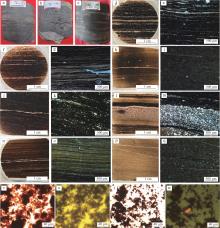
图2
鄂尔多斯盆地长73油层亚组页岩岩心、岩石薄片和显微组分照片a. W336井,埋深1 954.40 m,黑色页岩夹棕黄色凝灰岩,TOC = 19.90%,岩心照片;b. W336井,埋深2 062.35 m,黑色泥岩,发育滑塌变形构造,凝灰质砂岩与泥岩不规则接触,TOC = 6.66%, 岩心照片;c. ZU375井,埋深1 970.65 m,黑色页岩夹砂质薄层或砂岩透镜体,岩心照片;d, e. 分别为薄片全视域照片和普通岩石薄片照片(单偏光),ZU375井,埋深1 968.25 m,层状页岩岩相,发育连续长英质纹层、黏土质纹层和块状结构等3种以上显微沉积构造,TOC = 29.20%,Ⅱ2型干酪根,类型指数1.50;f, g. 分别为薄片全视域照片和普通岩石薄片照片(单偏光),W336井,埋深1 954.40 m,不连续-连续纹层状页岩,发育连续的长英质纹层和黏土质纹层,砂质含量高,TOC = 19.90%,Ⅱ1型干酪根,类型指数57.00;h, i. 分别为薄片全视域照片和普通岩石薄片照片(单偏光),H269井,埋深2 531.30 m,块状-不连续纹层状含粉砂页岩岩相,以块状结构和不连续的长英质纹层和黏土质纹层为主,粉砂质含量低,TOC = 13.10%,Ⅱ2型干酪根,类型指数39.75;j, k. 分别为薄片全视域照片和普通岩石薄片照片(单偏光),HA87-1井,埋深2 010.80 m,块状-不连续纹层状粉砂质页岩,TOC = 8.13%,Ⅱ2型干酪根,类型指数33.50;l, m. 分别为薄片全视域照片和普通岩石薄片照片(单偏光),ZU375井,埋深1 962.55 m,层状粉砂质页岩,发育长英质纹层、黏土质纹层和块状结构等3种以上显微沉积构造,砂质含量高,TOC = 5.35%,Ⅱ2型干酪根,类型指数36.75;n, o. 分别为薄片全视域照片和普通岩石薄片照片(单偏光),W336井,埋深1 956.90 m,纹层状粉砂质页岩,发育连续的长英质纹层和黏土质纹层,砂质含量高,TOC = 9.20%,Ⅱ1型干酪根,类型指数71.75;p, q. 分别为薄片全视域照片和普通岩石薄片照片(单偏光), W336井,埋深2 060.00 m,块状粉砂质页岩,无明显显微沉积构造,粉砂质含量高,TOC = 7.32%,Ⅱ1型干酪根,类型指数56.50;r. W336井,埋深1 954.40 m,腐泥无定型,透射光下黄棕色,TOC = 19.90%,Ⅱ1型干酪根,类型指数66.50,干酪根显微组分照片,透射光;s. W336井,埋深1 954.40 m,腐泥无定型,蓝光激发下呈褐色荧光,TOC = 19.90%,Ⅱ1型干酪根,类型指数66.50,干酪根显微显组分薄片照片,荧光;t. ZU375井,埋深1 968.85 m,透射光下正常镜质体以棕色为主,腐殖无定型,呈褐黄-浅棕色,TOC = 26.70%,Ⅲ型干酪根,类型指数-0.50,干酪根显微组分照片,透射光;s. ZU375井,埋深1 968.85 m,蓝光激发下正常镜质体无荧光,腐殖无定型,呈黄褐色,TOC = 26.70%,Ⅲ型干酪根,类型指数-0.50,干酪根显微显组分薄片照片,荧光"


图3
鄂尔多斯盆地4口井长73油层亚组页岩样品TOC分布箱形图"
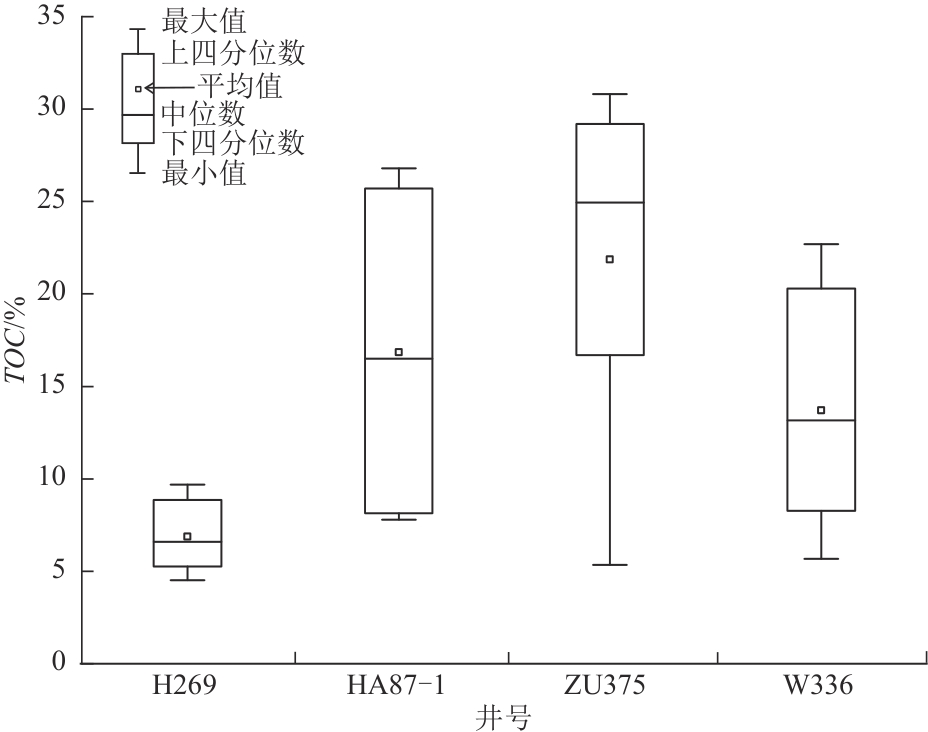
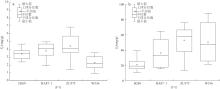
图4
鄂尔多斯盆地4口井长73油层亚组页岩样品热解分析中S1(a)和S2(b)分布箱形图(S1为游离液态烃含量;S2为裂解烃含量。)"


图5
鄂尔多斯盆地4口井长73油层亚组页岩样品热解分析中干酪根类型判别图版(HI表示氢指数;Tmax表示最高热解峰温。)"

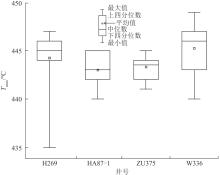
图6
鄂尔多斯盆地4口井长73油层亚组页岩样品热解分析中Tmax分布箱形图(Tmax表示最高热解峰温。)"

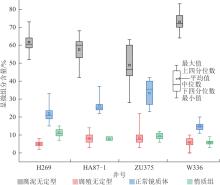
图7
鄂尔多斯盆地4口井长73油层亚组页岩样品干酪根显微组分分布箱形图"


图8
鄂尔多斯盆地4口井长73油层亚组页岩样品干酪根类型分布柱状图"
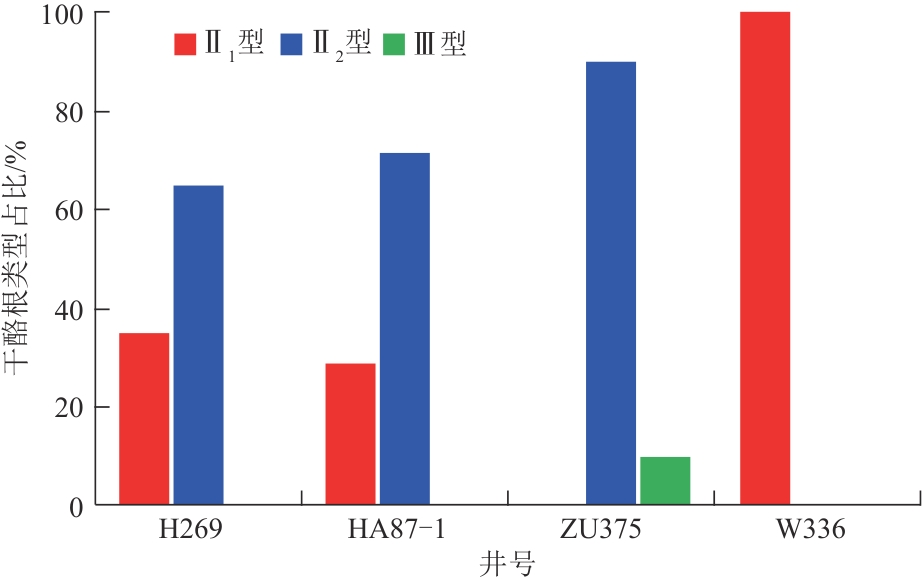
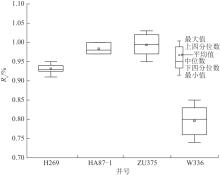
图9
鄂尔多斯盆地4口井长73油层亚组页岩样品分布箱形图(Ro表示镜质体反射率。)"


图10
鄂尔多斯盆地W336井长73油层亚组页岩样品饱和烃气相色谱(埋深1 965.20 m)"


图11
鄂尔多斯盆地W336井长73油层亚组页岩样品饱和烃气相色谱-质谱(埋深1 965.20 m)(m/z为质/荷比。)"
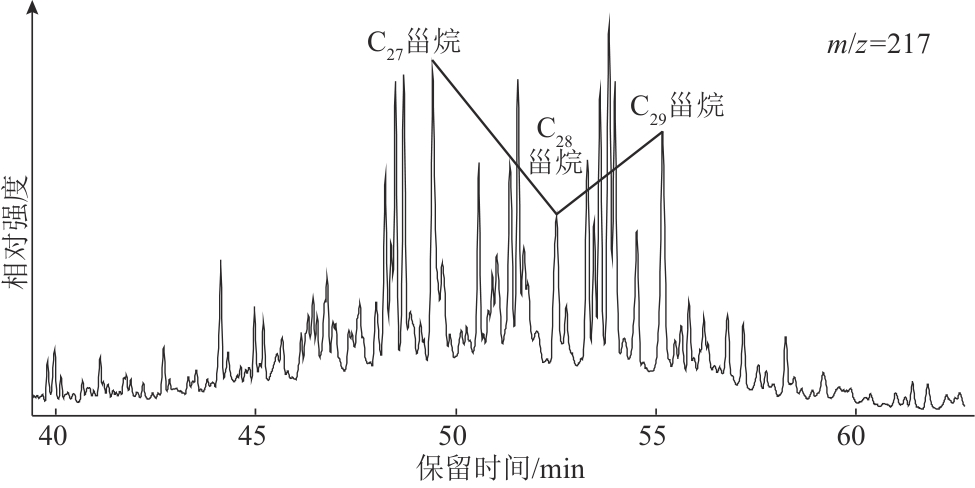

图12
鄂尔多斯盆地4口井长73油层亚组不同埋深样品饱和烃气相色谱正构烷烃主峰碳数分布柱状图"
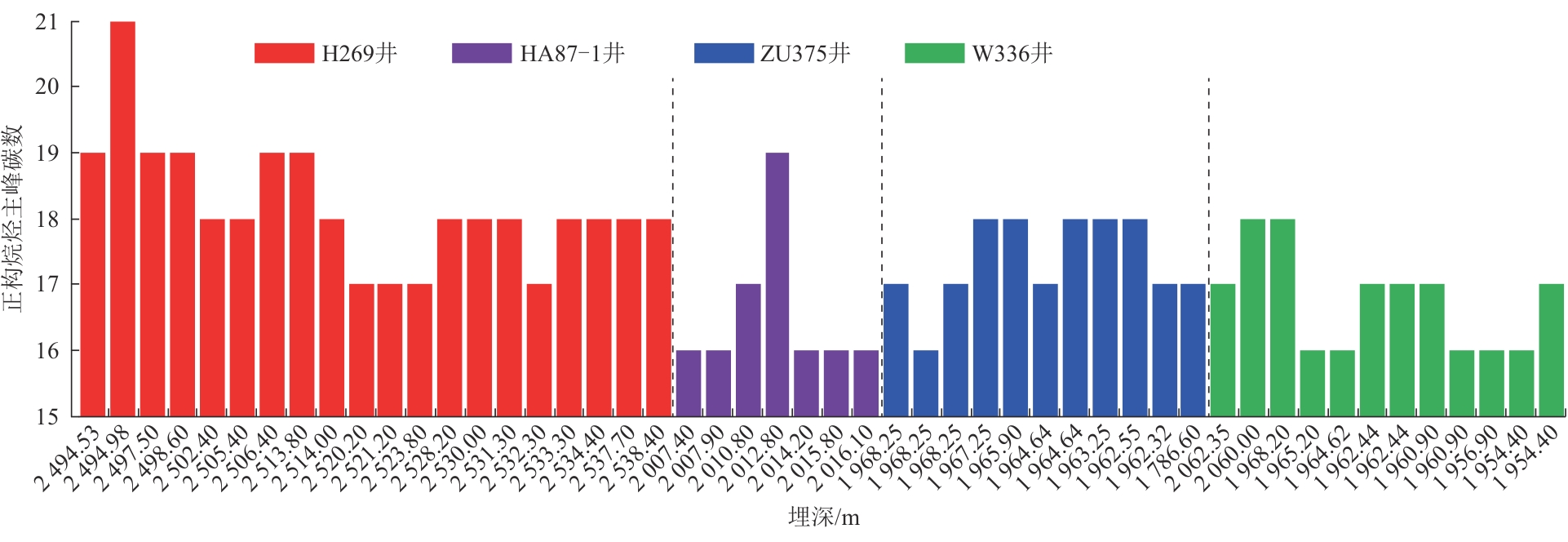
表1
鄂尔多斯盆地4口井长73油层亚组页岩岩相类型划分与沉积环境意义"
岩相 类型 | 层状页岩 | 不连续-连续纹层状页岩 | 块状-不连续纹层含粉砂页岩 | 块状-不连续纹层粉砂质页岩 | 层状粉砂质页岩 | 纹层状粉砂质页岩 | 块状粉砂质页岩 |
|---|---|---|---|---|---|---|---|
| 显微结构特征 | 发育连续长英质纹层、黏土质纹层和块状结构等3种以上显微沉积构造,纹层厚度 > 1.0 mm | 以连续和不连续的长英质纹层与黏土质纹层为主,纹层厚度 < 1.0 mm | 以块状结构和不连续的长英质纹层和黏土质纹层为主,长英质含量低 | 以块状、不连续的长英质纹层和黏土质纹层为主,纹层厚度 < 1.0 mm,长英质含量偏高 | 发育长英质纹层、黏土质纹层和块状结构等3种以上显微沉积构造,层厚 > 1.5 mm,长英质含量高 | 发育连续的长英质纹层和黏土质纹层,纹层厚度 < 1.0 mm,纹层数量多,长英质含量偏高 | 无明显显微沉积构造,长英质含量高 |
| 沉积环境意义 | 水体安静,受重力流沉积影响,沉积分异明显 | 水体较安静,存在波动,受重力流沉积影响大 | 水体动荡性增加,受重力流沉积影响大,沉积分异作用弱 | 水体动荡性增加,受重力流沉积影响大,陆源输入增加,沉积分异作用弱 | 水体动荡,受重力流沉积影响大,陆源输入增加 | 水体安静,受重力流沉积影响大,陆源输入增加,沉积分异明显 | 水体动荡,陆源输入影响大,沉积分异不明显 |
| 陆源物质影响 | 弱 | 偏弱 | 偏强 | 强 | 强 | 强 | 强 |
| 腐泥组含量/% | |||||||
| 镜质组含量/% | |||||||
| 干酪根类型指数 | |||||||
| H269井 | - | - | + | ++ | ++ | + | + |
| HA87-1井 | + | - | + | + | - | + | - |
| ZU375井 | + | ++ | - | - | ++ | - | - |
| W336井 | ++ | + | + | + | + | + | + |

图13
鄂尔多斯盆地4口井长73油层亚组页岩样品Ph/nC18与Pr/nC17含量比值交会图(Ph/nC18 表示植烷与正十八烷的比值;Pr/nC17 表示姥鲛烷与正十七烷的比值。)"
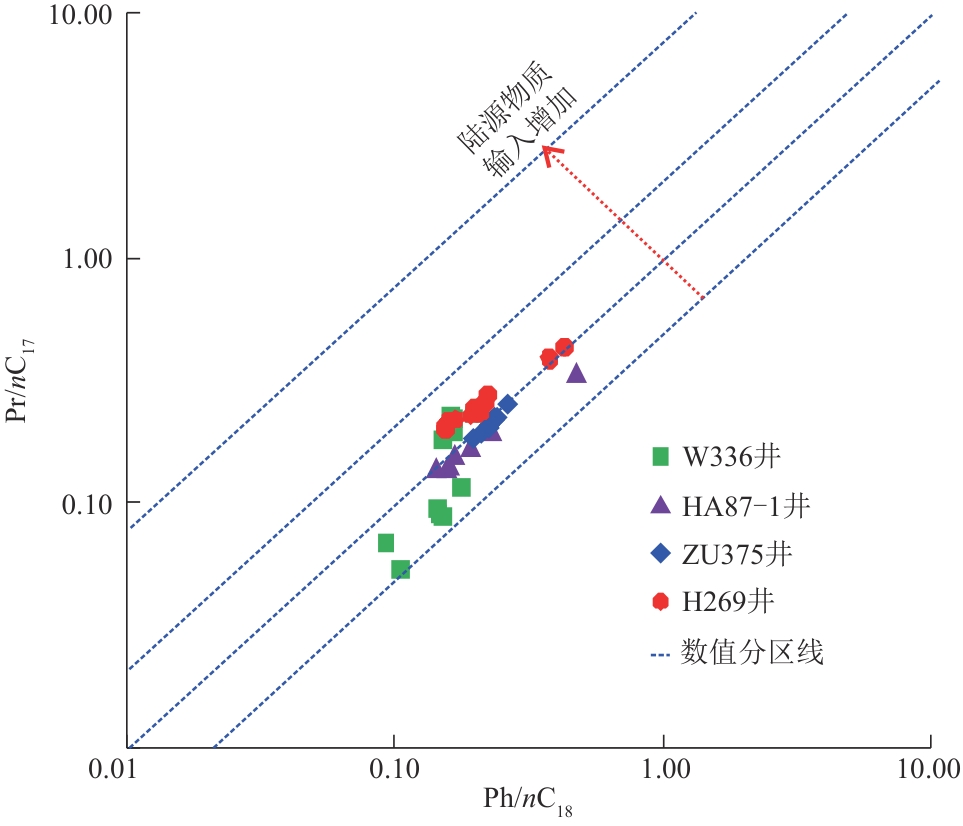

图14
鄂尔多斯盆地长73油层亚组无重力流事件(a)和有重力流事件(b)影响下的页岩干酪根类型发育模式"


图15
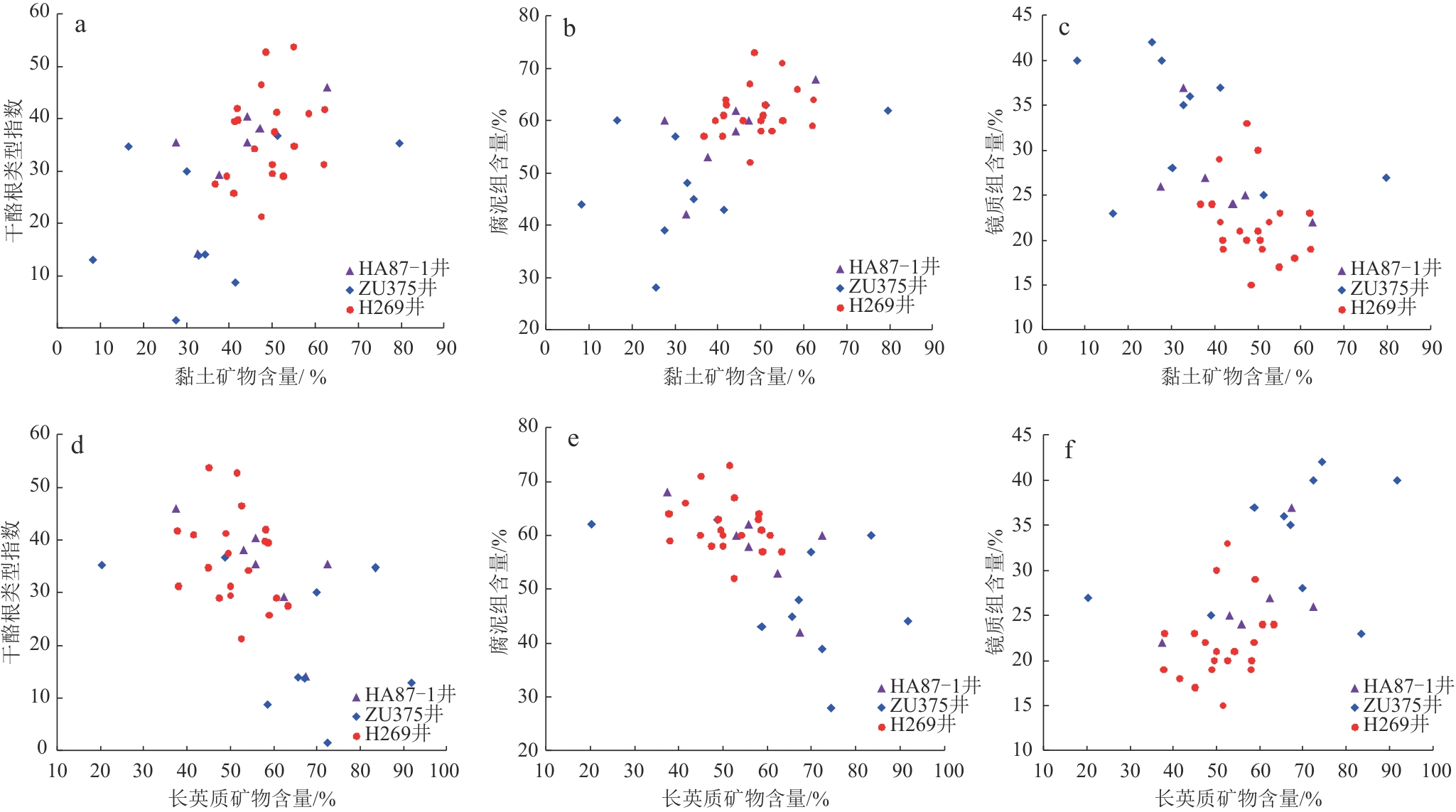
鄂尔多斯盆地长73油层亚组页岩矿物组分含量与干酪根类型和显微组分含量关系a. 黏土矿物含量与干酪根类型指数关系; b. 黏土矿物含量与腐泥组含量关系; c. 黏土矿物含量与镜质组含量关系; d. 长英质矿物含量与干酪根类型指数关系;e. 长英质矿物含量与与腐泥组含量关系, f. 长英质矿物含量与与与镜质组含量关系"
| [1] | 雷启鸿, 何右安, 郭芪恒, 等. 鄂尔多斯盆地页岩油水平井开发关键科技问题[J]. 天然气地球科学, 2023, 34(6): 939-949. |
| LEI Qihong, HE Youan, GUO Qiheng, et al. Key scientific and technological issues in the development of horizontal shale oil wells in the Ordos Basin[J]. Natural Gas Geoscience, 2023, 34(6): 939-949. | |
| [2] | 何永宏, 薛婷, 李桢, 等. 鄂尔多斯盆地长7页岩油开发技术实践——以庆城油田为例[J]. 石油勘探与开发, 2023, 50(6): 1245-1258. |
| HE Yonghong, XUE Ting, LI Zhen, et al. Development technologies for Triassic Chang 7 shale oil in Ordos Basin: A case study of Qingcheng Oilfield, NW China[J]. Petroleum Exploration and Development, 2023, 50(6): 1245-1258. | |
| [3] | 包书景, 葛明娜, 徐兴友, 等. 我国陆相页岩油勘探开发进展与发展建议[J]. 中国地质, 2023, 50(5): 1343-1354. |
| BAO Shujing, GE Mingna, XU Xingyou, et al. Progress and development proposals in the exploration and development of continental shale oil in China[J]. Geology in China, 2023, 50(5): 1343-1354. | |
| [4] | 王建, 郭秋麟, 赵晨蕾, 等. 中国主要盆地页岩油气资源潜力及发展前景[J]. 石油学报, 2023, 44(12): 2033-2044. |
| WANG Jian, GUO Qiulin, ZHAO Chenlei, et al. Potentials and prospects of shale oil-gas resources in major basins of China[J]. Acta Petrolei Sinica, 2023, 44(12): 2033-2044. | |
| [5] | 赵贤正, 蒲秀刚, 金凤鸣, 等. 黄骅坳陷页岩型页岩油富集规律及勘探有利区[J]. 石油学报, 2023, 44(1): 158-175. |
| ZHAO Xianzheng, PU Xiugang, JIN Fengming, et al. Enrichment law and favorable exploration area of shale-type shale oil in Huanghua depression[J]. Acta Petrolei Sinica, 2023, 44(1): 158-175. | |
| [6] | 谢建勇, 崔新疆, 李文波, 等. 准噶尔盆地吉木萨尔凹陷页岩油效益开发探索与实践[J]. 中国石油勘探, 2022, 27(1): 99-110. |
| XIE Jianyong, CUI Xinjiang, LI Wenbo, et al. Exploration and practice of benefit development of shale oil in Jimsar Sag, Junggar Basin[J]. China Petroleum Exploration, 2022, 27(1): 99-110. | |
| [7] | 金之钧, 梁新平, 王小军, 等. 玛湖凹陷风城组页岩油富集机制与甜点段优选[J]. 新疆石油地质, 2022, 43(6): 631-639. |
| JIN Zhijun, LIANG Xinping, WANG Xiaojun, et al. Shale oil enrichment mechanism and sweet spot selection of Fengcheng Formation in Mahu Sag, Junggar Basin[J]. Xinjiang Petroleum Geology, 2022, 43(6): 631-639. | |
| [8] | 赵文智, 胡素云, 侯连华, 等. 中国陆相页岩油类型、资源潜力及与致密油的边界[J]. 石油勘探与开发, 2020, 47(1): 1-10. |
| ZHAO Wenzhi, HU Suyun, HOU Lianhua, et al. Types and resource potential of continental shale oil in China and its boundary with tight oil[J]. Petroleum Exploration and Development, 2020, 47(1): 1-10. | |
| [9] | 金之钧, 王冠平, 刘光祥, 等. 中国陆相页岩油研究进展与关键科学问题[J]. 石油学报, 2021, 42(7): 821-835. |
| JIN Zhijun, WANG Guanping, LIU Guangxiang, et al. Research progress and key scientific issues of continental shale oil in China[J]. Acta Petrolei Sinica, 2021, 42(7): 821-835. | |
| [10] | 赵文智, 朱如凯, 张婧雅, 等. 中国陆相页岩油类型、勘探开发现状与发展趋势[J]. 中国石油勘探, 2023, 28(4): 1-13. |
| ZHAO Wenzhi, ZHU Rukai, ZHANG Jingya, et al. Classification, exploration and development status and development trend of continental shale oil in China[J]. China Petroleum Exploration, 2023, 28(4): 1-13. | |
| [11] | 葸克来, 李克, 操应长, 等. 鄂尔多斯盆地三叠系延长组长73亚段富有机质页岩纹层组合与页岩油富集模式[J]. 石油勘探与开发, 2020, 47(6): 1244-1255. |
| XI Kelai, LI Ke, CAO Yingchang, et al. Laminae combination and shale oil enrichment patterns of Chang 73 sub-member organic-rich shales in the Triassic Yanchang Formation, Ordos Basin, NW China[J]. Petroleum Exploration and Development, 2020, 47(6): 1244-1255. | |
| [12] | 黎茂稳, 马晓潇, 金之钧, 等. 中国海、陆相页岩层系岩相组合多样性与非常规油气勘探意义[J]. 石油与天然气地质, 2022, 43(1): 1-25. |
| LI Maowen, MA Xiaoxiao, JIN Zhijun, et al. Diversity in the lithofacies assemblages of marine and lacustrine shale strata and significance for unconventional petroleum exploration in China[J]. Oil & Gas Geology, 2022, 43(1): 1-25. | |
| [13] | 姜在兴, 张建国, 孔祥鑫, 等. 中国陆相页岩油气沉积储层研究进展及发展方向[J]. 石油学报, 2023, 44(1): 45-71. |
| JIANG Zaixing, ZHANG Jianguo, KONG Xiangxin, et al. Research progress and development direction of continental shale oil and gas deposition and reservoirs in China[J]. Acta Petrolei Sinica, 2023, 44(1): 45-71. | |
| [14] | 王小军, 宋永, 郭旭光, 等. 陆相咸化湖盆细粒沉积岩分类及其石油地质意义[J]. 沉积学报, 2023, 41(1): 303-317. |
| WANG Xiaojun, SONG Yong, GUO Xuguang, et al. Classification of fine-grained sedimentary rocks in saline lacustrine basins and its petroleum geological significance[J]. Acta Sedimentologica Sinica, 2023, 41(1): 303-317. | |
| [15] | 朱筱敏, 王晓琳, 张美洲, 等. 中国典型陆相盆地细粒沉积环境和岩相特征[J]. 石油与天然气地质, 2024, 45(4): 873-892. |
| ZHU Xiaomin, WANG Xiaolin, ZHANG Meizhou, et al. Sedimentary environments and lithofacies characteristics of fine-grained sediments in typical continental basins in China[J]. Oil & Gas Geology, 2024, 45(4): 873-892. | |
| [16] | SONDERGELD C H, NEWSHAM K E, COMISKY J T, et al. Petrophysical considerations in evaluating and producing shale gas resources[C]//SPE Unconventional Gas Conference, Pittsburgh, 2010. Richardson: Society of Petroleum Engineers, 2010: SPE-131768-MS. |
| [17] | ALDRICH J, SEIDLE J. “Sweet spot” identification and optimization in unconventional reservoirs[C]//AAPG Annual Convention and Exhibition. Salt Lake City: AAPG, 2018. . |
| [18] | 赵贤正, 蒲秀刚, 周立宏, 等. 深盆湖相区页岩油富集理论、勘探技术及前景——以渤海湾盆地黄骅坳陷古近系为例[J]. 石油学报, 2021, 42(2): 143-162. |
| ZHAO Xianzheng, PU Xiugang, ZHOU Lihong, et al. Enrichment theory, exploration technology and prospects of shale oil in lacustrine facies zone of deep basin: A case study of the Paleogene in Huanghua Depression, Bohai Bay Basin[J]. Acta Petrolei Sinica, 2021, 42(2): 143-162. | |
| [19] | 马永生, 蔡勋育, 赵培荣, 等. 中国陆相页岩油地质特征与勘探实践[J]. 地质学报, 2022, 96(1): 155-171. |
| MA Yongsheng, CAI Xunyu, ZHAO Peirong, et al. Geological characteristics and exploration practices of continental shale oil in China[J]. Acta Geologica Sinica, 2022, 96(1): 155-171. | |
| [20] | 孙龙德, 赵文智, 刘合, 等. 页岩油 “甜点” 概念及其应用讨论[J]. 石油学报, 2023, 44(1): 1-13. |
| SUN Longde, ZHAO Wenzhi, LIU He, et al. Concept and application of “sweet spot” for shale oil[J]. Acta Petrolei Sinica, 2023, 44(1): 1-13. | |
| [21] | 李志明, 刘雅慧, 何晋译, 等. 陆相页岩油 “甜点” 段评价关键参数界限探讨[J]. 石油与天然气地质, 2023, 44(6): 1453-1467. |
| LI Zhiming, LIU Yahui, HE Jinyi, et al. Limits of critical parameters for sweet-spot interval evaluation of lacustrine shale oil[J]. Oil & Gas Geology, 2023, 44(6): 1453-1467. | |
| [22] | 张顺, 刘惠民, 王永诗, 等. 东营凹陷古近系页岩成岩事件及其对页岩储集空间发育特征的影响[J]. 油气地质与采收率, 2019, 26(1): 109-118. |
| ZHANG Shun, LIU Huimin, WANG Yongshi, et al. Diagenetic event of Paleogene shale and its influence on development characteristics of shale pore space in Dongying Sag[J]. Petroleum Geology and Recovery Efficiency, 2019, 26(1): 109-118. | |
| [23] | 王民, 马睿, 李进步, 等. 济阳坳陷古近系沙河街组湖相页岩油赋存机理[J]. 石油勘探与开发, 2019, 46(4): 789-802. |
| WANG Min, MA Rui, LI Jinbu, et al. Occurrence mechanism of lacustrine shale oil in the Paleogene Shahejie Formation of Jiyang Depression, Bohai Bay Basin, China[J]. Petroleum Exploration and Development, 2019, 46(4): 789-802. | |
| [24] | 吴松涛, 朱如凯, 崔景伟, 等. 非常规储层孔隙结构表征: 思路、思考与展望[J]. 地质论评, 2020, 66(): 151-154. |
| WU Songtao, ZHU Rukai, CUI Jingwei, et al. Ideas and prospect of porous structure characterization in unconventional reservoirs[J]. Geological Review, 2020, 66(S1): 151-154. | |
| [25] | 王濡岳, 胡宗全, 董立, 等. 页岩气储层表征评价技术进展与思考[J]. 石油与天然气地质, 2021, 42(1): 54-65. |
| WANG Ruyue, HU Zongquan, DONG Li, et al. Advancement and trends of shale gas reservoir characterization and evaluation[J]. Oil & Gas Geology, 2021, 42(1): 54-65. | |
| [26] | 柳波, 孙嘉慧, 张永清, 等. 松辽盆地长岭凹陷白垩系青山口组一段页岩油储集空间类型与富集模式[J]. 石油勘探与开发, 2021, 48(3): 521-535. |
| LIU Bo, SUN Jiahui, ZHANG Yongqing, et al. Reservoir space and enrichment model of shale oil in the first member of Cretaceous Qingshankou Formation in the Changling Sag, southern Songliao Basin, NE China[J]. Petroleum Exploration and Development, 2021, 48(3): 521-535. | |
| [27] | 王林生, 叶义平, 覃建华, 等. 陆相页岩油储层微观孔喉结构表征与含油性分级评价-以准噶尔盆地吉木萨尔凹陷二叠系芦草沟组为例[J]. 石油与天然气地质, 2022, 43(1): 149-160. |
| WANG Linsheng, YE Yiping, QIN Jianhua, et al. Microscopic pore structure characterization and oil-bearing property evaluation of lacustrine shale reservoir: A case study of the Permian Lucaogou Formation in Jimsar Sag, Junggar Basin[J]. Oil & Gas Geology, 2022, 43(1): 149-160. | |
| [28] | 钱门辉, 蒋启贵, 黎茂稳, 等. 湖相页岩不同赋存状态的可溶有机质定量表征[J]. 石油实验地质, 2017, 39(2): 278-286. |
| QIAN Menhui, JIANG Qigui, LI Maowen, et al. Quantitative characterization of extractable organic matter in lacustrine shale with different occurrences[J]. Petroleum Geology and Experiment, 2017, 39(2): 278-286. | |
| [29] | 付金华, 郭雯, 李士祥, 等. 鄂尔多斯盆地长7段多类型页岩油特征及勘探潜力[J]. 天然气地球科学, 2021, 32(12): 1749-1761. |
| FU Jinhua, GUO Wen, LI Shixiang, et al. Characteristics and exploration potential of muti-type shale oil in the 7th member of Yanchang Formation, Ordos Basin[J]. Natural Gas Geoscience, 2021, 32(12): 1749-1761. | |
| [30] | 皇甫玉慧, 张金友, 张水昌, 等. 松辽盆地北部白垩系青山口组不同赋存状态页岩油特征[J]. 地质学报, 2023, 97(2): 523-538. |
| HUANGFU Yuhui, ZHANG Jinyou, ZHANG Shuichang, et al. Characteristics of shale oil in different occurrence states of the Cretaceous Qingshankou Formation in the northern Songliao Basin[J]. Acta Geologica Sinica, 2023, 97(2): 523-538. | |
| [31] | 梅启亮, 郭睿良, 周新平, 等. 鄂尔多斯盆地延长组长73亚段纹层型页岩油储层孔隙结构特征与影响因素[J]. 天然气地球科学, 2023, 34(5): 851-867. |
| MEI Qiliang, GUO Ruiliang, ZHOU Xinping, et al. Pore structure characteristics and impact factors of laminated shale oil reservoir in Chang 73 sub-member of Ordos Basin[J]. Natural Gas Geoscience, 2023, 34(5): 851-867. | |
| [32] | 白莹, 白斌, 徐旺林, 等. 鄂尔多斯盆地南部延长组7段页岩孔隙特征及页岩油赋存方式[J]. 石油学报, 2022, 43(10): 1395-1408. |
| BAI Ying, BAI Bin, XU Wanglin, et al. Pore characteristics of shale and occurrence mode of shale oil in member 7 of Yanchang Formation in southern Ordos Basin[J]. Acta Petrolei Sinica, 2022, 43(10): 1395-1408. | |
| [33] | 蒋启贵, 黎茂稳, 钱门辉, 等. 不同赋存状态页岩油定量表征技术与应用研究[J]. 石油实验地质, 2016, 38(6): 842-849. |
| JIANG Qigui, LI Maowen, QIAN Menhui, et al. Quantitative characterization of shale oil in different occurrence states and its application[J]. Petroleum Geology and Experiment, 2016, 38(6): 842-849. | |
| [34] | 董明哲, 李亚军, 桑茜, 等. 页岩油流动的储层条件和机理[J]. 石油与天然气地质, 2019, 40(3): 636-644. |
| DONG Mingzhe, LI Yajun, SANG Qian, et al. Reservoir conditions and mechanism of shale oil flow[J]. Oil & Gas Geology, 2019, 40(3): 636-644. | |
| [35] | 赵文智, 卞从胜, 李永新, 等. 陆相页岩油可动烃富集因素与古龙页岩油勘探潜力评价[J]. 石油勘探与开发, 2023, 50(3): 455-467. |
| ZHAO Wenzhi, BIAN Congsheng, LI Yongxin, et al. Enrichment factors of movable hydrocarbons in lacustrine shale oil and exploration potential of shale oil in Gulong Sag, Songliao Basin, NE China[J]. Petroleum Exploration and Development, 2023, 50(3): 455-467. | |
| [36] | 胡涛, 姜福杰, 庞雄奇, 等. 页岩油微运移识别、评价及其石油地质意义[J]. 石油勘探与开发, 2024, 51(1): 114-126. |
| HU Tao, JIANG Fujie, PANG Xiongqi, et al. Identification and evaluation of shale oil micro-migration and its petroleum geological significance[J]. Petroleum Exploration and Development, 2024, 51(1): 114-126. | |
| [37] | 赵文智, 卞从胜, 李永新, 等. 陆相中高成熟页岩油 “组分流动” 条件及其在提高页岩油产量中的作用[J]. 石油勘探与开发, 2024, 51(4): 720-730. |
| ZHAO Wenzhi, BIAN Congsheng, LI Yongxin, et al. “Component flow” conditions and its effects on enhancing production of continental medium-to-high maturity shale oil[J]. Petroleum Exploration and Development, 2024, 51(4): 720-730. | |
| [38] | 赵文智, 刘伟, 卞从胜, 等. 保存条件对陆相中高熟页岩油富集与流动性保持的作用[J]. 石油勘探与开发, 2025, 52(1): 1-14. |
| ZHAO Wenzhi, LIU Wei, BIAN Congsheng, et al. Role of preservation conditions on enrichment and fluidity maintenance of medium to high maturity lacustrine shale oil[J]. Petroleum Exploration and Development, 2025, 52(1): 1-14. | |
| [39] | 刘显阳, 刘江艳, 王秀娟, 等. 陆相淡水湖盆细粒沉积成因机制及页岩油储集特征——以鄂尔多斯盆地西南部三叠系延长组长73亚段为例[J]. 石油勘探与开发, 2025, 52(1): 84-98. |
| LIU Xianyang, LIU Jiangyan, WANG Xiujuan, et al. Mechanisms of fine-grained sedimentation and reservoir characteristics of shale oil in continental freshwater lacustrine basin: A case study from Chang 73 sub-member of Triassic Yanchang Formation in southwestern Ordos Basin, NW China[J]. Petroleum Exploration and Development, 2025, 52(1): 84-98. | |
| [40] | 匡立春, 侯连华, 杨智, 等. 陆相页岩油储层评价关键参数及方法[J]. 石油学报, 2021, 42(1): 1-14. |
| KUANG Lichun, HOU Lianhua, YANG Zhi, et al. Key parameters and methods of lacustrine shale oil reservoir characterization[J]. Acta Petrolei Sinica, 2021, 42(1): 1-14. | |
| [41] | 金之钧, 朱如凯, 梁新平, 等. 当前陆相页岩油勘探开发值得关注的几个问题[J]. 石油勘探与开发, 2021, 48(6): 1276-1287. |
| JIN Zhijun, ZHU Rukai, LIANG Xinping, et al. Several issues worthy of attention in current lacustrine shale oil exploration and development[J[J]. Petroleum Exploration and Development, 2021, 48(6): 1276-1287. | |
| [42] | 赵文智, 朱如凯, 刘伟, 等. 中国陆相页岩油勘探理论与技术进展[J]. 石油科学通报, 2023, 8(4): 373-390. |
| ZHAO Wenzhi, ZHU Rukai, LIU Wei, et al. Advances in theory and technology of non-marine shale oil exploration in China[J]. Petroleum Science Bulletin, 2023, 8(4): 373-390. | |
| [43] | 张慧芳, 吴欣松, 王斌, 等. 陆相湖盆沉积有机质富集机理研究进展[J]. 沉积学报, 2016, 34(3): 463-477. |
| ZHANG Huifang, WU Xinsong, WANG Bin, et al. Research progress of the enrichment mechanism of sedimentary organics in lacustrine basin[J]. Acta Sedimentologica Sinica, 2016, 34(3): 463-477. | |
| [44] | ZHANG Wenzheng, YANG Weiwei, XIE Liqin. Controls on organic matter accumulation in the Triassic Chang 7 lacustrine shale of the Ordos Basin, central China[J]. International Journal of Coal Geology, 2017, 183: 38-51. |
| [45] | 付金华, 李士祥, 徐黎明, 等. 鄂尔多斯盆地三叠系延长组长7段古沉积环境恢复及意义[J]. 石油勘探与开发, 2018, 45(6): 936-946. |
| FU Jinhua, LI Shixiang, XU Liming, et al. Paleo-sedimentary environmental restoration and its significance of Chang 7 member of Triassic Yanchang Formation in Ordos Basin, NW China[J]. Petroleum Exploration and Development, 2018, 45(6): 936-946. | |
| [46] | 刘全有, 李鹏, 金之钧, 等. 湖相泥页岩层系富有机质形成与烃类富集——以长7为例[J]. 中国科学(地球科学), 2022, 52(2): 270-290. |
| LIU Quanyou, LI Peng, JIN Zhijun, et al. Organic-rich formation and hydrocarbon enrichment of lacustrine shale strata: A case study of Chang 7 member[J]. Science China Earth Sciences, 2022, 52(2): 270-290. | |
| [47] | 刘翰林, 邹才能, 邱振, 等. 鄂尔多斯盆地延长组7段3亚段异常高有机质沉积富集因素[J]. 石油学报, 2022, 43(11): 1520-1541. |
| LIU Hanlin, ZOU Caineng, QIU Zhen, et al. Sedimentary enrichment factors of extraordinarily high organic matter in the sub-member 3 of member 7 of Yanchang Formation, Ordos Basin[J]. Acta Petrolei Sinica, 2022, 43(11): 1520-1541. | |
| [48] | 刘翰林, 邹才能, 邱振, 等. 陆相黑色页岩沉积环境及有机质富集机制——以鄂尔多斯盆地长7段为例[J]. 沉积学报, 2023, 41(6): 1810-1829. |
| LIU Hanlin, ZOU Caineng, QIU Zhen, et al. Sedimentary depositional environment and organic matter enrichment mechanism of lacustrine black shales: A case study of the Chang 7 member in the Ordos Basin[J]. Acta Sedimentologica Sinica, 2023, 41(6): 1810-1829. | |
| [49] | 张文正, 杨华, 杨奕华, 等. 鄂尔多斯盆地长7优质烃源岩的岩石学、元素地球化学特征及发育环境[J]. 地球化学, 2008, 37(1): 59-64. |
| ZHANG Wenzheng, YANG Hua, YANG Yihua, et al. Petrology and element geochemistry and development environment of Yanchang Formation Chang-7 high quality source rocks in Ordos Basin[J]. Geochimica, 2008, 37(1): 59-64. | |
| [50] | ZHANG Kun, LIU Rong, LIU Zhaojun, et al. Geochemical characteristics and geological significance of humid climate events in the Middle-Late Triassic (Ladinian-Carnian) of the Ordos Basin, central China[J]. Marine and Petroleum Geology, 2021, 131: 105179. |
| [51] | SHI Jun, ZOU Yanrong, CAI Yulan, et al. Organic matter enrichment of the Chang 7 member in the Ordos Basin: Insights from chemometrics and element geochemistry[J]. Marine and Petroleum Geology, 2022, 135: 105404. |
| [52] | YANG Renchao, LI Yang, HE Faqi, et al. Analysing of palaeoenvironment and organic matter enrichment: A case study from the Triassic Yanchang Formation in the southern Ordos Basin, China[J]. Geological Journal, 2024, 59(2): 732-745. |
| [53] | 吉利明, 吴涛, 李林涛. 鄂尔多斯盆地西峰地区延长组烃源岩干酪根地球化学特征[J]. 石油勘探与开发, 2007, 34(4): 424-428. |
| JI Liming, WU Tao, LI Lintao. Geochemical characteristics of kerogen in Yanchang Formation source rocks, Xifeng area, Ordos Basin[J]. Petroleum Exploration and Development, 2007, 34(4): 424-428. | |
| [54] | 孙勃, 袁伟, 王淑敏, 等. 鄂尔多斯盆地郝滩地区长7段烃源岩特征及油源对比[J]. 断块油气田, 2025, 32(3): 353-362. |
| SUN Bo, YUAN Wei, WANG Shumin, et al. Characteristics and oil-source correlation of Chang 7 member source rocks in Haotan area, Ordos Basin[J]. Fault-Block Oil & Gas Field, 2025, 32(3): 353-362. | |
| [55] | TISSOT B P, WELTE D H. Petroleum formation and occurrence[M]. 2nd ed. Berlin: Springer, 1984. |
| [56] | GAREL S, BEHAR F, SCHNYDER J, et al. Palaeoenvironmental control on primary fluids characteristics of lacustrine source rocks in the Autun Permian Basin (France)[J]. Bulletin de la Société Géologique de France, 2017, 188(5): 29. |
| [57] | WU Zhongrui, GROHMANN S, LITTKE R. Geochemistry and petrology of Early Permian lacustrine shales in the Lodève Basin, Southern France: Depositional history, organic matter accumulation and thermal maturity[J]. International Journal of Coal Geology, 2024, 284: 104469. |
| [58] | ELLIS G S, KATZ B J, SCHOLZ C A, et al. Organic sedimentation in modern lacustrine systems: A case study from Lake Malawi, East Africa[M]//LARSEN D, EGENHOFF S O, FISHMAN N S. Paying Attention to Mudrocks: Priceless! Denver: Geological Society of America, 2015: 19-47. |
| [59] | SATYANA A H, PURWANINGSIH M E. Variability of Paleogene source facies of circum-sundaland basins, western Indonesia: tectonic, sedimentary and geochemical constraints-implications for oil characteristic[C]//Proceedings, Indonesian Petroleum Association, Thirty-Seventh Annual Convention & Exhibition. [S.l.]: [s.n.], 2013. . |
| [60] | WOLLAST R. Interactions in estuaries and coastal waters[M]//BOLIN B, COOK R B. The Major Biogeochemical Cycles and Their Interactions. Chichester: Published on behalf of SCOPE by John Wiley & Sons, 1983: 385-407. |
| [61] | TYSON R V. Distribution of the phytoclast group[M]//TYSON R V. Sedimentary Organic Matter: Organic Facies and Palynofacies. Dordrecht: Springer, 1995: 213-248. |
| [62] | ITTEKKOT V. Global trends in the nature of organic matter in river suspensions[J]. Nature, 1988, 332(6163): 436-438. |
| [63] | MARZI R, RULLKÖTTER J. Organic matter accumulation and migrated hydrocarbons in deep-sea sediments of the Mississippi Fan and adjacent intraslope basins, northern Gulf of Mexico[J]. Biochemistry of Black Shales, 1986, 60: 359-379. |
| [64] | 崔景伟, 朱如凯, 李扬, 等. 鄂尔多斯盆地三叠系延长组黑炭的发现、地质意义及其对烃源岩评价的影响[J]. 石油勘探与开发, 2024, 51(6): 1280-1290. |
| CUI Jingwei, ZHU Rukai, LI Yang, et al. Discovery and geological significance of black carbon in Triassic Yanchang Formation in Ordos Basin and its influences on source rock evaluation, NW China[J]. Petroleum Exploration and Development, 2024, 51(6): 1280-1290. | |
| [65] | BEHAR F, LORANT F, LEWAN M. Role of NSO compounds during primary cracking of a Type II kerogen and a Type III lignite[J]. Organic Geochemistry, 2008, 39(1): 1-22. |
| [66] | PETERSEN H I, BOJESEN-KOEFOED J A, MATHIESEN A. Variations in composition, petroleum potential and kinetics of Ordovician-Miocene type Ⅰ and type Ⅰ-Ⅱ source rocks (oil shales): Implications for hydrocarbon generation characteristics[J]. Journal of Petroleum Geology, 2010, 33(1): 19-41. |
| [67] | CHEN Zhuoheng, GUO Qiulin, JIANG Chunqing, et al. Source rock characteristics and Rock-Eval-based hydrocarbon generation kinetic models of the lacustrine Chang-7 shale of Triassic Yanchang Formation, Ordos Basin, China[J]. International Journal of Coal Geology, 2017, 182: 52-65. |
| [68] | 周新平, 何青, 刘江艳, 等. 鄂尔多斯盆地三叠系延长组7段深水碎屑流沉积特征及成因[J]. 石油与天然气地质, 2021, 42(5): 1063-1077. |
| ZHOU Xinping, HE Qing, LIU Jiangyan, et al. Features and origin of deep-water debris flow deposits in the Triassic Chang 7 member, Ordos Basin[J]. Oil & Gas Geology, 2021, 42(5): 1063-1077. | |
| [69] | 吕奇奇, 付金华, 罗顺社, 等. 坳陷湖盆重力流水道-朵叶复合体沉积特征及模式——以鄂尔多斯盆地西南部三叠系延长组长7段为例[J]. 石油勘探与开发, 2022, 49(6): 1143-1156. |
| Qiqi LYU, FU Jinhua, LUO Shunshe, et al. Sedimentary characteristics and model of gravity flow channel-lobe complex in a depression lake basin: A case study of Chang 7 member of Triassic Yanchang Formation in southwestern Ordos Basin, NW China[J]. Petroleum Exploration and Development, 2022, 49(6): 1143-1156. | |
| [70] | NIU Xiaobing, YANG Tian, CAO Yingchang, et al. Characteristics and formation mechanisms of gravity-flow deposits in a lacustrine depression basin: Examples from the Late Triassic Chang 7 oil member of the Yanchang Formation, Ordos Basin, Central China[J]. Marine and Petroleum Geology, 2023, 148: 106048. |
| [71] | 张军, 白玉彬, 闫新智, 等. 鄂尔多斯盆地富县地区延长组长7段深水重力流沉积特征及油气勘探意义[J/OL]. 沉积学报. . |
| ZHANG Jun, BAI Yubin, YAN Xinzhi, et al. Sedimentary characteristics of deep-water gravity flow in Chang 7 Member of Yanchang Formation in Fuxian area, Ordos Basin and its significance for petroleum exploration[J/OL]. Acta Sedimentologica Sinica. . | |
| [72] | 付金华, 李士祥, 郭芪恒, 等. 鄂尔多斯盆地陆相页岩油富集条件及有利区优选[J]. 石油学报, 2022, 43(12): 1702-1716. |
| FU Jinhua, LI Shixiang, GUO Qiheng, et al. Enrichment conditions and favorable area optimization of continental shale oil in Ordos Basin[J]. Acta Petrolei Sinica, 2022, 43(12): 1702-1716. | |
| [73] | 崔景伟, 朱如凯, 徐旺林, 等. 鄂尔多斯盆地延长组等时地层对比方案与沉积新认识[J]. 古地理学报, 2023, 25(1): 93-104. |
| CUI Jingwei, ZHU Rukai, XU Wanglin, et al. New cognition and isochronous stratigraphic division scheme of the Yanchang Formation sedimentation in Ordos Basin[J]. Journal of Palaeogeography(Chinese Edition), 2023, 25(1): 93-104. | |
| [74] | 邓胜徽, 卢远征, 罗忠, 等. 鄂尔多斯盆地延长组的划分、时代及中-上三叠统界线[J]. 中国科学(地球科学), 2018, 48(10): 1293-1311. |
| DENG Shenghui, LU Yuanzheng, LUO Zhong, et al. Subdivision and age of the Yanchang Formation and the Middle/Upper Triassic boundary in Ordos Basin, North China[J]. Science China Earth Sciences, 2018, 48(10): 1293-1311. | |
| [75] | 杨华, 牛小兵, 徐黎明, 等. 鄂尔多斯盆地三叠系长7段页岩油勘探潜力[J]. 石油勘探与开发, 2016, 43(4): 511-520. |
| YANG Hua, NIU Xiaobing, XU Liming, et al. Exploration potential of shale oil in Chang7 member, Upper Triassic Yanchang Formation, Ordos Basin, NW China[J]. Petroleum Exploration and Development, 2016, 43(4): 511-520. | |
| [76] | 付锁堂, 金之钧, 付金华, 等. 鄂尔多斯盆地延长组7段从致密油到页岩油认识的转变及勘探开发意义[J]. 石油学报, 2021, 42(5): 561-569. |
| FU Suotang, JIN Zhijun, FU Jinhua, et al. Transformation of understanding from tight oil to shale oil in the member 7 of Yanchang Formation in Ordos Basin and its significance of exploration and development[J]. Acta Petrolei Sinica, 2021, 42(5): 561-569. | |
| [77] | 付金华, 牛小兵, 李明瑞, 等. 鄂尔多斯盆地延长组7段3亚段页岩油风险勘探突破与意义[J]. 石油学报, 2022, 43(6): 760-769, 787. |
| FU Jinhua, NIU Xiaobing, LI Mingrui, et al. Breakthrough and significance of risk exploration in the 3rd sub-member, 7th member of Yanchang Formation in Ordos Basin[J]. Acta Petrolei Sinica, 2022, 43(6): 760-769, 787. | |
| [78] | 付金华, 牛小兵, 淡卫东, 等. 鄂尔多斯盆地中生界延长组长7段页岩油地质特征及勘探开发进展[J]. 中国石油勘探, 2019, 24(5): 601-614. |
| FU Jinhua, NIU Xiaobing, DAN Weidong, et al. The geological characteristics and the progress on exploration and development of shale oil in Chang 7 Member of Mesozoic Yanchang Formation, Ordos Basin[J]. China Petroleum Exploration, 2019, 24(5): 601-614. | |
| [79] | 高波, 武晓玲, 张英, 等. 鄂尔多斯盆地南部张家滩油页岩生烃演化特征[J]. 石油实验地质, 2022, 44(1): 24-32. |
| GAO Bo, WU Xiaoling, ZHANG Ying, et al. Hydrocarbon generation and evolution characteristics of Triassic Zhangjiatan oil shale in southern Ordos Basin[J]. Petroleum Geology and Experiment, 2022, 44(1): 24-32. | |
| [80] | 杨华, 窦伟坦, 刘显阳, 等. 鄂尔多斯盆地三叠系延条组长7沉积相分析[J]. 沉积学报, 2010, 28(2): 254-263. |
| YANG Hua, DOU Weitan, LIU Xianyang, et al. Analysis on sedimentary facies of member 7 in yanchang formation of triassic in ordos basin[J]. Acta Sedimentologica Sinica, 2010, 28(2): 254-263. | |
| [81] | 付金华, 李士祥, 牛小兵, 等. 鄂尔多斯盆地三叠系长7段页岩油地质特征与勘探实践[J]. 石油勘探与开发, 2020, 47(5): 870-883. |
| FU Jinhua, LI Shixiang, NIU Xiaobing, et al. Geological characteristics and exploration of shale oil in Chang 7 member of Triassic Yanchang Formation, Ordos Basin, NW China[J]. Petroleum Exploration and Development, 2020, 47(5): 870-883. | |
| [82] | 甘德祥, 卞从胜, 杨伟伟, 等. 鄂尔多斯盆地延长组长7段烃源岩中磷酸盐化的浮游绿藻化石[J]. 微体古生物学报(中英文), 2023, 40(4): 327-349. |
| GAN Dexiang, BIAN Congsheng, YANG Weiwei, et al. Phosphatized planktonic green algae fossils in the source rocks of the Chang 7 member of the Yanchang Formation in the Ordos Basin[J]. Acta Micropalaeontologica Sinica, 2023, 40(4): 327-349. | |
| [83] | 石油地质勘探专业标准化委员会. 烃源岩地球化学评价方法: [S]. 北京: 石油工业出版社, 2019. |
| Petroleum Geological Exploration Professional Standardization Committee. Geochemical method for source rock evaluation: [S]. Beijing: Petroleum Industry Press, 2019. | |
| [84] | TALBOT M R, ALLEN P A. Lakes[M]//READING H G. Sedimentary Environments: Processes, Facies and Stratigraphy. 3rd ed. Oxford: Blackwell Science, 1996: 83-124. |
| [85] | LIU Wei, LIU Mu, YANG Tao, et al. Organic matter accumulations in the Santonian-Campanian (Upper Cretaceous) lacustrine Nenjiang shale (K2n) in the Songliao Basin, NE China: Terrestrial responses to OAE3?[J]. International Journal of Coal Geology, 2022, 260: 104069. |
| [86] | BOGGS S Jr. Principles of sedimentology and stratigraphy[M]. 5th ed. Boston:Pearson, 2014: 213-248. |
| [87] | TYSON R V. Sedimentation rate, dilution, preservation and total organic carbon: Some results of a modelling study[J]. Organic Geochemistry, 2001, 32(2): 333-339. |
| [88] | 朱如凯, 李梦莹, 杨静儒, 等. 细粒沉积学研究进展与发展方向[J]. 石油与天然气地质, 2022, 43(2): 251-264. |
| ZHU Rukai, LI Mengying, YANG Jingru, et al. Advances and trends of fine-grained sedimentology[J]. Oil & Gas Geology, 2022, 43(2): 251-264. |
| [1] | 赵靖舟, 高振东, 孟选刚, 吴伟涛, 白玉彬, 曹磊, 赵子龙. 鄂尔多斯盆地陕北地区三叠系延长组长7—长9油层组重力流沉积致密油富集条件与勘探潜力——兼论拗陷型湖盆的石油勘探范式[J]. 石油与天然气地质, 2025, 46(5): 1367-1391. |
| [2] | 吴伟涛, 李天宇, 闫新智, 周凯, 殷露, 曹磊. 鄂尔多斯盆地定边—富县地区延长组长8油层组致密油富集因素与富集模式[J]. 石油与天然气地质, 2025, 46(5): 1392-1409. |
| [3] | 曹磊, 闫新智, 李辉, 吴伟涛, 白玉彬, 赵子龙. 鄂尔多斯盆地陕北地区延长组长8与长9油层组烃源岩分布与地球化学特征及页岩油资源潜力评价[J]. 石油与天然气地质, 2025, 46(5): 1410-1429. |
| [4] | 丁蓉, 庞雄奇, 贾承造, 熊先钺, 邓泽, 田文广, 蒲庭玉, 王飞宇, 林浩, 陈雨萱. 鄂尔多斯盆地石炭纪—二叠纪煤系全油气系统天然气成藏特征与有序分布模式[J]. 石油与天然气地质, 2025, 46(4): 1333-1348. |
| [5] | 田刚, 卢明德, 薛海军, 汶小岗, 马丽, 袁安龙, 宋立军, 蒲仁海, 贾会冲, 陈杰, 陈硕, 吴大林, 杨明慧. 鄂尔多斯盆地伊盟隆起南部构造边界厘定及其油气勘探意义[J]. 石油与天然气地质, 2025, 46(1): 108-122. |
| [6] | 费世祥, 崔越华, 李小锋, 汪淑洁, 王晔, 张正涛, 孟培龙, 郑小鹏, 徐运动, 高建文, 罗文琴, 蒋婷婷. 鄂尔多斯盆地中、东部深层煤岩气水平井高效开发主控因素[J]. 石油与天然气地质, 2025, 46(1): 273-287. |
| [7] | 时保宏, 蔺嘉昊, 张涛, 王红伟, 张雷, 魏嘉怡, 李涵, 刘刚, 王蓉. 鄂尔多斯盆地西缘冲断带中段奥陶系克里摩里组高能滩隐伏构造成藏潜力[J]. 石油与天然气地质, 2025, 46(1): 78-90. |
| [8] | 李宏涛. 基于井-震联合的辫状河沉积微相分析[J]. 石油与天然气地质, 2025, 46(1): 91-107. |
| [9] | 刘大锰, 王子豪, 陈佳明, 邱峰, 朱凯, 高羚杰, 周柯宇, 许少博, 孙逢瑞. 基于ResNet残差神经网络识别的深部煤层显微组分和微裂缝分类[J]. 石油与天然气地质, 2024, 45(6): 1524-1536. |
| [10] | 李亚辉. 鄂尔多斯盆地大牛地气田深层中煤阶煤层气勘探实践及产能新突破[J]. 石油与天然气地质, 2024, 45(6): 1555-1566. |
| [11] | 何发岐, 雷涛, 齐荣, 徐兵威, 李晓慧, 张茹. 鄂尔多斯盆地大牛地气田深部煤层气勘探突破及其关键技术[J]. 石油与天然气地质, 2024, 45(6): 1567-1576. |
| [12] | 牛小兵, 张辉, 王怀厂, 虎建玲, 吴陈君, 赵伟波, 潘博. 鄂尔多斯盆地中、东部石炭系本溪组煤储层纵向非均质性特征及成因[J]. 石油与天然气地质, 2024, 45(6): 1577-1589. |
| [13] | 李明瑞, 史云鹤, 范立勇, 戴贤铎, 荆雪媛, 张沂. 鄂尔多斯盆地上古生界本溪组8#煤岩煤岩气与致密砂岩气主要气藏特征对比[J]. 石油与天然气地质, 2024, 45(6): 1590-1604. |
| [14] | 侯雨庭, 周国晓, 黄道军, 王彦卿, 焦鹏帅. 鄂尔多斯盆地纳林河地区煤岩气成藏地质特征[J]. 石油与天然气地质, 2024, 45(6): 1605-1616. |
| [15] | 黄道军, 周国晓, 杨兆彪, 顾俊雨, 荆雪媛, 王嘉楠. 鄂尔多斯盆地深部煤岩气井产出气-水地球化学特征及其地质响应[J]. 石油与天然气地质, 2024, 45(6): 1617-1627. |
| 阅读次数 | ||||||
|
全文 |
|
|||||
|
摘要 |
|
|||||
