

石油与天然气地质 ›› 2025, Vol. 46 ›› Issue (5): 1446-1465.doi: 10.11743/ogg20250505
• 油气地质 • 上一篇
张军1,2( ), 白玉彬1,2(), 张海3, 赵靖舟1,2, 徐宁4
收稿日期:2025-04-27
修回日期:2025-08-19
出版日期:2025-10-30
发布日期:2025-10-29
通讯作者:
白玉彬
E-mail:zj1012311730@126.com;baiyubin@xsyu.edu.cn
第一作者简介:张军(1998—),男,硕士研究生,致密油(页岩油)成藏与地质评价。E-mail: zj1012311730@126.com。
基金项目:
Jun ZHANG1,2(), Yubin BAI1,2(), Hai ZHANG3, Jingzhou ZHAO1,2, Ning XU4
Received:2025-04-27
Revised:2025-08-19
Online:2025-10-30
Published:2025-10-29
Contact:
Yubin BAI
E-mail:zj1012311730@126.com;baiyubin@xsyu.edu.cn
摘要:
鄂尔多斯盆地富县地区三叠系延长组长7油层组广泛发育深水重力流储层,但储层致密化机理尚不明确。综合运用X射线衍射(XRD)、物性分析、粒度分析、铸体薄片、扫描电镜(SEM)、高压压汞和油层解释等测试方法和技术,分析了长7油层组重力流储层的基本特征,并重点探讨了其储层致密化机理和分布规律。结果表明:①长7油层组岩性以细粒长石砂岩和岩屑长石砂岩为主,孔隙度介于0.50% ~ 18.40%,平均值为8.44%,渗透率介于(0.01 ~ 14.10) × 10-3 µm²,平均值为0.36 × 10⁻³ µm²。砂质碎屑流储层孔隙结构最优,物性最佳,平均孔隙度为8.94%,渗透率为0.39 × 10⁻³ µm²;滑动-滑塌储层次之,平均孔隙度为8.28%,渗透率为0.40 × 10⁻³ µm²;浊积岩储层最差,平均孔隙度为6.90%,渗透率为0.28 × 10⁻³ µm²。②重力流储层粒度细、分选性差、杂基含量高,抗压实能力弱,碳酸盐胶结物含量高,是导致储层致密化的主要原因,后期溶蚀作用较弱,未能改变长7油层组储层整体致密的面貌。③长7油层组整体处于中成岩A期。期间经历1期油气充注,包裹体均一温度主要为110 ~ 120 ℃,油气大规模成藏发生于早白垩世晚期(120 ~ 105 Ma)。④长7油层组砂质碎屑流发育Ⅰ类优质储层,砂质碎屑流 + 浊流区发育Ⅱ类中等储层,而浊流发育Ⅲ类差储层。综合分析认为,长71和长72油层亚组砂质碎屑流发育层段是深水致密砂岩油藏勘探开发的有利区。
中图分类号:

图1
鄂尔多斯盆地构造区划(a)及长7油层组岩性地层综合柱状图(b)"

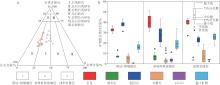
图2
富县地区长7油层组致密砂岩储层岩石学特征a. 重力流储层岩性三角图; b. 重力流储层矿物含量箱形图"

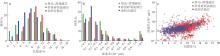
图3
富县地区长7油层组致密砂岩储层物性特征a. 孔隙度频率分布直方图; b. 渗透率频率分布直方图; c. 孔隙度和渗透率相关性"

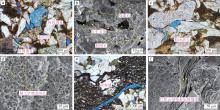
图4
富县地区长7油层组深水致密砂岩储层储集空间类型典型显微照片a. 原生残余粒间孔、粒间溶孔和粒内溶孔,埋深1 631.9 m,FX168井,单偏光,铸体薄片;b. 原生残余粒间孔,埋深1 432.5 m,FX120井,扫描电镜;c. 粒间溶孔,埋深1 638.5 m,FX168井,单偏光,铸体薄片;d. 黏土矿物晶间孔,埋深844.9 m,FX77井,扫描电镜;e. 微裂缝,埋深1 638.5 m,FX168井,单偏光,铸体薄片;f.片状云母残余层间缝隙,埋深1 541.6 m,FX134井,扫描电镜"

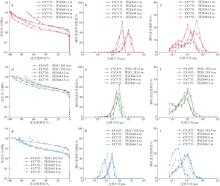
图5
富县地区长7油层组致密砂岩储层孔隙结构特征a. Ⅰ类储层进汞饱和度-进汞压力关系; b. Ⅰ类储层孔喉半径-瞬时渗透率贡献值关系; c. Ⅰ类储层孔喉半径-瞬时进汞饱和度关系; d. Ⅱ类储层进汞饱和度-进汞压力关系; e. Ⅱ类储层孔喉半径-瞬时渗透率贡献值关系; f. Ⅱ类储层孔喉半径-瞬时进汞饱和度关系; g. Ⅲ类储层进汞饱和度-进汞压力关系; h. Ⅲ类储层孔喉半径-瞬时渗透率贡献值关系; i. Ⅲ类储层孔喉半径-瞬时进汞饱和度关系"

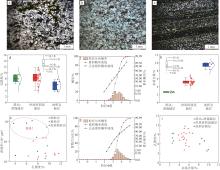
图6
富县地区长7油层组致密砂岩储层沉积条件a.滑动-滑塌储层,颗粒大小均一,分选较好,夹杂泥质变形带,埋深1 556.04 m,L241井,铸体薄片,单偏光显微照片;b.砂质碎屑流储层,颗粒大小混杂,分选性差,埋深1 638.50 m,FX168井,铸体薄片,单偏光显微照片;c.浊积岩储层,砂、泥韵律互层,非均质性强,发育微裂缝,埋深1 564.70 m,L241井,铸体薄片,单偏光显微照片;d. 重力流储层孔隙度分布特征;e. 不同岩性储层孔隙度和渗透率的关系;f. 浊积岩储层粒度累积概率曲线;g. 砂质碎屑流储层粒度累积概率曲线;h. 重力流储层杂基含量分布特征;i. 重力流储层杂基含量-孔隙度关系"


图7
富县地区长7油层组压实作用对储层物性的影响a.压实和胶结作用对孔隙度的影响;b.孔隙度-现今埋深关系;c.渗透率-现今埋深关系"

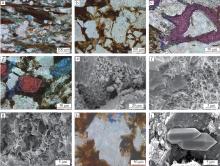
图8
富县地区长7油层组致密砂岩储层压实作用和胶结作用典型显微照片a. 云母受到压实作用顺层分布或弯曲变形,埋深1 547.0 m,FX191井,单偏光,铸体薄片;b. 颗粒之间呈点-线接触,埋深1 628.6 m,FX168井,单偏光,铸体薄片;c. 颗粒间被方解石胶结,埋深1 552.4 m,L241井,单偏光,铸体薄片;d. 颗粒间被白云石胶结,见少量铁方解石胶结,埋深1 565.7 m,FX191井,单偏光,铸体薄片;e. 高岭石向绿泥石转化,发育绿泥石膜,埋深843.9 m,FX77井,扫描电镜;f.充填于粒间孔隙中的毛发状伊利石,埋深1 283.6 m,FX18井,扫描电镜;g.发育丝片状伊利石,埋深1 534.1 m,FX134井,扫描电镜;h.石英次生加大,埋深1 631.9 m,FX168井,单偏光,铸体薄片;i.自生石英充填孔隙生长,埋深1 433.2 m,FX120井,扫描电镜"

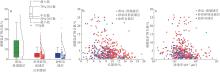
图9
富县地区长7油层组重力流储层碳酸盐胶结作用特征a. 碳酸盐矿物含量分布特征;b. 孔隙度与碳酸盐矿物含量交会图;c. 渗透率与碳酸盐矿物含量交会图"
表1
富县地区长7油层组重力流砂岩储层填隙物含量统计"
| 重力流储层类型 | 样品个数 | 填隙物含量/% | ||||
|---|---|---|---|---|---|---|
| 杂基 | 高岭石 | 绿泥石 | 方解石 | 白云石 | ||
| 滑动-滑塌储层 | 5 | 2.6 | 0.5 | 4.3 | 4.3 | 0.2 |
| 砂质碎屑流储层 | 19 | 5.3 | 0.6 | 5.2 | 3.1 | 2.4 |
| 浊积岩储层 | 5 | 9.4 | 0.7 | 6.7 | 4.8 | 2.8 |
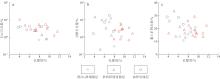
图10
富县地区长7油层组重力流储层致密化因素特征a. 孔隙度与白云石含量交会图; b. 孔隙度与方解石含量交会图; c. 孔隙度与黏土矿物含量交会图"
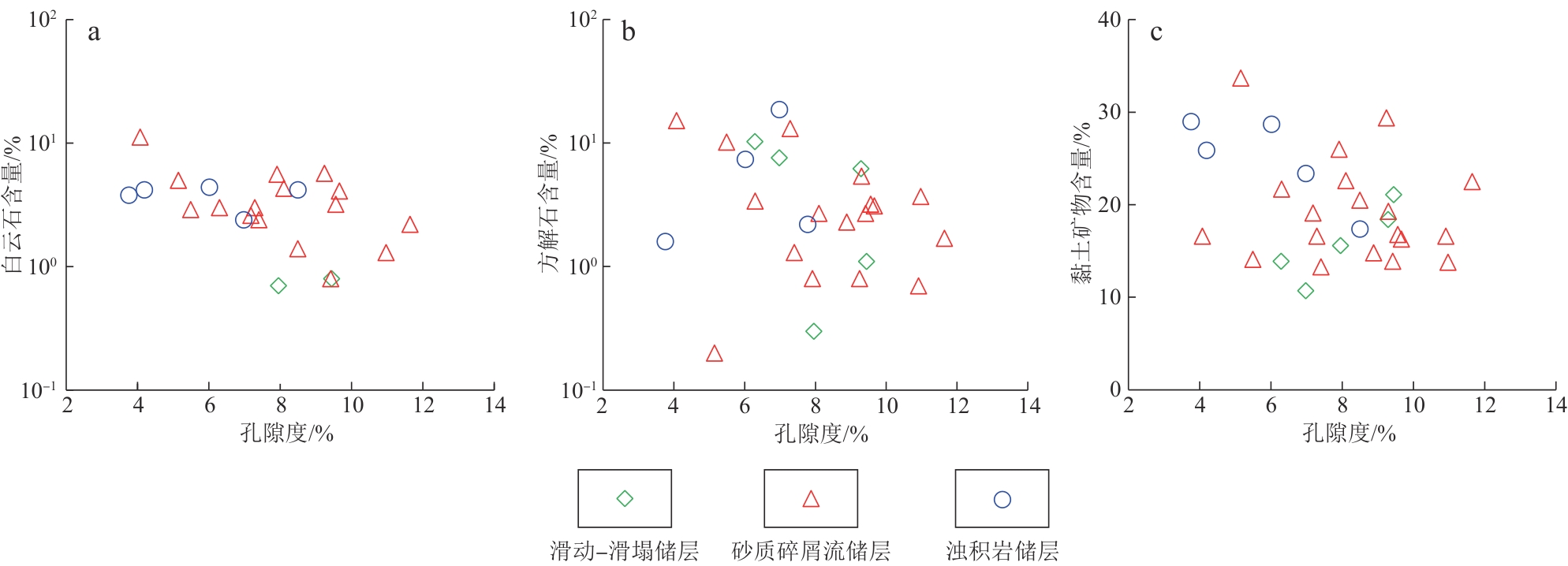
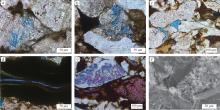
图11
富县地区长7油层组致密砂岩储层溶蚀作用和交代作用典型显微照片a. 长石颗粒内部溶蚀,1 556.0 m,L241井,铸体薄片,单偏光;b. 长石颗粒顺解理缝发生溶蚀,1 566.4 m,L241井,铸体薄片,单偏光;c. 石英颗粒边缘发生溶蚀,1 638.50 m,FX168井,铸体薄片,单偏光;d. 发育云母缝,1 560.8 m,FX191井,铸体薄片,单偏光;e. 长石颗粒被方解石交代,1 628.6 m,FX168井,铸体薄片,单偏光;f. 毛发状伊利石交代颗粒边缘形成边缘溶蚀孔,1 061.4 m,FX18井,铸体薄片,单偏光"

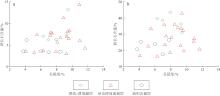
图12
富县地区长7油层组重力流储层溶蚀作用特征a. 孔隙度与钾长石含量交会图;b. 孔隙度与斜长石含量交会图"

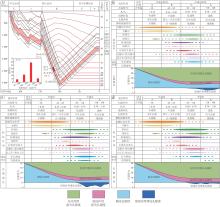
图13
富县地区长7油层组致密砂岩储层成岩阶段划分及孔隙演化特征a.长7油层组埋藏史及包裹体均一温度分布;b.滑动-滑塌储层成岩阶段及孔隙演化特征;c.砂质碎屑流储层成岩阶段及孔隙演化特征; d.浊积岩储层成岩阶段及孔隙演化特征"

表2
富县地区长7油层组各砂岩类型成岩孔隙演化定量统计"
| 储层类型 | 原始孔隙度/% | 压实减孔量/% | 胶结减孔量/% | 压实 + 胶结后 剩余孔隙度/% | 溶蚀作用 增孔率/% | 现今面孔率/% | 现今实测 孔隙度/% |
|---|---|---|---|---|---|---|---|
| 滑动-滑塌储层 | 39.0 | 29.9 | 7.2 | 1.9 | 0.5 | 0.3 | 8.0 |
| 砂质碎屑流储层 | 38.5 | 24.9 | 9.7 | 3.9 | 1 | 0.8 | 8.3 |
| 浊积岩储层 | 39.0 | 17.8 | 13.6 | 7.5 | 0.3 | 1.2 | 5.7 |
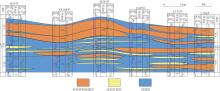
图14
富县地区长7油层组致密砂岩储层剖面分布规律(剖面位置见图15)"

表3
富县地区长7油层组致密砂岩储层综合评价"
| 储层级别特征参数 | Ⅰ类储层 | Ⅱ类储层 | Ⅲ类储层 |
|---|---|---|---|
| 孔隙度/% | > 9.00 | 7.00 ~ 9.00 | < 7.00 |
| 渗透率/(10-3μm2) | > 0.30 | 0.10 ~ 0.30 | < 0.10 |
| 排驱压力/MPa | 0.30 ~ 1.50 | 1.00 ~ 1.20 | 1.00 ~ 1.50 |
| 中值压力/MPa | 1.94 ~ 11.69 | 7.21 ~ 18.67 | 9.51 ~ 42.62 |
| 平均喉道半径/μm | 0.13 ~ 0.46 | 0.08 ~ 0.14 | 0.03 ~ 0.13 |
| 中值喉道半径/μm | 0.06 ~ 0.38 | 0.04 ~ 0.10 | 0.02 ~ 0.08 |
| 孔隙类型 | 粒间孔、粒间孔-溶孔 | 溶孔、溶孔-微孔 | 微孔 |
| 孔隙结构特征 | Ⅰ类 | Ⅱ类 | Ⅲ类 |
| 岩性 | 细砂岩 | 粉砂岩 | 泥质粉砂岩 |
| 含油性 | 油斑及以上 | 油迹 | 荧光或不含油 |
| 砂厚/m | > 15.00 | 5.00 ~ 15.00 | < 5.00 |
| 沉积微相类型 | 砂质碎屑流沉积 | 滑动-滑塌沉积、浊流沉积 | 浊流沉积 |
| 储层评价 | 优质 | 中等 | 差 |
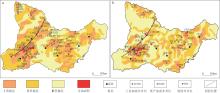
图15
富县地区长7油层组优质储层分布规律a.长71油层亚组储层分级平面展布;b.长72油层亚组储层分级平面展布"

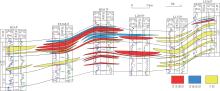
图16
富县地区长7油层组致密砂岩储层油藏剖面(剖面位置见图15)"

| [1] | ABREU V, SULLIVAN M, PIRMEZ C, et al. Lateral accretion packages (LAPs): An important reservoir element in deep water sinuous channels[J]. Marine and Petroleum Geology, 2003, 20(6/8): 631-648. |
| [2] | 曹江骏, 陈朝兵, 程皇辉, 等. 成岩作用对深水致密砂岩储层微观非均质性的影响——以鄂尔多斯盆地合水地区长7油层组为例[J]. 沉积学报, 2021, 39(4): 1031-1046. |
| CAO Jiangjun, CHEN Chaobing, CHENG Huanghui, et al. Effect of diagenesis on microheterogeneity of deepwater tight sandstone reservoirs: A case study from the Triassic Chang 7 oil-bearing formation in Heshui area, Ordos Basin, NW China[J]. Acta Geologica Sinica, 2021, 39(4): 1031-1046. | |
| [3] | 蒋恕, 王浩, 郭涛, 等. 渤海湾盆地辽东湾坳陷盆中隆起缓坡带重力流沉积形态及其控制因素[J]. 石油与天然气地质, 2022, 43(4): 823-832. |
| JIANG Shu, WANG Hao, GUO Tao, et al. Geomorphology of gravity flow deposits in the gentle slope zone of intra-basinal high in the Liaodong Bay Depression, Bohai Bay Basin and its controlling factors[J]. Oil & Gas Geology, 2022, 43(4): 823-832. | |
| [4] | ZOU Caineng, FENG Youliang, YANG Zhi, et al. Fine-grained gravity flow sedimentation and its influence on development of shale oil sweet sections in lacustrine basins in China[J]. Petroleum Exploration and Development, 2023, 50(5): 1013-1029. |
| [5] | 王冠民, 庞小军, 黄晓波, 等. 渤海海域辽中凹陷南部古近系东营组三段重力流砂岩优质储层特征及成因[J]. 石油与天然气地质, 2024, 45(1): 81-95. |
| WANG Guanmin, PANG Xiaojun, HUANG Xiaobo, et al. Characteristics and origin of high-quality gravity-flow sandstone reservoirs in the 3rd member of the Dongying Formation, southern Liaozhong Sag, Bohai Sea[J]. Oil & Gas Geology, 2024, 45(1): 81-95. | |
| [6] | 王俊杰, 丁祖鹏, 张雨晴, 等. 东营凹陷沙三中亚段湖底扇重力流砂岩成岩演化进程及差异分布[J]. 中国石油大学学报(自然科学版), 2025, 49(1): 44-58. |
| WANG Junjie, DING Zupeng, ZHANG Yuqing, et al. Diagenetic evolution process and differential distribution of gravity flow sandstones in sublacustrine fan in the middle sub-member of the 3rd member, Shashejie Formation in Dongying Sag[J]. Journal of China University of Petroleum (Edition of Natural Science), 2025, 49(1): 44-58. | |
| [7] | 付超, 谢玉洪, 赵雨初, 等. 深水峡谷上游复合浊积砂岩储层类型及其展布规律——以琼东南盆地中央峡谷陵水气田为例[J]. 石油与天然气地质, 2024, 45(2): 516-529. |
| FU Chao, XIE Yuhong, ZHAO Yuchu, et al. Types and distribution patterns of complex turbidite sandstone reservoirs in the upper reaches of deep-water canyons—A case study of the Lingshui gas field in the Central Canyon of Qiongdongnan Basin[J]. Oil & Gas Geology, 2024, 45(2): 516-529. | |
| [8] | 邹才能, 赵政璋, 杨华, 等. 陆相湖盆深水砂质碎屑流成因机制与分布特征——以鄂尔多斯盆地为例[J]. 沉积学报, 2009, 27(6): 1065-1075. |
| ZOU Caineng, ZHAO Zhengzhang, YANG Hua, et al. Genetic mechanism and distribution of sandy debris flows in terrestrial lacustrine basin[J]. Acta Sedimentologica Sinica, 2009, 27(6): 1065-1075. | |
| [9] | 李相博, 刘化清, 陈启林, 等. 大型坳陷湖盆沉积坡折带特征及其对砂体与油气的控制作用——以鄂尔多斯盆地三叠系延长组为例[J]. 沉积学报, 2010, 28(4): 717-729. |
| LI Xiangbo, LIU Huaqing, CHEN Qilin, et al. Characteristics of slope break belt in large depression lacustrine basin and its controlling effect on sandbody and petroleum: Taking the Triassic Yanchang Formation in the Ordos Basin as an example[J]. Acta Sedimentologica Sinica, 2010, 28(4): 717-729. | |
| [10] | 潘树新, 王建功, 刘彩燕, 等. 坳陷湖盆沿岸坝沉积特征、分布规律及成藏机制——以松辽盆地南部青山口组为例[J]. 吉林大学学报(地球科学版), 2012, 42(): 70-78. |
| PAN Shuxin, WANG Jiangong, LIU Caiyan, et al. Sedimentary features, distribution pattern and accumulation mechanism of lakeshore bar: Taking the Qingshankou Formation in the southern Songliao Basin as an example[J]. Journal of Jilin University (Earth Science Edition), 2012, 42(S2): 70-78. | |
| [11] | 符勇, 李忠诚, 万谱, 等. 三角洲前缘滑塌型重力流沉积特征及控制因素——以松辽盆地大安地区青一段为例[J]. 岩性油气藏, 2021, 33(1): 198-208. |
| FU Yong, LI Zhongcheng, WAN Pu, et al. Sedimentary characteristics and controlling factors of slump gravity flow in delta front: A case study of Qing 1 member in Da’an area, Songliao Basin[J]. Lithologic Reservoirs, 2021, 33(1): 198-208. | |
| [12] | 李军亮, 王鑫, 王伟庆, 等. 致密砂岩砂-泥结构发育特征及其对储集空间的控制作用——以渤海湾盆地临南洼陷古近系沙河街组三段下亚段为例[J]. 石油与天然气地质, 2023, 44(5): 1173-1187. |
| LI Junliang, WANG Xin, WANG Weiqing, et al. Influence of sand-mud assemblages in tight sandstones on reservoir storage spaces: A case study of the lower submember of the 3rd member of the Paleogene Shahejie Formation in the Linnan sub-sag, Bohai Bay Basin[J]. Oil & Gas Geology, 2023, 44(5): 1173-1187. | |
| [13] | 冯有良, 杨智, 张洪, 等. 咸化湖盆细粒重力流沉积特征及其页岩油勘探意义——以准噶尔盆地玛湖凹陷风城组为例[J]. 地质学报, 2023, 97(3): 839-863. |
| FENG Youliang, YANG Zhi, ZHANG Hong, et al. Fine-grained gravity flow sedimentary features and their petroleum significance within saline lacustrine basins: A case study of the Fengcheng Formation in Mahu Depression, Junggar Basin, China[J]. Acta Geologica Sinica, 2023, 97(3): 839-863. | |
| [14] | 黄立良, 朱涛, 陈方文, 等. 玛湖凹陷风城组沉积特征及异重流水槽模拟研究[J]. 中国矿业大学学报, 2024, 53(4): 763-776. |
| HUANG Liliang, ZHU Tao, CHEN Fangwen, et al. Sedimentary characteristics and hyperpycnal flow flume simulation of the Fengcheng Formation in Mahu Sag, Junggar Basin[J]. Journal of China University of Mining & Technology, 2024, 53(4): 763-776. | |
| [15] | 杨华, 付金华, 何海清, 等. 鄂尔多斯华庆地区低渗透岩性大油区形成与分布[J]. 石油勘探与开发, 2012, 39(6): 641-648. |
| YANG Hua, FU Jinhua, HE Haiqing, et al. Formation and distribution of large low-permeability lithologic oil regions in Huaqing, Ordos Basin[J]. Petroleum Exploration and Development, 2012, 39(6): 641-648. | |
| [16] | 杨仁超, 尹伟, 樊爱萍, 等. 鄂尔多斯盆地南部三叠系延长组湖相重力流沉积细粒岩及其油气地质意义[J]. 古地理学报, 2017, 19(5): 791-806. |
| YANG Renchao, YIN Wei, FAN Aiping, et al. Fine-grained, lacustrine gravity-flow deposits and their hydrocarbon significance in the Triassic Yanchang Formation in southern Ordos Basin[J]. Journal of Palaeogeography (Chinese Edition), 2017, 19(5): 791-806. | |
| [17] | 周新平, 何青, 刘江艳, 等. 鄂尔多斯盆地三叠系延长组7段深水碎屑流沉积特征及成因[J]. 石油与天然气地质, 2021, 42(5): 1063-1077. |
| ZHOU Xinping, HE Qing, LIU Jiangyan, et al. Features and origin of deep-water debris flow deposits in the Triassic Chang 7 member, Ordos Basin[J]. Oil & Gas Geology, 2021, 42(5): 1063-1077. | |
| [18] | 黄军平, 杨田, 张艳, 等. 湖相细粒沉积岩沉积动力学机制与沉积模式——以鄂尔多斯盆地铜川地区延长组长7油层组露头为例[J]. 沉积学报, 2023, 41(4): 1227-1239. |
| HUANG Junping, YANG Tian, ZHANG Yan, et al. Sedimentary dynamics and deposition model of lacustrine fine-grained sedimentary rocks: A case study of the Chang 7 oil member from the Yanchang Formation in the Ordos Basin, Tongchuan area[J]. Acta Sedimentologica Sinica, 2023, 41(4): 1227-1239. | |
| [19] | 陈朝兵, 赵振宇, 付玲, 等. 鄂尔多斯盆地华庆地区延长组6段深水致密砂岩填隙物特征及对储层发育的影响[J]. 石油与天然气地质, 2021, 42(5): 1098-1111. |
| CHEN Chaobing, ZHAO Zhenyu, FU Ling, et al. Interstitial matter and its impact on reservoir development in Chang 6 deepwater tight sandstone in Huaqing area, Ordos Basin[J]. Oil & Gas Geology, 2021, 42(5): 1098-1111. | |
| [20] | 徐黎明, 郭芪恒, 刘元博, 等. 鄂尔多斯盆地长73亚段深水重力流砂岩储层特征及控制因素——以华池地区CY1井为例[J]. 天然气地球科学, 2021, 32(12): 1797-1809. |
| XU Liming, GUO Qiheng, LIU Yuanbo, et al. Characteristics and controlling factors of deep-water gravity flow sandstone reservoir in the Chang 73 sub-member in Ordos Basin: Case study of Well CY1 in Huachi area[J]. Natural Gas Geoscience, 2021, 32(12): 1797-1809. | |
| [21] | 江琦, 丁晓琪, 刘曦翔, 等. 鄂尔多斯盆地南部长8段砂质碎屑流储层特征及主控因素[J]. 东北石油大学学报, 2015, 39(6): 56-65. |
| JIANG Qi, DING Xiaoqi, LIU Xixiang, et al. Reservoir characteristics and control factors of sandy debris flow from Chang 8 interval, south of Ordos Basin[J]. Journal of Northeast Petroleum University, 2015, 39(6): 56-65. | |
| [22] | 李晓路, 马芳侠, 贺永红, 等. 鄂尔多斯盆地东南部长6段重力流沉积类型及成因[J]. 断块油气田, 2022, 29(1): 40-46. |
| LI Xiaolu, MA Fangxia, HE Yonghong, et al. Sedimentary types and genesis of gravity flow in Chang 6 Member of southeastern Ordos Basin[J]. Fault-Block Oil and Gas Field, 2022, 29(1): 40-46. | |
| [23] | 刘曦翔, 张宇, 蒲柏宇, 等. 鄂尔多斯盆地延长组深水致密砂岩大气淡水溶蚀及其油气地质意义[J]. 天然气勘探与开发, 2019, 42(2): 48-55. |
| LIU Xixiang, ZHANG Yu, PU Boyu, et al. Meteoric water dissolution in deepwater tight sandstone of Yanchang Formation in Ordos Basin and its geological significance[J]. Natural Gas Exploration and Development, 2019, 42(2): 48-55. | |
| [24] | 高丽华, 夏迪, 韩作振, 等. 临南洼陷北部沙三中亚段砂质碎屑流储层定量分类评价[J]. 山东科技大学学报(自然科学版), 2018, 37(1): 71-81, 91. |
| GAO Lihua, XIA Di, HAN Zuozhen, et al. Reservoir quantitative classification and evaluation of sand dibris flow in Middle-Es3 of north of Linnan subsag[J]. Journal of Shandong University of Science and Technology (Natural Science), 2018, 37(1): 71-81, 91. | |
| [25] | 罗静兰, 罗晓容, 白玉彬, 等. 差异性成岩演化过程对储层致密化时序与孔隙演化的影响——以鄂尔多斯盆地西南部长7致密浊积砂岩储层为例[J]. 地球科学与环境学报, 2016, 38(1): 79-92. |
| LUO Jinglan, LUO Xiaorong, BAI Yubin, et al. Impact of differential diagenetic evolution on the chronological tightening and pore evolution of tight sandstone reservoirs—A case study from the Chang-7 tight turbidite sandstone reservoir in the southwestern Ordos Basin[J]. Journal of Earth Sciences and Environment, 2016, 38(1): 79-92. | |
| [26] | 孙宁亮, 钟建华, 刘绍光, 等. 鄂尔多斯盆地南部延长组重力流致密储层成岩作用及物性演化[J]. 地球科学, 2017, 42(10): 1802-1816. |
| SUN Ningliang, ZHONG Jianhua, LIU Shaoguang, et al. Diagenesis and physical property evolution of gravity flow tight reservoir of Yanchang Formation in southern Ordos Basin[J]. Earth Science, 2017, 42(10): 1802-1816. | |
| [27] | 杨莎莎, 黄旭日, 贾继生, 等. 黄陵地区延长组长6段深水砂岩储层特征分析[J]. 西南石油大学学报(自然科学版), 2022, 44(1): 53-65. |
| YANG Shasha, HUANG Xuri, JIA Jisheng, et al. An analysis on the characteristics of deepwater sandstone reservoir of Chang 6 member, Yanchang Formation in Huangling area[J]. Journal of Southwest Petroleum University (Science & Technology Edition), 2022, 44(1): 53-65. | |
| [28] | 曹江骏, 陈朝兵, 罗静兰, 等. 自生黏土矿物对深水致密砂岩储层微观非均质性的影响——以鄂尔多斯盆地西南部合水地区长6油层组为例[J]. 岩性油气藏, 2020, 32(6): 36-49. |
| CAO Jiangjun, CHEN Chaobing, LUO Jinglan, et al. Impact of authigenic clay minerals on micro-heterogeneity of deep water tight sandstone reservoirs: A case study of Triassic Chang 6 oil reservoir in Heshui area, southwestern Ordos Basin[J]. Lithologic Reservoirs, 2020, 32(6): 36-49. | |
| [29] | 张军, 白玉彬, 闫新智, 等. 鄂尔多斯盆地富县地区长7段深水重力流沉积及勘探意义[J/OL]. 沉积学报: 1-21[2025-04-17]. . |
| ZHANG Jun, BAI Yubin, YAN Xinzhi, et al. Sedimentary characteristics of deep-water gravity flow in the Chang 7 member of the Yanchang Formation in the Fuxian area, Ordos Basin and its significance for petroleum exploration[J/OL]. Acta Sedimentologica Sinica: 1-21[2025-04-17]. . | |
| [30] | 葛毓柱, 钟建华, 李勇, 等. 鄂尔多斯盆地富县地区三叠系延长组长8-长6油层组类眼状构造成因探讨[J]. 古地理学报, 2015, 17(6): 797-804. |
| GE Yuzhu, ZHONG Jianhua, LI Yong, et al. Genetic discussion about eye-like structure of the Chang 8-6 intervals of Triassic Yanchang Formation in Fuxian area, Ordos Basin[J]. Journal of Palaeogeography (Chinese Edition), 2015, 17(6): 797-804. | |
| [31] | 白玉彬, 赵靖舟, 方朝强, 等. 优质烃源岩对鄂尔多斯盆地延长组石油聚集的控制作用[J]. 西安石油大学学报(自然科学版), 2012, 27(2): 1-5, 117. |
| BAI Yubin, ZHAO Jingzhou, FANG Chaoqiang, et al. Control effect of high-quality source rocks on petroleum accumulation in Yanchang Formation, Ordos Basin[J]. Journal of Xi’an Shiyou University (Natural Science Edition), 2012, 27(2): 1-5, 117. | |
| [32] | 王梓毅, 付金华, 刘显阳, 等. 鄂尔多斯盆地上三叠统延长组7段埋藏期热液活动对页岩油储层的影响[J]. 石油与天然气地质, 2023, 44(4): 899-909. |
| WANG Ziyi, FU Jinhua, LIU Xianyang, et al. The influence of hydrothermal activities on shale oil reservoirs during the burial period of the Upper Triassic Chang 7 member, Ordos Basin[J]. Oil & Gas Geology, 2023, 44(4): 899-909. | |
| [33] | 高嘉洪, 金之钧, 梁新平, 等. 火山活动对鄂尔多斯盆地三叠系长7段淡水湖盆富营养化与沉积水体介质环境的影响[J]. 石油与天然气地质, 2023, 44(4): 887-898. |
| GAO Jiahong, JIN Zhijun, LIANG Xinping, et al. The impact of volcanism on eutrophication and water column in a freshwater lacustrine basin: A case study of Triassic Chang 7 Member in Ordos Basin[J]. Oil & Gas Geology, 2023, 44(4): 887-898. | |
| [34] | 姜龙燕, 钱门辉, 何发岐, 等. 鄂尔多斯盆地富县地区三叠系延长组长7页岩油特征及其主控因素[J]. 石油实验地质, 2024, 46(5): 941-953. |
| JIANG Longyan, QIAN Menhui, HE Faqi, et al. Characteristics and main controlling factors of Chang 7 shale oil in Triassic Yanchang Formation, Fuxian area, Ordos Basin[J]. Petroleum Geology and Experiment, 2024, 46(5): 941-953. | |
| [35] | 王颖, 王晓州, 王英民, 等. 沉积物理模拟实验在确定重力流临界坡度中的应用[J]. 成都理工大学学报(自然科学版), 2010, 37(4): 463-468. |
| WANG Ying, WANG Xiaozhou, WANG Yingmin, et al. Determination of the gravity flow critical gradient using sedimentary simulation experiment[J]. Journal of Chengdu University of Technology (Science & Technology Edition), 2010, 37(4): 463-468. | |
| [36] | 谢芸雅, 刘显凤, 王健, 等. 鄂尔多斯盆地陕北地区延长组长7段致密油储层特征及其主控因素[J]. 海洋地质与第四纪地质, 2022, 42(3): 149-159. |
| XIE Yunya, LIU Xianfeng, WANG Jian, et al. Characteristics and main controlling factors of tight oil reservoirs in Chang 7 member of Yanchang Formation in Ordos Basin, North Shaanxi[J]. Marine Geology & Quaternary Geology, 2022, 42(3): 149-159. | |
| [37] | LI Huan, HU Qinhong, JONES S, et al. A review and discussion on the influences of grain-coating clay minerals on water-rock interactions in sandstones[J]. Earth-Science Reviews, 2025, 263: 105073. |
| [38] | 牛君, 王聪, 梁飞. 绿泥石与浊沸石矿物特征及其对储集层物性的影响——以准噶尔盆地陆梁隆起西部下乌尔禾组为例[J]. 新疆石油地质, 2025, 46(1): 13-21. |
| NIU Jun, WANG Cong, LIANG Fei. Mineral features of chlorite and laumontite and their impacts on reservoir physical properties: A case study of Lower Wuerhe Formation in western Luliang uplift, Junggar Basin[J]. Xinjiang Petroleum Geology, 2025, 46(1): 13-21. | |
| [39] | 贾京坤, 尹伟, 邱楠生, 等. 红河油田延长组长8段油气输导体系及运聚模式[J]. 油气地质与采收率, 2016, 23(2): 9-15. |
| JIA Jingkun, YIN Wei, QIU Nansheng, et al. Petroleum carrier systems and migration and accumulation patterns in Chang 8 member of Yanchang Formation in Honghe Oilfield[J]. Petroleum Geology and Recovery Efficiency, 2016, 23(2): 9-15. | |
| [40] | 孙致学, 孙治雷, 鲁洪江, 等. 砂岩储集层中碳酸盐胶结物特征——以鄂尔多斯盆地中南部延长组为例[J]. 石油勘探与开发, 2010, 37(5): 543-551. |
| SUN Zhixue, SUN Zhilei, LU Hongjiang, et al. Characteristics of carbonate cements in sandstone reservoirs: A case from Yanchang Formation, middle and southern Ordos Basin, China[J]. Petroleum Exploration and Development, 2010, 37(5): 543-551. | |
| [41] | GLUMAC B, WALKER K R. Effects of grand-cycle cessation on the diagenesis of Upper Cambrian carbonate deposits in the southern Appalachians, U.S.A.[J]. Journal of Sedimentary Research, 2002, 72(4): 570-586. |
| [42] | REZAEE M R, TINGATE P R. Origin of quartz cement in the Tirrawarra sandstone, southern Cooper Basin, South Australia[J]. Journal of Sedimentary Research, 1997, 67(1): 168-177. |
| [43] | 罗瑞, 查明, 何皓, 等. 有机酸溶蚀作用对泥页岩储层孔隙结构的影响[J]. 中国石油大学学报(自然科学版), 2017, 41(2): 49-59. |
| LUO Rui, ZHA Ming, HE Hao, et al. Effect of mineral dissolution by organic acids on pore structure of shale reservoir[J]. Journal of China University of Petroleum (Edition of Natural Science), 2017, 41(2): 49-59. | |
| [44] | BOLES J R. Active albitization of plagioclase, Gulf Coast Tertiary[J]. American Journal of Science, 1982, 282(2): 165-180. |
| [45] | 祝海华, 张秋霞, 董国栋, 等. 鄂尔多斯盆地长7段重力流砂岩长石溶蚀特征及控制因素[J]. 石油勘探与开发, 2024, 51(1): 102-113. |
| ZHU Haihua, ZHANG Qiuxia, DONG Guodong, et al. Characteristics and control factors of feldspar dissolution in gravity flow sandstone of Chang 7 member, Triassic Yanchang Formation, Ordos Basin, NW China[J]. Petroleum Exploration and Development, 2024, 51(1): 102-113. | |
| [46] | BOLES J R, JOHNSON K S. Influence of mica surfaces on pore-water pH[J]. Chemical Geology, 1984, 43(3/4): 303-317. |
| [47] | ZHU Haihua, ZHONG Dakang, ZHANG Tingshan, et al. Diagenetic controls on the reservoir quality of fine-grained “tight” sandstones: A case study based on NMR analysis[J]. Energy & Fuels, 2018, 32(2): 1612-1623. |
| [48] | LAI Jin, WANG Guiwen, RAN Ye, et al. Impact of diagenesis on the reservoir quality of tight oil sandstones: The case of Upper Triassic Yanchang Formation Chang 7 oil layers in Ordos Basin, China[J]. Journal of Petroleum Science and Engineering, 2016, 145: 54-65. |
| [49] | 叶瑛, 沈忠悦, 郑丽波, 等. 塔里木库车坳陷中新生界储层砂岩成岩期钠长石化[J]. 高校地质学报, 1999, 5(3): 251-259. |
| YE Ying, SHEN Zhongyue, ZHENG Libo, et al. Diagenetic albitization in the Mesozoic and Cenozoic reservoir sandstones from Kuche Depression, north Tarim, Xinjiang, China[J]. Geological Journal of China Universities, 1999, 5(3): 251-259. | |
| [50] | MORAD S, KETZER J M, DE ROS L F. Spatial and temporal distribution of diagenetic alterations in siliciclastic rocks: implications for mass transfer in sedimentary basins[J]. Sedimentology, 2000, 47(S1): 95-120. |
| [51] | 中华人民共和国国家经济贸易委员会. 碎屑岩成岩阶段划分: [S]. 北京: 石油工业出版社, 2003. |
| State Economic and Trade Commission of the People’s Republic of China. The division of diagenetic stages in clastic rocks: [S]. Beijing: Petroleum Industry Press, 2003. | |
| [52] | EHRENBERG S N. Assessing the relative importance of compaction processes and cementation to reduction of porosity in sandstones: Discussion; compaction and porosity evolution of Pliocene sandstones, Ventura Basin, California: Discussion[J]. AAPG Bulletin, 1989, 73(10): 1274-1276. |
| [53] | BEARD D C, WEYL P K. Influence of texture on porosity and permeability of unconsolidated sand[J]. AAPG Bulletin, 1973, 57(2): 349-369. |
| [1] | 赵靖舟, 高振东, 孟选刚, 吴伟涛, 白玉彬, 曹磊, 赵子龙. 鄂尔多斯盆地陕北地区三叠系延长组长7—长9油层组重力流沉积致密油富集条件与勘探潜力——兼论拗陷型湖盆的石油勘探范式[J]. 石油与天然气地质, 2025, 46(5): 1367-1391. |
| [2] | 吴伟涛, 李天宇, 闫新智, 周凯, 殷露, 曹磊. 鄂尔多斯盆地定边—富县地区延长组长8油层组致密油富集因素与富集模式[J]. 石油与天然气地质, 2025, 46(5): 1392-1409. |
| [3] | 曹磊, 闫新智, 李辉, 吴伟涛, 白玉彬, 赵子龙. 鄂尔多斯盆地陕北地区延长组长8与长9油层组烃源岩分布与地球化学特征及页岩油资源潜力评价[J]. 石油与天然气地质, 2025, 46(5): 1410-1429. |
| [4] | 耳闯, 关宏博, 刘伟, 程妮, 白洁, 胡崇. 陆源物质输入对有机质类型的影响——以鄂尔多斯盆地三叠系延长组长73油层亚组页岩为例[J]. 石油与天然气地质, 2025, 46(5): 1430-1445. |
| [5] | 丁蓉, 庞雄奇, 贾承造, 熊先钺, 邓泽, 田文广, 蒲庭玉, 王飞宇, 林浩, 陈雨萱. 鄂尔多斯盆地石炭纪—二叠纪煤系全油气系统天然气成藏特征与有序分布模式[J]. 石油与天然气地质, 2025, 46(4): 1333-1348. |
| [6] | 田刚, 卢明德, 薛海军, 汶小岗, 马丽, 袁安龙, 宋立军, 蒲仁海, 贾会冲, 陈杰, 陈硕, 吴大林, 杨明慧. 鄂尔多斯盆地伊盟隆起南部构造边界厘定及其油气勘探意义[J]. 石油与天然气地质, 2025, 46(1): 108-122. |
| [7] | 费世祥, 崔越华, 李小锋, 汪淑洁, 王晔, 张正涛, 孟培龙, 郑小鹏, 徐运动, 高建文, 罗文琴, 蒋婷婷. 鄂尔多斯盆地中、东部深层煤岩气水平井高效开发主控因素[J]. 石油与天然气地质, 2025, 46(1): 273-287. |
| [8] | 时保宏, 蔺嘉昊, 张涛, 王红伟, 张雷, 魏嘉怡, 李涵, 刘刚, 王蓉. 鄂尔多斯盆地西缘冲断带中段奥陶系克里摩里组高能滩隐伏构造成藏潜力[J]. 石油与天然气地质, 2025, 46(1): 78-90. |
| [9] | 李宏涛. 基于井-震联合的辫状河沉积微相分析[J]. 石油与天然气地质, 2025, 46(1): 91-107. |
| [10] | 刘大锰, 王子豪, 陈佳明, 邱峰, 朱凯, 高羚杰, 周柯宇, 许少博, 孙逢瑞. 基于ResNet残差神经网络识别的深部煤层显微组分和微裂缝分类[J]. 石油与天然气地质, 2024, 45(6): 1524-1536. |
| [11] | 李亚辉. 鄂尔多斯盆地大牛地气田深层中煤阶煤层气勘探实践及产能新突破[J]. 石油与天然气地质, 2024, 45(6): 1555-1566. |
| [12] | 何发岐, 雷涛, 齐荣, 徐兵威, 李晓慧, 张茹. 鄂尔多斯盆地大牛地气田深部煤层气勘探突破及其关键技术[J]. 石油与天然气地质, 2024, 45(6): 1567-1576. |
| [13] | 牛小兵, 张辉, 王怀厂, 虎建玲, 吴陈君, 赵伟波, 潘博. 鄂尔多斯盆地中、东部石炭系本溪组煤储层纵向非均质性特征及成因[J]. 石油与天然气地质, 2024, 45(6): 1577-1589. |
| [14] | 李明瑞, 史云鹤, 范立勇, 戴贤铎, 荆雪媛, 张沂. 鄂尔多斯盆地上古生界本溪组8#煤岩煤岩气与致密砂岩气主要气藏特征对比[J]. 石油与天然气地质, 2024, 45(6): 1590-1604. |
| [15] | 侯雨庭, 周国晓, 黄道军, 王彦卿, 焦鹏帅. 鄂尔多斯盆地纳林河地区煤岩气成藏地质特征[J]. 石油与天然气地质, 2024, 45(6): 1605-1616. |
| 阅读次数 | ||||||
|
全文 |
|
|||||
|
摘要 |
|
|||||
