

Oil & Gas Geology ›› 2025, Vol. 46 ›› Issue (1): 304-314.doi: 10.11743/ogg20250121
• Methods and Technologies • Previous Articles Next Articles
Wenxi REN1( ), Xiaojun ZENG1, Guangfu WANG2, Jianchun GUO1, Yuxuan LIU1
Received:2024-06-21
Revised:2024-11-06
Online:2025-02-28
Published:2025-03-03
CLC Number:
Wenxi REN, Xiaojun ZENG, Guangfu WANG, Jianchun GUO, Yuxuan LIU. Molecular simulations of a multicomponent hydrocarbon-water mixture in the organic matter-clay mineral composite pore system of lacustrine shales: A case study of the Da’anzhai Member of the Jurassic Ziliujing Formation, Sichuan Basin[J]. Oil & Gas Geology, 2025, 46(1): 304-314.
Add to citation manager EndNote|Reference Manager|ProCite|BibTeX|RefWorks

Fig.1
Diagram showing the organic matter-clay mineral composite pore system"

Table 1
Pressures set for the molecular simulations of multicomponent hydrocarbon-water mixture occurrence"
| 狭缝孔孔径/nm | 压力/MPa | ||
|---|---|---|---|
| 流体分子总数4 040个 | 流体分子总数8 080个 | 流体分子总数12 120个 | |
| 2 | 17 | 35 | — |
| 4 | 11 | 21 | 35 |
| 6 | — | — | 17 |
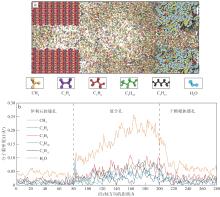
Fig. 2
Distributions of multicomponent hydrocarbons and water in the organic matter-clay mineral composite pore system (with a pore diameter of 4 nm at 21 MPa)"


Fig. 3
Interaction energy between hydrocarbons/water molecules and solids"
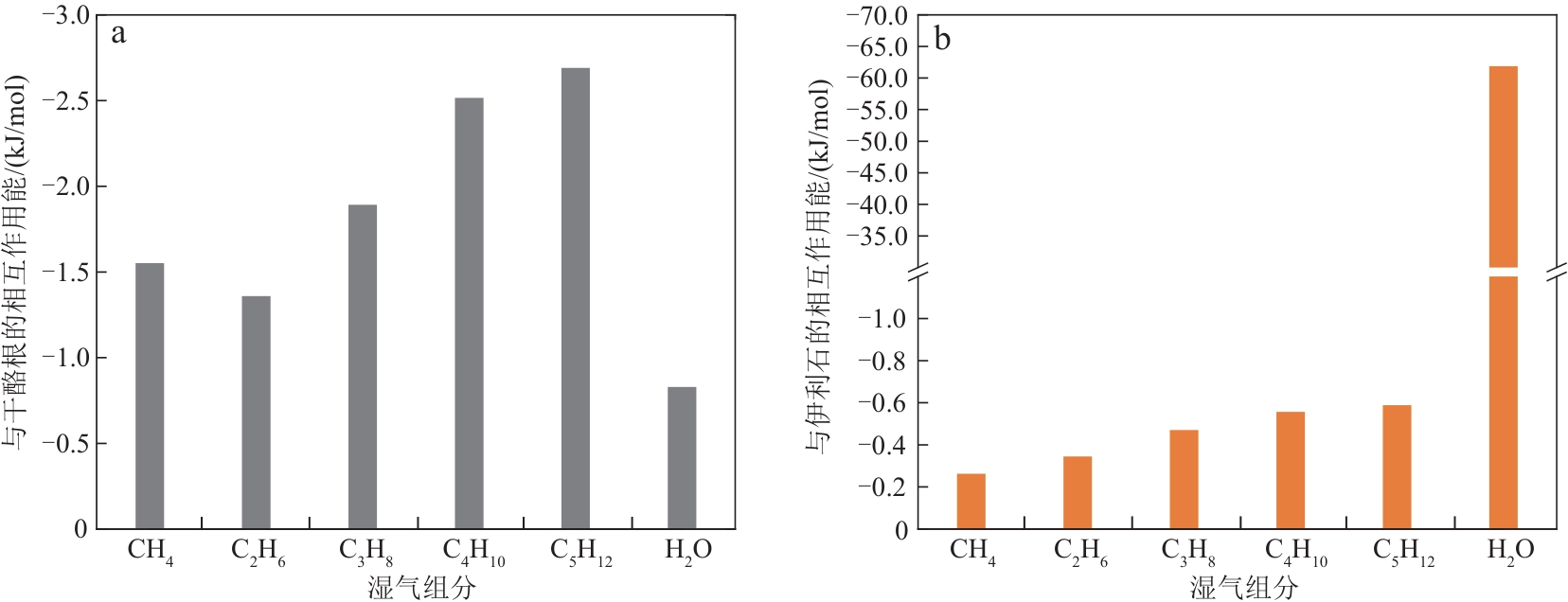

Fig. 4
Spatial configurations of hydrocarbon and water molecules in the organic matter-clay mineral composite pore system under different pressures (slit pore width: 4 nm)"


Fig. 5
Density profiles of hydrocarbon molecules in slit pores of illite and kerogen, and composite pores under different pressures (slit pore width: 4 nm)"

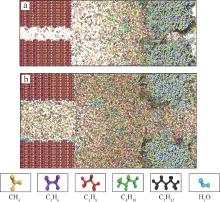
Fig. 6
Spatial configuration of hydrocarbon and water molecules in the organic matter-clay mineral composite pore system at 17 MPa"

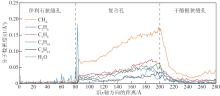
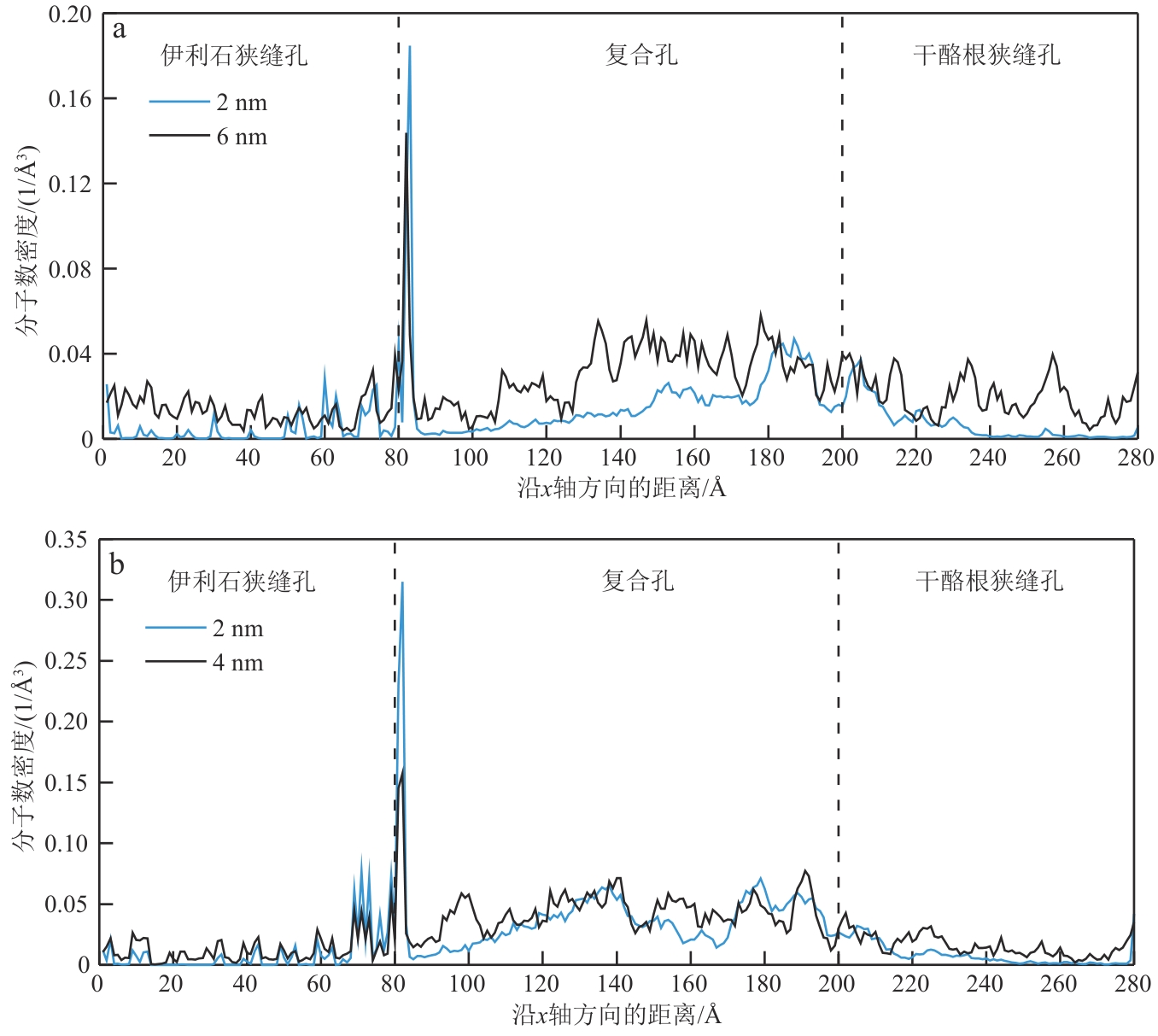
Fig. 7
Density profile of hydrocarbon and water molecules in slit pores of illite and kerogen, and composite pores at 17 MPa (slit pore width: 2 nm)"


Fig. 8
Spatial configuration of hydrocarbon and water molecules in the organic matter-clay mineral composite pore system at 35 MPa (slit pore width: 2 nm)"


Fig. 9
Occurrence states of water molecules in the organic matter-clay mineral composite pore system at 35 MPa (slit pore width: 4 nm)"


Fig. 10
Density distribution of CH4 molecules in slit pores of illite and kerogen, and composite pores under different pressures"


Fig. 11
Density distribution of C5H12 molecules in slit pores of illite and kerogen, and composite pores under different pressures"


Fig. 12
Density distribution of H2O molecules in slit pores of illite and kerogen, and composite pores under different pressures"
| 1 | 邹才能, 潘松圻, 荆振华, 等. 页岩油气革命及影响[J]. 石油学报, 2020, 41(1): 1-12. |
| ZOU Caineng, PAN Songqi, JING Zhenhua, et al. Shale oil and gas revolution and its impact[J]. Acta Petrolei Sinica, 2020, 41(1): 1-12. | |
| 2 | 郭旭升, 魏志红, 魏祥峰, 等. 四川盆地侏罗系陆相页岩油气富集条件及勘探方向[J]. 石油学报, 2023, 44(1): 14-27. |
| GUO Xusheng, WEI Zhihong, WEI Xiangfeng, et al. Enrichment conditions and exploration direction of Jurassic continental shale oil and gas in Sichuan Basin[J]. Acta Petrolei Sinica, 2023, 44(1): 14-27. | |
| 3 | 邹才能, 董大忠, 王玉满, 等. 中国页岩气特征、挑战及前景(一)[J]. 石油勘探与开发, 2015, 42(6): 689-701. |
| ZOU Caineng, DONG Dazhong, WANG Yuman, et al. Shale gas in China: Characteristics, challenges and prospects (Ⅰ)[J]. Petroleum Exploration and Development, 2015, 42(6): 689-701. | |
| 4 | 魏志红, 刘若冰, 魏祥峰, 等. 四川盆地复兴地区陆相页岩油气勘探评价与认识[J]. 中国石油勘探, 2022, 27(1): 111-119. |
| WEI Zhihong, LIU Ruobing, WEI Xiangfeng, et al. Exploration evaluation and recognition of continental shale oil and gas in Fuxing area, Sichuan Basin[J]. China Petroleum Exploration, 2022, 27(1): 111-119. | |
| 5 | 周德华, 孙川翔, 刘忠宝, 等. 川东北地区大安寨段陆相页岩气藏地质特征[J]. 中国石油勘探, 2020, 25(5): 32-42. |
| ZHOU Dehua, SUN Chuanxiang, LIU Zhongbao, et al. Geological characteristics of continental shale gas reservoir in the Jurassic Da’anzhai member in the northeastern Sichuan Basin[J]. China Petroleum Exploration, 2020, 25(5): 32-42. | |
| 6 | 王民, 余昌琦, 费俊胜, 等. 页岩油在干酪根中吸附行为的分子动力学模拟与启示[J]. 石油与天然气地质, 2023, 44(6): 1442-1452. |
| WANG Min, YU Changqi, FEI Junsheng, et al. Molecular dynamics simulation of shale oil adsorption in kerogen and its implications[J]. Oil & Gas Geology, 2023, 44(6): 1442-1452. | |
| 7 | 计秉玉, 方吉超, 杨书, 等. 分子采油的概念、方法及展望[J]. 石油与天然气地质, 2023, 44(1): 195-202. |
| JI Bingyu, FANG Jichao, YANG Shu, et al. Concept, method and prospect of molecular oil recovery[J]. Oil & Gas Geology, 2023, 44(1): 195-202. | |
| 8 | WANG Tianyu, TIAN Shouceng, LI Gensheng, et al. Molecular simulation of gas adsorption in shale nanopores: A critical review[J]. Renewable and Sustainable Energy Reviews, 2021, 149: 111391. |
| 9 | WANG Tianyu, TIAN Shouceng, LIU Qingling, et al. Pore structure characterization and its effect on methane adsorption in shale kerogen[J]. Petroleum Science, 2021, 18(2): 565-578. |
| 10 | 田守嶒, 王天宇, 李根生, 等. 页岩不同类型干酪根内甲烷吸附行为的分子模拟[J]. 天然气工业, 2017, 37(12): 18-25. |
| TIAN Shouceng, WANG Tianyu, LI Gensheng, et al. Molecular simulation of methane adsorption behavior in different shale kerogen types[J]. Natural Gas Industry, 2017, 37(12): 18-25. | |
| 11 | 黄亮, 陈秋桔, 吴建发, 等. 深层页岩伊利石中甲烷吸附特征分子模拟[J]. 中南大学学报(自然科学版), 2022, 53(9): 3522-3531. |
| HUANG Liang, CHEN Qiujie, WU Jianfa, et al. Molecular simulation of methane adsorption characteristics in illite nanopores of deep shale reservoirs[J]. Journal of Central South University (Science and Technology), 2022, 53(9): 3522-3531. | |
| 12 | WANG Sen, FENG Qihong, JAVADPOUR F, et al. Multiscale modeling of gas transport in shale matrix: An integrated study of molecular dynamics and rigid-pore-network model[J]. SPE Journal, 2020, 25(3): 1416-1442. |
| 13 | DE ARAUJO I S, JAGADISAN A, HEIDARI Z. Impacts of kerogen type and thermal maturity on methane and water adsorption isotherms: a molecular simulation approach[J]. Fuel, 2023, 352: 128944. |
| 14 | JIA Tengfei, ZHANG Songhang, TANG Shuheng, et al. Density and volume of adsorbed methane in key applications for in-situ gas content: Insights from molecular simulation[J]. Chemical Engineering Journal, 2024, 490: 151809. |
| 15 | TIAN Yuanyuan, YAN Changhui, JIN Zhehui. Characterization of methane excess and absolute adsorption in various clay nanopores from molecular simulation[J]. Scientific Reports, 2017, 7(1): 12040. |
| 16 | 张益, 张斌, 刘帮华, 等. 页岩气储层吸附渗流研究现状及发展趋势[J]. 石油与天然气地质, 2024, 45(1): 256-280. |
| ZHANG Yi, ZHANG Bin, LIU Banghua, et al. Status quo and development trends of research on shale gas adsorption and seepage in shale gas reservoirs[J]. Oil & Gas Geology, 2024, 45(1): 256-280. | |
| 17 | 丛奇, 陈君青, 卢贵武, 等. 利用分子动力学模拟研究页岩吸附能力的影响因素及微观机理的综述[J]. 中南大学学报(自然科学版), 2022, 53(9): 3474-3489. |
| CONG Qi, CHEN Junqing, LU Guiwu, et al. Review on influencing factors and microscopic mechanism of shale adsorption capacity by molecular dynamics simulation[J]. Journal of Central South University (Science and Technology), 2022, 53(9): 3474-3489. | |
| 18 | YANG Feng, XIE Congjiao, NING Zhengfu, et al. High-pressure methane sorption on dry and moisture-equilibrated shales[J]. Energy & Fuels, 2017, 31(1): 482-492. |
| 19 | REN Wenxi, GUO Jianchun, ZENG Fanhui, et al. Modeling of high-pressure methane adsorption on wet shales[J]. Energy and Fuels, 2019, 33(8): 7043-7051. |
| 20 | 陈掌星, 冯东, 吴克柳, 等. 页岩气有机质和无机质吸附能力定量表征[J]. 中国石油大学学报(自然科学版), 2023, 47(5): 65-75. |
| CHEN Zhangxing, FENG Dong, WU Keliu, et al. Quantificational determination of methane adsorption in organic matter and inorganic matter of shale rocks[J]. Journal of China University of Petroleum(Edition of Natural Science), 2023, 47(5): 65-75. | |
| 21 | 任文希, 周玉, 郭建春, 等. 适用于中深层-深层页岩气的高压吸附模型[J]. 地球科学, 2022, 47(5): 1865-1875. |
| REN Wenxi, ZHOU Yu, GUO Jianchun, et al. High-pressure adsorption model for middle-deep and deep shale gas[J]. Earth Science, 2022, 47(5): 1865-1875. | |
| 22 | CURTIS M E, SONDERGELD C H, AMBROSE R J, et al. Microstructural investigation of gas shales in two and three dimensions using nanometer-scale resolution imaging[J]. AAPG Bulletin, 2012, 96(4): 665-677. |
| 23 | YANG Feng, NING Zhengfu, WANG Qing, et al. Pore structure characteristics of lower Silurian shales in the southern Sichuan Basin, China: Insights to pore development and gas storage mechanism[J]. International Journal of Coal Geology, 2016, 156: 12-24. |
| 24 | CAI Chuan, CAI Jingong, LIU Huiming, et al. Occurrence of organic matter in argillaceous sediments and rocks and its geological significance: A review[J]. Chemical Geology, 2023, 639: 121737. |
| 25 | 冯动军. 四川盆地侏罗系大安寨段陆相页岩油气地质特征及勘探方向[J]. 石油实验地质, 2022, 44(2): 219-230. |
| FENG Dongjun. Geological characteristics and exploration direction of continental shale gas in Jurassic Daanzhai Member, Sichuan Basin[J]. Petroleum Geology and Experiment, 2022, 44(2): 219-230. | |
| 26 | UNGERER P, COLLELL J, YIANNOURAKOU M. Molecular modeling of the volumetric and thermodynamic properties of kerogen: Influence of organic type and maturity[J]. Energy and Fuels, 2015, 29(1): 91-105. |
| 27 | HUANG Liang, NING Zhengfu, WANG Qing, et al. Effect of organic type and moisture on CO2/CH4 competitive adsorption in kerogen with implications for CO2 sequestration and enhanced CH4 recovery[J]. Applied Energy, 2018, 210: 28-43. |
| 28 | WANG Tianyu, TIAN Shouceng, LI Gensheng, et al. Molecular simulation of CO2/CH4 competitive adsorption on shale kerogen for CO2 sequestration and enhanced gas recovery[J]. The Journal of Physical Chemistry C, 2018, 122(30): 17009-17018. |
| 29 | WU Hong, WEN Long, ZHANG Li, et al. Gas adsorption capacity of type-Ⅱ kerogen at a varying burial depth[J]. Energy & Fuels, 2022, 36(14): 7472-7482. |
| 30 | YU Kaibin, BOWERS G M, LOGANATHAN N, et al. Diffusion behavior of methane in 3D kerogen models[J]. Energy & Fuels, 2021, 35(20): 16515-16526. |
| 31 | 黄亮, 冯鑫霓, 杨琴, 等. 深层页岩干酪根纳米孔隙中甲烷微观赋存特征[J]. 石油钻探技术, 2023, 51(5): 112-120. |
| HUANG Liang, FENG Xinni, YANG Qin, et al. Microscopic occurrence characteristics of methane in kerogen nanopores of deep shale reservoirs[J]. Petroleum Drilling Techniques, 2023, 51(5): 112-120. | |
| 32 | DOWNS R T, HALL-WALLACE M. The American Mineralogist crystal structure database[J]. American Mineralogist, 2003, 88(1): 247-250. |
| 33 | CYGAN R T, LIANG Jianjie, KALINICHEV A G. Molecular models of hydroxide, oxyhydroxide, and clay phases and the development of a general force field[J]. The Journal of Physical Chemistry B, 2004, 108(4): 1255-1266. |
| 34 | HAGLER A T, LIFSON S, DAUBER P. Consistent force field studies of intermolecular forces in hydrogen-bonded crystals. 2. A benchmark for the objective comparison of alternative force fields[J]. Journal of the American Chemical Society, 1979, 101(18): 5122-5130. |
| 35 | 郭彤楼, 李宇平, 魏志红. 四川盆地元坝地区自流井组页岩气成藏条件[J]. 天然气地球科学, 2011, 22(1): 1-7. |
| GUO Tonglou, LI Yuping, WEI Zhihong. Reservoir-forming conditions of shale gas in Ziliujing Formation of Yuanba area in Sichuan Basin[J]. Natural Gas Geoscience, 2011, 22(1): 1-7. | |
| 36 | 闫建平, 崔志鹏, 耿斌, 等. 四川盆地龙马溪组与大安寨段泥页岩差异性分析[J]. 岩性油气藏, 2016, 28(4): 16-23. |
| YAN Jianping, CUI Zhipeng, GENG Bin, et al. Differences of shale between Longmaxi Formation and Da’anzhai member in Sichuan Basin[J]. Lithologic Reservoirs, 2016, 28(4): 16-23. | |
| 37 | LIU Xinyue, ZHANG Dongxiao. A review of phase behavior simulation of hydrocarbons in confined space: Implications for shale oil and shale gas[J]. Journal of Natural Gas Science and Engineering, 2019, 68: 102901. |
| 38 | 吴建发, 赵圣贤, 李博, 等. 四川盆地南部地区志留系龙马溪组页岩基质孔隙水赋存规律[J]. 天然气工业, 2023, 43(7): 44-54. |
| WU Jianfa, ZHAO Shengxian, LI Bo, et al. Occurrence law of pore water in shale matrix: A case study of the Silurian Longmaxi Formation in southern Sichuan Basin[J]. Natural Gas Industry, 2023, 43(7): 44-54. | |
| 39 | KIM C, DEVEGOWDA D. Molecular dynamics study of fluid-fluid and solid-fluid interactions in mixed-wet shale pores[J]. Fuel, 2022, 319: 123587. |
| [1] | Yueming YANG, Maoyun WANG, Changjiang WU, Jianhui ZENG, Ke PAN, Huanle ZHANG, Xiaojuan WANG, Dongxia CHEN, Huwang CUI. Origin of calcium-rich formation water and its implications for natural gas migration and accumulation in the 2nd member of the Jurassic Shaximiao Formation, central Sichuan Basin [J]. Oil & Gas Geology, 2025, 46(1): 178-191. |
| [2] | Jie GUO, Di XIAO, Bing LUO, Benjian ZHANG, Xiao CHEN, Xihua ZHANG, Minglong LI, Xiucheng TAN. Platform-trough differential evolution and recent findings on conventional and unconventional natural gas play fairways in the Middle Permian Maokou Formation, eastern Sichuan Basin [J]. Oil & Gas Geology, 2025, 46(1): 192-210. |
| [3] | Yue MU, Xiucheng TAN, Bing LUO, Minglong LI, Fabo XU, Juanzi YI, Yonghong WU, Wenjie YANG, Jie GUO, Di XIAO. Sedimentary evolution and hydrocarbon exploration potential of platform-margin zones in the upper sub-member of the 2nd member of the Middle Permian Maokou Formation, eastern Sichuan Basin [J]. Oil & Gas Geology, 2025, 46(1): 211-229. |
| [4] | Xinpei WANG, Chenglin LIU, Liwei JIANG, Dehao FENG, Chen ZOU, Fei LIU, Junjun LI, Yubo HE, Mingxiang DONG, Pengfei JIAO. Pore microstructure and its controlling effects on gas content of deep shale reservoirs in the Wufeng-Longmaxi formations, Da'an area, western Chongqing [J]. Oil & Gas Geology, 2025, 46(1): 230-245. |
| [5] | Feng WU, Yun LIANG, Song TANG, Yuhan LI, Xingwang TIAN, Huiting YANG, Feng LI. Microconductivity of deep, bitumen-bearing carbonate rocks of dissolved pore and cavity types: A case study of the Cambrian Longwangmiao Formation in the Gaoshiti-Moxi area, Sichuan Basin [J]. Oil & Gas Geology, 2025, 46(1): 288-303. |
| [6] | Ling QI, Zhensheng SHI, Hongyan WANG, Tianqi ZHOU, Guizhong LI, Meng ZHAO, Hui CHENG, Zihao CHENG. Methodology for research on the provenance of black shales and its problems and prospects: A case study of the Wufeng-Longmaxi formations, southern Sichuan Basin [J]. Oil & Gas Geology, 2025, 46(1): 62-77. |
| [7] | Long WEN, Ying MING, Haofei SUN, Benjian ZHANG, Xiao CHEN, Shida CHEN, Song LI, Haiqi LI. Geological characteristics and exploration potential of deep coalbed methane in the Permian Longtan Formation, Sichuan Basin: A case study of well NT1H [J]. Oil & Gas Geology, 2024, 45(6): 1678-1685. |
| [8] | Jingdong LIU, Chenggang REN, Xiaojuan WANG, Ke PAN, Shaohua WANG, Xiaoting PANG, Xu GUAN. Quantitative assessment of hydrocarbon transport effectiveness along faults in the Middle Jurassic Shaximiao Formation, central Sichuan Basin [J]. Oil & Gas Geology, 2024, 45(6): 1705-1719. |
| [9] | Shengxian ZHAO, Yong LIU, Bo LI, Xin CHEN, Dongchen LIU, Meixuan YIN, Ying CHANG, Rui JIANG. Characteristics and patterns of the pore connectivity in shale gas reservoirs in the Wufeng-Longmaxi formations, Luzhou block, Sichuan Basin [J]. Oil & Gas Geology, 2024, 45(6): 1720-1735. |
| [10] | Qianqian JIANG, Juan WU, Heng WANG, Longwei KUANG, Zhipeng ZHOU, Yuran YANG, Yanyou LI, Chao LUO, Bin DENG, Kun JIAO. Thermal evolution of organic matter in the Lower Silurian Longmaxi Formation, southern Sichuan Basin and its main controlling factors [J]. Oil & Gas Geology, 2024, 45(5): 1321-1336. |
| [11] | Jun PENG, Fanglan LIU, Lianjin ZHANG, Binsong ZHENG, Song TANG, Shun LI, Xinyu LIANG. Characteristics and main controlling factors of reservoirs in the Middle Permian Maokou Formation, Longnvsi area, central Sichuan Basin [J]. Oil & Gas Geology, 2024, 45(5): 1337-1354. |
| [12] | Wei WANG, Zhujiang LIU, Fubin WEI, Fei LI. Characteristics and determinants of shale reservoir development in the Permian Dalong Formation, northeastern Sichuan Basin [J]. Oil & Gas Geology, 2024, 45(5): 1355-1367. |
| [13] | Xiaofei FENG, Xiaoming ZHAO, Xi ZHANG, Jiawang GE, Changcheng YANG, Yueli LIANG, Massine Bouchakour. Astronomically forced lake-level fluctuation and sediment distribution patterns during the early Middle Jurassic, central Sichuan Basin [J]. Oil & Gas Geology, 2024, 45(5): 1368-1382. |
| [14] | Qin ZHANG, Zhen QIU, Qun ZHAO, Dazhong DONG, Wen LIU, Weiliang KONG, Zhenglian PANG, Wanli GAO, Guangyin CAI, Yongzhou LI, Xingtao LI, Wenji LIN. Different characteristics and formation mechanisms of transitional and marine shale gas sweet spots [J]. Oil & Gas Geology, 2024, 45(5): 1400-1416. |
| [15] | Xun GONG, Zhijun JIN, Xinhua MA, Yuyang LIU, Guanfang LI, Huan MIU. Mechanical properties of the Silurian Longmaxi Formation shale, southern Sichuan Basin and its microfracturing mechanisms [J]. Oil & Gas Geology, 2024, 45(5): 1447-1455. |
| Viewed | ||||||
|
Full text |
|
|||||
|
Abstract |
|
|||||
