

Oil & Gas Geology ›› 2025, Vol. 46 ›› Issue (3): 846-859.doi: 10.11743/ogg20250310
• Petroleum Geology • Previous Articles Next Articles
Qianghu LIU1( ), Guangrong PENG2,3, Pei LIU2,3, Xiongbiao YU1,4, Wanlin XIONG2,3, Ziqiang ZHOU5, Hongtao ZHU1
Received:2024-10-10
Revised:2025-01-03
Online:2025-06-30
Published:2025-06-26
CLC Number:
Qianghu LIU, Guangrong PENG, Pei LIU, Xiongbiao YU, Wanlin XIONG, Ziqiang ZHOU, Hongtao ZHU. Migration of the Late Eocene knickpoints and their source-to-sink system along the northern margin of the Dongsha Uplift, South China Sea[J]. Oil & Gas Geology, 2025, 46(3): 846-859.
Add to citation manager EndNote|Reference Manager|ProCite|BibTeX|RefWorks
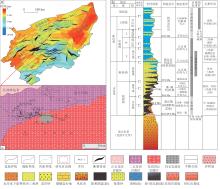
Fig. 1
Topographic pattern (a), synthetic stratigraphic column (b), and the basement lithology map along the northern margin (c) of the Dongsha Uplift in the South China Sea"


Fig. 2
Well-tied seismic stratigraphic framework section and basement lithology correlation across well A-1 to C-10 of the northern Dongsha Uplift in the South China Sea (see Fig.1 for the section location)"


Fig. 3
T80 interface remnant landscape and seismic stratigraphic framework section perpendicular to the strike for the northern Dongsha Uplift, South China Sea"


Fig. 4
Geomorphic drainage systems of the T80 and T70 interface overlapping area, longitudinal channel space extraction of steep-gentle slope zone, and well-crossing seismic stratigraphic framework sections of steep-gentle slope catchment of the Late Eocene in the northern Dongsha Uplift, South China Sea"


Fig. 5
Histogram showing the fault activity during the deposition of the Eocene Wenchang and Enping formations in southwestern Huizhou Sag of the northern Dongsha Uplift, South China Sea (see Fig. 4a for the framework location)"
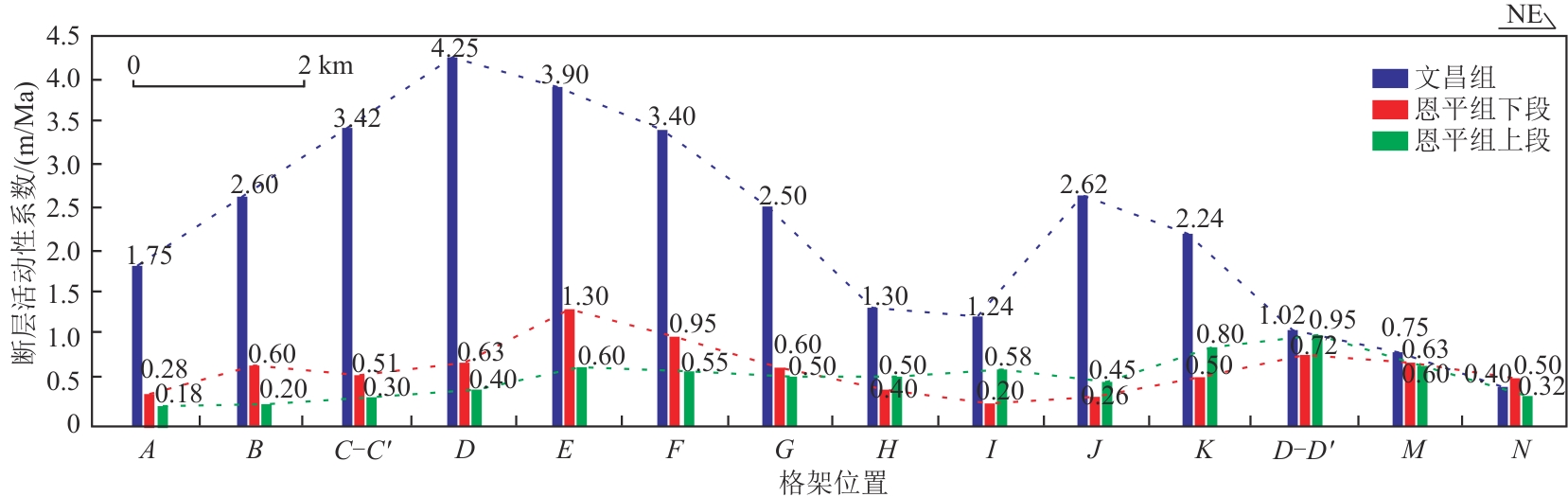

Fig. 6
Stratigraphic framework and core calibration of wells in the Late Eocene steep and gentle slope catchment (Enping Formation) of the northern Dongsha Uplift, South China Sea (see Fig.4a for the location)"


Fig. 7
Tectonic knickpoint migration and its sedimentary fan responses in the steep and gentle slope catchment of the northern Dongsha Uplift, South China Sea during the deposition of the Late Eocene Enping Formation"


Fig. 8
Statistical histogram showing the lithological grain size from the Eocene boreholes (Enping Formation) in the northern Dongsha Uplift, South China Sea"

Table 1
Sediment supply flux and sediment accumulation flux data of the Late Eocene steep and gentle slope catchment (Enping Formation) in the northern Dongsha Uplift, South China Sea"
| 源区 | A/km2 | R/m | T/℃ | Qs/ (Mt/yr) | V/ (1010 m³) | T/ (Myr) | Qf / (Mt/yr) |
|---|---|---|---|---|---|---|---|
惠州26 上段 | 260 | 900 | 20 | 0.10 | 3.79 | 2.1 | 0.05 |
惠州26 下段 | 200 | 950 | 20 | 0.09 | 2.92 | 2.0 | 0.04 |
惠州27 上段 | 440 | 700 | 20 | 0.12 | 6.76 | 2.1 | 0.08 |
惠州27 下段 | 240 | 750 | 20 | 0.08 | 3.93 | 2.0 | 0.05 |

Fig. 9
Coupling response models for tectonic knickpoint migration in the source area and sedimentary fan in the sink area of continental basins (modified after reference[32,34])"

| 1 | WHITTAKER A C, ATTAL M, ALLEN P A. Characterising the origin, nature and fate of sediment exported from catchments perturbed by active tectonics[J]. Basin Research, 2010, 22(6): 809-828. |
| 2 | HELLAND-HANSEN W, SØMME T O, MARTINSEN O J, et al. Deciphering earth’s natural hourglasses: Perspectives on source-to-sink analysis[J]. Journal of Sedimentary Research, 2016, 86(9): 1008-1033. |
| 3 | ALLEN P A. Sediment routing systems: The fate of sediment from source to sink[M]. Cambridge: Cambridge University Press, 2017. |
| 4 | ATTAL M, MUDD S M, HURST M D, et al. Impact of change in erosion rate and landscape steepness on hillslope and fluvial sediments grain size in the Feather River Basin (Sierra Nevada, California)[J]. Earth Surface Dynamics, 2015, 3(1): 201-222. |
| 5 | LIU Qianghu, ZHU Hongtao, ZHU Xiaomin, et al. Proportional relationship between the flux of catchment-fluvial segment and their sedimentary response to diverse bedrock types in subtropical lacustrine rift basins[J]. Marine and Petroleum Geology, 2019, 107: 351-364. |
| 6 | 刘强虎, 李志垚, 陈贺贺, 等. 陆相裂陷盆地深时源-汇系统关键地质问题及革新方向[J]. 地球科学, 2023, 48(12): 4586-4612. |
| LIU Qianghu, LI Zhiyao, CHEN Hehe, et al. Key geological issues and innovation directions in deep-time source-to-sink system of continental rift basins[J]. Earth Science, 2023, 48(12): 4586-4612. | |
| 7 | 徐长贵, 龚承林. 从层序地层走向源-汇系统的储层预测之路[J]. 石油与天然气地质, 2023, 44(3): 521-538. |
| XU Changgui, GONG Chenglin. Predictive stratigraphy: From sequence stratigraphy to source-to-sink system[J]. Oil & Gas Geology, 2023, 44(3): 521-538. | |
| 8 | 朱红涛, 徐长贵, 杜晓峰, 等. 陆相盆地古源-汇系统定量重建、级次划分及耦合模式[J]. 石油与天然气地质, 2023, 44(3): 539-552. |
| ZHU Hongtao, XU Changgui, DU Xiaofeng, et al. Quantitative reconstruction, hierarchical division and coupling mode establishment for ancient source-to-sink systems in continental basins[J]. Oil & Gas Geology, 2023, 44(3): 539-552. | |
| 9 | CROSBY B T, WHIPPLE K X. Knickpoint initiation and distribution within fluvial networks: 236 waterfalls in the Waipaoa River, North Island, New Zealand[J]. Geomorphology, 2006, 82(1/2): 16-38. |
| 10 | WHITTAKER A C, WALKER A S. Geomorphic constraints on fault throw rates and linkage times: Examples from the Northern Gulf of Evia, Greece[J]. Journal of Geophysical Research. Earth Surface, 2015, 120(1): 137-158. |
| 11 | WHITTAKER A C, BOULTON S J. Tectonic and climatic controls on knickpoint retreat rates and landscape response times[J]. Journal of Geophysical Research: Earth Surface, 2012, 117(F2): F02024. |
| 12 | 栾锡武, 刘鸿, 彭学超. 南海北部东沙古隆起的综合地球物理解释[J]. 地球物理学报, 2011, 54(12): 3217-3232. |
| LUAN Xiwu, LIU Hong, PENG Xuechao. The geophysical interpretation of a Dongsha ancient uplift on the northern margin of South China Sea[J]. Chinese Journal of Geophysics, 2011, 54(12): 3217-3232. | |
| 13 | 李德生, 姜仁旗. 南海东沙隆起及其周围坳陷的地质演化[J]. 海洋学报, 1989, 11(6): 737-741. |
| LI Desheng, JIANG Renqi. Geology evolution at Dongsha uplift and its surrounding depression in South China Sea[J]. Acta Oceanologica Sinica, 1989, 11(6): 737-741. | |
| 14 | 单竞男, 张功成, 饶松, 等. 南海北缘东沙隆起中生代以来的埋藏史和热史重建——来自LF35-1-1井(U-Th)/He和Ro的证据[J]. 地球物理学报, 2017, 60(10): 3899-3915. |
| SHAN Jingnan, ZHANG Gongcheng, RAO Song, et al. Mesozoic burial and geothermal history reconstruction of the Dongsha Uplift located in northern margin of the South China Sea: Evidence from (U-Th)/He and vitrinite reflectance Ro data of drillhole LF35-1-1[J]. Chinese Journal of Geophysics, 2017, 60(10): 3899-3915. | |
| 15 | 张丽丽, 舒誉, 蔡国富, 等. 珠江口盆地东部始新世—渐新世沉积环境演变及对烃源条件的影响[J]. 石油学报, 2019, 40(): 153-165. |
| ZHANG Lili, SHU Yu, CAI Guofu, et al. Eocene-Oligocene sedimentary environment evolution and its impact on hydrocarbon source conditions in eastern pearl river mouth basin[J]. Acta Petrolei Sinica, 2019, 40(S1): 153-165. | |
| 16 | 李平鲁, 梁慧娴, 戴一丁. 珠江口盆地基岩油气藏远景探讨[J]. 中国海上油气(地质), 1998, 12(6): 361-369. |
| LI Pinglu, LIANG Huixian, DAI Yiding. Exploration perspective of basement hydrocarbon accumulations in the Pearl River Mouth Basin[J]. China Offshore Oil and Gas(Geology), 1998, 12(6): 361-369. | |
| 17 | LARSEN I J, EGER A, ALMOND P C, et al. The influence of erosion and vegetation on soil production and chemical weathering rates in the Southern Alps, New Zealand[J]. Earth and Planetary Science Letters, 2023, 608: 118036. |
| 18 | WOBUS C W. Geomorphic and thermochronologic signatures of active tectonics in the central Nepalese Himalaya[D]. Cambridge: Massachusetts Institute of Technology, 2005: 17-70. |
| 19 | BERLIN M M, ANDERSON R S. Modeling of knickpoint retreat on the Roan Plateau, western Colorado[J]. Journal of Geophysical Research: Earth Surface, 2007, 112(F3): F03S06. |
| 20 | SCHWANGHART W, SCHERLER D. Short communication: TopoToolbox 2-MATLAB-based software for topographic analysis and modeling in Earth surface sciences[J]. Earth Surface Dynamics, 2014, 2(1): 1-7. |
| 21 | WRONA T, WHITTAKER A C, BELL R E, et al. Rift kinematics preserved in deep-time erosional landscape below the northern North Sea[J]. Basin Research, 2023, 35(2): 744-761. |
| 22 | YE Qing, MEI Lianfu, SHI Hesheng, et al. The influence of pre-existing basement faults on the Cenozoic structure and evolution of the proximal domain, northern South China Sea rifted margin[J]. Tectonics, 2020, 39(3): e2019TC005845. |
| 23 | 徐长贵, 高阳东, 刘军, 等. 南海东部富砂砾型大中型油气田发现与启示——以珠江口盆地惠州26洼古近系恩平组为例[J]. 石油勘探与开发, 2024, 51(1): 14-27. |
| XU Changgui, GAO Yangdong, LIU Jun, et al. Discovery and inspiration of large-and medium-sized glutenite-rich oil and gas fields in the eastern South China Sea: An example from Paleogene Enping Formation in Huizhou 26 subsag, Pearl River Mouth Basin[J]. Petroleum Exploration and Development, 2024, 51(1): 14-27. | |
| 24 | 施和生, 舒誉, 杜家元, 等. 珠江口盆地古近系石油地质[M]. 北京: 地质出版社, 2017. |
| SHI Hesheng, SHU Yu, DU Jiayuan, et al. Petroleum geology of Paleogene in the Pearl River Mouth Basin[M]. Beijing: Geological Publishing House, 2017. | |
| 25 | SYVITSKI J P M, MILLIMAN J D. Geology, geography, and humans battle for dominance over the delivery of fluvial sediment to the coastal ocean[J]. The Journal of Geology, 2007, 115(1): 1-19. |
| 26 | ZHANG Jinyu, COVAULT J, PYRCZ M, et al. Quantifying sediment supply to continental margins: Application to the Paleogene Wilcox Group, Gulf of Mexico[J]. AAPG Bulletin, 2018, 102(9): 1685-1702. |
| 27 | 徐川. 珠江口盆地阳江东凹始新统文昌组湖相泥岩有机质富集机制[D]. 长春: 吉林大学, 2022. |
| XU Chuan. Enrichment mechanism of organic matter in the lacustrine mudstone of the Eocene Wenchang Formation, eastern Yangjiang Sag, Pearl River Mouth Basin[D]. Changchun: Jilin University, 2022. | |
| 28 | 石油云. 岩石的各种密度[EB/OL]. [2024-09-01]. . |
| Cloud Oil. Various densities of rocks[EB/OL]. [2024-09-01]. . | |
| 29 | 高阳东, 汪旭东, 林鹤鸣, 等. 珠江口盆地陆丰凹陷恩平组内部构造——沉积转换面识别及意义[J]. 天然气地球科学, 2021, 32(7): 961-970. |
| GAO Yangdong, WANG Xudong, LIN Heming, et al. Characteristics and significances of the tectono-sedimentary transitional unconformity in Enping Formation of Lufeng Sag, Pearl River Mouth Basin[J]. Natural Gas Geoscience, 2021, 32(7): 961-970. | |
| 30 | 彭光荣, 王绪诚, 陈维涛, 等. 珠江口盆地惠州26洼东南缘古近系恩平组上段断-拗转换期源-汇系统及勘探意义[J]. 石油与天然气地质, 2023, 44(3): 613-625. |
| PENG Guangrong, WANG Xucheng, CHEN Weitao, et al. Source-to-sink system during rifting-depression transition period and its exploration significance: A case study of the Upper Enping Formation at southeastern margin of Huizhou 26 sub-sag, Pearl River Mouth Basin[J]. Oil & Gas Geology, 2023, 44(3): 613-625. | |
| 31 | GAWTHORPE R L, LEEDER M R. Tectono-sedimentary evolution of active extensional basins[J]. Basin Research, 2000, 12(3/4): 195-218. |
| 32 | HENSTRA G A, GRUNDVÅG S A, JOHANNESSEN E P, et al. Depositional processes and stratigraphic architecture within a coarse-grained rift-margin turbidite system: The Wollaston Forland Group, east Greenland[J]. Marine and Petroleum Geology, 2016, 76: 187-209. |
| 33 | 朱筱敏, 陈贺贺, 葛家旺, 等. 陆相断陷湖盆层序构型与砂体发育分布特征[J]. 石油与天然气地质, 2022, 43(4): 746-762. |
| ZHU Xiaomin, CHEN Hehe, GE Jiawang, et al. Characterization of sequence architectures and sandbody distribution in continental rift basins[J]. Oil & Gas Geology, 2022, 43(4): 746-762. | |
| 34 | WHITTAKER A C, COWIE P A, ATTAL M, et al. Contrasting transient and steady-state rivers crossing active normal faults: New field observations from the Central Apennines, Italy[J]. Basin Research, 2007, 19(4): 529-556. |
| Viewed | ||||||
|
Full text |
|
|||||
|
Abstract |
|
|||||
