

Oil & Gas Geology ›› 2025, Vol. 46 ›› Issue (3): 983-994.doi: 10.11743/ogg20250319
• Methods and Technologies • Previous Articles Next Articles
Huanpeng CHI1,2( ), Caiqin BI1,2(), Dongping WAN3, Chengxiang WEI4, Chengzheng CAI5, Shouceng TIAN4, Fanshi ZHENG6, Tianyu WANG4
Received:2025-01-24
Revised:2025-03-26
Online:2025-06-30
Published:2025-06-26
Contact:
Caiqin BI
E-mail:chp2121@126.com;bicaiqin@mail.cgs.gov.cn
CLC Number:
Huanpeng CHI, Caiqin BI, Dongping WAN, Chengxiang WEI, Chengzheng CAI, Shouceng TIAN, Fanshi ZHENG, Tianyu WANG. Degradation of the mechanical properties of medium-rank coals under supercritical CO2 soaking and its mechanisms[J]. Oil & Gas Geology, 2025, 46(3): 983-994.
Add to citation manager EndNote|Reference Manager|ProCite|BibTeX|RefWorks
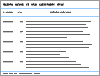
Table 1
Statistics of tested fundamental data on the No. 54 coal seam of the Chengzihe Formation, Xinghua coal mine, Jixi Basin"
| 样品编号 | Ro,max/% | 显微组分含量/% | 工业分析组分含量/% | |||||
|---|---|---|---|---|---|---|---|---|
| 镜质组 | 壳质组 | 惰质组 | 水分 | 灰分 | 挥发分 | 固定碳 | ||
| C54 | 1.76 | 79.30 | 0 | 20.70 | 0.91 | 12.86 | 4.12 | 82.11 |
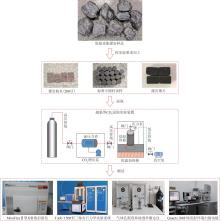
Fig. 1
Test devices used in SC-CO2 soaking and the experimental flow chart"

Table 2
Soaking schemes for tri-axial compression tests on coal samples"
样品 编号 | 实验条件 | 备注 | |||
|---|---|---|---|---|---|
| 围压/MPa | 浸泡压力/MPa | 浸泡 温度/℃ | 浸泡 时间/h | ||
| 1# | 0 | 0 | 常温 | 0 | 无浸泡 |
| 2# | |||||
| 3# | 15 | ||||
| 4# | |||||
| 5# | 30 | ||||
| 6# | |||||
| 7# | 0 | 15 | 60 | 48 | 超临界CO2浸泡 |
| 8# | |||||
| 9# | 15 | ||||
| 10# | |||||
| 11# | 30 | ||||
| 12# | |||||
| 13# | 0 | 0 | 常温 | 48 | 活性水浸泡 |
| 14# | |||||
| 15# | 15 | ||||
| 16# | |||||
| 17# | 30 | ||||
| 18# | |||||

Fig. 2
Stress-strain curves of coal samples under different confining pressures before and after SC-CO2 soaking in tri-axial compression tests"

Table 3
Statistics of average compressive strength and elastic modulus of coal samples before and after soaking using SC-CO2 and active water in tri-axial compression tests"
| 浸泡流体 | 浸泡条件 | 抗压强度/MPa | 弹性模量/GPa | |||
|---|---|---|---|---|---|---|
| 浸泡压力/MPa | 浸泡温度/℃ | 浸泡时间/h | 围压/MPa | |||
| 无 | 0 | 常温 | 0 | 0 | 11.38 | 1.85 |
| 15 | 71.75 | 7.45 | ||||
| 30 | 91.23 | 7.58 | ||||
| 超临界CO2 | 15 | 60 | 48 | 0 | 6.17 | 1.26 |
| 15 | 47.23 | 5.68 | ||||
| 30 | 71.86 | 6.89 | ||||
| 活性水 | 0 | 常温 | 48 | 0 | 7.20 | 1.62 |
| 15 | 62.01 | 6.54 | ||||
| 30 | 84.18 | 7.01 | ||||

Fig. 3
Variation curves of the compressive strength and elastic modulus of coal samples before and after SC-CO2 soaking in tri-axial compression tests"
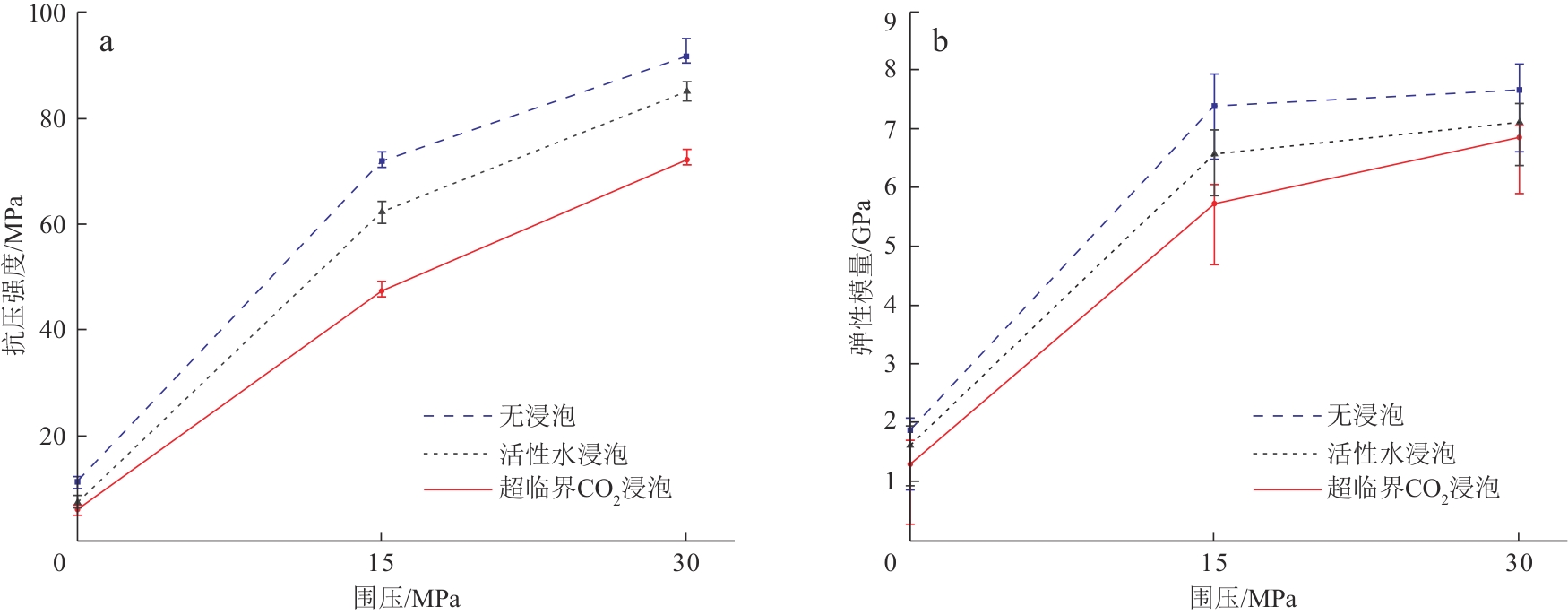

Fig. 4
Variation curves of the degree of degradation of the compressive strength and elastic modulus of coal samples subjected to soaking using SC-CO2 and active water in tri-axial compression tests"

Table 4
Test results of the whole-rock mineralogy of coal samples in tri-axial compression tests"
| 流体类型 | 浸泡 时间/h | 矿物含量/% | |||
|---|---|---|---|---|---|
| 石英 | 方解石 | 菱铁矿 | 黏土矿物 | ||
| 无 | 0 | 39.3 | 13.2 | 4.9 | 42.6 |
| 超临界CO2 | 48 | 41.4 | 11.6 | 4.1 | 42.9 |
| 活性水 | 48 | 39.5 | 12.9 | 4.6 | 43.0 |

Fig. 5
Contents of mineral components in coal samples and their variations in tri-axial compression tests"


Fig. 6
Scanning electron microscope (SEM) images of coal samples before and after SC-CO2 soaking in tri-axial compression tests"

Table 5
Statistics of the porosity and permeability of coal samples before and after soaking using SC-CO2 and active water in tri-axial compression tests"
| 浸泡情况 | 浸泡时间/h | 孔隙度/% | 渗透率/ (10-3 μm2) |
|---|---|---|---|
| 超临界CO2浸泡前 | 0 | 7.02 | 0.028 30 |
| 超临界CO2浸泡后 | 48 | 14.57 | 0.615 52 |
| 120 | 20.79 | 0.811 20 | |
| 活性水浸泡前 | 0 | 3.56 | 0.117 21 |
| 活性水浸泡后 | 48 | 3.43 | 0.100 61 |
| 120 | 2.29 | 0.029 32 |

Fig. 7
Variations in the porosity and permeability of coal samples under varying soaking times in tri-axial compression tests"

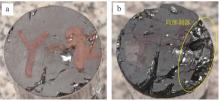
Fig. 8
Images of a cored coal section before and after SC-CO2 soaking in tri-axial compression tests"
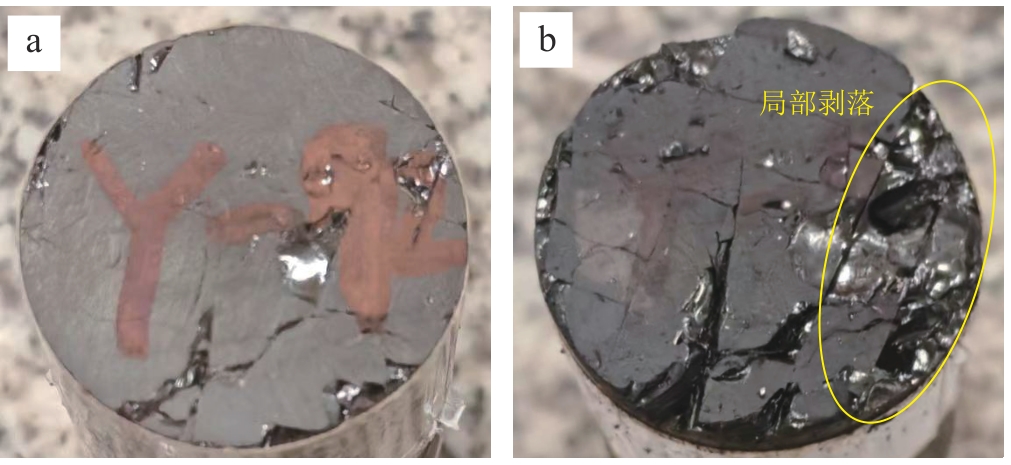

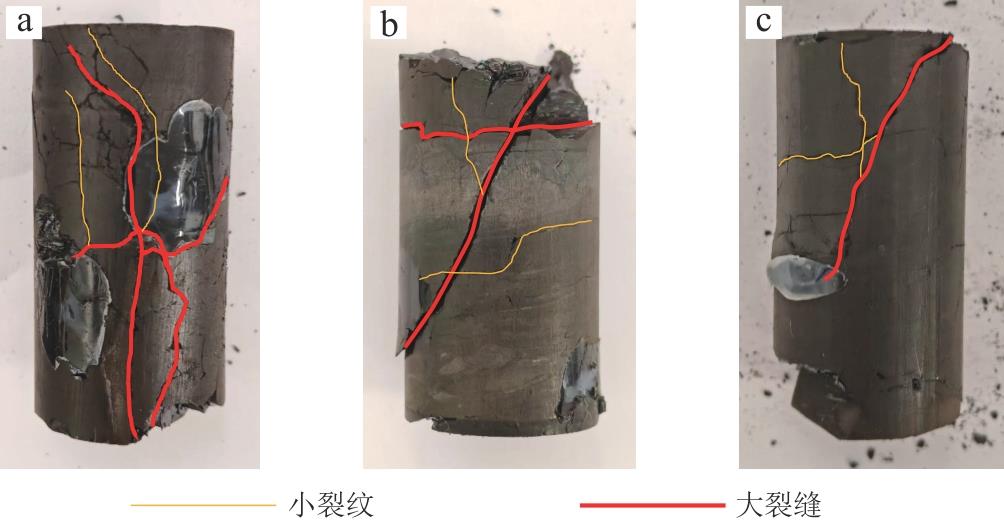
Fig. 9
Fracture morphology of coal samples after SC-CO2 soaking in tri-axial compression tests"
| 1 | 郭旭升, 胡宗全, 李双建, 等. 深层—超深层天然气勘探研究进展与展望[J]. 石油科学通报, 2023, 8(4): 461-474. |
| GUO Xusheng, HU Zongquan, LI Shuangjian, et al. Progress and prospect of natural gas exploration and research in deep and ultra-deep strata[J]. Petroleum Science Bulletin, 2023, 8(4): 461-474. | |
| 2 | 郭旭升, 赵培荣, 申宝剑, 等. 中国深层煤层气地质特征与勘探实践[J]. 石油与天然气地质, 2024, 45(6): 1511-1523. |
| GUO Xusheng, ZHAO Peirong, SHEN Baojian, et al. Geological features and exploration practices of deep coalbed methane in China[J]. Oil & Gas Geology, 2024, 45(6): 1511-1523. | |
| 3 | 徐凤银, 肖芝华, 陈东, 等. 我国煤层气开发技术现状与发展方向[J]. 煤炭科学技术, 2019, 47(10): 205-215. |
| XU Fengyin, XIAO Zhihua, CHEN Dong, et al. Current status and development direction of coalbed methane exploration technology in China[J]. Coal Science and Technology, 2019, 47(10): 205-215. | |
| 4 | 黄中伟, 李国富, 杨睿月, 等. 我国煤层气开发技术现状与发展趋势[J]. 煤炭学报, 2022, 47(9): 3212-3238. |
| HUANG Zhongwei, LI Guofu, YANG Ruiyue, et al. Review and development trends of coalbed methane exploitation technology in China[J]. Journal of China Coal Society, 2022, 47(9): 3212-3238. | |
| 5 | 郭旭升, 周德华, 赵培荣, 等. 鄂尔多斯盆地石炭系-二叠系煤系非常规天然气勘探开发进展与攻关方向[J]. 石油与天然气地质, 2022, 43(5): 1013-1023. |
| GUO Xusheng, ZHOU Dehua, ZHAO Peirong, et al. Progresses and directions of unconventional natural gas exploration and development in the Carboniferous-Permian coal measure strata, Ordos Basin[J]. Oil & Gas Geology, 2022, 43(5): 1013-1023. | |
| 6 | 李勇, 郭涛, 刘欣妍, 等. 中国低煤阶煤层气资源潜力及发展方向[J]. 石油与天然气地质, 2024, 45(6): 1537-1554. |
| LI Yong, GUO Tao, LIU Xinyan, et al. Resource potential and exploration targets of low-rank coalbed methane in China[J]. Oil & Gas Geology, 2024, 45(6): 1537-1554. | |
| 7 | 何发岐, 董昭雄. 深部煤层气资源开发潜力——以鄂尔多斯盆地大牛地气田为例[J]. 石油与天然气地质, 2022, 43(2): 277-285. |
| HE Faqi, DONG Zhaoxiong. Development potential of deep coalbed methane: A case study in the Daniudi Gas Field, Ordos Basin[J]. Oil & Gas Geology, 2022, 43(2): 277-285. | |
| 8 | 吴裕根, 门相勇, 娄钰. 我国 “十四五” 煤层气勘探开发新进展与前景展望[J]. 中国石油勘探, 2024, 29(1): 1-13. |
| WU Yugen, Xiangyong MEN, LOU Yu. New progress and prospect of coalbed methane exploration and development in China during the 14th Five-Year Plan period[J]. China Petroleum Exploration, 2024, 29(1): 1-13. | |
| 9 | 张懿, 朱光辉, 郑求根, 等. 中国煤层气资源分布特征及勘探研究建议[J]. 非常规油气, 2022, 9(4): 1-8, 45. |
| ZHANG Yi, ZHU Guanghui, ZHENG Qiugen, et al. Distribution characteristics of coalbed methane resources in China and recommendations for exploration research[J]. Unconventional Oil & Gas, 2022, 9(4): 1-8, 45. | |
| 10 | 甄怀宾, 张伟强, 吴飞鹏, 等. 煤层水力压裂影响因素数值模拟研究[J]. 非常规油气, 2020, 7(6): 101-106. |
| ZHEN Huaibin, ZHANG Weiqiang, WU Feipeng, et al. Numerical simulation study on influencing factors of hydraulic fracturing of coal seam[J]. Unconventional Oil & Gas, 2020, 7(6): 101-106. | |
| 11 | 张烨, 邓智, 潘林华, 等. 高陡构造区薄-中厚煤层群复合氮气泡沫压裂液研究——以合川地区煤层气为例[J]. 非常规油气, 2021, 8(6): 83-90. |
| ZHANG Ye, DENG Zhi, PAN Linhua, et al. Study on compound nitrogen foam fracturing fluid in thin-medium thick coal seam group in high-steep structure area——Taking coalbed methane in Hechuan area as an example[J]. Unconventional Oil & Gas, 2021, 8(6): 83-90. | |
| 12 | 宋爱莉, 张宸, 陈维余, 等. 悬浮煤粉低伤害压裂液体系研究与应用[J]. 非常规油气, 2021, 8(1): 100-105. |
| SONG Aili, ZHANG Chen, CHEN Weiyu, et al. Research and application of low damage fracturing fluid system for suspended pulverized coal[J]. Unconventional Oil & Gas, 2021, 8(1): 100-105. | |
| 13 | 管保山, 刘玉婷, 刘萍, 等. 煤层气压裂液研究现状与发展[J]. 煤炭科学技术, 2016, 44(5): 11-17, 22. |
| GUAN Baoshan, LIU Yuting, LIU Ping, et al. Present situation and development of coalbed methane fracturing fluid[J]. Coal Science and Technology, 2016, 44(5): 11-17, 22. | |
| 14 | 卢凌云, 张遂安, 郭文朋, 等. 煤层气直井低产原因与高产因素诊断分析[J]. 非常规油气, 2017, 4(5): 71-75. |
| LU Lingyun, ZHANG Suian, GUO Wenpeng, et al. The diagnosis and analysis of the low-yield cause and high-yield factor of vertical well in coalbed methane[J]. Unconventional Oil & Gas, 2017, 4(5): 71-75. | |
| 15 | 陈海汇, 范洪富, 郭建平, 等. 煤层气井水力压裂液分析与展望[J]. 煤田地质与勘探, 2017, 45(5): 33-40. |
| CHEN Haihui, FAN Hongfu, GUO Jianping, et al. Analysis and prospect on hydraulic fracturing fluid used in coalbed methane well[J]. Coal Geology & Exploration, 2017, 45(5): 33-40. | |
| 16 | 何学秋, 田向辉, 宋大钊. 煤层CO2安全封存研究进展与展望[J]. 煤炭科学技术, 2022, 50(1): 212-219. |
| HE Xueqiu, TIAN Xianghui, SONG Dazhao. Progress and expectation of CO2 sequestration safety in coal seams[J]. Coal Science and Technology, 2022, 50(1): 212-219. | |
| 17 | 叶建平, 张兵, 韩学婷, 等. 深煤层井组CO2注入提高采收率关键参数模拟和试验[J]. 煤炭学报, 2016, 41(1): 149-155. |
| YE Jianping, ZHANG Bing, HAN Xueting, et al. Well group carbon dioxide injection for enhanced coalbed methane recovery and key parameter of the numerical simulation and application in deep coalbed methane[J]. Journal of China Coal Society, 2016, 41(1): 149-155. | |
| 18 | 蔡益栋, 李倩, 肖帆, 等. 深部煤-岩组合体力学特征及裂隙扩展规律[J]. 石油与天然气地质, 2024, 45(6): 1686-1704. |
| CAI Yidong, LI Qian, XIAO Fan, et al. Mechanical characteristics and fracture propagation patterns of deep coal-rock assemblages: A case study of the Wuxiang block, Qinshui Basin[J]. Oil & Gas Geology, 2024, 45(6): 1686-1704. | |
| 19 | 管保山, 刘玉婷, 梁利, 等. 煤岩微观结构分析及其与压裂液设计的关系研究[J]. 煤炭科学技术, 2018, 46(6): 178-182. |
| GUAN Baoshan, LIU Yuting, LIANG Li, et al. Study on coal-rock microstructure and it’s relationship with fracturing fluid design[J]. Coal Science and Technology, 2018, 46(6): 178-182. | |
| 20 | 肖畅, 王开, 张小强, 等. 超临界CO2作用后无烟煤力学损伤演化特性及机理[J]. 煤炭学报, 2022, 47(6): 2340-2351. |
| XIAO Chang, WANG Kai, ZHANG Xiaoqiang, et al. Mechanical damage evolution characteristics and mechanism of anthracite treated with supercritical CO2 [J]. Journal of China Coal Society, 2022, 47(6): 2340-2351. | |
| 21 | WANG Hanpeng, LIU Zhongzhong, WANG Su, et al. Experimental study on mechanical properties degradation and acoustic emission characteristics of coal rock caused by CO2 injection[J]. Geotechnical and Geological Engineering, 2022, 40(4): 2063-2075. |
| 22 | 刘力源, 马文成, 王卫东. 超临界CO2吸附诱发煤力学性质劣化的双重损伤效应分析[J]. 山东科技大学学报(自然科学版), 2020, 39(4): 79-86. |
| LIU Liyuan, MA Wencheng, WANG Weidong. Dual damage mechanism of supercritical CO2 adsorption-induced weakening effect on coal[J]. Journal of Shandong University of Science and Technology (Natural Science), 2020, 39(4): 79-86. | |
| 23 | 何立国, 杨栋. 超临界CO2对煤体力学特性劣化影响研究[J]. 矿业研究与开发, 2021, 41(2): 94-99. |
| HE Liguo, YANG Dong. Study on the degradation effect of supercritical CO2 on the coal mechanical properties[J]. Mining Research and Development, 2021, 41(2): 94-99. | |
| 24 | 吴迪, 王翰阳, 苗丰, 等. 超临界CO2作用下CO2渗流特性与煤层增透效果研究[J]. 煤炭科学技术, 2020, 48(10): 90-96. |
| WU Di, WANG Hanyang, MIAO Feng, et al. Seepage characteristics and permeability enhancement effect of coal seam under supercritical CO2 condition[J]. Coal Science and Technology, 2020, 48(10): 90-96. | |
| 25 | YANG Dong, ZENG Qingyou, WANG Lei, et al. Modification characteristics of supercritical carbon dioxide temperature and action time on coal mesostructure[J]. Arabian Journal of Geosciences, 2022, 15(7): 652. |
| 26 | 侯东升, 梁卫国, 张倍宁, 等. CO2驱替煤层CH4中混合气体渗流规律的研究[J]. 煤炭学报, 2019, 44(11): 3463-3471. |
| HOU Dongsheng, LIANG Weiguo, ZHANG Beining, et al. Seepage law of mixed gases in CO2 displacement of coal seam CH4 [J]. Journal of China Coal Society, 2019, 44(11): 3463-3471. | |
| 27 | ZHANG Guanglei, RANJITH P G, Qiao LYU. Direct evidence of CO2 softening effects on coal using nanoindentation[J]. Energy, 2022, 254(Part A): 124221. |
| 28 | 闫霞, 徐凤银, 聂志宏, 等. 深部微构造特征及其对煤层气高产“甜点区”的控制——以鄂尔多斯盆地东缘大吉地区为例[J]. 煤炭学报, 2021, 46(8): 2426-2439. |
| YAN Xia, XU Fengyin, NIE Zhihong, et al. Microstructure characteristics of Daji area in east Ordos Basin and its control over the high yield dessert of CBM[J]. Journal of China Coal Society, 2021, 46(8): 2426-2439. | |
| 29 | 姚红生, 陈贞龙, 何希鹏, 等. 深部煤层气“有效支撑”理念及创新实践——以鄂尔多斯盆地延川南煤层气田为例[J]. 天然气工业, 2022, 42(6): 97-106. |
| YAO Hongsheng, CHEN Zhenlong, HE Xipeng, et al. “Effective support” concept and innovative practice of deep CBM in South Yanchuan Gas Field of the Ordos Basin[J]. Natural Gas Industry, 2022, 42(6): 97-106. | |
| 30 | 张慧梅, 夏浩峻, 张嘉凡, 等. 长期浸润状态下煤岩损伤机制研究[J]. 岩土工程学报, 2024, 46(6): 1206-1214. |
| ZHANG Huimei, XIA Haojun, ZHANG Jiafan, et al. Damage evolution mechanism of coal rock under long-term soaking[J]. Chinese Journal of Geotechnical Engineering, 2024, 46(6): 1206-1214. | |
| 31 | 张登峰, 李超, 李艳红, 等. 封存过程中CO2流体与煤中矿物作用关系研究进展[J]. 安全与环境学报, 2020, 20(1): 297-309. |
| ZHANG Dengfeng, LI Chao, LI Yanhong, et al. Research review on the interaction of CO2 fluid with the minerals in the process of CO2 sequestration in coal seams[J]. Journal of Safety and Environment, 2020, 20(1): 297-309. | |
| 32 | JIANG Renxia, YU Hongguan. Interaction between sequestered supercritical CO2 and minerals in deep coal seams[J]. International Journal of Coal Geology, 2019, 202: 1-13. |
| 33 | 刘佳佳, 聂子硕, 于宝种, 等. 超临界二氧化碳对煤体增透的作用机理及影响因素分析[J]. 煤炭科学技术, 2023, 51(2): 204-216. |
| LIU Jiajia, NIE Zishuo, YU Baozhong, et al. Analysis of the mechanism and influencing factors of supercritical carbon dioxide on coal permeability enhancement[J]. Coal Science and Technology, 2023, 51(2): 204-216. |
| [1] | Wei TIAN, Zhongchao LI, Chuanmou YU, Hongyan HAN, Kaicheng WANG, Liqiang GUO, Kun WANG, Xiao YANG. Threshold pressure gradient characteristics and drainage radius determination of low-permeability reservoirs [J]. Oil & Gas Geology, 2025, 46(3): 959-966. |
| [2] | Liu YANG, Fei GONG, Xiaoyu JIANG, Zhaoyang LIU, Guangtao DONG, Jiawei CAI. Mechanisms behind CO2-brine-Sandy Conglomerate interactions and resulting variations in mineral components, fluid occurrence, and pores: A case study of the Mahu Sag, Junggar Basin [J]. Oil & Gas Geology, 2025, 46(3): 967-982. |
| [3] | Jiahao KANG, Xingzhi WANG, Deming ZENG, Zisang HUANG, Yiqing ZHU, Bo LI, Shengyang XIE, Rui ZHANG. Effects of lithofacies on pore structure characteristics and evolution of lacustrine shales: A case study of the Jurassic Da’anzhai Member, central Sichuan Basin [J]. Oil & Gas Geology, 2025, 46(2): 491-509. |
| [4] | Xinpei WANG, Chenglin LIU, Liwei JIANG, Dehao FENG, Chen ZOU, Fei LIU, Junjun LI, Yubo HE, Mingxiang DONG, Pengfei JIAO. Pore microstructure and its controlling effects on gas content of deep shale reservoirs in the Wufeng-Longmaxi formations, Da'an area, western Chongqing [J]. Oil & Gas Geology, 2025, 46(1): 230-245. |
| [5] | Zhongqun LIU, Ying JIA, Bin LIANG, Chong CHEN, Jun NIU, Yabing GUO, Qingyan YU, Qian LI. Microscopic analysis of gas and water retention mechanisms and CO2 injection for enhanced gas recovery of tight sandstones: A case study of the Daniudi gas field, Ordos Basin [J]. Oil & Gas Geology, 2025, 46(1): 261-272. |
| [6] | Xusheng GUO, Peirong ZHAO, Baojian SHEN, Zengqin LIU, Bing LUO, Shihu ZHAO, Jiaqi ZHANG, Jiayuan HE, Weishu FU, Haipeng WEI, Jiong LIU, Xinjun CHEN, Jincheng YE. Geological features and exploration practices of deep coalbed methane in China [J]. Oil & Gas Geology, 2024, 45(6): 1511-1523. |
| [7] | Yahui LI. Exploration practices of and recent production breakthroughs in deep middle-rank coalbed methane in the Daniudi gas field,Ordos Basin [J]. Oil & Gas Geology, 2024, 45(6): 1555-1566. |
| [8] | Faqi HE, Tao LEI, Rong QI, Bingwei XU, Xiaohui LI, Ru ZHANG. Breakthroughs and key technology in deep coalbed methane exploration in the Daniudi gas field in the Ordos Basin [J]. Oil & Gas Geology, 2024, 45(6): 1567-1576. |
| [9] | Shihu ZHAO, Zengqin LIU, Baojian SHEN, Bing LUO, Gang CHEN, Xinjun CHEN, Jiaqi ZHANG, Junyu WAN, Ziyi LIU, Youxiang LIU. Geological characteristics and exploration potential of deep coalbed methane in the slope area of the northeastern Ordos Basin [J]. Oil & Gas Geology, 2024, 45(6): 1628-1639. |
| [10] | Pengwei MOU, Peijie LI, Yanbin YAO, Dameng LIU, Limin MA, Xiaoxiao SUN, Yongkai QIU. In-situ stress in deep coal seams and its control on reservoir physical properties in the Jiaxian area, Ordos Basin [J]. Oil & Gas Geology, 2024, 45(6): 1640-1652. |
| [11] | Long WEN, Ying MING, Haofei SUN, Benjian ZHANG, Xiao CHEN, Shida CHEN, Song LI, Haiqi LI. Geological characteristics and exploration potential of deep coalbed methane in the Permian Longtan Formation, Sichuan Basin: A case study of well NT1H [J]. Oil & Gas Geology, 2024, 45(6): 1678-1685. |
| [12] | Duo WANG, Zhidi LIU, Chengwang WANG, Tianding LIU, Gaojie CHEN, Jinmei HAO, Bowen SUN. Logging-based evaluation for geological-engineering sweet spots in deep coal reservoirs of the DJ block, Ordos Basin [J]. Oil & Gas Geology, 2024, 45(6): 1772-1788. |
| [13] | Zhuang RUAN, Rui XU, Jie WANG, Qiuhong CHANG, Dahua WANG, Jiandong WANG, Guangqing ZHOU, Bingsong YU. Micro-pore structure characteristics of the Paleogene sandstone reservoirs and genesis of microscopic tight zones in the Mahaidong area, Qaidam Basin [J]. Oil & Gas Geology, 2024, 45(4): 1032-1045. |
| [14] | Yibo LI, Yaowang CHEN, Jinzhou ZHAO, Zhiqiang WANG, Bing WEI, Kadet Valeriy. Interaction mechanism between supercritical carbon dioxide and shale [J]. Oil & Gas Geology, 2024, 45(4): 1180-1194. |
| [15] | Zaihua HAN, Hua LIU, Lanquan ZHAO, Jingdong LIU, Lijuan YIN, Lei LI. Source rock-reservoir assemblage types and differential oil enrichment model in tight (low-permeability) sandstone reservoirs in the Paleocene Shahejie Formation in the Linnan Sub-sag, Bohai Bay Basin [J]. Oil & Gas Geology, 2024, 45(3): 722-738. |
| Viewed | ||||||
|
Full text |
|
|||||
|
Abstract |
|
|||||
