

Oil & Gas Geology ›› 2025, Vol. 46 ›› Issue (3): 995-1005.doi: 10.11743/ogg20250320
• Methods and Technologies • Previous Articles Next Articles
Liang HUANG1,2,3( ), Zhenyao XU2, Qiujie CHEN2, Baohua TIAN2, Qin YANG2, Xinni FENG2, Zishuo QU2, Zhe YANG2, Sirun AN2
Received:2024-10-16
Revised:2025-05-15
Online:2025-06-30
Published:2025-06-26
CLC Number:
Liang HUANG, Zhenyao XU, Qiujie CHEN, Baohua TIAN, Qin YANG, Xinni FENG, Zishuo QU, Zhe YANG, Sirun AN. Molecular simulation of methane adsorption/desorption characteristics of deformed kerogen in shales[J]. Oil & Gas Geology, 2025, 46(3): 995-1005.
Add to citation manager EndNote|Reference Manager|ProCite|BibTeX|RefWorks
Table 1
Relaxation process of the kerogen model"
| 步骤 | 系综 | 温度/K | 压力/MPa | 密度/(g/cm3) | 模拟时间/ps |
|---|---|---|---|---|---|
| 1 | NVT | 300 | — | 0.100 | 100 |
| 2 | NVT | 300 ~ 1 000 | — | 0.100 | 100 |
| 3 | NVT | 1 000 | — | 0.100 | 100 |
| 4 | NPT | 700 ~ 1 000 | 10.0 | 0.100 ~ 1.130 | 100 |
| 5 | NPT | 500 ~ 700 | 10.0 | 1.130 ~ 1.180 | 100 |
| 6 | NPT | 300 ~ 500 | 10.0 | 1.180 ~ 1.210 | 100 |
| 7 | NPT | 300 | 0.1 ~ 10.0 | 1.210 ~ 1.220 | 100 |
| 8 | NPT | 300 | 0.1 | 1.220 ± 0.004 | 300 |

Fig.1
Structural relaxation and annealing of the nanopore model of kerogen"

Table 2
Parameters of the polymer consistent force field (PCFF) in the model of kerogen"
| 分子类型 | 原子类型 | ε/(kcal/mol) | σ/Å |
|---|---|---|---|
| 干酪根 | oc | 0.240 | 3.535 |
| c5 | 0.064 | 4.010 | |
| cp | 0.064 | 4.010 | |
| npc | 0.134 | 4.070 | |
| c2 | 0.054 | 4.010 | |
| hc | 0.020 | 2.995 | |
| cs | 0.064 | 4.010 | |
| c1 | 0.054 | 4.010 | |
| sp | 0.071 | 4.027 | |
| nh | 0.134 | 4.070 | |
| hn | 0.013 | 1.098 | |
| np | 0.041 | 3.570 | |
| c3 | 0.054 | 4.010 | |
| 甲烷 | c | 0.054 | 4.010 |
| hc | 0.020 | 2.995 |

Fig.2
Pore structures of kerogen"


Fig.3
Validation results of the methane model and adsorption simulation method"
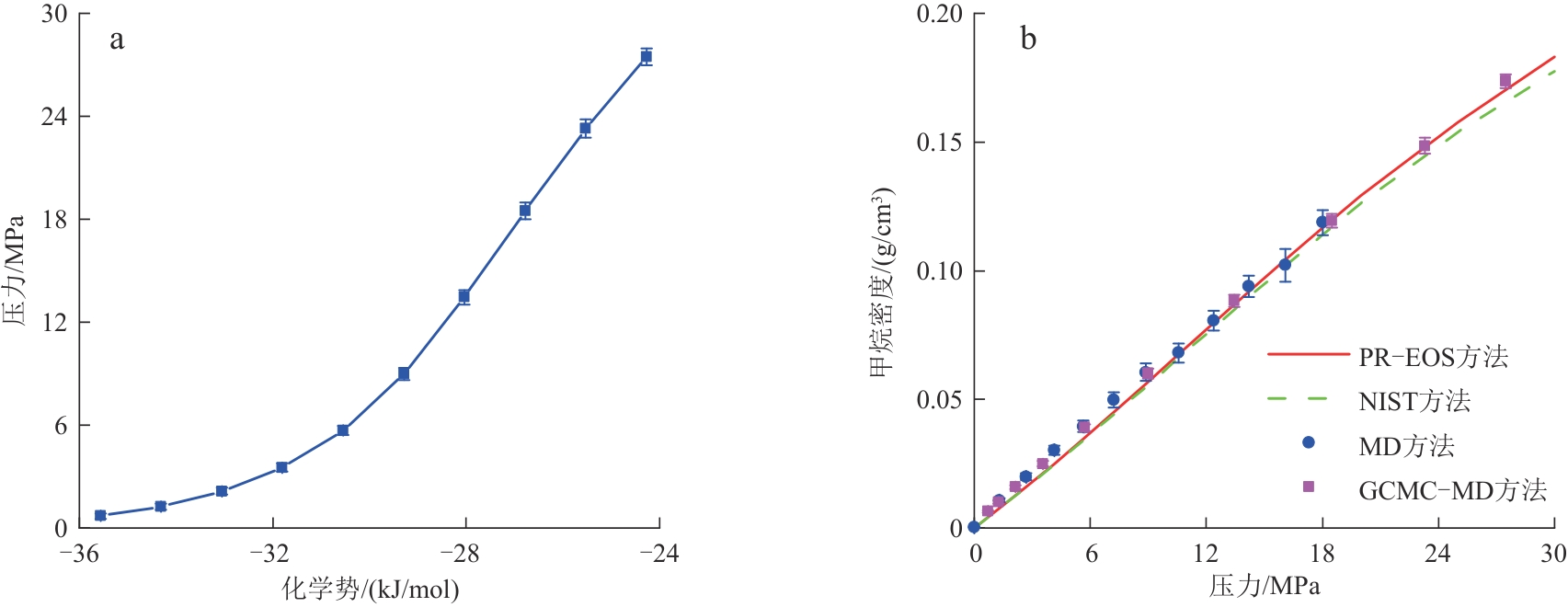
Table 3
Pore structure parameters of kerogen under varying pressures"
| 压力/MPa | 模型体积/Å3 | 孔隙度/% | 孔隙比表面积/(m2/g) |
|---|---|---|---|
| 0.10 | 101 310 ± 206 | 16.4 ± 0.3 | 567.1 ± 15.4 |
| 10.13 | 100 911 ± 197 | 15.9 ± 0.2 | 545.1 ± 8.2 |
| 20.27 | 100 463 ± 251 | 15.7 ± 0.4 | 533.1 ± 18.2 |
| 30.40 | 100 188 ± 218 | 14.9 ± 0.3 | 505.8 ± 11.0 |
| 20.27 | 100 373 ± 206 | 15.2 ± 0.2 | 512.3 ± 4.4 |
| 10.13 | 100 543 ± 222 | 15.7 ± 0.3 | 534.3 ± 14.5 |
| 0.10 | 100 842 ± 373 | 16.1 ± 0.2 | 550.9 ± 7.0 |

Fig.4
Kerogen pore structures under varying pressures"

Fig.5
Characteristics of methane adsorption-induced kerogen deformation"
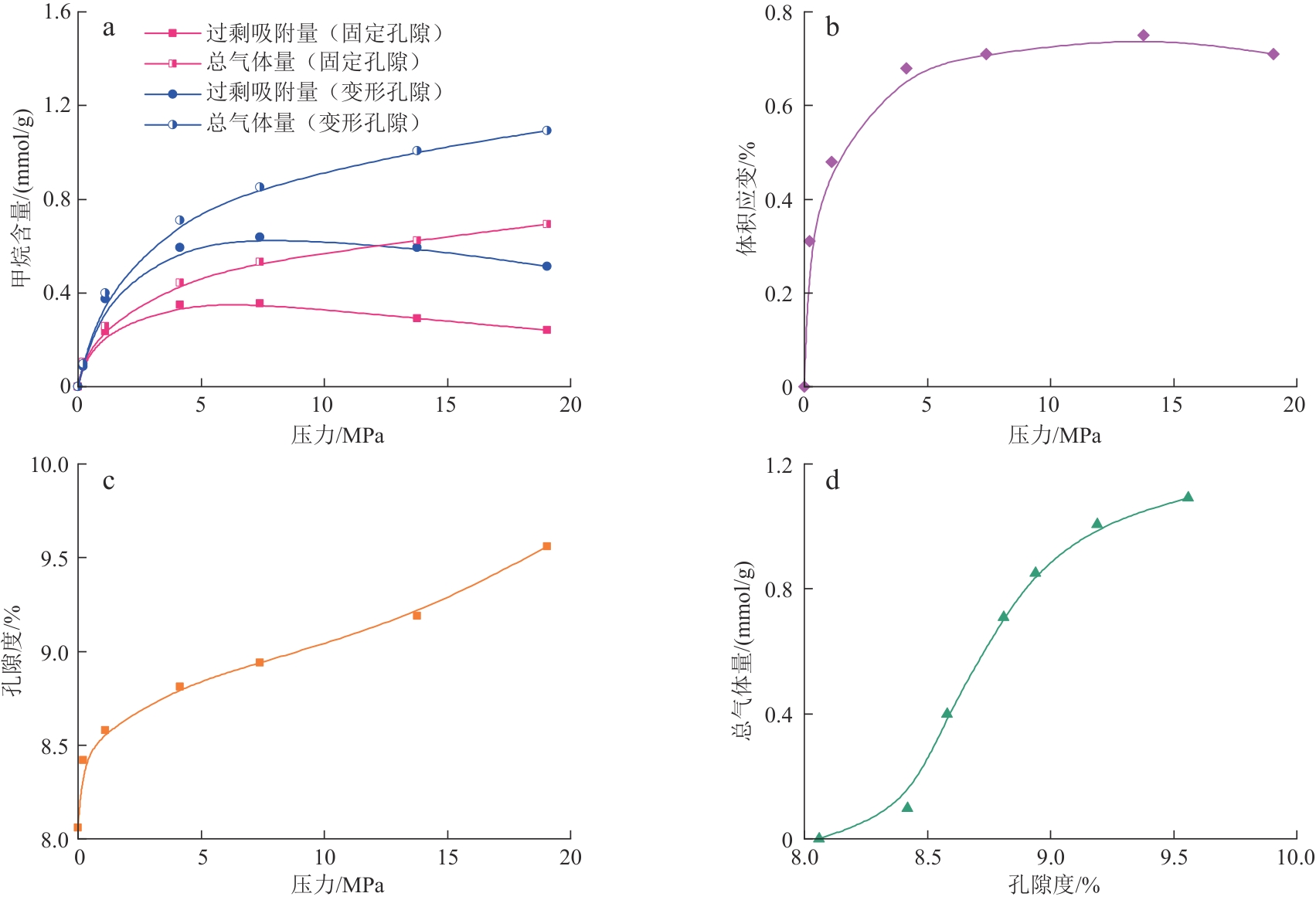

Fig.6
Pore and void structures of kerogen under varying fluid pressures"
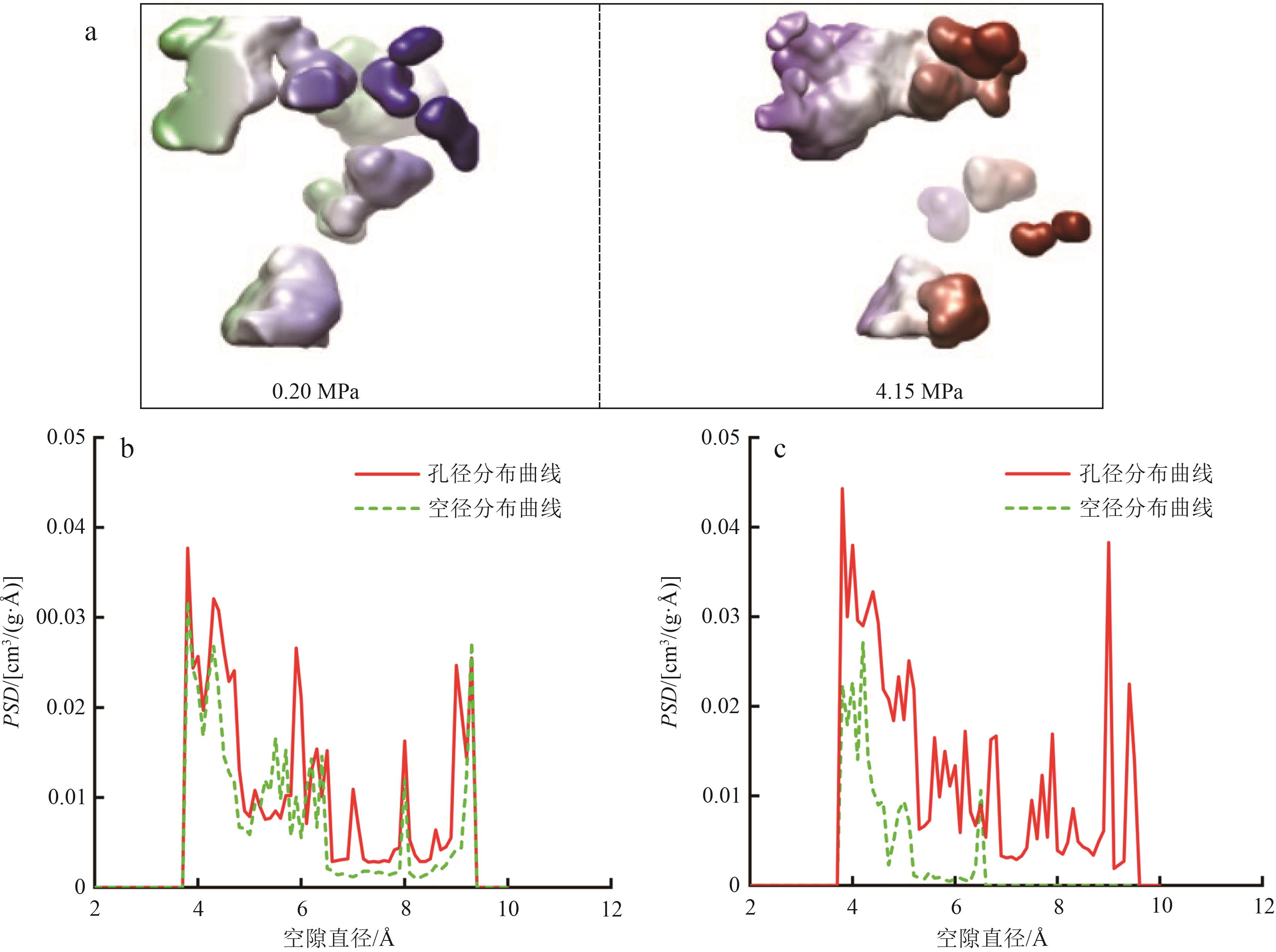
Table 4
Void parameters of kerogen under varying fluid pressures"
| 压力/MPa | 空隙分数/% | 空隙比表面积/(m2/g) |
|---|---|---|
| 0 | 8.1 ± 0.4 | 188.7 ± 12.1 |
| 0.20 | 7.6 ± 0.2 | 177.1 ± 5.2 |
| 1.11 | 5.8 ± 0.3 | 131.7 ± 9.4 |
| 4.15 | 4.1 ± 0.2 | 79.6 ± 13.0 |
| 7.40 | 3.6 ± 0.3 | 70.0 ± 8.9 |
| 13.78 | 2.6 ± 0.1 | 43.7 ± 15.7 |
| 19.05 | 2.4 ± 0.4 | 37.5 ± 5.7 |

Fig.7
Methane adsorption/desorption curves of fixed (a) and deformed (b) pores in kerogen"

| 1 | 王红岩, 周尚文, 赵群, 等. 川南地区深层页岩气富集特征、勘探开发进展及展望[J]. 石油与天然气地质, 2023, 44(6): 1430-1441. |
| WANG Hongyan, ZHOU Shangwen, ZHAO Qun, et al. Enrichment characteristics, exploration and exploitation progress, and prospects of deep shale gas in the southern Sichuan Basin, China[J]. Oil & Gas Geology, 2023, 44(6): 1430-1441. | |
| 2 | 邹才能, 董大忠, 熊伟, 等. 中国页岩气新区带、新层系和新类型勘探进展、挑战及对策[J]. 石油与天然气地质, 2024, 45(2): 309-326. |
| ZOU Caineng, DONG Dazhong, XIONG Wei, et al. Advances, challenges, and countermeasures in shale gas exploration of underexplored plays, sequences and new types in China[J]. Oil & Gas Geology, 2024, 45(2): 309-326. | |
| 3 | 张益, 张斌, 刘帮华, 等. 页岩气储层吸附渗流研究现状及发展趋势[J]. 石油与天然气地质, 2024, 45(1): 256-280. |
| ZHANG Yi, ZHANG Bin, LIU Banghua,et al. Status quo and development trends of research on shale gas adsorption and seepage in shale gas reservoirs[J]. Oil & Gas Geology, 2024, 45(1): 256-280. | |
| 4 | FROIDL F, LITTKE R, GROHMANN S, et al. Kerogen composition and origin, oil and gas generation potential of the Berriasian Wealden Shales of the Lower Saxony Basin[J]. International Journal of Coal Geology, 2021, 246: 103831. |
| 5 | WANG F P, REED R M, JOHN A, et al. Pore networks and fluid flow in gas shales[C]//SPE Annual Technical Conference and Exhibition, New Orleans, 2009. Richardson: Society of Petroleum Engineers, 2009: SPE-124253-MS. |
| 6 | HUANG Liang, ZHOU Wen, XU Hao, et al. Dynamic fluid states in organic-inorganic nanocomposite: Implications for shale gas recovery and CO2 sequestration[J]. Chemical Engineering Journal, 2021, 411: 128423. |
| 7 | 辛晓知. 页岩气解吸规律研究[D]. 北京: 中国石油大学(北京), 2016. |
| XIN Xiaozhi. Law of shale gas desorption[D]. Beijing: China University of Petroleum (Beijing), 2016. | |
| 8 | ZHAO Huangjing, LAI Zhiping, FIROOZABADI A. Sorption hysteresis of light hydrocarbons and carbon dioxide in shale and kerogen[J]. Scientific Reports, 2017, 7(1): 16209. |
| 9 | ZHAO Huangjing, WU Tianhao, FIROOZABADI A. High pressure sorption of various hydrocarbons and carbon dioxide in Kimmeridge Blackstone and isolated kerogen[J]. Fuel, 2018, 224: 412-423. |
| 10 | WU Tianhao, ZHAO Huangjing, TESSON S, et al. Absolute adsorption of light hydrocarbons and carbon dioxide in shale rock and isolated kerogen[J]. Fuel, 2019, 235: 855-867. |
| 11 | BHOWMIK S, DUTTA P. A study on the effect of gas shale composition and pore structure on methane sorption[J]. Journal of Natural Gas Science and Engineering, 2019, 62: 144-156. |
| 12 | GUO Wei, XIONG Wei, GAO Shusheng, et al. Impact of temperature on the isothermal adsorption/desorption of shale gas[J]. Petroleum Exploration and Development, 2013, 40(4): 514-519. |
| 13 | LI Aifen, HAN Wencheng, FANG Qi, et al. Experimental investigation of methane adsorption and desorption in water-bearing shale[J]. Capillarity, 2020, 3(3): 45-55. |
| 14 | WANG Man, ZHANG Dengfeng. Influences of moisture on adsorption and desorption of methane on gas shales[J]. Energy Sources, Part A: Recovery, Utilization, and Environmental Effects, 2024, 46(1): 12556-12574. |
| 15 | EKUNDAYO J M, REZAEE R, FAN Chunyan. Experimental investigation and mathematical modelling of shale gas adsorption and desorption hysteresis[J]. Journal of Natural Gas Science and Engineering, 2021, 88: 103761. |
| 16 | 关富佳, 张杰, 王海涛, 等. 川东龙马溪组页岩解吸滞后现象实验研究[J]. 西安石油大学学报(自然科学版), 2017, 32(1): 71-74, 82. |
| GUAN Fujia, ZHANG Jie, WANG Haitao, et al. Experimental study on desorption hysteresis of longmaxi formation shale in eastern Sichuan[J]. Journal of Xi’an Shiyou University (Natural Science Edition), 2017, 32(1): 71-74, 82. | |
| 17 | 黄亮, 陈秋桔, 吴建发, 等. 深层页岩伊利石中甲烷吸附特征分子模拟[J]. 中南大学学报(自然科学版), 2022, 53(9): 3522-3531. |
| HUANG Liang, CHEN Qiujie, WU Jianfa, et al. Molecular simulation of methane adsorption characteristics in illite nanopores of deep shale reservoirs[J]. Journal of Central South University (Science and Technology), 2022, 53(9): 3522-3531. | |
| 18 | 杨琴, 黄亮, 周文, 等. 深层页岩伊利石孔隙中甲烷吸附相密度特征[J]. 断块油气田, 2023, 30(5): 799-807. |
| YANG Qin, HUANG Liang, ZHOU Wen, et al. Adsorption phase density characteristics of methane in illite pores of deep shale[J]. Fault-Block Oil and Gas Field, 2023, 30(5): 799-807. | |
| 19 | 黄亮, 冯鑫霓, 杨琴, 等. 深层页岩干酪根纳米孔隙中甲烷微观赋存特征[J]. 石油钻探技术, 2023, 51(5): 112-120. |
| HUANG Liang, FENG Xinni, YANG Qin, et al. Microscopic occurrence characteristics of methane in kerogen nanopores of deep shale reservoirs[J]. Petroleum Drilling Techniques, 2023, 51(5): 112-120. | |
| 20 | 黄亮, 杨琴, 吴建发, 等. 深层页岩纳米孔隙中气水微观动用机理[J]. 天然气工业, 2024, 44(1): 139-148. |
| HUANG Liang, YANG Qin, WU Jianfa, et al. Microscopic mobilization mechanism of gas and water in deep shale nanopores[J]. Natural Gas Industry, 2024, 44(1): 139-148. | |
| 21 | 黄亮, 宁正福, 王庆, 等. 湿度对CH4/CO2在干酪根中吸附的影响: 分子模拟研究[J]. 石油科学通报, 2017, 2(3): 422-430. |
| HUANG Liang, NING Zhengfu, WANG Qing, et al. Effect of moisture on CH4/CO2 adsorption on kerogen: A molecular simulation study[J]. Petroleum Science Bulletin, 2017, 2(3): 422-430. | |
| 22 | 杨建, 詹国卫, 赵勇, 等. 川南深层页岩气超临界吸附解吸附特征研究[J]. 油气藏评价与开发, 2021, 11(2): 184-189, 196. |
| YANG Jian, ZHAN Guowei, ZHAO Yong, et al. Characteristics of supercritical adsorption and desorption of deep shale gas in South Sichuan[J]. Petroleum Reservoir Evaluation and Development, 2021, 11(2): 50-55. | |
| 23 | HUANG Liang, NING Zhengfu, WANG Qing, et al. Effect of organic type and moisture on CO2/CH4 competitive adsorption in kerogen with implications for CO2 sequestration and enhanced CH4 recovery[J]. Applied Energy, 2018, 210: 28-43. |
| 24 | HUANG Liang, NING Zhengfu, WANG Qing, et al. Molecular simulation of adsorption behaviors of methane, carbon dioxide and their mixtures on kerogen: Effect of kerogen maturity and moisture content[J]. Fuel, 2018, 211: 159-172. |
| 25 | TESSON S, FIROOZABADI A. Methane adsorption and self-diffusion in shale kerogen and slit nanopores by molecular simulations[J]. The Journal of Physical Chemistry C, 2018, 122(41): 23528-23542. |
| 26 | VASILEIADIS M, PERISTERAS L D, PAPAVASILEIOU K D, et al. Transport properties of shale gas in relation to kerogen porosity[J]. The Journal of Physical Chemistry C, 2018, 122(11): 6166-6177. |
| 27 | FENG Feng, AKKUTLU I Y. Flow of hydrocarbons in nanocapillary: A non-equilibrium molecular dynamics study[C]//SPE Asia Pacific Unconventional Resources Conference and Exhibition, Brisbane, 2015. Richardson: Society of Petroleum Engineers, 2015: SPE-177005-MS. |
| 28 | WU Tianhao, FIROOZABADI A. Methane flow in shale nanopores with kerogen microstructure by molecular simulations[C]//SPE Annual Technical Conference and Exhibition, Dallas, 2018. Richardson: Society of Petroleum Engineers, 2018: SPE-191686-MS. |
| 29 | 黄海帆. 基于分子模拟的页岩气吸附与解吸数值模拟研究[D]. 贵阳: 贵州大学, 2017. |
| HUANG Haifan. Numerical simulation of shale gas adsorption and desorption based on molecular simulation[D]. Guiyang: Guizhou University, 2017. | |
| 30 | UNGERER P, COLLELL J, YIANNOURAKOU M. Molecular modeling of the volumetric and thermodynamic properties of kerogen: Influence of organic type and maturity[J]. Energy & Fuels, 2015, 29(1): 91-105. |
| 31 | 王民, 余昌琦, 费俊胜, 等. 页岩油在干酪根中吸附行为的分子动力学模拟与启示[J]. 石油与天然气地质, 2023, 44(6): 1442-1452. |
| WANG Min, YU Changqi, FEI Junsheng, et al. Molecular dynamics simulation of shale oil adsorption in kerogen and its implications[J]. Oil & Gas Geology, 2023, 44(6): 1442-1452. | |
| 32 | 吕方涛, 宁正福, 康瑛, 等. 古龙油页岩干酪根热解特性分子动力学模拟[J]. 大庆石油地质与开发, 2024, 43(6): 1-10. |
| Fangtao LYU, NING Zhengfu, KANG Ying, et al. Molecular dynamics simulation of kerogen pyrolysis of Gulong shale[J]. Petroleum Geology & Oilfield Development in Daqing, 2024, 43(6): 1-10. | |
| 33 | ZHAO Tianyi, LI Xiangfang, ZHAO Huawei, et al. Molecular simulation of adsorption and thermodynamic properties on type II kerogen: Influence of maturity and moisture content[J]. Fuel, 2017, 190: 198-207. |
| 34 | COLLELL J, UNGERER P, GALLIERO G, et al. Molecular simulation of bulk organic matter in type II shales in the middle of the oil formation window[J]. Energy & Fuels, 2014, 28(12): 7457-7466. |
| 35 | HO T A, WANG Yifeng, CRISCENTI L J. Chemo-mechanical coupling in kerogen gas adsorption/desorption[J]. Physical Chemistry Chemical Physics, 2018, 20(18): 12390-12395. |
| 36 | GELB L D, GUBBINS K E. Pore size distributions in porous glasses: A computer simulation study[J]. Langmuir, 1999, 15(2): 305-308. |
| 37 | VOSS N R, GERSTEIN M. 3V: cavity, channel and cleft volume calculator and extractor[J]. Nucleic Acids Research, 2010, 38(S2): W555-W562. |
| 38 | THOMMES M, KANEKO K, NEIMARK A V, et al. Physisorption of gases, with special reference to the evaluation of surface area and pore size distribution (IUPAC Technical Report)[J]. Pure and Applied Chemistry, 2015, 87(9/10): 1051-1069. |
| 39 | MÜLLER E A, RULL L F, VEGA L F, et al. Adsorption of water on activated carbons: A molecular simulation study[J]. The Journal of Physical Chemistry, 1996, 100(4): 1189-1196. |
| 40 | STRIOLO A, CHIALVO A A, CUMMINGS P T, et al. Water adsorption in carbon-slit nanopores[J]. Langmuir, 2003, 19(20): 8583-8591. |
| [1] | Zongquan HU, Qianru WANG, Baojian SHEN, Dongjun FENG, Wei DU, Chuanxiang SUN. Classification and characteristics of pores in marine shale gas reservoirs in the Lower Paleozoic Wufeng-Longmaxi formations, Sichuan Basin [J]. Oil & Gas Geology, 2025, 46(3): 705-718. |
| [2] | Zhijun JIN, Guangxiang LIU, Pengwei WANG, Haikuan NIE, Min LI, Guanping WANG. Exploration potential and targets of the Permian shale gas in the Yangtze region, South China [J]. Oil & Gas Geology, 2025, 46(2): 335-347. |
| [3] | Shujing BAO, Mingna GE, Peirong ZHAO, Tianxu GUO, Bo GAO, Shizhen LI, Jiaqi ZHANG, Tuo LIN, Kun YUAN, Fei LI. Status-quo, potential, and recommendations on shale gas exploration and exploitation in China [J]. Oil & Gas Geology, 2025, 46(2): 348-364. |
| [4] | Guili MA, Junqing CHEN, Changtao YUE, Yue MA, Yuying WANG, Hong PANG, Fujie JIANG, Xungang HUO. Molecular structure and hydrocarbon generation characteristics of kerogen in low-maturity shales: A case of the Paleocene Shahejie Formation in Shuguang area, Liaohe Depression, Bohai Bay Basin [J]. Oil & Gas Geology, 2025, 46(2): 427-442. |
| [5] | Shuangbiao HAN, Jin WANG, Jie HUANG, Chengshan WANG. Adsorption characteristics and occurrence pattern of natural hydrogen in a continental scientific drilling well of the Songliao Basin [J]. Oil & Gas Geology, 2025, 46(2): 462-477. |
| [6] | Runwei QIAO, Shicheng ZHANG, Jinwei WANG, Fei WANG, Fengxia LI, Ning LI. Retrograde condensation and hydrocarbon flow characteristics in condensate shale gas reservoirs [J]. Oil & Gas Geology, 2025, 46(2): 617-629. |
| [7] | Xianjun TANG, Honghao ZHU, Ning LI, Yixin YU, Rongquan ZHONG, Lang YU. Segmented differential deformation of inverted anticlines and its significance on hydrocarbon accumulation in the Ningbo structural zone, Xihu Sag, East China Sea Shelf Basin [J]. Oil & Gas Geology, 2025, 46(1): 167-177. |
| [8] | Xinpei WANG, Chenglin LIU, Liwei JIANG, Dehao FENG, Chen ZOU, Fei LIU, Junjun LI, Yubo HE, Mingxiang DONG, Pengfei JIAO. Pore microstructure and its controlling effects on gas content of deep shale reservoirs in the Wufeng-Longmaxi formations, Da'an area, western Chongqing [J]. Oil & Gas Geology, 2025, 46(1): 230-245. |
| [9] | Wenxi REN, Xiaojun ZENG, Guangfu WANG, Jianchun GUO, Yuxuan LIU. Molecular simulations of a multicomponent hydrocarbon-water mixture in the organic matter-clay mineral composite pore system of lacustrine shales: A case study of the Da’anzhai Member of the Jurassic Ziliujing Formation, Sichuan Basin [J]. Oil & Gas Geology, 2025, 46(1): 304-314. |
| [10] | Shihu ZHAO, Zengqin LIU, Baojian SHEN, Bing LUO, Gang CHEN, Xinjun CHEN, Jiaqi ZHANG, Junyu WAN, Ziyi LIU, Youxiang LIU. Geological characteristics and exploration potential of deep coalbed methane in the slope area of the northeastern Ordos Basin [J]. Oil & Gas Geology, 2024, 45(6): 1628-1639. |
| [11] | Shengxian ZHAO, Yong LIU, Bo LI, Xin CHEN, Dongchen LIU, Meixuan YIN, Ying CHANG, Rui JIANG. Characteristics and patterns of the pore connectivity in shale gas reservoirs in the Wufeng-Longmaxi formations, Luzhou block, Sichuan Basin [J]. Oil & Gas Geology, 2024, 45(6): 1720-1735. |
| [12] | Shang DENG, Huabiao QIU, Dawei LIU, Jun HAN, Zhixing RU, Weilong PENG, Qing BIAN, Cheng HUANG. Advances in research on the genetic mechanisms of intracratonic strike-slip fault system and their control on hydrocarbon accumulation: A case study of the northern Tarim Basin [J]. Oil & Gas Geology, 2024, 45(5): 1211-1225. |
| [13] | Qin ZHANG, Zhen QIU, Qun ZHAO, Dazhong DONG, Wen LIU, Weiliang KONG, Zhenglian PANG, Wanli GAO, Guangyin CAI, Yongzhou LI, Xingtao LI, Wenji LIN. Different characteristics and formation mechanisms of transitional and marine shale gas sweet spots [J]. Oil & Gas Geology, 2024, 45(5): 1400-1416. |
| [14] | Qin ZHANG, Donglian LU, Kai WANG, Chang LIU, Mingqiang GUO, Mengjie ZHANG, Chaojie GUO, Ying WANG, Wenzhong HU, Xiaomin ZHU. Lithofacies classification and microscopic pore characteristics of fine-grained sedimentary rocks in the Hetang Formation, Lower Yangtze region [J]. Oil & Gas Geology, 2024, 45(4): 1089-1105. |
| [15] | Yuehao YE, Wei CHEN, Hua WANG, Jinmin SONG, Ying MING, Xin DAI, Zhiwu LI, Haofei SUN, Xiaogang MA, Tingting LIU, Hui TANG, Shugen LIU. Characteristics and determinants of shale reservoirs in the Upper Permian Dalong Formation, Sichuan Basin [J]. Oil & Gas Geology, 2024, 45(4): 979-991. |
| Viewed | ||||||
|
Full text |
|
|||||
|
Abstract |
|
|||||
