

Oil & Gas Geology ›› 2025, Vol. 46 ›› Issue (5): 1682-1699.doi: 10.11743/ogg20250518
• Methods and Technologies • Previous Articles
Liu YANG( ), Guangtao DONG, Xiaoyu JIANG(), Mingjun LI, Fei GONG, Kai ZHU, Yijie PEI
Received:2025-02-20
Revised:2025-04-14
Online:2025-10-30
Published:2025-10-29
Contact:
Xiaoyu JIANG
E-mail:shidayangliu@cumtb.edu.cn;18801191349@163.com
CLC Number:
Liu YANG, Guangtao DONG, Xiaoyu JIANG, Mingjun LI, Fei GONG, Kai ZHU, Yijie PEI. Microfluidic experimental study on imbibition-displacement mechanism of tight oil reservoirs using fracture-matrix etched chips[J]. Oil & Gas Geology, 2025, 46(5): 1682-1699.
Add to citation manager EndNote|Reference Manager|ProCite|BibTeX|RefWorks
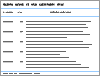
Table 1
Working fluid properties and parameter setting in microfluidic experiments"
| 分组编号 | 非润湿相流体 | 润湿相流体 | 注入速度/(μL/min) | 注入时间/h |
|---|---|---|---|---|
| M1 | 白油 | 蒸馏水 | 2 | 2 |
| M2 | 白油 | 蒸馏水 | 4 | 2 |
| M3 | 白油 | 蒸馏水 | 6 | 2 |
| M4 | 白油 | 3%甜菜碱+碳化水 | 1 | 4 |
| M5 | 白油 | 3%甜菜碱+碳化水 | 2 | 4 |
| M6 | 白油 | 3%甜菜碱+碳化水 | 3 | 4 |

Fig.1
An etched chip model and its partially zoomed-out image in microfluidic experiment"
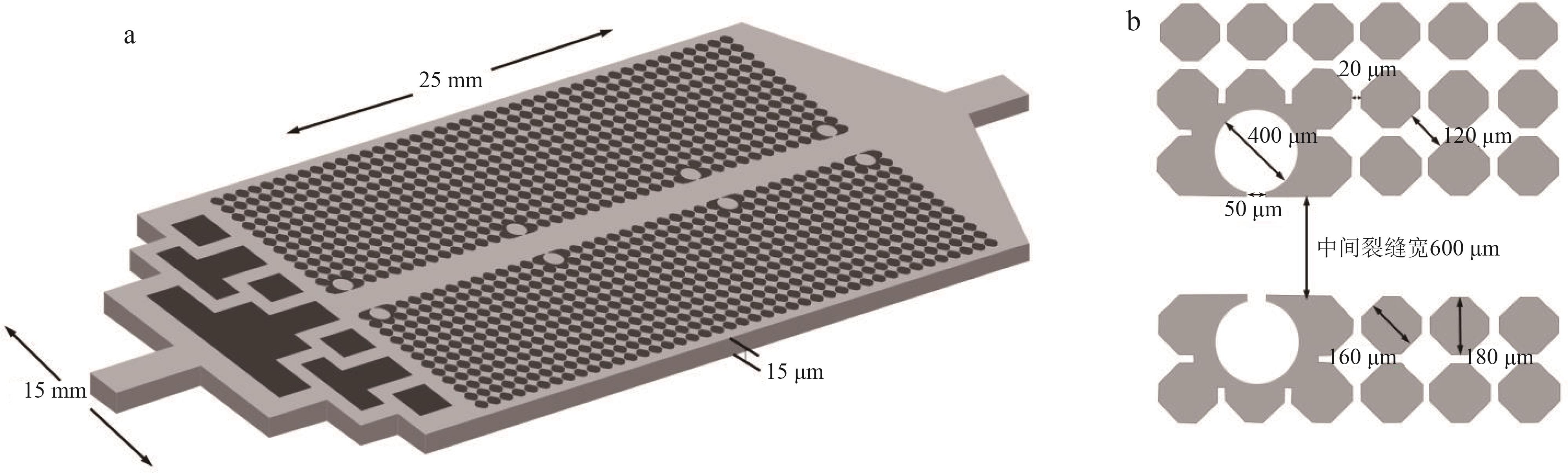
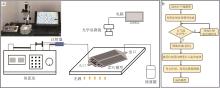
Fig.2
Setup (a) and flow chart (b) of microfluidic experiments"

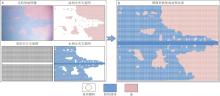
Fig.3
Joint intelligent digital processing using multiple software tools in microfluidic experiment"

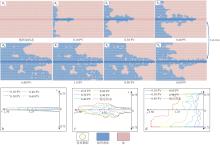
Fig.4
Results of two-phase flow in microfluidic experiments"

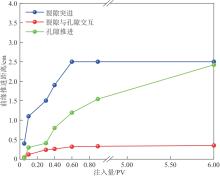
Fig.5
Curves showing the ranges and characteristics of varying seepage processes in microfluidic experiments"

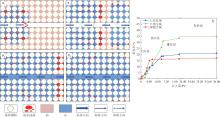
Fig.6
Schematic diagrams (a1—a4) and oil recovery curves (b) of distilled water flooding of reservoirs at an injection rate of 2 μL/min in microfluidic experiments"

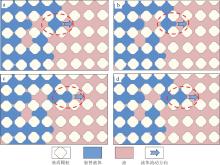
Fig.7
Microscopic zoomed-out images showing flow states at successive moments (t) in microfluidic experiments"

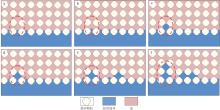
Fig.8
Images showing the microscopic imbibition on both sides of the fracture at different moments (t) in microfluidic experiments"

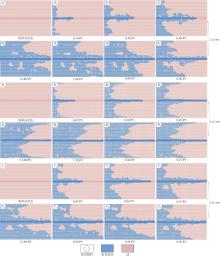
Fig.9
Images showing macroscopic seepage changes at varying injection rates of fracturing fluids in microfluidic experiment"

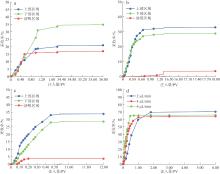
Fig. 10
Oil recovery curves of water flooding at different injection rates in microfluidic experiment"

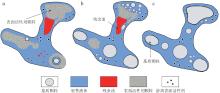
Fig.11
Impact of surfactants on interfacial properties in microfluidic experiment"
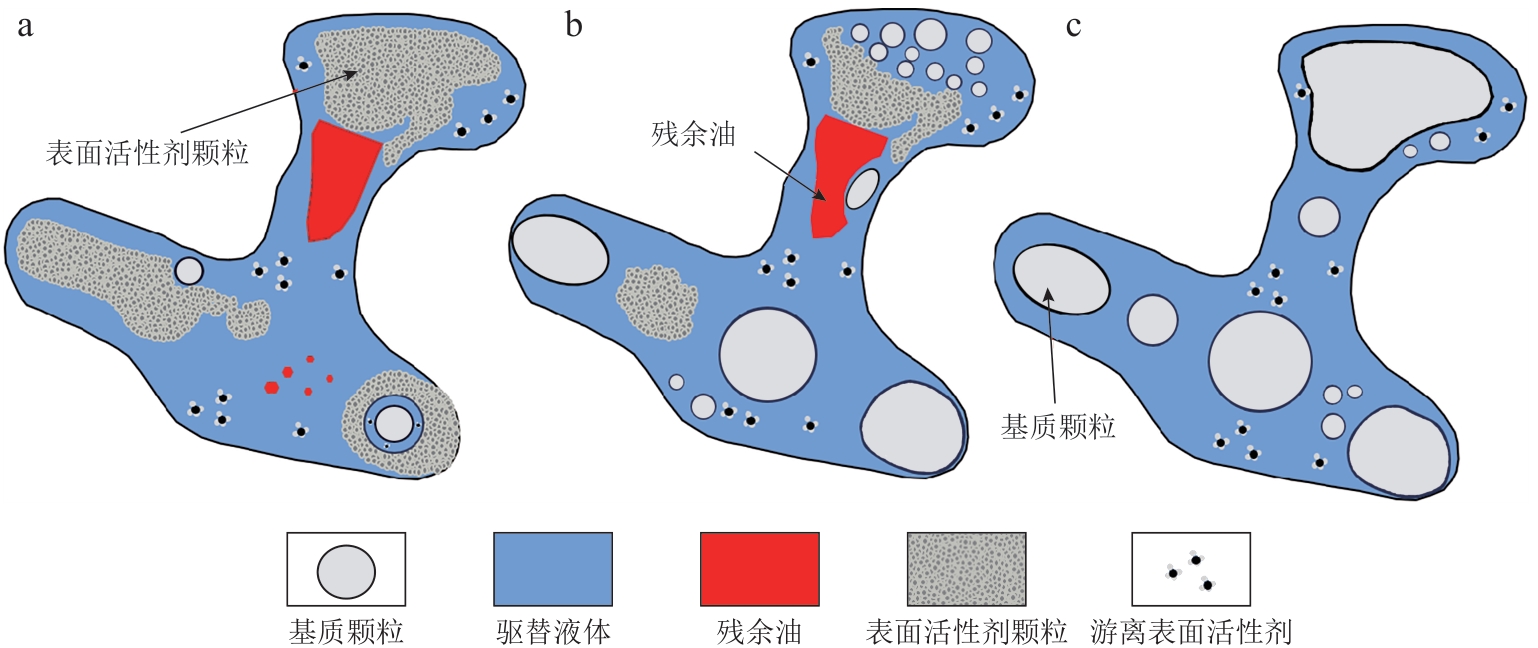
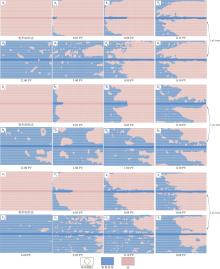
Fig.12
Experimental results of surfactant flooding of reservoirs at varying injection rates in microfluidic experiment"

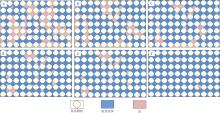
Fig.13
Zoomed-out images showing surfactant flooding at varying injection volumes in microfluidic experimenta.0.03 PV;b.0.08 PV;c.0.12 PV;d.1.00 PV;e.2.50 PV;f.6.00 PV"

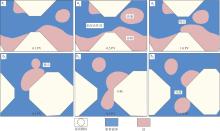
Fig.14
Microscopic zoomed-out images of some regions at successive moments in microfluidic experiment"

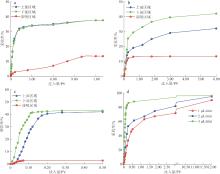
Fig.15
Oil recovery curves of surfactant flooding at varying injection rates in microfluidic experiment"
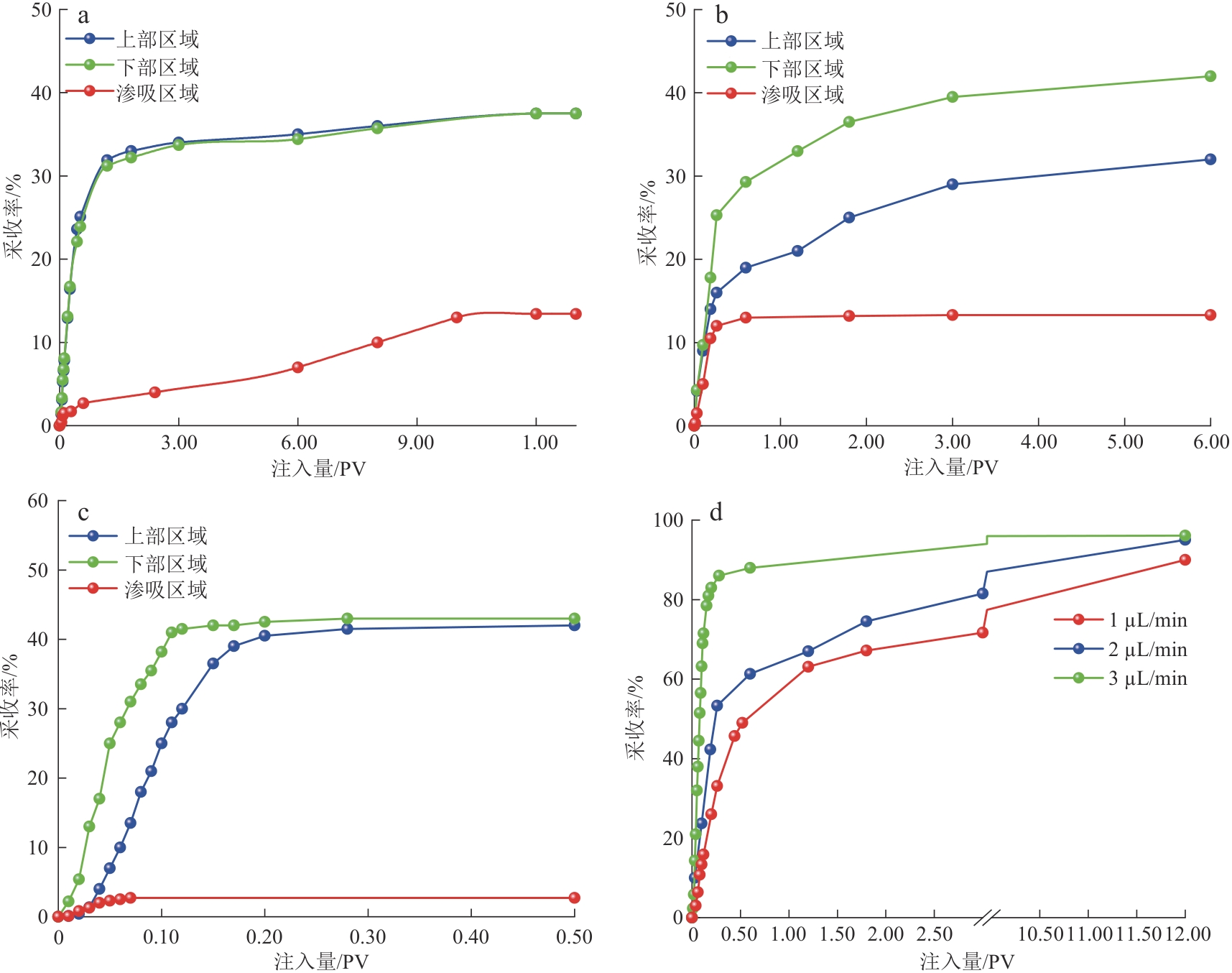
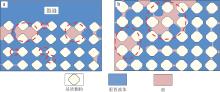
Fig.16
Microscopic zoomed-out images of oil and water distributions in the imbibition-displacement zone in microfluidic experiment"

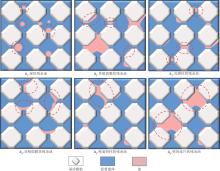
Fig.17
Classification of residual oil in microfluidic experiment"

| [1] | 邹才能, 丁云宏, 卢拥军, 等. “人工油气藏”理论、技术及实践[J]. 石油勘探与开发, 2017, 44(1): 144-154. |
| ZOU Caineng, DING Yunhong, LU Yongjun, et al. Concept, technology and practice of “man-made reservoirs” development[J]. Petroleum Exploration and Development, 2017, 44(1): 144-154. | |
| [2] | BAZAZI P, GATES I D, SANATI NEZHAD A, et al. Silica-based nanofluid heavy oil recovery a microfluidic approach[C]//SPE Canada Heavy Oil Technical Conference, Calgary, 2017. Richardson: Society of Petroleum Engineers, 2017: SPE-185008-MS. |
| [3] | 朱卫红, 周代余, 冯积累, 等. 塔里木油田典型油气藏水平井开发效果评价[J]. 石油勘探与开发, 2010, 37(6): 716-725. |
| ZHU Weihong, ZHOU Daiyu, FENG Jilei, et al. Development effect evaluation of horizontal wells in typical oil and gas reservoirs of Tarim Oilfield[J]. Petroleum Exploration and Development, 2010, 37(6): 716-725. | |
| [4] | 杨胜来, 陈浩, 冯积累, 等. 塔里木油田改善注气开发效果的关键问题[J]. 油气地质与采收率, 2014, 21(1): 40-44. |
| YANG Shenglai, CHEN Hao, FENG Jilei, et al. A brief discussion on some scientific issues to improve oil displacement during gas injection, Tarim Oilfield[J]. Petroleum Geology and Recovery Efficiency, 2014, 21(1): 40-44. | |
| [5] | 王玉丹, 杨玉双, 刘可禹, 等. 非常规油气储集孔隙多尺度连通性的定量显微CT研究[J]. 矿物岩石地球化学通报, 2015, 34(1): 86-92. |
| WANG Yudan, YANG Yushuang, LIU Keyu, et al. Quantitative and multi-scale characterization of pore connections in tight reservoirs with micro-CT and DCM[J]. Bulletin of Mineralogy, Petrology and Geochemistry, 2015, 34(1): 86-92. | |
| [6] | 徐中一, 方思冬. 边界层对致密油藏逆向渗吸的数值模拟[J]. 石油与天然气地质, 2020, 41(3): 638-646. |
| XU Zhongyi, FANG Sidong. Numerical simulation on tight oil reservoir reverse imbibition with boundary layers[J]. Oil & Gas Geology, 2020, 41(3): 638-646. | |
| [7] | 李兆敏, 徐正晓, 李宾飞, 等. 泡沫驱技术研究与应用进展[J]. 中国石油大学学报(自然科学版), 2019, 43(5): 118-127. |
| LI Zhaomin, XU Zhengxiao, LI Binfei, et al. Advances in research and application of foam flooding technology[J]. Journal of China University of Petroleum (Edition of Natural Science), 2019, 43(5): 118-127. | |
| [8] | 侯健, 邱茂鑫, 陆努, 等. 采用CT技术研究岩心剩余油微观赋存状态[J]. 石油学报, 2014, 35(2): 319-325. |
| HOU Jian, QIU Maoxin, LU Nu, et al. Characterization of residual oil microdistribution at pore scale using computerized tomography[J]. Acta Petrolei Sinica, 2014, 35(2): 319-325. | |
| [9] | 刘柯, 范洪富, 闫飚, 等. 低渗透油藏渗吸采油机理及技术进展[J]. 油田化学, 2023, 40(1): 182-190. |
| LIU Ke, FAN Hongfu, YAN Biao, et al. Progress in mechanism and technology of imbibition recovery in low permeability reservoirs[J]. Oilfield Chemistry, 2023, 40(1): 182-190. | |
| [10] | SHEN Yinghao, GE Hongkui, LI Caoxiong, et al. Water imbibition of shale and its potential influence on shale gas recovery—a comparative study of marine and continental shale formations[J]. Journal of Natural Gas Science and Engineering, 2016, 35(Part A): 1121-1128. |
| [11] | 孙焕泉, 杨勇, 方吉超, 等. 提高油气田采收率技术协同方法与应用[J]. 石油与天然气地质, 2024, 45(3): 600-608. |
| SUN Huanquan, YANG Yong, FANG Jichao, et al. Technological synergy for enhancing hydrocarbon recovery and its applications[J]. Oil & Gas Geology, 2024, 45(3): 600-608. | |
| [12] | 康万利, 赵晗, 邵硕, 等. 表面活性剂复配提高超低渗油藏渗吸采收率[J]. 油田化学, 2019, 36(4): 667-671. |
| KANG Wanli, ZHAO Han, SHAO Shuo, et al. Surfactant combination for improving the imbibition recovery of ultra-low permeability reservoir[J]. Oilfield Chemistry, 2019, 36(4): 667-671. | |
| [13] | SOHN Y K. Rapid development of gravelly high-density turbidity currents in marine Gilbert-type fan deltas, Loreto Basin, Baja California Sur, Mexico[J]. Sedimentology, 1999, 46(4): 757-761. |
| [14] | 石立华, 魏登峰, 常毓文, 等. 基于微流控模型的致密油藏微观渗吸机制试验[J]. 中国石油大学学报(自然科学版), 2024, 48(2): 99-108. |
| SHI Lihua, WEI Dengfeng, CHANG Yuwen, et al. Experiment on micro imbibition mechanisms of tight reservoirs based on a microfluidic model[J]. Journal of China University of Petroleum (Edition of Natural Science), 2024, 48(2): 99-108. | |
| [15] | MI L, JIANG H, PEI Y, et al. Microscopic oil and water percolation characteristic investigation of water flood reservoir in ultrahigh water cut period[C]//SPE Trinidad and Tobago Section Energy Resources Conference, Port of Spain, 2016. Richardson: Society of Petroleum Engineers, 2016: SPE-180864-MS. |
| [16] | 林炳承, 秦建华. 微流控芯片分析化学实验室[J]. 高等学校化学学报, 2009, 30(3): 433-445. |
| LIN Bingcheng, QIN Jianhua. Analysis laboratory based on a microfluidic chip[J]. Chemical Journal of Chinese Universities, 2009, 30(3): 433-445. | |
| [17] | 王鸣川, 王燃, 岳慧, 等. 页岩油微观渗流机理研究进展[J]. 石油实验地质, 2024, 46(1): 98-110. |
| WANG Mingchuan, WANG Ran, YUE Hui, et al. Research progress of microscopic percolation mechanism of shale oil[J]. Petroleum Geology and Experiment, 2024, 46(1): 98-110. | |
| [18] | 曹同锋, 高东华, 李占东, 等. 柳赞油田多层砂岩优势渗流通道特征及喉道体积[J]. 新疆石油地质, 2024, 45(1): 53-57. |
| CAO Tongfeng, GAO Donghua, LI Zhandong, et al. Characteristics of dominant flowing channels and throat volume of multi-layer sandstone reservoirs in Liuzan Oilfield[J]. Xinjiang Petroleum Geology, 2024, 45(1): 53-57. | |
| [19] | 谷丽冰, 李治平, 侯秀林. 二氧化碳驱引起储层物性改变的实验室研究[J]. 石油天然气学报, 2007, 29(3): 258-260. |
| GU Libing, LI Zhiping, HOU Xiulin. Experimental research of reservoir physical changes induced by CO2 flooding[J]. Journal of Oil and Gas Technology, 2007, 29(3): 258-260. | |
| [20] | KIM Y, WAN Jiamin, KNEAFSEY T J, et al. Dewetting of silica surfaces upon reactions with supercritical CO2 and brine: Pore-scale studies in micromodels[J]. Environmental Science & Technology, 2012, 46(7): 4228-4235. |
| [21] | XU Ting, PU Jun, QIN Xuejie, et al. Experimental analysis of matrix moveable oil saturation in tight sandstone reservoirs of the South Ordos Basin, China[J]. Energy Geoscience, 2024, 5(1): 100097. |
| [22] | CHANG Chun, ZHOU Quanlin, OOSTROM M, et al. Pore-scale supercritical CO2 dissolution and mass transfer under drainage conditions[J]. Advances in Water Resources, 2017, 100: 14-25. |
| [23] | BAO Bo, RIORDON J, MOSTOWFI F, et al. Microfluidic and nanofluidic phase behaviour characterization for industrial CO2, oil and gas[J]. Lab on a Chip, 2017, 17(16): 2740-2759. |
| [24] | GAVOILLE T, PANNACCI N, BERGEOT G, et al. Microfluidic approaches for accessing thermophysical properties of fluid systems[J]. Reaction Chemistry & Engineering, 2019, 4(10): 1721-1739. |
| [25] | 王勇, 姜汉桥, 郭晨, 等. 基于微流控技术的裂缝性碳酸盐岩油藏脱气后水窜治理实验研究[J]. 中国海上油气, 2023, 35(1): 78-88. |
| WANG Yong, JIANG Hanqiao, GUO Chen, et al. Microfluidics experimental investigation of water channeling control strategy after degassing in fractured carbonate reservoirs[J]. China Offshore Oil and Gas, 2023, 35(1): 78-88. | |
| [26] | 耿向飞, 丁彬, 张玉亮, 等. 致密储层纳米流度改性剂的微流控模拟评价[J]. 油田化学, 2019, 36(2): 267-270, 276. |
| GENG Xiangfei, DING Bin, ZHANG Yuliang, et al. Microfluidics simulation investigation of nano fluidity modifier for tight reservoir[J]. Oilfield Chemistry, 2019, 36(2): 267-270, 276. | |
| [27] | 王永诗, 巩建强, 陈冬霞, 等. 渤海湾盆地东营凹陷盐家地区深层砂砾岩油气藏相态演化及成藏过程[J]. 石油与天然气地质, 2023, 44(5): 1159-1172. |
| WANG Yongshi, GONG Jianqiang, CHEN Dongxia, et al. Phase evolution and accumulation mode of hydrocarbons in deep coarse-grained clastic reservoirs in the Yanjia area, Dongying Sag, Bohai Bay Basin[J]. Oil & Gas Geology, 2023, 44(5): 1159-1172. | |
| [28] | 李俊键, 刘洋, 高亚军, 等. 微观孔喉结构非均质性对剩余油分布形态的影响[J]. 石油勘探与开发, 2018, 45(6): 1043-1052. |
| LI Junjian, LIU Yang, GAO Yajun, et al. Effects of microscopic pore structure heterogeneity on the distribution and morphology of remaining oil[J]. Petroleum Exploration and Development, 2018, 45(6): 1043-1052. | |
| [29] | 徐飞, 姜汉桥, 刘铭, 等. 基于2.5D微流控技术的黏土矿物运移对喉道封堵和原油运移的影响[J]. 大庆石油地质与开发, 2023, 42(4): 64-73. |
| XU Fei, JIANG Hanqiao, LIU Ming, et al. Effect of clay minerals migration on pore throats plugging and oil migration based on 2.5D microfluidics technology[J]. Petroleum Geology & Oilfield Development in Daqing, 2023, 42(4): 64-73. | |
| [30] | MOLLA S, MOSTOWFI F. Microfluidic platform for PVT measurements[C]///SPE Annual Technical Conference and Exhibition, Amsterdam, 2014. Richardson: Society of Petroleum Engineers, 2014: SPE-170910-MS. |
| [31] | CABODI M, TURNER S W P, CRAIGHEAD H G. Entropic recoil separation of long DNA molecules[J]. Analytical Chemistry, 2002, 74(20): 5169-5174. |
| [32] | MOIRÉ M, PEYSSON Y, PANNACCI N, et al. A new microfluidic tensiometer for optimizing EOR formulations[C]//SPE Improved Oil Recovery Conference, Tulsa, 2016. Richardson: Society of Petroleum Engineers, 2016: SPE-179557-MS. |
| [33] | HE Kai, XU Liang, KENZHEKHANOV S, et al. A rock-on-a-chip approach to study fluid invasion and flowback in liquids-rich shale formations[C]//SPE Oklahoma Oil and Gas Symposium, Oklahoma City, 2017. Richardson: Society of Petroleum Engineers, 2017: SPE-185088-MS. |
| [34] | DU Yujing, XU Ke, MEJIA L, et al. Surface-active compounds induce time-dependent and non-monotonic fluid-fluid displacement during low-salinity water flooding[J]. Journal of Colloid and Interface Science, 2023, 631(Part A): 245-259. |
| [35] | LEI Wenhai, LU Xukang, WANG Moran. Multiphase displacement manipulated by micro/nanoparticle suspensions in porous media via microfluidic experiments: From interface science to multiphase flow patterns[J]. Advances in Colloid and Interface Science, 2023, 311: 102826. |
| Viewed | ||||||
|
Full text |
|
|||||
|
Abstract |
|
|||||
