

Oil & Gas Geology ›› 2025, Vol. 46 ›› Issue (5): 1700-1716.doi: 10.11743/ogg20250519
• Methods and Technologies • Previous Articles Next Articles
Hao DIAO1,2( ), Xinzhi YAN3, Jingzhou ZHAO2,4(), Rong MA4,5
Received:2025-08-03
Revised:2025-09-08
Online:2025-10-30
Published:2025-10-29
Contact:
Jingzhou ZHAO
E-mail:dhgzgy@163.com;jzzhao@xsyu.edu.cn
CLC Number:
Hao DIAO, Xinzhi YAN, Jingzhou ZHAO, Rong MA. Characteristics and genesis of high-gamma sandstones in the 6th to 9th oil groups of the Triassic Yanchang Formation, Wuqi area, Ordos Basin[J]. Oil & Gas Geology, 2025, 46(5): 1700-1716.
Add to citation manager EndNote|Reference Manager|ProCite|BibTeX|RefWorks

Fig.1
Map showing the structural unit division and composite stratigraphic column of the Yanchang Formation in the Ordos Basin (modified after reference [21])"

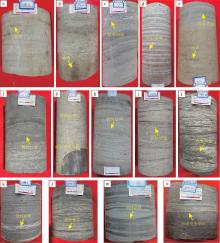
Fig.2
Core photos showing the characteristics of sedimentary structures of the Chang 6‒9 oil groups, Wuqi area, Ordos Basin"

Table 1
Statistics of logging parameters of different lithologies in the Chang 6‒9 oil groups, Wuqi area, Ordos Basin"
| 岩性 | GR/API | AC/(μs/m) | SP/mV | SH/% | RILD/(Ω·m) |
|---|---|---|---|---|---|
| 砂岩 | 222.2 | 50.5 | 23.2 | 46.3 | |
| 粉砂岩 | 222.5 | 44.9 | 34.2 | 43.1 | |
| 泥质粉砂岩 | 233.4 | 54.4 | 45.9 | 31.8 | |
| 粉砂质泥岩 | 126.9 | 244.5 | 61.3 | 64.1 | 30.7 |
| 泥页岩 | 167.4 | 256.6 | 35.3 | 87.4 | 46.2 |
Table 2
Statistics of the GR values of samples with different lithologies from the Chang 6‒9 oil groups, Wuqi area, Ordos Basin"
| 层位 | 自然伽马值/API | ||
|---|---|---|---|
| 常规砂岩 | 高伽马砂岩 | 粉砂岩 | |
| 长6油层组 | 74.2 | 96.2 | 102.1 |
| 长7油层组 | 75.5 | 98.3 | — |
| 长8油层组 | 71.8 | 93.5 | 103.6 |
| 长9油层组 | 74.8 | 96.5 | 104.2 |

Fig.3
Logging response sections of wells ZE77 and S3 in the Wuqi area, Ordos Basin"

Table 3
Statistics of mineral components in sandstone samples from the Chang 6‒9 oil groups, Wuqi area, Ordos Basin"
| 类别 | 井号 | 深度/m | 自然伽马值/API | 矿物组分含量/% | ||||||
|---|---|---|---|---|---|---|---|---|---|---|
| 石英 | 斜长石 | 钾长石 | 碳酸盐矿物 | 云母 | 黄铁矿 | 黏土矿物 | ||||
| 常规砂岩 | Ti70 | 2 439.8 | 65.7 | 35.4 | 42.7 | 12.4 | 2.0 | — | — | 7.5 |
| S5 | 2 142.2 | 75.7 | 42.6 | 35.4 | 9.0 | 0.8 | — | — | 12.2 | |
| W79 | 2 435.5 | 82.3 | 41.5 | 33.5 | 8.7 | 1.2 | — | — | 15.1 | |
| ZE88 | 2 320.8 | 83.2 | 41.7 | 50.2 | — | 0.7 | — | — | 7.4 | |
| W71 | 2 120.2 | 66.2 | 49.4 | 25.6 | 16.0 | 3.9 | — | — | 5.1 | |
| 2 125.7 | 81.9 | 22.1 | 39.3 | 10.5 | 21.2 | — | — | 7.0 | ||
| 2 126.6 | 69.5 | 27.3 | 23.7 | 7.7 | 32.8 | — | — | 8.4 | ||
| 2 127.5 | 75.3 | 38.8 | 39.5 | 7.6 | 2.4 | — | — | 11.7 | ||
| 2 345.2 | 54.6 | 21.5 | 24.4 | 15.2 | 30.0 | — | — | 9.0 | ||
| 2 346.1 | 53.6 | 20.0 | 42.5 | 7.2 | 25.2 | — | — | 5.2 | ||
| W94 | 2 331.5 | 79.4 | 37.8 | 40.1 | 9.5 | 0.9 | — | — | 11.7 | |
| 2 333.4 | 77.5 | 29.9 | 26.1 | 6.7 | 27.5 | — | 0.5 | 9.3 | ||
| 2 334.3 | 76.0 | 32.2 | 42.3 | 12.7 | 2.1 | — | 0.5 | 10.2 | ||
| 2 337.3 | 75.3 | 36.6 | 40.5 | 7.6 | 3.2 | — | 0.6 | 11.5 | ||
| 2 337.8 | 74.1 | 34.8 | 39.5 | 8.8 | 6.3 | — | — | 10.6 | ||
| 2 338.4 | 56.2 | 38.8 | 39.0 | 9.6 | 0.4 | — | 0.5 | 11.7 | ||
| 平均值 | — | 71.7 | 34.4 | 36.5 | 9.9 | 10.0 | — | 0.5 | 9.6 | |
高伽马 砂岩 | Ti70 | 2 439.3 | 103.1 | 33.1 | 44.8 | 6.1 | 7.3 | — | — | 8.7 |
| T22 | 2 042.4 | 93.2 | 30.6 | 19.8 | 6.3 | 4.9 | — | 0.5 | 37.9 | |
| ZE95 | 2 047.2 | 89.5 | 40.9 | 47.8 | — | 1.2 | — | — | 10.1 | |
| ZE88 | 2 322.6 | 87.4 | 25.3 | 41.2 | — | 29.9 | — | — | 6.2 | |
| 2 326.7 | 89.2 | 32.4 | 53.4 | — | — | 4.2 | — | 10.0 | ||
| W71 | 2 128.4 | 88.5 | 32.6 | 34.6 | 15.5 | 3.0 | — | — | 14.3 | |
| 2 343.3 | 85.8 | 20.6 | 36.9 | 9.5 | 21.3 | — | — | 11.8 | ||
| 2 343.6 | 85.6 | 20.8 | 29.7 | 9.3 | 31.7 | — | — | 8.5 | ||
| W94 | 2 332.9 | 93.5 | 38.7 | 43.0 | 6.3 | 3.1 | — | 0.4 | 8.6 | |
| 2 335.0 | 92.4 | 35.1 | 38.4 | 7.8 | 7.3 | — | — | 11.4 | ||
| 2 335.4 | 93.1 | 35.2 | 38.6 | 8.1 | 2.2 | — | — | 15.9 | ||
| 2 336.6 | 87.0 | 26.0 | 28.6 | 8.2 | 28.8 | — | — | 8.5 | ||
| ZE96 | 2 098.4 | 97.6 | 34.7 | 49.9 | — | 2.9 | 1.7 | — | 10.8 | |
| 2 098.9 | 86.7 | 37.4 | 49.6 | — | 3.9 | — | — | 9.1 | ||
| 2 099.8 | 89.3 | 29.7 | 57.3 | — | 4.2 | — | — | 8.9 | ||
| 2 101.2 | 102.5 | 28.6 | 55.8 | — | 1.6 | 3.7 | — | 10.4 | ||
| 2 104.9 | 99.4 | 24.0 | 62.5 | — | 2.2 | 7.3 | — | 5.1 | ||
| 2 105.0 | 102.2 | 33.1 | 59.9 | — | — | — | — | 7.0 | ||
| 平均值 | — | 92.6 | 31.0 | 44.0 | 8.6 | 9.7 | 4.2 | 0.45 | 11.0 | |
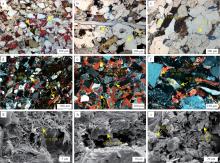
Fig.4
Micrographs of sandstone samples from the Chang 6‒9 oil groups, Wuqi area, Ordos Basin"

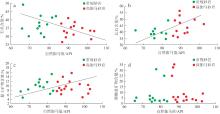
Fig.5
Relationships between mineral components and GR values for sandstone samples from the Chang 6‒9 oil groups, Wuqi area, Ordos Basin"

Table 4
Statistics of the physical properties of sandstone samples from the Chang 6‒9 oil groups, Wuqi area, Ordos Basin"
| 岩性 | 井号 | 深度/m | 物性参数 | 测井值 | |||||
|---|---|---|---|---|---|---|---|---|---|
| 渗透率/(10-3 µm²) | 孔隙度/% | 含油饱和度/% | GR/API | U含量/10-6 | Th含量/10-6 | K含量/% | |||
| 常规砂岩 | ZE84 | 2 456.42 | 0.11 | 4.90 | 64.78 | 76.89 | 1.97 | 9.71 | 2.02 |
| 2 458.05 | 0.08 | 4.06 | — | 84.94 | 1.87 | 10.75 | 2.61 | ||
| Ti15 | 2 323.08 | 0.09 | 7.40 | 73.80 | 84.97 | 2.97 | 11.67 | 2.29 | |
| Ti27 | 2 095.98 | 1.48 | 15.90 | 58.21 | 81.74 | 3.48 | 8.48 | 1.95 | |
| 2 096.13 | 1.10 | 14.90 | 58.22 | 78.42 | 1.52 | 5.46 | 1.91 | ||
| 2 384.69 | 0.31 | 9.40 | 68.62 | 78.24 | 2.14 | 7.04 | 1.65 | ||
| X2 | 2 086.69 | 0.71 | 6.25 | 69.38 | 67.61 | 2.16 | 5.50 | 2.12 | |
| 2 087.60 | 0.73 | 9.24 | — | 79.42 | 1.52 | 6.87 | 2.47 | ||
| 2 088.26 | 0.73 | 5.91 | 79.65 | 75.66 | 2.30 | 6.05 | 2.38 | ||
| 2 089.14 | 0.77 | 8.14 | — | 79.20 | 2.57 | 4.95 | 2.57 | ||
| X53 | 1 963.03 | 0.32 | 8.60 | 74.54 | 84.43 | 3.48 | 4.84 | 2.68 | |
| L27 | 2 067.26 | 0.22 | 9.51 | 78.27 | 72.73 | 2.38 | 7.35 | 2.27 | |
| 平均值 | — | 0.55 | 8.68 | 69.50 | 78.69 | 2.36 | 7.39 | 2.24 | |
| 高伽马砂岩 | ZE84 | 2 459.68 | 0.07 | 5.10 | 63.25 | 87.86 | 3.04 | 8.66 | 2.52 |
| 2 460.39 | 0.11 | 4.50 | 57.51 | 94.21 | 2.78 | 7.08 | 2.88 | ||
| ZE86 | 1 974.59 | 0.54 | 13.53 | 57.34 | 90.70 | 3.19 | 10.05 | 2.47 | |
| 1 976.61 | 0.55 | 12.48 | 51.14 | 94.12 | 3.64 | 9.35 | 2.17 | ||
| 1 979.44 | 0.89 | 15.32 | 56.33 | 94.08 | 3.74 | 11.71 | 2.06 | ||
| Ti15 | 2 318.22 | 0.42 | 4.40 | 51.73 | 89.45 | 3.17 | 14.52 | 1.84 | |
| 2 319.09 | 0.07 | 6.00 | 64.10 | 91.66 | 4.67 | 10.21 | 2.16 | ||
| 2 323.08 | 0.09 | 7.40 | 73.80 | 85.97 | 2.97 | 11.67 | 2.29 | ||
| 2 323.94 | 0.18 | 4.80 | 53.56 | 91.08 | 2.76 | 13.69 | 2.18 | ||
| Ti23 | 2 250.20 | 0.06 | 5.90 | 45.94 | 95.01 | 2.24 | 10.86 | 3.13 | |
| Ti31 | 2 131.75 | 0.15 | 3.83 | — | 90.13 | 2.38 | 11.69 | 1.66 | |
| 2 132.11 | 0.24 | 10.60 | 62.10 | 89.98 | 2.58 | 11.07 | 1.42 | ||
| ZE48 | 2 346.34 | 0.37 | 5.15 | — | 98.55 | 2.51 | 13.67 | 2.47 | |
| Ti27 | 2 095.83 | 1.08 | 14.6 | 61.78 | 85.7 | 10.6 | 8.46 | 1.96 | |
| 2 097.17 | 0.27 | 8.60 | 59.25 | 89.47 | 9.79 | 8.37 | 2.68 | ||
| ZE55 | 2 288.63 | 0.06 | 6.73 | — | 94.70 | 2.25 | 13.79 | 2.29 | |
| X56 | 1 914.70 | 0.26 | 12.90 | 44.90 | 95.42 | 2.15 | 12.73 | 2.32 | |
| 1 915.39 | 0.53 | 12.10 | — | 90.05 | 2.51 | 11.57 | 2.51 | ||
| W118 | 1 904.59 | 0.64 | 13.22 | 62.22 | 86.80 | 2.45 | 7.49 | 2.67 | |
| 平均值 | — | 0.35 | 8.80 | 57.66 | 91.31 | 3.65 | 10.88 | 2.30 | |

Fig.6
Relationships of porosity with permeability and oil saturation for sandstone samples from the Chang 6‒9 oil groups, Wuqi area, Ordos Basin"

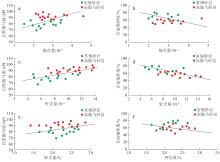
Fig.7
Cross plots of the U, Th, and K concentrations vs. GR values and oil saturation for sandstone samples from the Chang 6‒9 oil groups, Wuqi area, Ordos Basin"


Fig.8
Schematic diagram showing volcanic activity in the Ordos Basin (modified after reference [33])"

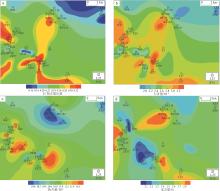
Fig.9
Contour maps showing the distribution of radioactive element concentrations in high-gamma sandstones of the Chang 6‒9 oil groups, Wuqi area, Ordos Basin"

Table 5
Comparison of radioactive element concentrations in high-gamma sandstones from the Chang 6‒9 oil groups, Wuqi area, Ordos Basin"
| 吴起地区位置 | 层位 | U含量/10-6 | Th含量/10-6 | K含量/% | U/Th |
|---|---|---|---|---|---|
| 东北部 | 长6油层组 | 2.3(8) | 9.9(8) | 2.7(8) | 0.2(8) |
| 长7油层组 | 2.3(8) | 9.4(8) | 2.8(8) | 0.2(8) | |
| 长8油层组 | 2.4(8) | 10.1(8) | 2.5(8) | 0.2(8) | |
| 长9油层组 | 2.5(8) | 11.7(8) | 2.3(8) | 0.2(8) | |
| 西南部 | 长6 油层组 | 2.7(27) | 10.8(27) | 2.5(27) | 0.3(27) |
| 长7油层组 | 3.0(28) | 11.3(28) | 2.4(28) | 0.3(28) | |
| 长8油层组 | 3.3(21) | 11.8(21) | 2.3(21) | 0.3(21) | |
| 长9油层组 | 2.9(26) | 11.7(26) | 2.2(26) | 0.3(26) |
Table 6
Statistics of the relative contents of different clay minerals in sandstones from the Chang 6‒9 oil groups, Wuqi area, Ordos Basin"
| 类别 | 井号 | 深度/m | 自然伽马值/API | 黏土矿物组分相对含量/% | |||||
|---|---|---|---|---|---|---|---|---|---|
| 蒙皂石 | 伊利石 | 高岭石 | 绿泥石 | 伊/蒙混层 | 绿/蒙混层 | ||||
| 常规砂岩 | S5 | 2 142.2 | 75.7 | — | 38 | 7 | 52 | 3 | — |
| ZC129 | 2 126.1 | 82.6 | — | 9 | 10 | 76 | 5 | — | |
| W79 | 2 435.5 | 82.3 | — | 31 | 6 | 50 | 13 | — | |
| W91 | 2 345.8 | 71.3 | — | 17 | 4 | 54 | 25 | — | |
| 高伽马砂岩 | Z12 | 2 065.7 | 88.8 | — | 31 | 6 | 51 | 12 | — |
| T22 | 2 042.4 | 94.3 | — | 50 | 2 | 34 | 14 | — | |
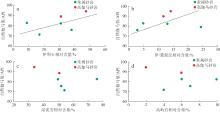
Fig.10
Relationships between the relative contents of different clay minerals and GR values for sandstones from the Chang 6‒9 oil groups, Wuqi area, Ordos Basin"

| [1] | 孟卫工. 辽河高成熟探区持续勘探发现技术及应用[J]. 特种油气藏, 2020, 27(6): 1-11. |
| MENG Weigong. Continuous exploration and discovery technology and Its application in Liaohe high mature exploration area[J]. Special Oil & Gas Reservoirs, 2020, 27(6): 1-11. | |
| [2] | 谢万学, 梅安鑫, 陈丹, 等. 转换波地震成像技术在川南碳酸盐岩储层勘探中的应用及效果[J/OL]. 地球物理学进展: 1-17[2025-09-04]. . |
| XIE Wanxue, MEI Anxin, CHEN Dan, et al. Application and effect of converted wave seismic imaging technology in carbonate reservoir exploration in southern Sichuan[J/OL]. Progress in Geophysics: 1-17[2025-09-04]. . | |
| [3] | 周俊林, 王仲军, 丁超, 等. 准噶尔盆地乌尔禾油田高自然伽马砂砾岩特征及其沉积微相研究——以乌36井区百口泉组为例[J]. 沉积学报, 2014, 32(4): 734-743. |
| ZHOU Junlin, WANG Zhongjun, DING Chao, et al. High GR glutinite feature and micro-sedimentary facies in Wuerhe oil-field, Junggar Basin——Taking the Baikouquan group in Wu 36 area as an example[J]. Acta Sedimentologica Sinica, 2014, 32(4): 734-743. | |
| [4] | 向巧维, 李小平, 丁琳, 等. 珠江口盆地珠一坳陷古近系高自然伽马砂岩形成机制及油气地质意义[J]. 岩性油气藏, 2021, 33(2): 93-103. |
| XIANG Qiaowei, LI Xiaoping, DING Lin, et al. Formation mechanism and petroleum geological significance of Paleogene sandstone with high natural gamma value in Zhuyi Depression, Pearl River Mouth Basin[J]. Lithologic Reservoirs, 2021, 33(2): 93-103. | |
| [5] | 刘行军, 柳益群, 周鼎武, 等. 鄂尔多斯盆地深部流体示踪: 三叠系延长组高自然伽马砂岩特征及成因分析[J]. 地学前缘, 2013, 20(5): 149-165. |
| LIU Xingjun, LIU Yiqun, ZHOU Dingwu, et al. Deep fluid tracer in Ordos Basin: Characteristics and origin of high natural gamma sandstone in Triassic Yanchang Formation[J]. Earth Science Frontiers, 2013, 20(5): 149-165. | |
| [6] | 张小莉, 冯乔, 孙佩, 等. 鄂尔多斯盆地延长组高自然伽马砂岩储层特征[J]. 地球物理学报, 2010, 53(1): 205-213. |
| ZHANG Xiaoli, FENG Qiao, SUN Pei, et al. Characteristics of high gamma ray reservoir of Yanchang Formation in Ordos Basin[J]. Chinese Journal of Geophysics, 2010, 53(1): 205-213. | |
| [7] | LIU Huaqing, LI Xiangbo, LIAO Jianbo, et al. Genesis of the high gamma sandstone of the Yanchang Formation in the Ordos Basin, China[J]. Petroleum Science, 2013, 10(1): 50-54. |
| [8] | 焦玉玺, 鄢继华, 陈世悦, 等. 沧东凹陷孔二段高伽马砂岩成因探讨及识别[J]. 新疆石油地质, 2017, 38(3): 309-313. |
| JIAO Yuxi, YAN Jihua, CHEN Shiyue, et al. Genesis and identification of sandstones with high gamma values in the second member of Kongdian Formation, Cangdong Sag[J]. Xinjiang Petroleum Geology, 2017, 38(3): 309-313. | |
| [9] | 于振锋, 程日辉, 赵小青, 等. 海拉尔盆地乌南凹陷南一段高伽马砂岩成因与识别[J]. 中国石油大学学报(自然科学版), 2012, 36(3): 76-83. |
| YU Zhenfeng, CHENG Rihui, ZHAO Xiaoqing, et al. Genesis and identification of high gamma sandstone in the first member of Nantun Formation of Wunan Depression in Hailar Basin[J]. Journal of China University of Petroleum (Edition of Natural Science), 2012, 36(3): 76-83. | |
| [10] | ASQUITH G, KRYGOWSKI D, HENDERSON S, et al. Basic well log analysis[M]. Tulsa: American Association of Petroleum Geologists, 2004. |
| [11] | 侯雨庭, 李高仁. 元素俘获谱测井在长庆天然气勘探中的应用[J]. 中国石油勘探, 2005, 10(3): 46-49. |
| HOU Yuting, LI Gaoren. Application of element capture spectroscopy logging in Changqing gas exploration[J]. China Petroleum Exploration, 2005, 10(3): 46-49. | |
| [12] | 谭成仟, 刘池洋, 赵军龙, 等. 鄂尔多斯盆地典型地区放射性异常特征及其地质意义[J]. 中国科学(D辑: 地球科学), 2007, 37(): 147-156. |
| TAN Chengqian, LIU Chiyang, ZHAO Junlong, et al. Characteristics and geological significance of radioactive anomalies in typical areas of the Ordos Basin[J]. Science China Earth Sciences, 2007, 37(S1): 147-156. | |
| [13] | 刘行军, 冯春珍, 柳益群, 等. 陕北长6段高自然伽马砂岩地球化学特征及意义[J]. 成都理工大学学报(自然科学版), 2013, 40(4): 445-456. |
| LIU Xingjun, FENG Chunzhen, LIU Yiqun, et al. Geochemical characteristics and significance of Chang 6 high natural gamma ray sandstones in Yanchang Formation in North of Shaanxi, China[J]. Journal of Chengdu University of Technology (Science & Technology Edition), 2013, 40(4): 445-456. | |
| [14] | 马艳丽, 辛红刚, 马文忠, 等. 鄂尔多斯盆地陕北地区长7段页岩油富集主控因素及甜点区预测[J]. 天然气地球科学, 2021, 32(12): 1822-1829. |
| MA Yanli, XIN Honggang, MA Wenzhong, et al. The main controlling factors on the enrichment and sweet-spot area prediction of Chang 7 Member shale oil in northern Shaanxi area, Ordos Basin[J]. Natural Gas Geoscience, 2021, 32(12): 1822-1829. | |
| [15] | SZALAY A. Cation exchange properties of humic acids and their importance in the geochemical enrichment of UO2 ++ and other cations[J]. Geochimica et Cosmochimica Acta, 1964, 28(10/11): 1605-1614. |
| [16] | 孙佩, 张小莉, 郭兰, 等. 相对高放射性砂岩成因及储集性能定性评价——以鄂尔多斯盆地志丹油田长6油层组为例[J]. 西安石油大学学报(自然科学版), 2010, 25(2): 18-21, 109. |
| SUN Pei, ZHANG Xiaoli, GUO Lan, et al. Genesis of the sandstone with higher radioactivity and the qualitative evaluation of its reservoir property: Taking Chang 6 oil-bearing strata in Zhidan Oilfield, Ordos Basin as an example[J]. Journal of Xi’an Shiyou University (Natural Science Edition), 2010, 25(2): 18-21, 109. | |
| [17] | 李高仁, 郭清娅, 石玉江, 等. 鄂尔多斯盆地高自然伽马储层识别研究[J]. 测井技术, 2006, 30(6): 511-515. |
| LI Gaoren, GUO Qingya, SHI Yujiang, et al. Identification of high gamma ray reservoir in Ordos Basin[J]. Well Logging Technology, 2006, 30(6): 511-515. | |
| [18] | 李士祥, 周新平, 郭芪恒, 等. 鄂尔多斯盆地长73亚段页岩油可动烃资源量评价方法[J]. 天然气地球科学, 2021, 32(12): 1771-1784. |
| LI Shixiang, ZHOU Xinping, GUO Qiheng, et al. Research on evaluation method of movable hydrocarbon resources of shale oil in the Chang 73 sub-member in the Ordos Basin[J]. Natural Gas Geoscience, 2021, 32(12): 1771-1784. | |
| [19] | 梁庆韶, 田景春, 王峰, 等. 构造活动影响下地质事件沉积序列——以鄂尔多斯盆地延长组长7油层组为例[J]. 地质论评, 2023, 69(2): 481-495. |
| LIANG Qingshao, TIAN Jingchun, WANG Feng, et al. Sedimentary sequence of geological events under the influence of tectonic activities—A case from Chang 7 oil member of Yanchang Formation in Ordos Basin[J]. Geological Review, 2023, 69(2): 481-495. | |
| [20] | 王子野, 毛治国, 袁选俊, 等. 鄂尔多斯盆地西南部三叠系延长组长9段事件沉积类型、特征及地质意义[J]. 石油勘探与开发, 2023, 50(3): 516-529. |
| WANG Ziye, MAO Zhiguo, YUAN Xuanjun, et al. Types, characteristics and geological significance of event deposits of Chang 9 Member of Triassic Yanchang Formation in southwestern Ordos Basin, NW China[J]. Petroleum Exploration and Development, 2023, 50(3): 516-529. | |
| [21] | 刘广林, 邓静, 王艳梅, 等. 鄂尔多斯盆地中生界延长组凝灰岩标志层识别、分布及意义[J]. 天然气地球科学: 1-15[2025-09-06]. . |
| LIU Guanglin, DENG Jing, WANG Yanmei, et al. Identification, distribution, and significance of tuff marker layers in the Mesozoic Yanchang Formation of the Ordos Basin[J/OL]. Natural Gas Geoscience: 1-15[2025-09-06]. . | |
| [22] | 张涛, 林承焰, 张宪国, 等. 高伽马值储层成因分析及识别方法[J]. 石油地球物理勘探, 2012, 47(3): 491-495, 359-360, 518. |
| ZHANG Tao, LIN Chengyan, ZHANG Xianguo, et al. Genesis analysis of high GR reservoir and its well-log based recognition method[J]. Oil Geophysical Prospecting, 2012, 47(3): 491-495, 359-360, 518. | |
| [23] | 游富粮, 柳广弟, 孙明亮, 等. 鄂尔多斯盆地三叠系延长组7段高伽马砂岩测井识别及其展布特征[J]. 石油实验地质, 2023, 45(1): 99-108. |
| YOU Fuliang, LIU Guangdi, SUN Mingliang, et al. Logging identification and distribution characteristics of high-gamma sandstones in the 7th member of Triassic Yanchang Formation, Ordos Basin[J]. Petroleum Geology and Experiment, 2023, 45(1): 99-108. | |
| [24] | 成大伟, 袁选俊, 周川闽, 等. 测井岩性识别方法及应用- 以鄂尔多斯盆地中西部长7油层组为例[J]. 中国石油勘探, 2016, 21(5): 117-126. |
| CHENG Dawei, YUAN Xuanjun, ZHOU Chuanmin, et al. Logging-lithology identification methods and their application: A case study on Chang 7 Member in central-western Ordos Basin, NW China[J]. China Petroleum Exploration, 2016, 21(5): 117-126. | |
| [25] | TYSON R V. Sedimentary organic matter: Organic facies and palynofacies[M]. Dordrecht: Springer, 1995. |
| [26] | 付金华, 李士祥, 郭芪恒, 等. 鄂尔多斯盆地陆相页岩油富集条件及有利区优选[J]. 石油学报, 2022, 43(12): 1702-1716. |
| FU Jinhua, LI Shixiang, GUO Qiheng, et al. Enrichment conditions and favorable area optimization of continental shale oil in Ordos Basin[J]. Acta Petrolei Sinica, 2022, 43(12): 1702-1716. | |
| [27] | 高嘉洪, 金之钧, 梁新平, 等. 火山活动对鄂尔多斯盆地三叠系长7段淡水湖盆富营养化与沉积水体介质环境的影响[J]. 石油与天然气地质, 2023, 44(4): 887-898. |
| GAO Jiahong, JIN Zhijun, LIANG Xinping, et al. The impact of volcanism on eutrophication and water column in a freshwater lacustrine basin: A case study of Triassic Chang 7 Member in Ordos Basin[J]. Oil & Gas Geology, 2023, 44(4): 887-898. | |
| [28] | 王梓毅, 付金华, 刘显阳, 等. 鄂尔多斯盆地上三叠统延长组7段埋藏期热液活动对页岩油储层的影响[J]. 石油与天然气地质, 2023, 44(4): 899-909. |
| WANG Ziyi, FU Jinhua, LIU Xianyang, et al. The influence of hydrothermal activities on shale oil reservoirs during the burial period of the Upper Triassic Chang 7 Member, Ordos Basin[J]. Oil & Gas Geology, 2023, 44(4): 899-909. | |
| [29] | 李明, 高建荣. 鄂尔多斯盆地基底断裂与火山岩的分布[J]. 中国科学: 地球科学, 2010, 40(8): 1005-1013. |
| LI Ming, GAO Jianrong. Distribution of basement faults and volcanic rocks in the Ordos Basin[J]. Science China Earth Sciences, 2010, 40(8): 1005-1013. | |
| [30] | 邱欣卫, 刘池洋, 毛光周, 等. 鄂尔多斯盆地延长组火山灰沉积物岩石地球化学特征[J]. 地球科学(中国地质大学学报), 2011, 36(1): 139-150. |
| QIU Xinwei, LIU Chiyang, MAO Guangzhou, et al. Petrological-geochemical characteristics of volcanic ash sediments in Yanchang Formation in Ordos Basin[J]. Earth Science (Journal of China University of Geosciences), 2011, 36(1): 139-150. | |
| [31] | 师学耀, 高超利, 刘伟, 等. 洛河地区高自然伽马砂岩识别及主控因素[J]. 西安科技大学学报, 2023, 43(3): 530-538. |
| SHI Xueyao, GAO Chaoli, LIU Wei, et al. Identification and main controlling factors of method high gamma sandstone in Luohe area[J]. Journal of Xi’an University of Science and Technology, 2023, 43(3): 530-538. | |
| [32] | 潘保芝, 李舟波, 付有升, 等. 测井资料在松辽盆地火成岩岩性识别和储层评价中的应用[J]. 石油物探, 2009, 48(1): 48-52, 56, 16. |
| PAN Baozhi, LI Zhoubo, FU Yousheng, et al. Application of logging data in lithology identification and reservoir evaluation of igneous rock in Songliao Basin[J]. Geophysical Prospecting for Petroleum, 2009, 48(1): 48-52, 56, 16. | |
| [33] | 李庆, 卢浩, 吴胜和, 等. 鄂尔多斯盆地南部三叠系长73亚段凝灰岩沉积成因及储层特征[J]. 石油与天然气地质, 2022, 43(5): 1141-1154. |
| LI Qing, LU Hao, WU Shenghe, et al. Sedimentary origins and reservoir characteristics of the Triassic Chang 73 tuffs in the southern Ordos Basin[J]. Oil & Gas Geology, 2022, 43(5): 1141-1154. | |
| [34] | 王敏, 李菲. 放射性元素在测井解释中的应用进展及分析[J]. 地质论评, 2023, 69(): 423-424. |
| WANG Min, LI Fei. Application progress and analysis of radioactive elements in logging interpretation[J]. Geological Review, 2023, 69(S1): 423-424. | |
| [35] | 司庆红, 朱强, 苗培森, 等. 鄂尔多斯盆地彭阳地区洛河组砂岩褪色蚀变特征及对铀成矿流体的指示作用[J]. 中国地质, 2024, 51(5): 1455-1468. |
| SI Qinghong, ZHU Qiang, MIAO Peisen, et al. Alteration characteristics and implication to uranium metallogenetic fluids of faded sandstones in Luohe Formation, Pengyang area, Ordos Basin[J]. Geology in China, 2024, 51(5): 1455-1468. | |
| [36] | 王峰, 刘玄春, 邓秀芹, 等. 鄂尔多斯盆地纸坊组微量元素地球化学特征及沉积环境指示意义[J]. 沉积学报, 2017, 35(6): 1265-1273. |
| WANG Feng, LIU Xuanchun, DENG Xiuqin, et al. Geochemical characteristics and environmental implications of trace elements of Zhifang Formation in Ordos Basin[J]. Acta Sedimentologica Sinica, 2017, 35(6): 1265-1273. | |
| [37] | 郭艳琴, 李文厚, 郭彬程, 等. 鄂尔多斯盆地沉积体系与古地理演化[J]. 古地理学报, 2019, 21(2): 293-320. |
| GUO Yanqin, LI Wenhou, GUO Bincheng, et al. Sedimentary systems and palaeogeography evolution of Ordos Basin[J]. Journal of Palaeogeography (Chinese Edition), 2019, 21(2): 293-320. | |
| [38] | 付金华, 郭正权, 邓秀芹. 鄂尔多斯盆地西南地区上三叠统延长组沉积相及石油地质意义[J]. 古地理学报, 2005, 7(1): 34-44. |
| FU Jinhua, GUO Zhengquan, DENG Xiuqin. Sedimentary facies of the Yanchang Formation of Upper Triassic and petroleum geological implication in southwestern Ordos Basin[J]. Journal of Palaeogeography (Chinese Edition), 2005, 7(1): 34-44. | |
| [39] | 李元昊. 鄂尔多斯盆地西部中区延长组下部石油成藏机理及主控因素[D]. 西安: 西北大学, 2008. |
| LI Yuanhao. The oil reservoir forming mechanisms and its main controlling factors of the Lower Yanchang Formation in the middle of the west Ordos Basin[D]. Xi’an: Northwest University, 2008. | |
| [40] | ROGERS J J W, ADAMS J A S. Handbook of thorium and uranium geochemistry[M]. Beijing: Atomic press, 1976. |
| [41] | JONES B, MANNING D A C. Comparison of geochemical indices used for the interpretation of palaeoredox conditions in ancient mudstones[J]. Chemical Geology, 1994, 111(1/4): 111-129. |
| [42] | 陈更生, 王林琪, 石学文, 等. 川北地区大隆组页岩储层特征及勘探潜力[J]. 成都理工大学学报(自然科学版), 2024, 51(3): 361-378. |
| CHEN Gengsheng, WANG Linqi, SHI Xuewen, et al. Characteristics and potential for exploration of shale reservoir in Dalong Formation in northern Sichuan[J]. Journal of Chengdu University of Technology (Science & Technology Edition), 2024, 51(3): 361-378. | |
| [43] | 吴一雄, 高华, 吴健, 等. 高伽马含气储层泥质含量精细评价——以莺歌海盆地BV气田为例[J]. 科学技术与工程, 2015, 15(6): 26-31. |
| WU Yixiong, GAO Hua, WU Jian, et al. Shale content precise evaluation of gas reservoir with high gamma——For example of BV Gas Field of Yinggehai Basin[J]. Science Technology and Engineering, 2015, 15(6): 26-31. | |
| [44] | 杨涛涛, 吕福亮, 李林, 等. 西沙海域上新统—全新统高伽马地层的发现及地质分析[J]. 地球物理学进展, 2019, 34(6): 2526-2532. |
| YANG Taotao, Fuliang LYU, LI Lin, et al. Identification and geology analysis of high natural gamma value formation of Pliocene-Holocene in Xisha offshore[J]. Progress in Geophysics, 2019, 34(6): 2526-2532. | |
| [45] | 彭军, 张新怡, 许天宇, 等. 四川盆地元坝地区千佛崖组二段细粒沉积岩岩相特征及储集性分析[J]. 石油实验地质, 2024, 46(2): 247-262. |
| PENG Jun, ZHANG Xinyi, XU Tianyu, et al. Lithofacies characteristics and reservoir capacity of fine-grained sedimentary rocks of second member of Qianfoya Formation in Yuanba area, Sichuan Basin[J]. Petroleum Geology and Experiment, 2024, 46(2): 247-262. | |
| [46] | 夏文谦, 朱祥, 金民东, 等. 川北地区上二叠统吴家坪组火山碎屑岩油气藏储层特征及主控因素[J]. 石油实验地质, 2023, 45(2): 307-316. |
| XIA Wenqian, ZHU Xiang, JIN Mindong, et al. Characteristics and controlling factors of volcanic clastic rock reservoirs in Wujiaping Formation of Upper Permian in northern Sichuan Basin[J]. Petroleum Geology and Experiment, 2023, 45(2): 307-316. | |
| [47] | 石立华, 师调调, 廖志昊, 等. 低渗致密砂岩油藏水驱储层变化规律[J]. 特种油气藏, 2024, 31(3): 106-115. |
| SHI Lihua, SHI Diaodiao, LIAO Zhihao, et al. The variation law of water flooding reservoir in low permeability tight sandstone reservoirs[J]. Special Oil & Gas Reservoirs, 2024, 31(3): 106-115. |
| Viewed | ||||||
|
Full text |
|
|||||
|
Abstract |
|
|||||
