

Oil & Gas Geology ›› 2025, Vol. 46 ›› Issue (1): 15-30.doi: 10.11743/ogg20250102
• Petroleum Geology • Previous Articles Next Articles
Lu YUN( ), Zicheng CAO, Feng GENG, Yang WANG, Yong DING(), Yongli LIU
Received:2024-07-17
Revised:2024-12-18
Online:2025-02-28
Published:2025-03-03
Contact:
Yong DING
E-mail:yunl.xbsj@sinopec.com;178932832@qq.com
CLC Number:
Lu YUN, Zicheng CAO, Feng GENG, Yang WANG, Yong DING, Yongli LIU. Regularity of the Ordovician hydrocarbon system distribution in the Tabei non-foreland area of the Tarim Basin[J]. Oil & Gas Geology, 2025, 46(1): 15-30.
Add to citation manager EndNote|Reference Manager|ProCite|BibTeX|RefWorks

Fig. 1
Structural location of the Tahe-Shunbei area and distribution of the Middle-Lower Ordovician faults in the area"


Fig. 2
Map showing the distributions of the temperatures at the interface between the Ordovician hydrocarbon reservoirs and the T75, as well as high-yield wells and major fault zones in the Tabei non-foreland area"


Fig. 3
Hydrocarbon reservoir profile crossing Tazhong-Shunbei No. 4 fault zone - Fuman-Tahe areas (see Fig. 1c for the profile location)"


Fig. 4
Schematic diagrams showing reservoir architecture within transpressional and transtensional strike-slip fault zones in the Shunbei oil and gas field"


Fig. 5
Comprehensive analysis chart showing hydrocarbon accumulation events in the Tahe oil and gas field"


Fig. 6
Comprehensive analysis chart showing hydrocarbon properties and reservoir characteristics in the Tabei non-foreland area (see Fig. 2 for the profile location)"


Fig.7
Major hydrocarbon accumulation periods of the Ordovician hydrocarbon reservoirs in the Shunbei area"

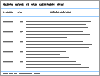
Table 1
Comparison of the hydrocarbon accumulation characteristics of the Ordovician reservoirs in the Tahe-Shunbei area"
| 成藏特征 | 塔河油气田 | 顺北油气田 |
|---|---|---|
| 构造位置 | 加里东期—海西期持续古隆起 | 夹持于塔北和塔中地区两大古隆起之间的低隆带 |
| 地质作用 | 多个不整合面、奥陶系多期岩溶;油藏受强烈氧化降解改造 | 多类型溶蚀,溶蚀作用弱;油气藏微弱改造 |
| 烃源岩 | 中东部寒武系—中-下奥陶统、西部下寒武统玉尔吐斯组 | 下寒武统玉尔吐斯组、东部寒武系—中-下奥陶统 |
| 储层 | 中奥陶统一间房碳酸盐岩岩溶缝洞体储层、 中奥陶统鹰山组内幕碳酸盐岩储层 | 中奥陶统一间房断控缝洞体储层、 中奥陶统鹰山组内幕碳酸盐岩储层 |
| 油气藏平均埋深/m | 6 529 | 7 512 |
| 温、压特征 | 100 ~ 130 ℃, 常压,压力系数1.05 ~ 1.10 | 150 ~ 160 ℃, 常压,压力系数1.12 ~ 1.17 |
| 盖层 | 下石炭统石炭系巴楚组、上奥陶统桑塔木组泥岩 | 上奥陶统桑塔木组泥岩 |
| 储-盖组合 | 下石炭统巴楚组—奥陶系、上奥陶统桑塔木组—中奥陶统一间房组 | 上奥陶统桑塔木组—中奥陶统一间房组 |
| 油气性质 | 西部中质油-重质油和超重质油,中东部轻质油; 伴生气 | 轻质油-挥发油;伴生气 |
| 油气成熟度 | 成熟-高成熟 | 高成熟 |
| 输导条件 | 断裂、不整合面和岩溶缝洞体横向输导为主 | 断裂垂向输导、东部岩性与不整合面输导 |
| 成藏期次 | 海西晚期为主,加里东晚期和燕山期为辅 | 海西晚期和燕山期 |
| 油气藏类型 | 残留-改造古油藏 | 原生油气藏 |

Fig. 8
Evolutionary histories of reservoir formation and hydrocarbon generation in the Shunbei area"


Fig. 9
Differential structural evolution from the Shuntuoguole low uplift to the Shaya uplift (see Fig. 1c for the profile location)"

| 1 | 翟光明, 王建君. 论油气分布的有序性[J]. 石油学报, 2000, 21(1): 1-9. |
| ZHAI Guangming, WANG Jianjun. The regularity of oil deposits’ distribution[J]. Acta Petrolei Sinica, 2000, 21(1): 1-9. | |
| 2 | 何治亮, 陆建林, 林娟华, 等. 中国海相盆地原型-改造分析与油气有序聚集模式[J]. 地学前缘, 2022, 29(6): 60-72. |
| HE Zhiliang, LU Jianlin, LIN Juanhua, et al. Marine basins in China—A prototype-reconstruction analyses and ordered hydrocarbon accumulation patterns[J]. Earth Science Frontiers, 2022, 29(6): 60-72. | |
| 3 | 郭旭升, 黄仁春, 张殿伟, 等. 四川盆地海相碳酸盐岩全油气系统成藏特征与有序分布规律[J]. 石油勘探与开发, 2024, 51(4): 743-758. |
| GUO Xusheng, HUANG Renchun, ZHANG Dianwei, et al. Hydrocarbon accumulation and orderly distribution of whole petroleum system in marine carbonate rocks of Sichuan Basin, SW China[J]. Petroleum Exploration and Development, 2024, 51(4): 743-758. | |
| 4 | CHOI J H, EDWARDS P, KO K, et al. Definition and classification of fault damage zones: A review and a new methodological approach[J]. Earth-Science Reviews, 2016, 152: 70-87. |
| 5 | DENG Shang, LI Huili, ZHANG Zhongpei, et al. Structural characterization of intracratonic strike-slip faults in the central Tarim Basin[J]. AAPG Bulletin, 2019, 103(1): 109-137. |
| 6 | AYDIN A, BERRYMAN J G. Analysis of the growth of strike-slip faults using effective medium theory[J]. Journal of Structural Geology, 2010, 32(11): 1629-1642. |
| 7 | 李国会, 李世银, 李会元, 等. 塔里木盆地中部走滑断裂系统分布格局及其成因[J]. 天然气工业, 2021, 41(3): 30-37. |
| LI Guohui, LI Shiyin, LI Huiyuan, et al. Distribution pattern and formation mechanism of the strike-slip fault system in the central Tarim Basin[J]. Natural Gas Industry, 2021, 41(3): 30-37. | |
| 8 | 云露, 闫文新, 赵江. 阿克库勒凸起成藏地质条件及控油规律[J]. 新疆地质, 2001, 19(4): 305-308, 314. |
| YUN Lu, YAN Wenxin, ZHAO Jiang. geological condition and ore-controlling regularity of oil-pool formation in Akekule uplift[J]. Xinjiang Geology, 2001, 19(4): 305-308, 314. | |
| 9 | 云露, 肖志高, 徐明军. 浅谈塔里木盆地台盆区天然气勘探前景[J]. 石油与天然气地质, 2004, 25(4): 428-432. |
| YUN Lu, XIAO Zhigao, XU Mingjun. A brief talk on gas exploration potential in the platform-basin region, Tarim Basin[J]. Oil & Gas Geology, 2004, 25(4): 428-432. | |
| 10 | 漆立新, 云露. 塔河油田奥陶系碳酸盐岩岩溶发育特征与主控因素[J]. 石油与天然气地质, 2010, 31(1): 1-12. |
| QI Lixin, YUN Lu. Development characteristics and main controlling factors of the Ordovician carbonate karst in Tahe Oilfield[J]. Oil & Gas Geology, 2010, 31(1): 1-12. | |
| 11 | 云露. 塔河油田奥陶系油气成藏模式研究[D]. 北京: 中国地质大学(北京), 2008. |
| YUN Lu. Petroleum accumulation model of Ordovician reservoir in Tahe Oilfield[D]. Beijing: China University of Geosciences(Beijing), 2008. | |
| 12 | 陈红汉, 吴悠, 丰勇, 等. 塔河油田奥陶系油气成藏期次及年代学[J]. 石油与天然气地质, 2014, 35(6): 806-819. |
| CHEN Honghan, WU You, FENG Yong, et al. Timing and chronology of hydrocarbon charging in the Ordovician of Tahe oilfield, Tarim Basin, NW China[J]. Oil & Gas Geology, 2014, 35(6): 806-819. | |
| 13 | 云露, 蒋华山. 塔里木盆地北部沙雅隆起含油气系统及勘探靶区选择[J]. 石油实验地质, 2002, 24(6): 506-511. |
| YUN Lu, JIANG Huashan. Petroleum system and exploration strategy in Shaya uplift of the northern Tarim Basin[J]. Petroleum Geology & Experiment, 2002, 24(6): 506-511. | |
| 14 | 云露, 曹自成. 塔里木盆地顺南地区奥陶系油气富集与勘探潜力[J]. 石油与天然气地质, 2014, 35(6): 788-797. |
| YUN Lu, CAO Zicheng. Hydrocarbon enrichment pattern and exploration potential of the Ordovician in Shunnan area, Tarim Basin[J]. Oil & Gas Geology, 2014, 35(6): 788-797. | |
| 15 | 李斌, 赵星星, 邬光辉, 等. 塔里木盆地塔中Ⅱ区奥陶系油气差异富集模式[J]. 石油与天然气地质, 2023, 44(2): 308-320. |
| LI Bin, ZHAO Xingxing, WU Guanghui, et al. Differential hydrocarbon accumulation model of the Ordovician in Tazhong Ⅱ block, Tarim Basin[J]. Oil & Gas Geology, 2023, 44(2): 308-320. | |
| 16 | 翟晓先, 云露. 塔里木盆地塔河大型油田地质特征及勘探思路回顾[J]. 石油与天然气地质, 2008, 29(5): 565-573. |
| ZHAI Xiaoxian, YUN Lu. Geology of giant Tahe Oilfield and a review of exploration thinking in the Tarim Basin[J]. Oil & Gas Geology, 2008, 29(5): 565-573. | |
| 17 | 漆立新, 云露. 塔里木台盆区碳酸盐岩成藏模式与勘探实践[J]. 石油实验地质, 2020, 42(5): 867-876. |
| QI Lixin, YUN Lu. Carbonate reservoir forming model and exploration in Tarim Basin[J]. Petroleum Geology and Experiment, 2020, 42(5): 867-876. | |
| 18 | 胡伟, 徐婷, 杨阳, 等. 塔里木盆地超深油气藏流体相行为变化特征[J]. 石油与天然气地质, 2023, 44(4): 1044-1053. |
| HU Wei, XU Ting, YANG Yang, et al. Fluid phases and behaviors in ultra-deep oil and gas reservoirs, Tarim Basin[J]. Oil & Gas Geology, 2023, 44(4): 1044-1053. | |
| 19 | 云露, 邓尚. 塔里木盆地深层走滑断裂差异变形与控储控藏特征——以顺北油气田为例[J]. 石油学报, 2022, 43(6): 770-787. |
| YUN Lu, DENG Shang. Structural styles of deep strike-slip faults in Tarim Basin and the characteristics of their control on reservoir formation and hydrocarbon accumulation: A case study of Shunbei oil and gas field[J]. Acta Petrolei Sinica, 2022, 43(6): 770-787. | |
| 20 | 云露. 顺北东部北东向走滑断裂体系控储控藏作用与突破意义[J]. 中国石油勘探, 2021, 26(3): 41-52. |
| YUN Lu. Controlling effect of NE strike-slip fault system on reservoir development and hydrocarbon accumulation in the eastern Shunbei area and its geological significance, Tarim Basin[J]. China Petroleum Exploration, 2021, 26(3): 41-52. | |
| 21 | 张红波, 周雨双, 沙旭光, 等. 塔里木盆地顺北5号走滑断裂隆起段发育特征与演化机制[J]. 石油与天然气地质, 2023, 44(2): 321-334. |
| ZHANG Hongbo, ZHOU Yushuang, SHA Xuguang, et al. Development characteristics and evolution mechanism of the uplifted segment of the No. 5 strike-slip fault zone in Shunbei area, Tarim Basin[J]. Oil & Gas Geology, 2023, 44(2): 321-334. | |
| 22 | 黄诚, 云露, 曹自成, 等. 塔里木盆地顺北地区中-下奥陶统 “断控”缝洞系统划分与形成机制[J]. 石油与天然气地质, 2022, 43(1): 54-68. |
| HUANG Cheng, YUN Lu, CAO Zicheng, et al. Division and formation mechanism of fault-controlled fracture-vug system of the Middle-to-Lower Ordovician, Shunbei area, Tarim Basin[J]. Oil & Gas Geology, 2022, 43(1): 54-68. | |
| 23 | 云露. 顺北地区奥陶系超深断溶体油气成藏条件[J]. 新疆石油地质, 2021, 42(2): 136-142. |
| YUN Lu. Hydrocarbon accumulation of ultra-deep Ordovician fault-karst reservoirs in Shunbei area[J]. Xinjiang Petroleum Geology, 2021, 42(2): 136-142. | |
| 24 | 段太忠, 张文彪, 何治亮, 等. 塔里木盆地顺北油田超深断溶体深度学习地质建模方法[J]. 石油与天然气地质, 2023, 44(1): 203-212. |
| DUAN Taizhong, ZHANG Wenbiao, HE Zhiliang, et al. Deep learning-based geological modeling of ultra-deep fault-karst reservoirs in Shunbei Oilfield, Tarim Basin[J]. Oil & Gas Geology, 2023, 44(1): 203-212. | |
| 25 | 漆立新, 云露, 曹自成, 等. 顺北油气田地质储量评估与油气勘探方向[J]. 新疆石油地质, 2021, 42(2): 127-135. |
| QI Lixin, YUN Lu, CAO Zicheng, et al. Geological reserves assessment and petroleum exploration targets in Shunbei Oil & Gas Field[J]. Xinjiang Petroleum Geology, 2021, 42(2): 127-135. | |
| 26 | 宋兴国, 陈石, 谢舟, 等. 塔里木盆地富满油田东部走滑断裂发育特征与油气成藏[J]. 石油与天然气地质, 2023, 44(2): 335-349. |
| SONG Xingguo, CHEN Shi, XIE Zhou, et al. Strike-slip faults and hydrocarbon accumulation in the eastern part of Fuman Oilfield, Tarim Basin[J]. Oil & Gas Geology, 2023, 44(2): 335-349. | |
| 27 | 漆立新, 云露, 黄太柱, 等. 顺托果勒地区油气分布规律与突破目标优选[Z]. 新疆维吾尔自治区, 中石化西北油田分公司, 2018-12-20. |
| QI Lixin, YUN Lu, HUANG Taizhu, et al. Oil and gas distribution pattern and breakthrough target optimization in Shuntuoguole area[Z]. Xinjiang Uyghur Autonomous Region, Sinopec Northwest Oilfield Branch, 2018-12-20. | |
| 28 | 漆立新, 丁勇. 塔里木盆地顺北地区东西部海相油气成藏差异[J]. 石油实验地质, 2023, 45(1): 20-28. |
| QI Lixin, DING Yong. Differences in marine hydrocarbon accumulation between the eastern and western parts of Shunbei area, Tarim Basin[J]. Petroleum Geology and Experiment, 2023, 45(1): 20-28. | |
| 29 | 马安来, 漆立新. 顺北地区四号断裂带奥陶系超深层油气地球化学特征与相态差异性成因[J]. 地学前缘, 2023, 30(6): 247-262. |
| MA Anlai, QI Lixin. Qi lixin the geochemical characteristics and phase differences of Ordovician ultra deep oil and gas in the Shunbei area’s No.4 fault zone[J]. Earth Science Frontiers, 2023, 30(6): 247-262. | |
| 30 | 刘建章, 蔡忠贤, 滕长宇, 等. 塔里木盆地顺北地区克拉通内走滑断裂带中-下奥陶统储集体方解石脉形成及其与油气充注耦合关系[J]. 石油与天然气地质, 2023, 44(1): 125-137. |
| LIU Jianzhang, CAI Zhongxian, TENG Changyu, et al. Coupling relationship between formation of calcite veins and hydrocarbon charging in Middle-Lower Ordovician reservoirs in strike-slip fault zones within craton in Shunbei area, Tarim Basin[J]. Oil & Gas Geology, 2023, 44(1): 125-137. | |
| 31 | 黄越义, 廖玉宏, 陈承声, 等. 塔里木盆地顺南1井和顺南4井油气相态演化的数值模拟与预测[J]. 石油与天然气地质, 2023, 44(1): 138-149. |
| HUANG Yueyi, LIAO Yuhong, CHEN Chengsheng, et al. Numerical simulation and prediction of hydrocarbon phase evolution of Wells Shunnan 1 and 4, Tarim Basin[J]. Oil & Gas Geology, 2023, 44(1): 138-149. | |
| 32 | 庄新兵, 顾忆, 邵志兵, 等. 塔里木盆地地温场对油气成藏过程的控制作用——以古城墟隆起为例[J]. 石油学报, 2017, 38(5): 502-511. |
| ZHUANG Xinbing, GU Yi, SHAO Zhibing, et al. Control effect of geothermal field on hydrocarbon accumulation process in Tarim Basin: A case study of Guchengxu uplift[J]. Acta Petrolei Sinica, 2017, 38(5): 502-511. | |
| 33 | 丁勇, 彭守涛, 夏东领. 塔河油田艾丁地区奥陶系油气藏特征与成藏期[J]. 新疆石油地质, 2013, 34(3): 262-264. |
| DING Yong, PENG Shoutao, XIA Dongling. The reservoir characteristics and hydrocarbon accumulation stages of Ordovician in aiding area of Tahe Oilfield, Tarim Basin[J]. Xinjiang Petroleum Geology, 2013, 34(3): 262-264. | |
| 34 | 罗明霞, 曹自成, 徐勤琪, 等. 塔里木盆地塔河油田塔深5井震旦系原油地球化学特征及地质意义[J]. 地质科技通报, 2024, 43(1): 135-149. |
| LUO Mingxia, CAO Zicheng, XU Qinqi, et al. Geochemical characteristics and geological significance of Sinian crude oil from Well Tashen 5, Tahe Oilfield, Tarim Basin[J]. Bulletin of Geological Science and Technology, 2024, 43(1): 135-149. | |
| 35 | 吴鲜, 李丹, 韩俊, 等. 塔里木盆地顺托果勒北部地区超深层现今地温场特征[J]. 石油学报, 2022, 43(1): 29-40. |
| WU Xian, LI Dan, HAN Jun, et al. Characteristics of present ultra-deep geothermal field in the northern Shuntuoguole low uplift, Tarim Basin[J]. Acta Petrolei Sinica, 2022, 43(1): 29-40. | |
| 36 | CHAI Zhi, CHEN Zhonghong, LIU Hua, et al. Light hydrocarbons and diamondoids of light oils in deep reservoirs of Shuntuoguole Low Uplift, Tarim Basin: Implication for the evaluation on thermal maturity, secondary alteration and source characteristics[J]. Marine and Petroleum Geology, 2020, 117: 104388. |
| 37 | 黄第藩, 赵孟军, 刘宝泉, 等. 塔里木盆地东部天然气的成因类型及其成熟度判识[J]. 中国科学(D辑:地球科学), 1996, 36(4): 365-372. |
| HUANG Difan, ZHAO Mengjun, LIU Baoqun, et al. Genetic types and maturity identification of natural gas in eastern Tarim Basin[J]. Science China Earth Sciences, 1996, 36(4): 365-372. | |
| 38 | 田家奇, 李国蓉, 刘永立, 等. 塔北地区鹰山组下段—蓬莱坝组白云岩成因及控储意义[J]. 新疆石油地质, 2024, 45(3): 306-316. |
| TIAN Jiaqi, LI Guorong, LIU Yongli, et al. Genesis of Dolomite and Its Controls on Reservoir Spaces in Lower Yingshan Formation-Penglaiba Formation, Northern Tarim Basin[J]. Xinjiang Petroleum Geology, 2024, 45(3): 306-316. | |
| 39 | 仲米虹, 唐武. 塔北地区三叠纪拗陷湖盆异重流沉积特征及主控因素[J]. 新疆石油地质, 2023, 44(1): 1-8. |
| ZHONG Mihong, TANG Wu. Sedimentary Characteristics and Controlling Factors of Hyperpycnal Flow in Triassic Depressed Lake Basin, Northern Tarim Basin[J]. Xinjiang Petroleum Geology, 2023, 44(1): 1-8. | |
| 40 | 段永贤, 宋金鹏, 郇志鹏, 等. 塔北、塔中奥陶系碳酸盐岩异常高压形成、保存与分布[J]. 新疆石油地质, 2023, 44(4): 421-428. |
| DUAN Yongxian, SONG Jinpeng, HUAN Zhipeng, et al. Formation, Preservation and Distribution of Abnormally High Pressure in Ordovician Carbonate Rocks in Northern and Central Tarim Basin[J]. Xinjiang Petroleum Geology, 2023, 44(4): 421-428. | |
| 41 | 姚红生, 云露, 昝灵, 等. 苏北盆地溱潼凹陷阜二段断块型页岩油定向井开发模式及实践[J]. 油气藏评价与开发, 2023, 13(2): 141-151. |
| YAO Hongsheng, YUN Lu, ZAN Ling, et al. Development mode and practice of fault-block oriented shale oil well in the second member of Funing Formation, Qintong Sag, Subei Basin[J]. Petroleum Reservoir Evaluation and Development, 2023, 13(2): 141-151. | |
| 42 | 曹自成, 唐大卿, 骆满嵩, 等. 塔里木盆地顺北地区中新生界断裂构造特征及演化[J]. 地质科技通报, 2023, 42(1): 226-238. |
| CAO Zicheng, TANG Daqing, LUO Mansong, et al. Structural characteristics and tectonic evolution of Mesozoic-Cenozoic faults in the Shunbei area, Tarim Basin[J]. Bulletin of Geological Science and Technology, 2023, 42(1): 226-238. |
| [1] | Shuai HE, Anlai MA, Lu YUN, Zicheng CAO, Xianqing LI, Cheng HUANG, Guosong ZHANG, Song HU, Tieyi WANG, Weilong PENG, Zhili ZHU, Futian CUI. Organic geochemical characteristics and exploration significance of the Upper Ordovician Qrebake Formation source rocks, Shunbei area, Tarim Basin [J]. Oil & Gas Geology, 2025, 46(1): 246-260. |
| [2] | Fenglei LI, Chengyan LIN, Lihua REN, Guoyin ZHANG, Yongfeng ZHU, Yintao ZHANG, Baozhu GUAN. Connectivity and residual oil distribution patterns of fractured-vuggy karst reservoirs in strike-slip fault zone: A case study of the Tarim Basin [J]. Oil & Gas Geology, 2025, 46(1): 315-334. |
| [3] | Baohong SHI, Jiahao LIN, Tao ZHANG, Hongwei WANG, Lei ZHANG, Jiayi WEI, Han LI, Gang LIU, Rong WANG. Hydrocarbon accumulation potential of concealed structures in the high-energy shoals of the Ordovician Kelimoli Formation in the central section of the thrust zone along the western margin of the Ordos Basin [J]. Oil & Gas Geology, 2025, 46(1): 78-90. |
| [4] | Ping CHEN, Wei LI, Yijun ZHOU, Wenrui PEI, Xiaowei YU, Wei HAN, Guoping LIANG, Pengcheng LU, Lei WANG. Formation and evolution of the Wushenqi and Central paleo-uplifts, Ordos Basin and their control on hydrocarbon accumulation [J]. Oil & Gas Geology, 2024, 45(6): 1653-1664. |
| [5] | Xinrui LYU, Jianfang SUN, Hongkai LI, Dongling XIA, Xingwei WU, Kelong HAN, Jiagen HOU. Fine geological modelling technology for deep fractured-vuggy carbonate oil reservoirs in the Tarim Basin [J]. Oil & Gas Geology, 2024, 45(5): 1195-1210. |
| [6] | Shang DENG, Huabiao QIU, Dawei LIU, Jun HAN, Zhixing RU, Weilong PENG, Qing BIAN, Cheng HUANG. Advances in research on the genetic mechanisms of intracratonic strike-slip fault system and their control on hydrocarbon accumulation: A case study of the northern Tarim Basin [J]. Oil & Gas Geology, 2024, 45(5): 1211-1225. |
| [7] | Juncheng QIAO, Shaoying CHANG, Jianhui ZENG, Peng CAO, Keliang DONG, Mengxiu WANG, Jining YANG, Yazhou LIU, Hui LONG, Ting AN, Rui YANG, Lin WEN. Origin of differential hydrocarbon accumulation in ultra-deep carbonate reservoirs along strike-slip fault zones in the Fuman area, northern Tarim Basin [J]. Oil & Gas Geology, 2024, 45(5): 1226-1246. |
| [8] | Zhenghe WANG, Ronghu ZHANG, Yong YUE, Jinxiang CHENG. Basin-mountain coupling-controlled sequence stratigraphic characteristics of the Upper Triassic Huangshanjie Formation, Kuqa Depression, Tarim Basin [J]. Oil & Gas Geology, 2024, 45(5): 1247-1258. |
| [9] | Hailong MA, Lin JIANG, Wenlong DING, Pengyuan HAN, Zhen WANG, Changjian ZHANG, Huan WEN, Liming DING, Jie LI. Deformation characteristics and hydrocarbon accumulation models of the Lan’ga and Hotan River fault zones in the Tarim Basin [J]. Oil & Gas Geology, 2024, 45(5): 1259-1274. |
| [10] | Zhou YU, Jingao ZHOU, Xiaorong LUO, Yongzhou LI, Xiaowei YU, Xiucheng TAN, Dongxu WU. Discovery and implications for hydrocarbon exploration of the Shenmu-Zhidan low paleo-uplift in the 4th member of the Ordovician Majiagou Formation, eastern Ordos Basin [J]. Oil & Gas Geology, 2024, 45(5): 1383-1399. |
| [11] | Yongjin GAO, Chengming YIN, Lihong LIU, Darong XU, Youxing YANG, Yuanyin ZHANG, Zezhang SONG, Mantong ZHEN. Characteristics of source rocks in the Cambrian Xiaoerbulake Formation in the northwestern Tarim Basin [J]. Oil & Gas Geology, 2024, 45(4): 1064-1078. |
| [12] | Xiaojiao PANG, Guiwen WANG, Dali YUE, Dong LI, Hongbin LI, Chongyang WANG, Lichun KUANG, Jin LAI. Advances in well log-based assessments of fine-grained sedimentary rocks [J]. Oil & Gas Geology, 2024, 45(4): 954-978. |
| [13] | Liqing ZHOU, Donghui JIANG, Pengcheng YANG, Rufeng ZHANG, Xin DONG, Yadi SANG. Philosophy and potential breakthroughs for hydrocarbon exploration in block LS13-2 on the northern slope of the Lingshui Sag, Qiongdongnan Basin [J]. Oil & Gas Geology, 2024, 45(3): 673-683. |
| [14] | Pengyuan HAN, Wenlong DING, Debin YANG, Juan ZHANG, Hailong MA, Shenghui WANG. Characteristics of the S80 strike-slip fault zone and its controlling effects on the Ordovician reservoirs in the Tahe oilfield, Tarim Basin [J]. Oil & Gas Geology, 2024, 45(3): 770-786. |
| [15] | Yanqiu ZHANG, Honghan CHEN, Xiepei WANG, Peng WANG, Danmei SU, Zhou XIE. Assessment of connectivity between source rocks and strike-slip fault zone in the Fuman oilfield, Tarim Basin [J]. Oil & Gas Geology, 2024, 45(3): 787-800. |
| Viewed | ||||||
|
Full text |
|
|||||
|
Abstract |
|
|||||
