

Oil & Gas Geology ›› 2025, Vol. 46 ›› Issue (2): 567-574.doi: 10.11743/ogg20250215
• Methods and Technologies • Previous Articles Next Articles
Zhijiang KANG1,2( ), Ziyan DENG3(), Fan YANG1,2, Dongsheng ZHOU3
Received:2024-10-20
Revised:2025-01-02
Online:2025-04-30
Published:2025-04-27
Contact:
Ziyan DENG
E-mail:kangzj.syky@sinopec.com;2111210013@email.cugb.edu.cn
CLC Number:
Zhijiang KANG, Ziyan DENG, Fan YANG, Dongsheng ZHOU. A deep learning-based model for predicting porosity of ultradeep fractured-vuggy hydrocarbon reservoirs[J]. Oil & Gas Geology, 2025, 46(2): 567-574.
Add to citation manager EndNote|Reference Manager|ProCite|BibTeX|RefWorks

Fig. 1
Flow chart of machine learning-based model for porosity prediction"


Fig. 2
Model of fault-controlled fractured-vuggy reservoirs of ultradeep formation from a single well"


Fig. 3
Porosity prediction based on seismic wave impedance vs. well log-derived porosity for ultradeep hydrocarbon reservoirs"


Fig. 4
Heatmap showing Pearson correlation coefficients between seismic attributes and reservoir porosity"

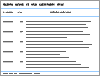
Table 1
Statistics for certain seismic attribute before and after generalized logarithmic transformation"
| 参数 | 变换前 | 变换后 |
|---|---|---|
| 统计数量/个 | 13 000 | 13 000 |
| 平均值 | 15.288 | 2.482 |
| 方差 | 15.567 | 0.748 |
| 最小值 | 1.943 | 1.079 |
| 最大值 | 87.242 | 4.480 |

Fig. 5
Frequency histograms showing the distributions of seismic attribute values before and after Box-Cox transformation"

Table 2
Statistics of optimal parameter values of the deep learning-based model"
| 参数 | 取值 |
|---|---|
| 地震相损失项的权重 | 1.100 |
| 批处理大小 | 32.000 |
| 网络层数 | 3.000 |
| 学习率 | 0.016 |
| 训练轮数 | 348.000 |
| 丢失率 | 0.180 |
Table 3
Comparison of porosity in three test wells predicted using traditional and deep learning-based models(MSE and R2)"
| 井号 | MSE | R2 | ||
|---|---|---|---|---|
| 传统模型 | 深度学习 | 传统模型 | 深度学习 | |
| 平均值 | 19.70 | 0.27 | 0.24 | 0.92 |
| 1 | 6.70 | 0.40 | 0.19 | 0.89 |
| 2 | 9.60 | 0.15 | 0.24 | 0.94 |
| 3 | 42.80 | 0.25 | 0.29 | 0.93 |

Fig. 6
Comparison between predicted and well log-derived porosity of three test wells"


Fig. 7
Comparison of the plan views of porosity predicted using the conventional physical method (a) and the deep learning-based method (b)"


Fig. 8
Comparison of the profiles of porosity predicted using the conventional physical method (a) and the deep learning-based method (b)"

| 1 | 马永生, 蔡勋育, 云露, 等. 塔里木盆地顺北超深层碳酸盐岩油气田勘探开发实践与理论技术进展[J]. 石油勘探与开发, 2022, 49(1): 1-17. |
| MA Yongsheng, CAI Xunyu, YUN Lu, et al. Practice and theoretical and technical progress in exploration and development of Shunbei ultra-deep carbonate oil and gas field, Tarim Basin, NW China[J]. Petroleum Exploration and Development, 2022, 49(1): 1-17. | |
| 2 | 康志江, 张冬梅, 张振坤, 等. 深层缝洞型油藏井间连通路径智能预测技术[J]. 石油与天然气地质, 2023, 44(5): 1290-1299. |
| KANG Zhijiang, ZHANG Dongmei, ZHANG Zhenkun, et al. Intelligent prediction of inter-well connectivity path in deep fractured-vuggy reservoirs[J]. Oil & Gas Geology, 2023, 44(5): 1290-1299. | |
| 3 | 李阳, 康志江, 薛兆杰, 等. 中国碳酸盐岩油气藏开发理论与实践[J]. 石油勘探与开发, 2018, 45(4): 669-678. |
| LI Yang, KANG Zhijiang, XUE Zhaojie, et al. Theories and practices of carbonate reservoirs development in China[J]. Petroleum Exploration and Development, 2018, 45(4): 669-678. | |
| 4 | 康志江, 李阳, 计秉玉, 等. 碳酸盐岩缝洞型油藏提高采收率关键技术[J]. 石油与天然气地质, 2020, 41(2): 434-441. |
| KANG Zhijiang, LI Yang, JI Bingyu, et al. Key technologies for EOR in fractured-vuggy carbonate reservoirs[J]. Oil & Gas Geology, 2020, 41(2): 434-441. | |
| 5 | 张煜, 李海英, 陈修平, 等. 塔里木盆地顺北地区超深断控缝洞型油气藏地质-工程一体化实践与成效[J]. 石油与天然气地质, 2022, 43(6): 1466-1480. |
| ZHANG Yu, LI Haiying, CHEN Xiuping, et al. Practice and effect of geology-engineering integration in the development of ultra-deep fault-controlled fractured-vuggy oil/gas reservoirs, Shunbei area, Tarim Basin[J]. Oil & Gas Geology, 2022, 43(6): 1466-1480. | |
| 6 | MIAH M I. Porosity assessment of gas reservoir using wireline log data: A case study of Bokabil Formation, Bangladesh[J]. Procedia Engineering, 2014, 90: 663-668. |
| 7 | 申波, 王刚, 樊海涛, 等. 一种基于变骨架参数的孔隙度预测新方法[J]. 石油与天然气地质, 2022, 43(3): 711-716. |
| SHEN Bo, WANG Gang, FAN Haitao, et al. A new method for porosity prediction based on variable matrix parameters[J]. Oil & Gas Geology, 2022, 43(3): 711-716. | |
| 8 | 王西文, 石兰亭, 雍学善, 等. 地震波阻抗反演方法研究[J]. 岩性油气藏, 2007, 19(3): 80-88, 100. |
| WANG Xiwen, SHI Lanting, YONG Xueshan, et al. Study on seismic impedance inversion[J]. Lithologic Reservoirs, 2007, 19(3): 80-88, 100. | |
| 9 | 邹冠贵, 彭苏萍, 张辉, 等. 地震波阻抗反演预测采区孔隙度方法[J]. 煤炭学报, 2009, 34(11): 1507-1511. |
| ZOU Guangui, PENG Suping, ZHANG Hui, et al. Predicting aquifer porosity of coal mine by impedance inversion[J]. Journal of China Coal Society, 2009, 34(11): 1507-1511. | |
| 10 | 张秉铭, 刘致水, 刘俊州, 等. 基于多边形孔隙结构模型的砂岩储层总孔隙度预测方法[J]. 西安石油大学学报(自然科学版), 2023, 38(5): 12-19. |
| ZHANG Bingming, LIU Zhishui, LIU Junzhou, et al. A porosity prediction method for sandstone reservoir based on polygonal pore structure model[J]. Journal of Xi’an Shiyou University(Natural Science Edition), 2023, 38(5): 12-19. | |
| 11 | 段友祥, 柳璠, 孙歧峰, 等. 基于相带划分的孔隙度预测[J]. 南京大学学报(自然科学), 2019, 55(6): 934-941. |
| DUAN Youxiang, LIU Fan, SUN Qifeng, et al. Porosity prediction based on sedimentary facies[J]. Journal of Nanjing University(Natural Sciences), 2019, 55(6): 934-941. | |
| 12 | 李阳, 廉培庆, 薛兆杰, 等. 大数据及人工智能在油气田开发中的应用现状及展望[J]. 中国石油大学学报(自然科学版), 2020, 44(4): 1-11. |
| LI Yang, LIAN Peiqing, XUE Zhaojie, et al. Application status and prospect of big data and artificial intelligence in oil and gas field development[J]. Journal of China University of Petroleum(Edition of Natural Science), 2020, 44(4): 1-11. | |
| 13 | ELKATATNY S, MAHMOUD M, TARIQ Z, et al. New insights into the prediction of heterogeneous carbonate reservoir permeability from well logs using artificial intelligence network[J]. Neural Computing and Applications, 2018, 30(9): 2673-2683. |
| 14 | SALJOOGHI B S, HEZARKHANI A. Comparison of WAVENET and ANN for predicting the porosity obtained from well log data[J]. Journal of Petroleum Science and Engineering, 2014, 123: 172-182. |
| 15 | ZHOU Zhihua, WU Jianxin, TANG Wei. Ensembling neural networks: Many could be better than all[J]. Artificial Intelligence, 2002, 137(1/2): 239-263. |
| 16 | 魏国华, 韩宏伟, 刘浩杰, 等. 基于半监督高斯混合模型与梯度提升树的砂岩储层相控孔隙度预测[J]. 石油地球物理勘探, 2023, 58(1): 46-55. |
| WEI Guohua, HAN Hongwei, LIU Haojie, et al. Facies-controlled porosity prediction of sandstone reservoirs based on semi-supervised Gaussian mixture model and gradient boosting tree[J]. Oil Geophysical Prospecting, 2023, 58(1): 46-55. | |
| 17 | 侯贤沐, 王付勇, 宰芸, 等. 基于机器学习和测井数据的碳酸盐岩孔隙度与渗透率预测[J]. 吉林大学学报(地球科学版), 2022, 52(2): 644-653. |
| HOU Xianmu, WANG Fuyong, ZAI Yun, et al. Prediction of carbonate porosity and permeability based on machine learning and logging data[J]. Journal of Jilin University(Earth Science Edition), 2022, 52(2): 644-653. | |
| 18 | MEHRABI A, BAGHERI M, BIDHENDI M N, et al. Improved porosity estimation in complex carbonate reservoirs using hybrid CRNN deep learning model[J]. Earth Science Informatics, 2024, 17(5): 4773-4790. |
| [1] | Xusheng GUO, Baojian SHEN, Pengwei WANG, Longfei LU, Qianwen LI, Guanping WANG, Jiaqi CHANG, Weixin LIU, Chuxiong LI, Jinyi HE. A new approach to the evaluation and optimal selection of shale oil and gas sweet-spot intervals based on source rock-reservoir units [J]. Oil & Gas Geology, 2025, 46(1): 1-14. |
| [2] | Yue MU, Xiucheng TAN, Bing LUO, Minglong LI, Fabo XU, Juanzi YI, Yonghong WU, Wenjie YANG, Jie GUO, Di XIAO. Sedimentary evolution and hydrocarbon exploration potential of platform-margin zones in the upper sub-member of the 2nd member of the Middle Permian Maokou Formation, eastern Sichuan Basin [J]. Oil & Gas Geology, 2025, 46(1): 211-229. |
| [3] | Feng WU, Yun LIANG, Song TANG, Yuhan LI, Xingwang TIAN, Huiting YANG, Feng LI. Microconductivity of deep, bitumen-bearing carbonate rocks of dissolved pore and cavity types: A case study of the Cambrian Longwangmiao Formation in the Gaoshiti-Moxi area, Sichuan Basin [J]. Oil & Gas Geology, 2025, 46(1): 288-303. |
| [4] | Pengwei MOU, Peijie LI, Yanbin YAO, Dameng LIU, Limin MA, Xiaoxiao SUN, Yongkai QIU. In-situ stress in deep coal seams and its control on reservoir physical properties in the Jiaxian area, Ordos Basin [J]. Oil & Gas Geology, 2024, 45(6): 1640-1652. |
| [5] | Jingao ZHOU, Zhehang XU, Shiwei HUAN, Wenzheng LI, Junmao DUAN, Yongjin ZHU, Jianfeng ZHENG, Dongxu WU, Shaoying CHANG. Frontiers and trends in the research on carbonate sedimentology and reservoir geology [J]. Oil & Gas Geology, 2024, 45(4): 929-953. |
| [6] | Yuehao YE, Wei CHEN, Hua WANG, Jinmin SONG, Ying MING, Xin DAI, Zhiwu LI, Haofei SUN, Xiaogang MA, Tingting LIU, Hui TANG, Shugen LIU. Characteristics and determinants of shale reservoirs in the Upper Permian Dalong Formation, Sichuan Basin [J]. Oil & Gas Geology, 2024, 45(4): 979-991. |
| [7] | Debin YANG, Xinbian LU, Dian BAO, Fei CAO, Yan WANG, Ming WANG, Runcheng XIE. New insights into the genetic types and characteristics of the Ordovician marine fault-karst carbonate reservoirs in the northern Tarim Basin [J]. Oil & Gas Geology, 2024, 45(2): 357-366. |
| [8] | Tongwen JIANG, Xingliang DENG, Peng CAO, Shaoying CHANG. Storage space types and water-flooding efficiency for fault-controlled fractured oil reservoirs in Fuman oilfield, Tarim Basin [J]. Oil & Gas Geology, 2024, 45(2): 542-552. |
| [9] | Zongquan HU, Ruyue WANG, Jing LU, Dongjun FENG, Yuejiao LIU, Baojian SHEN, Zhongbao LIU, Guanping WANG, Jianhua HE. Storage characteristic comparison of pores between lacustrine shales and their interbeds and differential evolutionary patterns [J]. Oil & Gas Geology, 2023, 44(6): 1393-1404. |
| [10] | Jinxiong SHI, Xiangyuan ZHAO, Renfang PAN, Lianbo ZENG, Zhengping ZHU. Characteristics of natural fractures in carbonate reservoirs and their impacts on well productivity in the Sinian Dengying Formation, central Sichuan Basin [J]. Oil & Gas Geology, 2023, 44(2): 393-405. |
| [11] | Caineng ZOU, Zengye XIE, Jian LI, Lu ZHANG, Chunlong YANG, Huiying CUI, Xiaobo WANG, Zeqing GUO, Songqi PAN. Differences and main controlling factors of large-scale gas accumulations in typical giant carbonate gas fields: A case study on Anyue gas field in the Sichuan Basin and Jingbian gas field in the Ordos Basin [J]. Oil & Gas Geology, 2023, 44(1): 1-15. |
| [12] | Taizhong DUAN, Wenbiao ZHANG, Zhiliang HE, Yanfeng LIU, Qiqi MA, Meng LI, Peiqing LIAN, Yuan HUANG. Deep learning-based geological modeling of ultra-deep fault-karst reservoirs in Shunbei oilfield, Tarim Basin [J]. Oil & Gas Geology, 2023, 44(1): 203-212. |
| [13] | Yanfeng LIU, Taizhong DUAN, Yuan HUANG, Wenbiao ZHANG, Meng LI. Deep learning-based geological modeling driven by sedimentary process simulation [J]. Oil & Gas Geology, 2023, 44(1): 226-237. |
| [14] | Jian LI, Chunlong YANG, Wuren XIE, Yurun RUI, Xiaobo WANG, Lu ZHANG, Zengye XIE, Zeqing GUO. Differences of natural gas accumulation and play fairways in the marginal zone and interior of Sinian platform in Anyue gas field, Sichuan Basin [J]. Oil & Gas Geology, 2023, 44(1): 34-45. |
| [15] | Yixiong QIAN, Hengzhi WU, Lingfang ZHOU, Shaofeng DONG, Qiongxian WANG, Xiaobo SONG, Meizhou DENG, Yong LI. Diagenesis and porosity evolution of microbial carbonate rocks undergone a deep burial history: Taking the Leikoupo Formation of Middle Triassic in western Sichuan Basin as an example [J]. Oil & Gas Geology, 2023, 44(1): 55-74. |
| Viewed | ||||||
|
Full text |
|
|||||
|
Abstract |
|
|||||
