

Oil & Gas Geology ›› 2025, Vol. 46 ›› Issue (1): 315-334.doi: 10.11743/ogg20250122
• Methods and Technologies • Previous Articles Next Articles
Fenglei LI1,2,3,4( ), Chengyan LIN1,2,3(), Lihua REN1,2,3, Guoyin ZHANG1,2,3, Yongfeng ZHU5, Yintao ZHANG5, Baozhu GUAN5
Received:2024-06-08
Revised:2024-12-05
Online:2025-02-28
Published:2025-03-03
Contact:
Chengyan LIN
E-mail:lfl_winter@163.com;lincy@upc.edu.cn
CLC Number:
Fenglei LI, Chengyan LIN, Lihua REN, Guoyin ZHANG, Yongfeng ZHU, Yintao ZHANG, Baozhu GUAN. Connectivity and residual oil distribution patterns of fractured-vuggy karst reservoirs in strike-slip fault zone: A case study of the Tarim Basin[J]. Oil & Gas Geology, 2025, 46(1): 315-334.
Add to citation manager EndNote|Reference Manager|ProCite|BibTeX|RefWorks

Fig.1
Structural distribution of the Tarim Basin, geological overview of the outcrop area in the basin, and composite stratigraphic column of the study area"


Fig.2
All-round exploration results of the outcrop in the fault-fracture zone within the Tarim Basin"


Fig.3
Geological model showing the fractured-vuggy reservoir development in the fault zone of the outcrop area, Tarim Basin"


Fig.4
Planar distributions and corresponding basis for interpretation of the strike-slip fault in the target layer of the Yueman well block,Tarim Basin"


Fig.5
Three-dimensional developmental characteristics of a single shear strike-slip fault in the Yueman well block, Tarim Basin"

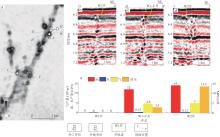
Fig.6
Seismic responses and single-well production of fractured-vuggy reservoirs in a typical well group in the Yueman well block, Tarim Basin"
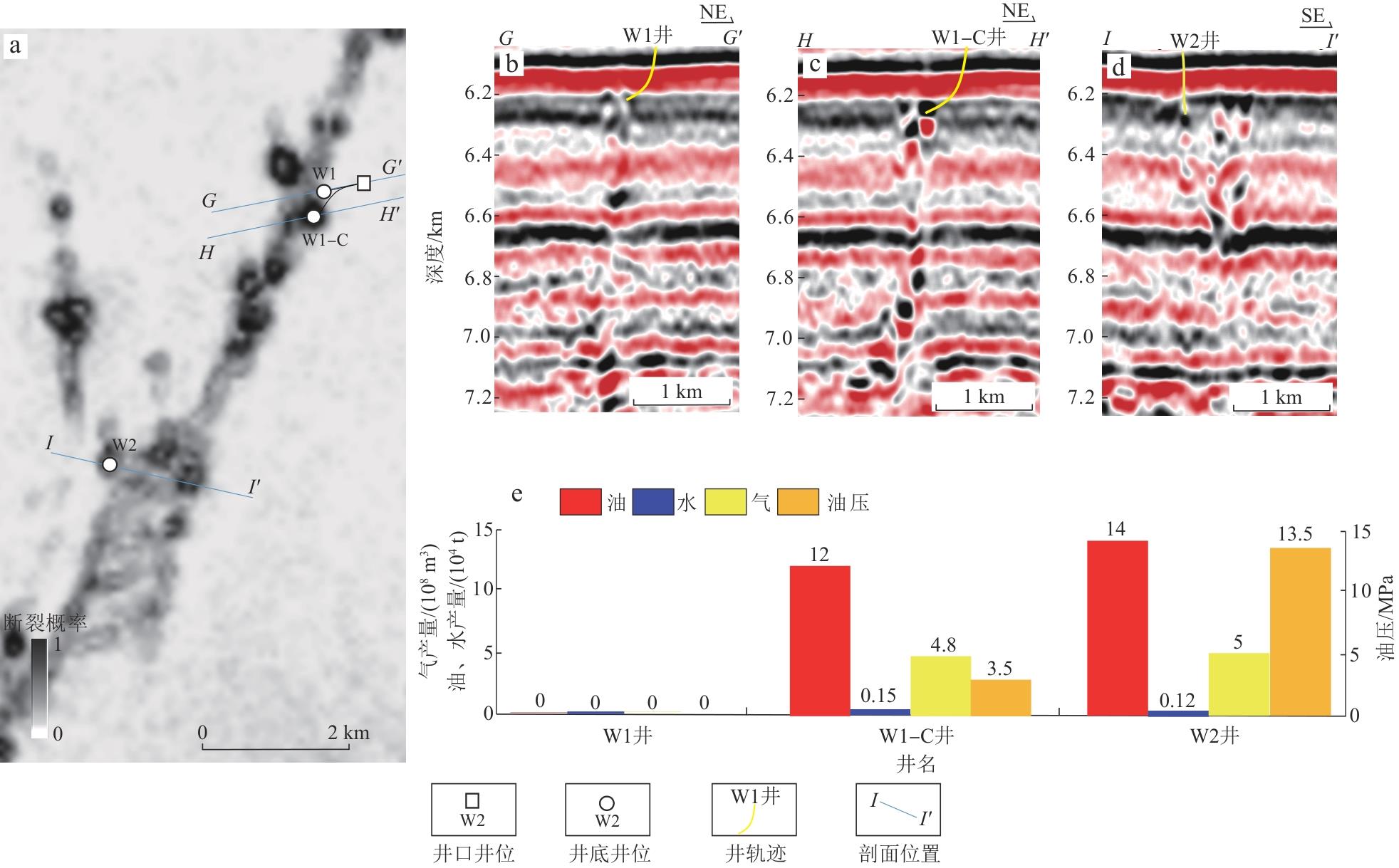

Fig.7
Forward models and prediction results designed based on the interpretation results of typical sections in Yueman well area,Tarim Basin(modified after references [27])"


Fig.8
Intelligent predictions and drilling verification for reservoir architecture in the Yueman well block, Tarim Basin"


Fig.9
Connectivity analysis of typical fractured-vuggy reservoirs in the fault-fracture zone through interference tests of a connected well group in the Yueman well block, Tarim Basin"


Fig.10
Connection pattern of fractured-vuggy karst reservoirs in a fault-fracture zone of the Yueman well block, Tarim Basin"


Fig.11
Static characterization of interconnected units in reservoirs based on the geological modeling results of faults and karst caves in the Yueman well block, Tarim Basin"


Fig.12
Comparison of production of different well groups in the same fault zone in the Yueman well block, Tarim Basin"


Fig.13
Section showing oil-water contacts and the developmental characteristics for reservoirs in some wells of the Yueman well block,Tarim Basin"
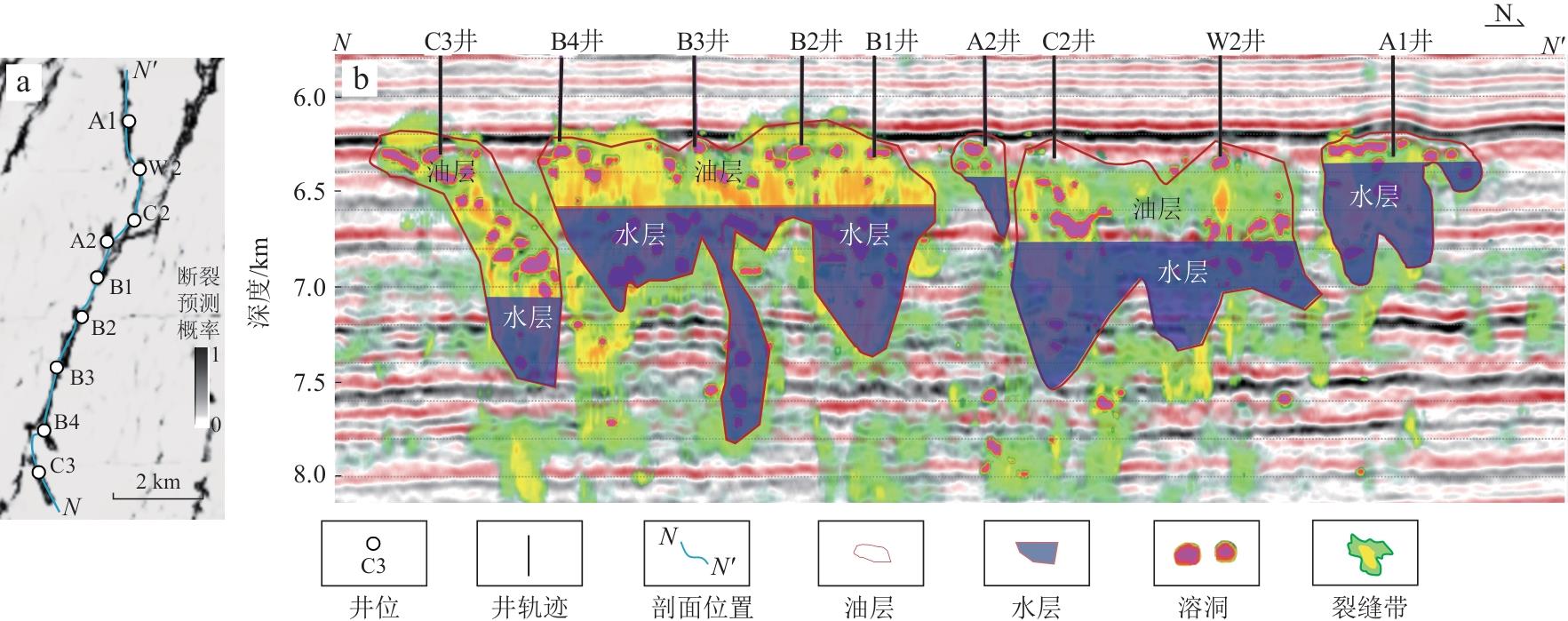

Fig.14
Fractured-vuggy karst reservoir units derived from combined dynamic and static analysis of the Yueman well block, Tarim Basin"
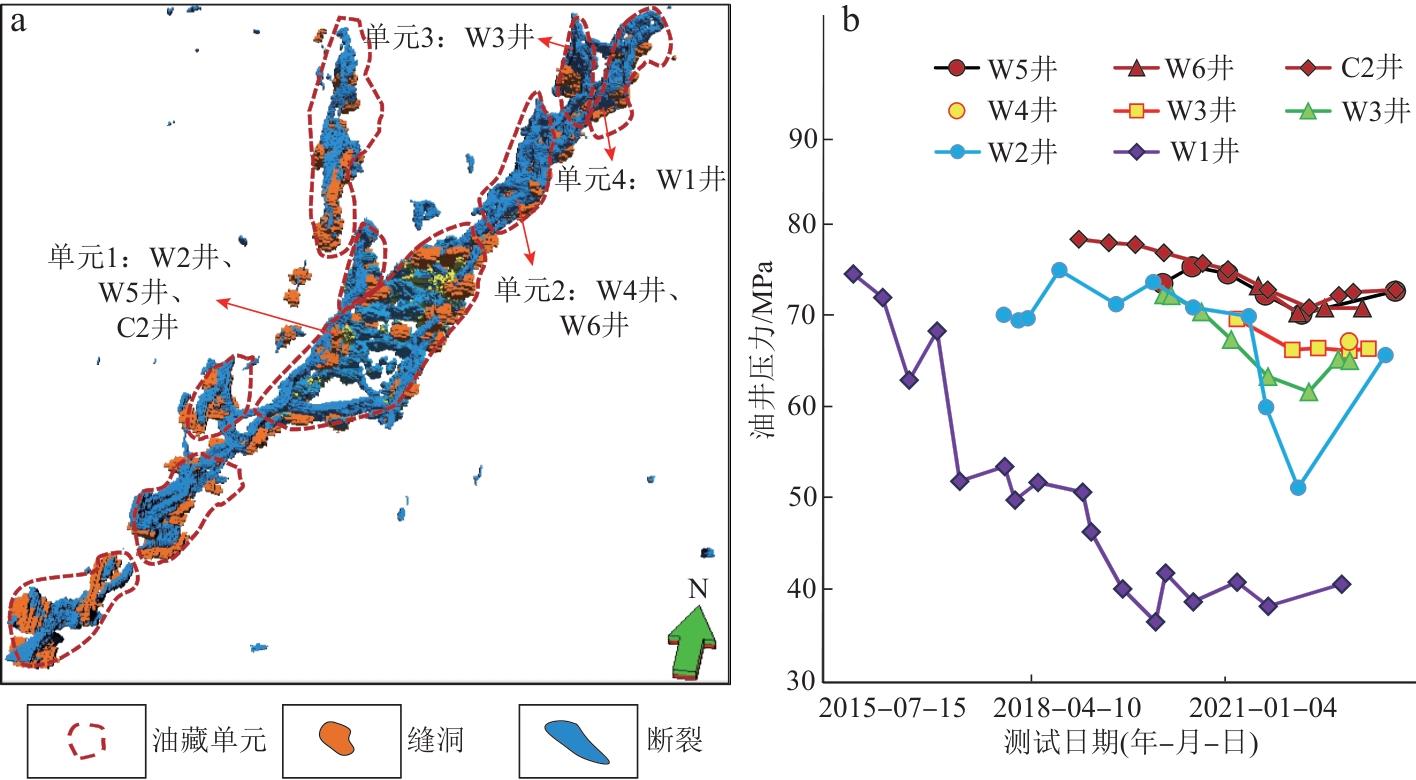

Fig.15
Residual oil development model of fractured-vuggy reservoirs in a fault-fracture zone within the Yueman area, Tarim Basin"

Table 1
Distribution patterns and production methods of residual oil in the Yueman well block, Tarim Basin"
| 剩余油模式 | 储层结构 | 单元连通性 | 剩余油特点 | 开发方式 |
|---|---|---|---|---|
| 已动用油藏单元剩余油 | 斜列断缝面组合模式(Ⅲ) | 不同断裂间储层连通性中等偏弱 | 优势通道附近断缝带,不同向断裂有利部位难波及部位 | 加密井, 注水增压扩容 |
| 同向单断裂组合模式(Ⅰ) | 连通性强,开发效果好 | 优势通道附近断缝带,单元高部位未动用 | 长断裂加密井, 短断裂注水增压扩容, 局部注气压驱 | |
| 未动用油藏单元剩余油 | 不同向多断缝面组合模式(Ⅱ) | 底部弱连通,顶部不连通,油藏孤立 | 孤立油藏剩余油 | 加密井, 侧钻井 |
| 1 | 贾承造. 塔里木盆地构造特征与油气聚集规律[J]. 新疆石油地质, 1999, 20(3): 177-183. |
| JIA Chengzao. Structural characteristics and oil/gas accumulative regularity in Tarim Basin[J]. Xinjiang Petroleum Geology, 1999, 20(3): 177-183. | |
| 2 | 韩剑发, 苏洲, 陈利新, 等. 塔里木盆地台盆区走滑断裂控储控藏作用及勘探潜力[J]. 石油学报, 2019, 40(11): 1296-1310. |
| HAN Jianfa, SU Zhou, CHEN Lixin, et al. Reservoir-controlling and accumulation-controlling of strike-slip faults and exploration potential in the platform of Tarim Basin[J]. Acta Petrolei Sinica, 2019, 40(11): 1296-1310. | |
| 3 | 李凤磊, 林承焰, 任丽华, 等. 塔里木盆地塔北地区多期断裂差异匹配控制下超深岩溶缝洞储层成藏特征[J]. 地学前缘, 2024, 31(4): 219-236. |
| LI Fenglei, LIN Chengyan, REN Lihua, et al. Characteristics of deep karst fracture-cavity reservoir formation controlled by multi-phase faults matching in the northern Tarim Basin[J]. Earth Science Frontiers, 2024, 31(4): 219-236. | |
| 4 | 杨德彬, 鲁新便, 鲍典, 等. 塔里木盆地北部奥陶系海相碳酸盐岩断溶体油藏成因类型及特征再认识[J]. 石油与天然气地质, 2024, 45(2): 357-366. |
| YANG Debin, LU Xinbian, BAO Dian, et al. New insights into the genetic types and characteristics of the Ordovician marine fault-karst carbonate reservoirs in the northern Tarim Basin[J]. Oil & Gas Geology, 2024, 45(2): 357-366. | |
| 5 | 计秉玉, 郑松青, 顾浩. 缝洞型碳酸盐岩油藏开发技术的认识与思考——以塔河油田和顺北油气田为例[J]. 石油与天然气地质, 2022, 43(6): 1459-1465. |
| JI Bingyu, ZHENG Songqing, GU Hao. On the development technology of fractured-vuggy carbonate reservoirs: A case study on Tahe Oilfield and Shunbei oil and gas field[J]. Oil & Gas Geology, 2022, 43(6): 1459-1465. | |
| 6 | 江同文, 邓兴梁, 曹鹏, 等. 塔里木盆地富满断控破碎体油藏储集类型特征与注水替油效果[J]. 石油与天然气地质, 2024, 45(2): 542-552. |
| JIANG Tongwen, DENG Xingliang, CAO Peng, et al. Storage space types and water-flooding efficiency for fault-controlled fractured oil reservoirs in Fuman Oilfield, Tarim Basin[J]. Oil & Gas Geology, 2024, 45(2): 542-552. | |
| 7 | 曹自成, 云露, 漆立新, 等. 塔里木盆地顺北地区顺北84X井超千米含油气重大发现及其意义[J]. 石油与天然气地质, 2024, 45(2): 341-356. |
| CAO Zicheng, YUN Lu, QI Lixin, et al. A major discovery of hydrocarbon-bearing layers over 1 000-meter thick in well Shunbei 84X, Shunbei area, Tarim Basin and its implications[J]. Oil & Gas Geology, 2024, 45(2): 341-356. | |
| 8 | 林波, 云露, 李海英, 等. 塔里木盆地顺北5号走滑断层空间结构及其油气关系[J]. 石油与天然气地质, 2021, 42(6): 1344-1353, 1400. |
| LIN Bo, YUN Lu, LI Haiying, et al. Spatial structure of Shunbei No.5 strike-slip fault and its relationship with oil and gas reservoirs in the Tarim Basin[J]. Oil & Gas Geology, 2021, 42(6): 1344-1353, 1400. | |
| 9 | 李凤磊, 林承焰, 崔仕提, 等. 塔北地区奥陶系古地貌及走滑断裂差异性控储规律[J]. 中国石油大学学报(自然科学版), 2022, 46(6): 48-58. |
| LI Fenglei, LIN Chengyan, CUI Shidi, et al. Analysis on difference of Ordovician fracture-cavity reservoirs controlled by ancient landform and slip fault in Tabei area, Tarim Basin[J]. Journal of China University of Petroleum(Edition of Natural Science), 2022, 46(6): 48-58. | |
| 10 | 邓尚, 刘雨晴, 刘军, 等. 克拉通盆地内部走滑断裂发育、演化特征及其石油地质意义: 以塔里木盆地顺北地区为例[J]. 大地构造与成矿学, 2021, 45(6): 1111-1126. |
| DENG Shang, LIU Yuqing, LIU Jun, et al. Structural styles and evolution models of intracratonic strike-slip faults and the implications for reservoir exploration and appraisal: A case study of the Shunbei area, Tarim Basin[J]. Geotectonica et Metallogenia, 2021, 45(6): 1111-1126. | |
| 11 | 林波, 张旭, 况安鹏, 等. 塔里木盆地走滑断裂构造变形特征及油气意义——以顺北地区1号和5号断裂为例[J]. 石油学报, 2021, 42(7): 906-923. |
| LIN Bo, ZHANG Xu, KUANG Anpeng, et al. Structural deformation characteristics of strike-slip faults in Tarim Basin and their hydrocarbon significance: A case study of No.1 fault and No.5 fault in Shunbei area[J]. Acta Petrolei Sinica, 2021, 42(7): 906-923. | |
| 12 | 常少英, 曾溅辉, 徐旭辉, 等. 碳酸盐岩断溶体内部结构识别技术及应用[J]. 石油地球物理勘探, 2022, 57(2): 414-422. |
| CHANG Shaoying, ZENG Jianhui, XU Xuhui, et al. Identification technology for internal structures of carbonate fault-karst and its application[J]. Oil Geophysical Prospecting, 2022, 57(2): 414-422. | |
| 13 | 邬光辉, 张韬, 朱永峰, 等. 碳酸盐岩断裂破碎带结构、分布与发育机制[J]. 地质科学, 2020, 55(1): 68-80. |
| WU Guanghui, ZHANG Tao, ZHU Yongfeng, et al. The architecture, distribution and growth of carbonate fault damage zone[J]. Chinese Journal of Geology, 2020, 55(1): 68-80. | |
| 14 | 李映涛, 漆立新, 张哨楠, 等. 塔里木盆地顺北地区中——下奥陶统断溶体储层特征及发育模式[J]. 石油学报, 2019, 40(12): 1470-1484. |
| LI Yingtao, QI Lixin, ZHANG Shaonan, et al. Characteristics and development mode of the Middle and Lower Ordovician fault-karst reservoir in Shunbei area, Tarim Basin[J]. Acta Petrolei Sinica, 2019, 40(12): 1470-1484. | |
| 15 | 姚超, 赵宽志, 孙海航, 等. 断溶体内部缝洞结构组合模式研究及应用[C]//西安石油大学, 陕西省石油学会. 2018油气田勘探与开发国际会议(IFEDC 2018)论文集. 北京: 中国石油塔里木油田勘探开发研究院, 2018: 1903-1910. |
| YAO Chao, ZHAO Kuanzhi, SUN Haihang, et al. Research and application of the combination mode of internal fracture cavity structure in fractured solution bodies[C]//Xi’an Shiyou University, Shaanxi Petroleum Society. Proceedings of the 2018 International Conference on Oil and Gas Field Exploration and Development (IFEDC 2018). Beijing: China Petroleum Tarim Oilfield Exploration and Development Research Institute, 2018: 1903-1910. | |
| 16 | 王健, 庞宇晗, 操应长, 等. 塔里木盆地石灰窑露头区寒武系碳酸盐岩断控岩溶储层的形成机制及指示意义[J]. 中国石油大学学报(自然科学版), 2021, 45(5): 1-12. |
| WANG Jian, PANG Yuhan, CAO Yingchang, et al. Formation mechanism and significance of Cambrian carbonate fault-controlled karst reservoir in Shihuiyao outcrop area, Tarim Basin[J]. Journal of China University of Petroleum(Edition of Natural Science), 2021, 45(5): 1-12. | |
| 17 | 杜赫, 徐守余, 冯建伟, 等. 基于数字露头表征的岩溶缝洞组构特征[J]. 中国石油大学学报(自然科学版), 2020, 44(5): 1-9. |
| DU He, XU Shouyu, FENG Jianwei, et al. Digital outcrop representation for karst fracture-cave reservoir[J]. Journal of China University of Petroleum(Edition of Natural Science), 2020, 44(5): 1-9. | |
| 18 | 尹兵祥, 刘展, 徐凯军. 探地雷达技术在岩石露头研究中的应用[C]//中国地球物理学会. 中国地球物理· 2009. 青岛: 中国石油大学(华东)地球资源与信息学院, 2009: 360. |
| YIN Bingxiang, LIU Zhan, XU Kaijun. Application of ground penetrating radar technology in rock outcrop research[C]//Chinese Geophysical Society. Chinese Geophysics, 2009. Qingdao: School of Earth Resources and Information Science, China University of Petroleum (East China), 2009: 360. | |
| 19 | 徐红霞, 沈春光, 李斌, 等. 多属性分析技术在碳酸盐岩断溶体预测中的应用[J]. 石油地球物理勘探, 2017, 52(): 158-163. |
| XU Hongxia, SHEN Chunguang, LI Bin, et al. Fault-karst carbonate reservoir prediction with comprehensive multi-attribute analysis[J]. Oil Geophysical Prospecting, 2017, 52(S2): 158-163. | |
| 20 | 韩长城, 林承焰, 马存飞. 地震多属性优选技术在碳酸盐岩缝洞型储层预测中的应用[J]. 岩性油气藏, 2013, 25(6): 67-70, 78. |
| HAN Changcheng, LIN Chengyan, MA Cunfei. Application of seismic multi-attribute optimization technology to the prediction of carbonate fractured-vuggy reservoir[J]. Lithologic Reservoirs, 2013, 25(6): 67-70, 78. | |
| 21 | 李凤磊, 林承焰, 张国印, 等. 塔北地区多期走滑断裂地球物理响应特征及精细识别[J]. 中国石油大学学报(自然科学版), 2024, 48(3): 1-14. |
| LI Fenglei, LIN Chengyan, ZHANG Guoyin, et al. Characteristics of geophysical response and fine identification of multi-stage strike-slip fault in Tabei area[J]. Journal of China University of Petroleum (Edition of Natural Science), 2024, 48(3): 1-14. | |
| 22 | WU Xinming, YAN Shangsheng, QI Jie, et al. Deep learning for characterizing paleokarst collapse features in 3-D seismic images[J]. Journal of Geophysical Research: Solid Earth, 2020, 125(9): e2020JB019685. |
| 23 | ZHANG Guoyin, LIN Chengyan, REN Lihua, et al. Seismic characterization of deeply buried paleocaves based on Bayesian deep learning[J]. Journal of Natural Gas Science and Engineering, 2022, 97: 104340. |
| 24 | 李凤磊, 林承焰, 任丽华, 等. 超深层断缝带岩溶缝洞体储层结构分析与智能预测[J/OL]. 地学前缘: 1-20[2024-07-13]. . |
| LI Fenglei, LIN Chengyan, REN Lihua, et al. Structural analysis and intelligent prediction of karst fracture cave reservoirs in ultra deep fault zones[J/OL]. Earth Science Frontiers: 1-20[2024-07-13]. . | |
| 25 | 邓辉, 李果营, 杨海风, 等. 走滑应变椭圆模型的改进及应用举例[J]. 地球科学进展, 2019, 34(8): 868-878. |
| DENG Hui, LI Guoying, YANG Haifeng, et al. Improvement and application of Riedel shear system[J]. Advances in Earth Science, 2019, 34(8): 868-878. | |
| 26 | 李艳友, 漆家福, 周赏. 走滑构造差异变形特征及其主控因素分析——基于砂箱模拟实验[J]. 石油实验地质, 2017, 39(5): 711-715. |
| LI Yanyou, QI Jiafu, ZHOU Shang. Differential deformation and its main controls on strike-slip structures: Evidence from sandbox experiments[J]. Petroleum Geology and Experiment, 2017, 39(5): 711-715. | |
| 27 | 郑晓丽, 安海亭, 王祖君, 等. 塔北哈拉哈塘地区走滑断裂分段特征及其与油气成藏的关系[J]. 浙江大学学报(理学版), 2018, 45(2): 219-225. |
| ZHENG Xiaoli, AN Haiting, WANG Zujun, et al. The segmentation features of strike-slip fault and its relation with the fault and reservoirs in Halahatang area, North Tarim Basin[J]. Journal of ZhejiangUniversity(Science Edition), 2018, 45(2): 219-225. | |
| 28 | 杨敬雅, 李相文, 朱冬辉, 等. 基于正演模拟的碳酸盐岩缝洞体系连通性分析[J]. 复杂油气藏, 2019, 12(2): 22-27. |
| YANG Jingya, LI Xiangwen, ZHU Donghui, et al. Connectivity analysis of carbonate fracture-cave system based on forward modeling[J]. Complex Hydrocarbon Reservoirs, 2019, 12(2): 22-27. | |
| 29 | 李凡异, 魏建新, 狄帮让, 等. 碳酸盐岩孔洞储层地震物理模型研究[J]. 石油地球物理勘探, 2016, 51(2): 272-280. |
| LI Fanyi, WEI Jianxin, DI Bangrang, et al. Seismic physical model of carbonate cavern reservoirs[J]. Oil Geophysical Prospecting, 2016, 51(2): 272-280. | |
| 30 | 杨敬雅, 李相文, 朱冬辉, 等. 基于正演模拟的碳酸盐岩缝洞体系连通性分析[J]. 复杂油气藏, 2019, 12(2): 22-27. |
| YANG Jingya, LI Xiangwen, ZHU Donghui, et al. Connectivity analysis of carbonate fracture-cave system based on forward modeling[J]. Complex Hydrocarbon Reservoirs, 2019, 12(2): 22-27. | |
| 31 | 张洁, 袁晓满, 刘勇, 等. 富满油田富源210井区井间连通性研究及应用[C]//中国地质大学(武汉), 西安石油大学, 陕西省石油学会. 2023油气田勘探与开发国际会议论文集Ⅰ. 库尔勒市: 中国石油塔里木油田分公司哈得油气开发部, 2023: 277-285. |
| ZHANG Jie, YUAN Xiaoman, LIU Yong, et al. Research and application of inter well connectivity in Fuyuan 210 well area of Fuman Oilfield[C]//China University of Geosciences (Wuhan), Xi’an Shiyou University, the Shaanxi Petroleum Society. Proceedings of the 2023 International Conference on Oil and Gas Field Exploration and Development I. Korla: Hade Oil and Gas Development Department of China Petroleum Tarim Oilfield Branch, 2023: 277-285. | |
| 32 | 苏泽中. 利用动态资料研究碳酸盐岩缝洞型油藏井间连通性[D]. 西安: 西安石油大学, 2018. |
| SU Zezhong. The study of interwell connectivity in fracture-vuggy carbonate reservoirs by dynamic data[D]. Xi’an: Xi’an Shiyou University, 2018. | |
| 33 | 缪立南, 邸士莹. 类干扰试井井间连通程度的定量分析[J]. 油气田地面工程, 2014, 33(7): 16-17. |
| MIAO Linan, DI Shiying. Quantitative analysis of inter well connectivity in interference testing[J]. Oil-Gas Field Surface Engineering, 2014, 33(7): 16-17. | |
| 34 | 顾浩, 王光付, 杨敏, 等. 超深断溶体油藏油井动用深度确定方法及其对开发的指导意义[J]. 石油学报, 2021, 42(9): 1202-1211. |
| GU Hao, WANG Guangfu, YANG Min, et al. A method for estimating the drainage depth of oil well in ultra-deep fault-karst reservoirs and its guiding significance to oilfield development[J]. Acta Petrolei Sinica, 2021, 42(9): 1202-1211. | |
| 35 | WU Guanghui, MA Bingshan, HAN Jianfa, et al. Origin and growth mechanisms of strike-slip faults in the central Tarim cratonic basin, NW China[J]. Petroleum Exploration and Development, 2021, 48(3): 595-607. |
| 36 | 叶天竺, 黄崇轲,邓志奇. 1∶250万中华人民共和国数字地质图空间数据库[J]. 中国地质, 2017, 44(): 19-24, 139-146. |
| YE Tianzhu, HUANG Chongke, DENG Zhiqi. Spatial database of 1∶2 500 000 digital geologic map of People’s Republic of China[J]. Geology in China, 2017, 44(S1): 19-24, 139-146. | |
| 37 | 赵倩倩, 雷宛, 邓艳, 等. 探地雷达在工程勘察中天线频率的选择[J]. 勘察科学技术, 2013(2): 61-64. |
| ZHAO Qianqian, LEI Wan, DENG Yan, et al. Ground penetrating radar (GPR) in antenna frequency selection of engineering investigation[J]. Site Investigation Science and Technology, 2013(2): 61-64. | |
| 38 | 栗宝鹃, 刘栋臣, 王志豪, 等. 基于电磁原理的浅地表地质病害探测方法及应用[J]. 工程地球物理学报, 2022, 19(6): 753-761. |
| LI Baojuan, LIU Dongchen, WANG Zhihao, et al. Electromagnetic method and application for geological defects detection in shallow surface[J]. Chinese Journal of Engineering Geophysics, 2022, 19(6): 753-761. | |
| 39 | RICHARD P D, NAYLOR M A, KOOPMAN A. Experimental models of strike-slip tectonics[J]. Petroleum Geoscience, 1995, 1(1): 71-80. |
| 40 | MCCLAY K, BONORA M. Analog models of restraining stepovers in strike-slip fault systems[J]. AAPG Bulletin, 2001, 85(2): 233-260. |
| 41 | 康志江, 张冬梅, 张振坤, 等. 深层缝洞型油藏井间连通路径智能预测技术[J]. 石油与天然气地质, 2023, 44(5): 1290-1299. |
| KANG Zhijiang, ZHANG Dongmei, ZHANG Zhenkun, et al. Intelligent prediction of inter-well connectivity path in deep fractured-vuggy reservoirs[J]. Oil & Gas Geology, 2023, 44(5): 1290-1299. | |
| 42 | 吕心瑞, 孙建芳, 李红凯, 等. 塔里木盆地深层碳酸盐岩缝洞型油藏精细地质建模技术[J]. 石油与天然气地质, 2024, 45(5): 1195-1210. |
| Xinrui LYU, SUN Jianfang, LI Hongkai, et al. Fine geological modelling technology for deep fractured-vuggy carbonate oil reservoirs in the Tarim Basin[J]. Oil & Gas Geology, 2024, 45(5): 1195-1210. | |
| 43 | 杨继东, 孙加星, 黄建平, 等. 面向断溶体缝洞储层的智能化散射波地震成像方法[J]. 中国石油大学学报(自然科学版),2024, 48(2): 67-73. |
| YANG Jidong, SUN Jiaxing, HUANG Jianping, et al. Intelligent diffractions imaging method for fault-karst reservoir[J]. Journal of China University of Petroleum (Edition of Natural Science), 2024, 48(2): 67-73. | |
| 44 | 毛毳, 张云峰, 袁红旗, 等. 南堡凹陷及周边露头下古生界岩溶储集体特征及对比[J]. 中国石油大学学报(自然科学版), 2023, 47(4): 24-34. |
| MAO Cui, ZHANG Yunfeng, YUAN Hongqi, et al. Characteristics and comparison of karst reservoirs of lower Paleozoic in Nanpu Sag and outcrops[J]. Journal of China University of Petroleum (Edition of Natural Science), 2023, 47(4): 24-34. |
| [1] | Lu YUN, Zicheng CAO, Feng GENG, Yang WANG, Yong DING, Yongli LIU. Regularity of the Ordovician hydrocarbon system distribution in the Tabei non-foreland area of the Tarim Basin [J]. Oil & Gas Geology, 2025, 46(1): 15-30. |
| [2] | Shuai HE, Anlai MA, Lu YUN, Zicheng CAO, Xianqing LI, Cheng HUANG, Guosong ZHANG, Song HU, Tieyi WANG, Weilong PENG, Zhili ZHU, Futian CUI. Organic geochemical characteristics and exploration significance of the Upper Ordovician Qrebake Formation source rocks, Shunbei area, Tarim Basin [J]. Oil & Gas Geology, 2025, 46(1): 246-260. |
| [3] | Xinrui LYU, Jianfang SUN, Hongkai LI, Dongling XIA, Xingwei WU, Kelong HAN, Jiagen HOU. Fine geological modelling technology for deep fractured-vuggy carbonate oil reservoirs in the Tarim Basin [J]. Oil & Gas Geology, 2024, 45(5): 1195-1210. |
| [4] | Shang DENG, Huabiao QIU, Dawei LIU, Jun HAN, Zhixing RU, Weilong PENG, Qing BIAN, Cheng HUANG. Advances in research on the genetic mechanisms of intracratonic strike-slip fault system and their control on hydrocarbon accumulation: A case study of the northern Tarim Basin [J]. Oil & Gas Geology, 2024, 45(5): 1211-1225. |
| [5] | Juncheng QIAO, Shaoying CHANG, Jianhui ZENG, Peng CAO, Keliang DONG, Mengxiu WANG, Jining YANG, Yazhou LIU, Hui LONG, Ting AN, Rui YANG, Lin WEN. Origin of differential hydrocarbon accumulation in ultra-deep carbonate reservoirs along strike-slip fault zones in the Fuman area, northern Tarim Basin [J]. Oil & Gas Geology, 2024, 45(5): 1226-1246. |
| [6] | Zhenghe WANG, Ronghu ZHANG, Yong YUE, Jinxiang CHENG. Basin-mountain coupling-controlled sequence stratigraphic characteristics of the Upper Triassic Huangshanjie Formation, Kuqa Depression, Tarim Basin [J]. Oil & Gas Geology, 2024, 45(5): 1247-1258. |
| [7] | Hailong MA, Lin JIANG, Wenlong DING, Pengyuan HAN, Zhen WANG, Changjian ZHANG, Huan WEN, Liming DING, Jie LI. Deformation characteristics and hydrocarbon accumulation models of the Lan’ga and Hotan River fault zones in the Tarim Basin [J]. Oil & Gas Geology, 2024, 45(5): 1259-1274. |
| [8] | Yongjin GAO, Chengming YIN, Lihong LIU, Darong XU, Youxing YANG, Yuanyin ZHANG, Zezhang SONG, Mantong ZHEN. Characteristics of source rocks in the Cambrian Xiaoerbulake Formation in the northwestern Tarim Basin [J]. Oil & Gas Geology, 2024, 45(4): 1064-1078. |
| [9] | Guangfu WANG, Yang LI, Rui WANG, Yingbang ZHOU, Ying JIA. Recent advances in geological carbon dioxide storage and utilization [J]. Oil & Gas Geology, 2024, 45(4): 1168-1179. |
| [10] | Pengyuan HAN, Wenlong DING, Debin YANG, Juan ZHANG, Hailong MA, Shenghui WANG. Characteristics of the S80 strike-slip fault zone and its controlling effects on the Ordovician reservoirs in the Tahe oilfield, Tarim Basin [J]. Oil & Gas Geology, 2024, 45(3): 770-786. |
| [11] | Yanqiu ZHANG, Honghan CHEN, Xiepei WANG, Peng WANG, Danmei SU, Zhou XIE. Assessment of connectivity between source rocks and strike-slip fault zone in the Fuman oilfield, Tarim Basin [J]. Oil & Gas Geology, 2024, 45(3): 787-800. |
| [12] | Wenlong DING, Yuntao LI, Jun HAN, Cheng HUANG, Laiyuan WANG, Qingxiu MENG. Methods for high-precision tectonic stress field simulation and multi-parameter prediction of fracture distribution for carbonate reservoirs and their application [J]. Oil & Gas Geology, 2024, 45(3): 827-851. |
| [13] | Zicheng CAO, Lu YUN, Lixin QI, Haiying LI, Jun HAN, Feng GENG, Bo LIN, Jingping CHEN, Cheng HUANG, Qingyan MAO. A major discovery of hydrocarbon-bearing layers over 1,000-meter thick in well Shunbei 84X, Shunbei area, Tarim Basin and its implications [J]. Oil & Gas Geology, 2024, 45(2): 341-356. |
| [14] | Debin YANG, Xinbian LU, Dian BAO, Fei CAO, Yan WANG, Ming WANG, Runcheng XIE. New insights into the genetic types and characteristics of the Ordovician marine fault-karst carbonate reservoirs in the northern Tarim Basin [J]. Oil & Gas Geology, 2024, 45(2): 357-366. |
| [15] | Changjian ZHANG, Debin YANG, Lin JIANG, Yingbing JIANG, Qi CHANG, Xuejian MA. Characteristics and origin of over-dissolution residual fault-karst reservoirs in the northern Tahe oilfield, Tarim Basin [J]. Oil & Gas Geology, 2024, 45(2): 367-383. |
| Viewed | ||||||
|
Full text |
|
|||||
|
Abstract |
|
|||||
