

Oil & Gas Geology ›› 2025, Vol. 46 ›› Issue (3): 926-943.doi: 10.11743/ogg20250315
• Petroleum Geology • Previous Articles Next Articles
Yifan XUE1( ), Haitao ZHAO2, Yahao HUANG1(), Zhigang WEN1, Yukun LIU1, Yintao ZHANG2, Zhanfeng QIAO3, Tao LUO4
Received:2024-08-29
Revised:2025-03-06
Online:2025-06-30
Published:2025-06-26
Contact:
Yahao HUANG
E-mail:xyf257248@163.com;hyhtr08916@163.com
CLC Number:
Yifan XUE, Haitao ZHAO, Yahao HUANG, Zhigang WEN, Yukun LIU, Yintao ZHANG, Zhanfeng QIAO, Tao LUO. Differential fluid overpressure evolution and hydrocarbon accumulation mechanisms of deep Ordovician reservoirs in areas with and without strike-slip faults, Tarim Basin[J]. Oil & Gas Geology, 2025, 46(3): 926-943.
Add to citation manager EndNote|Reference Manager|ProCite|BibTeX|RefWorks
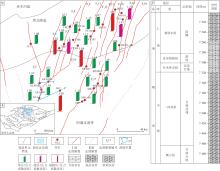
Fig.1
Tectonic location of the strike-slip fault zones, and composite stratigraphic column of the Fuman oilfield in the non-foreland area of the Tarim Basin"

Table 1
Distances from the major faults and pressure coefficients of areas with and without strike-slip faults in the Tarim Basin"
| 区域 | 井号 | 主干断裂带 | 距主干断裂带 距离a/km | 压力 系数b |
|---|---|---|---|---|
| 非断裂区 | GL2 | FI10 | 20.2 | 1.68 |
| FY104 | FI9 | 6.3 | 1.89 | |
| HD23 | FI13 | 4.2 | 2.01 | |
| YM9 | FI7 | 3.1 | 1.62 | |
| YK101 | FI14 | 3.2 | 1.26 | |
| YK1 | FI14 | 5.8 | 1.45 | |
| YM8 | FI9 | 3.4 | 1.31 | |
| 断裂区 | YM5 | FI7 | 0 | 1.09 |
| FY101 | FI9 | 0 | 1.09 | |
| HD251 | FI12 | 0 | 1.07 | |
| HD201-H6 | FI15 | 0 | 1.08 | |
| GL301H | FI5 | 0 | 1.07 | |
| GL305H | FI5 | 0 | 1.01 | |
| FY202 | FI11 | 0 | 1.14 | |
| MS1-H1 | FI17 | 0 | 1.16 | |
| MS1 | FI17 | 0 | 1.11 |

Fig.2
Seismic profiles tied to typical wells in the Fuman oilfield, Tarim Basin"
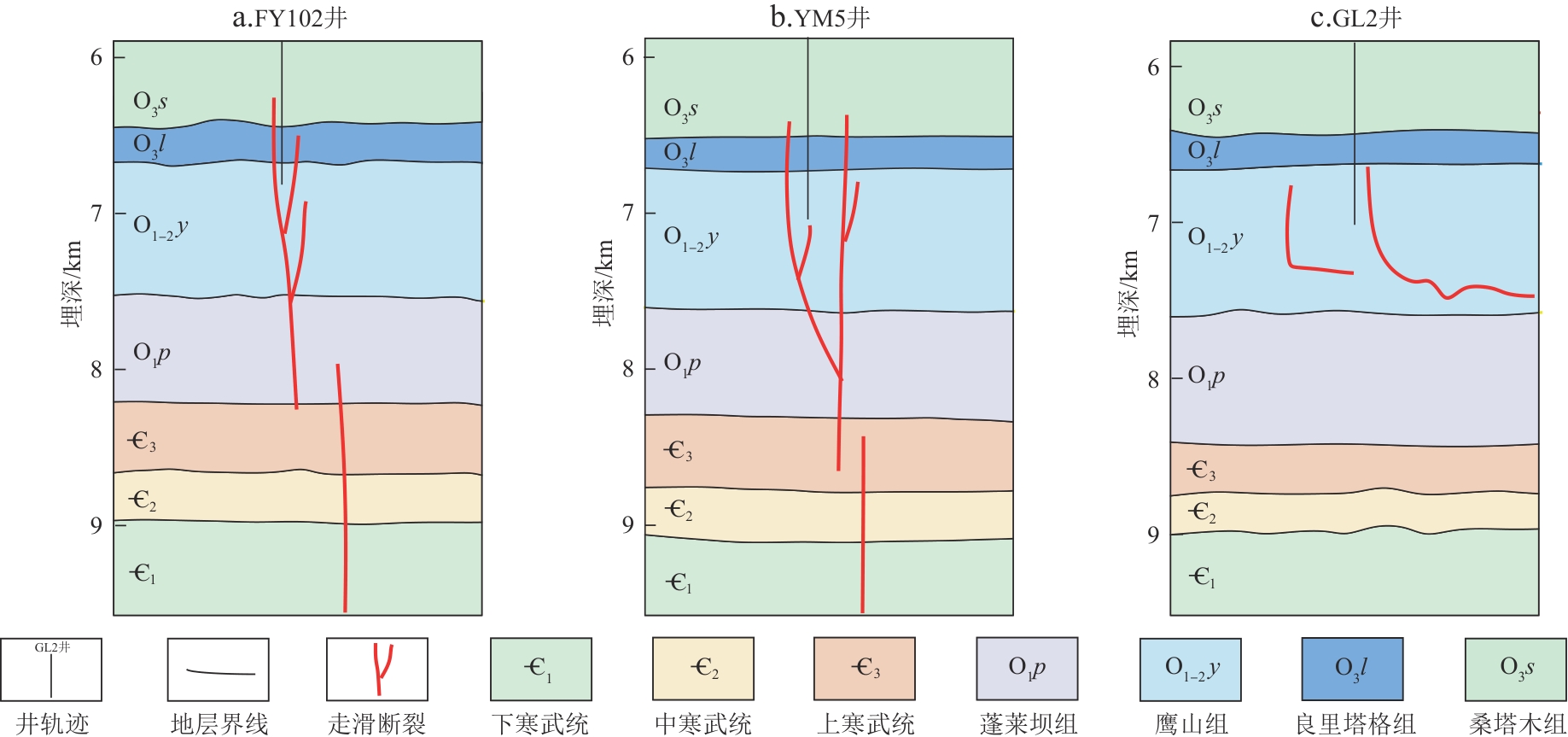

Fig.3
Micrographs of thin sections showing the reservoir space characteristics of the Yijianfang Formation, Fuman oilfield, Tarim Basin"

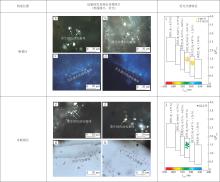
Fig.4
Photos showing the petrography of oil inclusions from the Ordovician Yijianfang Formation, Tarim Basin"


Fig.5
Charts showing the statistics of the homogenization temperatures of fluid inclusions from the Ordovician Yijianfang Formation, Tarim Basin"


Fig.6
Confocal scanning laser microscopy (CSLM) images showing the gas-to-liquid volume ratios of oil inclusions from calcite veins in the Ordovician Yijianfang Formation, well YM5,Tarim Basin"
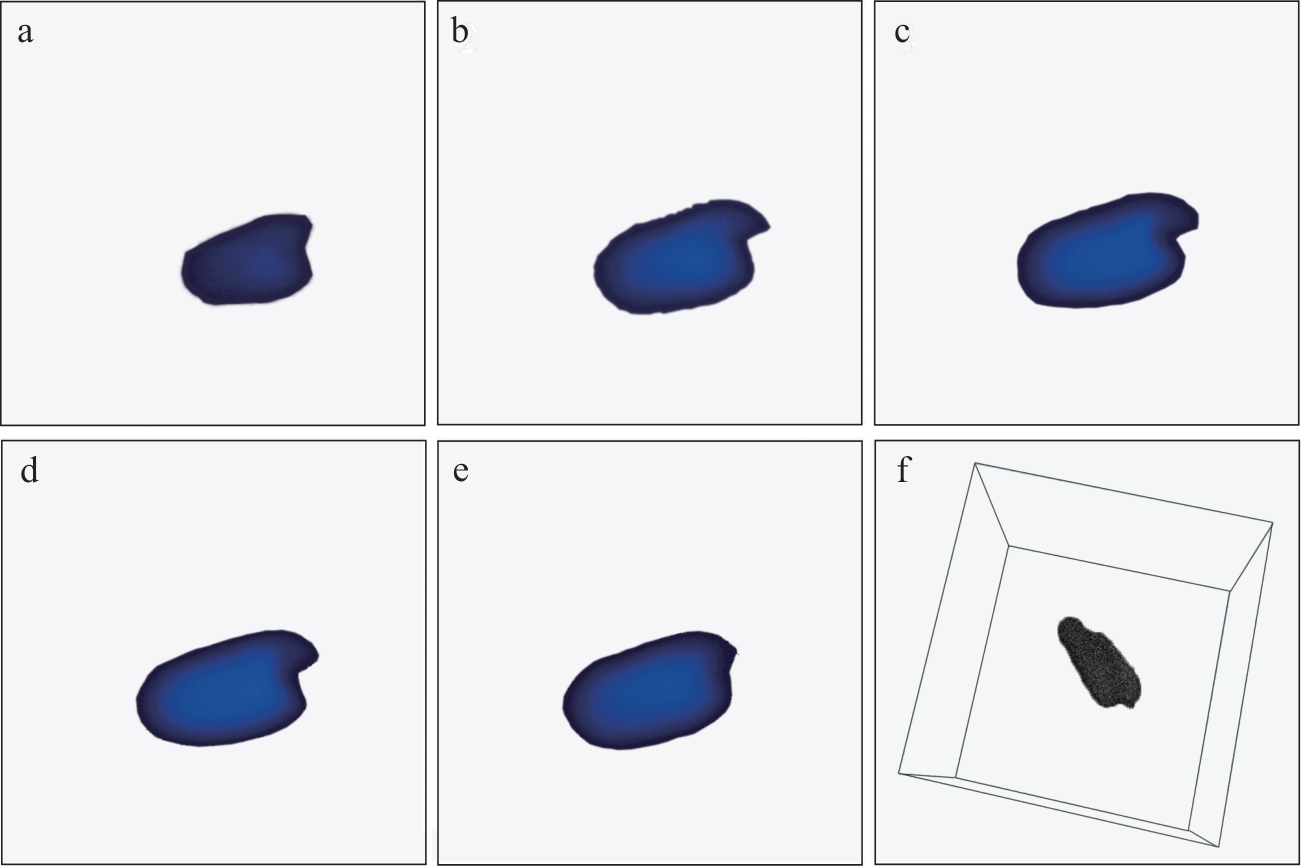

Fig.7
Curves showing the simulated minimum trapping pressures of oil inclusions from calcite veins in the Ordovician Yijianfang Formation, Tarim Basin"

Table 2
Paleopressure simulation results of oil inclusions from the Ordovician reservoirs in the Fuman oilfield, Tarim Basin"
| 井号 | 荧光颜色 | 油包裹体均一温度/℃ | 气/液比/% | 伴生盐水包裹体均一温度/℃ | 捕获压力/MPa | 捕获深度/m | 压力系数 |
|---|---|---|---|---|---|---|---|
| YM5 | 绿色 | 56.4 | 9.1 | 72.4 | 31.5 | 2 635 | 1.21 |
| YM5 | 绿色 | 58.2 | 6.4 | 75.1 | 33.6 | 2 587 | 1.29 |
| YM5 | 绿色 | 56.1 | 8.9 | 74.3 | 34.5 | 2 618 | 1.33 |
| YM5 | 绿色 | 57.2 | 12.3 | 74.9 | 33.3 | 2 665 | 1.28 |
| YM5 | 绿色 | 55.4 | 4.9 | 72.8 | 33.3 | 2 579 | 1.28 |
| YM5 | 蓝白色 | 78.2 | 7.5 | 98.4 | 32.5 | 3 146 | 1.05 |
| YM5 | 蓝白色 | 76.5 | 8.2 | 97.6 | 34.0 | 3 123 | 1.10 |
| YM5 | 蓝白色 | 77.4 | 9.6 | 102.5 | 36.8 | 3 531 | 1.05 |
| YM5 | 蓝白色 | 79.3 | 5.8 | 98.3 | 32.7 | 3 125 | 1.06 |
| YM5 | 蓝白色 | 76.8 | 5.9 | 104.5 | 37.3 | 3 542 | 1.07 |
| YM5 | 蓝白色 | 74.8 | 6.4 | 97.1 | 32.8 | 3 127 | 1.06 |
| FY102 | 绿色 | 62.4 | 8.8 | 84.9 | 37.0 | 3 025 | 1.23 |
| FY102 | 绿色 | 64.4 | 9.4 | 82.8 | 38.7 | 3 018 | 1.29 |
| FY102 | 绿色 | 63.3 | 9.6 | 83.4 | 38.6 | 2 990 | 1.29 |
| FY102 | 绿色 | 66.9 | 5.7 | 85.6 | 40.1 | 2 986 | 1.34 |
| FY102 | 绿色 | 64.8 | 12.5 | 87.1 | 39.4 | 3 008 | 1.31 |
| FY102 | 蓝白色 | 75.9 | 10.5 | 98.3 | 34.4 | 3 153 | 1.11 |
| FY102 | 蓝白色 | 76.4 | 9.7 | 99.8 | 34.3 | 3 068 | 1.10 |
| FY102 | 蓝白色 | 76.3 | 6.4 | 103.6 | 37.5 | 3 128 | 1.16 |
| FY102 | 蓝白色 | 75.9 | 7.5 | 104.9 | 38.0 | 3 072 | 1.09 |
| GL2 | 绿色 | 86.4 | 6.8 | 96.8 | 42.4 | 3 523 | 1.21 |
| GL2 | 绿色 | 85.2 | 8.4 | 106.4 | 41.3 | 3 525 | 1.18 |
| GL2 | 绿色 | 87.2 | 7.5 | 108.7 | 42.5 | 3 448 | 1.25 |
| GL2 | 绿色 | 87.1 | 10.1 | 113.5 | 42.2 | 3 459 | 1.24 |

Fig.8
Typical Raman spectrum of CH4 inclusions from calcite veins in well GL2, Tarim Basin"
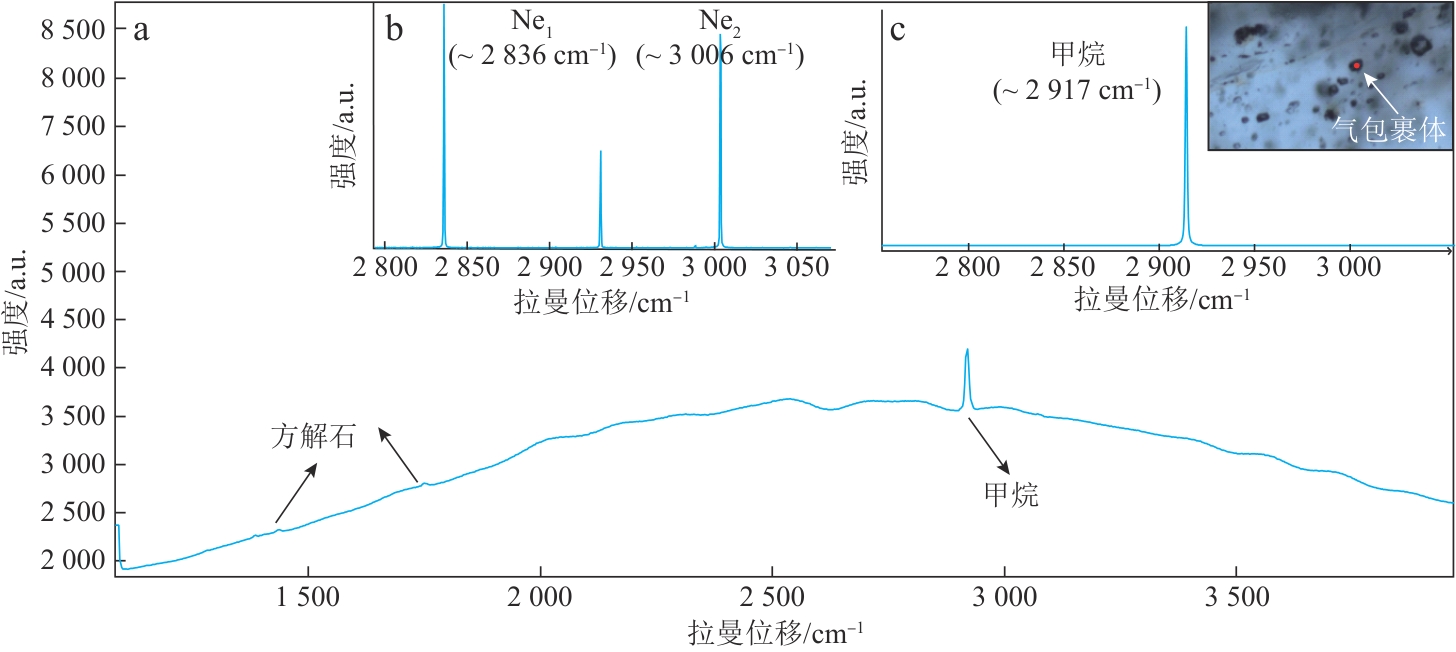
Table 3
Paleopressure reconstruction results of gas inclusions from the Ordovician reservoirs in well GL2, Fuman oilfield, Tarim Basin"
| 甲烷伸缩振动峰拉曼位移/cm-1 | 气包裹体密度/(g/cm3) | 伴生盐水包裹体均一温度/℃ | 捕获压力/MPa | 压力系数 |
|---|---|---|---|---|
| 2 911.03 | 0.268 4 | 133.5 | 86.79 | 1.74 |
| 2 911.02 | 0.268 9 | 133.5 | 87.14 | 1.74 |
| 2 911.01 | 0.269 4 | 133.5 | 87.50 | 1.75 |
| 2 911.03 | 0.268 4 | 133.5 | 86.79 | 1.74 |
| 2 911.05 | 0.267 4 | 133.8 | 86.18 | 1.72 |
| 2 911.05 | 0.267 4 | 133.8 | 86.18 | 1.72 |
| 2 911.12 | 0.264 0 | 133.8 | 83.75 | 1.68 |
| 2 911.05 | 0.267 4 | 133.8 | 86.18 | 1.72 |
| 2 911.06 | 0.267 0 | 133.8 | 85.83 | 1.72 |
| 2 911.09 | 0.265 5 | 135.6 | 85.40 | 1.71 |
| 2 911.10 | 0.265 0 | 135.6 | 85.06 | 1.70 |
| 2 911.08 | 0.266 0 | 135.6 | 85.75 | 1.72 |
| 2 911.08 | 0.266 0 | 135.6 | 85.75 | 1.72 |
| 2 911.07 | 0.266 5 | 135.6 | 86.10 | 1.72 |

Fig.9
Diagrams showing the burial and thermal evolution histories of the Ordovician Yijianfang Formation in typical wells, Tarim Basin"


Fig.10
U-Pb Tera-Wasserburg concordia diagrams of calcite samples from reservoirs in typical wells, Tarim Basin"


Fig.11
Cross plots of acoustic velocity vs. vertical effective stress showing varying genetic mechanisms of overpressure"

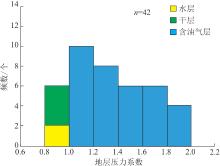
Fig.12
Histogram showing pressure coefficients across different types of fluid-bearing layers in the Tarim Basin"


Fig.13
Statistical column of the porosity of reservoirs in areas with and without strike-slip faults within the Tarim Basin"
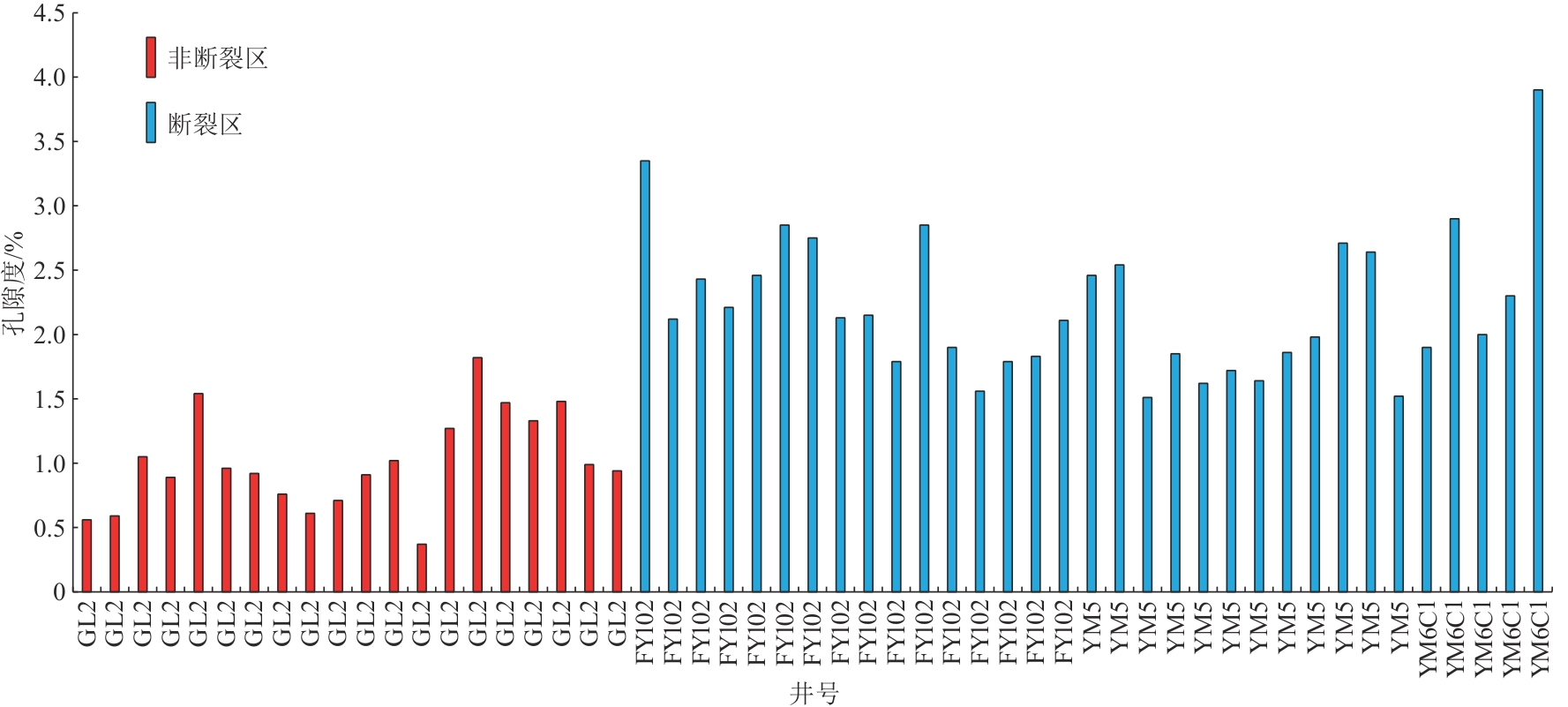

Fig.14
Evolution of paleopressure coefficients of the Middle-Lower Ordovician strata in the Tarim Basin"


Fig.15
Hydrocarbon accumulation patterns of the areas without strike-slip faults in the Tarim Basin"

| 1 | 王清华, 杨海军, 汪如军, 等. 塔里木盆地超深层走滑断裂断控大油气田的勘探发现与技术创新[J]. 中国石油勘探, 2021, 26(4): 58-71. |
| WANG Qinghua, YANG Haijun, WANG Rujun, et al. Discovery and exploration technology of fault-controlled large oil and gas fields of ultra-deep formation in strike slip fault zone in Tarim Basin[J]. China Petroleum Exploration, 2021, 26(4): 58-71. | |
| 2 | 田军, 杨海军, 朱永峰, 等. 塔里木盆地富满油田成藏地质条件及勘探开发关键技术[J]. 石油学报, 2021, 42(8): 971-985. |
| TIAN Jun, YANG Haijun, ZHU Yongfeng, et al. Geological conditions for hydrocarbon accumulation and key technologies for exploration and development in Fuman Oilfield, Tarim Basin[J]. Acta Petrolei Sinica, 2021, 42(8): 971-985. | |
| 3 | 王清华, 杨海军, 张银涛, 等. 塔里木盆地富满油田富东1井奥陶系重大发现及意义[J]. 中国石油勘探, 2023, 28(1): 47-58. |
| WANG Qinghua, YANG Haijun, ZHANG Yintao, et al. Great discovery and its significance in the Ordovician in Well Fudong 1 in Fuman Oilfield, Tarim Basin[J]. China Petroleum Exploration, 2023, 28(1): 47-58. | |
| 4 | LEI Qun, XU Yun, YANG Zhanwei, et al. Progress and development directions of stimulation techniques for ultra-deep oil and gas reservoirs[J]. Petroleum Exploration and Development, 2021, 48(1): 221-231. |
| 5 | 何登发, 贾承造, 赵文智, 等. 中国超深层油气勘探领域研究进展与关键问题[J]. 石油勘探与开发, 2023, 50(6): 1162-1172. |
| HE Dengfa, JIA Chengzao, ZHAO Wenzhi, et al. Research progress and key issues of ultra-deep oil and gas exploration in China[J]. Petroleum Exploration and Development, 2023, 50(6): 1162-1172. | |
| 6 | 邓尚, 邱华标, 刘大卫, 等. 克拉通内走滑断裂成因与控藏机制研究进展——以塔里木盆地北部为例[J]. 石油与天然气地质, 2024, 45(5): 1211-1225. |
| DENG Shang, QIU Huabiao, LIU Dawei, et al. Advances in research on the genetic mechanisms of intracratonic strike-slip fault system and their control on hydrocarbon accumulation: A case study of the northern Tarim Basin[J]. Oil & Gas Geology, 2024, 45(5): 1211-1225. | |
| 7 | 张红波, 周雨双, 沙旭光, 等. 塔里木盆地顺北5号走滑断裂隆起段发育特征与演化机制[J]. 石油与天然气地质, 2023, 44(2): 321-334. |
| ZHANG Hongbo, ZHOU Yushuang, SHA Xuguang, et al. Development characteristics and evolution mechanism of the uplifted segment of the No.5 strike-slip fault zone in Shunbei area, Tarim Basin[J]. Oil & Gas Geology, 2023, 44(2): 321-334. | |
| 8 | YUAN Feifei, TIAN Jinqiang, HAO Fang, et al. Fault characterization and its significance on hydrocarbon migration and accumulation of western Tazhong Uplift, Tarim Basin: Insight from seismic, geochemistry, fluid inclusion and in situ U-Pb dating[J]. Marine and Petroleum Geology, 2024, 170: 107137. |
| 9 | LI Fenglei, LIN Chengyan, REN Lihua, et al. Fault system dynamics and their impact on ordovician carbonate karst reservoirs: Outcrop analogs and 3D seismic analysis in the Tabei region, Tarim Basin, NW China[J]. Marine and Petroleum Geology, 2024, 167: 106923. |
| 10 | BIAN Qing, DENG Shang, LIN Huixi, et al. Strike-slip salt tectonics in the Shuntuoguole Low Uplift, Tarim Basin, and the significance to petroleum exploration[J]. Marine and Petroleum Geology, 2022, 139: 105600. |
| 11 | QIU Huabiao, DENG Shang, ZHANG Jibiao, et al. The evolution of a strike-slip fault network in the Guchengxu high, Tarim Basin (NW China)[J]. Marine and Petroleum Geology, 2022, 140: 105655. |
| 12 | 邱楠生, 刘雯, 徐秋晨, 等. 深层-古老海相层系温压场与油气成藏[J]. 地球科学, 2018, 43(10): 3511-3525. |
| QIU Nansheng, LIU Wen, XU Qiuchen, et al. Temperature-Pressure field and hydrocarbon accumulation in Deep-Ancient marine strata[J]. Earth Science, 2018, 43(10): 3511-3525. | |
| 13 | 曾帅, 邱楠生, 李慧莉, 等. 塔里木盆地顺托果勒地区奥陶系碳酸盐岩超压差异分布研究[J]. 地学前缘, 2023, 30(6): 305-315. |
| ZENG Shuai, QIU Nansheng, LI Huili, et al. Differential overpressure distribution in Ordovician carbonates, Shuntuoguole area, Tarim Basin[J]. Earth Science Frontiers, 2023, 30(6): 305-315. | |
| 14 | 段永贤, 宋金鹏, 郇志鹏, 等. 塔北、塔中奥陶系碳酸盐岩异常高压形成、保存与分布[J]. 新疆石油地质, 2023, 44(4): 421-428. |
| DUAN Yongxian, SONG Jinpeng, XUN Zhipeng, et al. Formation, preservation and distribution of abnormally high pressure in Ordovician carbonate rocks in northern and central Tarim Basin[J]. Xinjiang Petroleum Geology, 2023, 44(4): 421-428. | |
| 15 | 黄亚浩, 汪如军, 文志刚, 等. 塔里木盆地富满油田深层—超深层油气成藏过程[J]. 石油学报, 2024, 45(6): 947-960. |
| HUANG Yahao, WANG Rujun, WEN Zhigang, et al. Hydrocarbon accumulation process of the deep to ultra deep reservoirs in Fuman Oilfield, Tarim Basin[J]. Acta Petrolei Sinica, 2024, 45(6): 947-960. | |
| 16 | 王斌, 赵永强, 何生, 等. 塔里木盆地顺北5号断裂带北段奥陶系油气成藏期次及其控制因素[J]. 石油与天然气地质, 2020, 41(5): 965-974. |
| WANG Bin, ZHAO Yongqiang, HE Sheng, et al. Hydrocarbon accumulation stages and their controlling factors in the northern Ordovician Shunbei 5 fault zone, Tarim Basin[J]. Oil & Gas Geology, 2020, 41(5): 965-974. | |
| 17 | 韩强, 云露, 蒋华山, 等. 塔里木盆地顺北地区奥陶系油气充注过程分析[J]. 吉林大学学报(地球科学版), 2021, 51(3): 645-658. |
| HAN Qiang, YUN Lu, JIANG Huashan, et al. Marine oil and gas filling and accumulation process in the north of Shuntuoguole area in northern Tarim Basin[J]. Journal of Jilin University (Earth Science Edition), 2021, 51(3): 645-658. | |
| 18 | BECKER S P, EICHHUBL P, LAUBACH S E, et al. A 48 m.y. history of fracture opening, temperature, and fluid pressure: Cretaceous Travis Peak Formation, East Texas basin[J]. GSA Bulletin, 2010, 122(7/8): 1081-1093. |
| 19 | KARLSEN D A, NEDKVITNE T, LARTER S R, et al. Hydrocarbon composition of authigenic inclusions: Application to elucidation of petroleum reservoir filling history[J]. Geochimica et Cosmochimica Acta, 1993, 57(15): 3641-3659. |
| 20 | FALL A, EICHHUBL P, CUMELLA S P, et al. Testing the basin-centered gas accumulation model using fluid inclusion observations: Southern Piceance Basin, Colorado[J]. AAPG Bulletin, 2012, 96(12): 2297-2318. |
| 21 | FALL A, EICHHUBL P, BODNAR R J, et al. Natural hydraulic fracturing of tight-gas sandstone reservoirs, Piceance Basin, Colorado[J]. GSA Bulletin, 2015, 127(1/2): 61-75. |
| 22 | 席斌斌, 蒋宏, 许锦, 等. 基于包裹体PVTx数值模拟恢复油藏古温压——存在的问题、对策及应用实例[J]. 石油实验地质, 2021, 43(5): 886-895. |
| XI Binbin, JIANG Hong, XU Jin, et al. Reconstruction of paleo-temperature and pressure of oil reservoirs based on PVTx simulation: problems, strategies and case studies[J]. Petroleum Geology and Experiment, 2021, 43(5): 886-895. | |
| 23 | 苏奥, 陈红汉, 雷川, 等. 流体包裹体PVTx模拟研究油气充注期次和古压力恢复: 以西湖凹陷平湖构造带为例[J]. 地质科技情报, 2014, 33(6): 137-142. |
| SU Ao, CHEN Honghan, LEI Chuan, et al. Application of PVTx simulation of fluid inclusions to estimate petroleum charge stages and restore pressure: Using Pinghu structural belt in Xihu Depression as an example[J]. Geological Science and Technology Information, 2014, 33(6): 137-142. | |
| 24 | 尚培, 陈红汉, 鲁子野, 等. 塔里木盆地玉北地区奥陶系成岩流体演化与油气成藏时期的耦合关系[J]. 地球科学, 2020, 45(2): 569-582. |
| SHANG Pei, CHEN Honghan, LU Ziye, et al. The coupling relationship between diagenetic fluid evolution and hydrocarbon accumulation in the Ordovician of Yubei area, Tarim Basin[J]. Earth Science, 2020, 45(2): 569-582. | |
| 25 | HUANG Yahao, HE Sheng, GUO Xiaowen, et al. Pressure-temperature-time-composition (P-T-t-x) of paleo-fluid in Permian organic-rich shale of Lower Yangtze Platform, China: Insights from fluid inclusions in fracture cements[J]. Marine and Petroleum Geology, 2021, 126: 104936. |
| 26 | 谭然. 柴达木盆地马海东地区古近系油气成藏期次及调整改造研究[D]. 荆州: 长江大学, 2023. |
| TAN Ran. Paleogene oil and gas accumulation stages and reconstruction in Mahaidong area, Qaidam Basin[D]. Jingzhou: Yangtz University, 2023. | |
| 27 | ZOZULYA A A, DIDDAMS S A, CLEMENT T S. Investigations of nonlinear femtosecond pulse propagation with the inclusion of Raman, shock, and third-order phase effects[J]. Physical Review A, 1998, 58(4): 3303-3310. |
| 28 | Wenjia OU, GUO Huirong, LU Wanjun, et al. A re-evaluation of the effects of temperature and NaCl concentration on quantitative Raman spectroscopic measurements of dissolved CH4 in NaCl aqueous solutions: Application to fluid inclusion analysis[J]. Chemical Geology, 2015, 417: 1-10. |
| 29 | HUANG Yahao, TARANTOLA A, LU Wanjun, et al. CH4 accumulation characteristics and relationship with deep CO2 fluid in Lishui Sag, East China Sea Basin[J]. Applied Geochemistry, 2020, 115: 104563. |
| 30 | 田军, 王清华, 杨海军, 等. 塔里木盆地油气勘探历程与启示[J]. 新疆石油地质, 2021, 42(3): 272-282. |
| TIAN Jun, WANG Qinghua, YANG Haijun, et al. Petroleum exploration history and enlightenment in Tarim Basin[J]. Xinjiang Petroleum Geology, 2021, 42(3): 272-282. | |
| 31 | 安海亭, 李海银, 王建忠, 等. 塔北地区构造和演化特征及其对油气成藏的控制[J]. 大地构造与成矿学, 2009, 33(1): 142-147. |
| AN Haiting, LI Haiyin, WANG Jianzhong, et al. Tectonic evolution and its controlling on oil and gas accumulation in the northern Tarim Basin[J]. Geotectonica et Metallogenia, 2009, 33(1): 142-147. | |
| 32 | 何登发, 周新源, 杨海军, 等. 塔里木盆地克拉通内古隆起的成因机制与构造类型[J]. 地学前缘, 2008, 15(2): 207-221. |
| HE Dengfa, ZHOU Xinyuan, YANG Haijun, et al. Formation mechanism and tectonic types of intracratonic paleo-uplifts in the Tarim Basin[J]. Earth Science Frontiers, 2008, 15(2): 207-221. | |
| 33 | 邬光辉, 陈鑫, 马兵山, 等. 塔里木盆地晚新元古代-早古生代板块构造环境及其构造-沉积响应[J]. 岩石学报, 2021, 37(8): 2431-2441. |
| WU Guanghui, CHEN Xin, MA Bingshan, et al. The tectonic environments of the Late Neoproterozoic-Early Paleozoic and its tectono-sedimentary response in the Tarim Basin[J]. Acta Petrologica Sinica, 2021, 37(8): 2431-2441. | |
| 34 | 宋兴国, 陈石, 谢舟, 等. 塔里木盆地富满油田东部走滑断裂发育特征与油气成藏[J]. 石油与天然气地质, 2023, 44(2): 335-349. |
| SONG Xingguo, CHEN Shi, XIE Zhou, et al. Strike-slip faults and hydrocarbon accumulation in the eastern part of Fuman Oilfield, Tarim Basin[J]. Oil & Gas Geology, 2023, 44(2): 335-349. | |
| 35 | 宋兴国, 陈石, 谢舟, 等. 塔里木盆地富满油田东部走滑断裂发育特征与油气成藏[J]. 石油与天然气地质, 2023, 44(2): 335-349. |
| SONG Xingguo, CHEN Shi, XIE Zhou, et al. Strike-slip faults and hydrocarbon accumulation in the eastern part of Fuman Oilfield, Tarim Basin[J]. Oil & Gas Geology, 2023, 44(2): 335-349. | |
| 36 | 邓兴梁, 闫婷, 张银涛, 等. 走滑断裂断控碳酸盐岩油气藏的特征与井位部署思路——以塔里木盆地为例[J]. 天然气工业, 2021, 41(3): 21-29. |
| DENG Xingliang, YAN Ting, ZHANG Yintao, et al. Characteristics and well location deployment ideas of strike-slip fault controlled carbonate oil and gas reservoirs: A case study of the Tarim Basin[J]. Natural Gas Industry, 2021, 41(3): 21-29. | |
| 37 | WANG Shen, LIU Hua, DENG Xingliang, et al. Genetic mechanism of multiphase states of Ordovician oil and gas reservoirs in Fuman Oilfield, Tarim Basin, China[J]. Marine and Petroleum Geology, 2023, 157: 106449. |
| 38 | 李凤磊, 林承焰, 任丽华, 等. 基于地质成因的走滑断裂带岩溶缝洞型储层连通性与剩余油分布模式——以塔里木盆地为例[J]. 石油与天然气地质, 2025, 46(1): 315-334. |
| LI Fenglei, LIN Chengyan, REN Lihua, et al. Connectivity and residual oil distribution patterns of fractured-vuggy karst reservoirs in strike-slip fault zone: A case study of the Tarim Basin[J]. Oil & Gas Geology, 2025, 46(1): 315-334. | |
| 39 | 韩鹏远, 丁文龙, 杨德彬, 等. 塔里木盆地塔河油田S80走滑断裂发育特征及其对奥陶系储层的控制作用[J]. 石油与天然气地质, 2024, 45(3): 770-786. |
| HAN Pengyuan, DING Wenlong, YANG Debin, et al. Characteristics of the S80 strike-slip fault zone and its controlling effects on the Ordovician reservoirs in the Tahe Oilfield, Tarim Basin[J]. Oil & Gas Geology, 2024, 45(3): 770-786. | |
| 40 | 淡永, 梁彬, 张庆玉, 等. 塔北哈拉哈塘地区奥陶系碳酸盐岩浅覆盖区岩溶储层特征与形成机理[J]. 石油物探, 2015, 54(1): 90-98. |
| DAN Yong, LIANG Bin, ZHANG Qingyu, et al. Characteristics and genesis of Ordovician carbonate karst reservoir in the shallow coverage zone of Halahatang area, northern Tarim Basin[J]. Geophysical Prospecting for Petroleum, 2015, 54(1): 90-98. | |
| 41 | 杨率, 邬光辉, 朱永峰, 等. 塔里木盆地北部地区超深断控油藏关键成藏期[J]. 石油勘探与开发, 2022, 49(2): 249-261. |
| YANG Lv, WU Guanghui, ZHU Yongfeng, et al. Key oil accumulation periods of ultra-deep fault-controlled oil reservoir in northern Tarim Basin, NW China[J]. Petroleum Exploration and Development, 2022, 49(2): 249-261. | |
| 42 | 陈家旭, 王斌, 郭小文, 等. 应用方解石激光原位U-Pb同位素定年确定多旋回叠合盆地油气成藏绝对时间——以塔里木盆地塔河油田为例[J]. 石油与天然气地质, 2021, 42(6): 1365-1375. |
| CHEN Jiaxu, WANG Bin, GUO Xiaowen, et al. Application of laser in-situ U-Pb dating of calcite to determination of the absolute time of hydrocarbon accumulation in polycyclic superimposed basins: A case study on Tahe Oilfield, Tarim Basin[J]. Oil & Gas Geology, 2021, 42(6): 1365-1375. | |
| 43 | 苏奥, 陈红汉, 雷川, 等. 流体包裹体PVTx模拟研究油气充注期次和古压力恢复: 以西湖凹陷平湖构造带为例[J]. 地质科技情报, 2014, 33(6): 137-142. |
| SU Ao, CHEN Honghan, LEI Chuan, et al. Application of PVTx simulation of fluid inclusions to estimate petroleum charge stages and restore pressure: Using Pinghu structural belt in Xihu Depression as an example[J]. Geological Science and Technology Information, 2014, 33(6): 137-142. | |
| 44 | 平宏伟, 陈红汉, THIÉRY R. 石油包裹体热动力学模拟古压力改进: 饱和压力预测和体积校正[J]. 地球科学(中国地质大学学报), 2013, 38(1): 143-155. |
| PING Hongwei, CHEN Honghan, THIÉRY R. Improvement on paleopressure prediction using petroleum inclusions thermodynamic modeling: Saturaiton pressure prediction and volume calibration[J]. Earth Science-Journal of China University of Geosciences, 2013, 38(1): 143-155. | |
| 45 | SU Ao, CHEN Honghan, FENG Yuexing, et al. LA-ICP-MS U-Pb dating and geochemical characterization of oil inclusion-bearing calcite cements: Constraints on primary oil migration in lacustrine mudstone source rocks[J]. GSA Bulletin, 2022, 134(7/8): 2022-2036. |
| 46 | 高键, 李英强, 何生, 等. 鄂西宜昌地区页岩气勘探发现对MVT铅锌矿成矿的指示意义[J]. 地球科学, 2021, 46(6): 2230-2245. |
| GAO Jian, LI Yingqiang, HE Sheng, et al. Exploration discovery of shale gas and its indicative significance to mineralization of MVT lead-zinc deposit in Yichang area, west Hubei[J]. Earth Science, 2021, 46(6): 2230-2245. | |
| 47 | 高键, 何生, 易积正. 焦石坝页岩气田中高密度甲烷包裹体的发现及其意义[J]. 石油与天然气地质, 2015, 36(3): 472-480. |
| GAO Jian, HE Sheng, YI Jizheng. Discovery of high density methane inclusions in Jiaoshiba shale gas field and its significance[J]. Oil & Gas Geology, 2015, 36(3): 472-480. | |
| 48 | BURKE E A J. Raman microspectrometry of fluid inclusions[J]. Lithos, 2001, 55(1/4): 139-158. |
| 49 | LU Wanjun, CHOU Iming, BURRUSS R C, et al. A unified equation for calculating methane vapor pressures in the CH4-H2O system with measured Raman shifts[J]. Geochimica et Cosmochimica Acta, 2007, 71(16): 3969-3978. |
| 50 | DUAN Zhenhao, MØLLER N, WEARE J H. An equation of state for the CH4-CO2-H2O system: I. Pure systems from 0 to 1 000 °C and 0 to 8 000 bar[J]. Geochimica et Cosmochimica Acta, 1992, 56(7): 2605-2617. |
| 51 | BOWERS G L. Detecting high overpressure[J]. The Leading Edge, 2002, 21(2): 174-177. |
| 52 | GUO Xiaowen, LIU Keyu, JIA Chengzao, et al. Constraining tectonic compression processes by reservoir pressure evolution: Overpressure generation and evolution in the Kelasu Thrust Belt of Kuqa Foreland Basin, NW China[J]. Marine and Petroleum Geology, 2016, 72: 30-44. |
| 53 | TINGAY M R P, MORLEY C K, LAIRD A, et al. Evidence for overpressure generation by kerogen-to-gas maturation in the northern Malay Basin[J]. AAPG Bulletin, 2013, 97(4): 639-672. |
| 54 | BOWERS G L. Pore pressure estimation from velocity data: Accounting for overpressure mechanisms besides undercompaction[J]. SPE Drilling & Completion, 1995, 10(2): 89-95. |
| 55 | 赵靖舟, 李军, 徐泽阳. 沉积盆地超压成因研究进展[J]. 石油学报, 2017, 38(9): 973-998. |
| ZHAO Jingzhou, LI Jun, XU Zeyang. Advances in the origin of overpressures in sedimentary basins[J]. Acta Petrolei Sinica, 2017, 38(9): 973-998. |
| [1] | Wei HU, Ting XU, Yang YANG, Zhijiang KANG, Zengmin LUN, Zongyu LI, Ruiming ZHAO, Wenxue ZHANG. Experimental assessment of enhanced gas condensate recovery by gas injection in ultra-deep fault-controlled condensate gas reservoirs: A case study of the No. 4 fault zone in the Shunbei area, Tarim Basin [J]. Oil & Gas Geology, 2025, 46(2): 586-598. |
| [2] | Lu YUN, Zicheng CAO, Feng GENG, Yang WANG, Yong DING, Yongli LIU. Regularity of the Ordovician hydrocarbon system distribution in the Tabei non-foreland area of the Tarim Basin [J]. Oil & Gas Geology, 2025, 46(1): 15-30. |
| [3] | Shuai HE, Anlai MA, Lu YUN, Zicheng CAO, Xianqing LI, Cheng HUANG, Guosong ZHANG, Song HU, Tieyi WANG, Weilong PENG, Zhili ZHU, Futian CUI. Organic geochemical characteristics and exploration significance of the Upper Ordovician Qrebake Formation source rocks, Shunbei area, Tarim Basin [J]. Oil & Gas Geology, 2025, 46(1): 246-260. |
| [4] | Fenglei LI, Chengyan LIN, Lihua REN, Guoyin ZHANG, Yongfeng ZHU, Yintao ZHANG, Baozhu GUAN. Connectivity and residual oil distribution patterns of fractured-vuggy karst reservoirs in strike-slip fault zone: A case study of the Tarim Basin [J]. Oil & Gas Geology, 2025, 46(1): 315-334. |
| [5] | Baohong SHI, Jiahao LIN, Tao ZHANG, Hongwei WANG, Lei ZHANG, Jiayi WEI, Han LI, Gang LIU, Rong WANG. Hydrocarbon accumulation potential of concealed structures in the high-energy shoals of the Ordovician Kelimoli Formation in the central section of the thrust zone along the western margin of the Ordos Basin [J]. Oil & Gas Geology, 2025, 46(1): 78-90. |
| [6] | Ping CHEN, Wei LI, Yijun ZHOU, Wenrui PEI, Xiaowei YU, Wei HAN, Guoping LIANG, Pengcheng LU, Lei WANG. Formation and evolution of the Wushenqi and Central paleo-uplifts, Ordos Basin and their control on hydrocarbon accumulation [J]. Oil & Gas Geology, 2024, 45(6): 1653-1664. |
| [7] | Xinrui LYU, Jianfang SUN, Hongkai LI, Dongling XIA, Xingwei WU, Kelong HAN, Jiagen HOU. Fine geological modelling technology for deep fractured-vuggy carbonate oil reservoirs in the Tarim Basin [J]. Oil & Gas Geology, 2024, 45(5): 1195-1210. |
| [8] | Shang DENG, Huabiao QIU, Dawei LIU, Jun HAN, Zhixing RU, Weilong PENG, Qing BIAN, Cheng HUANG. Advances in research on the genetic mechanisms of intracratonic strike-slip fault system and their control on hydrocarbon accumulation: A case study of the northern Tarim Basin [J]. Oil & Gas Geology, 2024, 45(5): 1211-1225. |
| [9] | Juncheng QIAO, Shaoying CHANG, Jianhui ZENG, Peng CAO, Keliang DONG, Mengxiu WANG, Jining YANG, Yazhou LIU, Hui LONG, Ting AN, Rui YANG, Lin WEN. Origin of differential hydrocarbon accumulation in ultra-deep carbonate reservoirs along strike-slip fault zones in the Fuman area, northern Tarim Basin [J]. Oil & Gas Geology, 2024, 45(5): 1226-1246. |
| [10] | Zhenghe WANG, Ronghu ZHANG, Yong YUE, Jinxiang CHENG. Basin-mountain coupling-controlled sequence stratigraphic characteristics of the Upper Triassic Huangshanjie Formation, Kuqa Depression, Tarim Basin [J]. Oil & Gas Geology, 2024, 45(5): 1247-1258. |
| [11] | Hailong MA, Lin JIANG, Wenlong DING, Pengyuan HAN, Zhen WANG, Changjian ZHANG, Huan WEN, Liming DING, Jie LI. Deformation characteristics and hydrocarbon accumulation models of the Lan’ga and Hotan River fault zones in the Tarim Basin [J]. Oil & Gas Geology, 2024, 45(5): 1259-1274. |
| [12] | Zhou YU, Jingao ZHOU, Xiaorong LUO, Yongzhou LI, Xiaowei YU, Xiucheng TAN, Dongxu WU. Discovery and implications for hydrocarbon exploration of the Shenmu-Zhidan low paleo-uplift in the 4th member of the Ordovician Majiagou Formation, eastern Ordos Basin [J]. Oil & Gas Geology, 2024, 45(5): 1383-1399. |
| [13] | Yongjin GAO, Chengming YIN, Lihong LIU, Darong XU, Youxing YANG, Yuanyin ZHANG, Zezhang SONG, Mantong ZHEN. Characteristics of source rocks in the Cambrian Xiaoerbulake Formation in the northwestern Tarim Basin [J]. Oil & Gas Geology, 2024, 45(4): 1064-1078. |
| [14] | Pengyuan HAN, Wenlong DING, Debin YANG, Juan ZHANG, Hailong MA, Shenghui WANG. Characteristics of the S80 strike-slip fault zone and its controlling effects on the Ordovician reservoirs in the Tahe oilfield, Tarim Basin [J]. Oil & Gas Geology, 2024, 45(3): 770-786. |
| [15] | Yanqiu ZHANG, Honghan CHEN, Xiepei WANG, Peng WANG, Danmei SU, Zhou XIE. Assessment of connectivity between source rocks and strike-slip fault zone in the Fuman oilfield, Tarim Basin [J]. Oil & Gas Geology, 2024, 45(3): 787-800. |
| Viewed | ||||||
|
Full text |
|
|||||
|
Abstract |
|
|||||
