

Oil & Gas Geology ›› 2025, Vol. 46 ›› Issue (2): 530-549.doi: 10.11743/ogg20250213
• Petroleum Geology • Previous Articles Next Articles
Yongshuai PAN1,2( ), Bo LIU1,2(), Yizhuo YANG3, Tong QU4, Zhilong HUANG1,2,3, Xiongfei XU5
Received:2024-12-05
Revised:2025-02-26
Online:2025-04-30
Published:2025-04-27
Contact:
Bo LIU
E-mail:Panyongshuai@nepu.edu.cn;liubo@nepu.edu.cn
CLC Number:
Yongshuai PAN, Bo LIU, Yizhuo YANG, Tong QU, Zhilong HUANG, Xiongfei XU. Impacts of volcanic ash alteration on element anomalies in fine-grained mixed deposits and paleoenvironmental reconstruction: A case study of the 2nd member of the Permian Lucaogou Formation, Tiaohu-Malang Sag, Santanghu Basin[J]. Oil & Gas Geology, 2025, 46(2): 530-549.
Add to citation manager EndNote|Reference Manager|ProCite|BibTeX|RefWorks

Fig.1
Geological overview map (a) and the Permian composite stratigraphic column (b) of the Santanghu Basin (after reference [16])"


Fig. 2
Mineral characteristics of the fine-grained mixed deposits in the P2l2, Tiaohu-Malang Sag, Santanghu Basin"

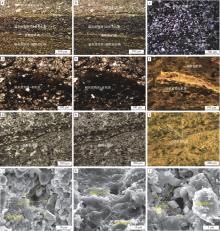
Fig.3
Microscopic characteristics of components in the fine-grained mixed deposits in the P2l2, Tiaohu-Malang Sag, Santanghu Basin"


Fig.4
Characteristics of major and trace elements in the fine-grained mixed deposits in the P2l2, Tiaohu-Malang Sag, Santanghu Basin"


Fig.5
Depositional genetic model of the fine-grained mixed deposits in the P2l2, Tiaohu-Malang Sag, Santanghu Basin"


Fig. 6
Images showing volcanic ash alteration in the P2l2, Tiaohu-Malang Sag, Santanghu Basin"

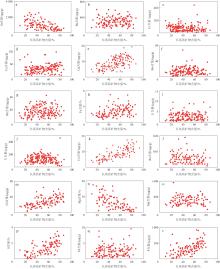
Fig. 7
Scatter plots of felsic mineral content vs. contents of different elements in the fine-grained mixed deposits in the P2l2, Tiaohu-Malang Sag, Santanghu Basin"


Fig.8
Sample screening based on Sr replacement in carbonates in fine-grained mixed deposits in the P2l2, Tiaohu-Malang Sag, Santanghu Basin"


Fig.9
Covariation patterns between two indicators of sedimentary environments"
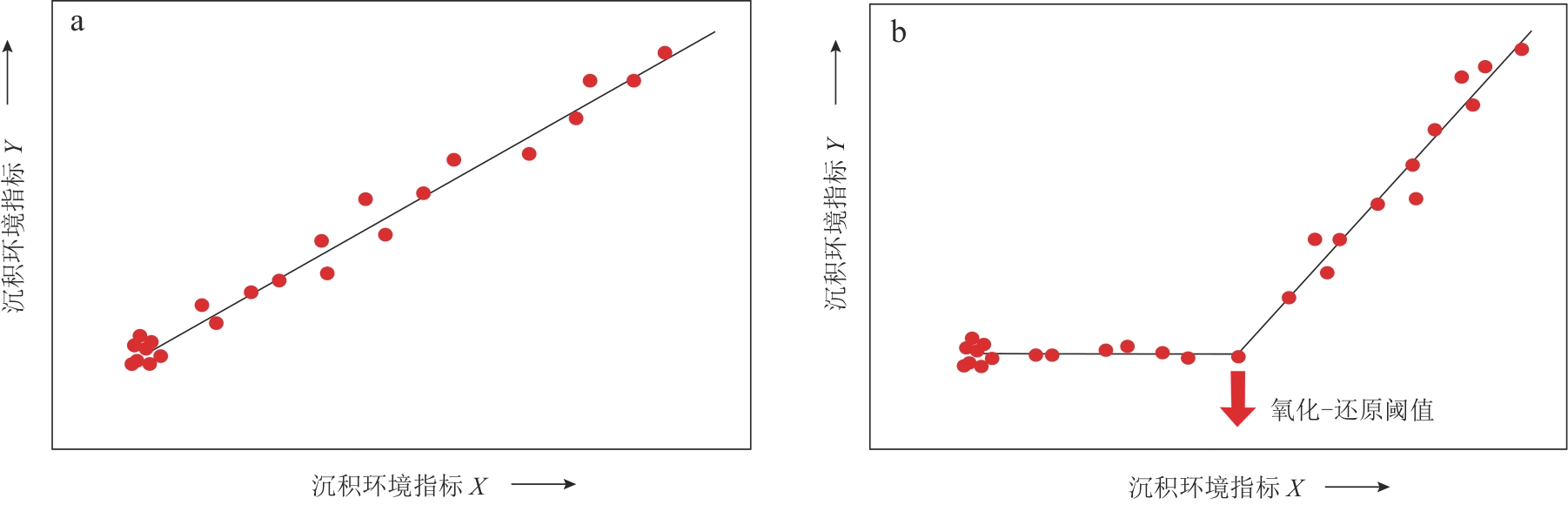

Fig.10
Redox threshold framework determined based on key redox couples and ionic contents (modified after references [8,17,35,39-44])"

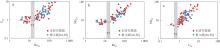
Fig.11
Scatter diagrams of the ReEF, MoEF, and UEF values of the fine-grained mixed deposits in the P2l2, Tiaohu-Malang Sag, Santanghu Basin"
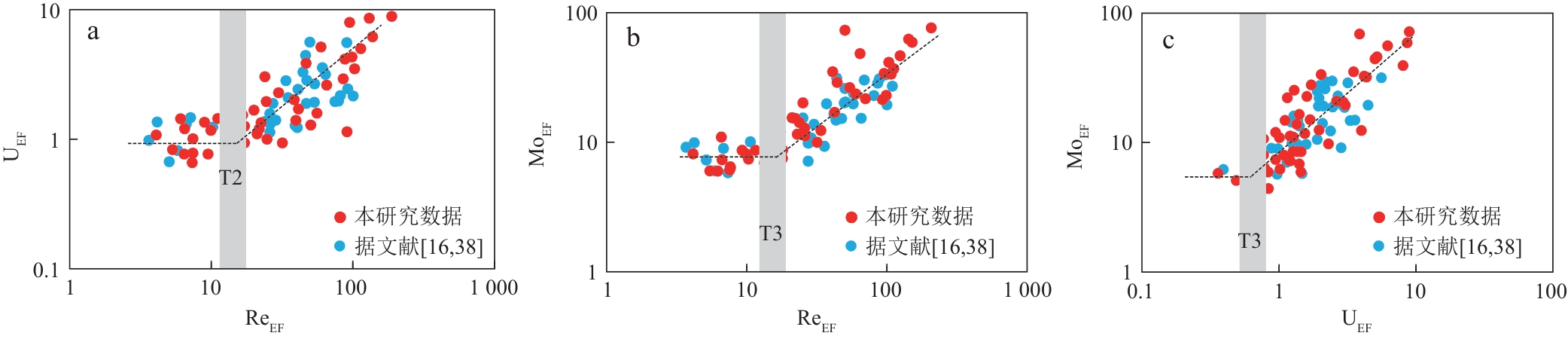
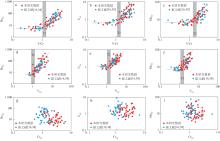
Fig.12
Scatter plots of V/Cr, VEF, and CrEFvs. ReEF, MoEF, and UEF of the fine-grained mixed deposits in the P2l2, Tiaohu-Malang Sag, Santanghu Basin"

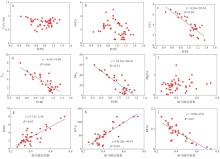
Fig. 13
Scatter plots of organic vs. inorganic geochemical indicators for characterizing different sedimentary environments of the P2l2, Tiaohu-Malang Sag, Santanghu Basin"


Fig. 14
Paleoclimate characteristics during the P2l2 deposition in the Tiaohu-Malang Sag, Santanghu Basin"


Fig.15
Paleosalinity characteristics during the P2l2 deposition in the Tiaohu-Malang Sag, Santanghu Basin"


Fig. 16
Paleoredox characteristics during the P2l2 deposition in the Tiaohu-Malang Sag, Santanghu Basin"

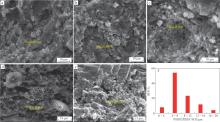
Fig.17
Particle size characteristics of pyrite framboids in the P2l2, Tiaohu-Malang Sag, Santanghu Basin"


Fig. 18
Characteristics of the P2l2 sedimentary environment in well ML1, Tiaohu-Malang Sag, Santanghu Basin"

| 1 | 曲长胜, 邱隆伟, 杨勇强, 等. 吉木萨尔凹陷芦草沟组碳酸盐岩碳氧同位素特征及其古湖泊学意义[J]. 地质学报, 2017, 91(3): 605-616. |
| QU Changsheng, QIU Longwei, YANG Yongqiang, et al. Carbon and oxygen isotope compositions of carbonatic rock from Permian Lucaogou Formation in the Jimsar Sag, NW China and their paleolimnological significance[J]. Acta Geologica Sinica, 2017, 91(3): 605-616. | |
| 2 | LIU Bo, BECHTEL A, GROSS D, et al. Middle Permian environmental changes and shale oil potential evidenced by high-resolution organic petrology, geochemistry and mineral composition of the sediments in the Santanghu Basin, northwest China[J]. International Journal of Coal Geology, 2018, 185: 119-137. |
| 3 | 何文渊, 蒙启安, 付秀丽, 等. 松辽盆地古龙凹陷青山口组页岩沉积环境特征及其有机质富集机理[J]. 沉积学报, 2024, 42(5): 1799-1816. |
| HE Wenyuan, MENG Qi’an, FU Xiuli, et al. Geochemical study of the sedimentary environment and its organic matter enrichment mechanism in Qingshankou Formation shale, Gulong Sag, Songliao Basin[J]. Acta Sedimentologica Sinica, 2024, 42(5): 1799-1816. | |
| 4 | ALGEO T J, MAYNARD J B. Trace-element behavior and redox facies in core shales of Upper Pennsylvanian Kansas-type cyclothems[J]. Chemical Geology, 2004, 206(3/4): 289-318. |
| 5 | SHEN Jun, ALGEO T J, HU Qing, et al. Volcanism in South China during the Late Permian and its relationship to marine ecosystem and environmental changes[J]. Global and Planetary Change, 2013, 105: 121-134. |
| 6 | 张桓, 陈亚军, 伍宏美, 等. 火山喷发间歇期沉积岩层古沉积环境的地球化学示踪与判别[J]. 吉林大学学报(地球科学版), 2023, 53(5): 1417-1436. |
| ZHANG Huan, CHEN Yajun, WU Hongmei, et al. Geochemical tracing and discrimination of paleosedimentary environment of sedimentary rock intercalation during volcanic eruption intervals[J]. Journal of Jilin University (Earth Science Edition), 2023, 53(5): 1417-1436. | |
| 7 | BRUMSACK H J. The trace metal content of recent organic carbon-rich sediments: Implications for Cretaceous black shale formation[J]. Palaeogeography, Palaeoclimatology, Palaeoecology, 2006, 232(2/4): 344-361. |
| 8 | WEI Wei, ALGEO T J. Elemental proxies for paleosalinity analysis of ancient shales and mudrocks[J]. Geochimica et Cosmochimica Acta, 2020, 287: 341-366. |
| 9 | XU Shengchuan, HU Huabin, ZHANG Pu, et al. Major and trace elements in mid-Eocene lacustrine oil shales of the Fushun Basin, NE China: Concentration features and paleolimnological implications[J]. Marine and Petroleum Geology, 2020, 121: 104610. |
| 10 | 刘翰林, 邹才能, 邱振, 等. 鄂尔多斯盆地延长组7段3亚段异常高有机质沉积富集因素[J]. 石油学报, 2022, 43(11): 1520-1541. |
| LIU Hanlin, ZOU Caineng, QIU Zhen, et al. Sedimentary enrichment factors of extraordinarily high organic matter in the sub-member 3 of Member 7 of Yanchang Formation, Ordos Basin[J]. Acta Petrolei Sinica, 2022, 43(11): 1520-1541. | |
| 11 | 刘全有, 李鹏, 金之钧, 等. 火山活动对海相和淡水湖相页岩形成的影响[J]. 地球化学, 2022, 51(5): 556-569. |
| LIU Quanyou, LI Peng, JIN Zhijun, et al. Effect of volcanic activity on the formation of marine shale and freshwater lacustrine shale[J]. Geochimica, 2022, 51(5): 556-569. | |
| 12 | 赵喆, 白斌, 刘畅, 等. 中国石油陆上中-高成熟度页岩油勘探现状、进展与未来思考[J]. 石油与天然气地质, 2024, 45(2): 327-340. |
| ZHAO Zhe, BAI Bin, LIU Chang, et al. Current status, advances, and prospects of CNPC’s exploration of onshore moderately to highly mature shale oil reservoirs[J]. Oil & Gas Geology, 2024, 45(2): 327-340. | |
| 13 | 邓远, 陈世悦, 蒲秀刚, 等. 渤海湾盆地沧东凹陷孔店组二段细粒沉积岩形成机理与环境演化[J]. 石油与天然气地质, 2020, 41(4): 811-823, 890. |
| DENG Yuan, CHEN Shiyue, PU Xiugang, et al. Formation mechanism and environmental evolution of fine-grained sedimentary rocks from the second member of Kongdian Formation in the Cangdong Sag, Bohai Bay Basin[J]. Oil & Gas Geology, 2020, 41(4): 811-823, 890. | |
| 14 | ALGEO T J, LI Chao. Redox classification and calibration of redox thresholds in sedimentary systems[J]. Geochimica et Cosmochimica Acta, 2020, 287: 8-26. |
| 15 | 魏巍, ALGEO T J, 陆永潮, 等. 古盐度指标与渤海湾盆地古近系海侵事件初探[J]. 沉积学报, 2021, 39(3): 571-592. |
| WEI Wei, ALGEO T J, LU Yongchao, et al. Paleosalinity proxies and marine incursions into the Paleogene Bohai Bay Basin lake system, northeastern China[J]. Acta Sedimentologica Sinica, 2021, 39(3): 571-592. | |
| 16 | PAN Yongshuai, HUANG Zhilong, LI Tianjun, et al. Environmental response to volcanic activity and its effect on organic matter enrichment in the Permian Lucaogou Formation of the Malang Sag, Santanghu Basin, northwest China[J]. Palaeogeography, Palaeoclimatology, Palaeoecology, 2020, 560: 110024. |
| 17 | 潘永帅. 火山灰影响下咸化湖盆混积岩特征与优质储层形成机理——以三塘湖盆地芦草沟组为例[D]. 北京: 中国石油大学(北京), 2023. |
| PAN Yongshuai. Characteristics of mixed rocks and formation mechanism of high-quality reservoir in saline lacustrine basin affected by volcanic ash: A case study of the Lucaogou Formation in Santanghu Basin[D]. Beijing: China University of Petroleum(Beijing), 2023. | |
| 18 | 刘艳. 三塘湖盆地构造演化及其与油气的关系[D]. 北京: 中国地质大学(北京), 2010: 1-66. |
| LIU Yan. The tectonic evolution in the Santanghu Basin and its relationship to oil and gas[D]. Beijing: China University of Petroleum(Beijing), 2010: 1-66. | |
| 19 | 张军东. 三塘湖盆地石炭—二叠系地层分布特征研究[D]. 西安: 西安石油大学, 2018: 1-56. |
| ZHANG Jundong. Study on the distribution characteristics of Carboniferous-Permian in Santanghu Basin[D]. Xi’an: Xi’an Shiyou University, 2018: 1-56. | |
| 20 | 范谭广, 徐雄飞, 范亮, 等. 三塘湖盆地二叠系芦草沟组页岩油地质特征与勘探前景[J]. 中国石油勘探, 2021, 26(4): 125-136. |
| FAN Tanguang, XU Xiongfei, FAN Liang, et al. Geological characteristics and exploration prospect of shale oil in Permian Lucaogou Formation, Santanghu Basin[J]. China Petroleum Exploration, 2021, 26(4): 125-136. | |
| 21 | 柳波, 吕延防, 孟元林, 等. 湖相纹层状细粒岩特征、成因模式及其页岩油意义——以三塘湖盆地马朗凹陷二叠系芦草沟组为例[J]. 石油勘探与开发, 2015, 42(5): 598-607. |
| LIU Bo, Yanfang LYU, MENG Yuanlin, et al. Petrologic characteristics and genetic model of lacustrine lamellar fine-grained rock and its significance for shale oil exploration: A case study of Permian Lucaogou Formation in Malang sag, Santanghu Basin, NW China[J]. Petroleum Exploration and Development, 2015, 42(5): 598-607. | |
| 22 | MA Jian, HUANG Zhilong, LIANG Shijun, et al. Geochemical and tight reservoir characteristics of sedimentary organic-matter-bearing tuff from the Permian Tiaohu Formation in the Santanghu Basin, Northwest China[J]. Marine and Petroleum Geology, 2016, 73: 405-418. |
| 23 | 陈旋, 刘俊田, 龙飞, 等. 三塘湖盆地二叠系凝灰岩致密油勘探开发实践及认识[J]. 中国石油勘探, 2019, 24(6): 771-780. |
| CHEN Xuan, LIU Juntian, LONG Fei, et al. Practical experience and understanding of exploration and development of Permian tight tuff reservoir in the Santanghu Basin[J]. China Petroleum Exploration, 2019, 24(6): 771-780. | |
| 24 | 支东明, 李建忠, 周志超, 等. 三塘湖盆地油气勘探开发新领域、新类型及资源潜力[J]. 石油学报, 2024, 45(1): 115-132. |
| ZHI Dongming, LI Jianzhong, ZHOU Zhichao, et al. New fields, new types and resource potentials of oil-gas exploration and development in Santanghu Basin[J]. Acta Petrolei Sinica, 2024, 45(1): 115-132. | |
| 25 | 陈旋, 刘小琦, 王雪纯, 等. 三塘湖盆地芦草沟组页岩油储层形成机理及分布特征[J]. 天然气地球科学, 2019, 30(8): 1180-1189. |
| CHEN Xuan, LIU Xiaoqi, WANG Xuechun, et al. Formation mechanism and distribution characteristics of Lucaogou shale oil reservoir in Sangtanghu Basin[J]. Natural Gas Geoscience, 2019, 30(8): 1180-1189. | |
| 26 | MOUNT J F. Mixing of siliciclastic and carbonate sediments in shallow shelf environments[J]. Geology, 1984, 12(7): 432-435. |
| 27 | 张雄华. 混积岩的分类和成因[J]. 地质科技情报, 2000, 19(4): 31-34. |
| ZHANG Xionghua. Classification and origin of mixosedimentite[J]. Bulletin of Geological Science and Technology, 2000, 19(4): 31-34. | |
| 28 | 沙庆安. 混合沉积和混积岩的讨论[J]. 古地理学报, 2001, 3(3): 63-66. |
| SHA Qingan. Discussion on mixing deposit and Hunji rock[J]. Journal of Palaeogeography(Chinese Edition), 2001, 3(3): 63-66. | |
| 29 | 徐伟, 杜晓峰, 黄晓波, 等. 混合沉积研究进展与关键问题[J]. 沉积学报, 2019, 37(2): 225-238. |
| XU Wei, DU Xiaofeng, HUANG Xiaobo, et al. Research advances and critical issues of “mixed siliciclastic and carbonate sediments”[J]. Acta Sedimentologica Sinica, 2019, 37(2): 225-238. | |
| 30 | 朱筱敏, 王晓琳, 张美洲, 等. 中国典型陆相盆地细粒沉积环境和岩相特征[J]. 石油与天然气地质, 2024, 45(4): 873-892. |
| ZHU Xiaomin, WANG Xiaolin, ZHANG Meizhou, et al. Sedimentary environments and lithofacies characteristics of fine-grained sediments in typical continental basins in China[J]. Oil & Gas Geology, 2024, 45(4): 873-892. | |
| 31 | 蒲秀刚, 董姜畅, 柴公权, 等. 渤海湾盆地沧东凹陷古近系孔店组二段页岩高丰度有机质富集模式[J]. 石油与天然气地质, 2024, 45(3): 696-709. |
| PU Xiugang, DONG Jiangchang, CHAI Gongquan, et al. Enrichment model of high-abundance organic matter in shales in the 2nd member of the Paleogene Kongdian Formation, Cangdong Sag, Bohai Bay Basin[J]. Oil & Gas Geology, 2024, 45(3): 696-709. | |
| 32 | 董桂玉, 陈洪德, 何幼斌, 等. 陆源碎屑与碳酸盐混合沉积研究中的几点思考[J]. 地球科学进展, 2007, 22(9): 931-939. |
| DONG Guiyu, CHEN Hongde, HE Youbin, et al. Some problems on the study of the mixed siliciclastic-carbonate sediments[J]. Advances in Earth Science, 2007, 22(9): 931-939. | |
| 33 | 李泉泉, 鲍志东, 肖毓祥, 等. 混合沉积研究进展与展望[J]. 沉积学报, 2021, 39(1): 153-167. |
| LI Quanquan, BAO Zhidong, XIAO Yuxiang, et al. Research advances and prospect of mixed deposition[J]. Acta Sedimentologica Sinica, 2021, 39(1): 153-167. | |
| 34 | 李天军. 胜北洼陷七克台组混积岩致密储层成因机理研究[D]. 北京: 中国石油大学(北京), 2021. |
| LI Tianjun. A study on the genetic mechanism to mixed siliciclastic-carbonate rock tight reservoir of the Qiketai Formation in the Shengbei Sag[D]. Beijing: China University of Petroleum(Beijing), 2021. | |
| 35 | 周家全, 王越, 宋子怡, 等. 准噶尔盆地博格达地区中二叠统芦草沟组热液硅质结核特征及页岩油意义[J]. 石油与天然气地质, 2023, 44(3): 789-800. |
| ZHOU Jiaquan, WANG Yue, SONG Ziyi, et al. Characterizing hydrothermal siliceous nodules to guide shale oil exploration in the Middle Permian Lucaogou Formation, Bogda area, Junggar Basin[J]. Oil & Gas Geology, 2023, 44(3): 789-800. | |
| 36 | LIU Bo, SONG Yu, ZHU Kai, et al. Mineralogy and element geochemistry of salinized lacustrine organic-rich shale in the Middle Permian Santanghu Basin: Implications for paleoenvironment, provenance, tectonic setting and shale oil potential[J]. Marine and Petroleum Geology, 2020, 120: 104569. |
| 37 | 曲长胜, 邱隆伟, 杨勇强, 等. 准噶尔盆地吉木萨尔凹陷二叠系芦草沟组火山活动的环境响应[J]. 地震地质, 2019, 41(3): 789-802. |
| QU Changsheng, QIU Longwei, YANG Yongqiang, et al. Environmental response of the Permian volcanism in Lucaogou Formation in Jimsar sag, Junggar Basin, northwest China[J]. Seismology and Geology, 2019, 41(3): 789-802. | |
| 38 | ALGEO T J, LIU Jiangsi. A re-assessment of elemental proxies for paleoredox analysis[J]. Chemical Geology, 2020, 540: 119549. |
| 39 | TRIBOVILLARD N, ALGEO T J, LYONS T, et al. Trace metals as paleoredox and paleoproductivity proxies: An update[J]. Chemical Geology, 2006, 232(1/2): 12-32. |
| 40 | ALGEO T J, TRIBOVILLARD N. Environmental analysis of paleoceanographic systems based on molybdenum-uranium covariation[J]. Chemical Geology, 2009, 268(3/4): 211-225. |
| 41 | PAN Yongshuai, HUANG Zhilong, GUO Xiaobo, et al. A re-assessment and calibration of redox thresholds in the Permian Lucaogou Formation of the Malang Sag, Santanghu Basin, Northwest China[J]. Marine and Petroleum Geology, 2022, 135: 105406. |
| 42 | JONES B, MANNING D A C. Comparison of geochemical indices used for the interpretation of palaeoredox conditions in ancient mudstones[J]. Chemical Geology, 1994, 111(1/4): 111-129. |
| 43 | MILLERO F J, YAO Wensheng, AICHER J. The speciation of Fe(II) and Fe(III) in natural waters[J]. Marine Chemistry, 1995, 50(1/4): 21-39. |
| 44 | MORFORD J L, EMERSON S. The geochemistry of redox sensitive trace metals in sediments[J]. Geochimica et Cosmochimica Acta, 1999, 63(11/12): 1735-1750. |
| 45 | ERICKSON B E, HELZ G R. Molybdenum(VI) speciation in sulfidic waters: Stability and lability of thiomolybdates[J]. Geochimica et Cosmochimica Acta, 2000, 64(7): 1149-1158. |
| 46 | LYONS T W, SEVERMANN S. A critical look at iron paleoredox proxies: New insights from modern euxinic marine basins[J]. Geochimica et Cosmochimica Acta, 2006, 70(23): 5698-5722. |
| 47 | POULTON S W, CANFIELD D E. Ferruginous conditions: A dominant feature of the ocean through Earth’s history[J]. Elements, 2011, 7(2): 107-112. |
| 48 | KAMO S L, CZAMANSKE G K, AMELIN Yuri, et al. Rapid eruption of Siberian flood-volcanic rocks and evidence for coincidence with the Permian-Triassic boundary and mass extinction at 251 Ma[J]. Earth and Planetary Science Letters, 2003, 214(1/2): 75-91. |
| 49 | ZHANG Kun, LIU Rong, LIU Zhaojun, et al. Influence of volcanic and hydrothermal activity on organic matter enrichment in the Upper Triassic Yanchang Formation, southern Ordos Basin, Central China[J]. Marine and Petroleum Geology, 2020, 112: 104059. |
| 50 | ALGEO T J, LYONS T W. Mo-total organic carbon covariation in modern anoxic marine environments: Implications for analysis of paleoredox and paleohydrographic conditions[J]. Paleoceanography, 2006, 21(1): 1-23. |
| 51 | 尤继元. 三塘湖盆地中二叠世沉积相及沉积环境研究[D]. 西安: 西北大学, 2011. |
| YOU Jiyuan. Study on sedimentary facies and sedimentary environment in Mid-Permian, Santanghu Basin[D]. Xi’an: Northwest University, 2011. | |
| 52 | 王瑞. 三塘湖盆地二叠系优质烃源岩形成特征与发育模式[D]. 北京: 中国石油大学(北京), 2022. |
| WANG Rui. Formation characteristics and development model of high quality Permian source rocks in Santanghu Basin[D]. Beijing: China University of Petroleum(Beijing), 2022. | |
| 53 | WILKIN R T, BARNES H L, BRANTLEY S L. The size distribution of framboidal pyrite in modern sediments: An indicator of redox conditions[J]. Geochimica et Cosmochimica Acta, 1996, 60(20): 3897-3912. |
| 54 | RICKARD D. Sedimentary pyrite framboid size-frequency distributions: A meta-analysis[J]. Palaeogeography, Palaeoclimatology, Palaeoecology, 2019, 522: 62-75. |
| 55 | 刘钰晨, 赵卫卫, 高剑波, 等. 鄂尔多斯盆地东南部长7段泥页岩黄铁矿成因及地质意义[J]. 断块油气田, 2024, 31(6): 978-984. |
| LIU Yuchen, ZHAO Weiwei, GAO Jianbo, et al. Genesis and geological significance of shale pyrite in Chang 7 member of southeastern Ordos Basin[J]. Fault-Block Oil and Gas Field, 2024, 31(6): 978-984. |
| Viewed | ||||||
|
Full text |
|
|||||
|
Abstract |
|
|||||
