

石油与天然气地质 ›› 2025, Vol. 46 ›› Issue (1): 167-177.doi: 10.11743/ogg20250112
唐贤君1( ), 朱虹浩1, 李宁1, 余一欣2,3(), 钟荣全1, 余浪2,3
收稿日期:2024-05-20
修回日期:2024-07-24
出版日期:2025-02-28
发布日期:2025-03-03
通讯作者:
余一欣
E-mail:tangxj4@cnooc.com.cn;yuxin0707@163.com
第一作者简介:唐贤君(1985—),男,高级工程师,含油气盆地构造地质学。E‑mail: tangxj4@cnooc.com.cn。
基金项目:
Xianjun TANG1(), Honghao ZHU1, Ning LI1, Yixin YU2,3(), Rongquan ZHONG1, Lang YU2,3
Received:2024-05-20
Revised:2024-07-24
Online:2025-02-28
Published:2025-03-03
Contact:
Yixin YU
E-mail:tangxj4@cnooc.com.cn;yuxin0707@163.com
摘要:
西湖凹陷宁波构造带Y背斜是近些年东海陆架盆地油气勘探评价的热点区域,但该构造油气差异富集主控因素及有利勘探方向仍不十分明确。通过对宁波构造带Y背斜进行精细构造解析,研究了背斜分段差异变形特征及其主控因素,探讨了其油气地质意义。研究结果表明:根据构造形态差异,可将Y背斜划分为南、中、北3段,各段次级背斜受控于不同的反转断裂,中段挤压抬升幅度最大。控制Y背斜南、北分段差异变形的主要因素为区域挤压应力作用、先存控洼断裂差异以及刚性基底导致的局部应力集中等。相对于Y背斜南、北段,中段的强烈挤压收缩过程引发整体抬升,将原本独立发育的南、北段次级背斜卷入变形,进而形成南、北差异的大型复式背斜。南北差异变形及不同期次叠加变形导致Y背斜不同部位油气差异富集。据此提出了花港组和龙井组多个有利勘探领域,为该地区的天然气勘探提供了重要方向。
中图分类号:
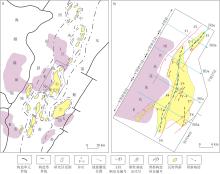
图1
西湖凹陷反转背斜分布(a)和宁波反转背斜带主要构造特征(b)(据文献[18-19]修改)①平湖构造带;②宝石构造带;③嘉兴构造带;④宁波构造带;⑤黄岩构造带;⑥天台构造带;⑦黄岩东构造带(Ⅰ—Ⅴ是根据重磁资料推测的刚性基底。)"

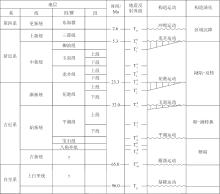
图2
西湖凹陷地层及构造演化(据文献[5]修改)"
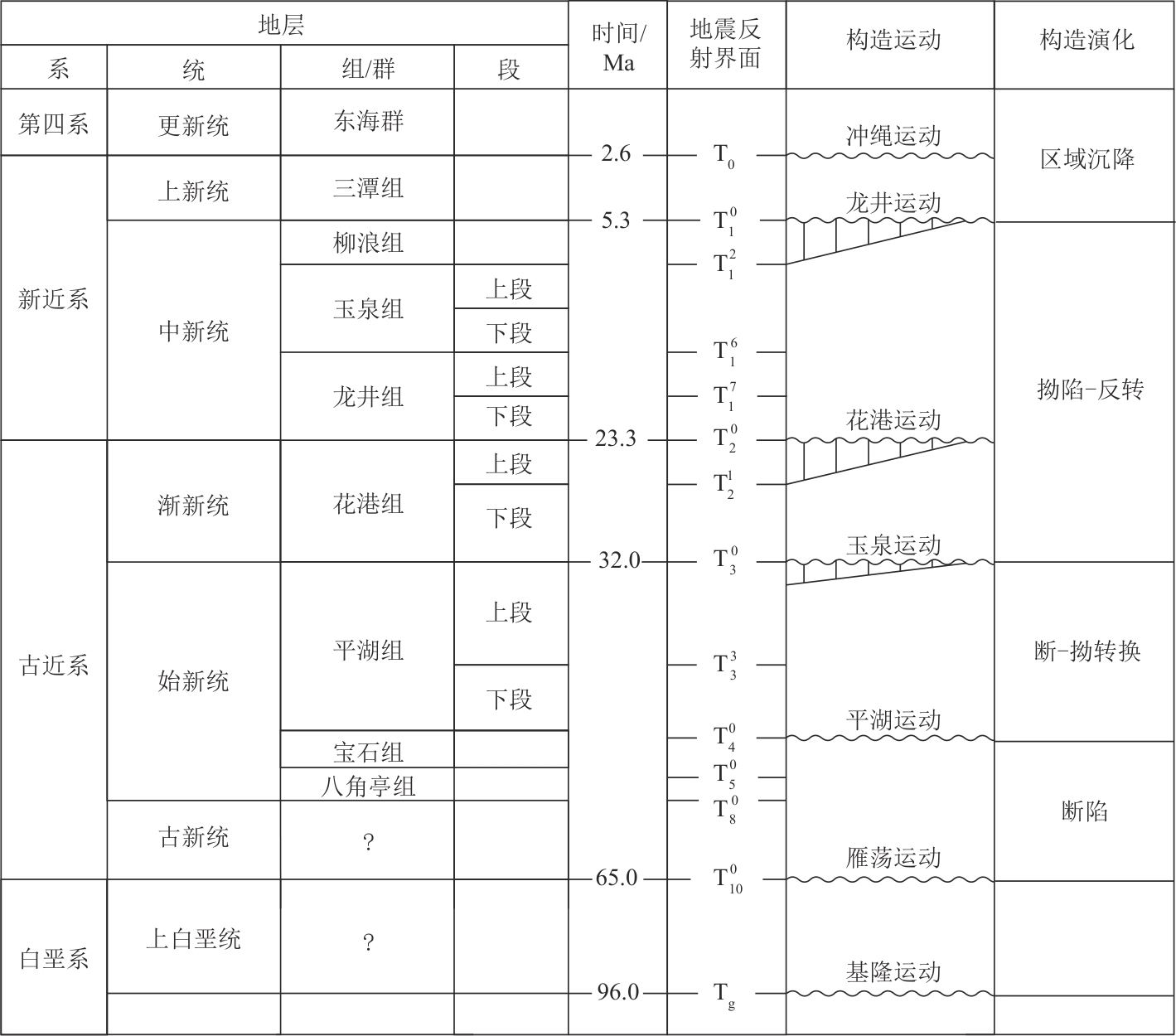
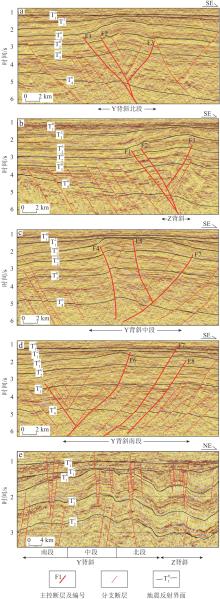
图3
西湖凹陷宁波构造带典型地震剖面(剖面位置见图1b)"

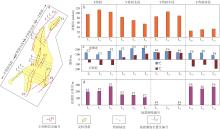
图4
西湖凹陷宁波构造带不同段背斜反转强度对比a. 宁波反转背斜带构造纲要;b. 背斜褶皱波幅比;c. 主控断层T20和T30界面反转逆断距;d. 主控断层花港组古落差"

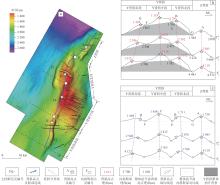
图5
西湖凹陷宁波构造带Y背斜南、北分段发育特征a. T16界面等T0构造图;b. 不同界面高点埋深;c. Y背斜中段整体抬升前各界面高点埋深"

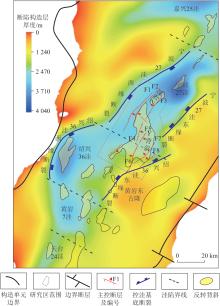
图6
西湖凹陷反转背斜与洼陷结构叠合图"

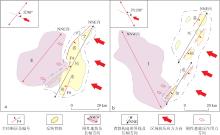
图7
西湖凹陷Y背斜及邻区刚性基底分布与挤压应力、背斜形态关系示意图(刚性基底位置据文献[18])a. 宁波构造带;b. 嘉兴构造带(Ⅰ和Ⅱ为推测的刚性基底地块编号。)"
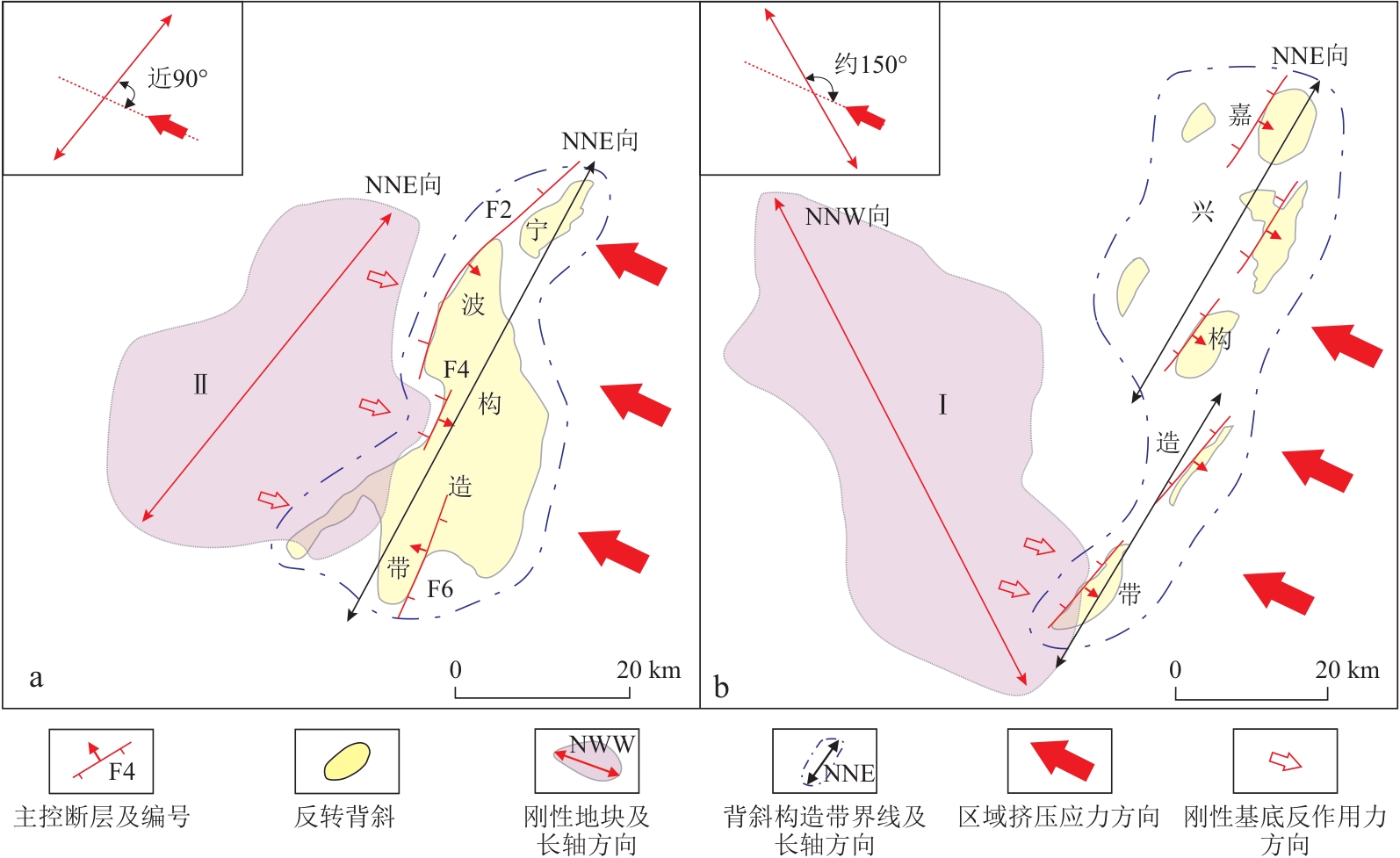
图8
西湖凹陷宁波构造带近EW向无根横断层与反转背斜主控断层垂向耦合关系"
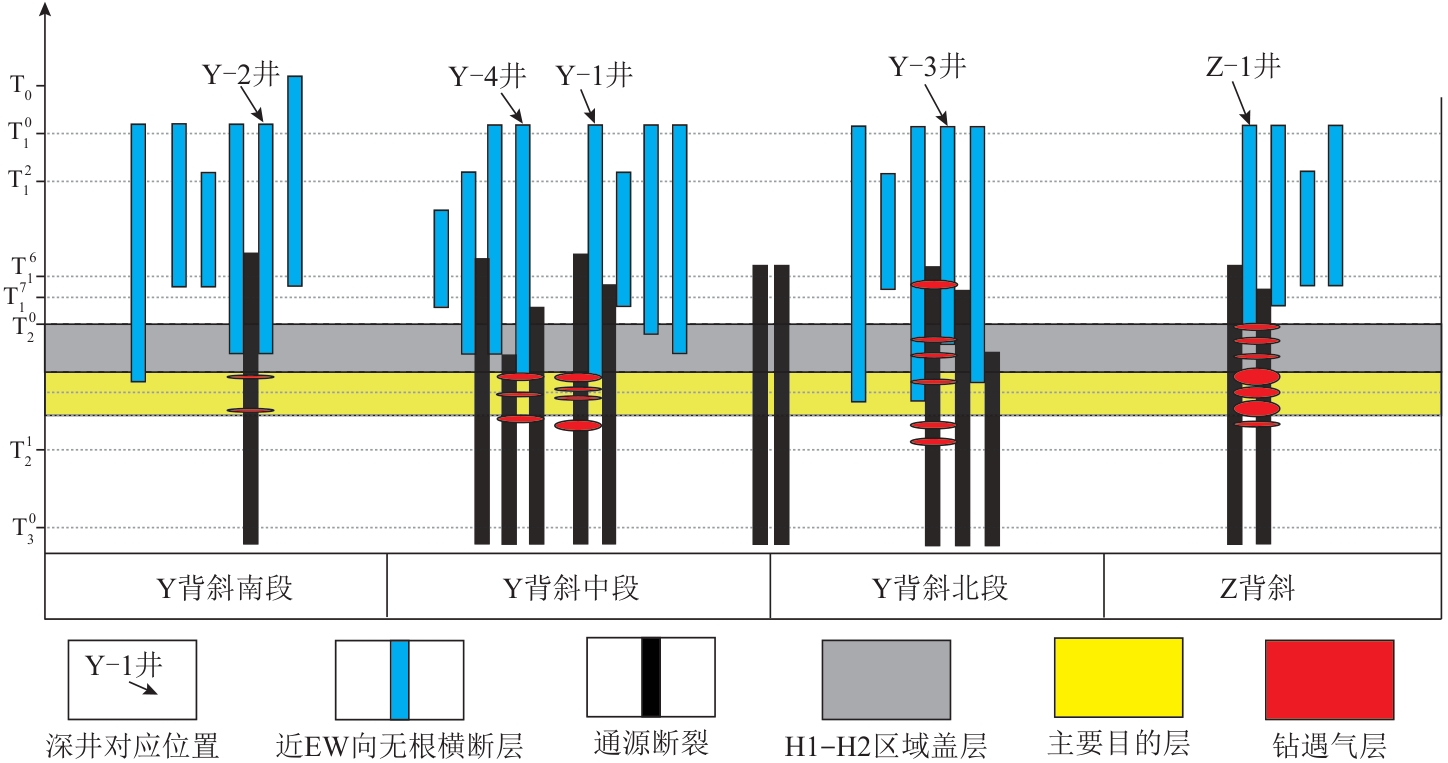
图9
西湖凹陷宁波构造带花港组及龙井组油气差异聚集模式"

| 1 | 王燮培, 严俊君, 林军. 反转构造及其石油地质意义[J]. 地球科学, 1989, 14(1): 101-108. |
| WANG Xiepei, YAN Junjun, LIN Jun. The inverted structure and its significance in petroleum geology[J]. Earth Science, 1989, 14(1): 101-108. | |
| 2 | MITRA S. Geometry and kinematic evolution of inversion structures[J]. AAPG Bulletin, 1993, 77(7): 1159-1191. |
| 3 | 胡望水, 刘学锋, 吕新华, 等. 论正反转构造的分类[J]. 新疆石油地质, 2000, 21(1): 5-8. |
| HU Wangshui, LIU Xuefeng, Xinhua LYU, et al. On the classifications of positive reversed structures[J]. Xinjiang Petroleum Geology, 2000, 21(1): 5-8. | |
| 4 | 高伟中, 谭思哲, 田超, 等. 西湖凹陷中央反转构造带圈闭油气充满度差异性原因分析[J]. 中国海上油气, 2019, 31(3): 20-28. |
| GAO Weizhong, TAN Sizhe, TIAN Chao, et al. Analysis on the oil and gas fullness difference of the central inversion tectonic belt of Xihu Sag in East China Sea Basin[J]. China Offshore Oil and Gas, 2019, 31(3): 20-28. | |
| 5 | 周心怀, 蒋一鸣, 唐贤君. 西湖凹陷成盆背景、原型盆地演化及勘探启示[J]. 中国海上油气, 2019, 31(3): 1-10. |
| ZHOU Xinhuai, JIANG Yiming, TANG Xianjun. Tectonic setting, prototype basin evolution and exploration enlightenment of Xihu Sag in East China Sea Basin[J]. China Offshore Oil and Gas, 2019, 31(3): 1-10. | |
| 6 | 张宙, 何新建, 唐贤君, 等. 东海盆地西湖凹陷构造圈闭特征及其油气藏类型[J]. 海洋地质前沿, 2022, 38(3): 27-35. |
| ZHANG Zhou, HE Xinjian, TANG Xianjun, et al. Structural trap characteristics and reservoir types in Xihu Sag, East China Sea Basin[J]. Marine Geology Frontiers, 2022, 38(3): 27-35. | |
| 7 | 张建培, 张涛, 刘景彦, 等. 西湖凹陷反转构造分布与样式[J]. 海洋石油, 2008, 28(4): 14-20. |
| ZHANG Jianpei, ZHANG Tao, LIU Jingyan, et al. Distribution and style of inversed structures in Xihu Depression[J]. Offshore Oil, 2008, 28(4): 14-20. | |
| 8 | DAI Liming, LI Sanzhong, LOU Da, et al. Numerical modeling of Late Miocene tectonic inversion in the Xihu Sag, East China Sea Shelf Basin, China[J]. Journal of Asian Earth Sciences, 2014, 86: 25-37. |
| 9 | 陈智远, 徐志星, 徐国盛, 等. 东海盆地西湖凹陷中央反转构造带异常高压与油气成藏的耦合关系[J]. 石油与天然气地质, 2017, 38(3): 570-581. |
| CHEN Zhiyuan, XU Zhixing, XU Guosheng, et al. Coupling relationship between abnormal overpressure and hydrocarbon accumulation in a central overturned structural belt, Xihu Sag, East China Sea Basin[J]. Oil & Gas Geology, 2017, 38(3): 570-581. | |
| 10 | 刘金水, 邹玮, 李宁, 等. “储保耦合” 控藏机制与西湖凹陷大中型油气田勘探实践[J]. 中国海上油气, 2019, 31(3): 11-19. |
| LIU Jinshui, ZOU Wei, LI Ning, et al. Hydrocarbon accumulation control mechanism of reservoir-conservation coupling and its large and medium-sized fields exploration practice in Xihu Sag, East China Sea basin[J]. China Offshore Oil and Gas, 2019, 31(3): 11-19. | |
| 11 | 徐昉昊, 徐国盛, 刘勇, 等. 东海西湖凹陷中央反转构造带古近系花港组致密砂岩储集层控制因素[J]. 石油勘探与开发, 2020, 47(1): 98-109. |
| XU Fanghao, XU Guosheng, LIU Yong, et al. Factors controlling the development of tight sandstone reservoirs in the Huagang Formation of the central inverted structural belt in Xihu Sag, East China Sea Basin[J]. Petroleum Exploration and Development, 2020, 47(1): 98-109. | |
| 12 | 张迎朝, 邹玮, 陈忠云, 等. 东海陆架盆地西湖凹陷中央反转构造带古近系花港组气藏“先汇后聚” 机制及地质意义[J]. 石油与天然气地质, 2023, 44(5): 1256-1269. |
| ZHANG Yingzhao, ZOU Wei, CHEN Zhongyun, et al. The mechanism of “convergence ahead of accumulation” and its geological significance for gas reservoirs in Paleogene Huagang Formation across the central inverted structural zone of Xihu Depression, East China Sea Shelf Basin[J]. Oil & Gas Geology, 2023, 44(5): 1256-1269. | |
| 13 | 刘贤, 葛家旺, 赵晓明, 等. 东海陆架盆地西湖凹陷渐新统花港组年代标尺及层序界面定量识别[J]. 石油与天然气地质, 2022, 43(4): 990-1004. |
| LIU Xian, GE Jiawang, ZHAO Xiaoming, et al. Time scale and quantitative identification of sequence boundaries for the Oligocene Huagang Formation in the Xihu Sag, East China Sea Shelf Basin[J]. Oil & Gas Geology, 2022, 43(4): 990-1004. | |
| 14 | 张敏强, 钟志洪, 夏斌, 等. 东海西湖凹陷中南部晚中新世构造反转与油气运聚[J]. 中国海上油气, 2005, 17(2): 73-79. |
| ZHANG Minqiang, ZHONG Zhihong, XIA Bin, et al. Late Miocene tectonic inversion and hydrocarbon migration and accumulation in central and southern Xihu Sag, East China Sea[J]. China Offshore Oil and Gas, 2005, 17(2): 73-79. | |
| 15 | 杨风丽, 王敏雪, 庄建建, 等. 西湖凹陷反转构造定量运动学过程及对油气的控制作用[J]. 石油学报, 2010, 31(4): 596-601. |
| YANG Fengli, WANG Minxue, ZHUANG Jianjian, et al. Kinematical processes of inversion structure and its contribution to hydrocarbon accumulation in Xihu Depression of East China Sea Basin[J]. Acta Petrolei Sinica, 2010, 31(4): 596-601. | |
| 16 | 张国华, 张建培. 东海陆架盆地构造反转特征及成因机制探讨[J]. 地学前缘, 2015, 22(1): 260-270. |
| ZHANG Guohua, ZHANG Jianpei. A discussion on the tectonic inversion and its genetic mechanism in the East China Sea Shelf Basin[J]. Earth Science Frontiers, 2015, 22(1): 260-270. | |
| 17 | 郭真, 刘池洋, 田建锋. 东海盆地西湖凹陷反转构造特征及其形成的动力环境[J]. 地学前缘, 2015, 22(3): 59-67. |
| GUO Zhen, LIU Chiyang, TIAN Jianfeng. Structural characteristics and main controlling factors of inversion structures in Xihu Depression in Donghai Basin[J]. Earth Science Frontiers, 2015, 22(3): 59-67. | |
| 18 | 蒋一鸣, 邹玮, 刘金水, 等. 东海西湖凹陷中新世末反转背斜构造成因机制: 来自基底结构差异的新认识[J]. 地球科学, 2020, 45(3): 968-979. |
| JIANG Yiming, ZOU Wei, LIU Jinshui, et al. Genetic mechanism of inversion anticline structure at the end of Miocene in Xihu Sag, East China Sea: A new understanding of basement structure difference[J]. Earth Science, 2020, 45(3): 968-979. | |
| 19 | 邹玮, 余一欣, 刘金水, 等. 东海盆地西湖凹陷中央反转构造带发育主控因素及宁波背斜形成过程[J]. 石油学报, 2021, 42(2): 176-185. |
| ZOU Wei, YU Yixin, LIU Jinshui, et al. Main controlling factors of the central inversional structure belt and the development of Ningbo anticline in Xihu Sag, East China Sea Basin[J]. Acta Petrolei Sinica, 2021, 42(2): 176-185. | |
| 20 | 刘卫红, 林畅松, 郭泽清, 等. 东海陆架盆地西湖凹陷新生代反转构造样式及其形成机制初探[J]. 地质科学, 2009, 44(1): 74-87. |
| LIU Weihong, LIN Changsong, GUO Zeqing, et al. Styles of inversion structures and their mechanisms of the Cenozoic Xihu Sag, East China Sea Shelf Basin[J]. Chinese Journal of Geology, 2009, 44(1): 74-87. | |
| 21 | 余逸凡, 张建培, 程超, 等. 东海陆架盆地西湖凹陷油气成藏主控因素及成藏模式[J]. 海洋地质前沿, 2022, 38(7): 40-47. |
| YU Yifan, ZHANG Jianpei, CHENG Chao, et al. Main controlling factors and reservoir forming model for hydrocarbon accumulation in the Xihu Sag, the East China Sea Shelf Basin[J]. Marine Geology Frontiers, 2022, 38(7): 40-47. | |
| 22 | 张迎朝, 陈忠云, 刁慧, 等. 东海盆地X凹陷油气成藏模式与勘探突破[J]. 中国海上油气, 2024, 36(2): 1-12. |
| ZHANG Yingchao, CHEN Zhongyun, DIAO Hui, et al. Reservoir-forming models and exploration breakthroughs in X Sag of East China Sea Basin[J]. China Offshore Oil and Gas, 2024, 36(2): 1-12. | |
| 23 | 周心怀. 西湖凹陷地质认识创新与油气勘探领域突破[J]. 中国海上油气, 2020, 32(1): 1-12. |
| ZHOU Xinhuai. Geological understanding and innovation in Xihu Sag and breakthroughs in oil and gas exploration[J]. China Offshore Oil and Gas, 2020, 32(1): 1-12. | |
| 24 | 蔡华, 张建培, 唐贤君. 西湖凹陷断裂系统特征及其控藏机制[J]. 天然气工业, 2014, 34(10): 18-26. |
| CAI Hua, ZHANG Jianpei, TANG Xianjun. Characteristics of the fault systems and their control on hydrocarbon accumulation in the Xihu Sag, East China Sea Shelf Basin[J]. Natural Gas Industry, 2014, 34(10): 18-26. | |
| 25 | 刘世宝, 范文科, 李永红, 等. 中祁连陆块三叠纪-侏罗纪地层变形特征[J]. 现代地质, 2015, 29(5): 1103-1109. |
| LIU Shibao, FAN Wenke, LI Yonghong, et al. Deformation features of Triassic and Jurassic strata in mid-Qilian orogenic belt[J]. Geoscience, 2015, 29(5): 1103-1109. | |
| 26 | 刘景彦, 林畅松, 姜亮, 等. 东海西湖凹陷第三系反转构造及其对油气聚集的影响[J]. 地球学报, 2000, 21(4): 350-355. |
| LIU Jingyan, LIN Changsong, JIANG Liang, et al. Characteristics of tertiary inversion structures and their influence on oil-gas accumulation in Xihu trough, East China Sea[J]. Acta Geoscientica Sinica, 2000, 21(4): 350-355. | |
| 27 | 孙倩倩, 刘志娜, 余一欣, 等. 先存断层产状及其组合关系对反转构造变形影响的离散元数值模拟研究[J]. 大地构造与成矿学, 2022, 46(1): 22-35. |
| SUN Qianqian, LIU Zhina, YU Yixin, et al. Discrete element modelling of the Impacts of attitudes and geometric parameters of pre-existing faults on inversion structures[J]. Geotectonica et Metallogenia, 2022, 46(1): 22-35. | |
| 28 | 李三忠, 余珊, 赵淑娟, 等. 东亚大陆边缘的板块重建与构造转换[J]. 海洋地质与第四纪地质, 2013, 33(3): 65-94. |
| LI Sanzhong, YU Shan, ZHAO Shujuan, et al. Tectonic transition and plate reconstructions of the East Asian continental margin[J]. Marine Geology & Quaternary Geology, 2013, 33(3): 65-94. | |
| 29 | CHENG Yanjun, WU Zhiping, XU Bin, et al. The Mesozoic tectonic evolution of the East China Sea Basin: New insights from 3D seismic reflection data[J]. Tectonophysics, 2023, 848: 229717. |
| 30 | 余浪, 余一欣, 蒋一鸣, 等. 东海陆架盆地西湖凹陷天台斜坡构造变换带发育特征及形成机理[J]. 石油与天然气地质, 2023, 44(3): 753-763. |
| YU Lang, YU Yixin, JIANG Yiming, et al. Characteristics and forming mechanisms of transform zone in the Tiantai slope, Xihu Sag, East China Sea Shelf Basin[J]. Oil & Gas Geology, 2023, 44(3): 753-763. |
| [1] | 韩鹏远, 丁文龙, 杨德彬, 张娟, 马海陇, 王生晖. 塔里木盆地塔河油田S80走滑断裂发育特征及其对奥陶系储层的控制作用[J]. 石油与天然气地质, 2024, 45(3): 770-786. |
| [2] | 董鑫旭, 周兴海, 李昆, 蒲仁海, 王爱国, 关蕴文, 张鹏. 海上稀疏井区高精度地层格架约束下的地震沉积学刻画[J]. 石油与天然气地质, 2024, 45(1): 293-308. |
| [3] | 张迎朝, 邹玮, 陈忠云, 蒋一鸣, 刁慧. 东海陆架盆地西湖凹陷中央反转构造带古近系花港组气藏“先汇后聚”机制及地质意义[J]. 石油与天然气地质, 2023, 44(5): 1256-1269. |
| [4] | 朱珍君, 李琦, 陈贺贺, 李剑, 张卫平, 杨丰繁, 张迎朝, 覃军, 李风勋, 单帅强. 东海陆架盆地丽水凹陷古新统源-汇系统耦合及时-空演化[J]. 石油与天然气地质, 2023, 44(3): 735-752. |
| [5] | 余浪, 余一欣, 蒋一鸣, 邹玮, 陈石, 唐贤君, 梁鑫鑫, 何新建, 陈冬霞. 东海陆架盆地西湖凹陷天台斜坡构造变换带发育特征及形成机理[J]. 石油与天然气地质, 2023, 44(3): 753-763. |
| [6] | 宋兴国, 陈石, 谢舟, 康鹏飞, 李婷, 杨明慧, 梁鑫鑫, 彭梓俊, 史绪凯. 塔里木盆地富满油田东部走滑断裂发育特征与油气成藏[J]. 石油与天然气地质, 2023, 44(2): 335-349. |
| [7] | 刘建章, 蔡忠贤, 滕长宇, 张恒, 陈诚. 塔里木盆地顺北地区克拉通内走滑断裂带中-下奥陶统储集体方解石脉形成及其与油气充注耦合关系[J]. 石油与天然气地质, 2023, 44(1): 125-137. |
| [8] | 刘贤, 葛家旺, 赵晓明, 阴国峰, 周雪松, 王建伟, 代茂林, 孙莉, 范廷恩. 东海陆架盆地西湖凹陷渐新统花港组年代标尺及层序界面定量识别[J]. 石油与天然气地质, 2022, 43(4): 990-1004. |
| [9] | 李天军, 黄志龙, 郭小波, 赵静, 蒋一鸣, 谭思哲. 东海盆地西湖凹陷平北斜坡带平湖组煤系原油地球化学特征与油-源精细对比[J]. 石油与天然气地质, 2022, 43(2): 432-444. |
| [10] | 陈哲, 张昌民, 侯国伟, 冯文杰, 徐清海. 东海陆架盆地西湖凹陷平湖组断层组合样式及其控砂机制[J]. 石油与天然气地质, 2020, 41(4): 824-837. |
| [11] | 徐陈杰, 叶加仁, 刘金水, 曹强, 盛溢勇, 余汉文. 东海西湖凹陷平湖组Ⅲ型干酪根暗色泥岩生排烃模拟[J]. 石油与天然气地质, 2020, 41(2): 359-366. |
| [12] | 朱毅秀, 黄导武, 王欢, 何贤科, 师源, 佘亚明. 东海西湖凹陷A气田渐新统花港组三段厚层砂岩沉积环境[J]. 石油与天然气地质, 2019, 40(6): 1226-1235. |
| [13] | 林建力, 张宪国, 林承焰, 段冬平, 黄鑫, 孙小龙, 董春梅. 岩相约束下的深层致密砂岩气藏储层演化特征[J]. 石油与天然气地质, 2019, 40(4): 886-899. |
| [14] | 许红, 张威威, 季兆鹏, 王黎, 王晴, 苏大鹏, 雷宝华, 杨艳秋. 东海陆架盆地大春晓油气田成藏动力学特征及成藏模式[J]. 石油与天然气地质, 2019, 40(1): 1-11. |
| [15] | 邓尚, 李慧莉, 张仲培, 吴鲜, 张继标. 塔里木盆地顺北及邻区主干走滑断裂带差异活动特征及其与油气富集的关系[J]. 石油与天然气地质, 2018, 39(5): 878-888. |
| 阅读次数 | ||||||
|
全文 |
|
|||||
|
摘要 |
|
|||||
