

石油与天然气地质 ›› 2025, Vol. 46 ›› Issue (4): 1107-1122.doi: 10.11743/ogg20250406
施砍园1,2,3( ), 庞雄奇2,3(), 陈君青2,4, 陈掌星5, 王雷2,3, 蒲庭玉2,3, 鲍李银2,3, 惠沙沙6, 肖惠译2,3, 崔新璇2,3
收稿日期:2025-05-08
修回日期:2025-07-08
出版日期:2025-08-30
发布日期:2025-09-06
通讯作者:
庞雄奇
E-mail:shikycup@163.com;pangxq@cup.edu.cn
第一作者简介:施砍园(1996—),男,博士,油气藏形成机理与分布规律。E-mail: shikycup@163.com。
基金项目:
Kanyuan SHI1,2,3(), Xiongqi PANG2,3(), Junqing CHEN2,4, Zhangxing CHEN5, Lei WANG2,3, Tingyu PU2,3, Liyin BAO2,3, Shasha HUI6, Huiyi XIAO2,3, Xinxuan CUI2,3
Received:2025-05-08
Revised:2025-07-08
Online:2025-08-30
Published:2025-09-06
Contact:
Xiongqi PANG
E-mail:shikycup@163.com;pangxq@cup.edu.cn
摘要:
由于受实验室条件和仪器性能制约,难以在高温、高压或超致密环境下准确测定储层岩石的润湿角、界面张力及孔喉半径,从而难以确定油气运聚过程中所遇到的毛细管力。为解决这一难题,采用分子动力学模拟方法,计算了较低温-压条件下方解石、蒙脱石、石英和长石矿物表面的润湿角,以及油-水和气-水界面张力。在模拟结果与实验数据高度吻合的基础上,将该方法拓展至高温、高压条件,模拟相应参数的变化。结合多元线性回归方法计算了储层孔喉半径,依据准噶尔盆地、鄂尔多斯盆地、松辽盆地的区域背景开展系统模拟研究,获得了中国高、中、低地温场条件下砂岩、火山岩和碳酸盐岩储层润湿角、界面张力以及孔喉半径随埋深的变化数据,建立了它们与含油气盆地温度和压力之间的定量关系。研究表明:① 随着温度的升高,方解石、蒙脱石、石英和长石的水润湿角逐渐减小,亲水性增强,压力的增加则使矿物的水润湿角增大,导致其亲水性减弱。整体而言,油藏中的方解石表现出油湿型,蒙脱石介于中性至水湿性之间,而石英和长石则主要呈水湿性。② 油-水界面张力随着温度的升高逐渐降低,但随着压力的增加逐渐上升;气-水界面张力随温度升高而降低,但随着压力的增加进一步减小。岩石孔喉半径与孔隙度和渗透率存在一定的关联性,表明储层的物性特征在流体运移过程中起到了重要作用。③ 不同矿物在不同地温场中的润湿性、界面张力及孔喉结构存在显著差异。随着地温梯度的增加,湿润角呈减小趋势。界面张力随地温梯度升高逐渐降低,削弱了油-水或气-水界面的分子作用力,提高了流体的流动性。
中图分类号:
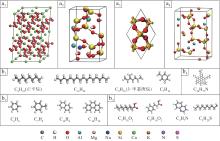
图1
矿物的晶体结构以及油组分的分子结构立体示意图a1. 方解石;a2. 蒙脱石;a3. 石英;a4. 长石;b1. 饱和烃;b2. 芳香烃;b3. 非烃;b4. 沥青质"

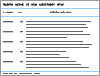
表1
润湿性模型中各种盒子的组分尺寸"
| 盒子类型 | 组分尺寸/(nm × nm × nm) | |||
|---|---|---|---|---|
| 方解石 | 蒙脱石 | 石英 | 长石 | |
| 油盒子 | 8.00 × 3.49 × 8.25 | 8.00 × 3.59 × 8.03 | 8.00 × 3.24 × 8.90 | 8.00 × 3.89 × 7.40 |
| 油-水盒子 | 25.10 × 3.49 × 15.73 | 25.80 × 3.59 × 14.89 | 25.53 × 3.24 × 16.67 | 25.73 × 3.89 × 13.78 |
| 矿物 | 25.10 × 3.49 × 0.92 | 25.80 × 3.59 × 1.87 | 25.53 × 3.24 × 3.82 | 25.73 × 3.89 × 1.29 |
| 最终模型 | 25.10 × 3.49 × 18.06 | 25.80 × 3.59 × 17.37 | 25.53 × 3.24 × 30.22 | 25.73 × 3.89 × 21.55 |

图2
油-水-矿物润湿性模型的构建过程(以蒙脱石为例)a. 油-水盒子;b. 蒙脱石;c. 蒙脱石最终的润湿性模型(图中油为蓝色,水为红色,油、水和矿物模型均采用线性方式显示。)"

表2
润湿性模型中4种矿物的力场参数"
| 原子类型 | ε/(kcal/mol) | δ/Å | q/e | 摩尔质量/(g/mol) |
|---|---|---|---|---|
| Ca(方解石) | 0.439 0 | 0.275 7 | 2.000 0 | 40.078 0 |
| C(方解石) | 0.241 1 | 0.303 3 | 1.123 3 | 12.010 7 |
| O(方解石) | 0.879 0 | 0.289 5 | -1.041 1 | 15.999 4 |
| H(蒙脱石,—OH) | 0 | 0 | 0.425 0 | 1.007 9 |
| O(蒙脱石,—OH) | 0.650 2 | 0.316 6 | -0.950 0 | 15.999 4 |
| Mg(蒙脱石) | 3.778 1 × 10⁻⁶ | 0.526 4 | 1.360 0 | 24.305 0 |
| Al(蒙脱石) | 5.563 9 × 10⁻⁶ | 0.427 1 | 1.575 0 | 26.981 5 |
| Si(蒙脱石) | 7.700 7 × 10⁻⁶ | 0.330 2 | 2.100 0 | 28.085 5 |
| Na(蒙脱石) | 0.544 3 | 0.004 2 | 1.000 0 | 22.989 8 |
| Si(石英) | 7.700 7 × 10⁻⁶ | 0.330 2 | 2.100 0 | 28.085 5 |
| O(石英,桥接氧) | 0.650 2 | 0.316 6 | -1.050 0 | 15.999 4 |
| K(长石) | 0.418 4 | 0.333 4 | 1.000 0 | 39.098 3 |
| Al(长石) | 5.563 9 × 10⁻⁶ | 0.427 1 | 1.575 0 | 26.981 5 |
| Si(长石) | 7.700 7 × 10⁻⁶ | 0.330 2 | 2.100 0 | 28.085 5 |
| O(长石) | 0.879 0 | 0.289 5 | -1.041 1 | 15.999 4 |

图3
润湿角模拟过程中的参数设置"

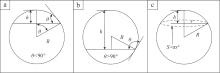
图4
分子动力学模拟中润湿角测量方法a. 锐角;b. 钝角;c. 立体图[θ为润湿角,(°);h为液滴的中心点到固体矿物表面的高度,cm;R为液滴所对应圆球的半径,cm;r为液体与固体表面接触的表面圆的半径,cm;S为液滴与矿物表面接触的面积,cm2。]"

图5
界面张力初始模型a. 油-水界面;b. 气-水界面"

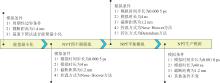
图6
界面张力模拟过程中的参数设置"

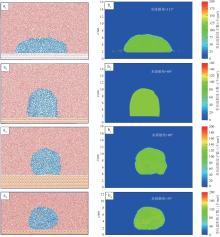
图7
润湿性模拟的最后时刻截图及其二维密度分布a1—a4. 分别为方解石、蒙脱石、石英和长石润湿性模拟的最后时刻截图;b1—b4. 分别为方解石、蒙脱石、石英和长石润湿性模拟中原油组分的二维密度分布(以温度298.15 K和压力0.1 MPa为例)(图中油为蓝色,水为红色;z为在z轴方向上的高度。)"


图8
不同温度和压力下矿物润湿角模拟测量结果柱状图a. 方解石;b. 蒙脱石;c. 石英;d. 长石"

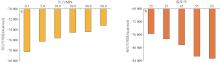
图9
润湿性模拟中不同温度、不同压力下水-方解石表面相互作用能柱状图a. 25℃,不同压力下; b. 5 MPa,不同温度下"


图10
分子动力学模拟结果与前人实验结果的对比"

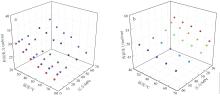
图11
不同温度和压力下界面张力模拟结果三维图a. 油-水界面;b. 气-水界面"


图12
界面张力模拟中油-水体系的密度分布a.界面张力模拟最终结果; b. 界面张力模拟最终油-水密度分布(图中油为蓝色,水为红色。)"


图13
本次分子动力学模拟计算的界面张力与前人实验和模拟结果的比较"


图14
不同岩性的孔喉半径随埋深的变化a. 准噶尔盆地,砂岩和泥岩;b. 准噶尔盆地,火山岩;c. 塔里木盆地,碳酸盐岩"

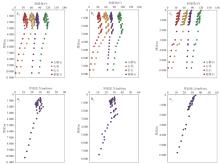
图15
低、中、高地温场盆地中润湿角(a1,a2,a3)和界面张力(b1,b2,b3)随埋深的变化a1,a2. 准噶尔盆地(地温梯度 < 25 ℃/km);b1,b2. 鄂尔多斯盆地(地温梯度25 ~ 35 ℃/km);c1,c2. 松辽盆地(地温梯度> 35 ℃/km)"

表3
分子动力学模拟中不同温-压条件下润湿角、界面张力和孔喉半径模拟结果"
| 温度/℃ | 压力/MPa | 界面张力/(mN/m) | 方解石 | 石英 | 长石 | 蒙脱石 | ||||||||||||
|---|---|---|---|---|---|---|---|---|---|---|---|---|---|---|---|---|---|---|
| 润湿角/(°) | 孔喉半径/μm | 润湿角/(°) | 孔喉半径/μm | 润湿角/(°) | 孔喉半径/μm | 润湿角/(°) | 孔喉半径/μm | |||||||||||
| 准噶尔盆地 | 鄂尔多斯盆地 | 松辽盆地 | 准噶尔盆地 | 鄂尔多斯盆地 | 松辽盆地 | 准噶尔盆地 | 鄂尔多斯盆地 | 松辽盆地 | 准噶尔盆地 | 鄂尔多斯盆地 | 松辽盆地 | |||||||
| 25 | 0.1 | 30.45 | 111 | 4.497 | 5.008 | 4.904 | 60 | 5.845 | 6.432 | 6.314 | 35 | 3.244 | 3.696 | 3.604 | 80 | 2.422 | 5.010 | 4.320 |
| 25 | 5.0 | 30.74 | 113 | 4.226 | 4.581 | 4.972 | 62 | 5.530 | 5.942 | 6.391 | 37 | 3.009 | 3.318 | 3.664 | 81 | 1.657 | 2.728 | 4.756 |
| 25 | 10.0 | 30.96 | 115 | 3.966 | 4.183 | 5.041 | 66 | 5.227 | 5.481 | 6.470 | 38 | 2.786 | 2.972 | 3.726 | 82 | 1.156 | 1.561 | 5.255 |
| 25 | 20.0 | 31.30 | 117 | 3.494 | 3.488 | 5.183 | 69 | 4.670 | 4.662 | 6.632 | 41 | 2.389 | 2.384 | 3.854 | 84 | 0.606 | 0.601 | 6.447 |
| 25 | 40.0 | 32.43 | 120 | 2.711 | 2.424 | 5.479 | 70 | 3.727 | 3.374 | 6.968 | 45 | 1.757 | 1.534 | 4.122 | 85 | 0.215 | 0.149 | 9.903 |
| 25 | 60.0 | 34.05 | 122 | 2.104 | 1.685 | 5.793 | 72 | 2.974 | 2.442 | 7.321 | 46 | 1.292 | 0.987 | 4.409 | 87 | 0.099 | 0.060 | 15.654 |
| 35 | 0.1 | 28.51 | 109 | 3.944 | 4.689 | 4.245 | 55 | 5.202 | 6.067 | 5.553 | 34 | 2.767 | 3.413 | 3.025 | 79 | 1.121 | 3.180 | 1.702 |
| 35 | 5.0 | 28.79 | 110 | 3.707 | 4.289 | 4.303 | 60 | 4.922 | 5.605 | 5.621 | 35 | 2.567 | 3.064 | 3.076 | 79 | 0.809 | 1.811 | 1.847 |
| 35 | 10.0 | 30.31 | 111 | 3.479 | 3.917 | 4.364 | 65 | 4.652 | 5.169 | 5.691 | 38 | 2.377 | 2.744 | 3.128 | 82 | 0.594 | 1.080 | 2.009 |
| 35 | 20.0 | 30.97 | 112 | 3.065 | 3.266 | 4.487 | 68 | 4.156 | 4.398 | 5.833 | 40 | 2.038 | 2.201 | 3.235 | 83 | 0.341 | 0.446 | 2.388 |
| 35 | 40.0 | 31.49 | 115 | 2.378 | 2.270 | 4.743 | 70 | 3.317 | 3.182 | 6.129 | 43 | 1.499 | 1.417 | 3.461 | 84 | 0.140 | 0.122 | 3.433 |
| 35 | 60.0 | 31.88 | 119 | 1.846 | 1.578 | 5.014 | 71 | 2.647 | 2.303 | 6.439 | 44 | 1.102 | 0.912 | 3.702 | 86 | 0.072 | 0.052 | 5.055 |
| 45 | 0.1 | 27.05 | 108 | 3.460 | 4.391 | 3.675 | 55 | 4.629 | 5.722 | 4.884 | 33 | 2.361 | 3.152 | 2.540 | 78 | 0.579 | 2.087 | 0.775 |
| 45 | 5.0 | 27.13 | 110 | 3.251 | 4.016 | 3.725 | 59 | 4.380 | 5.286 | 4.944 | 34 | 2.190 | 2.829 | 2.582 | 79 | 0.438 | 1.239 | 0.830 |
| 45 | 10.0 | 27.59 | 113 | 3.052 | 3.667 | 3.777 | 64 | 4.140 | 4.876 | 5.005 | 35 | 2.028 | 2.534 | 2.626 | 81 | 0.336 | 0.767 | 0.891 |
| 45 | 20.0 | 27.59 | 115 | 2.688 | 3.058 | 3.884 | 67 | 3.699 | 4.148 | 5.130 | 40 | 1.739 | 2.033 | 2.716 | 82 | 0.209 | 0.338 | 1.032 |
| 45 | 40.0 | 29.72 | 117 | 2.086 | 2.126 | 4.106 | 68 | 2.952 | 3.002 | 5.390 | 40 | 1.279 | 1.308 | 2.905 | 83 | 0.097 | 0.102 | 1.402 |
| 45 | 60.0 | 30.47 | 118 | 1.619 | 1.478 | 4.340 | 69 | 2.356 | 2.172 | 5.664 | 43 | 0.940 | 0.842 | 3.108 | 83 | 0.055 | 0.047 | 1.944 |
| 55 | 0.1 | 25.42 | 105 | 3.035 | 4.111 | 3.181 | 54 | 4.120 | 5.397 | 4.296 | 31 | 2.014 | 2.910 | 2.132 | 76 | 0.328 | 1.413 | 0.398 |
| 55 | 5.0 | 25.78 | 107 | 2.852 | 3.761 | 3.224 | 55 | 3.898 | 4.986 | 4.348 | 34 | 1.868 | 2.612 | 2.168 | 80 | 0.258 | 0.872 | 0.422 |
| 55 | 10.0 | 27.01 | 108 | 2.677 | 3.434 | 3.270 | 61 | 3.685 | 4.599 | 4.402 | 35 | 1.730 | 2.340 | 2.205 | 80 | 0.206 | 0.559 | 0.448 |
| 55 | 20.0 | 27.61 | 110 | 2.358 | 2.863 | 3.362 | 62 | 3.292 | 3.912 | 4.512 | 38 | 1.483 | 1.877 | 2.280 | 81 | 0.137 | 0.262 | 0.507 |
| 55 | 40.0 | 29.48 | 117 | 1.830 | 1.990 | 3.554 | 63 | 2.627 | 2.831 | 4.741 | 40 | 1.091 | 1.208 | 2.439 | 82 | 0.071 | 0.086 | 0.658 |
| 55 | 60.0 | 29.81 | 118 | 1.420 | 1.384 | 3.757 | 63 | 2.097 | 2.049 | 4.981 | 42 | 0.802 | 0.777 | 2.609 | 82 | 0.044 | 0.042 | 0.867 |
| 65 | 0.1 | 24.54 | 104 | 2.662 | 3.850 | 2.753 | 49 | 3.667 | 5.090 | 3.778 | 30 | 1.718 | 2.687 | 1.790 | 75 | 0.202 | 0.985 | 0.227 |
| 65 | 5.0 | 25.54 | 106 | 2.502 | 3.522 | 2.791 | 54 | 3.469 | 4.703 | 3.824 | 31 | 1.594 | 2.412 | 1.820 | 77 | 0.164 | 0.629 | 0.238 |
| 65 | 10.0 | 25.61 | 107 | 2.348 | 3.216 | 2.830 | 59 | 3.279 | 4.338 | 3.872 | 32 | 1.476 | 2.160 | 1.851 | 78 | 0.135 | 0.417 | 0.251 |
| 65 | 20.0 | 25.83 | 109 | 2.068 | 2.681 | 2.910 | 60 | 2.930 | 3.690 | 3.969 | 33 | 1.265 | 1.733 | 1.914 | 79 | 0.095 | 0.207 | 0.279 |
| 65 | 40.0 | 26.13 | 115 | 1.605 | 1.864 | 3.076 | 61 | 2.338 | 2.670 | 4.170 | 34 | 0.931 | 1.115 | 2.048 | 80 | 0.054 | 0.074 | 0.347 |
| 65 | 60.0 | 27.11 | 117 | 1.246 | 1.296 | 3.252 | 62 | 1.866 | 1.933 | 4.381 | 36 | 0.684 | 0.718 | 2.190 | 82 | 0.036 | 0.038 | 0.438 |
| 100 | 60.0 | 26.19 | 111 | 0.787 | 1.029 | 1.962 | 57 | 1.241 | 1.575 | 2.796 | 33 | 0.392 | 0.543 | 1.187 | 73 | 0.022 | 0.028 | 0.083 |
| 130 | 60.0 | 22.57 | 107 | 0.531 | 0.845 | 1.273 | 50 | 0.875 | 1.322 | 1.902 | 28 | 0.244 | 0.428 | 0.703 | 72 | 0.017 | 0.023 | 0.037 |
| 160 | 60.0 | 21.69 | 102 | 0.359 | 0.694 | 1.029 | 43 | 0.617 | 1.109 | 1.575 | 23 | 0.151 | 0.337 | 0.543 | 70 | 0.014 | 0.020 | 0.028 |
| 190 | 60.0 | 19.26 | 98 | 0.242 | 0.570 | 0.986 | 36 | 0.435 | 0.930 | 1.516 | 17 | 0.094 | 0.265 | 0.516 | 69 | 0.013 | 0.017 | 0.027 |
| 220 | 70.0 | 18.05 | 95 | 0.144 | 0.390 | 0.733 | 31 | 0.274 | 0.664 | 1.164 | 14 | 0.050 | 0.167 | 0.360 | 67 | 0.012 | 0.014 | 0.020 |
| 250 | 80.0 | 16.52 | 92 | 0.086 | 0.267 | 0.544 | 26 | 0.172 | 0.474 | 0.894 | 10 | 0.027 | 0.106 | 0.251 | 65 | 0.011 | 0.013 | 0.017 |
| 280 | 90.0 | 14.25 | 90 | 0.051 | 0.183 | 0.404 | 20 | 0.109 | 0.338 | 0.686 | 6 | 0.014 | 0.067 | 0.175 | 63 | 0.011 | 0.012 | 0.015 |
| [1] | 庞雄奇, 贾承造, 宋岩, 等. 全油气系统定量评价: 方法原理与实际应用[J]. 石油学报, 2022, 43(6): 727-759. |
| PANG Xiongqi, JIA Chengzao, SONG Yan, et al. Quantitative evaluation of whole petroleum system: Principle and application[J]. Acta Petrolei Sinica, 2022, 43(6): 727-759. | |
| [2] | PANG Xiongqi. Quantitative evaluation of the whole petroleum system[M]. Singapore: Springer, 2023. |
| [3] | JIA Chengzao, PANG Xiongqi, SONG Yan. Whole petroleum system and ordered distribution pattern of conventional and unconventional oil and gas reservoirs[J]. Petroleum Science, 2023, 20(1): 1-19. |
| [4] | 庞雄奇, 陈冬霞, 张俊, 等. 相―势―源复合控油气成藏机制物理模拟实验研究[J]. 古地理学报, 2013, 15(5): 575-592. |
| PANG Xiongqi, CHEN Dongxia, ZHANG Jun, et al. Physical simulation experimental study on mechanism for hydrocarbon accumulation controlled by facies-potential-source coupling[J]. Journal of Palaeogeography (Chinese Edition), 2013, 15(5): 575-592. | |
| [5] | PANG Xiongqi, LIU Keyu, MA Zhongzhen, et al. Dynamic field division of hydrocarbon migration, accumulation and hydrocarbon enrichment rules in sedimentary basins[J]. Acta Geologica Sinica (English Edition), 2012, 86(6): 1559-1592. |
| [6] | SAAFAN M, MOHYALDINN M, ELRAIES K. Obtaining capillary pressure curves from resistivity measurements in low-permeability sandstone[J]. Geoenergy Science and Engineering, 2023, 221: 111297. |
| [7] | ESMAEILI B, HOSSEINZADEH S, KADKHODAIE A, et al. Simulating reservoir capillary pressure curves using image processing and classification machine learning algorithms applied to petrographic thin sections[J]. Journal of African Earth Sciences, 2024, 209: 105098. |
| [8] | 王民, 余昌琦, 费俊胜, 等. 页岩油在干酪根中吸附行为的分子动力学模拟与启示[J]. 石油与天然气地质, 2023, 44(6): 1442-1452. |
| WANG Min, YU Changqi, FEI Junsheng, et al. Molecular dynamics simulation of shale oil adsorption in kerogen and its implications[J]. Oil & Gas Geology, 2023, 44(6): 1442-1452. | |
| [9] | 严刚, 徐耀辉, 刘保磊, 等. 烷基二苯并噻吩类化合物的运移示踪:基于驱替实验和分子模拟的研究[J]. 石油与天然气地质, 2023, 44(2): 510-520. |
| YAN Gang, XU Yaohui, LIU Baolei, et al. Tracer analysis of alkyl dibenzothiophenes migration based on displacement experiment and molecular simulation[J]. Oil & Gas Geology, 2023, 44(2): 510-520. | |
| [10] | 李倩文. 渤海湾盆地东营凹陷古近系沙河街组页岩储层润湿性及其主控因素[J]. 石油与天然气地质, 2024, 45(4): 1142-1154. |
| LI Qianwen. Wettability and its major determinants of shale reservoirs in the Shahejie Formation, Dongying Sag, Bohai Bay Basin[J]. Oil & Gas Geology, 2024, 45(4): 1142-1154. | |
| [11] | 王晓明, 陈军斌, 任大忠. 陆相页岩油储层孔隙结构表征和渗流规律研究进展及展望[J]. 油气藏评价与开发, 2023, 13(1): 23-30. |
| WANG Xiaoming, CHEN Junbin, REN Dazhong. Research progress and prospect of pore structure representation and seepage law of continental shale oil reservoir[J]. Petroleum Reservoir Evaluation and Development, 2023, 13(1): 23-30. | |
| [12] | 王鑫, 曾溅辉, 贾昆昆, 等. 成岩作用控制下低渗透砂岩润湿性演化过程及机制——以渤海湾盆地东营凹陷为例[J]. 石油与天然气地质, 2023, 44(5): 1308-1320. |
| WANG Xin, ZENG Jianhui, JIA Kunkun, et al. Evolutionary process of the wettability of low-permeability sandstone reservoirs under the control of diagenesis and its mechanism: A case study of the Dongying Sag, Bohai Bay Basin[J]. Oil & Gas Geology, 2023, 44(5): 1308-1320. | |
| [13] | LIU Benjieming, LEI Xuantong, AHMADI M, et al. Surface modeling of wettability transition on α-quartz: Insights from experiments and molecular dynamics simulations[J]. Journal of Molecular Liquids, 2024, 406: 125147. |
| [14] | SHEN Jiawei, LI Chunli, VAN DER VEGT N F A, et al. Understanding the control of mineralization by polyelectrolyte additives: Simulation of preferential binding to calcite surfaces[J]. The Journal of Physical Chemistry C, 2013, 117(13): 6904-6913. |
| [15] | ZHANG Yingnan, GUO Wenyue. Molecular insight into the tight oil movability in nano-pore throat systems[J]. Fuel, 2021, 293: 120428. |
| [16] | JORGENSEN W L, MAXWELL D S, TIRADO-RIVES J. Development and testing of the OPLS all-atom force field on conformational energetics and properties of organic liquids[J]. Journal of the American Chemical Society, 1996, 118(45): 11225-11236. |
| [17] | CYGAN R T, LIANG Jianjie, KALINICHEV A G. Molecular models of hydroxide, oxyhydroxide, and clay phases and the development of a general force field[J]. The Journal of Physical Chemistry B, 2004, 108(4): 1255-1266. |
| [18] | WANG Jianwei, BECKER U. Structure and carbonate orientation of vaterite (CaCO3)[J]. American Mineralogist, 2009, 94(2/3): 380-386. |
| [19] | BERENDSEN H J C, GRIGERA J R, STRAATSMA T P. The missing term in effective pair potentials[J]. Journal of Physical Chemistry, 1987, 91(24): 6269-6271. |
| [20] | BUSSI G, DONADIO D, PARRINELLO M. Canonical sampling through velocity rescaling[J]. The Journal of Chemical Physics, 2007, 126(1): 014101. |
| [21] | DONG Hang, ZHOU Yu, ZHENG Chao, et al. On the role of the amphiphobic surface properties in droplet wetting behaviors via molecular dynamics simulation[J]. Applied Surface Science, 2021, 544: 148916. |
| [22] | LI Jicun, WANG Feng. Water graphene contact surface investigated by pairwise potentials from force-matching PAW-PBE with dispersion correction[J]. The Journal of Chemical Physics, 2017, 146(5): 054702. |
| [23] | TAUBIN G. Estimation of planar curves, surfaces, and nonplanar space curves defined by implicit equations with applications to edge and range image segmentation[J]. IEEE Transactions on Pattern Analysis and Machine Intelligence, 1991, 13(11): 1115-1138. |
| [24] | 施砍园, 陈君青, 庞雄奇, 等. 储层矿物润湿性的测量方法综述[J]. 特种油气藏, 2024, 31(2): 1-9. |
| SHI Kanyuan, CHEN Junqing, PANG Xiongqi, et al. A review of methods for measuring the wettability of reservoir minerals[J]. Special Oil & Gas Reservoirs, 2024, 31(2): 1-9. | |
| [25] | 王业飞, 张楚晗, 崔佳, 等. 表面活性剂对油湿性致密砂岩渗吸作用与界面协同效应[J]. 中国石油大学学报(自然科学版), 2024, 48(5): 129-137. |
| WANG Yefei, ZHANG Chuhan, CUI Jia, et al. Spontaneous imbibition and interface synergistic effect of surfactants on oil-wet tight sandstone[J]. Journal of China University of Petroleum (Edition of Natural Science), 2024, 48(5): 129-137. | |
| [26] | 计秉玉, 方吉超, 杨书, 等. 分子采油的概念、方法及展望[J]. 石油与天然气地质, 2023, 44(1): 195-202. |
| JI Bingyu, FANG Jichao, YANG Shu, et al. Concept, method and prospect of molecular oil recovery[J]. Oil & Gas Geology, 2023, 44(1): 195-202. | |
| [27] | HULSHOF H. The direct deduction of the capillary constant o as a surface tension[C]//KNAW, Proceedings, 2, 1899-1900. Amsterdam: Royal Netherlands Academy of Arts and Sciences, 1900: 389-406. |
| [28] | KIRKWOOD J G, BUFF F P. The statistical mechanical theory of surface tension[J]. The Journal of Chemical Physics, 1949, 17(3): 338-343. |
| [29] | JORGE M, CORDEIRO M N D S. Molecular dynamics study of the interface between water and 2-nitrophenyl octyl ether[J]. The Journal of Physical Chemistry B, 2008, 112(8): 2415-2429. |
| [30] | LEE K, IM S, LEE B. Prediction of renewable energy hosting capacity using multiple linear regression in KEPCO system[J]. Energy Reports, 2023, 9(): 343-347. |
| [31] | AJONA M, VASANTHI P, VIJAYAN D S. Application of multiple linear and polynomial regression in the sustainable biodegradation process of crude oil[J]. Sustainable Energy Technologies and Assessments, 2022, 54: 102797. |
| [32] | TREIBER L E, OWENS W W. A laboratory evaluation of the wettability of fifty oil-producing reservoirs[J]. SPE Journal, 1972, 12(6): 531-540. |
| [33] | CHILINGAR G V, YEN T F. Some notes on wettability and relative permeabilities of carbonate reservoir rocks, II[J]. Energy Sources, 1983, 7(1): 67-75. |
| [34] | 张永超. 致密砂岩中的润湿性及其对石油运移和聚集的影响研究[D]. 北京: 中国石油大学(北京), 2019. |
| ZHANG Yongchao. The wettability in tight sandstone formations and its effects on oil migration and accumulation[D]. Beijing: China University of Petroleum (Beijing), 2019. | |
| [35] | JENNINGS H Y Jr, NEWMAN G H. The effect of temperature and pressure on the interfacial tension of water against methane-normal decane mixtures[J]. SPE Journal, 1971, 11(2): 171-175. |
| [36] | SACHS W, MEYN V. Surface tension in the system Methane/Waters A glance at numeric and precision of the experimental method “pendant drop” and precise experimental results in comparison with literature[J]. Erdoel Erdgas Kohle, 1996, 111: 119-121. |
| [37] | 田宜灵, 肖衍繁, 朱红旭, 等. 高温高压下水与非极性流体间的界面张力[J]. 物理化学学报, 1997, 13(1): 89-95 |
| TIAN Yiling, XIAO Yanfan, ZHU Hongxu, et al. Interfacial tensions between water and non-polar fluids at high pressures and high temperatures[J]. Acta Physico-Chimica Sinica, 1997, 13(1): 89-95. | |
| [38] | REN Quanyuan, CHEN Guangjin, YAN Wei, et al. Interfacial tension of (CO2 + CH4) + water from 298 K to 373 K and pressures up to 30 MPa[J]. Journal of Chemical & Engineering Data, 2000, 45(4): 610-612. |
| [39] | BISCAY F, GHOUFI A, LACHET V, et al. Monte Carlo calculation of the methane-water interfacial tension at high pressures[J]. The Journal of Chemical Physics, 2009, 131(12): 124707. |
| [40] | KASHEFI K, PEREIRA L M C, CHAPOY A, et al. Measurement and modelling of interfacial tension in methane/water and methane/brine systems at reservoir conditions[J]. Fluid Phase Equilibria, 2016, 409: 301-311. |
| [41] | YANG Yafan, NARAYANAN NAIR A K, SUN Shuyu. Molecular dynamics simulation study of carbon dioxide, methane, and their mixture in the presence of brine[J]. The Journal of Physical Chemistry B, 2017, 121(41): 9688-9698. |
| [42] | FENG Dong, WU Keliu, WANG Xiangzeng, et al. Effects of temperature and pressure on spontaneous counter-current imbibition in unsaturated porous media[J]. Energy & Fuels, 2019, 33(9): 8544-8556. |
| [43] | 赵文, 吴克柳, 姜林, 等. 基于孔隙网络模拟的致密砂岩气充注与微观气水赋存特征[J]. 天然气工业, 2022, 42(5): 69-79. |
| ZHAO Wen, WU Keliu, JIANG Lin, et al. Charging and microscopic gas-water occurrence characteristics of tight sandstone gas based on pore network model[J]. Natural Gas Industry, 2022, 42(5): 69-79. | |
| [44] | 杨智. 准噶尔盆地腹部超压顶面附近油气成藏研究[D]. 武汉: 中国地质大学, 2009. |
| YANG Zhi. Hydrocarbon accumulation mechanisms near the top overpressured surface in central Junggar Basin, northwest China[D]. Wuhan: China University of Geosciences, 2009. | |
| [45] | 于强. 鄂尔多斯盆地南部中生界热演化史及其与多种能源关系研究[D]. 西安: 西北大学, 2009. |
| YU Qiang. The thermal evolution history of Ordos Basin Mesozoic and its relationship with various energy mineral deposit[D]. Xi'an: Northwest University, 2009. | |
| [46] | 李阳, 倪小明, 王延斌, 等. 鄂尔多斯盆地临兴地区上古生界压力特征及其成因机制[J]. 天然气地球科学, 2019, 30(7): 997-1005. |
| LI Yang, NI Xiaoming, WANG Yanbin, et al. Pressure characteristics and genetic mechanism of Upper Paleozoic in Linxing area of Ordos Basin[J]. Natural Gas Geoscience, 2019, 30(7): 997-1005. | |
| [47] | 张翘然, 肖红平, 饶松, 等. 松辽盆地现今地温场特征及控制因素[J]. 地质科技通报, 2023, 42(5): 191-204. |
| ZHANG Qiaoran, XIAO Hongping, RAO Song, et al. Characteristics and controlling factors of the present geothermal field in the Songliao Basin[J]. Bulletin of Geological Science and Technology, 2023, 42(5): 191-204. | |
| [48] | 黄越, 常健, 邱楠生, 等. 松辽盆地齐家—古龙凹陷青山口组压力场特征和超压成因[J]. 石油学报, 2024, 45(12): 1800-1817. |
| HUANG Yue, CHANG Jian, QIU Nansheng, et al. Pressure field characteristics and overpressure geneses of Qingshankou Formation in Qijia-Gulong Sag, Songliao Basin[J]. Acta Petrolei Sinica, 2024, 45(12): 1800-1817. | |
| [49] | YAO Weijiang, CHEN Zhonghong, DONG Xuemei, et al. Storage space, pore-throat structure of igneous rocks and the significance to petroleum accumulation: An example from Junggar Basin, western China[J]. Marine and Petroleum Geology, 2021, 133: 105270. |
| [50] | 庞礴, 董月霞, 陈迪, 等. 含油气盆地砂岩目的层油气富集主控因素与基本模式——以渤海湾盆地南堡凹陷新近系砂岩油气藏为例[J]. 石油学报, 2019, 40(5): 519-531. |
| PANG Bo, DONG Yuexia, CHEN Di, et al. Main controlling factors and basic model for hydrocarbon enrichment in the sandstone target layer of petroliferous basin: A case study of Neogene sandstone reservoirs in Nanpu Sag, Bohai Bay Basin[J]. Acta Petrolei Sinica, 2019, 40(5): 519-531. |
| [1] | 鲍李银, 庞雄奇, 邹亮, 陈宏飞, 林昊, 张婷, 沈彬, 王凯, 王睿. 全油气系统油气成藏动力判别与贡献量评价——以准噶尔盆地玛湖凹陷二叠系风城组为例[J]. 石油与天然气地质, 2025, 46(4): 1267-1280. |
| [2] | 杨晓斌, 陈君青, 张潇, 王玉莹, 火勋港, 姜福杰, 庞宏, 施砍园, 冉钧. 页岩弹性参数测量方法及影响因素综述[J]. 石油与天然气地质, 2025, 46(2): 630-653. |
| [3] | 王民, 余昌琦, 费俊胜, 李进步, 张宇辰, 言语, 吴艳, 董尚德, 唐育龙. 页岩油在干酪根中吸附行为的分子动力学模拟与启示[J]. 石油与天然气地质, 2023, 44(6): 1442-1452. |
| [4] | 何春波, 张亚雄, 于英华, 袁红旗. 断裂诱发砂体输导油气变径部位预测方法及其应用[J]. 石油与天然气地质, 2023, 44(5): 1300-1307. |
| [5] | 李威, 徐建永, 刘志峰, 李友川, 朱文奇. 幔源CO2对渤海海域秦皇岛29构造带油气成藏的影响[J]. 石油与天然气地质, 2023, 44(2): 418-428. |
| [6] | 严刚, 徐耀辉, 刘保磊, 孙砚泽, 李姗姗, 赵守钰, 钟鸣. 烷基二苯并噻吩类化合物的运移示踪:基于驱替实验和分子模拟的研究[J]. 石油与天然气地质, 2023, 44(2): 510-520. |
| [7] | 计秉玉, 方吉超, 杨书, 胡勇. 分子采油的概念、方法及展望[J]. 石油与天然气地质, 2023, 44(1): 195-202. |
| [8] | 李美俊, 刘晓强, 韩秋雅, 肖洪, 方镕慧, 何大祥, 高志伟. 分子模拟在油气地球化学中的应用研究进展[J]. 石油与天然气地质, 2021, 42(4): 919-930. |
| [9] | 梅啸寒, 张琴, 王雅芸, 吴欣松, 刘景彦, 赵家宏, 王武学. 松辽盆地扶新隆起带扶杨油层地层水化学特征及其与油气运聚关系[J]. 石油与天然气地质, 2020, 41(2): 328-338, 358. |
| [10] | 孙同文, 高喜成, 吕延防, 付广, 王海学, 王浩然. 断裂转换带作为油气侧向、垂向运移通道的研究进展[J]. 石油与天然气地质, 2019, 40(5): 1011-1021. |
| [11] | 王浩然, 付广, 宿碧霖, 孙同文, 汤文浩. 下生上储式油气运移优势路径确定方法及其应用[J]. 石油与天然气地质, 2018, 39(6): 1237-1245. |
| [12] | 江宁, 何敏, 刘军, 薛怀艳, 郑金云, 张青林. 珠江口盆地靖海凹陷多边形断层系统成因及油气成藏意义[J]. 石油与天然气地质, 2017, 38(2): 363-370. |
| [13] | 王伟, 孙同文, 曹兰柱, 吕延防, 付广, 鲁秀芹, 邓玮, 张桓. 油气由断裂向砂体侧向分流能力定量评价方法——以渤海湾盆地饶阳凹陷留楚构造为例[J]. 石油与天然气地质, 2016, 37(6): 979-989. |
| [14] | 王君, 楼章华, 朱蓉, 何钰, 朱振宏, 王同军, 钱月红. 渤海湾盆地东濮凹陷文留地区现今地层水化学与油气运聚[J]. 石油与天然气地质, 2014, 35(4): 449-455. |
| [15] | 李爱荣, 王维喜, 武富礼, 赵靖舟, 张惠. 鄂尔多斯盆地延安三角洲长4+5和长6油气聚集模式[J]. 石油与天然气地质, 2013, 34(5): 667-671. |
| 阅读次数 | ||||||
|
全文 |
|
|||||
|
摘要 |
|
|||||
