

石油与天然气地质 ›› 2025, Vol. 46 ›› Issue (3): 777-789.doi: 10.11743/ogg20250306
刘成林1,2( ), 洪思婕1,2, 王馨佩1,2, 范立勇3, 王海东1,2, 陈践发1,2, 朱玉新4, 丁振刚1,2, 张雪1,2, 胡浩然1,2
收稿日期:2024-07-15
修回日期:2024-10-25
出版日期:2025-06-30
发布日期:2025-06-26
第一作者简介:刘成林(1970—),男,教授、博士研究生导师,油气成藏与资源评价。E‑mail: liucl@cup.edu.cn。
基金项目:
Chenglin LIU1,2(), Sijie HONG1,2, Xinpei WANG1,2, Liyong FAN3, Haidong WANG1,2, Jianfa CHEN1,2, Yuxin ZHU4, Zhengang DING1,2, Xue ZHANG1,2, Haoran HU1,2
Received:2024-07-15
Revised:2024-10-25
Online:2025-06-30
Published:2025-06-26
摘要:
氦气是重要的具有战略意义的资源,分析中国氦气勘探与开发进展及其勘探前景具有重大意义。研究分析了中国氦气勘探开发现状,梳理了中国典型含氦天然气田(藏)的地质条件,展望了中国氦气发展前景。研究认为:①氦气在中国主要与烃类或者非烃类气藏伴生,且富氦天然气藏具有多层、多类型分布特征,鄂尔多斯盆地、四川盆地和塔里木盆地是中国3大氦气富集盆地。②中国西部挤压型盆地以壳源氦气为主,少量为幔源氦气,与烃类和非烃类气藏伴生;中部盆地主要为壳源氦气,与烃类气藏伴生;东部拉张型盆地以壳-幔源氦气为主,主要与非烃类气藏伴生。③结合盆地构造背景,划分出7种氦气生运聚模式。④特殊的地质条件与构造演化史使中国具有不同于世界其他地区的氦气地质条件、资源潜力与分布特征。适合中国地质条件的氦气富集理论、对氦气资源潜力准确的认识和创新性的氦气勘探开发技术是中国氦气产量快速上升并稳定发展的关键。
中图分类号:
表1
中国主要含氦天然气田(藏)地质-地球化学特征与氦气生-运-聚模式"
| 气田名称 | 所属盆地及构造背景 | 天然气组分 | 氦气含量/% | R/Ra | 氦气探明地质储量/(108 m3) | 氦源岩 | 储-盖组合 | 生-运-聚模式 |
|---|---|---|---|---|---|---|---|---|
| 威远气田 | 四川盆地乐山-龙女寺古隆起核部的穹窿背斜 | 烃类、氦气 | 0.120 ~ 0.404/0.260 | 0.013 ~ 0.041/0.024 | 93.980 | 前震旦系花岗岩、寒武系筇竹寺组黑色页岩 | 储层为震旦系灯影组白云岩;盖层为下寒武统筇竹寺组泥页岩 | 以古隆起为构造背景-以基底花岗岩类与上覆富铀、钍沉积岩为氦源岩-主要与烃类伴生 |
| 庆阳气田 | 鄂尔多斯盆地中央古隆起 | 0.068~0.310/0.154 | 0.019 ~ 0.031/0.022 | 0.420 | 基底花岗岩、石炭系-二叠系煤、暗色泥岩、铝土岩 | 储层为二叠系太原组、山西组和下石盒子组砂岩;盖层为石千峰组厚层泥岩 | ||
| 黄龙气田 | 鄂尔多斯盆地伊陕斜坡和渭北隆起交汇部位 | 0.015~0.226/0.130 | — | 0.040 | 古元古界结晶变质基底及上古生界本溪组煤岩、暗色泥岩 | 储层为二叠系太原组、山西组和下石盒子组碎屑砂岩;盖层为石千峰组厚层泥岩 | ||
| 马北气田 | 柴达木盆地马海凸起 | 0.060~0.810/0.270 | 0.004 ~ 0.059/0.023 | 0.040 | 上志留统-下泥盆统花岗岩、花岗片麻岩及侏罗系沉积岩 | 储层为古近系砂岩;盖层为下干柴沟组上部泥岩 | ||
| 牛东气田 | 柴达木盆地北缘阿尔金山前东段 | 0.050~0.060/0.055 | 0.009 ~ 0.026/0.017 | — | 储层为侏罗系砂岩;盖层为侏罗系泥岩 | |||
| 东坪气田 | 柴达木盆地东坪斜坡,古近纪以来的大型盆缘鼻状古隆起 | 0.075~1.069/0.380 | 0.007~0.016/0.011 | 0.440 | 储层为基岩风化壳;盖层为古近系路乐河组含膏泥岩和膏质碳酸盐岩 | |||
| 尖北气田 | 柴达木盆地尖北斜坡带,古近纪以来的大型盆缘鼻状古隆起 | 0.160~0.570 | — | 0.420 | 储层为基岩风化壳;盖层为古近系路乐河组含膏泥岩和膏质碳酸盐岩 | |||
| 和田河气田 | 塔里木盆地巴楚隆起南缘玛扎塔格构造带 | 0.044~0.370/0.320 | 0.060~0.083/0.075 | 1.960 | 中元古界花岗岩、寒武系暗色泥岩 | 储层为石炭系生屑灰岩段及奥陶系潜山碳酸盐岩;盖层为石炭系含膏泥岩 | ||
| 东胜气田 | 鄂尔多斯盆地伊盟隆起 | 烃类、二氧化碳、氮气、氦气 | 0.045~0.487/0.133 | 0.013~0.045/0.024 | 2.440 | 基底花岗岩、石炭系-二叠系煤和暗色泥岩 | 储层为二叠系山西组和下石盒子组砂岩;盖层为石千峰组厚层泥岩 | 以古隆起为构造背景-以基底花岗岩类与上覆富铀、钍沉积岩为氦源岩-主要与烃类、二氧化碳、氮气伴生 |
| 阿克莫木 气田 | 塔里木盆地西南坳陷喀什凹陷北缘乌恰构造带 | 0.038~0.130/0.084 | 0.549~0.596 | — | 基底花岗岩与石炭系、二叠系及侏罗系泥岩 | 储层为下白垩统克孜勒苏群;盖层为白垩系和古近系泥岩 |
续表1 中国主要含氦天然气田(藏)地质-地球化学特征与氦气生-运-聚模式"
| 气田名称 | 所属盆地及构造背景 | 天然气组分 | 氦气含量/% | R/Ra | 氦气探明地质储量/(108 m3) | 氦源岩 | 储-盖组合 | 生-运-聚模式 |
|---|---|---|---|---|---|---|---|---|
| 金秋气田 | 四川盆地川中平缓褶皱带和川北低平褶皱带的过渡区域 | 烃类、氦气 | 0.050~0.100/0.071 | 0.010~0.080/0.033 | 1.500 | 三叠系须家河组煤系、侏罗系暗色泥岩 | 储层为侏罗系砂岩;盖层为侏罗系泥岩 | 以平缓褶皱带及斜坡为构造背景-以富铀、钍沉积岩为氦源岩-主要与烃类伴生 |
| 神木气田 | 鄂尔多斯盆地伊陕斜坡 | 0.017~0.116/0.052 | — | 1.730 | 石炭系-二叠系煤和暗色泥岩 | 储层为二叠系山西组和下石盒子组碎屑砂岩;盖层为石千峰组厚层泥岩 | ||
| 太平庄气田 | 松辽盆地长春岭背斜带 | 烃类、氦气 | 0.140~0.190/0.157 | 0.310~0.480/0.390 | 0.002 | 壳-幔复合 | 储层为下白垩统泉头组;盖层为上白垩统青山口组和嫩江组下部泥岩 | 以背斜带为构造背景-以地幔与上覆富铀、钍沉积岩为氦源-主要与烃类伴生 |
| 花沟气田 | 渤海湾盆地济阳坳陷东营凹陷西南与惠民凹陷东南结合部位的断鼻带 | 氮气、氦气 | 2.080~3.080/2.580 | 3.100~3.190/3.145 | — | 储层为新近系明化镇组砂岩;盖层为明化镇组泥岩 | 以凹陷为构造背景-地幔与上覆富铀、钍沉积岩为氦源-主要与氮气伴生 | |
| 黄桥气田 | 苏北盆地南京凹陷东北端黄桥复向斜带黄桥背斜 | 二氧化碳、氦气 | 0.109~0.571/0.340 | 1.960~3.240/2.600 | — | 幔源二氧化碳、氮气、氦气、高自然伽马砂层放射性成因的氦气、二叠系栖霞组灰岩变质成因的二氧化碳 | 储层为新近系下盐城组二段砂岩;盖层为下盐城组泥岩 | 以凹陷为构造背景-以地幔与上覆富铀、钍沉积岩为氦源-主要与二氧化碳伴生 |
| 苏仁诺尔气藏、巴彦塔拉气藏 | 海拉尔盆地乌尔逊断陷苏仁诺尔和巴彦塔拉构造 | 0.003~0.198/0.101 | 1.200~1.490/1.345 | — | 壳幔复合 | 储层为白垩系南屯组、铜钵庙组砂岩、砂砾岩及基岩风化壳;盖层为白垩系南屯组泥岩 | ||
| 宝月气藏 | 三水盆地宝月凹陷宝月背斜 | 烃类、二氧化碳、氮气、氦气 | 0.110~0.259/0.185 | 4.090~4.560/4.325 | — | 壳幔复合 | 储层为古近系布心组砂岩;盖层为布心组泥岩 | 以凹陷为构造背景-以地幔与上覆富铀、钍沉积岩为氦源-主要与烃类、二氧化碳、氮气伴生 |

图1
中国氦气大地构造背景与典型富集模式对比剖面"

表2
中国典型含氦盆地地质参数"
| 主要参数 | 挤压型含油气盆地 | 过渡型含油气盆地 | 拉张型含油气盆地 | |||
|---|---|---|---|---|---|---|
| 塔里木 | 柴达木 | 鄂尔多斯 | 四川 | 松辽 | 渤海湾 | |
| 面积/(104 km2) | 56 | 12 | 32 | 23 | 26 | 20 |
| 基底 | Ar,Pt结晶基底 | Pz褶皱基底 | AnZ结晶基岩 | Pt结晶基岩 | Pz褶皱基底 | AnZ结晶基岩 |
| 沉积盖层 | Pz,Mz | Mz, R,Q | Z,Pz,Mz | Z,Pz, Mz | J,K,R,Q | Z, Pz, Mz,R, Q |
| 沉积岩厚度/km | 5~12 | 3~10 | 6~7 | 6~10 | 4~6 | 3~10 |
| 磁场特征 | 北东、东西、北西3组磁场带 | 北西西宽缓正异常 | 宽缓磁场正异常 | 宽缓变化菱形磁场正异常 | 宽缓正异常 | NE向正、负 异常 |
| 重力加速度/ (10-5 m/s2) | -225~-125 | -350~-325 | -170~-130 | -170~-90 | 10~20 | 10~20 |
| 地壳厚度/km | 39~45 | 50~55 | 43~44 | 38~42 | 27~35 | 29~37 |
| 地温梯度/(℃/km) | 17~20 | 20~28 | 22~27 | 25~30 | 37 | 33~45 |
| 岩浆活动 | 二叠纪辉绿岩、玄武岩 | 古生代花岗岩 | 晚三叠世凝灰岩 | 二叠纪玄武岩 | 第四纪玄武岩 | 新生代玄武岩 |
| 含气层系 | 新近系、古近系、侏罗系、石炭系、奥陶系 | 第四系、新近系、古近系、石炭系 | 二叠系、石炭系、奥陶系、寒武系 | 侏罗系、三叠系、二叠系、石炭系、寒武系、震旦系 | 白垩系 | 新近系— 震旦系 |
| 盆地构造类型 | 碰撞挤压带之间大型复合盆地 | 碰撞挤压带之间大型复合盆地 | 板内多旋回拗陷盆地 | 板内多旋回拗陷盆地 | 板内断-拗 盆地 | 板内多旋回断-拗盆地 |
| 氦气来源 | 壳源为主,少量幔源 | 壳源为主,少量 幔源 | 壳源 | 壳源 | 壳-幔复合 | |
| 主要氦气生-运-聚模式 | 以古隆起为构造背景-以基底花岗岩类与上覆富铀、钍沉积层为氦源岩-主要与烃类、非烃气伴生 | 以古隆起为构造背景-以基底花岗岩类与上覆富铀、钍沉积层为氦源岩-主要与烃类伴生,以古隆起为构造背景-以上覆富铀、钍沉积层为氦源岩-主要与烃类伴生 | 以凹陷为构造背景-以地幔与上覆富铀、钍沉积岩为氦源岩-主要与非烃气伴生 | |||

图2
鄂尔多斯盆地庆阳富氦气田形成关键因素配置"


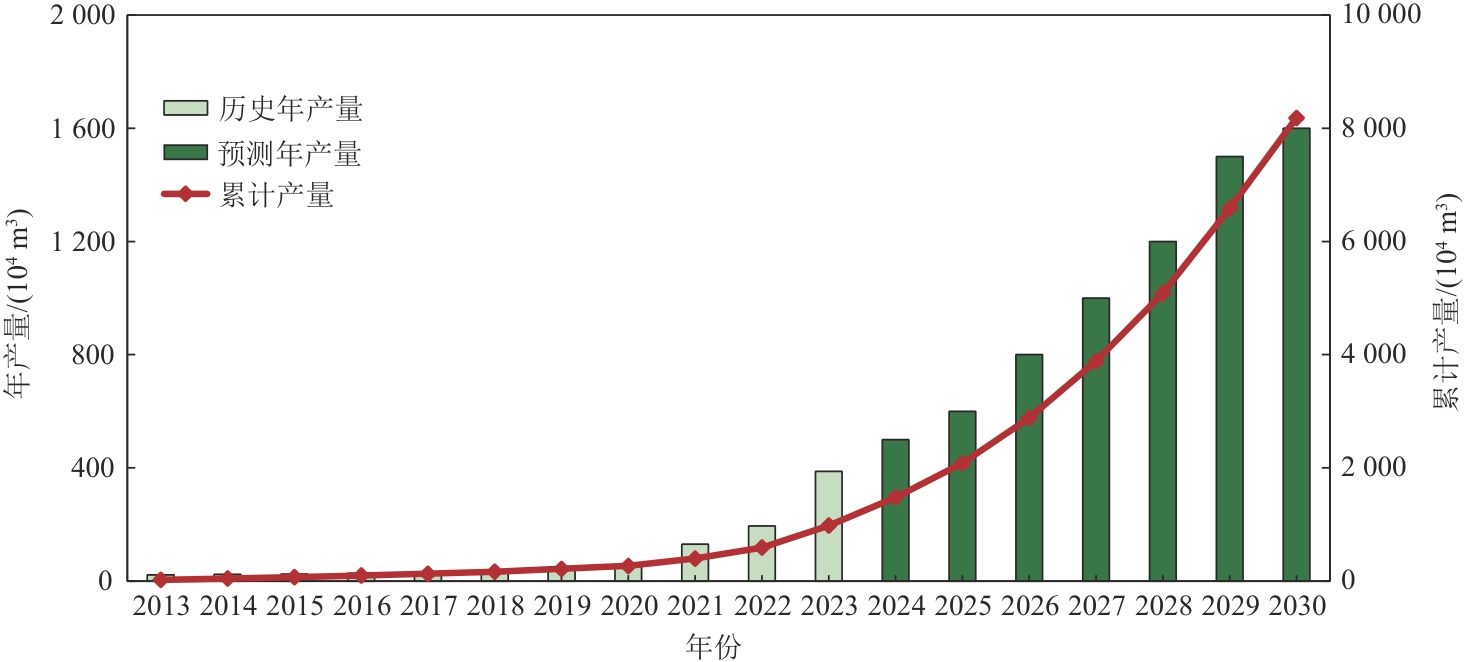
图3
中国2024—2030年氦气年产量和累计产量预测[13]"
| 1 | NUTTALL W J, CLARKE R H, GLOWACKI B A. The future of helium as a natural resource[M]. London: Routledge, 2012. |
| 2 | CAI Zhiming, CLARKE R H, GLOWACKI B A, et al. Ongoing ascent to the helium production plateau—Insights from system dynamics[J]. Resources Policy, 2010, 35(2): 77-89. |
| 3 | ANDERSON S T. Economics, helium, and the U.S. federal helium reserve: Summary and outlook[J]. Natural Resources Research, 2018, 27(4): 455-477. |
| 4 | HAMAK J E. 2015 Minerals yearbook-helium[R]. Virginia: United States Geological Survey, 2017. |
| 5 | 郝旭平. 关于我国氦气资源立法保护问题的建议[J]. 石油与天然气化工, 2009, 38(5): 393-395. |
| HAO Xuping. Discuss on domestic legislation protection for helium gas resource[J]. Chemical Engineering of Oil and Gas, 2009, 38(5): 393-395. | |
| 6 | 陈践发, 刘凯旋, 董勍伟, 等. 天然气中氦资源研究现状及我国氦资源前景[J]. 天然气地球科学, 2021, 32(10): 1436-1449. |
| CHEN Jianfa, LIU Kaixuan, DONG Qingwei, et al. Research status of helium resources in natural gas and prospects of helium resources in China[J]. Natural Gas Geoscience, 2021, 32(10): 1436-1449. | |
| 7 | USGS. Mineral commodity summaries 2023[EB/OL]. [2023-12-19]. . |
| 8 | PIERCE A P, GOTT G B, MYTTON J W. Uranium and helium in the Panhandle gas field, Texas, and adjacent areas: Professional paper 454-G[R]. Washington, D.C.: U.S. Government Printing Office, 1964: 57. |
| 9 | OZIMA M, IGARASHI G. The primordial noble gases in the Earth: a key constraint on Earth evolution models[J]. Earth and Planetary Science Letters, 2000, 176(2): 219-232. |
| 10 | 张哲, 王春燕, 王秋晨, 等. 中国氦气市场发展前景展望[J]. 油气与新能源, 2022, 34(1): 36-41. |
| ZHANG Zhe, WANG Chunyan, WANG Qiuchen, et al. Development prospects of China’s helium market[J]. Petroleum and New Energy, 2022, 34(1): 36-41. | |
| 11 | BRADSHAW A M, HAMACHER T. Nuclear fusion and the helium supply problem[J]. Fusion Engineering and Design, 2013, 88(9/10): 2694-2697. |
| 12 | 王晓锋, 刘文汇, 李晓斌, 等. 氦气资源的形成聚集与中国氦资源前景[C]//中国矿物岩石地球化学学会. 中国矿物岩石地球化学学会第17届学术年会论文摘要集, 杭州, 2019. 贵阳: 中国矿物岩石地球化学学会, 2019: 1154-1155. |
| WANG Xiaofeng, LIU Wenhui, LI Xiaobin, et al. The formation and accumulation of helium resources and the prospects of helium resources in China[C]//Chinese Society for Mineralogy Petrology and Geochemistry. Summary Collection of Papers at the 17th Academic Annual Conference of Chinese Society for Mineralogy Petrology and Geochemistry, Hangzhou, 2019. Guiyang: Chinese Society for Mineralogy Petrology and Geochemistry, 2019: 1154-1155. | |
| 13 | 刘成林, 张亚雄, 王馨佩, 等. 中国与美国氦气地质条件和资源潜力对比及启示[J]. 世界石油工业, 2024, 31(2): 1-10. |
| LIU Chenglin, ZHANG Yaxiong, WANG Xinpei, et al. Comparison and enlightenment of helium geological conditions and resource potential between China and the United States[J]. World Petroleum Industry, 2024, 31(2): 1-10. | |
| 14 | BROWN A. Origin of helium and nitrogen in the Panhandle-Hugoton field of Texas, Oklahoma, and Kansas, United States[J]. AAPG Bulletin, 2019, 103(2): 369-403. |
| 15 | DANABALAN D. Helium: Exploration methodology for a strategic resource[D]. Durham: Durham University, 2017. |
| 16 | FAIRHURST B, EWING T, LINDSAY B. West Texas (Permian) Super Basin, United States: Tectonics, structural development, sedimentation, petroleum systems, and hydrocarbon reserves[J]. AAPG Bulletin, 2021, 105(6): 1099-1147. |
| 17 | CHENG Anran, SHERWOOD LOLLAR B, GLUYAS J G, et al. Primary N2-He gas field formation in intracratonic sedimentary basins[J]. Nature, 2023, 615(7950): 94-99. |
| 18 | 陈悦, 陶士振, 杨怡青. 中国氦气地球化学特征、聚集规律与前景展望[J]. 中国矿业大学学报, 2023, 52(1): 145-167. |
| CHEN Yue, TAO Shizhen, YANG Yiqing. Geochemistry characteristics, accumulation regularity and development prospect of helium in China[J]. Journal of China University of Mining & Technology, 2023, 52(1): 145-167. | |
| 19 | 陶士振, 吴义平, 陶小晚, 等. 氦气地质理论认识、资源勘查评价与全产业链一体化评价关键技术[J]. 地学前缘, 2024, 31(1): 351-367. |
| TAO Shizhen, WU Yiping, TAO Xiaowan, et al. Helium: Accumulation model, resource exploration and evaluation, and integrative evaluation of the entire industrial chain[J]. Earth Science Frontiers, 2024, 31(1): 351-367. | |
| 20 | 李剑, 王晓波, 徐朱松, 等. 中国氦气资源成藏规律与开发前景[J]. 天然气地球科学, 2024, 35(5): 851-868. |
| LI Jian, WANG Xiaobo, XU Zhusong, et al. Helium resources accumulation regulations and their development prospects in China[J]. Natural Gas Geoscience, 2024, 35(5): 851-868. | |
| 21 | 秦胜飞, 李济远, 王佳美, 等. 中国含油气盆地富氦天然气藏氦气富集模式[J]. 天然气工业, 2022, 42(7): 125-134. |
| QIN Shengfei, LI Jiyuan, WANG Jiamei, et al. Helium enrichment model of helium-rich gas reservoirs in petroliferous basins in China[J]. Natural Gas Industry, 2022, 42(7): 125-134. | |
| 22 | 陶小晚, 李建忠, 赵力彬, 等. 我国氦气资源现状及首个特大型富氦储量的发现: 和田河气田[J]. 地球科学, 2019, 44(3): 1024-1041. |
| TAO Xiaowan, LI Jianzhong, ZHAO Libin, et al. Helium resources and discovery of first supergiant helium reserve in China: Hetianhe Gas Field[J]. Earth Science, 2019, 44(3): 1024-1041. | |
| 23 | 李玉宏, 卢进才, 李金超, 等. 渭河盆地天然气成因特征及其意义[J]. 西安石油大学学报(自然科学版), 2011, 26(5): 11-16. |
| LI Yuhong, LU Jincai, LI Jinchao, et al. Genetic characteristics of the natural gas in Weihe Basin and its significance[J]. Journal of Xi’an Shiyou University(Natural Science Edition), 2011, 26(5): 11-16. | |
| 24 | 李玉宏, 张国伟, 周俊林, 等. 氦气资源调查理论与技术研究现状及建议[J]. 西北地质, 2022, 55(4): 1-10. |
| LI Yuhong, ZHANG Guowei, ZHOU Junlin, et al. Research status and suggestions on helium resource investigation theory and technology[J]. Northwestern Geology, 2022, 55(4): 1-10. | |
| 25 | 张文, 李玉宏, 王利, 等. 渭河盆地氦气成藏条件分析及资源量预测[J]. 天然气地球科学, 2018, 29(2): 236-244. |
| ZHANG Wen, LI Yuhong, WANG Li, et al. The analysis of helium accumulation conditions and prediction of helium resource in Weihe Basin[J]. Natural Gas Geoscience, 2018, 29(2): 236-244. | |
| 26 | 张雪. 渭河盆地天然气及氦气成藏条件与资源量预测[D]. 西安: 长安大学, 2015. |
| ZHANG Xue. Accumulation conditions and resource prediction of nature gas and helium gas in Weihe Basin[D]. Xi’an: Chang’an University, 2015. | |
| 27 | 刘成林, 丁振刚, 范立勇, 等. 鄂尔多斯盆地含氦天然气地球化学特征与富集影响因素[J]. 石油与天然气地质, 2024, 45(2): 384-392. |
| LIU Chenglin, DING Zhengang, FAN Liyong, et al. Geochemical characteristics and enrichment factors of helium-bearing natural gas in the Ordos Basin[J]. Oil & Gas Geology, 2024, 45(2): 384-392. | |
| 28 | 何发岐, 王付斌, 王杰, 等. 鄂尔多斯盆地东胜气田氦气分布规律及特大型富氦气田的发现[J]. 石油实验地质, 2022, 44(1): 1-10. |
| HE Faqi, WANG Fubin, WANG Jie, et al. Helium distribution of Dongsheng Gas Field in Ordos Basin and discovery of a super large helium-rich gas field[J]. Petroleum Geology and Experiment, 2022, 44(1): 1-10. | |
| 29 | 刘成林, 丁振刚, 陈践发, 等. 鄂尔多斯盆地氦源岩特征及生氦潜力[J]. 石油与天然气地质, 2023, 44(6): 1546-1554. |
| LIU Chenglin, DING Zhengang, CHEN Jianfa, et al. Characteristics and helium-generating potential of helium source rocks in the Ordos Basin[J]. Oil & Gas Geology, 2023, 44(6): 1546-1554. | |
| 30 | 王杰, 贾会冲, 陶成, 等. 鄂尔多斯盆地杭锦旗地区东胜气田氦气成因来源及富集规律[J]. 天然气地球科学, 2023, 34(4): 566-575. |
| WANG Jie, JIA Huichong, TAO Cheng, et al. Source and enrichment regularity of helium in Dongsheng Gas Field of Hangjinqi area, Ordos Basin[J]. Natural Gas Geoscience, 2023, 34(4): 566-575. | |
| 31 | 魏国齐, 王东良, 王晓波, 等. 四川盆地高石梯—磨溪大气田稀有气体特征[J]. 石油勘探与开发, 2014, 41(5): 533-538. |
| WEI Guoqi, WANG Dongliang, WANG Xiaobo, et al. Characteristics of noble gases in the large Gaoshiti-Moxi Gas Field in Sichuan Basin[J]. Petroleum Exploration and Development, 2014, 41(5): 533-538. | |
| 32 | 仵宗涛, 刘兴旺, 李孝甫, 等. 稀有气体同位素在四川盆地元坝气藏气源对比中的应用[J]. 天然气地球科学, 2017, 28(7): 1072-1077. |
| WU Zongtao, LIU Xingwang, LI Xiaofu, et al. The application of noble gas isotope in gas-source correlation of Yuanba reservoir, Sichuan Basin[J]. Natural Gas Geoscience, 2017, 28(7): 1072-1077. | |
| 33 | 戴金星. 威远气田成藏期及气源[J]. 石油实验地质, 2003, 25(5): 473-480. |
| DAI Jinxing. Pool-forming periods and gas sources of Weiyuan gasfield[J]. Petroleum Geology & Experiment, 2003, 25(5): 473-480. | |
| 34 | 刘凯旋, 陈践发, 付娆, 等. 威远气田富氦天然气分布规律及控制因素探讨[J]. 中国石油大学学报(自然科学版), 2022, 46(4): 12-21. |
| LIU Kaixuan, CHEN Jianfa, FU Rao, et al. Discussion on distribution law and controlling factors of helium-rich natural gas in Weiyuan Gas Field[J]. Journal of China University of Petroleum (Edition of Natural Science), 2022, 46(4): 12-21. | |
| 35 | 张宝收, 张本健, 汪华, 等. 四川盆地金秋气田: 一个典型以中生界沉积岩为氦源岩的含氦-富氦气田[J]. 石油与天然气地质, 2024, 45(1): 185-199. |
| ZHANG Baoshou, ZHANG Benjian, WANG Hua, et al. The Jinqiu Gas Field in the Sichuan Basin: A typical helium-bearing to helium-rich gas field with the Mesozoic sedimentary rocks as helium source rocks[J]. Oil & Gas Geology, 2024, 45(1): 185-199. | |
| 36 | 赵安坤, 王东, 时志强, 等. 四川盆地及周缘地区氦气资源调查研究进展与未来工作方向[J]. 西北地质, 2022, 55(4): 74-84. |
| ZHAO Ankun, WANG Dong, SHI Zhiqiang, et al. Exploration status and helium resource potential of the helium-bearing natural gas field in Sichuan Basin and its surrounding areas[J]. Northwestern Geology, 2022, 55(4): 74-84. | |
| 37 | 彭威龙, 林会喜, 刘全有, 等. 塔里木盆地氦气地球化学特征及有利勘探区[J]. 天然气地球科学, 2023, 34(4): 576-586. |
| PENG Weilong, LIN Huixi, LIU Quanyou, et al. Geochemical characteristics of helium and favorable exploration areas in the Tarim Basin, China[J]. Natural Gas Geoscience, 2023, 34(4): 576-586. | |
| 38 | 常兴浩, 宋凯. 巴什托构造石炭系小海子组高氦气藏成藏机理浅析[J]. 天然气工业, 1997, 17(2): 18-20. |
| CHANG Xinghao, SONG Kai. Analysis of reservoir-forming mechanism of high-He pool in the Carboniferous of Xiaohaizi Formation of Bashitou structure[J]. Natural Gas Industry, 1997, 17(2): 18-20. | |
| 39 | 刘全有, 戴金星, 金之钧, 等. 塔里木盆地前陆区和台盆区天然气的地球化学特征及成因[J]. 地质学报, 2009, 83(1): 107-114. |
| LIU Quanyou, DAI Jinxing, JIN Zhijun, et al. Geochemistry and genesis of natural gas in the foreland and platform of the Tarim Basin[J]. Acta Geologica Sinica, 2009, 83(1): 107-114. | |
| 40 | 余琪祥, 史政, 王登高, 等. 塔里木盆地西北部氦气富集特征与成藏条件分析[J]. 西北地质, 2013, 46(4): 215-222. |
| YU Qixiang, SHI Zheng, WANG Denggao, et al. Analysis on helium enrichment characteristics and reservoir forming conditions in northwest Tarim Basin[J]. Northwestern Geology, 2013, 46(4): 215-222. | |
| 41 | 马明, 范桥辉. 常规天然气伴生氦气成藏条件——以柴达木盆地北缘地区为例[J]. 天然气地球科学, 2023, 34(4): 587-600. |
| MA Ming, FAN Qiaohui. Accumulation conditions of helium in natural conventional gas reservoirs: Case study of the northern margin of Qaidam Basin[J]. Natural Gas Geoscience, 2023, 34(4): 587-600. | |
| 42 | 张晓宝, 周飞, 曹占元, 等. 柴达木盆地东坪氦工业气田发现及氦气来源和勘探前景[J]. 天然气地球科学, 2020, 31(11): 1585-1592. |
| ZHANG Xiaobao, ZHOU Fei, CAO Zhanyuan, et al. Finding of the Dongping economic helium gas field in the Qaidam Basin, and helium source and exploration prospect[J]. Natural Gas Geoscience, 2020, 31(11): 1585-1592. | |
| 43 | 韩伟, 刘文进, 李玉宏, 等. 柴达木盆地北缘稀有气体同位素特征及氦气富集主控因素[J]. 天然气地球科学, 2020, 31(3): 385-392. |
| HAN Wei, LIU Wenjin, LI Yuhong, et al. Characteristics of rare gas isotopes and main controlling factors of Radon enrichment in the northern margin of Qaidam Basin[J]. Natural Gas Geoscience, 2020, 31(3): 385-392. | |
| 44 | 刘军, 王波, 周飞, 等. 柴达木盆地东坪气田氦源岩成因及其对天然气藏中氦气的影响[J]. 天然气地球科学, 2023, 34(4): 601-617. |
| LIU Jun, WANG Bo, ZHOU Fei, et al. Genesis of helium source rock in Dongping Gas Field, Qaidam Basin and its influence on helium in natural gas reservoirs[J]. Natural Gas Geoscience, 2023, 34(4): 601-617. | |
| 45 | 谢菁, 陈建洲, 李青, 等. 柴达木盆地北缘富氦天然气分布与成藏模式[J]. 天然气地球科学, 2023, 34(3): 486-495. |
| XIE Jing, CHEN Jianzhou, LI Qing, et al. Helium accumulation model in the northern margin of Qaidam Basin[J]. Natural Gas Geoscience, 2023, 34(3): 486-495. | |
| 46 | 刘雨桐, 段堃, 张晓宝, 等. 基岩型富氦气藏形成条件——以柴达木盆地东坪气田和美国中部潘汉德—胡果顿气田为例[J]. 天然气地球科学, 2023, 34(4): 618-627. |
| LIU Yutong, DUAN Kun, ZHANG Xiaobao, et al. Formation conditions of helium-rich gas in bedrock reservoirs: Taking Dongping Gas Field in Qaidam Basin and Panhandle-Hugoton Gas Field in central United States as examples[J]. Natural Gas Geoscience, 2023, 34(4): 618-627. | |
| 47 | 张云鹏, 李玉宏, 卢进才, 等. 柴达木盆地北缘富氦天然气的发现——兼议成藏地质条件[J]. 地质通报, 2016, 35(): 364-371. |
| ZHANG Yunpeng, LI Yuhong, LU Jincai, et al. The discovery and origin of helium-rich gas on the northern margin of the Qaidam Basin[J]. Geological Bulletin of China, 2016, 35(S1): 364-371. | |
| 48 | 曹忠祥, 车燕, 李军亮, 等. 济阳坳陷花沟地区高含He气藏成藏分析[J]. 石油实验地质, 2001, 23(4): 395-399. |
| CAO Zhongxiang, CHE Yan, LI Junliang, et al. Accumulation analysis on a helium-enriched gas reservoir in Huagou area, the Jiyang Depression[J]. Petroleum Geology & Experiment, 2001, 23(4): 395-399. | |
| 49 | 顾延景, 张保涛, 李孝军, 等. 济阳坳陷花沟地区氦气成藏控制因素探讨——以花501井为例[J]. 西北地质, 2022, 55(3): 257-266. |
| GU Yanjing, ZHANG Baotao, LI Xiaojun, et al. Discussion on helium resource accumulation mechanism in Huagou area of Jiyang Depression: Taking Well Hua 501 as an example[J]. Northwestern Geology, 2022, 55(3): 257-266. | |
| 50 | 冯子辉, 霍秋立, 王雪. 松辽盆地北部氦气成藏特征研究[J]. 天然气工业, 2001, 21(5): 27-30. |
| FENG Zihui, HUO Qiuli, WANG Xue. A study of helium reservoir formation characteristic in the north part of Songliao Basin[J]. Natural Gas Industry, 2001, 21(5): 27-30. | |
| 51 | 杨春, 陶士振, 侯连华, 等. 松辽盆地火山岩储层天然气藏He同位素组成累积效应[J]. 天然气地球科学, 2014, 25(1): 109-115. |
| YANG Chun, TAO Shizhen, HOU Lianhua, et al. Accumulative effect of helium isotope in gas volcanic reservoirs in Songliao Basin[J]. Natural Gas Geoscience, 2014, 25(1): 109-115. | |
| 52 | 刘金华, 葛政俊, 李晓凤. 苏北盆地CO2气藏成藏规律及富氦成因[J]. 天然气地球科学, 2023, 34(3): 477-485. |
| LIU Jinhua, GE Zhengjun, LI Xiaofeng. The accumulation law and helium rich genesis of CO2 gas reservoir in Subei Basin[J]. Natural Gas Geoscience, 2023, 34(3): 477-485. | |
| 53 | 王杰, 刘文汇, 秦建中, 等. 苏北盆地黄桥CO2气田成因特征及成藏机制[J]. 天然气地球科学, 2008, 19(6): 826-834. |
| WANG Jie, LIU Wenhui, QIN Jianzhong, et al. Reservoir forming mechanism and origin characteristics in Huangqiao carbon dioxide gas field, north Jiangsu Basin[J]. Natural Gas Geoscience, 2008, 19(6): 826-834. | |
| 54 | 李德生. 中国含油气盆地的构造类型[J]. 石油学报, 1982, 3(3): 1-12. |
| LI Desheng. Tectonic types of oil and gas basins in China[J]. Acta Petrolei Sinica, 1982, 3(3): 1-12. | |
| 55 | 王平在, 李明生, 王江. 海拉尔盆地乌尔逊含氦二氧化碳气藏石油地质特征及勘探前景[J]. 特种油气藏, 2003, 10(6): 9-12. |
| WANG Pingzai, LI Mingsheng, WANG Jiang. Petroleum geology and exploration potential of Wuerxun helium-bearing CO2 gas reservoir in Hailaer Basin[J]. Special Oil & Gas Reservoirs, 2003, 10(6): 9-12. | |
| 56 | 沈鹏飞, 张振国, 姜正龙, 等. 三水盆地油气成藏条件[J]. 河北理工大学学报(自然科学版), 2010, 32(3): 102-106. |
| SHEN Pengfei, ZHANG Zhenguo, JIANG Zhenglong, et al. Preliminary analysis of hydrocarbon accumulation condition in Sanshui Basin[J]. Journal of Hebei Polytechnic University(Natural Science Edition), 2010, 32(3): 102-106. |
| [1] | 金之钧, 刘光祥, 王鹏威, 聂海宽, 李敏, 王冠平. 中国南方扬子地区二叠系页岩气勘探潜力与方向[J]. 石油与天然气地质, 2025, 46(2): 335-347. |
| [2] | 包书景, 葛明娜, 赵培荣, 郭天旭, 高波, 李世臻, 张嘉琪, 林拓, 苑坤, 李飞. 中国页岩气勘探开发现状、潜力与发展建议[J]. 石油与天然气地质, 2025, 46(2): 348-364. |
| [3] | 田刚, 卢明德, 薛海军, 汶小岗, 马丽, 袁安龙, 宋立军, 蒲仁海, 贾会冲, 陈杰, 陈硕, 吴大林, 杨明慧. 鄂尔多斯盆地伊盟隆起南部构造边界厘定及其油气勘探意义[J]. 石油与天然气地质, 2025, 46(1): 108-122. |
| [4] | 杨跃明, 王茂云, 吴长江, 曾溅辉, 潘珂, 张欢乐, 王小娟, 陈冬霞, 崔虎旺. 川中地区侏罗系沙溪庙组二段富钙地层水成因及其对天然气运聚的指示意义[J]. 石油与天然气地质, 2025, 46(1): 178-191. |
| [5] | 郭杰, 肖笛, 罗冰, 张本健, 陈骁, 张玺华, 李明隆, 谭秀成. 川东地区中二叠世茅口组台-槽分异演化及常规-非常规天然气勘探有利区新发现[J]. 石油与天然气地质, 2025, 46(1): 192-210. |
| [6] | 白雪峰, 陆加敏, 李军辉, 孙立东, 杨亮, 刘家军, 许金双, 周翔, 李笑梅, 李国政. 松辽盆地北部白垩系沙河子组煤岩气成藏条件及勘探潜力[J]. 石油与天然气地质, 2025, 46(1): 47-61. |
| [7] | 郭旭升, 赵培荣, 申宝剑, 刘曾勤, 罗兵, 赵石虎, 张嘉琪, 贺甲元, 付维署, 魏海鹏, 刘炯, 陈新军, 叶金诚. 中国深层煤层气地质特征与勘探实践[J]. 石油与天然气地质, 2024, 45(6): 1511-1523. |
| [8] | 李勇, 郭涛, 刘欣妍, 彭苏萍. 中国低煤阶煤层气资源潜力及发展方向[J]. 石油与天然气地质, 2024, 45(6): 1537-1554. |
| [9] | 李亚辉. 鄂尔多斯盆地大牛地气田深层中煤阶煤层气勘探实践及产能新突破[J]. 石油与天然气地质, 2024, 45(6): 1555-1566. |
| [10] | 何发岐, 雷涛, 齐荣, 徐兵威, 李晓慧, 张茹. 鄂尔多斯盆地大牛地气田深部煤层气勘探突破及其关键技术[J]. 石油与天然气地质, 2024, 45(6): 1567-1576. |
| [11] | 赵石虎, 刘曾勤, 申宝剑, 罗兵, 陈刚, 陈新军, 张嘉琪, 万俊雨, 刘子驿, 刘友祥. 鄂尔多斯盆地东北部斜坡区深层煤层气地质特征与勘探潜力[J]. 石油与天然气地质, 2024, 45(6): 1628-1639. |
| [12] | 文龙, 明盈, 孙豪飞, 张本健, 陈骁, 陈世达, 李松, 李海琪. 四川盆地二叠系龙潭组深层煤岩气地质特征与勘探潜力[J]. 石油与天然气地质, 2024, 45(6): 1678-1685. |
| [13] | 刘景东, 任成刚, 王小娟, 潘珂, 王少华, 庞小婷, 关旭. 川中地区中侏罗统沙溪庙组断层输导有效性定量评价[J]. 石油与天然气地质, 2024, 45(6): 1705-1719. |
| [14] | 白雪峰, 高庚, 王彪, 李敬生, 李军辉, 徐慧, 马文娟, 刘璐. 海拉尔盆地呼和湖凹陷深层煤岩气赋存条件及勘探方向[J]. 石油与天然气地质, 2024, 45(6): 1736-1754. |
| [15] | 李茜, 胡安平, 沈安江, 张建勇, 乔占峰, 段军茂. 白云岩的成因、储集空间及实验技术研究新进展[J]. 石油与天然气地质, 2024, 45(5): 1456-1482. |
| 阅读次数 | ||||||
|
全文 |
|
|||||
|
摘要 |
|
|||||
