

石油与天然气地质 ›› 2025, Vol. 46 ›› Issue (3): 876-893.doi: 10.11743/ogg20250312
张学成1( ), 蔡全升1,2(), 王伟3, 胡潜伟4, 任丽娟4, 苏奥1, 胡明毅1,2, 胡忠贵1, 邓庆杰1
收稿日期:2025-01-14
修回日期:2025-05-16
出版日期:2025-06-30
发布日期:2025-06-26
通讯作者:
蔡全升
E-mail:tszxc0612@163.com;cqsh0713@163.com
第一作者简介:张学成(2001—),男,硕士研究生,沉积与储层研究。E-mail:tszxc0612@163.com。
基金项目:
Xuecheng ZHANG1(), Quansheng CAI1,2(), Wei WANG3, Qianwei HU4, Lijuan REN4, Ao SU1, Mingyi HU1,2, Zhonggui HU1, Qingjie DENG1
Received:2025-01-14
Revised:2025-05-16
Online:2025-06-30
Published:2025-06-26
Contact:
Quansheng CAI
E-mail:tszxc0612@163.com;cqsh0713@163.com
摘要:
为明确琼东南盆地环崖南地区古近系和新近系中-深层碎屑岩储层差异发育特征及其成因机制,利用大量分析测试资料对崖城凸起、崖城13-1低凸起与崖南低凸起的中-深层碎屑岩储层特征、成储环境以及储层发育主控因素进行了综合研究。结果表明:崖城凸起碎屑岩储层主要为新近系三亚组三角洲砂岩,岩性粒度细,埋深在2 800 ~ 3 100 m,常温、常压环境,颗粒以点-线接触为主,原生孔隙发育,储层平均孔隙度为17.1 %,平均渗透率为494.317 × 10⁻³ μm2;崖城13-1低凸起主要为古近系崖城组与陵水组三角洲砂岩储层,中-粗砂岩为主,埋深在3 800 ~ 4 100 m,高温常压环境,颗粒多以线-凹凸状接触,溶蚀孔常见,陵水组平均孔隙度为13.5 %,平均渗透率为285.661 × 10⁻³ μm2,崖城组平均孔隙度为9.2%,平均渗透率为49.158 × 10⁻³ μm2;崖南低凸起主要为古近系崖城组扇三角洲储层,岩性粒度粗,埋深在4 350 ~ 4 800 m,常温、高压环境,颗粒以点-线接触为主,溶蚀孔发育,见铁质胶结,平均孔隙度为15.8 %,平均渗透率为107.435 × 10⁻³ μm2。环崖南地区中-深层碎屑岩储层沉积-成岩环境不同,是导致不同构造带储层物性差异发育的主要原因。浅埋藏背景下的弱压实作用是崖城凸起优质储层发育的主控因素,早溶蚀作用以及强压实作用是制约崖城13-1低凸起优质储层发育的破坏性因素,而晚期快速埋藏所形成的超压环境则是崖南低凸起深层优质储层发育的关键。
中图分类号:

图1
琼东南盆地环崖南地区构造区划(a)、古近系-新近系地层综合柱状图(b)及地层格架(c,d)"


图2
环崖南地区古近系-新近系沉积特征a.环崖南地区古近系-新近系综合柱状图;b.三亚组沉积相平面分布;c.陵水组沉积相平面分布;d.崖城组沉积相平面分布"


图3
环崖南地区古近系-新近系储集砂岩类型特征三角图a.崖城凸起;b.崖13-1低凸起;c.崖南低凸起"


图4
环崖南地区古近系-新近系储层典型粒度累积概率曲线a.崖城凸起,A-2井,埋深2 763.62 m,三亚组,中砂岩;b.崖13-1低凸起,B-4井,埋深4 033.30 m,陵水组,粗砂岩;c.崖南低凸起,C-3井,埋深4 636.10 m,崖城组,含砾砂岩(图中蓝点为不同粒径对应的累积概率;红线为趋势线;柱状图为不同粒径对应的百分含量。)"


图5
环崖南地区不同构造带碎屑岩储层物性特征a.孔隙度频率分布直方图;b.渗透率频率分布直方图;c.沉积微相控制下的储层物性相关性特征"


图6
环崖南地区古近系-新近系储层孔隙类型显微照片a.中-粗砂岩,残余粒间孔发育,A-2井,埋深2 764.00 m,三亚组,铸体薄片,单偏光;b.含砾中-粗砂岩,粒间溶孔和粒内溶孔发育,B-7井,埋深3 978.00 m,崖城组,染色薄片,单偏光;c.中-细砂岩,岩屑颗粒溶蚀,B-3井,埋深3 806.43 m,陵水组,铸体薄片,单偏光;d.中-粗砂岩,长石颗粒被溶蚀,B-3井,埋深3 797.20 m,陵水组,铸体薄片,单偏光;e.中-粗砂岩,铸模孔发育,少量溶解残余,颗粒黏土化较重,C-5井,埋深4 381.00 m,崖城组,铸体薄片,单偏光;f.中-粗砂岩,可见杂基溶孔,A-2井,埋深2 797.00 m,三亚组,铸体薄片,单偏光"


图7
环崖南地区古近系-新近系储层埋藏演化史a.崖城凸起;b.崖13-1低凸起;c.崖南低凸起"


图8
环崖南地区不同构造带碎屑岩储层压力特征a.崖城凸起,A-2井;b.崖13-1低凸起,B-7井c.崖南低凸起,C-3井"


图9
环崖南地区古近系-新近系储层成岩作用类型显微照片a.颗粒间呈点-线接触,A-2井,埋深2 764.77 m,三亚组,铸体薄片,单偏光;b.颗粒间以线接触为主,局部凹凸接触,石英加大胶结明显,B-4井,埋深4 030.40 m,陵水组,铸体薄片,单偏光;c.颗粒间呈点-线接触,C-1井,埋深4 399.00 m,崖城组,铸体薄片,单偏光;d.铁质方解石胶结,C-5井,埋深4 345.00 m,崖城组,染色薄片,正交光;e.溶蚀作用发育,颗粒边缘呈港湾状,B-7井,埋深3 846.00 m,崖城组,铸体薄片,单偏光;f.溶蚀作用发育,颗粒边缘呈锯齿状,C-3井,埋深4 636.80 m,崖城组,铸体薄片,单偏光"


图10
环崖南地区不同构造区带储层成岩特征a.中-细砂岩,A-5井,埋深3 475 m,三亚组,铸体薄片,单偏光;b.中-粗砂岩,B-3井,埋深3 806 m,陵水组,铸体薄片,单偏光;c.中-粗砂岩,C-5井,埋深4 383 m,崖城组,铸体薄片,单偏光(Ro代表镜质体反射率;I/S中的I代表伊利石;S代表蒙皂石;图中数据格式为最小值 ~ 最大值/平均值。)"


图11
环崖南地区崖13-1低凸起古近系-新近系储层物性特征a.孔隙度与渗透率相关性;b.粒度与渗透率相关性;c.泥质杂基含量与渗透率相关性"
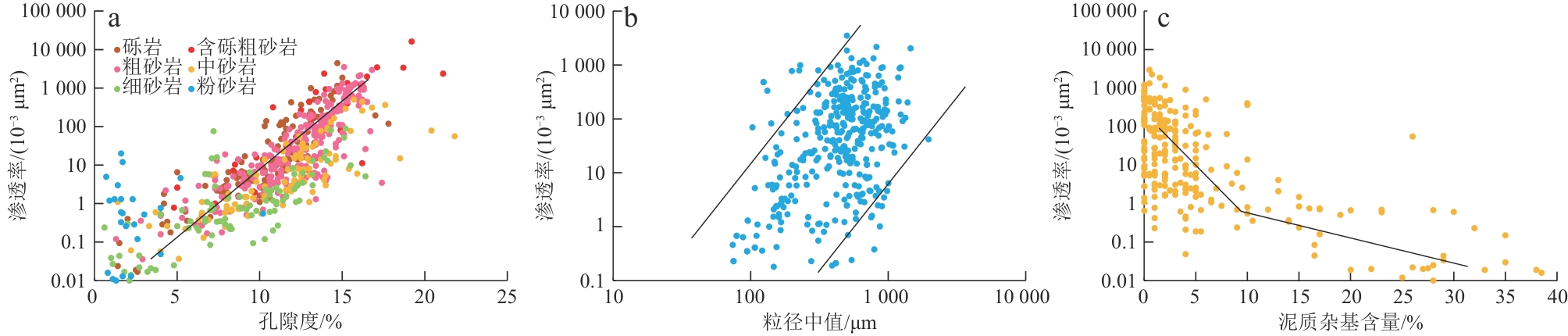
表1
环崖南地区不同构造带成岩作用对储层物性的影响"
| 构造区带 | 崖城凸起 | 崖13-1低凸起 | 崖南低凸起 |
|---|---|---|---|
| 岩性 | 中砂岩 | 粗砂岩 | 含砾中-粗砂岩 |
| 分选系数 | 1.65 | 1.45 | 2.07 |
| 初始孔隙度/% | 34.8 | 36.7 | 31.9 |
| 压实作用损失孔隙度/% | 21.0 | 27.7 | 23.6 |
| 胶结作用损失孔隙度/% | 3.0 | 5.1 | 7.3 |
| 溶蚀作用增加孔隙度/% | 10.2 | 9.0 | 14.3 |
| 分析孔隙度/% | 21.0 | 12.9 | 15.3 |
| 实测孔隙度/% | 22.3 | 13.7 | 16.9 |
| 误差/% | 1.3 | 0.8 | 1.6 |

图12
碎屑岩储层埋藏过程与孔隙演化对应关系(据文献[54-55,60-61]修改)(ti 为地层经历的埋藏时间, Ma;Zi 为埋藏深度,km;Si 为埋藏史曲线与时间轴围成的封闭区面积。)"


图13
环崖南地区崖南低凸起流体超压强度特征"
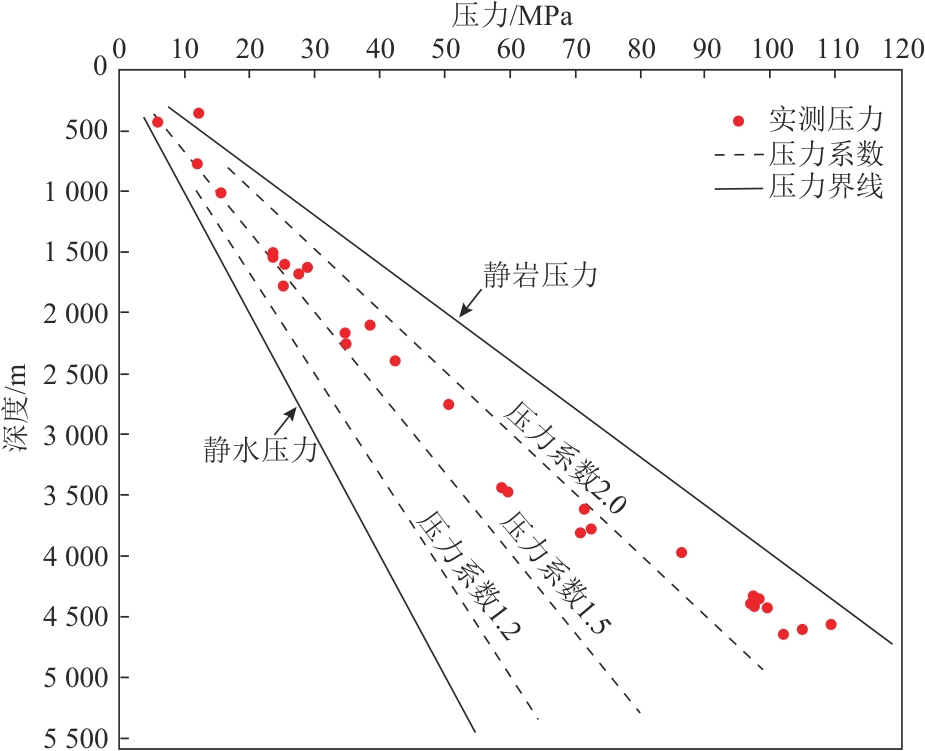

图14
环崖南地区储层深度与物性(a,b)、Ro(c)、温-压条件(d,e)及地层水矿化度(f)相关性"

| 1 | 马永生, 黎茂稳, 蔡勋育, 等. 中国海相深层油气富集机理与勘探开发: 研究现状、关键技术瓶颈与基础科学问题[J]. 石油与天然气地质, 2020, 41(4): 655-672, 683. |
| MA Yongsheng, LI Maowen, CAI Xunyu, et al. Mechanisms and exploitation of deep marine petroleum accumulations in China: Advances, technological bottlenecks and basic scientific problems[J]. Oil & Gas Geology, 2020, 41(4): 655-672, 683. | |
| 2 | 操应长, 远光辉, 杨海军, 等. 含油气盆地深层—超深层碎屑岩油气勘探现状与优质储层成因研究进展[J]. 石油学报, 2022, 43(1): 112-140. |
| CAO Yingchang, YUAN Guanghui, YANG Haijun, et al. Current situation of oil and gas exploration and research progress of the origin of high-quality reservoirs in deep-ultra-deep clastic reservoirs of petroliferous basins[J]. Acta Petrolei Sinica, 2022, 43(1): 112-140. | |
| 3 | 谢玉洪, 袁全社. 中国近海深水深层油气地球物理勘探实践与展望[J]. 石油物探, 2023, 62(2): 183-193. |
| XIE Yuhong, YUAN Quanshe. Practice and prospects of deep-water and deep-formation geophysical exploration[J]. Geophysical Prospecting for Petroleum, 2023, 62(2): 183-193. | |
| 4 | PANG Xiongqi, JIA Chengzao, ZHANG Kun, et al. The dead line for oil and gas and implication for fossil resource prediction[J]. Earth System Science Data, 2020, 12(1): 577-590. |
| 5 | DUTTON S P, LOUCKS R G. Diagenetic controls on evolution of porosity and permeability in lower Tertiary Wilcox sandstones from shallow to ultradeep (200~6 700 m) burial, Gulf of Mexico Basin, U.S.A.[J]. Marine and Petroleum Geology, 2010, 27(1): 69-81. |
| 6 | 蒲秀刚, 周立宏, 王文革, 等. 黄骅坳陷歧口凹陷斜坡区中深层碎屑岩储集层特征[J]. 石油勘探与开发, 2013, 40(1): 36-48. |
| PU Xiugang, ZHOU Lihong, WANG Wenge, et al. Medium-deep clastic reservoirs in the slope area of Qikou Sag, Huanghua depression, Bohai Bay Basin[J]. Petroleum Exploration and Development, 2013, 40(1): 36-48. | |
| 7 | 王恩泽, 刘国勇, 庞雄奇, 等. 南堡凹陷中深层碎屑岩储集层成岩演化特征及成因机制[J]. 石油勘探与开发, 2020, 47(2): 321-333. |
| WANG Enze, LIU Guoyong, PANG Xiongqi, et al. Diagenetic evolution and formation mechanisms of middle to deep clastic reservoirs in the Nanpu Sag, Bohai Bay Basin, East China[J]. Petroleum Exploration and Development, 2020, 47(2): 321-333. | |
| 8 | 罗晓容, 杨海军, 王震亮, 等. 深层—超深层碎屑岩储层非均质性特征与油气成藏模式[J]. 地质学报, 2023, 97(9): 2802-2819. |
| LUO Xiaorong, YANG Haijun, WANG Zhenliang, et al. Heterogeneity characteristics of clastic reservoirs and hydrocarbon accumulation mode in deep-ultradeep basins[J]. Acta Geologica Sinica, 2023, 97(9): 2802-2819. | |
| 9 | ZOU Caineng, TAO Shizhen, ZHANG Xiangxiang, et al. Geologic characteristics, controlling factors and hydrocarbon accumulation mechanisms of China’s Large Gas Provinces of low porosity and permeability[J]. Science in China Series D: Earth Sciences, 2009, 52(8): 1068-1090. |
| 10 | MORAD S, AL-RAMADAN K, KETZER J M, et al. The impact of diagenesis on the heterogeneity of sandstone reservoirs: A review of the role of depositional facies and sequence stratigraphy[J]. AAPG Bulletin, 2010, 94(8): 1267-1309. |
| 11 | 曹江骏, 王继平, 张道锋, 等. 深层致密砂岩储层成岩演化对含气性的影响——以鄂尔多斯盆地西南部庆阳气田二叠系山1段为例[J]. 石油与天然气地质, 2024, 45(1): 169-184. |
| CAO Jiangjun, WANG Jiping, ZHANG Daofeng, et al. Effects of diagenetic evolution on gas-bearing properties of deep tight sandstone reservoirs: A case study of reservoirs in the 1st member of the Permian Shanxi Formation in the Qingyang gas field, southwestern Ordos Basin[J]. Oil & Gas Geology, 2024, 45(1): 169-184. | |
| 12 | 李易隆, 贾爱林, 何东博. 致密砂岩有效储层形成的控制因素[J]. 石油学报, 2013, 34(1): 71-82. |
| LI Yilong, JIA Ailin, HE Dongbo. Control factors on the formation of effective reservoirs in tight sands: examples from Guang’an and Sulige gasfields[J]. Acta Petrolei Sinica, 2013, 34(1): 71-82. | |
| 13 | 潘荣, 朱筱敏, 王星星, 等. 深层有效碎屑岩储层形成机理研究进展[J]. 岩性油气藏, 2014, 26(4): 73-80. |
| PAN Rong, ZHU Xiaomin, WANG Xingxing, et al. Advancement on formation mechanism of deep effective clastic reservoir[J]. Lithologic Reservoirs, 2014, 26(4): 73-80. | |
| 14 | QI Yukai, LUO Xiaorong, WANG Yi, et al. Mechanical study of the effect of fractional-wettability on multiphase fluid flow[J]. International Journal of Multiphase Flow, 2017, 93: 205-212. |
| 15 | 曾庆鲁, 莫涛, 赵继龙, 等. 7000m以深优质砂岩储层的特征、成因机制及油气勘探意义——以库车坳陷下白垩统巴什基奇克组为例[J]. 天然气工业, 2020, 40(1): 38-47. |
| ZENG Qinglu, MO Tao, ZHAO Jilong, et al. Characteristics, genetic mechanism and oil & gas exploration significance of high-quality sandstone reservoirs deeper than 7000m: A case study of the Bashijiqike Formation of Lower Cretaceous in the Kuqa Depression[J]. Natural Gas Industry, 2020, 40(1): 38-47. | |
| 16 | WILKINSON M, DARBY D, HASZELDINE R S, et al. Secondary porosity generation during deep burial associated with overpressure leak-off: Fulmar formation, united kingdom central graben[J]. AAPG Bulletin, 1997, 81(5): 803-813. |
| 17 | 张凤奇, 鲁雪松, 卓勤功, 等. 准噶尔盆地南缘下组合储层异常高压成因机制及演化特征[J]. 石油与天然气地质, 2020, 41(5): 1004-1016. |
| ZHANG Fengqi, LU Xuesong, ZHUO Qingong, et al. Genetic mechanism and evolution characteristics of overpressure in the lower play at the southern margin of the Junggar Basin, northwestern China[J]. Oil & Gas Geology, 2020, 41(5): 1004-1016. | |
| 18 | 苏奥, 杜江民, 陈红汉, 等. 控制异常孔隙带发育的成岩流体类型与活动历史——以琼东南盆地东部宝岛北缘储层为例[J]. 天然气地球科学, 2016, 27(10): 1837-1847. |
| SU Ao, DU Jiangmin, CHEN Honghan, et al. Diagenetic fluid type and activity history of controlling the development of abnormal pore zone: Taking the North margin of Baodao Sag, Qiongdongnan Basin as an example[J]. Natural Gas Geoscience, 2016, 27(10): 1837-1847. | |
| 19 | 曹斌风, 孙卫. 吴旗地区薛岔区块延长组长6砂岩储层成岩作用研究[J]. 天然气地球科学, 2011, 22(6): 951-960. |
| CAO Binfeng, SUN Wei. Diagenesis of Chang 6 reservoir in Xuecha block of Wuqi area[J]. Natural Gas Geoscience, 2011, 22(6): 951-960. | |
| 20 | 朱伟林, 吴景富, 张功成, 等. 中国近海新生代盆地构造差异性演化及油气勘探方向[J]. 地学前缘, 2015, 22(1): 88-101. |
| ZHU Weilin, WU Jingfu, ZHANG Gongcheng, et al. Discrepancy tectonic evolution and petroleum exploration in China offshore Cenozoic basins[J]. Earth Science Frontiers, 2015, 22(1): 88-101. | |
| 21 | 何家雄, 夏斌, 施小斌, 等. 世界深水油气勘探进展与南海深水油气勘探前景[J]. 天然气地球科学, 2006, 17(6): 747-752, 806. |
| HE Jiaxiong, XIA Bin, SHI Xiaobin, et al. Prospect and progress for oil and gas in deep waters of the world, and the potential and prospect foreground for oil and gas in deep waters of the South China Sea[J]. Natural Gas Geoscience, 2006, 17(6): 747-752, 806. | |
| 22 | 何家雄, 夏斌, 张启明, 等. 南海北部边缘盆地生物气和亚生物气资源潜力与勘探前景分析[J]. 天然气地球科学, 2005, 16(2): 167-174. |
| HE Jiaxiong, XIA Bin, ZHANG Qiming, et al. Resources base and exploration potential of biogenic and sub-biogenic gas in marginal basin of the northern South China Sea[J]. Natural Gas Geoscience, 2005, 16(2): 167-174. | |
| 23 | 杨宏宇, 胡明毅, 蔡全升, 等. 琼东南盆地乐东北坡梅山组海底扇沉积特征及沉积模式[J]. 石油与天然气地质, 2025, 46(2): 550-566. |
| YANG Hongyu, HU Mingyi, CAI Quansheng, et al. Sedimentary characteristics and models of submarine fans in the Meishan Formation on the north slope of the Ledong Sag, Qiongdongnan Basin[J]. Oil & Gas Geology, 2025, 46(2): 550-566. | |
| 24 | 苏奥, 陈红汉, 贺聪, 等. 控制储层中异常高孔带发育的成岩作用——以琼东南盆地西部崖城区为例[J]. 中国矿业大学学报, 2017, 46(2): 345-355. |
| SU Ao, CHEN Honghan, HE Cong, et al. Digenesis controlling development of abnormal high porosity zones: A case from Yacheng area in the western Qiongdongnan Basin, South China Sea[J]. Journal of China University of Mining & Technology, 2017, 46(2): 345-355. | |
| 25 | 吴克强, 解习农, 裴健翔, 等. 超伸展陆缘盆地深部结构及油气勘探意义——以琼东南盆地为例[J]. 石油与天然气地质, 2023, 44(3): 651-661. |
| WU Keqiang, XIE Xinong, PEI Jianxiang, et al. Deep architecture of hyperextended marginal basin and implications for hydrocarbon exploration: A case study of Qiongdongnan Basin[J]. Oil & Gas Geology, 2023, 44(3): 651-661. | |
| 26 | 李胜利, 于兴河, 姜平, 等. 琼东南盆地崖13-1气田陵三段沉积微相对储层非均质性及流动单元划分的影响[J]. 地学前缘, 2010, 17(4): 160-166. |
| LI Shengli, YU Xinghe, JIANG Ping, et al. The influence of depositional facies on reservoir heterogeneities and flowing zone division in the 3rd member of Lingshui Formation of Ya13-1 Gas Field in QDN Basin[J]. Earth Science Frontiers, 2010, 17(4): 160-166. | |
| 27 | 龚再升. 中国近海含油气盆地新构造运动与油气成藏[J]. 地球科学, 2004, 29(5): 513-517. |
| GONG Zaisheng. Neotectonics and petroleum accumulation in offshore Chinese basins[J]. Earth Science, 2004, 29(5): 513-517. | |
| 28 | 张远泽, 漆家福, 吴景富. 南海北部新生代盆地断裂系统及构造动力学影响因素[J]. 地球科学, 2019, 44(2): 603-625. |
| ZHANG Yuanze, QI Jiafu, WU Jingfu. Cenozoic faults systems and its geodynamics of the continental margin basins in the northern of South China Sea[J]. Earth Science, 2019, 44(2): 603-625. | |
| 29 | 徐长贵, 邓勇, 吴克强, 等. 南海北部强活动型被动陆缘盆地宝岛21-1大气田的发现及地质意义[J]. 石油学报, 2023, 44(5): 713-729. |
| XU Changgui, DENG Yong, WU Keqiang, et al. Discovery and geological significance of the large gas field Baodao 21-1 in a passive epicontinental basin with strong activity in the northern South China Sea[J]. Acta Petrolei Sinica, 2023, 44(5): 713-729. | |
| 30 | 李三忠, 索艳慧, 周洁, 等. 华南洋陆过渡带构造演化: 特提斯构造域向太平洋构造域的转换过程与机制[J]. 地质力学学报, 2022, 28(5): 683-704. |
| LI Sanzhong, SUO Yanhui, ZHOU Jie, et al. Tectonic evolution of the South China Ocean-Continent Connection Zone: Transition and mechanism of the Tethyan to the Pacific tectonic domains[J]. Journal of Geomechanics, 2022, 28(5): 683-704. | |
| 31 | XIE Xinong, MÜLLER R D, LI Sitian, et al. Origin of anomalous subsidence along the Northern South China Sea margin and its relationship to dynamic topography[J]. Marine and Petroleum Geology, 2006, 23(7): 745-765. |
| 32 | 孙国强, 谢梅, 张永庶, 等. 柴北缘马北地区下干柴沟组下段沉积特征及演化[J]. 岩性油气藏, 2011, 23(6): 56-61. |
| SUN Guoqiang, XIE Mei, ZHANG Yongshu, et al. Sedimentary characteristics and evolution of Paleogene Lower Xiaganchaigou Formation in northern Mahai area, northern margin of Qaidam Basin[J]. Lithologic Reservoirs, 2011, 23(6): 56-61. | |
| 33 | 袁静, 杜玉民, 李云南. 惠民凹陷古近系碎屑岩主要沉积环境粒度概率累积曲线特征[J]. 石油勘探与开发, 2003, 30(3): 103-106. |
| YUAN Jing, DU Yumin, LI Yunnan. Probability cumulative grain size curves in terrigenous depositional environments of the Paleogene in Huimin Sag[J]. Petroleum Exploration and Development, 2003, 30(3): 103-106. | |
| 34 | 蔡全升, 胡明毅, 胡忠贵, 等. 东海盆地西湖凹陷中央隆起带古近系花港组储层特征及成岩孔隙演化[J]. 天然气地球科学, 2013, 24(4): 733-740. |
| CAI Quansheng, HU Mingyi, HU Zhonggui, et al. Reservoir characteristics and evolution of diagenetic porosity of Huagang Formation of Paleogene in the central anticlinal belt of Xihu Sag, Donghai Basin[J]. Natural Gas Geoscience, 2013, 24(4): 733-740. | |
| 35 | BLOCH S, LANDER R H, BONNELL L. Anomalously high porosity and permeability in deeply buried sandstone reservoirs: Origin and predictability[J]. AAPG Bulletin, 2002, 86(2): 301-328. |
| 36 | 李汶国, 张晓鹏, 钟玉梅. 长石砂岩次生溶孔的形成机理[J]. 石油与天然气地质, 2005, 26(2): 220-223, 229. |
| LI Wenguo, ZHANG Xiaopeng, ZHONG Yumei. Formation mechanism of secondary dissolved pores in arcose[J]. Oil & Gas Geology, 2005, 26(2): 220-223, 229. | |
| 37 | 张福顺, 朱允辉, 王芙蓉. 准噶尔盆地腹部深埋储层次生孔隙成因机理研究[J]. 沉积学报, 2008, 26(3): 469-478. |
| ZHANG Fushun, ZHU Yunhui, WANG Furong. Forming mechanism of secondary pores in deep buried reservoirs of Junggar Basin[J]. Acta Sedimentologica Sinica, 2008, 26(3): 469-478. | |
| 38 | 苏奥, 陈红汉, 贺聪, 等. 琼东南盆地崖城区泄压带流体活动特征及成岩响应[J]. 石油学报, 2016, 37(10): 1216-1230. |
| SU Ao, CHEN Honghan, HE Cong, et al. The characteristic of fluid activities and diagenetic responses of the pressure discharging zone in Yacheng area, Qiongdongnan Basin, South China Sea[J]. Acta Petrolei Sinica, 2016, 37(10): 1216-1230. | |
| 39 | 中华人民共和国国家经济贸易委员会. 碎屑岩成岩阶段划分: [S]. 北京: 石油工业出版社, 2003. |
| State Economic and Trade Commission of the People’s Republic of China. The division of diagenetic stages in clastic rocks: [S]. Beijing: Petroleum Industry Press, 2003. | |
| 40 | 钟大康, 朱筱敏, 王红军. 中国深层优质碎屑岩储层特征与形成机理分析[J]. 中国科学(D辑:地球科学), 2008, 38(): 11-18. |
| ZHONG Dakang, ZHU Xiaomin, WANG Hongjun. Analysis on reservoir characteristics and formation mechanism of deep high quality clastic rock in China[J]. Science China Earth Sciences, 2008, 38(S1): 11-18. | |
| 41 | 孙靖, 尤新才, 薛晶晶, 等. 准噶尔盆地深层-超深层碎屑岩致密气储层特征及其控制因素[J]. 石油与天然气地质, 2024, 45(4): 1046-1063. |
| SUN Jing, YOU Xincai, XUE Jingjing, et al. Characteristics and controlling factors of deep to ultra-deep tight-gas clastic reservoirs in the Junggar Basin[J]. Oil & Gas Geology, 2024, 45(4): 1046-1063. | |
| 42 | 孙靖, 尤新才, 薛晶晶, 等. 准噶尔盆地异常压力特征及其对深层-超深层致密储层的影响[J]. 石油与天然气地质, 2023, 44(2): 350-365. |
| SUN Jing, YOU Xincai, XUE Jingjing, et al. Characteristics of abnormal pressure and its influence on deep and ultra-deep tight reservoirs in the Junggar Basin[J]. Oil & Gas Geology, 2023, 44(2): 350-365. | |
| 43 | 佟欢, 朱世发, 崔航, 等. 渤海湾盆地桩海地区古近系沙河街组一段-二段混积岩优质储层特征与控制因素[J]. 石油与天然气地质, 2024, 45(4): 1106-1120. |
| TONG Huan, ZHU Shifa, CUI Hang, et al. Characteristics and controlling factors of high-quality reservoirs of mixed siliciclastic-carbonate sediments in the 1st to 2nd members of the Paleogene Shahejie Formation, Zhuanghai area, Bohai Bay Basin[J]. Oil & Gas Geology, 2024, 45(4): 1106-1120. | |
| 44 | 陈思芮, 鲜本忠, 纪友亮, 等. 埋藏过程对深层-超深层碎屑岩成岩作用及优质储层发育的影响——以准噶尔盆地南缘下白垩统清水河组为例[J]. 石油勘探与开发, 2024, 51(2): 323-336. |
| CHEN Sirui, XIAN Benzhong, JI Youliang, et al. Influences of burial process on diagenesis and high-quality reservoir development of deep-ultra-deep clastic rocks: A case study of Lower Cretaceous Qingshuihe Formation in southern margin of Junggar Basin, NW China[J]. Petroleum Exploration and Development, 2024, 51(2): 323-336. | |
| 45 | 孟元林, 李斌, 王志国, 等. 黄骅坳陷中区超压对有机酸生成和溶解作用的抑制[J]. 石油勘探与开发, 2008, 35(1): 40-43. |
| MENG Yuanlin, LI Bin, WANG Zhiguo, et al. Overpressure retardation of organic acid generation and clastic reservoirs dissolution in central Huanghua Depression[J]. Petroleum Exploration and Development, 2008, 35(1): 40-43. | |
| 46 | 叶素娟, 李嵘, 杨克明, 等. 川西坳陷叠覆型致密砂岩气区储层特征及定量预测评价[J]. 石油学报, 2015, 36(12): 1484-1494. |
| YE Sujuan, LI Rong, YANG Keming, et al. Characteristics and quantitative prediction of tight sand gas reservoirs in superimposed tight sandstone gas-bearing area, western Sichuan depression[J]. Acta Petrolei Sinica, 2015, 36(12): 1484-1494. | |
| 47 | 史原鹏, 刘占国, 王少春, 等. 深层—超深层优质碎屑岩储层成因及主控因素——以河套盆地临河坳陷古近系渐新统临河组为例[J]. 石油勘探与开发, 2024, 51(3): 478-489. |
| SHI Yuanpeng, LIU Zhanguo, WANG Shaochun, et al. Genetic mechanism and main controlling factors of high-quality clastic rock reservoirs in deep and ultra-deep layers: A case study of Oligocene Linhe Formation in Linhe Depression, Hetao Basin, NW China[J]. Petroleum Exploration and Development, 2024, 51(3): 478-489. | |
| 48 | 王宏博, 马存飞, 曹铮, 等. 基于岩相的致密砂岩差异成岩作用及其储层物性响应——以准噶尔盆地莫西庄地区下侏罗统三工河组为例[J]. 石油与天然气地质, 2023, 44(4): 976-992. |
| WANG Hongbo, MA Cunfei, CAO Zheng, et al. Differential diagenesis and reservoir physical property responses of tight sandstone based on lithofacies: A case study on the Lower Jurassic Sangonghe Formation in Moxizhuang area, Junggar Basin[J]. Oil & Gas Geology, 2023, 44(4): 976-992. | |
| 49 | SCHERER M. Parameters influencing porosity in sandstones: A model for sandstone porosity prediction[J]. AAPG Bulletin, 1987, 71(5): 485-491. |
| 50 | BEARD D C, WEYL P K. Influence of texture on porosity and permeability of unconsolidated sand[J]. AAPG Bulletin, 1973, 57(2): 349-369. |
| 51 | 王峰, 陈蓉, 田景春, 等. 鄂尔多斯盆地陇东地区长4+5油层组致密砂岩储层成岩作用及成岩相[J]. 石油与天然气地质, 2014, 35(2): 199-206. |
| WANG Feng, CHEN Rong, TIAN Jingchun, et al. Diagenesis and diagenetic facies of the Chang 4+5 tight sandstone reservoirs in Longdong area, Ordos Basin[J]. Oil & Gas Geology, 2014, 35(2): 199-206. | |
| 52 | 刘伟, 窦齐丰, 黄述旺, 等. 成岩作用的定量表征与成岩储集相研究——以科尔沁油田交2断块区九佛堂组(J3jf)下段为例[J]. 中国矿业大学学报, 2002, 31(5): 399-403. |
| LIU Wei, DOU Qifeng, HUANG Shuwang, et al. Quantitative characterization of diagenesis and diagenesis reservoir facies——The case study of lower member of J3jf of Jiao 2 block in Kerqin Oilfield[J]. Journal of China University of Mining & Technology, 2002, 31(5): 399-403. | |
| 53 | 曹江骏, 罗静兰, 马迪娜·马吾提汗, 等. 差异性沉积—成岩演化过程对砂砾岩储层致密化的影响——以准噶尔盆地东部二叠系上乌尔禾组为例[J]. 中国矿业大学学报, 2022, 51(5): 923-940. |
| CAO Jiangjun, LUO Jinglan, MADINA Mawutihan, et al. Influence of differential sedimentary-diagenetic evolution on the densification of the sandy conglomerate reservoir: A case study of the Permian Upper Wuerhe formation in eastern Junggar Basin[J]. Journal of China University of Mining & Technology, 2002, 31(5): 923-940. | |
| 54 | 何小胡, 刘震, 梁全胜, 等. 沉积地层埋藏过程对泥岩压实作用的影响[J]. 地学前缘, 2010, 17(4): 167-173. |
| HE Xiaohu, LIU Zhen, LIANG Quansheng, et al. The influence of burial history on mudstone compaction[J]. Earth Science Frontiers, 2010, 17(4): 167-173. | |
| 55 | 夏鲁, 刘震, 李潍莲, 等. 砂岩压实三元解析减孔模型及其石油地质意义——以鄂尔多斯盆地十里加汗地区二叠系下石盒子组致密砂岩为例[J]. 石油勘探与开发, 2018, 45(2): 275-286. |
| XIA Lu, LIU Zhen, LI Weilian, et al. Ternary analytic porosity-reduction model of sandstone compaction trend and its significance in petroleum geology: A case study of tight sandstones in Permian Lower Shihezi Formation of Shilijiahan area, Ordos Basin, China[J]. Petroleum Exploration and Development, 2018, 45(2): 275-286. | |
| 56 | SATHAR S, JONES S. Fluid overpressure as a control on sandstone reservoir quality in a mechanical compaction dominated setting: Magnolia Field, Gulf of Mexico[J]. Terra Nova, 2016, 28(3): 155-162. |
| 57 | 靳军, 鲜本忠, 连丽霞, 等. 晚期快速埋藏过程中微裂缝对深层不同成岩强度碎屑岩储集层的改造作用——来自准噶尔盆地南缘白垩系清水河组成岩物理模拟的启示[J]. 石油勘探与开发, 2023, 50(2): 309-321. |
| JIN Jun, XIAN Benzhong, LIAN Lixia, et al. Reformation of deep clastic reservoirs with different diagenetic intensities by microfractures during late rapid deep burial: Implications from diagenetic physical simulation of Cretaceous Qingshuihe Formation in the southern margin of Junggar Basin, NW China[J]. Petroleum Exploration and Development, 2023, 50(2): 309-321. | |
| 58 | 刘佳庚, 王艳忠, 操应长, 等. 渤海湾盆地东营凹陷民丰洼陷陡坡带深层-超深层碎屑岩优质储层控制因素[J]. 石油与天然气地质, 2023, 44(5): 1203-1217. |
| LIU Jiageng, WANG Yanzhong, CAO Yingchang, et al. Factors controlling the development of deep and ultra-deep coarse-grained siliciclastic reservoirs with high quality in the steep slope zone of the Minfeng sub-sag, Dongying Sag, Bohai Bay Basin[J]. Oil & Gas Geology, 2023, 44(5): 1203-1217. | |
| 59 | 曾联波, 巩磊, 宿晓岑, 等. 深层-超深层致密储层天然裂缝分布特征及发育规律[J]. 石油与天然气地质, 2024, 45(1): 1-14. |
| ZENG Lianbo, GONG Lei, SU Xiaocen, et al. Natural fractures in deep to ultra-deep tight reservoirs: Distribution and development[J]. Oil & Gas Geology, 2024, 45(1): 1-14. | |
| 60 | 胡宗全, 齐育楷, 张福顺, 等. 超深层碎屑岩有效储层成储机理与油气勘探前景[J]. 地质学报, 2025, 99(2): 631-648. |
| HU Zongquan, QI Yukai, ZHANG Fushun, et al. Formation mechanisms of effective ultra-deep clastic reservoirs and their oil and gas exploration prospects[J]. Acta Geologica Sinica, 2025, 99(2): 631-648. | |
| 61 | 郭华军, 司学强, 袁波, 等. 准噶尔盆地南缘中段超深层相对优质砂岩储层发育特征及主控因素[J]. 海相油气地质, 2022, 27(3): 313-324. |
| GUO Huajun, SI Xueqiang, YUAN Bo, et al. The characteristics and main controlling factors of ultra-deep sandstone reservoir in the middle part of the southern margin of Junggar Basin[J]. Marine Origin Petroleum Geology, 2022, 27(3): 313-324. | |
| 62 | OSBORNE M J, SWARBRICK R E. Diagenesis in North Sea HPHT clastic reservoirs—consequences for porosity and overpressure prediction[J]. Marine and Petroleum Geology, 1999, 16(4): 337-353. |
| 63 | TAYLOR T R, GILES M R, HATHON L A, et al. Sandstone diagenesis and reservoir quality prediction: Models, myths, and reality[J]. AAPG Bulletin, 2010, 94(8): 1093-1132. |
| 64 | COLTEN-BRADLEY V A. Role of pressure in smectite dehydration—effects on geopressure and smectite-to-illite transformation[J]. AAPG Bulletin, 1987, 71(11): 1414-1427. |
| 65 | DUAN Wei, LI Chunfeng, LUO Chengfei, et al. Effect of formation overpressure on the reservoir diagenesis and its petroleum geological significance for the DF11 block of the Yinggehai Basin, the South China Sea[J]. Marine and Petroleum Geology, 2018, 97: 49-65. |
| 66 | KUPECZ J A, GLUYAS J G, BLOCH S. Reservoir quality prediction in sandstones and carbonates[M]. Tulsa: American Association of Petroleum Geologists, 1997: 19-27. |
| [1] | 薛一帆, 赵海涛, 黄亚浩, 文志刚, 刘宇坤, 张银涛, 乔占峰, 罗涛. 塔里木盆地深层奥陶系走滑断裂区与非走滑断裂区储层流体超压演化差异特征与成藏机制[J]. 石油与天然气地质, 2025, 46(3): 926-943. |
| [2] | 杨宏宇, 胡明毅, 蔡全升, 陈志宏, 刘为. 琼东南盆地乐东北坡梅山组海底扇沉积特征及沉积模式[J]. 石油与天然气地质, 2025, 46(2): 550-566. |
| [3] | 彭军, 刘芳兰, 张连进, 郑斌嵩, 唐松, 李顺, 梁新玉. 川中龙女寺地区中二叠统茅口组储层特征及其主控因素[J]. 石油与天然气地质, 2024, 45(5): 1337-1354. |
| [4] | 郭原草, 郭建华, 劳海港, 李智宇, 余烨, 陈广, 吴诗情, 黄俨然. 琼东南盆地松南低凸起YA区花岗岩潜山风化壳储层特征及发育控制因素[J]. 石油与天然气地质, 2024, 45(4): 1155-1167. |
| [5] | 周荔青, 江东辉, 杨鹏程, 张如凤, 董鑫, 桑亚迪. 琼东南盆地陵水北坡LS13-2区勘探思路与突破方向[J]. 石油与天然气地质, 2024, 45(3): 673-683. |
| [6] | 丁文龙, 李云涛, 韩俊, 黄诚, 王来源, 孟庆修. 碳酸盐岩储层高精度构造应力场模拟与裂缝多参数分布预测方法及其应用[J]. 石油与天然气地质, 2024, 45(3): 827-851. |
| [7] | 潘辉, 蒋裕强, 朱讯, 邓海波, 宋林珂, 王占磊, 李杪, 周亚东, 冯林杰, 袁永亮, 王猛. 河流相致密砂岩气地质甜点评价[J]. 石油与天然气地质, 2024, 45(2): 471-485. |
| [8] | 付超, 谢玉洪, 赵雨初, 王晖, 苑志旺, 徐伟, 陈国宁. 深水峡谷上游复合浊积砂岩储层类型及其展布规律[J]. 石油与天然气地质, 2024, 45(2): 516-529. |
| [9] | 陈昌, 邱楠生, 高荣锦, 周晓龙, 孙永河, 杨琳琳, 付健. 渤海湾盆地辽河坳陷西部冷家—雷家地区中-深层超压成因及其对油气成藏的影响[J]. 石油与天然气地质, 2024, 45(1): 130-141. |
| [10] | 侯读杰, 吴克强, 尤丽, 张自鸣, 李雅君, 熊小峰, 徐敏, 严夏泽, 陈威合, 程熊. 琼东南盆地陆源海相烃源岩有机质富集机理[J]. 石油与天然气地质, 2024, 45(1): 31-43. |
| [11] | 王冠民, 庞小军, 黄晓波, 张雪芳, 潘凯. 渤海海域辽中凹陷南部古近系东营组三段重力流砂岩优质储层特征及成因[J]. 石油与天然气地质, 2024, 45(1): 81-95. |
| [12] | 杨小艺, 刘成林, 王飞龙, 李国雄, 冯德浩, 杨韬政, 何志斌, 苏加佳. 渤海湾盆地渤中凹陷西南洼古近系东营组超压分布特征及成因[J]. 石油与天然气地质, 2024, 45(1): 96-112. |
| [13] | 曾溅辉, 张亚雄, 张在振, 乔俊程, 王茂云, 陈冬霞, 姚泾利, 丁景辰, 熊亮, 刘亚洲, 赵伟波, 任克博. 致密砂岩气藏复杂气-水关系形成和分布主控因素及分布模式[J]. 石油与天然气地质, 2023, 44(5): 1067-1083. |
| [14] | 刘佳庚, 王艳忠, 操应长, 王淑萍, 李雪哲, 王铸坤. 渤海湾盆地东营凹陷民丰洼陷陡坡带深层-超深层碎屑岩优质储层控制因素[J]. 石油与天然气地质, 2023, 44(5): 1203-1217. |
| [15] | 尤丽, 权永彬, 庹雷, 滕长宇, 左高昆. 琼东南盆地深水区宝岛21-1气田天然气来源及输导体系[J]. 石油与天然气地质, 2023, 44(5): 1270-1278. |
| 阅读次数 | ||||||
|
全文 |
|
|||||
|
摘要 |
|
|||||
