

Oil & Gas Geology ›› 2025, Vol. 46 ›› Issue (3): 740-758.doi: 10.11743/ogg20250304
• Petroleum Geology • Previous Articles Next Articles
Anjiang SHEN1,2,3( ), Anping HU1,2,3(), Xiucheng TAN1,2,4, Zhanfeng QIAO1,2,3, Jianfeng ZHENG1,2,3, Liyin PAN1,2,3, Min SHE1,2,3
Received:2025-02-07
Revised:2025-04-21
Online:2025-06-30
Published:2025-06-26
Contact:
Anping HU
E-mail:shenaj_hz@petrochina.com.cn;huap_hz@petrochina.com.cn
CLC Number:
Anjiang SHEN, Anping HU, Xiucheng TAN, Zhanfeng QIAO, Jianfeng ZHENG, Liyin PAN, Min SHE. Geneses of dolomites and dolomite reservoirs: Review, advances, and prospects[J]. Oil & Gas Geology, 2025, 46(3): 740-758.
Add to citation manager EndNote|Reference Manager|ProCite|BibTeX|RefWorks
Table 1
Predominant dolomitization models and their connotations"
| 序号 | 模式名称 | 内涵 | 提出者 |
|---|---|---|---|
| 1 | 渗透回流白云石化 (seepage-reflux dolomitization) | ①蒸发潟湖石膏沉淀导致富Mg2+的重卤水形成; ②重卤水密度大,渗透-回流至海底或障壁导致碳酸盐沉积物被这种富镁重卤水交代白云石化 | Adams和Rhodes(1960) |
| 2 | 毛细管浓缩白云石化 (capillary concentration dolomitization) | 炎热、干旱气候条件下,海水通过毛细管泵汲到强蒸发潮上带蒸发,使潮上带碳酸盐沉积物孔隙中的海水盐度、Mg2+/Ca2+摩尔比和CO32-/Ca2+摩尔比增高,导致碳酸盐沉积物白云石化 | Friedman和Sanders(1967) |
| 3 | 蒸发泵白云石化 (evaporative pumping dolomitization) | ①海水由于萨布哈上面的蒸发泵作用从潟湖一侧被抽吸至潮上带碳酸盐沉积物内蒸发,导致石膏沉淀; ②石膏沉淀导致粒间水Mg2+/Ca2+摩尔比升高,从而导致文石的白云石化 | Mckenzie等(1980) |
| 4 | 库龙白云石化 (coorong model) | 蒸发量超过降雨量的干-湿季节交替气候下,富镁的大陆地下水不断补给海岸带暂时性湖泊并交代碳酸盐沉积物,使其白云石化 | Von der Borch(1975) |
| 5 | 混合水白云石化 (dorag dolomitization) | 通过理论计算,5 % ~ 30 %的海水和70 % ~ 95 %的淡水混合,降低了盐度和Mg2+/Ca2+摩尔比,减少了竞争离子,放慢了结晶速度,更有利于白云石化和规则有序白云石的形成 | Badiozamani(1973) |
| 6 | 海水热对流白云石化 (kohout dolomitization) | 远洋冷水和碳酸盐台地温水密度差导致海水循环,海水流动补偿Mg2+带走Ca2+,导致台缘碳酸盐沉积物白云石化 | Kohout等(1977) |
| 7 | 调整白云石化 (adjustment dolomitization) | 在大气淡水淋滤作用下,碳酸盐沉积物或岩石中的富镁成分发生调整,使沉积物或岩石某些部分发生白云石化 | Hardie等(1987) |
| 8 | 埋藏-压实白云石化 (burial dolomitization) | 埋藏高温条件下,泥岩压实脱水,镁离子析出并运移至石灰岩地层中,导致地层水Mg2+/Ca2+摩尔比增大,地层水中的Mg2+替换灰岩中的Ca2+,导致石灰岩白云石化 | Mattes和Monntjoy(1980) |
| 9 | 断裂控制的热液白云石化 (fault-controlled hydrothermal dolomitization) | 地幔深部热液流体沿着深部断裂运移至中-浅层灰岩中,由于灰岩上部致密隔挡层的阻隔,热液流体发生侧向运移,使灰岩发生白云石化或沿断裂、不整合面及相关的溶蚀孔洞中直接沉淀白云石 | Davies和Smith(2006) |
| 10 | 微生物诱导白云石化 (microbial-mediated dolomitization) | 在特殊类型的微生物(如硫酸盐还原菌、嗜盐古菌和产甲烷菌等)、特定的盐度(100 ‰ ~ 200 ‰)和碱度、特定的温度(30 ~ 50 ℃)以及低SO42-、高CO32-和高Mg2+浓度等条件可以诱导原白云石沉淀 | Vasconcelos等(1995) |

Fig.1
Schematic diagrams showing the predominant dolomitization models"

Table 2
Genetic types and geological characteristics of dolomites (dolostones)"
| 成岩阶段 | 成岩流体 | 白云石化 形式 | 白云石化 模式 | 白云石化机理 | 白云岩(白云石)地质特征 | ||
|---|---|---|---|---|---|---|---|
| 产状 | 有序度 | 矿物学 | |||||
| 准同生阶段 | 蒸发海水、海水、大气淡水和混合水等 | 低温有机沉淀白云石 | 微生物诱导白云石沉淀 | 特殊类型的细菌(如嗜盐古菌)+高盐度 | 层状-准层状 | 低 | 纹层状、叠层状微生物白云岩,由泥晶白云石构成 |
| 低温交代 白云石 | 渗透回流、毛细管浓缩、蒸发泵、库龙、混合水、海水热对流和调整白云石化 | 流体中Mg2+交代先期沉淀的方解石(灰岩)中的Ca2+,使灰岩发生白云石化 | 层状-准层状 | 低 | (含膏盐)泥晶白云岩、保留或残留原岩颗粒结构白云岩,颗粒由泥-粉晶白云石构成 | ||
| 埋藏阶段 | 地层水和深部地幔热液等 | 高温交代 白云石 | 埋藏-压实白云石化和断裂控制的热液白云石化 | 地层水或深部地幔热液中Mg2+交代方解石(灰岩)中的Ca2+,使灰岩发生白云石化 | 斑块状 | 中 | 晶粒(细晶及以上)白云岩,不保留或残留原岩结构,原岩为灰岩 |
| 高温无机沉淀白云石 | 断裂控制的热液白云石化 | 从富Mg2+的地层水或深部地幔热液中直接沉淀白云石 | 充填状 | 中-高 | 晶粒(细晶及以上)白云石,鞍状白云石常见,围岩为灰岩或白云岩 | ||
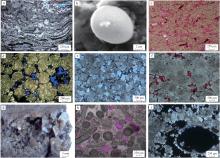
Fig.2
Micrographs showing the petro-mineralogical characteristics of dolomites of varying geneses"

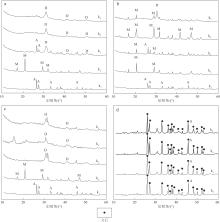
Fig.3
X-ray diffraction patterns of protodolomite precipitates mediated by Natrinema sp. with varying species and at diverse cell concentrations (OD600)[37]"

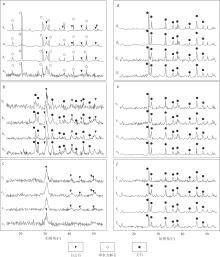
Fig.4
X-ray diffraction patterns of protodolomite precipitates mediated by Natrinema at varying cell concentrations (OD600) and salinities[37]"

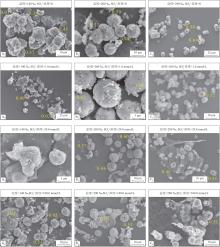
Fig.5
Characteristics of protodolomites precipitated under the mediation of Natrinema (SEM)[37]"

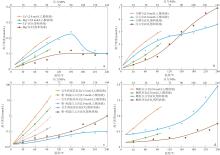
Fig.6
Simulation experimental results on major factors influencing the dissolution rates of carbonate minerals"

Table 3
Geological and geochemical characteristics of dolomites of varying geneses"
| 结构组分 | 地质特征和产状 | 地球化学特征 | 均一温度/团簇同位素(Δ47)温度 | U-Pb同位素年龄 | ||||
|---|---|---|---|---|---|---|---|---|
| 有序度 | 碳/氧同位素 | 锶同位素 (87Sr/86Sr) | 微量和稀土元素 | |||||
| 低温有机沉淀 白云石 | 微生物白云岩,层状-准层状,保留原岩结构 | < 0.4,低有序度 | δ18O(PDB): -5 ‰ ~ 0, 低负值; δ13C(PDB): -4 ‰ ~ -1 ‰, 低负值 | < 0.709 0, 低87Sr/86Sr 比值 | — | 地表低温(< 50 ℃) | 近似于白云石沉淀年龄 | |
| 低温交代白云石 | 颗粒白云岩、膏(盐)云岩,层状-准层状,保留原岩结构 | 0.4 ~ 0.6,中-低有序度 | δ18O(PDB): -8 ‰ ~ -5 ‰, 中-低负值; δ13C(PDB): -5‰ ~ 0,低负值 | 0.710 5 ~ 0.708 0,中-低87Sr/86Sr 比值 | — | 地表低温(< 50 ℃) | 与地层年龄相当,近似于白云石化年龄 | |
| 高温 交代 白云石 | 灰岩 白云石 化型 白云石 | 细晶—粗晶他形-半自形晶,斑块状产出,包裹体少见 | 0.5 ~ 0.8,中有序度 | δ18O(PDB): -8 ‰~ -4 ‰, 中-低负值; δ13C(PDB): -1 ‰~3 ‰, 低负-低正值 | 0.710 0 ~ 0.708 5,中-低87Sr/86Sr 比值 | 微量元素:低Mg/Ca元素含量比值、低Mn/Fe元素含量比值; 稀土元素总量:低ΣREE; 稀土元素配分模式: LREE, MREE和HREE型; 稀土元素异常:Eu正异常 | 包裹体少见,Δ47温度高,但不代表白云石形成温度 | 介于地层年龄和白云石化年龄之间,晶粒越粗越自形,越接近白云石化年龄 |
| 白云岩 继承型 白云石 | 细晶—粗晶半自形-自形晶,准层状-斑块状产出,包裹体少见 | > 0.8,高有序度 | δ18O(PDB):-10 ‰ ~ -8 ‰,中负值; δ13C(PDB):-3 ‰ ~ -1 ‰, 低负值 | 0.710 0 ~ 0.711 0,中-高87Sr/86Sr 比值 | 微量元素:高Mg/Ca元素含量比值、高Mn/Fe元素含量比值; 稀土元素总量: 高ΣREE; 稀土元素配分模式: LREE, MREE和HREE型; 稀土元素异常: Ce正异常 | 包裹体少见,Δ47温度低,但不代表白云石形成温度 | ||
| 高温无机沉淀 白云石 | 细晶—巨晶自形晶,充填于孔-洞-缝中,富含包裹体 | > 0.8,高有序度 | δ18O(PDB):-20 ‰ ~ -10 ‰,高负值; δ13C(PDB):-2 ‰ ~ 2 ‰,低负-低正值 | 0.710 5 ~0.712 0, 高87Sr/86Sr 比值 | — | 中-高温多期包裹体温度(> 80℃),代表白云石形成温度 | 代表白云石沉淀的年龄,多期,比围岩年轻 | |
Table 4
Conditions and results of simulation experiments on major factors controlling the dissolution rates of carbonate minerals and on the dissolution patterns of the minerals"
| 序号 | 模拟实验名称 | 样品特征 | 实验条件 | 实验结果 | |
|---|---|---|---|---|---|
| 中-浅层(压力 < 70 MPa、 温度 < 120 ℃) | 深-特深层 (压力 > 70 MPa、 温度 > 120 ℃) | ||||
| 1 | 碳酸盐矿物类型对溶解速率影响模拟实验 | 孔隙型白云岩和孔隙型灰岩柱塞样,孔隙度和渗透率分别为6.78 %和5.56 %以及1.43 × 10⁻³ μm2和1.27 × 10⁻³ μm2 | 浓度2 mol/L乙酸溶液和CO2饱和溶液,岩石内部溶蚀,开放-流动体系,流速1 mL/min | 乙酸对方解石溶解速率远大于白云石,随温-压增加,方解石和白云石溶蚀能力均呈上升趋势 | 随温-压增加,CO2饱和溶液对白云石的溶解速率迅速增大,并明显大于方解石 |
| 2 | 流体类型和浓度对碳酸盐矿物溶解速率影响模拟实验 | 孔隙型白云岩和孔隙型灰岩柱塞样,孔隙度和渗透率分别为6.78 %和5.56 %以及 1.43 × 10⁻³ μm2和1.27 × 10⁻³ μm2 | 浓度2 mol/L乙酸溶液、3.5 mol/L乙酸溶液和CO2饱和溶液,岩石内部溶蚀,内部溶蚀,开放-流动体系,流速1 mL/min | 随温-压增加,碳酸盐矿物的溶蚀速率增加,乙酸对碳酸盐矿的溶解速率大于CO2饱和溶液,乙酸流体浓度越高溶解速率越大 | 随温-压增加,CO2饱和溶液对白云石的溶解速率迅速增大,并明显大于方解石 |
| 3 | 岩性和物性对碳酸盐矿物溶解速率影响模拟实验 | 白云岩和灰岩柱塞样,孔隙度和渗透率分别为19.80 %和4.40 %以及1.70 × 10⁻³ μm2和3.60 × 10⁻³ μm2 | 浓度2 mol/L乙酸溶液和CO2饱和溶液,岩石内部溶蚀,开放-流动体系,流速1 mL/min | 随温-压增加,乙酸溶液和CO2饱和溶液对白云岩的溶解量(离子浓度)大于灰岩 | 随温-压增加,CO2饱和溶液对白云岩溶解量(离子浓度)大于灰岩 |
Table 5
Diagenetic pathways of dolomitization and the assessment of their reservoir-forming effects"
| 白云石化路径 | 白云岩特征与成因 | 白云岩储层特征与成因 | 储层评价 |
|---|---|---|---|
| 白云岩保持型 | 原岩为礁(丘)滩灰岩和蒸发潟湖周缘含膏(盐)的泥晶灰岩,经历准同生期白云石化,保留原岩结构 | 原生孔和早表生期组构选择性溶孔,是对原岩孔隙的继承,早期白云石化有利于孔隙的保存 | Ⅰ类 |
| 白云岩叠加改造型 | 准同生期白云石化形成的白云岩经历埋藏-热液交代白云石化叠加改造,形成晶粒白云岩,残留部分原岩结构 | 原生孔和早表生期组构选择性溶孔,是对原岩孔隙的继承,早期白云石化有利于孔隙的保存,埋藏交代白云石化是孔隙的调整过程,对孔隙增减的意义不大,但进一步提升了孔隙保持能力 | Ⅰ-Ⅱ类 |
| 灰岩埋藏白云石化型 | 埋藏环境灰岩白云石化,埋藏交代白云石化的产物,中-粗晶和粗晶白云岩为主,残留部分原岩结构 | 埋藏交代白云石化前,灰岩发生了强烈的压实-压溶作用,压实减孔和压溶产物对邻近孔隙的充填使初始孔隙几乎消失殆尽,少量的原生孔隙被继承 | Ⅲ-Ⅳ类 |
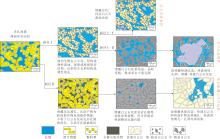
Fig.7
Schematic diagram showing the diagenetic pathways of dolomitization and their reservoir-forming effects[13-14]"

| 1 | WARREN J. Dolomite: Occurrence, evolution and economically important associations[J]. Earth-Science Reviews, 2000, 52(1/3): 1-81. |
| 2 | LAND L S. Failure to precipitate dolomite at 25°C from dilute solution despite 1000-fold oversaturation after 32 years[J]. Aquatic Geochemistry, 1998, 4(3): 361-368. |
| 3 | ADAMS J E, RHODES M L. Dolomitization by seepage refluxion[J]. AAPG Bulletin, 1960, 44(12): 1912-1920. |
| 4 | FRIEDMAN G M, SANDERS J E. Origin and occurrence of dolostones[M]//CHILINGAR G V, BISSELL H J, FAIRBRIDGE R W. Developments in Sedimentology: Volume 9, Part A: Carbonate Rocks Origin, Occurrence and Classification. Amsterdam: Elsevier, 1967: 267-348. |
| 5 | MCKENZIE J A, HSÜ K J, SCHNEIDER J F. Movement of subsurface waters under the Sabkha, Abu Dhabi, UAE, and its relation to evaporative dolomite genesis[M]//ZENGER D H, DUNHAM J B, ETHINGTON R L. Concepts and Models of Dolomitization. Broken Arrow, OK: SEPM Society for Sedimentary Geology, 1980: 11-30. |
| 6 | VON DER BORCH C C, LOCK D E, SCHWEBEL D. Ground-water formation of dolomite in the Coorong region of South Australia[J]. Geology, 1975, 3(5): 283-285. |
| 7 | BADIOZAMANI K. The Dorag dolomitization model, application to the middle Ordovician of Wisconsin[J]. Journal of Sedimentary Petrology, 1973, 43(4): 965-984. |
| 8 | KOHOUT E A, HENRY H R, BANKS J E. Hydrogeology related to geothermal conditions of the Floridan Plateau[M]//SMRFH K L, GRIFFIN G M. The Geothermal Nature of the Floridan Plateau. [S.l.]: Florida Department of Natural Resources Bureau, Geology Special Publications, 1977: 1-34. |
| 9 | HARDIE L A. Dolomitization; a critical view of some current views[J]. Journal of Sedimentary Petrology, 1987, 57(1): 166-183. |
| 10 | MATTES B W, MOUNTJOY E W. Burial dolomitization of the Upper Devonian Miette buildup, Jasper National Park, Alberta[M]//ZENGER D H, DUNHAM J B, ETHINGTON R L. Concepts and Models of Dolomitization. Broken Arrow, OK: SEPM Society for Sedimentary Geology, 1980: 259-297. |
| 11 | DAVIES G R, SMITH L B, Jr. Structurally controlled hydrothermal dolomite reservoir facies: An overview[J]. AAPG Bulletin, 2006, 90(11): 1641-1690. |
| 12 | VASCONCELOS C, MCKENZIE J A, BERNASCONI S, et al. Microbial mediation as a possible mechanism for natural dolomite formation at low temperatures[J]. Nature, 1995, 377(6546): 220-222. |
| 13 | 赵文智, 沈安江, 乔占峰, 等. 白云岩成因类型、识别特征及储集空间成因[J]. 石油勘探与开发, 2018, 45(6): 923-935. |
| ZHAO Wenzhi, SHEN Anjiang, QIAO Zhanfeng, et al. Genetic types and distinguished characteristics of dolomite and the origin of dolomite reservoirs[J]. Petroleum Exploration and Development, 2018, 45(6): 923-935. | |
| 14 | 沈安江, 罗宪婴, 胡安平, 等. 从准同生到埋藏环境的白云石化路径及其成储效应[J]. 石油勘探与开发, 2022, 49(4): 637-647. |
| SHEN Anjiang, LUO Xianying, HU Anping, et al. Dolomitization evolution and its effects on hydrocarbon reservoir formation from penecontemporaneous to deep burial environment [J]. Petroleum Exploration and Development, 2022, 49(4): 637-647. | |
| 15 | VAHRENKAMP V C, SWART P K. Late Cenozoic dolomites of the Bahamas: Metastable analogues for the genesis of ancient platform dolomites[M]//PURSER B, TUCKER M, ZENGER D. Dolomites: A Volume in Honour of Dolomieu. Oxford: Blackwell Scientific Publications, 1994: 133-153. |
| 16 | FAIRBRIDGE R W. The dolomite question[M]//LE BLANC R J, BREEDING J G. Regional Aspects of Carbonate Deposition. Broken Arrow, OK: SEPM Society for Sedimentary Geology, 1957: 125-178. |
| 17 | MOORE C H. Carbonate diagenesis and porosity[M]. Amsterdam: Elsevier, 1989. |
| 18 | LUCIA F J. Carbonate reservoir characterization[M]. Berlin: Springer, 1999: 226. |
| 19 | 杜金虎, 邹才能, 徐春春, 等. 川中古隆起龙王庙组特大型气田战略发现与理论技术创新[J]. 石油勘探与开发, 2014, 41(3): 268-277. |
| DU Jinhu, ZOU Caineng, XU Chunchun, et al. Theoretical and technical innovations in strategic discovery of a giant gas field in Cambrian Longwangmiao Formation of central Sichuan paleo-uplift, Sichuan Basin[J]. Petroleum Exploration and Development, 2014, 41(3): 268-277. | |
| 20 | 马永生, 蔡勋育, 云露, 等. 塔里木盆地顺北超深层碳酸盐岩油气田勘探开发实践与理论技术进展[J]. 石油勘探与开发, 2022, 49(1): 1-17. |
| MA Yongsheng, CAI Xunyu, YUN Lu, et al. Practice and theoretical and technical progress in exploration and development of Shunbei ultra-deep carbonate oil and gas field, Tarim Basin, NW China[J]. Petroleum Exploration and Development, 2022, 49(1): 1-17. | |
| 21 | 杨雨, 姜鹏飞, 张本健, 等. 龙门山山前复杂构造带双鱼石构造栖霞组超深层整装大气田的形成[J]. 天然气工业, 2022, 42(3): 1-11. |
| YANG Yu, JIANG Pengfei, ZHANG Benjian, et al. Formation of ultra-deep integrated giant gas field in Qixia Formation of Shuangyushi structure in the foothill complex structural belt of Longmen Mountain[J]. Natural Gas Industry, 2022, 42(3): 1-11. | |
| 22 | 韩剑发, 王彭, 朱光有, 等. 塔里木盆地超深层千吨井油气地质与高效区分布规律[J]. 天然气地球科学, 2023, 34(5): 735-748. |
| HAN Jianfa, WANG Peng, ZHU Guangyou, et al. Petroleum geology and distribution law of high efficiency areas in ultra-deep kiloton wells in Tarim Basin[J]. Natural Gas Geoscience, 2023, 34(5): 735-748. | |
| 23 | 沈安江, 赵文智, 胡安平, 等. 海相碳酸盐岩储集层发育主控因素[J]. 石油勘探与开发, 2015, 42(5): 545-554. |
| SHEN Anjiang, ZHAO Wenzhi, HU Anping, et al. Major factors controlling the development of marine carbonate reservoirs[J]. Petroleum Exploration and Development, 2015, 42(5): 545-554. | |
| 24 | 王大鹏, 白国平, 徐艳, 等. 全球古生界海相碳酸盐岩大油气田特征及油气分布[J]. 古地理学报, 2016, 18(1): 80-92. |
| WANG Dapeng, BAI Guoping, XU Yan, et al. Characteristics and hydrocarbon distribution of the Paleozoic giant marine carbonate rock oil-gas fields in the world[J]. Journal of Palaeogeography (Chinese Edition), 2016, 18(1): 80-92. | |
| 25 | 余宽宏, 金振奎, 潘怡, 等. 全球显生宇碳酸盐岩储层及油气资源量分布特征[J]. 天然气地球科学, 2012, 23(4): 748-755. |
| YU Kuanhong, JIN Zhenkui, PAN Yi, et al. Phanerozoic carbonate reservoir characteristics and petroleum resource distribution in the world[J]. Natural Gas Geoscience, 2012, 23(4): 748-755. | |
| 26 | WEYL P K. Porosity through dolomitization--Conservation-of-mass requirements[J]. Journal of Sedimentary Petrology, 1960, 30(1): 85-90. |
| 27 | LUCIA F J, MAJOR R P. Porosity evolution through hypersaline reflux dolomitization[M]//PURSER B, TUCKER M, ZENGER D. Dolomites: A Volume in Honour of Dolomieu. Oxford: Blackwell Scientific Publications, 1994: 325-341. |
| 28 | PURSER B H, BROWN A, AISSAOUI D M. Nature, origins and evolution of porosity in dolomites[M]//PURSER B, TUCKER M, ZENGER D. Dolomites: A Volume in Honour of Dolomieu. Oxford: Blackwell Scientific Publications, 1994: 281-308. |
| 29 | MOORE C H, HEYDARI E. Burial diagenesis and hydrocarbon migration in platform limestones: A conceptual model based on the Upper Jurassic of the Gulf Coast of the USA[M]//HORBURY A D, ROBINSON A G. Diagenesis and Basin Development. Tulsa: American Association of Petroleum Geologists, 1993: 213-229. |
| 30 | VAN LITH Y, VASCONCELOS C, WARTHMANN R, et al. Bacterial sulfate reduction and salinity: Two controls on dolomite precipitation in Lagoa Vermelha and Brejo do Espinho (Brazil)[J]. Hydrobiologia, 2002, 485(1): 35-49. |
| 31 | WARTHMANN R, VASCONCELOS C, SASS H, et al. Desulfovibrio brasiliensis sp. nov., a moderate halophilic sulfate-reducing bacterium from Lagoa Vermelha (Brazil) mediating dolomite formation[J]. Extremophiles, 2005, 9(3): 255-261. |
| 32 | BONTOGNALI T R R, VASCONCELOS C, WARTHMANN R J, et al. Dolomite-mediating bacterium isolated from the sabkha of Abu Dhabi (UAE)[J]. Terra Nova, 2012, 24(3): 248-254. |
| 33 | SÁNCHEZ-ROMÁN M, MCKENZIE J A, DE LUCA REBELLO WAGENER A, et al. Presence of sulfate does not inhibit low-temperature dolomite precipitation[J]. Earth and Planetary Science Letters, 2009, 285(1/2): 131-139. |
| 34 | KENWARD P A, FOWLE D A, GOLDSTEIN R H, et al. Ordered low-temperature dolomite mediated by carboxyl-group density of microbial cell walls[J]. AAPG Bulletin, 2013, 97(11): 2113-2125. |
| 35 | ROBERTS J A, BENNETT P C, GONZALEZ L A, et al. Microbial precipitation of dolomite in methanogenic groundwater[J]. Geology, 2004, 32(4): 277-280. |
| 36 | KENWARD P A, GOLDSTEIN R H, GONZÁLEZ L A, et al. Precipitation of low-temperature dolomite from an anaerobic microbial consortium: The role of methanogenic Archaea[J]. Geobiology, 2009, 7(5): 556-565. |
| 37 | 沈安江, 胡安平, 张杰, 等. 微生物碳酸盐岩 “三因素” 控储地质认识和分布规律[J]. 石油与天然气地质, 2022, 43(3): 582-596. |
| SHEN Anjiang, HU Anping, ZHANG Jie, et al. “Three-factor” driven microbial carbonate reservoirs and their distribution[J]. Oil & Gas Geology, 2022, 43(3): 582-596. | |
| 38 | 李茜, 朱光有, 李婷婷, 等. 塔里木盆地鹰山组白云岩成因与Mg同位素证据[J]. 地学前缘, 2023, 30(4): 352-375. |
| LI Xi, ZHU Guangyou, LI Tingting, et al. Genesis of dolostone of the Yingshan Formation in Tarim Basin and Mg isotope evidence[J]. Earth Science Frontiers, 2023, 30(4): 352-375. | |
| 39 | 李茜, 朱光有, 李婷婷, 等. 川中地区寒武系洗象池组白云岩Mg同位素特征与成因机制[J]. 石油学报, 2022, 43(11): 1585-1603. |
| LI Xi, ZHU Guangyou, LI Tingting, et al. Mg isotopic characteristics and genetic mechanism of dolomite of Cambrian Xixiangchi Formation in central Sichuan Basin[J]. Acta Petrolei Sinica, 2022, 43(11): 1585-1603. | |
| 40 | 李茜, 胡安平, 沈安江, 等. 白云岩的成因、储集空间及实验技术研究新进展[J]. 石油与天然气地质, 2024, 45(5): 1456-1482. |
| LI Xi, HU Anping, SHEN Anjiang, et al. Recent advances in the study of the origin and reservoir space of dolomites and emerging experimental techniques[J]. Oil & Gas Geology, 2024, 45(5): 1456-1482. | |
| 41 | 沈安江, 赵文智, 胡安平, 等. 碳酸盐矿物定年和定温技术及其在川中古隆起油气成藏研究中的应用[J]. 石油勘探与开发, 2021, 48(3): 476-487. |
| SHEN Anjiang, ZHAO Wenzhi, HU Anping, et al. The dating and temperature measurement technologies for carbonate minerals and their application in hydrocarbon accumulation research in the paleo-uplift in central Sichuan Basin, SW China[J]. Petroleum Exploration and Development, 2021, 48(3): 476-487. | |
| 42 | 沈安江, 胡安平, 程婷, 等. 激光原位U-Pb同位素定年技术及其在碳酸盐岩成岩-孔隙演化中的应用[J]. 石油勘探与开发, 2019, 46(6): 1062-1074. |
| SHEN Anjiang, HU Anping, CHENG Ting, et al. Laser ablation in situ U-Pb dating and its application to diagenesis-porosity evolution of carbonate reservoirs[J]. Petroleum Exploration and Development, 2019, 46(6): 1062-1074. | |
| 43 | 杨翰轩, 胡安平, 郑剑锋, 等. 面扫描和定年技术在古老碳酸盐岩储集层研究中的应用——以塔里木盆地西北部震旦系奇格布拉克组为例[J]. 石油勘探与开发, 2020, 47(5): 935-946. |
| YANG Hanxuan, HU Anping, ZHENG Jianfeng, et al. Application of mapping and dating techniques in the study of ancient carbonate reservoirs: A case study of Sinian Qigebrak Formation in northwestern Tarim Basin, NW China[J]. Petroleum Exploration and Development, 2020, 47(5): 935-946. | |
| 44 | 陈旭东, 许启鲁, 郝芳, 等. 塔里木盆地塔北地区上震旦统奇格布拉克组白云岩储层形成与成岩演化[J]. 中国科学: 地球科学, 2023, 53(10): 2348-2369. |
| CHEN Xudong, XU Qilu, HAO Fang, et al. Formation and diagenetic evolution of dolomite reservoir of Upper Sinian Qigebulak Formation in Tabei area, Tarim Basin[J]. Science China Earth Sciences, 2023, 53(10): 2348-2369. | |
| 45 | 刘媛媛, 王子晨, 明鑫雨, 等. 震旦系—下寒武统白云岩优势成岩—成储效应——深层白云岩成因及差异成储[J]. 沉积学报, 2024, 42(6): 2159-2173. |
| LIU Yuanyuan, WANG Zichen, MING Xinyu, et al. Profitable diagenetic path and reservoir formation efficiency of the Sinian-Lower Cambrian dolostone: Origins of deep dolomites and differential reservoir formation[J]. Acta Sedimentologica Sinica, 2024, 42(6): 2159-2173. | |
| 46 | 乔占峰, 张天付, 贺训云, 等. 塔里木盆地蓬莱坝组层状白云岩储层发育规律[J]. 地球科学, 2023, 48(2): 673-689. |
| QIAO Zhanfeng, ZHANG Tianfu, HE Xunyun, et al. Development and exploration direction of bedded massive dolomite reservoir of Lower Ordovician Penglaiba Formation in Tarim Basin[J]. Earth Science, 2023, 48(2): 673-689. | |
| 47 | 刘大卫, 李映涛, 韩俊, 等. 塔里木盆地顺北地区奥陶系鹰山组超深层白云岩类型及成储潜力评价[J]. 古地理学报, 2025, 27(1): 126-140. |
| LIU Dawei, LI Yingtao, HAN Jun, et al. Ultra-deep dolomite types and their reservoirs potential of the Ordovician Yingshan Formation in Shunbei area, Tarim Basin[J]. Journal of Palaeogeography (Chinese Edition), 2025, 27(1): 126-140. | |
| 48 | 李茜, 朱光有, 张志遥. 超深层白云岩成因与规模储层控制因素——以四川盆地震旦系灯影组和寒武系龙王庙组为例[J]. 中国科学:地球科学, 2024, 54(7): 2389-2418. |
| LI Xi, ZHU Guangyou, ZHANG Zhiyao. The genesis and controlling factors of ultra deep dolomite reservoirs: A case study of the Dengying Formation and Longwangmiao Formation of the Cambrian in the Sichuan Basin[J]. Science China Earth Sciences, 2024, 54(7): 2389-2418. | |
| 49 | 陈娅娜, 张建勇, 李文正, 等. 四川盆地寒武系龙王庙组岩相古地理特征及储层成因与分布[J]. 海相油气地质, 2020, 25(2): 171-180. |
| CHEN Yana, ZHANG Jianyong, LI Wenzheng, et al. Lithofacies paleogeography, reservoir origin and distribution of the Cambrian Longwangmiao Formation in Sichuan Basin[J]. Marine Origin Petroleum Geology, 2020, 25(2): 171-180. | |
| 50 | 狄贵东, 陈亚军, 陈康, 等. 四川盆地高石梯地区走滑断裂的分布及活动对二叠系栖霞组白云岩储层发育的控制作用与意义[J]. 石油学报, 2024, 45(12): 1761-1782. |
| DI Guidong, CHEN Yajun, CHEN Kang, et al. Distribution and activity of strike-slip faults in Gaoshiti area of Sichuan Basin and their control and significance for the development of dolomite reservoirs in Permian Q ixia Formation[J]. Acta Petrolei Sinica, 2024, 45(12): 1761-1782. | |
| 51 | 甯濛, 刘殊, 龚文平. 川西坳陷三叠系雷口坡组顶部白云岩储层分布预测[J]. 中国石油勘探, 2015, 20(3): 30-37. |
| NING Meng, LIU Shu, GONG Wenping. Prediction of dolomite reservoir distribution on top of Triassic Leikoupo Formation in Chuanxi Depression[J]. China Petroleum Exploration, 2015, 20(3): 30-37. | |
| 52 | 牛小兵, 吴东旭, 刘新社, 等. 鄂尔多斯盆地马家沟组中-下组合岩相古地理演化及储层分布规律[J]. 地质科学, 2024, 59(3): 625-636. |
| NIU Xiaobing, WU Dongxu, LIU Xinshe, et al. Paleogeographic evolution of the middle and lower assemblages of the Majiagou Formation in the Ordos Basin and the pattern of reservoir distribution[J]. Chinese Journal of Geology, 2024, 59(3): 625-636. | |
| 53 | 胡安平, 佘敏, 沈安江,等. 深层—超深层碳酸盐岩储层可视化模拟实验与孔隙演化机理[J]. 石油勘探与开发, 2025, 52(2): 334-346. |
| HU Anping, SHE Min, SHEN Anjiang, et al. Visualization simulation experiments and porosity evolution mechanisms of deep to ultra-deep carbonate reservoirs[J]. Petroleum Exploration and Development, 2025, 52(2): 334-346. | |
| 54 | JANSON X, KERANS C, BELLIAN J A, et al. Three-dimensional geological and synthetic seismic model of Early Permian redeposited basinal carbonate deposits, Victorio Canyon, west Texas[J]. AAPG Bulletin, 2007, 91(10): 1405-1436. |
| 55 | 乔占峰, 沈安江, 郑剑锋, 等. 基于数字露头模型的碳酸盐岩储集层三维地质建模[J]. 石油勘探与开发, 2015, 42(3): 328-337. |
| QIAO Zhanfeng, SHEN Anjiang, ZHENG Jianfeng, et al. Three-dimensional carbonate reservoir geomodeling based on the digital outcrop model[J]. Petroleum Exploration and Development, 2015, 42(3): 328-337. | |
| 56 | 宋新民, 李勇, 李峰峰, 等. 中东巨厚复杂碳酸盐岩油藏分层系均衡注水开发技术[J]. 石油勘探与开发, 2024, 51(3): 578-587. |
| SONG Xinmin, LI Yong, LI Fengfeng, et al. Separate-layer balanced waterflooding development technology for thick and complex carbonate reservoirs in the Middle East[J]. Petroleum Exploration and Development, 2024, 51(3): 578-587. | |
| 57 | 何治亮, 赵向原, 张文彪, 等. 深层-超深层碳酸盐岩储层精细地质建模技术进展与攻关方向[J]. 石油与天然气地质, 2023, 44(1): 16-33. |
| HE Zhiliang, ZHAO Xiangyuan, ZHANG Wenbiao, et al. Progress and direction of geological modeling for deep and ultra-deep carbonate reservoirs[J]. Oil & Gas Geology, 2023, 44(1): 16-33. |
| Viewed | ||||||
|
Full text |
|
|||||
|
Abstract |
|
|||||
