

Oil & Gas Geology ›› 2025, Vol. 46 ›› Issue (2): 491-509.doi: 10.11743/ogg20250211
• Petroleum Geology • Previous Articles Next Articles
Jiahao KANG1,2( ), Xingzhi WANG1,2(), Deming ZENG1,2, Zisang HUANG2,4, Yiqing ZHU3, Bo LI3, Shengyang XIE3, Rui ZHANG3
Received:2024-12-14
Revised:2025-02-10
Online:2025-04-30
Published:2025-04-27
Contact:
Xingzhi WANG
E-mail:kjh1371846074@163.com;wxzswpi@163.com
CLC Number:
Jiahao KANG, Xingzhi WANG, Deming ZENG, Zisang HUANG, Yiqing ZHU, Bo LI, Shengyang XIE, Rui ZHANG. Effects of lithofacies on pore structure characteristics and evolution of lacustrine shales: A case study of the Jurassic Da’anzhai Member, central Sichuan Basin[J]. Oil & Gas Geology, 2025, 46(2): 491-509.
Add to citation manager EndNote|Reference Manager|ProCite|BibTeX|RefWorks

Fig.1
Regional location map of the central Sichuan Basin (a) and the stratigraphic column of the Da’anzhai Member in the region (b)"

Table 1
Statistics of the experimental results of shale samples from the Da’anzhai Member in well LA1, central Sichuan Basin"
| 样品编号 | 深度/m | TOC/% | 矿物组分含量/% | 孔隙比表面积/(cm2/g) | 孔隙体积/ (cm3/g) | 岩相 | |||||
|---|---|---|---|---|---|---|---|---|---|---|---|
| 石英 | 方解石 | 白云石 | 黄铁矿 | 长石 | 黏土矿物 | ||||||
| LA1-01 | 3 499.30 | 1.75 | 33.10 | 34.00 | 0.80 | 2.60 | 1.00 | 28.50 | 2.71 | 0.009 592 | OMLS |
| LA1-02 | 3 500.00 | 0.88 | 22.00 | 19.00 | 0 | 1.80 | 2.00 | 55.20 | 3.77 | 0.016 280 | OLAS |
| LA1-03 | 3 503.00 | 1.78 | 30.00 | 33.20 | 2.00 | 1.50 | 1.20 | 32.10 | 3.67 | 0.013 330 | OMLC |
| LA1-04 | 3 505.02 | 2.40 | 24.30 | 20.90 | 3.20 | 1.60 | 7.00 | 43.00 | 3.35 | 0.012 580 | ORSC |
| LA1-05 | 3 508.20 | 1.74 | 20.20 | 35.00 | 0 | 1.20 | 1.00 | 42.60 | 1.89 | 0.008 353 | OMLC |
| LA1-06 | 3 509.20 | 1.71 | 24.30 | 28.70 | 0 | 1.00 | 4.00 | 42.00 | 3.39 | 0.012 370 | OMLC |
| LA1-07 | 3 510.97 | 1.62 | 19.00 | 31.00 | 6.00 | 3.00 | 3.90 | 37.10 | 2.50 | 0.010 400 | OMLC |
| LA1-09 | 3 521.10 | 0.66 | 27.50 | 45.00 | 0 | 2.00 | 3.50 | 22.00 | 1.32 | 0.005 092 | OLLS |
| LA1-10 | 3 526.85 | 0.51 | 28.30 | 46.30 | 0 | 0.50 | 2.20 | 22.70 | 1.99 | 0.006 451 | OLLS |
| LA1-11 | 3 532.15 | 1.28 | 14.00 | 48.00 | 1.10 | 3.10 | 2.00 | 31.80 | 0.73 | 0.002 514 | OMLC |
| LA1-12 | 3 535.20 | 0.70 | 32.00 | 40.80 | 0 | 0.70 | 2.20 | 24.30 | 1.61 | 0.006 182 | OLLS |
| LA1-13 | 3 527.46 | 1.10 | 43.10 | 15.10 | 0 | 2.20 | 4.30 | 34.50 | 1.89 | 0.011 640 | OMSC |
| LA1-14 | 3 528.40 | 1.40 | 32.60 | 20.20 | 0 | 1.30 | 4.10 | 41.00 | 2.93 | 0.010 687 | OMSC |
| LA1-15 | 3 532.10 | 1.21 | 24.10 | 19.00 | 0.10 | 2.40 | 1.00 | 52.40 | 4.98 | 0.017 800 | OMAS |
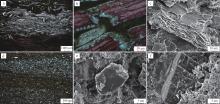
Fig. 2
Micrographs showing the microscopic characteristics of common inorganic mineral components of shale samples from the Da’anzhai Member, central Sichuan Basin"

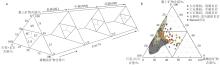
Fig.3
Lithofacies classification scheme for shales (a) and lithofacies classification results for shales in the Da’anzhai Member, Wufeng-Longmaxi formations[35], and the Barnett Shale[36] (b)"

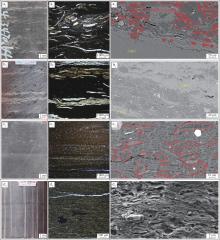
Fig.4
Micrographs showing the macroscopic and microscopic characteristics of the varying lithofacies types of shales in the Da’anzhai Member, central Sichuan Basin"

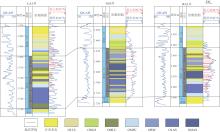
Fig.5
Vertical and horizontal distributions of various shale lithofacies in the Da’anzhai Member crossing wells LA1, G10, and RA1, central Sichuan Basin (see Fig. 1 for the well locations and Fig. 3 for lithofacies abbreviations)"

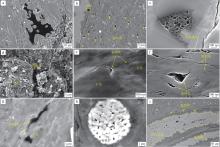
Fig.6
Scanning electron microscope (SEM) images showing the reserving space types of shales in the Da’anzhai Member, central Sichuan Basin"

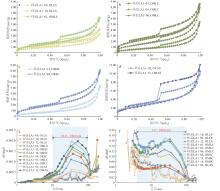
Fig.7
N2 adsorption-desorption curves and pore size distributions of shales in the Da’anzhai Member, central Sichuan Basin"

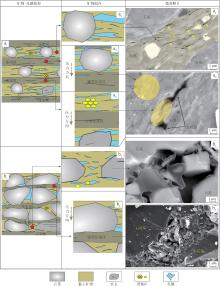
Fig.8
Developmental characteristics of mineral-pore network frameworks and their influence on pore development in shales of the Da’anzhai Member, central Sichuan Basin"

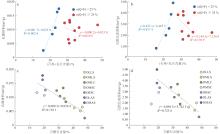
Fig.9
Impacts of terrigenous detrital minerals and carbonate minerals on the pore volume (specific surface area) of shales in the Da’anzhai Member, central Sichuan Basin"

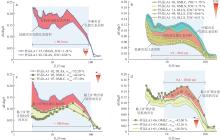
Fig.10
Pore size distributions of organic pores and clay-mineral intercrystalline pores across varying shale lithofacies in the Da’anzhai Member, central Sichuan Basin"

Table 2
Statistical summary for linear regression analysis of data on shale samples from the Da’anzhai Member, central Sichuan Basin"
w(Q+F)/ % | 岩相 | 样品编号 | 深度/m | 孔隙比表面积/(cm2/g) | 孔隙体积/ (cm3/g) | 估计孔隙比表面积/(cm2/g) | 估计孔隙体积/(cm3/g) | ||||
|---|---|---|---|---|---|---|---|---|---|---|---|
| 有机质 | 黏土矿物 | 有机质 | 碎屑矿物 | 黏土矿物 | |||||||
| <25 | OLAS | LA1-02 | 3 500.00 | 3.77 | 0.016 280 | 0.37 | 3.92 | 0.001 686 | — | 0.015 271 | |
| OMAS | LA1-15 | 3 532.10 | 4.98 | 0.017 800 | 0.51 | 3.64 | 0.002 319 | — | 0.014 179 | ||
| OMLC | LA1-05 | 3 508.20 | 1.89 | 0.008 353 | 0.74 | 1.98 | 0.003 334 | — | 0.007 629 | ||
| OMLC | LA1-07 | 3 510.97 | 2.50 | 0.010 400 | 0.69 | 1.14 | 0.003 104 | — | 0.004 293 | ||
| OMLC | LA1-11 | 3 532.15 | 0.73 | 0.002 514 | 0.54 | 0.32 | 0.002 453 | — | 0.001 078 | ||
| ≥25 | OLLS | LA1-09 | 3 521.10 | 1.32 | 0.005 092 | 0.64 | 0.42 | 0.001 849 | 0.003 392 | 0.003 078 | |
| OLLS | LA1-10 | 3 526.85 | 1.99 | 0.006 451 | 0.50 | 0.43 | 0.001 429 | 0.003 338 | 0.003 175 | ||
| OLLS | LA1-12 | 3 535.20 | 1.61 | 0.006 182 | 0.68 | 0.46 | 0.001 961 | 0.003 743 | 0.003 399 | ||
| OMLS | LA1-01 | 3 499.30 | 2.71 | 0.009 592 | 1.71 | 0.54 | 0.004 902 | 0.003 732 | 0.003 987 | ||
| OMLC | LA1-03 | 3 503.00 | 3.67 | 0.013 330 | 1.74 | 0.61 | 0.004 986 | 0.003 414 | 0.004 490 | ||
| OMLC | LA1-06 | 3 509.20 | 3.39 | 0.012 370 | 1.67 | 0.80 | 0.004 790 | 0.003 097 | 0.005 875 | ||
| OMSC | LA1-13 | 3 527.46 | 1.89 | 0.011 640 | 1.07 | 0.65 | 0.003 081 | 0.005 187 | 0.004 826 | ||
| OMSC | LA1-14 | 3 528.40 | 2.93 | 0.010 687 | 1.37 | 0.78 | 0.003 922 | 0.004 016 | 0.005 735 | ||
| ORSC | LA1-04 | 3 505.02 | 3.35 | 0.012 580 | 2.35 | 0.82 | 0.006 723 | 0.003 425 | 0.006 015 | ||

Fig.11
Correlation diagrams and bar charts showing the estimated and measured pore volumes, as well as estimated and measured specific surface areas of shale samples from the Da’anzhai Member, central Sichuan Basin"

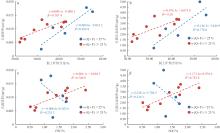
Fig.12
Relationships of clay mineral content and TOC with pore volume and specific surface area for shales in the Da’anzhai Member, central Sichuan Basin"


Fig.13
Diagram showing the evolutionary processes of the mineral-pore network frameworks across varying shale lithofacies of the Da’anzhai Member, central Sichuan Basin"

| 1 | APLIN A C, MACQUAKER J H S. Mudstone diversity: Origin and implications for source, seal, and reservoir properties in petroleum systems[J]. AAPG Bulletin, 2011, 95(12): 2031-2059. |
| 2 | 黎茂稳, 马晓潇, 金之钧, 等. 中国海、陆相页岩层系岩相组合多样性与非常规油气勘探意义[J]. 石油与天然气地质, 2022, 43(1): 1-25. |
| LI Maowen, MA Xiaoxiao, JIN Zhijun, et al. Diversity in the lithofacies assemblages of marine and lacustrine shale strata and significance for unconventional petroleum exploration in China[J]. Oil & Gas Geology, 2022, 43(1): 1-25. | |
| 3 | TIWARI P, DEO M, LIN C L, et al. Characterization of oil shale pore structure before and after pyrolysis by using X-ray micro CT[J]. Fuel, 2013, 107: 547-554. |
| 4 | ROSS D J K, MARC BUSTIN R. The importance of shale composition and pore structure upon gas storage potential of shale gas reservoirs[J]. Marine and Petroleum Geology, 2009, 26(6): 916-927. |
| 5 | 冯增昭. 沉积相的一些术语定义的评论[J]. 古地理学报, 2020, 22(2): 207-220. |
| FENG Zengzhao. A review on the definitions of terms of sedimentary facies[J]. Journal of Palaeogeography (Chinese Edition), 2020, 22(2): 207-220. | |
| 6 | WANG Yang, CHENG Hongfei, HU Qinhong, et al. Diagenesis and pore evolution for various lithofacies of the Wufeng-Longmaxi shale, southern Sichuan Basin, China[J]. Marine and Petroleum Geology, 2021, 133: 105251. |
| 7 | ZHANG Luchuan, XIAO Dianshi, LU Shuangfang, et al. Pore development of the Lower Longmaxi shale in the southeastern Sichuan Basin and its adjacent areas: Insights from lithofacies identification and organic matter[J]. Marine and Petroleum Geology, 2020, 122: 104662. |
| 8 | 钱计安, 蒋裕强, 罗彤彤, 等. 页岩储层渗吸过程微观孔缝演变特征及影响因素——以四川盆地渝西地区龙马溪组龙一1亚段为例[J]. 石油实验地质, 2024, 46(6): 1336-1348. |
| QIAN Ji’an, JIANG Yuqiang, LUO Tongtong, et al. Microscopic pore and fracture evolution characteristics and influencing factors during imbibition process of shale reservoirs: A case study of the first section of the first member[J]. Petroleum Geology & Experiment, 2024, 46(6): 1336-1348. | |
| 9 | 胡宗全, 刘忠宝, 李倩文, 等. 基于变尺度岩相组合的陆相页岩源-储耦合机理探讨——以四川盆地侏罗系页岩层段为例[J]. 石油与天然气地质, 2024, 45(4): 893-909. |
| HU Zongquan, LIU Zhongbao, LI Qianwen, et al. Exploring source rock-reservoir coupling mechanisms in lacustrine shales based on varying-scale lithofacies assemblages: A case study of the Jurassic shale intervals in the Sichuan Basin[J]. Oil & Gas Geology, 2024, 45(4): 893-909. | |
| 10 | 姜龙燕, 钱门辉, 何发岐, 等. 鄂尔多斯盆地富县地区三叠系延长组长7页岩油特征及其主控因素[J]. 石油实验地质, 2024, 46(5): 941-953. |
| JIANG Longyan, QIAN Menhui, HE Faqi, et al. Characteristics and main controlling factors of Chang 7 shale oil in Triassic Yanchang Formation, Fuxian area, Ordos Basin[J]. Petroleum Geology and Experiment, 2024, 46(5): 941-953. | |
| 11 | 柳波, 孙嘉慧, 张永清, 等. 松辽盆地长岭凹陷白垩系青山口组一段页岩油储集空间类型与富集模式[J]. 石油勘探与开发, 2021, 48(3): 521-535. |
| LIU Bo, SUN Jiahui, ZHANG Yongqing, et al. Reservoir space and enrichment model of shale oil in the first member of Cretaceous Qingshankou Formation in the Changling Sag, southern Songliao Basin, NE China[J]. Petroleum Exploration and Development, 2021, 48(3): 521-535. | |
| 12 | 彭君, 孙宁亮, 鹿坤, 等. 东濮凹陷古近系沙河街组页岩油储层岩石学及微观孔隙结构特征[J]. 地学前缘, 2023, 30(4): 128-141. |
| PENG Jun, SUN Ningliang, LU Kun, et al. Shale oil reservoir of the Palaeogene Shahejie Formation in the Dongpu Sag: Petrology and pore microstructural characteristics[J]. Earth Science Frontiers, 2023, 30(4): 128-141. | |
| 13 | 康家豪, 王兴志, 谢圣阳, 等. 川中地区侏罗系大安寨段页岩岩相类型及储层特征[J]. 岩性油气藏, 2022, 34(4): 53-65. |
| KANG Jiahao, WANG Xingzhi, XIE Shengyang, et al. Lithofacies types and reservoir characteristics of shales of Jurassic Da’anzhai member in central Sichuan Basin[J]. Lithologic Reservoirs, 2022, 34(4): 53-65. | |
| 14 | MILLIKEN K. A compositional classification for grain assemblages in fine-grained sediments and sedimentary rocks[J]. Journal of Sedimentary Research, 2014, 84(12): 1185-1199. |
| 15 | YANG Wei, ZUO Rusi, JIANG Zhenxue, et al. Effect of lithofacies on pore structure and new insights into pore-preserving mechanisms of the over-mature Qiongzhusi marine shales in Lower Cambrian of the southern Sichuan Basin, China[J]. Marine and Petroleum Geology, 2018, 98: 746-762. |
| 16 | ZHANG Luchuan, LU Shuangfang, JIANG Shu, et al. Effect of shale lithofacies on pore structure of the Wufeng-Longmaxi shale in southeast Chongqing, China[J]. Energy & Fuels, 2018, 32(6): 6603-6618. |
| 17 | 何文渊, 白雪峰, 蒙启安, 等. 四川盆地陆相页岩油成藏地质特征与重大发现[J]. 石油学报, 2022, 43(7): 885-898. |
| HE Wenyuan, BAI Xuefeng, MENG Qian, et al. Accumulation geological characteristics and major discoveries of lacustrine shale oil in Sichuan Basin[J]. Acta Petrolei Sinica, 2022, 43(7): 885-898. | |
| 18 | 李楠, 洪海涛, 赵正望, 等. 川东地区侏罗系大安寨段页岩储层特征及发育控制因素[J]. 断块油气田, 2024, 31(2): 187-196. |
| LI Nan, HONG Haitao, ZHAO Zhengwang, et al. Characteristics and development controlling factors of shale reservoirs of Jurassic Da’anzhai Member in eastern Sichuan Basin[J]. Fault-Block Oil and Gas Field, 2024, 31(2): 187-196. | |
| 19 | 刘忠宝, 李倩文, 刘光祥, 等. 川北地区大安寨段页岩油气源、储特征及富集层段优选[J]. 地质学报, 2023, 97(10): 3421-3437. |
| LIU Zhongbao, LI Qianwen, LIU Guangxiang, et al. Source and reservoir characteristics as well as optimization of favorable shale oil and gas enrichment intervals of the Da’anzhai Member in northern Sichuan[J]. Acta Geologica Sinica, 2023, 97(10): 3421-3437. | |
| 20 | 杨跃明, 文龙, 王兴志, 等. 四川盆地下侏罗统大安寨段页岩油气地质特征及勘探有利区优选[J]. 天然气工业, 2023, 43(4): 32-42. |
| YANG Yueming, WEN Long, WANG Xingzhi, et al. Geological characteristics and favorable exploration area selection of shale oil and gas of the Lower Jurassic Da’anzhai Member in the Sichuan Basin[J]. Natural Gas Industry, 2023, 43(4): 32-42. | |
| 21 | 丁一, 李智武, 冯逢, 等. 川中龙岗地区下侏罗统自流井组大安寨段湖相混合沉积及其致密油勘探意义[J]. 地质论评, 2013, 59(2): 389-400. |
| DING Yi, LI Zhiwu, FENG Feng, et al. Mixing of lacustrine siliciclastic-carbonate sediments and its significance for tight oil exploration in the Da’anzhai member, Ziliujing Formation, Lower Jurassic, in Longgang area, central Sichuan Basin[J]. Geological Review, 2013, 59(2): 389-400. | |
| 22 | 施振生, 赵圣贤, 周天琪, 等. 海相含气页岩水平层理类型、成因及其页岩气意义——以川南地区古生界五峰组-龙马溪组为例[J]. 石油与天然气地质, 2023, 44(6): 1499-1514. |
| SHI Zhensheng, ZHAO Shengxian, ZHOU Tianqi, et al. Types and genesis of horizontal bedding of marine gas-bearing shale and its significance for shale gas: A case study of the Wufeng-Longmaxi shale in southern Sichuan Basin, China[J]. Oil & Gas Geology,2023,44(6):1499-1514. | |
| 23 | 王濡岳, 胡宗全, 赖富强, 等. 川东北地区下侏罗统自流井组大安寨段陆相页岩脆性特征及其控制因素[J]. 石油与天然气地质, 2023, 44(2): 366-378. |
| WANG Ruyue, HU Zongquan, LAI Fuqiang, et al. Brittleness features and controlling factors of continental shale from Da’anzhai Member of the Lower Jurassic Ziliujing Formation, northeastern Sichuan Basin[J]. Oil & Gas Geology, 2023, 44(2): 366-378. | |
| 24 | 孔祥晔, 曾溅辉, 罗群, 等. 川中地区大安寨段陆相页岩岩相对孔隙结构的控制作用[J]. 新疆石油地质, 2023, 44(4): 392-403. |
| KONG Xiangye, ZENG Jianhui, LUO Qun, et al. Controls of continental shale lithofacies on pore structure of Jurassic Da’anzhai member in central Sichuan basin[J]. Xinjiang Petroleum Geology, 2023, 44(4): 392-403. | |
| 25 | 洪海涛, 路俊刚, 秦春雨, 等. 川中侏罗系自流井组大安寨段页岩油储层特征及其勘探启示[J]. 石油实验地质, 2024, 46(1): 11-21. |
| HONG Haitao, LU Jungang, QIN Chunyu, et al. Shale oil reservoir characteristics and exploration implication in Da’anzhai Member of Jurassic Ziliujing Formation in central Sichuan Basin[J]. Petroleum Geology and Experiment, 2024, 46(1): 11-21. | |
| 26 | 李倩文, 刘忠宝, 陈斐然, 等. 四川盆地侏罗系页岩层系岩相类型及储集特征——以元坝地区Y2井大安寨段为例[J]. 石油与天然气地质, 2022, 43(5): 1127-1140. |
| LI Qianwen, LIU Zhongbao, CHEN Feiran, et al. Lithofacies types and reservoir characteristics of Jurassic shale in the Sichuan Basin revealed by the Da’anzhai member, Well Y2, Yuanba area[J]. Oil & Gas Geology, 2022, 43(5): 1127-1140. | |
| 27 | 郑荣才, 郭春利, 梁西文, 等. 四川盆地大安寨段非常规储层的储集空间类型与评价[J]. 岩性油气藏, 2016, 28(1): 16-29. |
| ZHENG Rongcai, GUO Chunli, LIANG Xiwen, et al. Characteristics and evaluation of reservoir spaces of shale gas (oil) in Da’anzhai member of Ziliujing Formation in Sichuan Basin[J]. Lithologic Reservoirs, 2016, 28(1): 16-29. | |
| 28 | 郑荣才. 四川盆地下侏罗统大安寨段高分辨率层序地层学[J]. 沉积学报, 1998, 16(2): 42-49. |
| ZHENG Rongcai. High resolution sequence stratigraphy of Da’anzhai Formation, Lower Jurassic in Sichuan Basin[J]. Acta Sedimentologica Sinica, 1998, 16(2): 42-49. | |
| 29 | 杜江民, 张小莉, 张帆, 等. 川中龙岗地区下侏罗统大安寨段沉积相分析及有利储集层预测[J]. 古地理学报, 2015, 17(4): 493-502. |
| DU Jiangmin, ZHANG Xiaoli, ZHANG Fan, et al. Sedimentary facies and reservoir prediction of the Lower Jurassic Da’anzhai Member, Longgang area, central Sichuan Basin[J]. Journal of Palaeogeography (Chinese Edition), 2015, 17(4): 493-502. | |
| 30 | 张宇, 杜垚, 刘耘, 等. 四川盆地侏罗系大安寨段湖相页岩油气基本特征及勘探方向[J]. 中国地质, 2022, 49(1): 51-65. |
| ZHANG Yu, DU Yao, LIU Yun, et al. Basic characteristics and exploration direction of lacustrine shale oil and gas in Da’anzhai member of Jurassic in Sichuan Basin[J]. Geology in China, 2022, 49(1): 51-65. | |
| 31 | 张少敏, 杨跃明, 洪海涛, 等. 陆相页岩层段储集特征及其油气地质意义——以四川盆地中部大安寨段为例[J]. 中国矿业大学学报, 2022, 51(4): 718-730. |
| ZHANG Shaomin, YANG Yueming, HONG Haitao, et al. Reservoir characteristics and its petroleum significance of Jurassic Da’anzhai shale interval in central Sichuan Basin, SW China[J]. Journal of China University of Mining & Technology, 2022, 51(4): 718-730. | |
| 32 | 施开兰, 陈芳文, 段卓, 等. 重庆北碚和平水库剖面下侏罗统大安寨段湖相碳酸盐岩岩石类型及沉积环境[J]. 古地理学报, 2015, 17(2): 198-212. |
| SHI Kailan, CHEN Fangwen, DUAN Zhuo, et al. Lacustrine carbonate rock types and sedimentary environments of the Lower Jurassic Da’anzhai Member of Heping Reservoir section in Beibei area, Chongqing[J]. Journal of Palaeogeography, 2015, 17(2): 198-212. | |
| 33 | 王昕尧, 金振奎, 朱毅秀, 等. 四川盆地自流井组陆相页岩石英成因研究[J]. 沉积学报, 2022, 40(4): 1010-1018. |
| WANG Xinyao, JIN Zhenkui, ZHU Yixiu, et al. The genesis of quartz in Ziliujing nonmarine shale, Sichuan Basin[J]. Acta Sedimentologica Sinica, 2022, 40(4): 1010-1018. | |
| 34 | 李志明, 刘雅慧, 何晋译, 等. 陆相页岩油“甜点”段评价关键参数界限探讨[J]. 石油与天然气地质, 2023, 44(6): 1453-1467. |
| LI Zhiming, LIU Yahui, HE Jinyi, et al. Limits of critical parameters for sweet-spot interval evaluation of lacustrine shale oil[J]. Oil & Gas Geology, 2023, 44(6): 1453-1467. | |
| 35 | ZHAO Jianhua, JIN Zhijun, JIN Zhenkui, et al. Depositional environment of shale in Wufeng and Longmaxi Formations, Sichuan Basin[J]. Petroleum Research, 2017, 2(3): 209-221. |
| 36 | JARVIE D M, HILL R J, RUBLE T E, et al. Unconventional shale-gas systems: The Mississippian Barnett Shale of north-central Texas as one model for thermogenic shale-gas assessment[J]. AAPG Bulletin, 2007, 91(4): 475-499. |
| 37 | 孙龙德, 王小军, 冯子辉, 等. 松辽盆地古龙页岩纳米孔缝形成机制与页岩油富集特征[J]. 石油与天然气地质, 2023, 44(6): 1350-1365. |
| SUN Longde, WANG Xiaojun, FENG Zihui, et al. Formation mechanisms of nano-scale pores/fissures and shale oil enrichment characteristics for Gulong shale, Songliao Basin[J]. Oil & Gas Geology, 2023, 44(6): 1350-1365. | |
| 38 | LOUCKS R G, REED R M, RUPPEL S C, et al. Spectrum of pore types and networks in mudrocks and a descriptive classification for matrix-related mudrock pores[J]. AAPG Bulletin, 2012, 96(6): 1071-1098. |
| 39 | MENG Qingfeng, HAO Fang, TIAN Jinqiang. Origins of non-tectonic fractures in shale[J]. Earth-Science Reviews, 2021, 222: 103825. |
| 40 | WU Lanyu, LU Yangbo, JIANG Shu, et al. Pore structure characterization of different lithofacies in marine shale: A case study of the Upper Ordovician Wufeng-Lower Silurian Longmaxi Formation in the Sichuan Basin, SW China[J]. Journal of Natural Gas Science and Engineering, 2018, 57: 203-215. |
| 41 | 王昕尧, 金振奎, 郭芪恒, 等. 川东北下侏罗统大安寨段陆相页岩方解石成因[J]. 沉积学报, 2021, 39(3): 704-712. |
| WANG Xinyao, JIN Zhenkui, GUO Qiheng, et al. Genesis of calcite in nonmarine shale of the Lower Jurassic Da’anzhai member, northeastern Sichuan[J]. Acta Sedimentologica Sinica, 2021, 39(3): 704-712. | |
| 42 | 曹涛涛, 宋之光, 王思波, 等. 不同页岩及干酪根比表面积和孔隙结构的比较研究[J]. 中国科学(地球科学), 2015, 45(2): 139-151. |
| CAO Taotao, SONG Zhiguang, WANG Sibo, et al. A comparative study of the specific surface area and pore structure of different shales and their kerogens[J]. Science China Earth Sciences, 2015, 45(2): 139-151. | |
| 43 | XIE Weidong, WANG Meng, DUAN Hongyue. Adsorption characteristics and controlling factors of CH4 on coal-measure shale, Hedong coalfield[J]. Minerals, 2021, 11(1): 63. |
| 44 | ZHU Yixiu, LI Zezhou, ZENG Lianbo, et al. Diagenesis and its impact on the reservoir quality of continental shales: A case study of the Lower Jurassic Da’anzhai member of the Ziliujing Formation in the Sichuan Basin, China[J]. Geofluids, 2022, 2022: 5942370. |
| 45 | JIANG Daiqin, LI Pingping, ZHENG Mingjun, et al. Impacts of different matrix components on multi-scale pore structure and reservoir capacity: Insights from the Jurassic Da’anzhai member in the Yuanba area, Sichuan Basin[J]. Energy Reports, 2023, 9: 1251-1264. |
| 46 | LI Peng, LIU Zhongbao, NIE Haikuan, et al. Heterogeneity characteristics of lacustrine shale oil reservoir under the control of lithofacies: A case study of the Dongyuemiao member of Jurassic Ziliujing Formation, Sichuan Basin[J]. Frontiers in Earth Science, 2021, 9: 736544. |
| 47 | RIMSTIDT J D, CHERMAK J A, SCHREIBER M E. Processes that control mineral and element abundances in shales[J]. Earth-Science Reviews, 2017, 171: 383-399. |
| 48 | BAI Bin, DAI Chaocheng, HOU Xiulin, et al. Authigenic silica in continental lacustrine shale and its hydrocarbon significance[J]. Petroleum Exploration and Development, 2022, 49(5): 1033-1045. |
| 49 | 李颖莉, 蔡进功. 泥质烃源岩中蒙脱石伊利石化对页岩气赋存的影响[J]. 石油实验地质, 2014, 36(3): 352-358. |
| LI Yingli, CAI Jingong. Effect of smectite illitization on shale gas occurrence in argillaceous source rocks[J]. Petroleum Geology and Experiment, 2014, 36(3): 352-358. |
| Viewed | ||||||
|
Full text |
|
|||||
|
Abstract |
|
|||||
