

石油与天然气地质 ›› 2025, Vol. 46 ›› Issue (2): 670-684.doi: 10.11743/ogg20250222
杨柳( ), 姜晓宇, 董广涛(), 公飞, 朱凯, 裴奕杰, 蔡嘉伟
收稿日期:2024-10-29
修回日期:2025-01-05
出版日期:2025-04-30
发布日期:2025-04-27
通讯作者:
董广涛
E-mail:shidayangliu@cumtb.edu.cn;d15505185881@163.com
第一作者简介:杨柳(1987—),男,博士、副教授、博士研究生导师,深部岩体温度-应力-渗流-化学耦合、CO2地质封存与驱煤层气-页岩油气、非常规油气提高采收率。E‑mail: shidayangliu@cumtb.edu.cn。
基金项目:
Liu YANG(), Xiaoyu JIANG, Guangtao DONG(), Fei GONG, Kai ZHU, Yijie PEI, Jiawei CAI
Received:2024-10-29
Revised:2025-01-05
Online:2025-04-30
Published:2025-04-27
Contact:
Guangtao DONG
E-mail:shidayangliu@cumtb.edu.cn;d15505185881@163.com
摘要:
准噶尔盆地玛湖凹陷具有巨大的油气开发潜力,但由于储层非均质性强、产量递减快。目前前置CO2压裂-气驱-封存协同技术(PCFS)是砂砾岩储层强化开采的常用方法。为了研究前置压裂过程中CO2-水-岩相互作用对孔隙结构的影响以及气驱过程中CO2的运移规律,选取了玛湖凹陷砂砾岩岩心,开展了CO2浸泡实验、高精度Mirco-CT扫描以及基于流体体积法(VOF)的3D数字岩心两相流数值模拟。研究结果表明:①CO2-水-岩相互作用会导致砂砾岩孔隙结构发生溶蚀扩展,原本孤立的孔隙通道逐渐汇聚成为片状,从而扩大了CO2团簇的波及范围。该过程也引发了二次矿物沉淀和膨胀,进而导致流动通道的堵塞或重组,改变流体在孔隙结构内的流动路径和速度,阻碍优势流道的形成。②CO2浸泡导致孔隙空间溶蚀扩展所起到的积极作用要大于二次矿物沉淀和膨胀所引起的消极作用,增加渗透率,孔隙结构的渗流能力呈现出增强趋势。在不同流道中,CO2团簇具有凸形和凹形等不同的驱替前缘形态。浸泡前、后代表性单元体(REV)模型无因次数(Ca,θ,M)对驱替效率的影响程度不同。在浸泡后孔隙发育程度相对较高的REV模型中,驱替效率对无因次数(Ca,θ,M)变化的敏感性较强,表明PCFS技术在孔隙发育程度较高的储层中具有更好的应用效果。
中图分类号:

图1
砂砾岩储层PCFS技术应用工况图(a)和CO2-水-岩反应示意图(b)"


图2
孔隙模型及网格独立性验证a.原始孔隙结构(模型a);b.CO2-水-岩反应后孔隙结构(模型b);c.网格独立性验证(a图和b图中,绿色为入口边界;蓝色为孔隙结构。)"

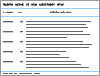
表1
网格特征及孔隙模型参数"
| 模型 | 网格数/个 | 节点数/个 | 孔隙体积/(10-12 m3) | 平均孔隙半径/μm | 平均喉道半径/μm | 孔隙度/% | 渗透率/(10-3 μm2) |
|---|---|---|---|---|---|---|---|
| a | 312 952 | 395 272 | 24.155 2 | 0.053 9 | 0.029 6 | 16.948 2 | 1.373 |
| b | 435 261 | 567 398 | 37.708 0 | 0.063 2 | 0.035 7 | 18.975 1 | 1.596 |
表2
模拟案例及影响因素参数"
| 案例 | 流体性质 | 无量纲数 | ||||
|---|---|---|---|---|---|---|
| 注入速度(v0)/(m/s) | 油黏度(μoil)/(mPa·s) | CO2黏度( | 润湿角(θ) | 黏度比(M) | 毛细管数(Ca) | |
| 1 | 0.02 | 7.6 × 10⁻³ | 1.37 × 10⁻⁵ | 150 | 0.002 | 6.75 × 10⁻⁶ |
| 2 | 0.05 | 7.6 × 10⁻³ | 1.37 × 10⁻⁵ | 150 | 0.002 | 2.35 × 10⁻⁵ |
| 3 | 0.10 | 7.6 × 10⁻³ | 1.37 × 10⁻⁵ | 150 | 0.002 | 3.38 × 10⁻⁵ |
| 4 | 0.05 | 7.6 × 10⁻³ | 7.60 × 10⁻⁶ | 150 | 0.001 | 2.35 × 10⁻⁵ |
| 5 | 0.05 | 7.6 × 10⁻³ | 7.60 × 10⁻⁵ | 150 | 0.010 | 2.35 × 10⁻⁵ |
| 6 | 0.05 | 7.6 × 10⁻³ | 7.60 × 10⁻⁴ | 150 | 0.100 | 2.35 × 10⁻⁵ |
| 7 | 0.05 | 7.6 × 10⁻³ | 1.37 × 10⁻⁵ | 100 | 0.002 | 2.35 × 10⁻⁵ |
| 8 | 0.05 | 7.6 × 10⁻³ | 1.37 × 10⁻⁵ | 150 | 0.002 | 2.35 × 10⁻⁵ |
| 9 | 0.05 | 7.6 × 10⁻³ | 1.37 × 10⁻⁵ | 170 | 0.002 | 2.35 × 10⁻⁵ |

图3
浸泡前、后数字岩心REV模型孔隙结构及对应截面分形维数提取a.CO2浸泡前;b.CO2浸泡后;a1, a2,a3和b1,b2,b3分别是浸泡前、后模型对应截面及分形维数提取(蓝色区域为孔隙;黑色区域为岩石基质;D为表面分形维数。)"


图4
砂砾岩数字岩心与REV单元体的孔隙、喉道半径及孔隙配位数分布频率a.孔隙半径;b.喉道半径;c.孔隙配位数"


图5
CO2浸泡前、后孔隙模型两相流模拟a1,a2,a3分别是CO2浸泡前模型在t=0.5 s,t=1.5 s和驱替稳定时刻的CO2体积分数分布;b1,b2,b3分别是CO2浸泡后模型在t=0.5 s,t=1.5 s和驱替稳定时刻的CO2体积分数分布(t为驱替时间;蓝色流体为CO2;其余透明流体为油。)"


图6
浸泡前、后模型CO2驱油采收率曲线"


图7
不同CO2团簇突破形态a.原始孔隙结构t=0.5 s时两相分布情况;b.凸型驱替前缘;c.凹型驱替前缘"


图8
最终时刻压力与流速分布a.原始孔隙结构驱替结束最终压力分布;b.原始孔隙结构驱替结束最终速度分布;c.CO2浸泡后孔隙模型驱替结束最终压力分布;d.CO2浸泡后孔隙模型驱替结束最终速度分布"


图9
不同毛细管数条件下CO2团簇分布a1,a2,a3分别是CO2浸泡前模型在毛细管数为6.75 × 10-6,2.35 × 10-5和3.35 × 10⁻⁵时驱替达到稳定时刻的CO2体积分数分布;b1,b2,b3分别是CO2浸泡后模型在毛细管数为6.75 × 10-6,2.35 × 10-5和3.35 × 10⁻⁵时驱替达到稳定时刻的CO2体积分数分布"


图10
不同毛细管数条件下CO2驱油采收率曲线a.最终采收率曲线;b.突破后拟合采收率曲线"


图11
不同接触角条件下CO2团簇分布a1,a2,a3分别是CO2浸泡前模型在接触角为100°,150°和170°时驱替达到稳定时刻的CO2体积分数分布;b1,b2,b3分别是CO2浸泡后模型在接触角为100°,150°和170°时驱替达到稳定时刻的CO2体积分数分布"


图12
不同接触角条件下CO2驱油采收率曲线a.最终采收率曲线;b.突破后拟合采收率曲线"


图13
不同黏度比条件下CO2团簇分布a1,a2,a3分别是CO2浸泡前模型在黏度比为0.001,0.01和0.1时驱替达到稳定时刻的CO2体积分数分布;b1,b2,b3分别是CO2浸泡后模型在黏度比为0.001,0.01和0.1时驱替达到稳定时刻的CO2体积分数分布"


图14
不同黏度比条件下CO2驱油采收率曲线a.最终采收率曲线;b.突破后拟合采收率曲线"


图15
无因次数与采收率相关性拟合a.拟合式对比;b.浸泡前、后模型采收率与无因次数拟合;c.相关性比较RF.采收率;NLTO. RF=108.85+7.45ln(NLTO); Nco. RF=47.44+7.60ln(Nco); N′gd. RF=47.45+7.60ln(N′gd); Ndis. RF=32.32+6.93ln(Ndis); Ncd-1. RF=281.97+11.97ln(Ncd-1); Ncd-2. RF=264.28+15.13ln(Ncd-2); R2Ncd= (R2Ncd-2+R2Ncd-2)/2"

| 1 | BACHU S. Sequestration of CO2 in geological media: Criteria and approach for site selection in response to climate change[J]. Energy Conversion and Management, 2000, 41(9): 953-970. |
| 2 | JIANG Lanlan, YU Minghao, TENG Ying, et al. Displacement and dissolution characteristics of CO2/brine system in unconsolidated porous media[J]. Transport in Porous Media, 2018, 122(3): 595-609. |
| 3 | 赵珊, 刘华, 杨宪章, 等. 温-压耦合作用下深层盐岩盖层封闭能力演化特征[J]. 石油与天然气地质, 2023, 44(5): 1321-1332. |
| ZHAO Shan, LIU Hua, YANG Xianzhang, et al. Evolutionary characteristics of sealing capacity of deep salt caprocks under temperature-pressure coupling[J]. Oil & Gas Geology, 2023, 44(5): 1321-1332. | |
| 4 | 钱根葆, 许长福, 陈玉琨, 等. 砂砾岩储集层聚合物驱油微观机理——以克拉玛依油田七东1区克拉玛依组下亚组为例[J]. 新疆石油地质, 2016, 37(1): 56-61. |
| QIAN Genbao, XU Changfu, CHEN Yukun, et al. Microscopic mechanism of polymer flooding in glutenite reservoir of Lower Karamay Formation in east district-7(1), Karamay Oilfield[J]. Xinjiang Petroleum Geology, 2016, 37(1): 56-61. | |
| 5 | 谭锋奇, 许长福, 王晓光, 等. 砾岩油藏水驱与聚合物驱微观渗流机理差异[J]. 石油学报, 2016, 37(11): 1414-1427. |
| TAN Fengqi, XU Changfu, WANG Xiaoguang, et al. Differences in microscopic porous flow mechanisms of water flooding and polymer flooding for conglomerate reservoir[J]. Acta Petrolei Sinica, 2016, 37(11): 1414-1427. | |
| 6 | 王香增, 陈小凡, 李剑, 等. 一种基于 “四区” 的低渗透油藏CO2埋存量计算方法及应用[J]. 特种油气藏, 2024, 31(3): 78-84. |
| WANG Xiangzeng, CHEN Xiaofan, LI Jian, et al. A calculation method of CO2 storage capacity in low permeability reservoirs based on “four-zone” method and its application[J]. Special Oil & Gas Reservoirs, 2024, 31(3): 78-84. | |
| 7 | 彭东宇, 唐洪明, 王子逸, 等. 致密砾岩储层与CO2作用机理及控制因素实验研究[J]. 油气地质与采收率, 2023, 30(2): 94-103. |
| PENG Dongyu, TANG Hongming, WANG Ziyi, et al. Experimental study on reaction mechanism between tight conglomerate reservoir and CO2 and its controlling factors[J]. Petroleum Geology and Recovery Efficiency, 2023, 30(2): 94-103. | |
| 8 | 李颖, 李茂茂, 李海涛, 等. 纳米SiO2强化CO2地质封存页岩盖层封堵能力机制试验[J]. 中国石油大学学报(自然科学版), 2024, 48(2): 92-98. |
| LI Ying, LI Maomao, LI Haitao, et al. Experiment on nano-SiO2 enhancing sealing capacity of shale caprocks for CO2 geological storage[J]. Journal of China University of Petroleum (Edition of Natural Science), 2024, 48(2): 92-98. | |
| 9 | LIU Haihu, VALOCCHI A J, KANG Qinjun, et al. Pore-scale simulations of gas displacing liquid in a homogeneous pore network using the lattice Boltzmann method[J]. Transport in Porous Media, 2013, 99(3): 555-580. |
| 10 | CHAUDHARY K, BAYANI CARDENAS M, WOLFE W W, et al. Pore-scale trapping of supercritical CO2 and the role of grain wettability and shape[J]. Geophysical Research Letters, 2013, 40(15): 3878-3882. |
| 11 | CHEN Cheng, ZENG Lingzao, SHI Liangsheng. Continuum-scale convective mixing in geological CO2 sequestration in anisotropic and heterogeneous saline aquifers[J]. Advances in Water Resources, 2013, 53: 175-187. |
| 12 | 李士伦, 汤勇, 段胜才, 等. CO2地质封存源汇匹配及安全性评价进展[J]. 油气藏评价与开发, 2023, 13(3): 269-279. |
| LI Shilun, TANG Yong, DUAN Shengcai, et al. Progress in source-sink matching and safety evaluation of CO2 geological sequestration[J]. Petroleum Reservoir Evaluation and Development, 2023, 13(3): 269-279. | |
| 13 | 庞辉, 孙雷, 闫成海, 等. ZJD油田CO2驱替室内实验研究[J]. 油气藏评价与开发, 2014, 4(2): 43-45. |
| PANG Hui, SUN Lei, YAN Chenghai, et al. Laboratory research on CO2 injection displacement in ZJD oilfield[J]. Petroleum Reservoir Evaluation and Development, 2014, 4(2): 43-45. | |
| 14 | 李世瑞, 赵凯, 徐江伟, 等. 三塘湖盆地MZ区块致密油藏CO2吞吐提高采收率[J]. 新疆石油地质, 2023, 44(5): 572-576. |
| LI Shirui, ZHAO Kai, XU Jiangwei, et al. Enhanced oil recovery by CO2 huff-n-puff in tight oil reservoirs in Mazhong Block, Santanghu Basin[J]. Xinjiang Petroleum Geology, 2023, 44(5): 572-576. | |
| 15 | 熊建华, 龙小泳, 朱璐, 等. 深层低渗透砂砾岩油藏注CO2吞吐提高采收率实验研究[J]. 科学技术与工程, 2023, 23(4): 1518-1525. |
| XIONG Jianhua, LONG Xiaoyong, ZHU Lu, et al. Experimental study on enhanced oil recovery by CO2 huff and puff in deep low permeability glutenite reservoir[J]. Science Technology and Engineering, 2023, 23(4): 1518-1525. | |
| 16 | 金之钧, 张川, 王晓峰, 等. 关于中国碳中和与能源转型实现路径的思考[J]. 石油与天然气地质, 2024, 45(3): 593-599. |
| JIN Zhijun, ZHANG Chuan, WANG Xiaofeng, et al. A pathway to China’s energy transition in a carbon neutrality vision[J]. Oil & Gas Geology, 2024, 45(3): 593-599. | |
| 17 | 刘合, 陶嘉平, 孟思炜, 等. 页岩油藏CO2提高采收率技术现状及展望[J]. 中国石油勘探, 2022, 27(1): 127-134. |
| LIU He, TAO Jiaping, MENG Siwei, et al. Application and prospects of CO2 enhanced oil recovery technology in shale oil reservoir[J]. China Petroleum Exploration, 2022, 27(1): 127-134. | |
| 18 | 郭肖, 冯金, 王鹏鲲, 等. 碳酸盐岩气藏注CO2埋存及提高采收率机理研究进展[J]. 断块油气田, 2023, 30(6): 888-894. |
| GUO Xiao, FENG Jin, WANG Pengkun, et al. Progress on mechanism of CO2 injection for storage and enhanced gas recovery in carbonate gas reservoir[J]. Fault-Block Oil and Gas Field, 2023, 30(6): 888-894. | |
| 19 | YANG Liu, JIANG Xiaoyu, XU Huijin, et al. Pore-scale evolution and flow dynamics in glutenite reservoirs: Insights into CO2-water-rock interactions and multiphase flow after preflushing CO2 fracturing[J]. Chemical Engineering Journal, 2025, 505: 159433. |
| 20 | 姜汉桥, 宋亮, 张贤松, 等. 基于核磁共振的正韵律厚油层高含水期挖潜室内实验[J]. 中国海上油气, 2014, 26(6): 40-43. |
| JIANG Hanqiao, SONG Liang, ZHANG Xiansong, et al. Laboratory NMR experiments on tapping the production potential of positive rhythmic and thick oil reservoirs in high water-cut stage[J]. China Offshore Oil and Gas, 2014, 26(6): 40-43. | |
| 21 | LI Junjian, JIANG Hanqiao, WANG Chuan, et al. Pore-scale investigation of microscopic remaining oil variation characteristics in water-wet sandstone using CT scanning[J]. Journal of Natural Gas Science and Engineering, 2017, 48: 36-45. |
| 22 | MI L, JIANG H, PEI Y, et al. Microscopic oil and water percolation characteristic investigation of water flood reservoir in ultrahigh water cut period[C]//SPE Trinidad and Tobago Section Energy Resources Conference, Port of Spain, 2016. Richardson: Society of Petroleum Engineers, 2016: SPE-180864-MS. |
| 23 | 刘佳慧, 苏玉亮, 李蕾, 等. 基于微流控实验的页岩油CO2吞吐提高采收率微观机理研究[C]//中国石油新疆油田分公司(新疆砾岩油藏实验室), 西安石油大学, 陕西省石油学会. 2022油气田勘探与开发国际会议论文集Ⅳ. 青岛: 中国石油大学(华东), 2022: 300-307. |
| LIU Jiahui, SU Yuliang, LI Lei, et al. Micro mechanism study on enhancing shale oil recovery by CO2 injection based on microfluidic experiments[C]//PetroChina Xinjiang Oilfield Company (Xinjiang Conglomerate Reservoir Laboratory), Xi’an Shiyou University, Shaanxi Petroleum Society. Proceedings of the 2022 International Conference on Oil and Gas Field Exploration and Development IV. Qingdao: China University of Petroleum (East China), 2022: 300-307. | |
| 24 | 王亚, 葛丽珍, 路研, 等. 基于核磁共振驱替实验的低渗透砂岩流体可动性及剩余油赋存特征研究[J]. 油气地质与采收率, 2023, 30(6): 22-31. |
| WANG Ya, GE Lizhen, LU Yan, et al. Study on fluid mobility and occurrence characteristics of remaining oil in low-permeability sandstone reservoirs based on nuclear magnetic resonance displacement experiments[J]. Petroleum Geology and Recovery Efficiency, 2023, 30(6): 22-31. | |
| 25 | 宋宪坤, 刘月田, 杨潇文, 等. 孔隙尺度下CO2混相驱替数值模拟研究[J]. 油气地质与采收率, 2024, 31(6): 140-152. |
| SONG Xiankun, LIU Yuetian, YANG Xiaowen, et al. Numerical simulation of CO2 miscible displacement at pore scale[J]. Petroleum Geology and Recovery Efficiency, 2024, 31(6): 140-152. | |
| 26 | YANG Liu, YANG Duo, ZHANG Mingyuan, et al. Application of nano-scratch technology to identify continental shale mineral composition and distribution length of bedding interfacial transition zone-A case study of Cretaceous Qingshankou formation in Gulong Depression, Songliao Basin, NE China[J]. Geoenergy Science and Engineering, 2024, 234: 212674. |
| 27 | RAEINI A Q, BIJELJIC B, BLUNT M J. Modelling capillary trapping using finite-volume simulation of two-phase flow directly on micro-CT images[J]. Advances in Water Resources, 2015, 83: 102-110. |
| 28 | RAEINI A Q, BIJELJIC B, BLUNT M J. Numerical modelling of sub-pore scale events in two-phase flow through porous media[J]. Transport in Porous Media, 2014, 101(2): 191-213. |
| 29 | NAMAEE-GHASEMI A, AYATOLLAHI S, MAHANI H. Pore-scale simulation of the interplay between wettability, capillary number, and salt dispersion on the efficiency of oil mobilization by low-salinity waterflooding[J]. SPE Journal, 2021, 26(6): 4000-4021. |
| 30 | RAEINI A Q, BIJELJIC B, BLUNT M J. Modelling capillary trapping using finite-volume simulation of two-phase flow directly on micro-CT images[J]. Advances in Water Resources, 2015, 83: 102-110. |
| 31 | RAEINI A Q, BLUNT M J, BIJELJIC B. Direct simulations of two-phase flow on micro-CT images of porous media and upscaling of pore-scale forces[J]. Advances in Water Resources, 2014, 74: 116-126. |
| 32 | TSUJI T, JIANG Fei, CHRISTENSEN K T. Characterization of immiscible fluid displacement processes with various capillary numbers and viscosity ratios in 3D natural sandstone[J]. Advances in Water Resources, 2016, 95: 3-15. |
| 33 | LIU Bing, WANG Chao, ZHANG Jun, et al. Displacement mechanism of oil in shale inorganic nanopores by supercritical carbon dioxide from molecular dynamics simulations[J]. Energy & Fuels, 2016, 31(1): 738-746. |
| 34 | XIONG Chunming, LI Shujun, DING Bin, et al. Molecular insight into the oil displacement mechanism of gas flooding in deep oil reservoir[J]. Chemical Physics Letters, 2021, 783: 139044. |
| 35 | IWASE M, LIANG Yunfeng, MASUDA Y, et al. Application of a digital oil model to solvent-based enhanced oil recovery of heavy crude oil[J]. Energy & Fuels, 2019, 33(11): 10868-10877. |
| [1] | 鲍李银, 庞雄奇, 崔新璇, 陈宏飞, 高军, 邹亮, 赵振丞, 王琛茜, 王雷, 李闻东, 刘利. 准噶尔盆地金龙油田二叠系佳木河组火山岩岩相组合及产能差异[J]. 石油与天然气地质, 2025, 46(1): 136-150. |
| [2] | 王继远, 王斌, 胡宗全, 商丰凯, 刘德志, 李振明, 邱岐, 宋振响, 胡志啟. 深层-超深层碎屑岩优质储层成因机理[J]. 石油与天然气地质, 2025, 46(1): 151-166. |
| [3] | 吴丰, 梁芸, 唐松, 李昱翰, 田兴旺, 杨辉廷, 李锋. 深层含沥青溶孔-溶洞型碳酸盐岩微观导电特性[J]. 石油与天然气地质, 2025, 46(1): 288-303. |
| [4] | 宋璠, 孔庆圆, 张学才, 曹海防, 焦国华, 杨悦. 干旱型浅水三角洲沉积特征及沉积模式[J]. 石油与天然气地质, 2024, 45(5): 1275-1288. |
| [5] | 冯德浩, 刘成林, 杨海波, 韩杨, 杨小艺, 苏加佳, 李国雄, 张景坤. 准噶尔盆地东部中二叠统咸化湖相烃源岩生气潜力及天然气勘探意义[J]. 石油与天然气地质, 2024, 45(5): 1289-1304. |
| [6] | 孙靖, 尤新才, 薛晶晶, 郑孟林, 常秋生, 王韬. 准噶尔盆地深层-超深层碎屑岩致密气储层特征及其控制因素[J]. 石油与天然气地质, 2024, 45(4): 1046-1063. |
| [7] | 杜晓宇, 金之钧, 曾联波, 刘国平, 杨森, 梁新平, 陆国青. 基于成像测井的深层陆相页岩油储层天然裂缝有效性评价[J]. 石油与天然气地质, 2024, 45(3): 852-865. |
| [8] | 潘虹, 于庆森, 李晓山, 宋俊强, 蒋志斌, 王丽, 罗官幸, 徐文秀, 尤浩宇. 准噶尔盆地红车断裂带石炭系重新认识及油气成藏特征[J]. 石油与天然气地质, 2024, 45(1): 215-230. |
| [9] | 陈轩, 陶鑫, 覃建华, 许长福, 李映艳, 邓远, 高阳, 尹太举. 准噶尔盆地吉木萨尔凹陷及周缘二叠系芦草沟组异重流沉积[J]. 石油与天然气地质, 2023, 44(6): 1530-1545. |
| [10] | 刘惠民, 张关龙, 范婕, 曾治平, 郭瑞超, 宫亚军. 准噶尔盆地腹部征沙村地区征10井的勘探发现与启示[J]. 石油与天然气地质, 2023, 44(5): 1118-1128. |
| [11] | 赵耀, 潘虹, 骆飞飞, 李亮, 李丹杨, 谢宗瑞, 卢东连, 张琴. 准噶尔盆地红车断裂带石炭系火山岩储层特征及质量控制因素[J]. 石油与天然气地质, 2023, 44(5): 1129-1140. |
| [12] | 王宏博, 马存飞, 曹铮, 李志鹏, 韩长城, 纪文明, 杨艺. 基于岩相的致密砂岩差异成岩作用及其储层物性响应[J]. 石油与天然气地质, 2023, 44(4): 976-992. |
| [13] | 周家全, 王越, 宋子怡, 柳季廷, 成赛男. 准噶尔盆地博格达地区中二叠统芦草沟组热液硅质结核特征及页岩油意义[J]. 石油与天然气地质, 2023, 44(3): 789-800. |
| [14] | 孙靖, 尤新才, 薛晶晶, 曹元婷, 常秋生, 陈超. 准噶尔盆地异常压力特征及其对深层-超深层致密储层的影响[J]. 石油与天然气地质, 2023, 44(2): 350-365. |
| [15] | 李建忠, 王小军, 杨帆, 宋永, 阿布力米提·依明null, 卞保力, 刘海磊, 王学勇, 龚德瑜. 准噶尔盆地中央坳陷西部下组合油气成藏模式及勘探前景[J]. 石油与天然气地质, 2022, 43(5): 1059-1072. |
| 阅读次数 | ||||||
|
全文 |
|
|||||
|
摘要 |
|
|||||
