

石油与天然气地质 ›› 2025, Vol. 46 ›› Issue (6): 1960-1979.doi: 10.11743/ogg20250614
刘惠民1,2( ), 李军亮1,3, 刘鑫金1,3(), 于福生4, 闫嘉杰4, 王勇1,3, 任嘉4, 冯海风4, 魏晓亮3, 杨晨4
收稿日期:2025-09-29
修回日期:2025-11-03
出版日期:2025-12-30
发布日期:2025-12-25
通讯作者:
刘鑫金
E-mail:liuhuimin717.slyt@sinopec.com;liuxinjin.slyt@sinopec.com
第一作者简介:刘惠民(1969—),男,博士、教授级高级工程师,常规油气与页岩油勘探。E-mail:liuhuimin717.slyt@sinopec.com。
基金项目:
Huimin LIU1,2(), Junliang LI1,3, Xinjin LIU1,3(), Fusheng YU4, Jiajie YAN4, Yong WANG1,3, Jia REN4, Haifeng FENG4, Xiaoliang WEI3, Chen YANG4
Received:2025-09-29
Revised:2025-11-03
Online:2025-12-30
Published:2025-12-25
Contact:
Xinjin LIU
E-mail:liuhuimin717.slyt@sinopec.com;liuxinjin.slyt@sinopec.com
摘要:
天然裂缝是页岩油藏重要的储集空间和主要渗流通道,控制了页岩油气的运移、富集和单井产能。渤海湾盆地东营凹陷(沙河街组)沙四上亚段-沙三下亚段泥页岩目前仍存在对泥页岩裂缝类型和发育规律认识不清的问题。通过岩心观察、成像测井解释、卷积神经网络预测和岩石物理实验综合研究,分析了该区页岩裂缝发育特征、发育期次、主控因素及成因机制。研究结果表明:①东营凹陷沙四上亚段-沙三下亚段页岩天然裂缝可分为构造裂缝、成岩裂缝和异常高压裂缝3种类型;构造裂缝是该区的主要裂缝类型,细分为低角度张-剪复合裂缝、中-高角度剪裂缝、中-高角度“Y”型剪裂缝、高角度扭-张裂缝、高角度混合裂缝和近直立张裂缝等6种亚类。②不同类型裂缝呈NEE向、近WE向和NWW向展布,与断裂密切共生;经历了6个构造演化阶段。③页岩天然裂缝发育程度受构造、页岩有机碳含量和页岩脆性指数共同控制。裂缝发育程度与到断层距离呈负相关,与有机碳含量和脆性指数呈正相关。④裂缝发育受构造应力状态控制。沙四上亚段-沙三下亚段及沙二段—东营组在断陷阶段伸展应力状态下形成中-高角度剪裂缝和张-剪混合裂缝。东营组在沉积末期挤压应力状态下形成低角度张-剪复合裂缝。馆陶组-明化镇组在拗-断作用下形成近直立的张裂缝和异常高压裂缝。⑤直剪实验证明页岩层理倾角、层理厚度及层面结合强度对裂缝的发育样式具有影响。
中图分类号:
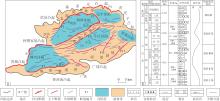
图1
渤海湾盆地东营凹陷地理位置及主要构造单元平面分布特征(a)和岩性-地层综合柱状图(b)"

表1
东营凹陷天然裂缝成因类型划分[4]"
| 成因类型 | 亚类 | 主要成因 |
|---|---|---|
| 构造裂缝 | 张裂缝 | 受单轴拉张或单轴挤压应力作用,岩石发生张破裂 |
| 剪裂缝 | 受双轴挤压或水平剪切应力影响,岩石发生剪切破裂 | |
| 成岩裂缝 | 层理缝 | 沿着层理面裂开形成的裂缝 |
| 收缩缝 | 成岩过程中黏土矿物脱水收缩形成的裂缝 | |
| 异常高压裂缝 | 异常高压缝 | 由于异常流体压力使得岩石破裂形成的裂缝 |
表2
东营凹陷构造裂缝力学成因类型划分"
| 成因类型 | 大类 | 亚类 | 主要力学成因机制 |
|---|---|---|---|
| 构造裂缝 | 剪裂缝 | 低角度张-剪复合裂缝(0° ~ 45°) | σ1水平挤压状态下产生的破裂 |
| 中-高角度剪裂缝(60° ~ 70°) | σ1直立状态下产生的剪破裂 | ||
| 中-高角度“Y”型裂缝(60° ~ 85°) | σ1直立状态下产生的剪破裂 | ||
| 张裂缝 | 高角度扭-张裂缝(80° ~ 90°) | σ2直立状态下产生的张-扭破裂 | |
| 高角度混合裂缝(70° ~ 80°) | σ1直立状态下产生的混合式破裂或σ3水平单轴伸展 | ||
| 近直立张裂缝(80° ~ 90°) | σ1直立状态下产生的张破裂或σ3水平单轴伸展 |

图2
东营凹陷页岩构造裂缝发育类型(岩心照片)a. 丰页1-2HF井,埋深3 999.3 m,Es4上;b. 樊页101HF井,埋深3 284.0 m,Es4上;c. 樊页101HF井,埋深3 999.3 m,Es4上;d. 滨689井,埋深3 399.8 m,Es3下;e. 牛页1-5HF井,埋深3 471.1 m,Es4上;f. 樊页101HF井,埋深3 256.1 m,Es3下;g. 樊页1井,埋深3 165.2 m,Es3下;h. 牛页1-5HF井,埋深3 562.0 m,Es4上;i. 利页5HF井,埋深3 500.2 m,Es3下;j. 丰页101HF井,埋深3 485.4 m,Es4上;k. 丰页1-12HF井,埋深3 451.9 m,Es4上;l. 滨689井,埋深3 467.4 m,Es4上;m. 樊页1井,埋深3 262.9 m,Es4上;n. 樊页1井,埋深3 191.2 m,Es3下;o. 丰页1-2HF井,埋深3 656.9 m,Es4上;p. 樊页3HF井,埋深3 921.4 m,Es4上;q. 樊页3HF井,埋深3 928.2 m,Es4上;r. 樊斜184井,埋深3 463.6 m,Es4上;s. 滨689井,埋深3 369.0 m,Es3下;t. 丰页1-12HF井,埋深3 344.6 m,Es4上;u. 牛页2HF井,埋深3 380.1 m,Es4上;v. 牛页2HF井,埋深3 505.0 m,Es3下;w. 樊页3HF井,埋深3 940.0 m,Es4上;x. 丰页1-4HF井,埋深3 614.2 m,Es4上;y. 牛页1-4HF井,埋深3 452.5 m,Es4上(a—e为低角度张-剪复合裂缝;f—j为中-高角度剪裂缝;k—o为高角度张-扭裂缝;p—t为中-高角度“Y”型裂缝;u为高角度混合裂缝;v—y为近直立张裂缝。)"


图3
东营凹陷构造裂缝倾角频率分布直方图a.博兴洼陷岩心观察统计;b.博兴洼陷成像测井统计;c.利津洼陷岩心观察统计;d.利津洼陷成像测井统计;e.民丰洼陷岩心观察统计;f.民丰洼陷成像测井统计;g.牛庄洼陷岩心观察统计;h.牛庄洼陷成像测井统计"


图4
东营凹陷断裂与裂缝走向叠合图a.沙四上亚段底面;b.沙三下亚段底面"


图5
东营凹陷成岩裂缝发育特征a. 丰页1-2HF井,埋深3 787.33 m,Es4上,岩心照片;b. 樊页1井,埋深3 286.1 m,Es4上,岩心照片;c. 利页2-1HF井,埋深3 686.3 m,Es3下,岩心照片;d. 樊斜184井,埋深3 531.7 m,Es4上,扫描电镜照片;e. 樊页101HF井,埋深3 433.9 m,Es4上,扫描电镜照片;f. 樊页1井,埋深3 243.2 m,Es3下,扫描电镜照片;g. 丰页1HF井,埋深3 605.2 m,Es4上,扫描电镜照片;h. 牛55-斜4井,埋深3 712.7 m,Es4上,扫描电镜照片;l. 丰页1HF井,埋深3 588.7 m,Es3下,扫描电镜照片(a—c为层理缝;d—i为收缩缝。)"


图6
东营凹陷异常高压裂缝发育特征(岩心照片)a. 樊斜184井,埋深3 434.1 m,Es4上;b. 樊页1井,埋深3 228.4 m,Es3下;c.樊页3HF井,埋深3 887.1 m,Es4上;d. 丰页1-20HF井,埋深3 468.9 m,Es3下;e. 牛页1-4HF井,埋深3 513.2 m,Es4上;f. 利页2HF井,埋深3 525.3 m,Es4上"


图7
东营凹陷岩心裂缝期次识别(岩心照片)a. 丰深斜-102井,埋深4 138.2 m,Es4上;b. 丰页1-12HF井,埋深3 543.7 m,Es4上;c. 牛页1-4HF井,埋深3 557.3 m,Es4上;d. 利页5HF井,埋深3 524.7 m,Es3下;e. 利页2HF井,埋深3 521.9 m,Es4上;f. 丰页1-17HF井,埋深3 695.2 m,Es4上(①—⑥代表裂缝发育期次;黄色、蓝色和粉色虚线代表地层线;红色实线代表微断层;粉色实线代表低角度张-剪复合裂缝;f1,f2,f3,f4s,f4x和f5代表断层编号。)"


图8
卷积神经网络预测东营凹陷主要构造界面裂缝分布特征a.预测裂缝剖面分布;b.馆陶组底界面;c.东营组底界面;d.沙三下亚段底界面;e.沙四上亚段底界面T1.馆陶组底界;T2.东营组底界;T3.沙二段底界;T4.沙三上亚段底界;T6s.沙三中亚段底界;T6.沙三下亚段底界;T7.沙四上亚段底界;T7x.沙四下亚段底界;Tr.孔店组底界;Tg.中生界底界;Tg2.古生界底界①沙四上亚段-沙三下亚段同构造期裂缝;②沙二段—东营期裂缝;③东营末期裂缝;④馆陶期—明化镇期裂缝(e图断裂为地震剖面解释的控洼边界断裂和主干控带断裂,断裂编号与图1相同。)"


图9
东营凹陷博兴洼陷FY3HF井岩心样品声发射测试曲线a. 样品FY3HF-1,发射角0°;b.样品FY3HF-2,发射角45°;c.样品FY3HF-3,发射角90°σ'. 轴向应力"


图10
东营凹陷页岩构造裂缝发育密度与总有机碳含量(TOC)关系图版a. 博兴洼陷,沙三下亚段;b. 利津洼陷,沙三下亚段;c. 民丰洼陷,沙三下亚段;d. 牛庄洼陷,沙三下亚段;e. 博兴洼陷,沙四上亚段;f. 利津洼陷,沙四上亚段;g. 民丰洼陷,沙四上亚段;h. 牛庄洼陷,沙四上亚段"


图11
东营凹陷页岩构造裂缝发育密度与脆性指数关系图版a. 博兴洼陷,沙三下亚段;b. 利津洼陷,沙三下亚段;c. 民丰洼陷,沙三下亚段;d. 牛庄洼陷,沙三下亚段;e. 博兴洼陷,沙四上亚段;f. 利津洼陷,沙四上亚段;g. 民丰洼陷,沙四上亚段;h. 牛庄洼陷,沙四上亚段"


图12
中-高角度剪裂缝和近直立张裂缝成因机制图解a.正断层成因安德森模式示意图,b.不同类型岩石破裂包络线;c.近直立张裂缝发育机制;d.高角度混合裂缝发育机制;e.“Y”型裂缝发育机制;f.中-高角度剪裂缝发育机制σ1.最大主应力;σ2.中间主应力;σ3.最小主应力;σ.正应力;τ.剪应力"


图13
近直立张裂缝与页岩层理相互作用模式图解a.Ⅰ型(张开型)相互作用模式;b.Ⅱ型(滑开型)相互作用模式;c.Ⅲ型(撕开型)相互作用模式;d.BY-1井,样品照片;e.BY-2井,样品照片;f.BY-3井,样品照片;g.丰页1-12HF井,埋深3 284.7 m,岩心照片;h.丰页1-17HF井,埋深3 629.4 m,岩心照片;i.樊页101HF井,埋深3 270.0 m,岩心照片(a—c为裂缝与页岩层理发育模式;d—f为三点弯实验结果;g—i为岩心观察裂缝发育样式。)"


图14
低角度张-剪复合裂缝成因机制图解a.水平挤压应力状态安德森模式示意图;b.低角度剪裂缝发育模式示意图;c.页岩直剪实验设置示意图;d.樊斜184井,埋深3 458.9 m,样品照片;e.牛55-斜3井,埋深3 794.0 m,样品照片;f.牛页2HF井,埋深3 525.4 m,样品照片;g.樊页101HF井,埋深3 284.0 m,Es4上,岩心照片;h.牛页1-5HF井,埋深3 471.1 m,Es4上,岩心照片;i.牛页1-8HF井,埋深3 622.3 m,Es4上,岩心照片;j—l.页理倾角分别为4°,18°和28°的页岩直剪实验破裂曲线[d—f.页理倾角分别为4°,18°和28°的页岩直剪实验结果照片;g—i.不同倾角页岩裂缝发育岩心照片(用来与实验结果进行对比)。]σ1.最大主应力;σ2.中间主应力;σ3.最小主应力"

| [1] | 邹才能, 潘松圻, 荆振华, 等. 页岩油气革命及影响[J]. 石油学报, 2020, 41(1): 1-12. |
| ZOU Caineng, PAN Songqi, JING Zhenhua, et al. Shale oil and gas revolution and its impact[J]. Acta Petrolei Sinica, 2020, 41(1): 1-12. | |
| [2] | 杨海风, 王飞龙, 胡安文, 等. 渤海湾盆地页岩油勘探现状、进展及展望[J]. 石油与天然气地质, 2025, 46(4): 1123-1135. |
| YANG Haifeng, WANG Feilong, HU Anwen, et al. Status quo, advances, and prospects of shale oil exploration in the Bohai Bay Basin[J]. Oil & Gas Geology, 2025, 46(4): 1123-1135. | |
| [3] | 韦自健, 盛家平, 张潇. 中—低成熟度页岩油原位转化对储集层的改造能力[J]. 新疆石油地质, 2023, 44(4): 485-496. |
| WEI Zijian, SHENG Jiaping, ZHANG Xiao. Stimulation capability of low-medium maturity shale oil reservoir during in-situ conversion[J]. Xinjiang Petroleum Geology, 2023, 44(4): 485-496. | |
| [4] | 曾联波, 马诗杰, 田鹤, 等. 富有机质页岩天然裂缝研究进展[J]. 地球科学, 2023, 48(7): 2427-2442. |
| ZENG Lianbo, MA Shijie, TIAN He, et al. Research progress of natural fractures in organic rich shale[J]. Earth Science, 2023, 48(7): 2427-2442. | |
| [5] | 曾联波, 巩磊, 宿晓岑, 等. 深层-超深层致密储层天然裂缝分布特征及发育规律[J]. 石油与天然气地质, 2024, 45(1): 1-14. |
| ZENG Lianbo, GONG Lei, SU Xiaocen, et al. Natural fractures in deep to ultra-deep tight reservoirs: Distribution and development[J]. Oil & Gas Geology, 2024, 45(1): 1-14. | |
| [6] | 刘艳祥, 吕文雅, 曾联波, 等. 鄂尔多斯盆地庆城油田长7页岩油储层多尺度裂缝三维地质建模[J]. 地学前缘, 2024, 31(5): 103-116. |
| LIU Yanxiang, Wenya LYU, ZENG Lianbo, et al. Three-dimensional modeling of multiscale fractures in Chang 7 shale oil reservoir in Qingcheng oilfield, Ordos Basin[J]. Earth Science Frontiers, 2024, 31(5): 103-116. | |
| [7] | 焦婷婷. 东营凹陷泥岩裂缝的特征成因与油气富集[J]. 石油地质与工程, 2010, 24(6): 22-25. |
| JIAO Tingting. Causes and characteristics of mudstone fracture and hydrocarbon accumulation in Dongying depression[J]. Petroleum Geology and Engineering, 2010, 24(6): 22-25. | |
| [8] | 袁静, 李春堂, 杨学君, 等. 东营凹陷盐家地区沙四段砂砾岩储层裂缝发育特征[J]. 中南大学学报(自然科学版), 2016, 47(5): 1649-1659. |
| YUAN Jing, LI Chuntang, YANG Xuejun, et al. Development characteristics of glutenite reservoir fractures of the fourth member of Shahejie Formation in Yanjiaarea, Dongying sag[J]. Journal of Central South University(Science and Technology), 2016, 47(5): 1649-1659. | |
| [9] | 何月明. 东营凹陷沙四上-沙三下亚段泥页岩储层裂缝特征及评价[D]. 青岛: 中国石油大学(华东), 2021. |
| HE Yueming. Fracture characteristics and evaluation of shale reservoir in the Lower Es3 and Upper Es4 sub-members, Dongying Depression[D]. Qingdao: China University of Petroleum(East China), 2021. | |
| [10] | 丁文龙, 李超, 李春燕, 等. 页岩裂缝发育主控因素及其对含气性的影响[J]. 地学前缘, 2012, 19(2): 212-220. |
| DING Wenlong, LI Chao, LI Chunyan, et al. Dominant factor of fracture development in shale and its relationship to gas accumulation[J]. Earth Science Frontiers, 2012, 19(2): 212-220. | |
| [11] | 王庶丞, 唐华风, 邹明倬, 等. 渤海湾盆地莱州湾凹陷南部斜坡带中生界火山岩裂缝特征及分布规律[J]. 吉林大学学报(地球科学版), 2024, 54(6): 1846-1859. |
| WANG Shucheng, TANG Huafeng, ZOU Mingzhuo, et al. Characteristics and distribution of fractures in Mesozoic volcanic rocks in southern slope of Laizhou Bay Depression, Bohai Bay Basin[J]. Journal of Jilin University(Earth Science Edition), 2024, 54(6): 1846-1859. | |
| [12] | 龙鹏宇, 张金川, 唐玄, 等. 泥页岩裂缝发育特征及其对页岩气勘探和开发的影响[J]. 天然气地球科学, 2011, 22(3): 525-532. |
| LONG Pengyu, ZHANG Jinchuan, TANG Xuan, et al. Feature of muddy shale fissure and its effect for shale gas exploration and development[J]. Natural Gas Geoscience, 2011, 22(3): 525-532. | |
| [13] | 王永诗, 巩建强, 陈冬霞, 等. 渤海湾盆地东营凹陷盐家地区深层砂砾岩油气藏相态演化及成藏过程[J]. 石油与天然气地质, 2023, 44(5): 1159-1172. |
| WANG Yongshi, GONG Jianqiang, CHEN Dongxia, et al. Phase evolution and accumulation mode of hydrocarbons in deep coarse-grained clastic reservoirs in the Yanjia area, Dongying Sag, Bohai Bay Basin[J]. Oil & Gas Geology, 2023, 44(5): 1159-1172. | |
| [14] | 赵宝银, 杨晓利, 徐颖新, 等. 渤海湾盆地南堡凹陷新生代构造演化特征及控藏作用[J]. 岩性油气藏, 2025, 37(5): 59-69. |
| ZHAO Baoyin, YANG Xiaoli, XU Yingxin, et al. Characteristics and reservoir control of Cenozoic tectonic evolution of Nanpu Sag, Bohai Bay Basin[J]. Lithologic Reservoirs, 2025, 37(5): 59-69. | |
| [15] | 雷文智, 陈冬霞, 王永诗, 等. 渤海湾盆地济阳坳陷东部深层砂砾岩多类型油气藏成藏机理及模式[J]. 石油与天然气地质, 2024, 45(1): 113-129. |
| LEI Wenzhi, CHEN Dongxia, WANG Yongshi, et al. Accumulation mechanism and model of multi-type deep coarse-grained siliciclastic reservoirs in the eastern Jiyang Depression, Bohai Bay Basin[J]. Oil & Gas Geology, 2024, 45(1): 113-129. | |
| [16] | 蒋成国. 利982井区沙三下亚段浊积岩储层预测及含油气有利区评价[D]. 青岛: 中国石油大学(华东), 2019. |
| JIANG Chengguo. Reservoir prediction and favorable oil-gas area evaluation for turbidite sandstone of Es3X in L982 wellblock[D]. Qingdao: China University of Petroleum (East China), 2019. | |
| [17] | 高健. 博兴洼陷古近系沙三下亚段细粒沉积特征与页岩油富集的关系[D]. 北京: 中国地质大学(北京), 2023. |
| GAO Jian. Relationship between fine-grained sedimentary characteristics and shale oil enrichment of the Lower Third Member of Paleogene Shahejie Formatinon, Boxing Depression[D]. Beijing: China University of Geosciences (Beijing), 2023. | |
| [18] | 冯有良, 周海民, 任建业, 等. 渤海湾盆地东部古近系层序地层及其对构造活动的响应[J]. 中国科学:地球科学, 2010, 40(10): 1356-1376. |
| FENG Youliang, ZHOU Haimin, REN Jianye, et al. Paleogene sequence stratigraphy in the east of the Bohai Bay Basin and its response to structural movement[J]. Science China Earth Sciences, 2010, 40(10): 1356-1376. | |
| [19] | 丁文龙, 许长春, 久凯, 等. 泥页岩裂缝研究进展[J]. 地球科学进展, 2011, 26(2): 135-144. |
| DING Wenlong, XU Changchun, Kai JIU, et al. The research progress of shale fractures[J]. Advances in Earth Science, 2011, 26(2): 135-144. | |
| [20] | 王子萌, 蒋裕强, 付永红, 等. 基于核磁共振表征渝西地区五峰组-龙一1亚段页岩储层孔隙结构及非均质性[J]. 地球科学, 2022, 47(2): 490-504. |
| WANG Zimeng, JIANG Yuqiang, FU Yonghong, et al. Characterization of pore structure and heterogeneity of shale reservoir from Wufeng Formation-sublayers Long-11 in western Chongqing based on nuclear magnetic resonance[J]. Earth Science, 2022, 47(2): 490-504. | |
| [21] | YU Fusheng, KOYI H. Cenozoic tectonic model of the Bohai Bay Basin in China[J]. Geological Magazine, 2016, 153(5/6): 866-886. |
| [22] | YANG Tian, CAO Yingchang, FRIIS H, et al. Diagenetic evolution and chemical changes of deep-water mudstones of Shahejie Formation in the Dongying Sag, Jiyang Depression, eastern China[J]. Marine and Petroleum Geology, 2018, 93: 14-32. |
| [23] | 郭小文, 陈家旭, 袁圣强, 等. 含油气盆地激光原位方解石U-Pb年龄对油气成藏年代的约束——以渤海湾盆地东营凹陷为例[J]. 石油学报, 2020, 41(3): 284-291. |
| GUO Xiaowen, CHEN Jiaxu, YUAN Shengqiang, et al. Constraint of in-situ calcite U-Pb dating by laser ablation on geochronology of hydrocarbon accumulation in petroliferous basins: A case study of Dongying Sag in the Bohai Bay Basin[J]. Acta Petrolei Sinica, 2020, 41(3): 284-291. | |
| [24] | 徐建春, 戴俊生. 利用声发射研究东营凹陷新生代构造期次[J]. 地质力学学报, 2004, 10(2): 172-178. |
| XU Jianchun, DAI Junsheng. Application of acoustic emission in the study of the number of cenozoic tectonic phases in the Dongying subbasin[J]. Journal of Geomechanics, 2004, 10(2): 172-178. | |
| [25] | 高键, 何生, 易积正. 焦石坝页岩气田中高密度甲烷包裹体的发现及其意义[J]. 石油与天然气地质, 2015, 36(3): 472-480. |
| GAO Jian, HE Sheng, YI Jizheng. Discovery of high density methane inclusions in Jiaoshiba shale gas field and its significance[J]. Oil & Gas Geology, 2015, 36(3): 472-480. | |
| [26] | 于正军, 张军华, 周昊, 等. 准噶尔盆地东南缘页岩油储层脆性预测与评价[J]. 吉林大学学报(地球科学版), 2024, 54(5): 1711-1723. |
| YU Zhengjun, ZHANG Junhua, ZHOU Hao, et al. Brittleness prediction and evaluation of shale oil reservoir in southeastern margin of Junggar Basin[J]. Journal of Jilin University(Earth Science Edition), 2024, 54(5): 1711-1723. | |
| [27] | 姚嘉琪. 松辽盆地南部泥页岩储层裂缝分布特征及综合评价[D]. 大庆: 东北石油大学, 2019. |
| YAO Jiaqi. Fracture distribution characteristics and comprehensive evaluation of shale reservoir in southern Songliao Basin[D]. Daqing: Northeast Petroleum University, 2019. | |
| [28] | FOSSEN H. Structural geology[M]. 2nd ed. Cambridge: Cambridge University Press, 2016. |
| [1] | 孙川翔, 张珂, 聂海宽, 苏海琨, 万成祥, 边瑞康, 俞凌杰, 杨振恒. 川东五峰组-龙马溪组深层-超深层页岩储层特征与差异[J]. 石油与天然气地质, 2025, 46(6): 1907-1926. |
| [2] | 李军亮, 刘惠民, 魏晓亮, 张奎华, 张鹏飞, 秦峰, 王勇, 张顺, 李政, 刘鑫金, 王伟庆, 孟伟. 咸化湖盆页岩自生矿物特征及其对微观孔隙发育的控制作用——以渤海湾盆地济阳坳陷沙河街组为例[J]. 石油与天然气地质, 2025, 46(6): 1980-1997. |
| [3] | 李军, 袁成灼, 尚晓庆, 吴涛, 吾尔妮萨罕·麦麦提敏, 许晨航, 徐泽阳, 徐会永. 成岩流体系统演化阶段与深层超压致密储层成因——以准噶尔盆地腹部地区为例[J]. 石油与天然气地质, 2025, 46(5): 1597-1613. |
| [4] | 杨海风, 王飞龙, 胡安文, 关超, 滑彦岐. 渤海湾盆地页岩油勘探现状、进展及展望[J]. 石油与天然气地质, 2025, 46(4): 1123-1135. |
| [5] | 庞宏, 刘国勇, 贾承造, 姜福杰, 姜林, 王建伟, 马学峰, 陈迪, 陈君青. 陆相断陷盆地全油气系统成藏动力场特征与有序分布模式——以渤海湾盆地南堡凹陷为例[J]. 石油与天然气地质, 2025, 46(4): 1136-1151. |
| [6] | 徐田武, 李素梅, 陈湘飞, 马学峰, 邓硕, 张莹莹. 渤海湾盆地东濮凹陷全油气系统特征及其成藏模式[J]. 石油与天然气地质, 2025, 46(4): 1152-1168. |
| [7] | 胡涛, 熊智明, 肖惠译, 徐田武, 徐云龙, 李素梅, 姜福杰, 黎茂稳, 姜林. 断陷湖盆全油气系统油气藏有序分布特征及差异富集机制——以渤海湾盆地东濮凹陷古近系沙河街组为例[J]. 石油与天然气地质, 2025, 46(4): 1169-1182. |
| [8] | 李素梅, 刘佳, 马学峰, 庞秋菊, 赵知非. 渤海湾盆地辽河坳陷西部凹陷全油气系统特征与勘探潜力[J]. 石油与天然气地质, 2025, 46(4): 1183-1199. |
| [9] | 张学成, 蔡全升, 王伟, 胡潜伟, 任丽娟, 苏奥, 胡明毅, 胡忠贵, 邓庆杰. 中-深层优质碎屑岩储层差异发育特征及其主控因素[J]. 石油与天然气地质, 2025, 46(3): 876-893. |
| [10] | 谈明轩, 袁赛赛, 陈绵培, 孙浩南, 马宏霞, 章诚诚. 西秦岭洮河盆地上三叠统窄陆架型海底扇发育特征与输运机制[J]. 石油与天然气地质, 2025, 46(3): 894-909. |
| [11] | 段金宝, 徐田武, 杨栋栋, 姜振学, 高永涛, 王德波, 李路, 袁波. 渤海湾盆地东濮凹陷洼陷带油气地质新认识与勘探突破[J]. 石油与天然气地质, 2025, 46(2): 377-391. |
| [12] | 李军亮, 王民, 秦峰, 王勇, 魏晓亮, 孟伟, 沈安超, 宋兆京, 余昌琦, 李俊乾, 刘嘉祺. 陆相富碳酸盐页岩纹层组合对页岩油富集的控制作用——以渤海湾盆地济阳坳陷古近系沙河街组页岩为例[J]. 石油与天然气地质, 2025, 46(2): 392-406. |
| [13] | 李卓奕, 谢敏. 渤海湾盆地东濮凹陷潜山油气成藏模式[J]. 石油与天然气地质, 2025, 46(2): 407-426. |
| [14] | 马桂丽, 陈君青, 岳长涛, 马跃, 王玉莹, 庞宏, 姜福杰, 火勋港. 低熟页岩干酪根分子结构及生烃特征——以渤海湾盆地辽河坳陷曙光地区古近系沙河街组为例[J]. 石油与天然气地质, 2025, 46(2): 427-442. |
| [15] | 游祖辉, 赵建华, 蒲秀刚, 刘可禹, 张伟, 王志昊, 时战楠, 韩文中, 官全胜, 王纪扬. 渤海湾盆地黄骅坳陷歧北次凹古近系沙河街组三段一亚段页岩含油性控制因素与页岩油富集模式[J]. 石油与天然气地质, 2025, 46(2): 443-461. |
| 阅读次数 | ||||||
|
全文 |
|
|||||
|
摘要 |
|
|||||
