

石油与天然气地质 ›› 2025, Vol. 46 ›› Issue (6): 1907-1926.doi: 10.11743/ogg20250611
孙川翔1,2,3( ), 张珂4, 聂海宽1,2,3(), 苏海琨4, 万成祥1,2,3, 边瑞康1,2,3, 俞凌杰1,2, 杨振恒1,2
收稿日期:2025-04-01
修回日期:2025-06-30
出版日期:2025-12-30
发布日期:2025-12-25
通讯作者:
聂海宽
E-mail:suncx.syky@sinopec.com;niehk.syky@sinopec.com
第一作者简介:孙川翔(1990—)硕士、副研究员,非常规油气地质。E‑mail: suncx.syky@sinopec.com。
基金项目:
Chuanxiang SUN1,2,3(), Ke ZHANG4, Haikuan NIE1,2,3(), Haikun SU4, Chengxiang WAN1,2,3, Ruikang BIAN1,2,3, Lingjie YU1,2, Zhenheng YANG1,2
Received:2025-04-01
Revised:2025-06-30
Online:2025-12-30
Published:2025-12-25
Contact:
Haikuan NIE
E-mail:suncx.syky@sinopec.com;niehk.syky@sinopec.com
摘要:
四川盆地五峰组-龙马溪组深层-超深层页岩气资源潜力大,但其储层特征与中-浅层存在显著差异。以川东凤来和梁平地区深层(埋深> 3 500 m)和超深层(埋深> 4 500 m)页岩为重点研究对象,通过场发射扫描电镜(FE-SEM)观测、高压压汞-气体吸附联合孔隙表征、聚焦离子束扫描电镜(FIB-SEM)三维孔隙重构、覆压孔-渗测试及流体包裹体显微测温等实验分析,结合与涪陵焦石坝中-浅层页岩储层的系统对比,阐明了深层-超深层页岩储层特征及其与中-浅层差异的主控因素。研究表明:①川东深层-超深层富有机质硅质页岩仍保持良好储集性能,表现为有机质孔主导的孔隙结构、相对较高的孔隙度和渗透率,并具有较强抗压实能力和有限裂缝-流体活动。②与中-浅层页岩储层相比,深层-超深层页岩无机质孔和微裂缝发育程度显著降低,介孔-宏孔占比增加,且受上覆压力影响渗透率显著下降。③深层-超深层与中-浅层储层差异主要受构造位置、矿物组分、成岩作用、构造演化和裂缝-流体活动共同控制。研究成果为四川盆地深层-超深层页岩气勘探开发提供了地质依据。
中图分类号:

图1
四川盆地东部五峰组埋深(a)、川东凤来和梁平地区研究区位置(b)以及川东五峰组-龙马溪组综合柱状图(c)"


图2
川东凤来地区JY11井五峰组-龙马溪组深层页岩孔隙特征(扫描电镜照片)a. 样品JY11-1,龙马溪组,埋深4 157.69 m,有机质内部孔隙发育较好;b.a图局部放大,发育大量圆形气孔,边缘光滑,呈圆-椭圆状;c. 样品JY11-12,五峰组,埋深4 184.36 m,有机质充填在石英颗粒和黏土矿物间;d.c图局部放大,有机质孔不发育;e. 样品JY11-6,埋深4 177.86 m,碳酸盐矿物粒缘缝、少量粒内溶蚀孔,黏土矿物收缩缝;f. 样品JY11-1,埋深4 177.86 m,顺层微裂缝,宽度几微米,未被充填"

表1
川东凤来地区JY11井五峰组-龙马溪组深层页岩孔容与孔隙比表面积"
| 层位 | 埋深/m | 孔容/(mL/g) | 孔容占比/% | 孔隙比表面积/(m2/g) | |||||
|---|---|---|---|---|---|---|---|---|---|
| 微孔 | 介孔 | 大孔 | 累计 | 微孔 | 介孔 | 宏孔 | |||
| 平均值 | 0.007 17 | 0.010 57 | 0.001 13 | 0.018 87 | 38 | 56 | 6 | 16.548 | |
| 龙马溪组 | 4 157.69 | 0.005 93 | 0.009 53 | 0.001 36 | 0.016 82 | 35 | 57 | 8 | 13.596 |
| 龙马溪组 | 4 167.25 | 0.006 18 | 0.010 53 | 0.001 07 | 0.017 78 | 35 | 59 | 6 | 14.615 |
| 龙马溪组 | 4 174.45 | 0.006 45 | 0.007 64 | 0.001 12 | 0.015 21 | 42 | 50 | 7 | 14.371 |
| 龙马溪组 | 4 177.86 | 0.003 51 | 0.007 14 | 0.000 91 | 0.011 56 | 30 | 62 | 8 | 8.437 |
| 龙马溪组 | 4 179.43 | 0.006 63 | 0.008 90 | 0.000 70 | 0.016 20 | 41 | 55 | 4 | 14.746 |
| 五峰组 | 4 182.56 | 0.008 52 | 0.013 48 | 0.000 91 | 0.022 91 | 37 | 59 | 4 | 20.014 |
| 五峰组 | 4 183.55 | 0.008 96 | 0.011 09 | 0.001 33 | 0.021 38 | 42 | 52 | 6 | 20.411 |
| 五峰组 | 4 184.36 | 0.011 17 | 0.016 28 | 0.001 55 | 0.029 00 | 39 | 56 | 5 | 26.197 |
表2
川东凤来地区JY11井五峰组-龙马溪组深层页岩覆压孔隙度和渗透率"
| 压力/MPa | 样品JY11-6 | 样品JY11-10 | 样品JY11-11 | |||
|---|---|---|---|---|---|---|
| 孔隙度/% | 渗透率/(10-3 μm2) | 孔隙度/% | 渗透率/(10-3 μm2) | 孔隙度/% | 渗透率/(10-3 μm2) | |
| 5 | 3.19 | 0.004 09 | 4.14 | 0.001 25 | 4.08 | 0.001 22 |
| 10 | 3.06 | 0.003 89 | 4.00 | 0.001 18 | 3.92 | 0.001 14 |
| 20 | 2.92 | 0.003 69 | 3.83 | 0.001 10 | 3.75 | 0.001 07 |
| 30 | 2.81 | 0.003 49 | 3.70 | 0.001 04 | 3.64 | 0.001 01 |
| 40 | 2.75 | 0.003 29 | 3.61 | 0.000 99 | 3.55 | 0.000 97 |
| 50 | 2.69 | 0.003 09 | 3.53 | 0.000 95 | 3.46 | 0.000 92 |

图3
川东凤来地区JY11井五峰组-龙马溪组深层页岩方解石脉流体包裹体特征(普通薄片显微照片)a. 样品JY11-15,方解石脉,透射光;b. 样品JY11-15,方解石脉中发育气-液两相盐水包裹体"

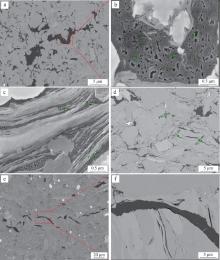
图4
川东梁平地区PS1井五峰组-龙马溪组超深层页岩孔隙特征(扫描电镜照片)a. 样品PS1-4,龙马溪组,埋深5 952.12 m,有机质充填于石英颗粒间;b.a图局部放大;c. 样品PS1-12,埋深5 961.86 m,黏土矿物间有机质孔发育;d. 样品PS1-11,埋深5 959.82 m,粒缘缝和黏土矿物间收缩缝放大;e. 样品PS1-3,埋深5 950.54 m,条带状生物碎屑;f. e图局部放大,生物碎屑边缘收缩缝发育,内部孔隙不发育"

表3
川东梁平地区PS1井五峰组-龙马溪组超深层页岩孔容与孔隙比表面积"
| 层位 | 埋深/m | 孔容/(mL/g) | 孔容占比/% | 孔隙比表面积/(m2/g) | |||||
|---|---|---|---|---|---|---|---|---|---|
| 微孔 | 介孔 | 大孔 | 累计 | 微孔 | 介孔 | 宏孔 | |||
| 平均值 | 0.008 760 | 0.013 690 | 0.008 060 | 0.030 510 | 29 | 45 | 26 | 20.343 | |
| 龙马溪组 | 5 950.54 | 0.006 120 | 0.011 560 | 0.001 081 | 0.018 761 | 33 | 62 | 6 | 14.523 |
| 龙马溪组 | 5 952.12 | 0.005 060 | 0.010 290 | 0.000 741 | 0.016 091 | 31 | 64 | 5 | 11.959 |
| 龙马溪组 | 5 953.55 | 0.008 690 | 0.011 790 | 0.003 965 | 0.024 445 | 36 | 48 | 16 | 19.793 |
| 龙马溪组 | 5 955.05 | 0.004 800 | 0.006 210 | 0.001 526 | 0.012 536 | 38 | 50 | 12 | 10.066 |
| 龙马溪组 | 5 957.91 | 0.016 320 | 0.012 410 | 0.060 193 | 0.088 923 | 18 | 14 | 68 | 36.592 |
| 五峰组 | 5 959.82 | 0.010 800 | 0.019 500 | 0.001 432 | 0.031 732 | 34 | 61 | 5 | 26.008 |
| 五峰组 | 5 961.86 | 0.009 040 | 0.016 430 | 0.000 951 | 0.026 421 | 34 | 62 | 4 | 21.473 |
| 五峰组 | 5 963.09 | 0.007 550 | 0.014 530 | 0.001 317 | 0.023 397 | 32 | 62 | 6 | 17.760 |
| 五峰组 | 5 965.41 | 0.010 460 | 0.020 490 | 0.001 346 | 0.032 296 | 32 | 63 | 4 | 24.920 |
表4
川东梁平地区PS1井五峰组-龙马溪组超深层页岩覆压孔隙度和渗透率"
| 压力/MPa | 样品PS1-3 | 样品PS1-5 | 样品PS1-12 | |||
|---|---|---|---|---|---|---|
| 孔隙度/% | 渗透率/(10-3 μm2) | 孔隙度/% | 渗透率/(10-3 μm2) | 孔隙度/% | 渗透率/(10-3 μm2) | |
| 5 | 6.75 | 0.002 75 | 4.76 | 0.005 16 | 5.87 | 0.010 80 |
| 10 | 6.56 | 0.002 40 | 4.57 | 0.004 99 | 5.68 | 0.008 81 |
| 20 | 6.41 | 0.002 22 | 4.42 | 0.004 82 | 5.47 | 0.007 14 |
| 30 | 6.32 | 0.002 05 | 4.32 | 0.004 65 | 5.34 | 0.005 97 |
| 40 | 6.22 | 0.001 87 | 4.23 | 0.004 48 | 5.21 | 0.005 64 |
| 50 | 6.17 | 0.001 69 | 4.18 | 0.004 32 | 5.14 | 0.005 47 |

图5
川东梁平地区PS1井五峰组-龙马溪组超深层页岩方解石脉流体包裹体特征(普通薄片显微照片)"

表5
四川盆地东部JY1井、JY11井和PS1井页岩储层特征"
| 井号 | JY1 | JY11 | PS1 |
|---|---|---|---|
| 埋深/m | 2 415 | 4 185 | 5 970 |
| TOC/% | 3.69 | 2.55 | 3.66 |
| 孔隙度/% | 4.70 | 4.10 | 5.30 |
| 主要孔隙类型和大小 | 有机质孔和无机质孔均发育、大小均一性高 | 有机质孔为主、孔隙大小均一性低 | 有机质孔为主、孔隙大小均一性较高 |
| 孔隙结构特征 | 微孔和介孔为主 | 微孔和介孔为主 | 微孔和介孔为主,大孔较发育 |
| GR/API | 182 | 168 | 184 |
| U/Th | 1.150 | 0.768 | 1.695 |
| 石英含量/% | 44.6 | 45.0 | 50.3 |
| 黏土矿物含量/% | 34.5 | 37.8 | 30.5 |
| 碳酸盐矿物含量/% | 9.7 | 8.3 | 8.1 |
| 岩相类型 | 高有机质黏土质硅质页岩 | 中有机质黏土质硅质页岩 | 高有机质硅质页岩 |
| WF2—LM4笔石页岩厚度/m | 19.0 | 16.0 | 17.2 |
| 压力系数 | 1.55 | 1.20 ~ 1.30 | 1.95 |

图6
四川盆地东部JY1井—JY11井—PS1井地层有效厚度(生物成因硅> 30%的地层连续厚度)"


图7
四川盆地东部JY11井(a)和PS1井(b)孔隙结构对比"


图8
四川盆地东部JY11井与PS1井覆压孔隙度和渗透率敏感性对比a.孔隙度-压力关系;b.渗透率-压力关系"
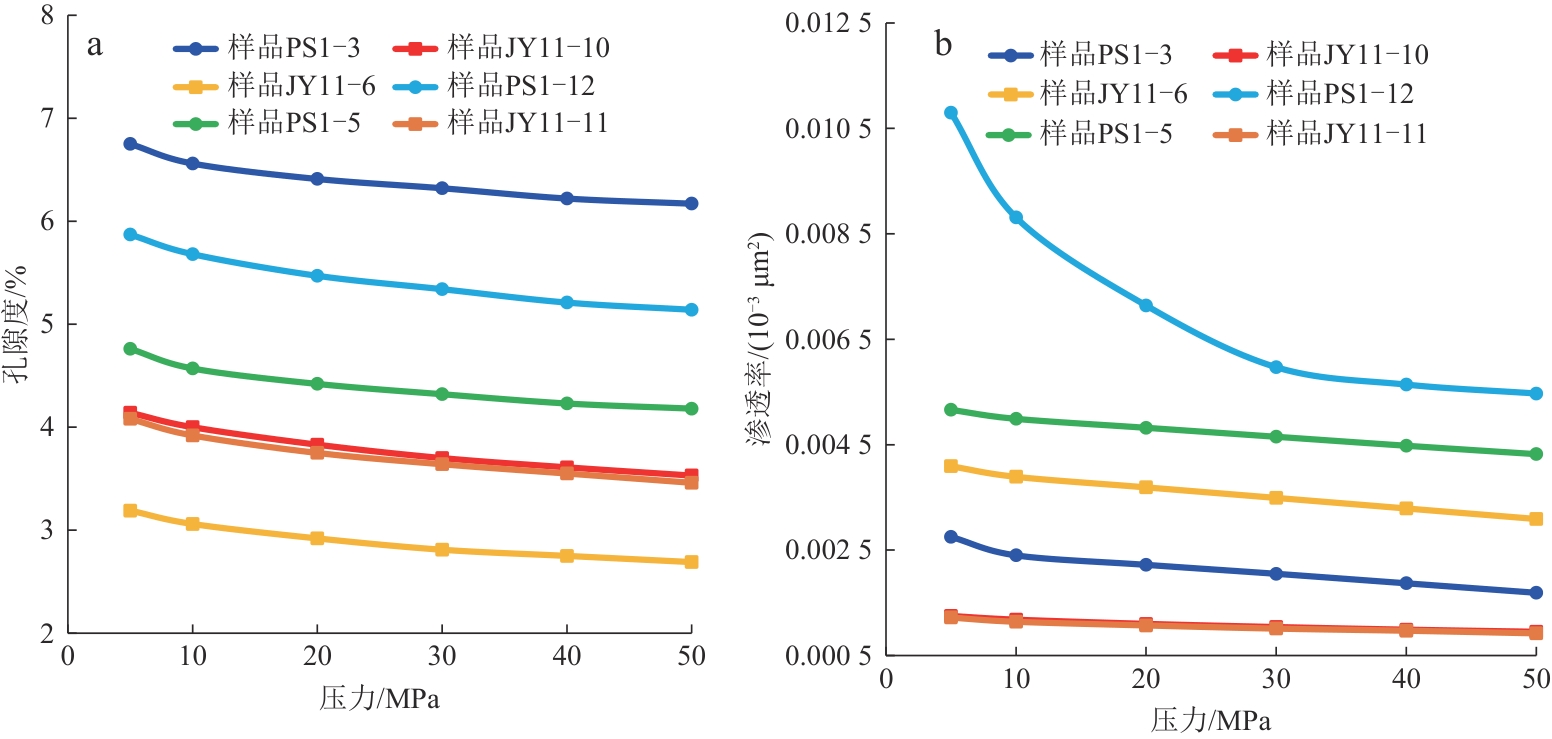

图9
四川盆地东部PS1井、JY11井和JY1井五峰组页岩裂缝发育情况岩心照片a. PS1井,埋深5 962.34 m;b. PS1井,埋深5 963.98 m;c. JY11井,埋深4 183.22 m;d. JY11井,埋深4 183.06 m;e. JY1井,埋深2 412.47 m;f. JY1井,埋深2 414.52 m"


图10
四川盆地东部JY1井(a)、JY11井(b)和PS1井(c)构造演化史与裂缝-流体活动史(JY1井数据引自文献[41])"

| [1] | 聂海宽, 党伟, 张珂, 等. 中国页岩气研究与发展20年: 回顾与展望[J]. 天然气工业, 2024, 44(3): 20-52. |
| NIE Haikuan, DANG Wei, ZHANG Ke, et al. Two decades of shale gas research & development in China: Review and prospects[J]. Natural Gas Industry, 2024, 44(3): 20-52. | |
| [2] | 马永生, 黎茂稳, 蔡勋育, 等. 中国海相深层油气富集机理与勘探开发: 研究现状、关键技术瓶颈与基础科学问题[J]. 石油与天然气地质, 2020, 41(4): 655-672, 683. |
| MA Yongsheng, LI Maowen, CAI Xunyu, et al. Mechanisms and exploitation of deep marine petroleum accumulations in China: Advances, technological bottlenecks and basic scientific problems[J]. Oil & Gas Geology, 2020, 41(4): 655-672, 683. | |
| [3] | SUN Chuanxiang, NIE Haikuan, DANG Wei, et al. Shale gas exploration and development in China: Current status, geological challenges, and future directions[J]. Energy & Fuels, 2021, 35(8): 6359-6379. |
| [4] | 黄志远. 东页深1井钻井设计与施工[J]. 内蒙古石油化工, 2019, 45(5): 45-46. |
| HUANG Zhiyuan. Design and construction of well-drilling for Well Shen-1 in Dongye[J]. Inner Mongolia Petrochemical Industry, 2019, 45(5): 45-46. | |
| [5] | 邹才能, 赵群, 丛连铸, 等. 中国页岩气开发进展、潜力及前景[J]. 天然气工业, 2021, 41(1): 1-14. |
| ZOU Caineng, ZHAO Qun, CONG Lianzhu, et al. Development progress, potential and prospect of shale gas in China[J]. Natural Gas Industry, 2021, 41(1): 1-14. | |
| [6] | 郭旭升, 马晓潇, 黎茂稳, 等. 陆相页岩油富集机理探讨[J]. 石油与天然气地质, 2023, 44(6): 1333-1349. |
| GUO Xusheng, MA Xiaoxiao, LI Maowen, et al. Mechanisms for lacustrine shale oil enrichment in Chinese sedimentary basins[J]. Oil & Gas Geology, 2023, 44(6): 1333-1349. | |
| [7] | 边瑞康, 孙川翔, 聂海宽, 等. 四川盆地东南部五峰组-龙马溪组深层页岩气藏类型、特征及勘探方向[J]. 石油与天然气地质, 2023, 44(6): 1515-1529. |
| BIAN Ruikang, SUN Chuanxiang, NIE Haikuan, et al. Types, characteristics, and exploration targets of deep shale gas reservoirs in the Wufeng-Longmaxi formations, southeastern Sichuan Basin[J]. Oil & Gas Geology, 2023, 44(6): 1515-1529. | |
| [8] | 施振生, 赵圣贤, 周天琪, 等. 海相含气页岩水平层理类型、成因及其页岩气意义——以川南地区古生界五峰组-龙马溪组为例[J]. 石油与天然气地质, 2023, 44(6): 1499-1514. |
| SHI Zhensheng, ZHAO Shengxian, ZHOU Tianqi, et al. Types and genesis of horizontal bedding of marine gas-bearing shale and its significance for shale gas: A case study of the Wufeng-Longmaxi shale in southern Sichuan Basin, China[J]. Oil & Gas Geology, 2023, 44(6): 1499-1514. | |
| [9] | 郭芪恒, 金振奎, 耿一凯, 等. 四川盆地龙马溪组页岩中碳酸盐矿物特征及对储集性能的影响[J]. 天然气地球科学, 2019, 30(5): 616-625. |
| GUO Qiheng, JIN Zhenkui, GENG Yikai, et al. The characteristics of carbonate minerals in the Longmaxi Formation gas shale and its impact on the reservoir performance in the Sichuan Basin[J]. Natural Gas Geoscience, 2019, 30(5): 616-625. | |
| [10] | 蒲泊伶, 董大忠, 耳闯, 等. 川南地区龙马溪组页岩有利储层发育特征及其影响因素[J]. 天然气工业, 2013, 33(12): 41-47. |
| PU Boling, DONG Dazhong, Chuang ER, et al. Favorable reservoir characteristics of the Longmaxi shale in the southern[J]. Natural Gas Industry, 2013, 33(12): 41-47. | |
| [11] | 李博, 于炳松, 史淼. 富有机质页岩有机质孔隙度研究——以黔西北下志留统五峰-龙马溪组为例[J]. 矿物岩石, 2019, 39(1): 92-101. |
| LI Bo, YU Bingsong, SHI Miao. Pore characteristics of organic-rich shale with high thermal maturity: A case study of the Lower Silurian Wufeng-Longmaxi Formation marine shale in northwestern Guizhou, China[J]. Mineralogy and Petrology, 2019, 39(1): 92-101. | |
| [12] | 赵圣贤, 刘勇, 李博, 等. 四川盆地泸州区块五峰组-龙马溪组页岩气储层孔隙连通性特征及模式[J]. 石油与天然气地质, 2024, 45(6): 1720-1735. |
| ZHAO Shengxian, LIU Yong, LI Bo, et al. Characteristics and patterns of the pore connectivity in shale gas reservoirs in the Wufeng-Longmaxi formations, Luzhou block, Sichuan Basin[J]. Oil & Gas Geology, 2024, 45(6): 1720-1735. | |
| [13] | 聂海宽, 张金川, 金之钧, 等. 论海相页岩气富集机理——以四川盆地五峰组—龙马溪组为例[J]. 地质学报, 2024, 98(3): 975-991. |
| NIE Haikuan, ZHANG Jinchuan, JIN Zhijun, et al. Enrichment mechanism of marine shale gas——A case study of the Wufeng Formation-Longmaxi Formation in the Sichuan Basin, SW China[J]. Acta Geologica Sinica, 2024, 98(3): 975-991. | |
| [14] | 唐洪明, 刘贤, 陈洋, 等. 不同构造单元页岩孔隙结构差异及其油气地质意义——以四川盆地泸州地区深层页岩为例[J]. 天然气工业, 2024, 44(5): 16-28. |
| TANG Hongming, LIU Xian, CHEN Yang, et al. Pore structure difference of shale in different structural units and its petroleum geological implications: A case study on deep shale in the Luzhou area, southern Sichuan Basin[J]. Natural Gas Industry, 2024, 44(5): 16-28. | |
| [15] | 郭旭升, 腾格尔, 魏祥峰, 等. 四川盆地深层海相页岩气赋存机理与勘探潜力[J]. 石油学报, 2022, 43(4): 453-468. |
| GUO Xusheng, BORJIGIN Tenger, WEI Xiangfeng, et al. Occurrence mechanism and exploration potential of deep marine shale gas in Sichuan Basin[J]. Acta Petrolei Sinica, 2022, 43(4): 453-468. | |
| [16] | 何治亮, 聂海宽, 胡东风, 等. 深层页岩气有效开发中的地质问题——以四川盆地及其周缘五峰组—龙马溪组为例[J]. 石油学报, 2020, 41(4): 379-391. |
| HE Zhiliang, NIE Haikuan, HU Dongfeng, et al. Geological problems in the effective development of deep shale gas: A case study of Upper Ordovician Wufeng-Lower Silurian Longmaxi formations in Sichuan Basin and its periphery[J]. Acta Petrolei Sinica, 2020, 41(4): 379-391. | |
| [17] | 聂海宽, 李沛, 党伟, 等. 四川盆地及周缘奥陶系—志留系深层页岩气富集特征与勘探方向[J]. 石油勘探与开发, 2022, 49(4): 648-659. |
| NIE Haikuan, LI Pei, DANG Wei, et al. Enrichment characteristics and exploration directions of deep shale gas of Ordovician-Silurian in the Sichuan Basin and its surrounding areas, China[J]. Petroleum Exploration and Development, 2022, 49(4): 648-659. | |
| [18] | 王红岩, 周尚文, 赵群, 等. 川南地区深层页岩气富集特征、勘探开发进展及展望[J]. 石油与天然气地质, 2023, 44(6): 1430-1441. |
| WANG Hongyan, ZHOU Shangwen, ZHAO Qun, et al. Enrichment characteristics, exploration and exploitation progress, and prospects of deep shale gas in the southern Sichuan Basin, China[J]. Oil & Gas Geology, 2023, 44(6): 1430-1441. | |
| [19] | 张成林, 赵圣贤, 张鉴, 等. 川南地区深层页岩气富集条件差异分析与启示[J]. 天然气地球科学, 2021, 32(2): 248-261. |
| ZHANG Chenglin, ZHAO Shengxian, ZHANG Jian, et al. Analysis and enlightenment of the difference of enrichment conditions for deep shale gas in southern Sichuan Basin[J]. Natural Gas Geoscience, 2021, 32(2): 248-261. | |
| [20] | 孙川翔, 聂海宽, 苏海琨, 等. 温压耦合作用下四川盆地深层龙马溪组页岩孔渗和岩石力学特征[J]. 石油勘探与开发, 2023, 50(1): 77-88. |
| SUN Chuanxiang, NIE Haikuan, SU Haikun, et al. Porosity, permeability and rock mechanics of Lower Silurian Longmaxi Formation deep shale under temperature-pressure coupling in the Sichuan Basin, SW China[J]. Petroleum Exploration and Development, 2023, 50(1): 77-88. | |
| [21] | 苏海琨, 聂海宽, 郭少斌, 等. 深层页岩含气量评价及其差异变化——以四川盆地威荣、永川页岩气田为例[J]. 石油实验地质, 2022, 44(5): 815-824. |
| SU Haikun, NIE Haikuan, GUO Shaobin, et al. Shale gas content evaluation for deep strata and its variation: A case study of Weirong, Yongchuan gas fields in Sichuan Basin[J]. Petroleum Geology and Experiment, 2022, 44(5): 815-824. | |
| [22] | 杨振恒, 陶国亮, 鲍云杰, 等. 南方海相深层页岩气储集空间差异化发育及保持机理探讨[J]. 石油实验地质, 2022, 44(5): 845-853, 865. |
| YANG Zhenheng, TAO Guoliang, BAO Yunjie, et al. Differential development and maintenance mechanism of reservoir space for marine shale gas in South China’s deep strata[J]. Petroleum Geology and Experiment, 2022, 44(5): 845-853, 865. | |
| [23] | 刘树根, 邓宾, 孙玮, 等. 四川盆地是“超级”的含油气盆地吗?[J]. 西华大学学报(自然科学版), 2020, 39(5): 20-35. |
| LIU Shugen, DENG Bin, SUN Wei, et al. May Sichuan Basin be a super petroliferous basin?[J]. Journal of Xihua University(Natural Science Edition), 2020, 39(5): 20-35. | |
| [24] | 张国伟, 郭安林, 王岳军, 等. 中国华南大陆构造与问题[J]. 中国科学: 地球科学, 2013, 43(10): 1553-1582. |
| ZHANG Guowei, GUO Anlin, WANG Yuejun, et al. Tectonics of South China continent and its implications[J]. Science China Earth Sciences, 2013, 43(10): 1553-1582. | |
| [25] | 聂海宽, 金之钧, 马鑫, 等. 四川盆地及邻区上奥陶统五峰组—下志留统龙马溪组底部笔石带及沉积特征[J]. 石油学报, 2017, 38(2): 160-174. |
| NIE Haikuan, JIN Zhijun, MA Xin, et al. Graptolites zone and sedimentary characteristics of Upper Ordovician Wufeng Formation-Lower Silurian Longmaxi Formation in Sichuan Basin and its adjacent areas[J]. Acta Petrolei Sinica, 2017, 38(2): 160-174. | |
| [26] | 郭旭升, 胡东风, 魏志红, 等. 涪陵页岩气田的发现与勘探认识[J]. 中国石油勘探, 2016, 21(3): 24-37. |
| GUO Xusheng, HU Dongfeng, WEI Zhihong, et al. Discovery and exploration of Fuling shale gas field[J]. China Petroleum Exploration, 2016, 21(3): 24-37. | |
| [27] | 赵圣贤, 刘勇, 李博, 等. 四川盆地泸州区块五峰组-龙马溪组页岩气储层孔隙连通性特征及模式[J]. 石油与天然气地质, 2024, 45(6): 1720-1735. |
| ZHAO Shengxian, LIU Yong, LI Bo, et al. Characteristics and patterns of the pore connectivity in shale gas reservoirs in the Wufeng-Longmaxi formations, Luzhou block, Sichuan Basin[J]. Oil & Gas Geology, 2024, 45(6): 1720-1735. | |
| [28] | 刘树根, 马文辛, JANSA L, 等. 四川盆地东部地区下志留统龙马溪组页岩储层特征[J]. 岩石学报, 2011, 27(8): 2239-2252. |
| LIU Shugen, MA Wenxin, JANSA L, et al. Characteristics of the shale gas reservoir rocks in the Lower Silurian Longmaxi Formation, East Sichuan Basin, China[J]. Acta Petrologica Sinica, 2011, 27(8): 2239-2252. | |
| [29] | 邹才能, 董大忠, 王玉满, 等. 中国页岩气特征、挑战及前景(一)[J]. 石油勘探与开发, 2015, 42(6): 689-701. |
| ZOU Caineng, DONG Dazhong, WANG Yuman, et al. Shale gas in China: Characteristics, challenges and prospects (Ⅰ)[J]. Petroleum Exploration and Development, 2015, 42(6): 689-701. | |
| [30] | 聂海宽, 张光荣, 李沛, 等. 页岩有机孔研究现状和展望[J]. 石油学报, 2022, 43(12): 1770-1787. |
| NIE Haikuan, ZHANG Guangrong, LI Pei, et al. Research status and prospect on organic matter pores in shale[J]. Acta Petrolei Sinica, 2022, 43(12): 1770-1787. | |
| [31] | 张光荣, 聂海宽, 唐玄, 等. 基于有机孔和生物成因硅优选页岩气富集高产层段的方法及应用——以四川盆地及其周缘五峰组—龙马溪组页岩为例[J]. 天然气地球科学, 2021, 32(6): 888-898. |
| ZHANG Guangrong, NIE Haikuan, TANG Xuan, et al. Optimization method and application of shale gas enrichment layer based on biogenic silica and organic matter pore: Case study of Wufeng-Longmaxi formations shale in the Sichuan Basin and its periphery[J]. Natural Gas Geoscience, 2021, 32(6): 888-898. | |
| [32] | 杨锐, 何生, 胡东风, 等. 焦石坝地区五峰组—龙马溪组页岩孔隙结构特征及其主控因素[J]. 地质科技情报, 2015, 34(5): 105-113. |
| YANG Rui, HE Sheng, HU Dongfeng, et al. Characteristics and the main controlling factors of micro-pore structure of the shale in Wufeng Formation-Longmaxi formation in Jiaoshiba area[J]. Bulletin of Geological Science and Technology, 2015, 34(5): 105-113. | |
| [33] | 魏富彬, 刘珠江, 陈斐然, 等. 川东南五峰组—龙马溪组深层、超深层页岩储层特征及其页岩气勘探意义[J]. 石油实验地质, 2023, 45(4): 751-760. |
| WEI Fubin, LIU Zhujiang, CHEN Feiran, et al. Characteristics of the deep and ultra-deep shale reservoirs of the Wufeng-Longmaxi formations in the southeastern Sichuan Basin and the significance of shale gas exploration[J]. Petroleum Geology and Experiment, 2023, 45(4): 751-760. | |
| [34] | ZHU Hongjian, JU Yiwen, QI Yu, et al. Impact of tectonism on pore type and pore structure evolution in organic-rich shale: Implications for gas storage and migration pathways in naturally deformed rocks[J]. Fuel, 2018, 228: 272-289. |
| [35] | DONG Tian, HARRIS N B, AYRANCI K, et al. Porosity characteristics of the Devonian Horn River shale, Canada: Insights from lithofacies classification and shale composition[J]. International Journal of Coal Geology, 2015, 141/142: 74-90. |
| [36] | ZOBACK M D. Reservoir geomechanics[M]. Cambridge: Cambridge University Press, 2007. |
| [37] | 何骁, 李武广, 党录瑞, 等. 深层页岩气开发关键技术难点与攻关方向[J]. 天然气工业, 2021, 41(1): 118-124. |
| HE Xiao, LI Wuguang, DANG Lurui, et al. Key technological challenges and research directions of deep shale gas development[J]. Natural Gas Industry, 2021, 41(1): 118-124. | |
| [38] | 叶玥豪, 陈伟, 汪华, 等. 四川盆地上二叠统大隆组页岩储层特征及其控制因素[J]. 石油与天然气地质, 2024, 45(4): 979-991. |
| YE Yuehao, CHEN Wei, WANG Hua, et al. Characteristics and determinants of shale reservoirs in the Upper Permian Dalong Formation, Sichuan Basin[J]. Oil & Gas Geology, 2024, 45(4): 979-991. | |
| [39] | 王红岩, 施振生, 孙莎莎, 等. 四川盆地及周缘志留系龙马溪组一段深层页岩储层特征及其成因[J]. 石油与天然气地质, 2021, 42(1): 66-75. |
| WANG Hongyan, SHI Zhensheng, SUN Shasha, et al. Characterization and genesis of deep shale reservoirs in the first member of the Silurian Longmaxi Formation in southern Sichuan Basin and its periphery[J]. Oil & Gas Geology, 2021, 42(1): 66-75. | |
| [40] | 孙川翔, 聂海宽, 刘光祥, 等. 石英矿物类型及其对页岩气富集开采的控制: 以四川盆地及其周缘五峰组-龙马溪组为例[J]. 地球科学, 2019, 44(11): 3692-3704. |
| SUN Chuanxiang, NIE Haikuan, LIU Guangxiang, et al. Quartz type and its control on shale gas enrichment and production: A case study of the Wufeng-Longmaxi formations in the Sichuan basin and its surrounding areas, China[J]. Earth Science, 2019, 44(11): 3692-3704. | |
| [41] | 赵建华, 金之钧, 金振奎, 等. 四川盆地五峰组—龙马溪组含气页岩中石英成因研究[J]. 天然气地球科学, 2016, 27(2): 377-386. |
| ZHAO Jianhua, JIN Zhijun, JIN Zhenkui, et al. The genesis of quartz in Wufeng-Longmaxi gas shales, Sichuan Basin[J]. Natural Gas Geoscience, 2016, 27(2): 377-386. | |
| [42] | 杨振恒, 陶国亮, 鲍云杰, 等. 南方海相深层页岩气储集空间差异化发育及保持机理探讨[J]. 石油实验地质, 2022, 44(5): 845-853, 865. |
| YANG Zhenheng, TAO Guoliang, BAO Yunjie, et al. Differential development and maintenance mechanism of reservoir space for marine shale gas in South China’s deep strata[J]. Petroleum Geology and Experiment, 2022, 44(5): 845-853, 865. | |
| [43] | 聂海宽, 何治亮, 刘光祥, 等. 四川盆地五峰组—龙马溪组页岩气优质储层成因机制[J]. 天然气工业, 2020, 40(6): 31-41. |
| NIE Haikuan, HE Zhiliang, LIU Guangxiang, et al. Genetic mechanism of high-quality shale gas reservoirs in the Wufeng-Longmaxi Fms in the Sichuan Basin[J]. Natural Gas Industry, 2020, 40(6): 31-41. | |
| [44] | 李东晖, 刘光祥, 聂海宽, 等. 焦石坝背斜上部气层开发特征及影响因素[J]. 地球科学, 2019, 44(11): 3653-3661. |
| LI Donghui, LIU Guangxiang, NIE Haikuan, et al. Development characteristics and influencing factors of upper gas reservoir in Jiaoshiba anticline[J]. Earth Science, 2019, 44(11): 3653-3661. | |
| [45] | NIE Haikuan, HE Zhiliang, WANG Ruyue, et al. Temperature and origin of fluid inclusions in shale veins of Wufeng-Longmaxi formations, Sichuan Basin, South China: Implications for shale gas preservation and enrichment[J]. Journal of Petroleum Science and Engineering, 2020, 193: 107329. |
| [46] | 腾格尔, 卢龙飞, 俞凌杰, 等. 页岩有机质孔隙形成、保持及其连通性的控制作用[J]. 石油勘探与开发, 2021, 48(4): 687-699. |
| BORJIGIN Tenger, LU Longfei, YU Lingjie, et al. Formation,preservation and connectivity control of organic pores in shale[J]. Petroleum Exploration and Development, 2021, 48(4): 687-699. | |
| [47] | MILLIKEN K L, CURTIS M E. Shale diagenesis: Processes and implications for porosity and permeability evolution[Z]. Shales and Mudstones: Volume 2. Petrography and Diagenesis. Society for Sedimentary Geology, 2012. |
| [48] | 何治亮, 胡宗全, 聂海宽, 等. 四川盆地五峰组—龙马溪组页岩气富集特征与“建造—改造”评价思路[J]. 天然气地球科学, 2017, 28(5): 724-733. |
| HE Zhiliang, HU Zongquan, NIE Haikuan, et al. Characterization of shale gas enrichment in the Wufeng-Longmaxi Formation in the Sichuan Basin and its evaluation of geological construction-transformation evolution sequence[J]. Natural Gas Geoscience, 2017, 28(5): 724-733. | |
| [49] | 梁志凯, 姜振学, 吴伟, 等. 川南长宁地区不同构造单元五峰组-龙马溪组流体包裹体特征及其地质意义[J]. 中南大学学报(自然科学版), 2022, 53(9): 3652-3665. |
| LIANG Zhikai, JIANG Zhenxue, WU Wei, et al. Characteristics and geological significance of fluid inclusion of Wufeng-Longmaxi Formation in different tectonic units in Changning area, southern Sichuan[J]. Journal of Central South University (Science and Technology), 2022, 53(9): 3652-3665. | |
| [50] | JIN Zhijun, NIE Haikuan, LIU Quanyou, et al. Source and seal coupling mechanism for shale gas enrichment in upper Ordovician Wufeng Formation-Lower Silurian Longmaxi Formation in Sichuan Basin and its periphery[J]. Marine and Petroleum Geology, 2018, 97: 78-93. |
| [51] | LIU Wenping, WU Juan, JIANG Hua, et al. Cenozoic exhumation and shale-gas enrichment of the Wufeng-Longmaxi Formation in the southern Sichuan Basin, western China[J]. Marine and Petroleum Geology, 2021, 125: 104865. |
| [52] | 马新华, 谢军, 雍锐, 等. 四川盆地南部龙马溪组页岩气储集层地质特征及高产控制因素[J]. 石油勘探与开发, 2020, 47(5): 841-855. |
| MA Xinhua, XIE Jun, YONG Rui, et al. Geological characteristics and high production control factors of shale gas reservoirs in Silurian Longmaxi Formation, southern Sichuan Basin, SW China[J]. Petroleum Exploration and Development, 2020, 47(5): 841-855. | |
| [53] | 王丹丹, 姜振学, 杜威, 等. 气藏抬升过程中孔隙结构差异特征及演化模式——以四川盆地及周缘五峰组—龙马溪组页岩储层为例[J]. 地质学报, 2025, 99(4): 1381-1397. |
| WANG Dandan, JIANG Zhenxue, DU Wei, et al. Pore structure difference characteristics and evolution model in the process of gas reservoir uplift: A case study of the shale reservoir of Wufeng Formation-Longmaxi Formation in Sichuan Basin and its surrounding areas[J]. Acta Geologica Sinica, 2025, 99(4): 1381-1397. | |
| [54] | WANG Duo, LI Xiao, LI Shouding, et al. Evolution of pore structure and methane adsorption in Lower Silurian Longmaxi shale: Implications for uplifted shale gas reservoirs[J]. Rock Mechanics and Rock Engineering, 2024, 57(8): 5335-5353. |
| [1] | 郭旭升, 赵培荣, 张宇, 申宝剑, 李倩文, 李沛, 李雄, 钱恪然, 蔡生娟, 马晓潇, 李鹏. 中国陆相页岩油分类分级评价的现状、挑战与发展趋势[J]. 石油与天然气地质, 2025, 46(6): 1745-1761. |
| [2] | 张宇, 李军, 王烽, 张永, 王敏, 孙伟. 中国石化页岩层系石油探明储量申报实践与思考[J]. 石油与天然气地质, 2025, 46(6): 1762-1777. |
| [3] | 郭彤楼, 董晓霞, 魏力民, 黄思钦, 冯少柯. 深层-超深层海相页岩气差异富集与高产机理[J]. 石油与天然气地质, 2025, 46(6): 1792-1806. |
| [4] | 姚红生, 张培先, 何希鹏, 高玉巧, 高全芳, 万静雅, 周頔娜. 四川盆地及其周缘地区五峰组-龙马溪组页岩气藏类型及勘探实践[J]. 石油与天然气地质, 2025, 46(6): 1807-1822. |
| [5] | 聂海宽, 苏海琨, 张珂, 林拓, 刘忠宝, 李沛, 戎佳, 王宇哲. 古老地层页岩气富集特征与勘探方向——来自中-上扬子地区寒武系的启示[J]. 石油与天然气地质, 2025, 46(6): 1840-1859. |
| [6] | 卢龙飞, 刘旺威, 刘伟新, 鲍芳, 周圆圆, 俞凌杰, 申宝剑. 四川盆地二叠系大隆组硅质页岩碳酸盐交代作用及其对页岩储层发育的影响[J]. 石油与天然气地质, 2025, 46(6): 1860-1873. |
| [7] | 杜心宇, 钱门辉, 刘雅慧, 亓华胜, 朱峰, 李志明, 俞凌杰, 李楚雄, 张文涛, 冷筠滢. 四川盆地复兴地区中-下侏罗统陆相页岩储层流体赋存规律与源-储耦合特征[J]. 石油与天然气地质, 2025, 46(6): 1874-1891. |
| [8] | 高波, 戎佳, 张明何, 刘自亮, 燕继红, 杜伟, 李王鹏. 川北地区下寒武统筇竹寺组页岩岩相类型及分布特征[J]. 石油与天然气地质, 2025, 46(6): 1892-1906. |
| [9] | 何希鹏, 昝灵, 高玉巧, 蔡潇, 陈鹏, 花彩霞, 白鸾羲, 张琬璐. 苏北盆地低有机碳含量陆相页岩层系页岩油富集高产机理与成藏模式[J]. 石油与天然气地质, 2025, 46(6): 1927-1946. |
| [10] | 高玉巧, 蔡潇, 夏威, 马晓东, 昝灵, 花彩霞, 李辉, 朱一川, 王雨梦. 苏北盆地古近系泰州组二段页岩油储层差异成储机理[J]. 石油与天然气地质, 2025, 46(6): 1947-1959. |
| [11] | 刘惠民, 李军亮, 刘鑫金, 于福生, 闫嘉杰, 王勇, 任嘉, 冯海风, 魏晓亮, 杨晨. 渤海湾盆地东营凹陷沙四上亚段-沙三下亚段页岩裂缝发育特征及成因机制[J]. 石油与天然气地质, 2025, 46(6): 1960-1979. |
| [12] | 李军亮, 刘惠民, 魏晓亮, 张奎华, 张鹏飞, 秦峰, 王勇, 张顺, 李政, 刘鑫金, 王伟庆, 孟伟. 咸化湖盆页岩自生矿物特征及其对微观孔隙发育的控制作用——以渤海湾盆地济阳坳陷沙河街组为例[J]. 石油与天然气地质, 2025, 46(6): 1980-1997. |
| [13] | 王恩泽, 黎茂稳, 唐勇, 马晓潇, 钱门辉, 曹婷婷, 李志明, 付英潇, 金之钧. 准噶尔盆地吉木萨尔凹陷二叠系芦草沟组陆相页岩油甜点评价与立体开发可行性分析[J]. 石油与天然气地质, 2025, 46(6): 1998-2011. |
| [14] | 孙中良, 李志明, 何文军, 冷筠滢, 祝庆敏, 刘得光, 王濡岳. 准噶尔盆地玛湖凹陷风城组页岩源-储协同演化机理[J]. 石油与天然气地质, 2025, 46(6): 2012-2025. |
| [15] | 王光付, 王海波, 郭建春, 谢凌志, 徐克, 李凤霞, 周彤, 陈世敬. 四川盆地侏罗系湖相页岩油气压裂开采技术难点与展望[J]. 石油与天然气地质, 2025, 46(6): 2026-2040. |
| 阅读次数 | ||||||
|
全文 |
|
|||||
|
摘要 |
|
|||||
