

Oil & Gas Geology ›› 2025, Vol. 46 ›› Issue (2): 575-585.doi: 10.11743/ogg20250216
• Methods and Technologies • Previous Articles Next Articles
Dehua ZHOU1( ), Yong YANG2, Yunhai WANG3, Chuanxiang SUN4, Yongwang ZHENG3(), Anhai ZHONG2, Mingjing LU2, Ke ZHANG5
Received:2024-07-04
Revised:2024-11-13
Online:2025-04-30
Published:2025-04-27
Contact:
Yongwang ZHENG
E-mail:zhoudh@sinopec.com;zhengyw.hdsj@sinopec.com
CLC Number:
Dehua ZHOU, Yong YANG, Yunhai WANG, Chuanxiang SUN, Yongwang ZHENG, Anhai ZHONG, Mingjing LU, Ke ZHANG. Mechanism and application of supercritical carbon dioxide hybrid fracturing: A case study of shale oil in the Jiyang Depression, Bohai Bay Basin[J]. Oil & Gas Geology, 2025, 46(2): 575-585.
Add to citation manager EndNote|Reference Manager|ProCite|BibTeX|RefWorks
Table 1
Comparison of key parameters of varying media for non-aqueous fracturing"
| 参数 | 液化石油气(LPG) | 液化天然气(LNG) | 液氮(N2) | 二氧化碳(CO2) | 超临界二氧化碳(SC-CO2) |
|---|---|---|---|---|---|
| 表面张力 | 低 | 低 | 高于CO2 | 极低 | 零 |
| 地层深度 | 深、浅均宜 | 深、浅均宜 | 仅浅部可用 | 深、浅均宜 | 深、浅均宜 |
| 黏度/携砂能力 | 中等黏度/携砂较好 | 低黏度/携砂较差 | 中等黏度/携砂好于CO2 | 低黏度/携砂差 | 低黏度/携砂差 |
| 气体分离与返排 | 易分离,返排快 | 可二次利用,返排快 | 需简单处理和清洁 | 难分离,返排彻底 | 可二次利用,返排快且彻底 |
| 毒性 | 强 | 无 | 无 | 弱 | 弱 |
| 环保性 | 需要少量水,利于环保 | 环保 | 环保 | CO2逸散于大气中 | 环保,超临界CO2可二次利用 |
| 初始成本 | 高 | 低 | 中等 | 高 | 高 |
| 运输成本 | 中等 | 低 | 高 | 高 | 很高 |
| 经济性 | NPV低 | NPV中等 | NPV较高 | NPV高 | NPV最高 |
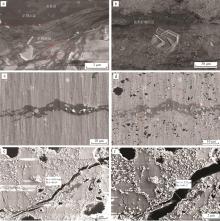
Fig.1
Scanning electron microscope (SEM) images of water-rock interactions in SC-CO2 environment at a burial depth of 4 111 m in well QY-1 in the 2nd member of the Funing Formation, Subei Basin"


Fig.2
Impacts of water-rock interactions in SC-CO2 environment on shale reservoirs in well QY-1 in the 2nd member of the Funing Formation, Subei Basin"
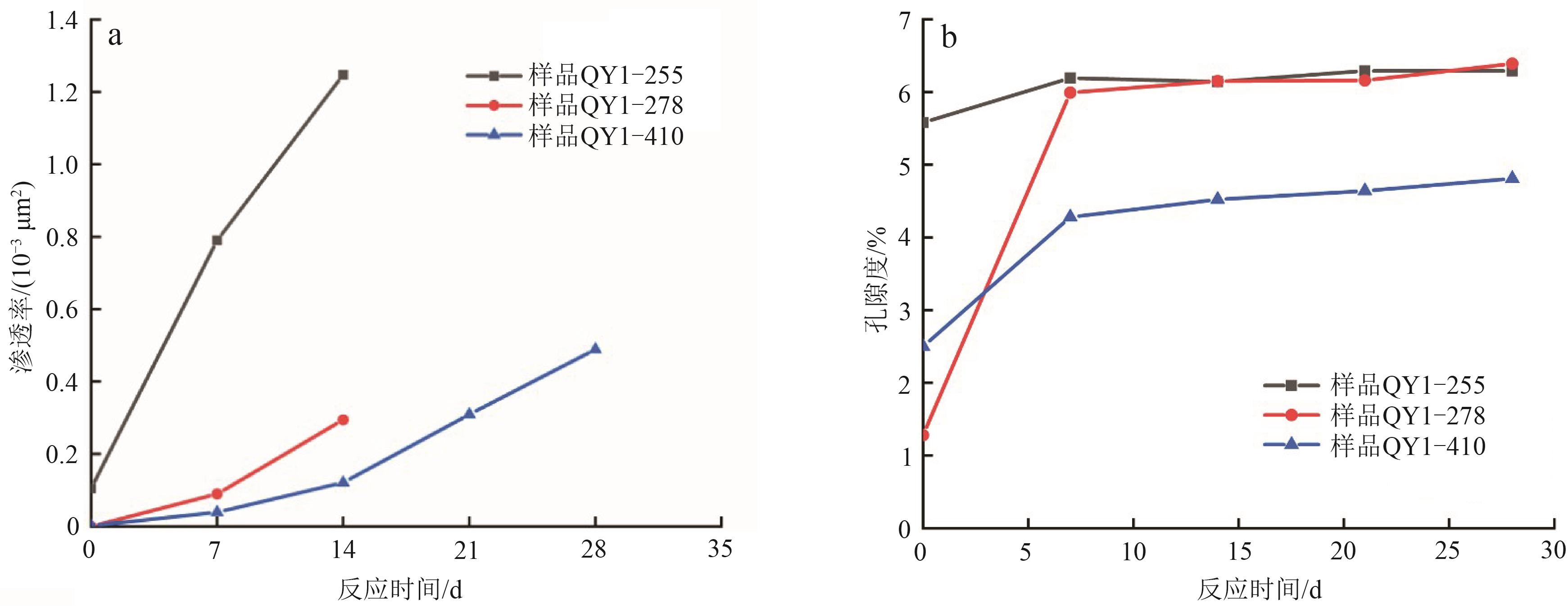

Fig.3
Viscosity variation curve of the CO2-shale oil system with CO2 concentration in well Y-1in the 3rd member of the Shahejie Formation, Shengli oilfield"
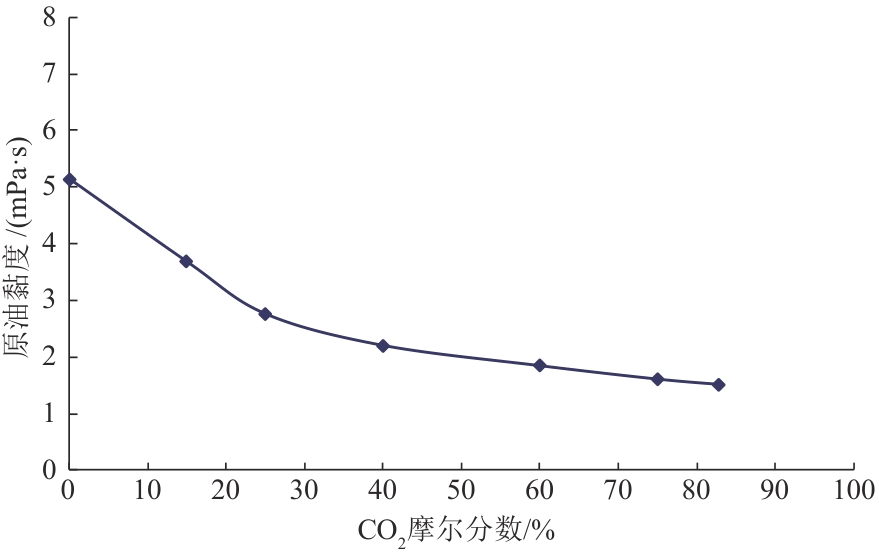

Fig.4
SC-CO2-induced ratio of producing to total reserves of crude oil in shale pores and fractures of varying sizes in well Y-1 in the 3rd member of the Shahejie Formation, Shengli oilfield"


Fig.5
Effects of crude oil extraction with SC-CO2 under varying extraction numbers and durations in well Y-1 in the 3rd member of the Shahejie Formation, Shengli oilfield"


Fig.6
Brazilian test-derived load-displacement curves of shales under dry and SC-CO2-water saturation conditions in well Y-1 in the 3rd member of the Shahejie Formation, Shengli oilfield"
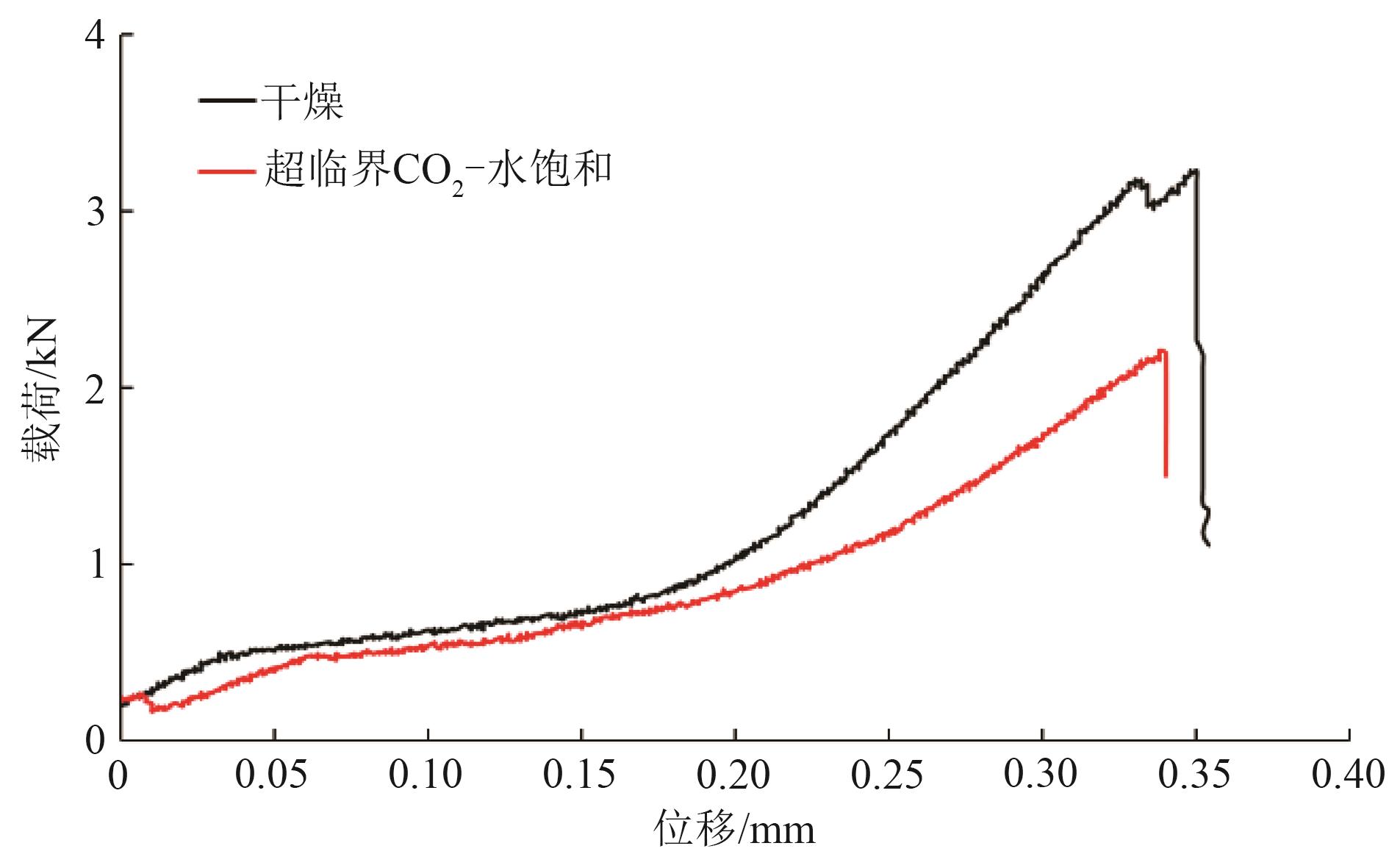

Fig.7
Brazilian test-derived fracture morphologies of shales under varying experimental conditions in well Y-1 in the 3rd member of the Shahejie Formation, Shengli oilfield"

Fig.8
Fracture morphologies of shales under SC-CO2 dry fracturing (a) and SC-CO2 hybrid fracturing (b) in well Y-1 in the 3rd member of the Shahejie Formation, Shengli oilfield"
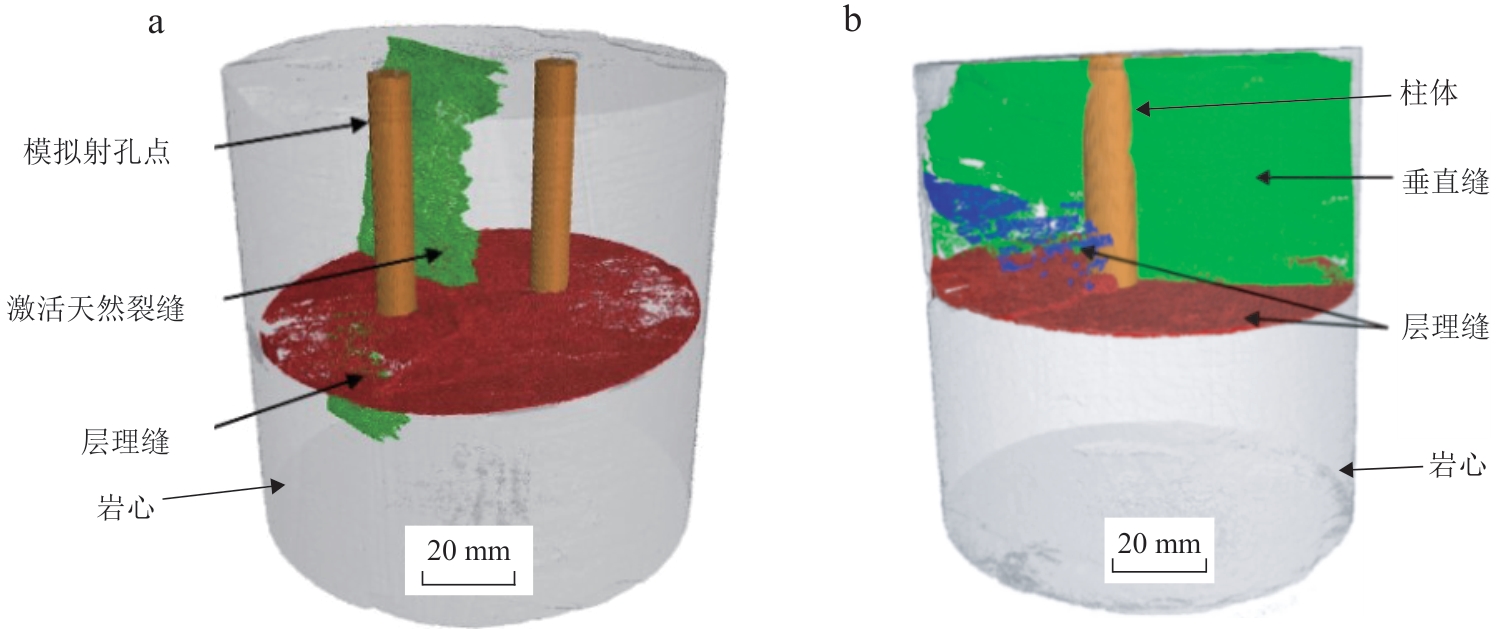
Table 2
Quality and average pressure of CO2 injected into each section of well Y-1"
| 压裂段号 | CO2注入量/t | 平均注入压力/MPa | 压裂段号 | CO2注入量/t | 平均注入压力/MPa | 压裂段号 | CO2注入量/t | 平均注入压力/MPa |
|---|---|---|---|---|---|---|---|---|
| 1 | 250 | 49.3 | 9 | 260 | 49.0 | 17 | 260 | 51.5 |
| 2 | 250 | 47.3 | 10 | 240 | 54.5 | 18 | — | — |
| 3 | 260 | 51.6 | 11 | 240 | 48.1 | 19 | 240 | 53.1 |
| 4 | 250 | 53.2 | 12 | 240 | 48.4 | 20 | — | — |
| 5 | 260 | 50.8 | 13 | 250 | 53.2 | 21 | — | — |
| 6 | 250 | 49.4 | 14 | 260 | 54.7 | 22 | — | — |
| 7 | 260 | 55.1 | 15 | 250 | 49.8 | 23 | — | — |
| 8 | 260 | 50.6 | 16 | — | — | 24 | — | — |
Table 3
Comparison of design schemes for fracturing in wells with and without CO2 injection"
| 参数 | 水平段长/m | 垂深/m | 段数 | 段长/m | 簇数 | 加液强度/(m3/m) | 加砂强度/(m3/m) | 平均砂比/% |
|---|---|---|---|---|---|---|---|---|
| Y-1井(注入CO2) | 1 739 | 3 500 | 24 | 57 ~ 88 | 7 ~ 8 | 43.11 | 3.06 | 7.42 |
| Y-2井(未注入CO2) | 1 732 | 3 615 ~ 3 745 | 28 | 62 ~ 70 | 7 ~ 8 | 46.20 | 3.04 | 6.80 |

Fig.9
Comparison of fracture propagation pressure in well Y-1 under fracturing in the 3rd member of the Shahejie Formation, Shengli oilfield"


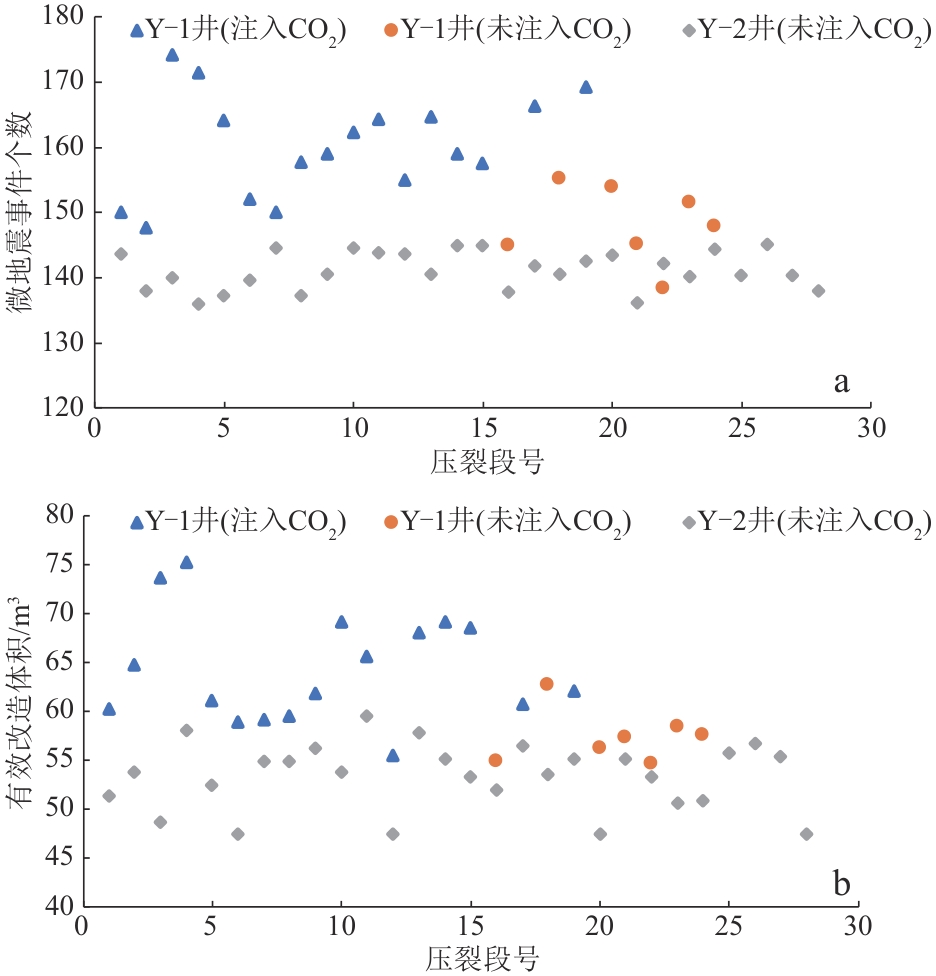
Fig.10
Comparison of fracture monitoring results in well Y-1 in the 3rd member of the Shahejie Formation, Shengli oilfield"
| 1 | 金之钧, 王冠平, 刘光祥, 等. 中国陆相页岩油研究进展与关键科学问题[J]. 石油学报, 2021, 42(7): 821-835. |
| JIN Zhijun, WANG Guanping, LIU Guangxiang, et al. Research progress and key scientific issues of continental shale oil in China[J]. Acta Petrolei Sinica, 2021, 42(7): 821-835. | |
| 2 | 郭旭升, 马晓潇, 黎茂稳, 等. 陆相页岩油富集机理探讨[J]. 石油与天然气地质, 2023, 44(6): 1333-1349. |
| GUO Xusheng, MA Xiaoxiao, LI Maowen, et al. Mechanisms for lacustrine shale oil enrichment in Chinese sedimentary basins[J]. Oil & Gas Geology, 2023, 44(6): 1333-1349. | |
| 3 | RIBEIRO L H, LI Huina, BRYANT J E. Use of a CO2-hybrid fracturing design to enhance production from unpropped-fracture networks[J]. SPE Production & Operations, 2017, 32(1): 28-40. |
| 4 | YANG Feng, XIE Congjiao, XU Shang, et al. Supercritical methane sorption on organic-rich shales over a wide temperature range[J]. Energy & Fuels, 2017, 31(12): 13427-13438. |
| 5 | PERERA M S A, RANJITH P G, VIETE D R. Effects of gaseous and super-critical carbon dioxide saturation on the mechanical properties of bituminous coal from the Southern Sydney Basin[J]. Applied Energy, 2013, 110: 73-81. |
| 6 | BLEAKLEY W B. Mitchell energy foam fracs tight gas zones[J]. Petroleum Engineer International, 1980, 52(15): 24, 26, 28. |
| 7 | WENDORFF C L, AINLEY B R. Massive hydraulic fracturing of high-temperature wells with stable frac foams[C]//SPE Annual Technical Conference and Exhibition, San Antonio, 1981. Richardson: Society of Petroleum Engineers, 1981: SPE-10257-MS. |
| 8 | GABRIS S J, TAYLOR J L III. The utility of CO2 as an energizing component for fracturing fluids[J]. SPE Production Engineering, 1986, 1(5): 351-358. |
| 9 | GRUNDMANN S R, LORD D L. Foam stimulation[J]. Journal of Petroleum Technology, 1983, 35(3): 597-602. |
| 10 | HARRIS P E, KLEBENOW D E, KUNDERT P D. Constant-internal-phase design improves stimulation results[J]. SPE Production Engineering, 1991, 6(1): 15-19. |
| 11 | WARD V L. N2 and CO2 in the oil field: Stimulation and completion applications[J]. SPE Production Engineering, 1986, 1(4): 275-278. |
| 12 | LILLIES A T, KING S R. Sand fracturing with liquid carbon dioxide[C]//SPE Production Technology Symposium, Hobbs, 1982. Richardson: Society of Petroleum Engineers, 1982: SPE-11341-MS. |
| 13 | BURKE L H, NEVISON G W, PETERS W E. Improved unconventional gas recovery with energized fracturing fluids: Montney example[C]//SPE Eastern Regional Meeting, Columbus, 2011. Richardson: Society of Petroleum Engineers, 2011: SPE-149344-MS. |
| 14 | 姚红生, 云露, 昝灵, 等. 苏北盆地溱潼凹陷阜二段断块型页岩油定向井开发模式及实践[J]. 油气藏评价与开发, 2023, 13(2): 141-151. |
| YAO Hongsheng, YUN Lu, ZAN Ling, et al. Development mode and practice of fault-block oriented shale oil well in the second member of Funing Formation, Qintong Sag, Subei Basin[J]. Petroleum Reservoir Evaluation and Development, 2023, 13(2): 141-151. | |
| 15 | 张志超, 柏明星, 杜思宇. 页岩油藏注CO2驱孔隙动用特征研究[J]. 油气藏评价与开发, 2024, 14(1): 42-47. |
| ZHANG Zhichao, BAI Mingxing, DU Siyu. Characteristics of pore dynamics in shale reservoirs by CO2 flooding[J]. Petroleum Reservoir Evaluation and Development, 2024, 14(1): 42-47. | |
| 16 | 杨兆臣, 卢迎波, 杨果, 等. 中深层稠油水平井前置CO2蓄能压裂技术[J]. 岩性油气藏, 2024, 36(1): 178-184. |
| YANG Zhaochen, LU Yingbo, YANG Guo, et al. Pre-CO2 energy storage fracturing technology in horizontal wells for medium-deep heavy oil[J]. Lithologic Reservoirs, 2024, 36(1): 178-184. | |
| 17 | 邹雨时, 李彦超, 李四海. CO2前置注入对页岩压裂裂缝形态和岩石物性的影响[J]. 天然气工业, 2021, 41(10): 83-94. |
| ZOU Yushi, LI Yanchao, LI Sihai. Influence of CO2 pre-injection on fracture mophology and the petrophysical properties in shale fracturing[J]. Natural Gas Industry, 2021, 41(10): 83-94. | |
| 18 | RIBEIRO L H, LI Huina, BRYANT J E. Use of a CO2-hybrid fracturing design to enhance production from unpropped fracture networks[C]//SPE Hydraulic Fracturing Technology Conference, the Woodlands, 2015. Richardson: Society of Petroleum Engineers, 2015: SPE-173380-MS. |
| 19 | ZHANG Xinwei, LU Yiyu, TANG Jiren, et al. Experimental study on fracture initiation and propagation in shale using supercritical carbon dioxide fracturing[J]. Fuel, 2017, 190: 370-378. |
| 20 | 陈立强, 田守嶒, 李根生, 等. 超临界CO2压裂起裂压力模型与参数敏感性研究[J]. 岩土力学, 2015, 36(S2): 125-131. |
| CHEN Liqiang, TIAN Shouceng, LI Gensheng, et al. Initiation pressure models for supercritical CO2 fracturing and sensitivity analysis[J]. Rock and Soil Mechanics, 2015, 36(S2): 125-131. | |
| 21 | RIBEIRO L, THOMA A, BRYANT J, et al. Lessons learned from the large-scale CO2 stimulation of 11 unconventional wells in the Williston Basin: A practical review of operations, logistics, production uplift, and CO2 storage[C]//SPE Hydraulic Fracturing Technology Conference and Exhibition, the Woodlands, 2022. Richardson: Society of Petroleum Engineers, 2022: SPE-209159-MS. |
| 22 | 张琴, 卢东连, 王凯, 等. 下扬子地区荷塘组细粒沉积岩岩相划分及微观孔隙发育特征[J]. 石油与天然气地质, 2024, 45(4): 1089-1105. |
| ZHANG Qin, LU Donglian, WANG Kai, et al. Lithofacies classification and microscopic pore characteristics of fine-grained sedimentary rocks in the Hetang Formation, Lower Yangtze region[J]. Oil & Gas Geology, 2024, 45(4): 1089-1105. | |
| 23 | 张瑾. 致密储层超临界二氧化碳—水—岩作用机理研究[D]. 成都: 西南石油大学, 2018. |
| ZHANG Jin. Research on mechanism of supercritical carbon dioxide-water-rock interaction in tight reservoir[D]. Chengdu: Southwest Petroleum University, 2018. | |
| 24 | LI Lei, CHEN Zheng, SU Yuliang, et al. Experimental investigation on enhanced-oil-recovery mechanisms of using supercritical carbon dioxide as prefracturing energized fluid in tight oil reservoir[J]. SPE Journal, 2021, 26(5): 3300-3315. |
| 25 | MOJID M R, NEGASH B M, ABDULELAH H, et al. A state-of-art review on waterless gas shale fracturing technologies[J]. Journal of Petroleum Science and Engineering, 2021, 196: 108048. |
| 26 | 王强, 李志明, 钱门辉, 等. 超临界二氧化碳萃取泥页岩中可动油实验研究[J]. 石油实验地质, 2020, 42(4): 646-652. |
| WANG Qiang, LI Zhiming, QIAN Menhui, et al. Movable oil extraction from shale with supercritical carbon dioxide[J]. Petroleum Geology and Experiment, 2020, 42(4): 646-652. | |
| 27 | 陈秀林, 王秀宇, 许昌民, 等. 基于核磁共振与微观数值模拟的CO2埋存形态及分布特征研究[J]. 油气藏评价与开发, 2023, 13(3): 296-304. |
| CHEN Xiulin, WANG Xiuyu, XU Changmin, et al. CO2 sequestration morphology and distribution characteristics based on NMR technology and microscopic numerical simulation[J]. Petroleum Reservoir Evaluation and Development, 2023, 13(3): 296-304. |
| Viewed | ||||||
|
Full text |
|
|||||
|
Abstract |
|
|||||
