

石油与天然气地质 ›› 2025, Vol. 46 ›› Issue (6): 1947-1959.doi: 10.11743/ogg20250613
高玉巧1,2,3( ), 蔡潇1,3(), 夏威1,3, 马晓东1,2,3, 昝灵1,2, 花彩霞1,2, 李辉1,3, 朱一川1,3, 王雨梦1,3
收稿日期:2025-07-30
修回日期:2025-11-17
出版日期:2025-12-30
发布日期:2025-12-25
通讯作者:
蔡潇
E-mail:gaoyq.hdsj@sinopec.com;caix.hdsj@sinopec.com
第一作者简介:高玉巧(1978—),女,博士、研究员,非常规油气地质研究与勘探开发管理。E-mail:gaoyq.hdsj@sinopec.com。
基金项目:
Yuqiao GAO1,2,3(), Xiao CAI1,3(), Wei XIA1,3, Xiaodong MA1,2,3, Ling ZAN1,2, Caixia HUA1,2, Hui LI1,3, Yichuan ZHU1,3, Yumeng WANG1,3
Received:2025-07-30
Revised:2025-11-17
Online:2025-12-30
Published:2025-12-25
Contact:
Xiao CAI
E-mail:gaoyq.hdsj@sinopec.com;caix.hdsj@sinopec.com
摘要:
为研究苏北盆地古近系泰州组二段页岩油储层的岩相组构、储集类型、含油性和可动性,基于取心井HY2井页岩样品,开展了大面积薄片拼接成像分析、氩离子抛光-场发射扫描电镜(FE-SEM)观察、全岩X射线衍射(XRD)分析、总有机碳含量(TOC)测定、岩石物性分析和激光共聚焦显微镜(CLSM)观测等实验,系统研究了泰州组二段页岩储层发育特征和差异成储机理。研究结果表明:①页岩储层矿物组成以高碳酸盐矿物、高黏土矿物和低长英质矿物含量为特征。碳酸盐矿物主要以泥晶分散状、团块状和纹层状形式产出。②页岩纹层发育程度较低且类型较单一,主要发育碳酸盐纹层和生物碎屑纹层,少见长英质纹层,页岩纹层矿物组合以“碳酸盐矿物+黏土矿物”和“生物碎屑+黏土矿物”两种类型为主。③页岩主要发育块状灰质泥岩和纹层状含灰/灰质页岩两种岩相。储集空间以黏土矿物晶间孔为主导,纹层缝和高角度裂缝发育少,局部可见少量溶蚀孔、粒间孔和有机质孔。④页岩油主要以分散状赋存,轻/重比介于0.52 ~ 0.77。⑤沉积环境控制页岩储层岩相组合,成岩作用控制页岩储层孔隙演化,构造作用控制页岩储层裂缝系统,页岩生烃热演化史控制页岩油气分布。
中图分类号:

图1
苏北盆地泰二段沉积相图"


图2
苏北盆地泰二段与阜二段矿物组成及产状差异a.苏北盆地泰二段与阜二段矿物组分含量柱状图;b. 基质中间大量碳酸盐矿物泥晶,生物碎屑多,疑似瓣鳃类,略见粉砂,HY2井,泰二段,埋深4 082.57 m;c. 碳酸盐矿物局部呈团块状分散于基质中,HY2井,泰二段,埋深4 086.91 m;d. 局部纹层发育,泥晶碳酸盐纹层与暗色富有机质黏土质纹层互层,HY2井,泰二段,埋深4 089.05 m(b—d图为单偏光普通薄片显微照片。)"


图3
苏北盆地海安凹陷泰二段纹层发育特征显微照片(单偏光,普通薄片)a. “泥晶碳酸盐+黏土质”纹层组合,纹层缝发育,HY2井,埋深4 089.05 m;b. 为图a中局部放大,泥晶碳酸盐矿物呈纹层状分布,水平方向纹层缝较发育,HY2井,埋深4 089.05 m;c. “生物碎屑+黏土质+富有机质”纹层组合,HY2井,埋深4 103.71 m;d. 为图c中局部放大,生物碎屑富集,呈纹层状分布,多为双壳类、瓣鳃类,HY2井,埋深4 103.71 m"


图4
苏北盆地海安凹陷泰二段储集空间特征扫描电镜照片a. 块状灰质泥岩,黏土矿物晶间孔,HY2井,埋深4 100.36 m;b. 块状灰质泥岩,黏土矿物晶间缝,HY2井,埋深4 085.68 m;c. 块状灰质泥岩,方解石表面溶蚀孔,粒间填充有少量黏土矿物和有机质,HY2井,埋深4 085.68 m;d. 块状灰质泥岩,残留少量微米级粒间孔,HY2井,埋深4 085.68 m;e. 纹层状灰质页岩,黄铁矿晶间孔,填充有机质,HY2井,埋深4 090.22 m;f. 块状灰质泥岩,块状有机质表面见少量有机孔,包裹长英质等矿物,HY2井,埋深4 100.36 m"


图5
苏北盆地泰二段与阜二段含油性特征差异分布箱形图a. TOC;b. S1;c. OSI;; d. 游离油占比TOC. 总有机碳含量; S1. 游离烃含量; OSI. 含油饱和度指数"


图6
苏北盆地泰二段与阜二段激光共聚焦显微特征a. 海安凹陷,HY2井,泰二段,埋深4 102.15 m,激光共聚焦显微照片,紫色为烃类分布情况; b. a图中位置1局部放大,轻质组分和重质组分在基质孔隙均匀分布,激光共聚焦三维定量扫描图像; c. a图中位置1—4的轻/重比定量结果; d.溱潼凹陷,QY1井,阜二段,埋深3 857.54 m,激光共聚焦显微照片,紫色为烃类分布情况; e. d图中位置2局部放大,轻质组分和重质组分在裂缝中聚集,激光共聚焦三维定量扫描图像; f. d图中位置1—4的轻/重比定量结果(图中位置1—4分别表示c和f图中4个对应开展三维定量扫描的位置;b和e图中红色部分表示轻质组分,蓝色部分表示重质组分。)"

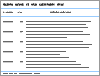
表1
苏北盆地不同凹陷、不同层位页岩油地质特征对比"
| 层位(凹陷) | 阜二段(金湖凹陷) | 阜二段(溱潼凹陷) | 阜二段(海安凹陷) | 泰二段(海安凹陷) | |
|---|---|---|---|---|---|
| 物质基础 | 沉积环境 | 半咸水-淡水 | 半咸水-淡水 | 半咸水-淡水 | 咸水-半咸水 |
| 厚度/m | 100 ~ 150 | 300 ~ 480 | 150 ~ 300 | 60 ~ 90 | |
| 岩相类型 | 含钙页岩 | 混合质页岩 | 钙质页岩 | 钙质页岩 | |
| 矿物组成 | 碳酸盐矿物含量/% | 18.0 | 20.4 | 22.9 | 29.5 |
| 长英质矿物含量/% | 46.0 | 43.6 | 34.4 | 30.9 | |
| 黏土矿物含量/% | 31.9 | 31.9 | 34.3 | 36.0 | |
| 地球化学指标 | TOC/% | 1.41 | 1.32 | 1.50 | 1.79 |
| Ro/% | 0.9 ~ 1.1 | 0.7 ~ 1.2 | 0.7 ~ 0.8 | 0.8 ~ 1.0 | |
| OSI/(mg/g) | 60 ~ 90 | 60 ~ 400 | 50 ~ 200 | 20 ~ 70 | |
| 储集条件 | 孔隙度/% | 4.1 | 4.2 | 3.9 | 3.6 |
| 裂缝发育程度 | 较发育 | 发育 | 欠发育 | 欠发育 | |
| 保存条件 | 压力系数 | 1.0 ~ 1.2 | 1.2 ~ 1.6 | 1.2 ~ 1.6 | 1.2 ~ 1.3 |

图7
苏北盆地海安凹陷HY2井泰二段综合柱状图TOC. 总有机碳含量; S1. 游离烃含量; OSI. 含油饱和度指数"


图8
苏北盆地海安凹陷HY2井储集岩显微照片a. 块状灰质泥岩,泥晶碳酸盐矿物,暗色、不透明,见介形虫碎屑,HY2井,泰二段,埋深4 077.31 m,单偏光,普通薄片;b. 层状灰质泥岩,微裂缝充填亮晶方解石,呈针状、纤维状,HY2井,泰二段,埋深4 090.22 m,单偏光,普通薄片;c. 纹层状灰质页岩,粉砂颗粒间充填泥晶碳酸盐矿物,HY2井,泰二段,埋深4 095.24 m,单偏光,普通薄片;d. 状灰质泥岩,机械压实作用强,生物碎屑与有机质呈长轴定向排列,少见粉砂块,HY2井,泰二段,埋深4 097.04 m,单偏光,普通薄片;e. 纹层状灰质页岩,黏土矿物周边大量微晶石英与白云石,HY2井,泰二段,埋深4 085.68 m,扫描电镜;f. 纹层状含灰页岩,黏土矿物周边大量微晶石英与白云石,HY2井,阜二段,埋深3 472.17 m,扫描电镜"


图9
苏北盆地阜二段与泰二段构造裂缝发育情况a. 构造缝发育,填充方解石,HY1井,阜二段,埋深3 477.90 m,岩心照片;b.构造缝局部可见,无填充, HY2井,泰二段,埋深4 089.90 m,岩心照片;c.苏北盆地各井构造裂缝平均密度统计柱状图(a和b图中黄色箭头指示构造缝;c图中QY1井位于溱潼凹陷,其余5口井位于海安凹陷。)"


图10
苏北盆地泰二段与阜二段激光共聚焦显微镜下不同孔径孔隙中轻质与重质组分分布柱状图a. 海安凹陷,HY2井,泰二段,埋深4 102.15 m;b. 溱潼凹陷,QY1井,阜二段,埋深3 857.54 m"

| [1] | 马永生, 黎茂稳, 蔡勋育, 等. 中国海相深层油气富集机理与勘探开发: 研究现状、关键技术瓶颈与基础科学问题[J]. 石油与天然气地质, 2020, 41(4): 655-672, 683. |
| MA Yongsheng, LI Maowen, CAI Xunyu, et al. Mechanisms and exploitation of deep marine petroleum accumulations in China: Advances, technological bottlenecks and basic scientific problems[J]. Oil & Gas Geology, 2020, 41(4): 655-672, 683. | |
| [2] | 金之钧, 王冠平, 刘光祥, 等. 中国陆相页岩油研究进展与关键科学问题[J]. 石油学报, 2021, 42(7): 821-835. |
| JIN Zhijun, WANG Guanping, LIU Guangxiang, et al. Research progress and key scientific issues of continental shale oil in China[J]. Acta Petrolei Sinica, 2021, 42(7): 821-835. | |
| [3] | 郭旭升, 马晓潇, 黎茂稳, 等. 陆相页岩油富集机理探讨[J]. 石油与天然气地质, 2023, 44(6): 1333-1349. |
| GUO Xusheng, MA Xiaoxiao, LI Maowen, et al. Mechanisms for lacustrine shale oil enrichment in Chinese sedimentary basins[J]. Oil & Gas Geology, 2023, 44(6): 1333-1349. | |
| [4] | 邹才能, 潘松圻, 荆振华, 等. 页岩油气革命及影响[J]. 石油学报, 2020, 41(1): 1-12. |
| ZOU Caineng, PAN Songqi, JING Zhenhua, et al. Shale oil and gas revolution and its impact[J]. Acta Petrolei Sinica, 2020, 41(1): 1-12. | |
| [5] | 孙龙德, 王小军, 冯子辉, 等. 松辽盆地古龙页岩纳米孔缝形成机制与页岩油富集特征[J]. 石油与天然气地质, 2023, 44(6): 1350-1365. |
| SUN Longde, WANG Xiaojun, FENG Zihui, et al. Formation mechanisms of nano-scale pores/fissures and shale oil enrichment characteristics for Gulong shale, Songliao Basin[J]. Oil & Gas Geology, 2023, 44(6): 1350-1365. | |
| [6] | 朱如凯, 李梦莹, 杨静儒, 等. 细粒沉积学研究进展与发展方向[J]. 石油与天然气地质, 2022, 43(2): 251-264. |
| ZHU Rukai, LI Mengying, YANG Jingru, et al. Advances and trends of fine-grained sedimentology[J]. Oil & Gas Geology, 2022, 43(2): 251-264. | |
| [7] | 金之钧, 张谦, 朱如凯, 等. 中国陆相页岩油分类及其意义[J]. 石油与天然气地质, 2023, 44(4): 801-819. |
| JIN Zhijun, ZHANG Qian, ZHU Rukai, et al. Classification of lacustrine shale oil reservoirs in China and its significance[J]. Oil & Gas Geology, 2023, 44(4): 801-819. | |
| [8] | 姚红生, 云露, 昝灵, 等. 苏北盆地溱潼凹陷阜二段断块型页岩油定向井开发模式及实践[J]. 油气藏评价与开发, 2023, 13(2): 141-151. |
| YAO Hongsheng, YUN Lu, ZAN Ling, et al. Development mode and practice of fault-block oriented shale oil well in the second member of Funing Formation, Qintong Sag, Subei Basin[J]. Petroleum Reservoir Evaluation and Development, 2023, 13(2): 141-151. | |
| [9] | 高玉巧, 何希鹏, 程熊, 等. 陆相咸化湖盆 “低TOC” 烃源岩高生烃效率探讨——以苏北盆地溱潼凹陷阜宁组二段泥页岩为例[J]. 油气藏评价与开发, 2024, 14(5): 678-687. |
| GAO Yuqiao, HE Xipeng, CHENG Xiong, et al. Discussion on high hydrocarbon generation efficiency of saline lacustrine source rocks with low TOC: A case study of the second member of Funing Formation, Qintong Sag, Subei Basin[J]. Petroleum Reservoir Evaluation and Development, 2024, 14(5): 678-687. | |
| [10] | 余文端, 高玉巧, 昝灵, 等. 溱潼凹陷阜宁组二段泥页岩含油性及页岩油富集层段分布[J]. 油气藏评价与开发, 2024, 14(5): 688-698. |
| YU Wenduan, GAO Yuqiao, ZAN Ling, et al. Distribution of oil bearing and shale oil-rich strata in the second member of Funing Formation in Qintong Sag[J]. Petroleum Reservoir Evaluation and Development, 2024, 14(5): 688-698. | |
| [11] | 昝灵. 苏北盆地金湖凹陷北港次洼古近系阜宁组二段页岩油富集特征及主控因素[J]. 石油实验地质, 2020, 42(4): 618-624. |
| ZAN Ling. Enrichment characteristics and main controlling factors of shale oil reservoir in the second member of Paleogene Funing Formation, Beigang Subsag, Jinhu Sag, Subei Basin[J]. Petroleum Geology and Experiment, 2020, 42(4): 618-624. | |
| [12] | 王欣, 韩建强, 昝灵, 等. 苏北盆地溱潼凹陷阜宁组二段页岩油测井评价研究[J]. 油气藏评价与开发, 2024, 14(3): 364-372. |
| WANG Xin, HAN Jianqiang, ZAN Ling, et al. Logging evaluation of shale oil in the second member of Funing Formation of Qintong Sag, Subei Basin[J]. Petroleum Reservoir Evaluation and Development, 2024, 14(3): 364-372. | |
| [13] | 高玉巧, 蔡潇, 夏威, 等. 苏北盆地古近系阜宁组二段页岩油储集空间特征及甜点段评价——以溱潼凹陷QY1井为例[J]. 石油实验地质, 2024, 46(5): 916-926. |
| GAO Yuqiao, CAI Xiao, XIA Wei, et al. Characteristics of reservoir space and sweet spot evaluation of shale oil in the second member of Paleogene Funing Formation in Subei Basin: A case study of well QY1 in Qintong Sag[J]. Petroleum Geology & Experiment, 2024, 46(5): 916-926. | |
| [14] | 蔡潇, 夏威, 马晓东, 等. 苏北盆地溱潼凹陷古近系阜宁组页岩油储集空间特征及其影响因素[J]. 吉林大学学报(地球科学版), 2024, 54(5): 1482-1493. |
| CAI Xiao, XIA Wei, MA Xiaodong, et al. Storage spaces characteristics and influencing factors of shale oil reservoirs of Paleogene in Funing Formation of Qintong Sag, Subei Basin[J]. Journal of Jilin University (Earth Science Edition), 2024, 54(5): 1482-1493. | |
| [15] | 姚红生, 昝灵, 高玉巧, 等. 苏北盆地溱潼凹陷古近系阜宁组二段页岩油富集高产主控因素与勘探重大突破[J]. 石油实验地质, 2021, 43(5): 776-783. |
| YAO Hongsheng, ZAN Ling, GAO Yuqiao, et al. Main controlling factors for the enrichment of shale oil and significant discovery in second member of Paleogene Funing Formation, Qintong Sag, Subei Basin[J]. Petroleum Geology and Experiment, 2021, 43(5): 776-783. | |
| [16] | 高玉巧, 花彩霞, 蔡潇, 等. 苏北盆地溱潼凹陷阜宁组二段页岩油储层裂缝形成机制及对烃类赋存的影响[J]. 地学前缘, 2024, 31(5): 35-45. |
| GAO Yuqiao, HUA Caixia, CAI Xiao, et al. Fracture formation mechanism in shale oil reservoirs, Qintong Depression, North Jiangsu Basin and its influence on hydrocarbon occurrence[J]. Earth Science Frontiers, 2024, 31(5): 35-45. | |
| [17] | 陈安定. 苏北盆地构造特征及箕状断陷形成机理[J]. 石油与天然气地质, 2010, 31(2): 140-150. |
| CHEN Anding. Tectonic features of the Subei Basin and the forming mechanism of its dustpan-shaped fault depression[J]. Oil & Gas Geology, 2010, 31(2): 140-150. | |
| [18] | 罗怀忠, 梁兴, 张介辉, 等. 苏北盆地泰州低凸起油气勘探前景及选区评价[J]. 天然气工业, 2011, 31(10): 42-46. |
| LUO Huaizhong, LIANG Xing, ZHANG Jiehui, et al. Exploration potential and favorable play identification in the Taizhou low salient of the Subei Basin[J]. Natural Gas Industry, 2011, 31(10): 42-46. | |
| [19] | 刘蕾, 宋骥衍. 苏北盆地高邮凹陷阜四段泥页岩储层可压裂性评价[J]. 中国锰业, 2019, 37(3): 45-48. |
| LIU Lei, SONG Jiyan. Fractureability evaluation of shale reservoirs in the fourth member of the fourth member of Gaoyou Sag, Subei Basin[J]. China Manganese Industry, 2019, 37(3): 45-48. | |
| [20] | 胡宗全, 王濡岳, 路菁, 等. 陆相页岩及其夹层储集特征对比与差异演化模式[J]. 石油与天然气地质, 2023, 44(6): 1393-1404. |
| HU Zongquan, WANG Ruyue, LU Jing, et al. Storage characteristic comparison of pores between lacustrine shales and their interbeds and differential evolutionary patterns[J]. Oil & Gas Geology, 2023, 44(6): 1393-1404. | |
| [21] | 何勇, 何叶. 苏北盆地洋心次凹泰二段细粒沉积新认识[J]. 非常规油气, 2017, 4(4): 1-6. |
| HE Yong, HE Ye. New understanding of fine-grained sediments of sub-member of Tai-2 sandstone reservoir in Yangxin subsag, Subei Basin[J]. Unconventional Oil & Gas, 2017, 4(4): 1-6. | |
| [22] | 刘玉瑞. 苏北盆地与南黄海盆地中-新生界成烃对比浅析[J]. 石油实验地质, 2010, 32(6): 541-546, 552. |
| LIU Yurui. Comparison analysis of Meso-Cenozoic hydrocarbon generation between the north Jiangsu Basin and the south Yellow Sea Basin[J]. Petroleum Geology and Experiment, 2010, 32(6): 541-546, 552. | |
| [23] | 王永建, 王延斌, 郑亚斌, 等. 苏北盆地高邮凹陷泰州组烃源岩演化[J]. 石油实验地质, 2007, 29(4): 411-414. |
| WANG Yongjian, WANG Yanbin, ZHENG Yabin, et al. Hydrocarbon source rock evolution in Taizhou Formation, the Gaoyou Sag, the north Jiangsu Basin[J]. Petroleum Geology and Experiment, 2007, 29(4): 411-414. | |
| [24] | 王永建, 王延斌, 高莎莎, 等. 苏北盆地高邮凹陷泰州组瓦6井油源对比[J]. 天然气地球科学, 2012, 23(2): 335-339. |
| WANG Yongjian, WANG Yanbin, GAO Shasha, et al. Oil-source correlation of Wa 6 Well Taizhou Formation in Gaoyou Sag, Subei Basin[J]. Natural Gas Geoscience, 2012, 23(2): 335-339. | |
| [25] | 王晓明, 陈军斌, 任大忠. 陆相页岩油储层孔隙结构表征和渗流规律研究进展及展望[J]. 油气藏评价与开发, 2023, 13(1): 23-30. |
| WANG Xiaoming, CHEN Junbin, REN Dazhong. Research progress and prospect of pore structure representation and seepage law of continental shale oil reservoir[J]. Petroleum Reservoir Evaluation and Development, 2023, 13(1): 23-30. | |
| [26] | 任红民, 陈丽琼, 王文军, 等. 苏北盆地晚白垩世泰州期原型盆地恢复[J]. 石油实验地质, 2008, 30(1): 52-57. |
| REN Hongmin, CHEN Liqiong, WANG Wenjun, et al. Restoration of prototype basins of Late Cretaceous Taizhou period in the northern Jiangsu Basin[J]. Petroleum Geology and Experiment, 2008, 30(1): 52-57. | |
| [27] | 唐旭. 苏北盆地高邮凹陷断裂演化及砂箱物理模拟[D]. 大庆: 东北石油大学, 2019. |
| TANG Xu. Fault evolution and analogue modelling of Gaoyou Sag in Subei Basin[D]. Daqing: Northeast Petroleum University, 2019. | |
| [28] | 刘长利, 朱筱敏, 王兴明, 等. 苏北盆地海安凹陷泰州组层序地层及沉积特征[J]. 吉林大学学报(地球科学版), 2010, 40(3): 519-526. |
| LIU Changli, ZHU Xiaomin, WANG Xingming, et al. Sequence stratigraphic framework and sedimentary characteristics of Taizhou Formation in Haian Depression of Subei Basin[J]. Journal of Jilin University (Earth Science Edition), 2010, 40(3): 519-526. | |
| [29] | 陈伟, 邱旭明. 金湖凹陷石港断裂发育特征及其控圈作用[J]. 复杂油气藏, 2020, 13(3): 1-5, 17. |
| CHEN Wei, QIU Xuming. Development characteristics of Shigang fault and its trap controlling role in Jinhu Depression[J]. Complex Hydrocarbon Reservoirs, 2020, 13(3): 1-5, 17. | |
| [30] | BIAN Ruikang. The formation and evolutionary characteristics of organic matter and pyrites in the continental shales of the 3rd submember of Chang 7 Member, Yanchang Formation, Ordos Basin, China[J]. Energy Geoscience, 2024, 5(2): 100250. |
| [31] | GANGULI S S, VASANTHI A, VERMA S. Recent advances in reservoir characterization: Introduction[J]. Energy Geoscience, 2024, 5(2): 100265. |
| [32] | LI Jijun, YOU Hang, ZHANG Xinwen, et al. Influence of shale reservoir properties on shale oil mobility and its mechanism[J]. Energy Geoscience, 2024, 5(4): 100329. |
| [33] | 杨旺旺, 王振林, 苏静, 等. 玛湖凹陷风城组页岩油赋存空间特征及可动性影响因素[J]. 新疆石油地质, 2025, 46(2): 192-200. |
| YANG Wangwang, WANG Zhenlin, SU Jing, et al. Occurrence space and mobility of shale oil in Fengcheng Formation, Mahu Sag, Junggar Basin[J]. Xinjiang Petroleum Geology, 2025, 46(2): 192-200. |
| [1] | 郭旭升, 赵培荣, 张宇, 申宝剑, 李倩文, 李沛, 李雄, 钱恪然, 蔡生娟, 马晓潇, 李鹏. 中国陆相页岩油分类分级评价的现状、挑战与发展趋势[J]. 石油与天然气地质, 2025, 46(6): 1745-1761. |
| [2] | 高波, 戎佳, 张明何, 刘自亮, 燕继红, 杜伟, 李王鹏. 川北地区下寒武统筇竹寺组页岩岩相类型及分布特征[J]. 石油与天然气地质, 2025, 46(6): 1892-1906. |
| [3] | 何希鹏, 昝灵, 高玉巧, 蔡潇, 陈鹏, 花彩霞, 白鸾羲, 张琬璐. 苏北盆地低有机碳含量陆相页岩层系页岩油富集高产机理与成藏模式[J]. 石油与天然气地质, 2025, 46(6): 1927-1946. |
| [4] | 刘惠民, 李军亮, 刘鑫金, 于福生, 闫嘉杰, 王勇, 任嘉, 冯海风, 魏晓亮, 杨晨. 渤海湾盆地东营凹陷沙四上亚段-沙三下亚段页岩裂缝发育特征及成因机制[J]. 石油与天然气地质, 2025, 46(6): 1960-1979. |
| [5] | 王恩泽, 黎茂稳, 唐勇, 马晓潇, 钱门辉, 曹婷婷, 李志明, 付英潇, 金之钧. 准噶尔盆地吉木萨尔凹陷二叠系芦草沟组陆相页岩油甜点评价与立体开发可行性分析[J]. 石油与天然气地质, 2025, 46(6): 1998-2011. |
| [6] | 孙中良, 李志明, 何文军, 冷筠滢, 祝庆敏, 刘得光, 王濡岳. 准噶尔盆地玛湖凹陷风城组页岩源-储协同演化机理[J]. 石油与天然气地质, 2025, 46(6): 2012-2025. |
| [7] | 王光付, 王海波, 郭建春, 谢凌志, 徐克, 李凤霞, 周彤, 陈世敬. 四川盆地侏罗系湖相页岩油气压裂开采技术难点与展望[J]. 石油与天然气地质, 2025, 46(6): 2026-2040. |
| [8] | 蒋廷学, 周珺. 页岩油气储层改造理论技术演进路径探讨[J]. 石油与天然气地质, 2025, 46(6): 2041-2058. |
| [9] | 曹磊, 闫新智, 李辉, 吴伟涛, 白玉彬, 赵子龙. 鄂尔多斯盆地陕北地区延长组长8与长9油层组烃源岩分布与地球化学特征及页岩油资源潜力评价[J]. 石油与天然气地质, 2025, 46(5): 1410-1429. |
| [10] | 耳闯, 关宏博, 刘伟, 程妮, 白洁, 胡崇. 陆源物质输入对有机质类型的影响——以鄂尔多斯盆地三叠系延长组长73油层亚组页岩为例[J]. 石油与天然气地质, 2025, 46(5): 1430-1445. |
| [11] | 张一帆, 葸克来, 操应长, 张博, 王秀娟, 尤源, 马文忠, 王雨轩, 孙琦慧. 鄂尔多斯盆地三叠系延长组长73油层亚组页岩岩相及页岩油差异赋存与微观运聚特征[J]. 石油与天然气地质, 2025, 46(5): 1536-1553. |
| [12] | 张佳琦, 赵靖舟, 曹磊, 叶卿元. 鄂尔多斯盆地三叠系延长组长8-长9油层组泥页岩储层孔隙和微裂缝发育特征与页岩油勘探前景[J]. 石油与天然气地质, 2025, 46(5): 1554-1581. |
| [13] | 白玉彬, 任海姣, 张军, 陈绍蓉, 吴伟涛, 赵辛楣, 吴和源, 邹阳. 页岩油组分特征及可动性评价——以准噶尔盆地玛湖凹陷二叠系风城组为例[J]. 石油与天然气地质, 2025, 46(5): 1582-1596. |
| [14] | 牛小兵, 樊建明, 张超, 任奕霖, 何右安, 常睿, 成良丙. 鄂尔多斯盆地庆城页岩油提高采收率实践及探索[J]. 石油与天然气地质, 2025, 46(5): 1664-1681. |
| [15] | 杨海风, 王飞龙, 胡安文, 关超, 滑彦岐. 渤海湾盆地页岩油勘探现状、进展及展望[J]. 石油与天然气地质, 2025, 46(4): 1123-1135. |
| 阅读次数 | ||||||
|
全文 |
|
|||||
|
摘要 |
|
|||||
