

石油与天然气地质 ›› 2025, Vol. 46 ›› Issue (4): 1200-1214.doi: 10.11743/ogg20250412
周能武1,2,3( ), 初众1,2,3, 卢双舫1,2,3,4(), 张鹏飞1,2,3, 王民4, 林子智4, 王军杰1,2,3, 姜新雨4, 刘阳5, 陈国辉1,2,3, 李文镖1,2,3
收稿日期:2025-04-17
修回日期:2025-07-15
出版日期:2025-08-30
发布日期:2025-09-06
通讯作者:
卢双舫
E-mail:nengwuzhou@163.com;lushuangfang@upc.edu.cn
第一作者简介:周能武(1993—),男,副教授、硕士研究生导师,非常规油气地质。E-mail:nengwuzhou@163.com。
基金项目:
Nengwu ZHOU1,2,3(), Zhong CHU1,2,3, Shuangfang LU1,2,3,4(), Pengfei ZHANG1,2,3, Min WANG4, Zizhi LIN4, Junjie WANG1,2,3, Xinyu JIANG4, Yang LIU5, Guohui CHEN1,2,3, Wenbiao LI1,2,3
Received:2025-04-17
Revised:2025-07-15
Online:2025-08-30
Published:2025-09-06
Contact:
Shuangfang LU
E-mail:nengwuzhou@163.com;lushuangfang@upc.edu.cn
摘要:
松辽盆地徐家围子断陷深层全油气系统主要由源内白垩系沙河子组滞留成藏的页岩气、短距离运移成藏的致密气以及经断裂运移后在基底变质岩和营城组火山岩内聚集形成的气藏共同构成。此全油气系统内,致密气和页岩气并非孤立存在,常常相伴相生,互相影响,但过去多将二者单独研究,未能系统剖析二者的共生特征及其关联性。以徐家围子断陷沙河子组泥页岩和砂砾岩互层为研究对象,将滞留成藏的页岩气与短距离运移成藏的致密气视为致密层系气一起解剖。在明确致密层系中烃源岩生-排气和储层储气能力的基础上,建立“三分烃源岩”和“四分储层”的分级评价标准,考虑砂/泥比配置,通过构建数值模型来阐明不同级别源-储配置条件的致密层系中,致密气和页岩气耦合成藏时的资源量分配和分布规律,从而认识致密气和页岩气的互补或共富关系。研究结果显示:致密气和页岩气耦合成藏类型可划分为24种,其中由Ⅰ级、Ⅱ级烃源岩,Ⅰ级、Ⅱ级致密储层和低于/等于最佳砂/泥比组合形成的4种致密层系为致密气和页岩气的共富区;由Ⅰ级、Ⅱ级烃源岩,Ⅰ级、Ⅱ级致密储层和高于最佳砂/泥比组合形成的4种致密层系为页岩气富集和紧邻烃源岩致密气富集区;由Ⅰ级、Ⅱ级烃源岩,Ⅲ级、Ⅳ级致密储层和任意砂/泥比组合形成的8种致密层系为页岩气富集而致密气贫乏区;由Ⅲ级烃源岩、任意级别致密储层和砂/泥比组合的8种致密层系为页岩气和致密气共贫区。沙河子组致密气和页岩气具有整体共富、局部互补的特征,主要富集区在北部安达—宋站地区,但是二者甜点并非完全重合,建议在达深24井区和宋站区域试着进行联合开发,其余区域以致密气开发为主。
中图分类号:
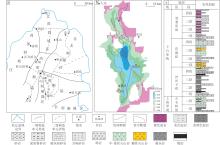
图1
松辽盆地徐家围子断陷基本区域地质情况a. 松辽盆地深层断陷构造分布[35];b. 沙河子组顶界面及主要断裂分布;c. 上侏罗统-下白垩统柱状图"


图2
徐家围子断陷沙河子组烃源岩厚度等值线分布a. 泥页岩;b. 煤层"


图3
徐家围子断陷沙河子组烃源岩有机地化特征频数分布直方图a. 泥页岩TOC;b. 煤层TOC;c. 泥页岩S1+S2;d. 泥页岩Tmax;e. 泥页岩+煤层干酪根类型分布柱状图;f. 泥页岩+煤层Ro[n为样本个数;TOC为总有机碳含量;S1 + S2为游离烃含量 + 裂解烃含量,即生烃潜量;Tmax为最高热解峰温;Ro为镜质体反射率。]"
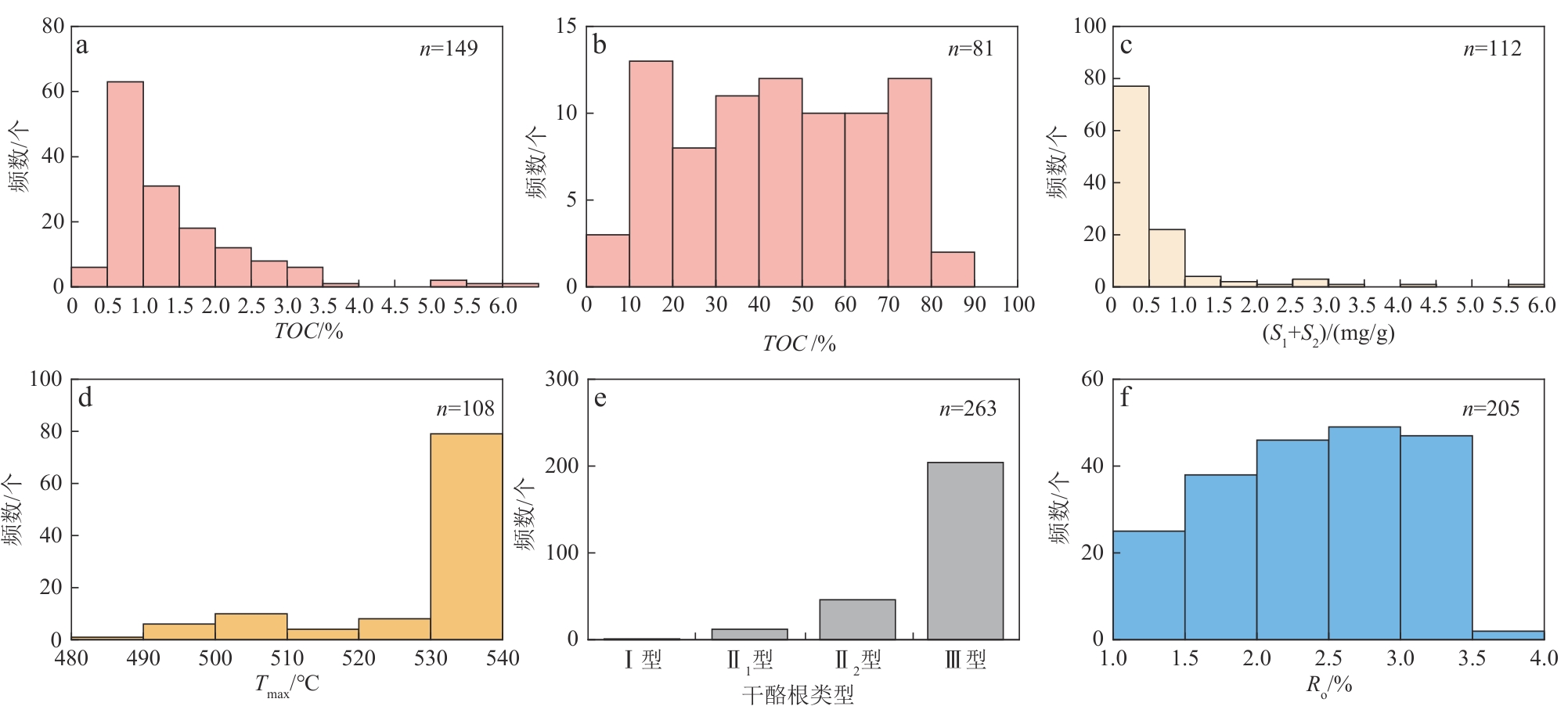

图4
徐家围子断陷沙河子组烃源岩排烃效率与总有机碳含量(TOC)关系图版"

表1
徐家围子断陷沙河子组致密气有效烃源岩下限及分级评价标准"
| 储集层分级 | TOC/% | 排烃效率 | 成储界限 |
|---|---|---|---|
| Ⅰ级烃源岩 | > 1.8 | 基本不再变化 | 优质烃源岩下限 |
| Ⅱ级烃源岩 | 0.6 ~ 1.8 | 随TOC的增大逐渐增加 | 有效烃源岩下限 |
| Ⅲ级烃源岩 | ≤ 0.6 | 0 | — |

图5
徐家围子断陷沙河子组砂砾岩储层物性分布特征a. 孔隙度频数分布直方图;b. 渗透率频数分布直方图;c. 不同地区孔隙度分布柱状图; d不同层序孔隙度分布柱状图(n为样本个数。)"
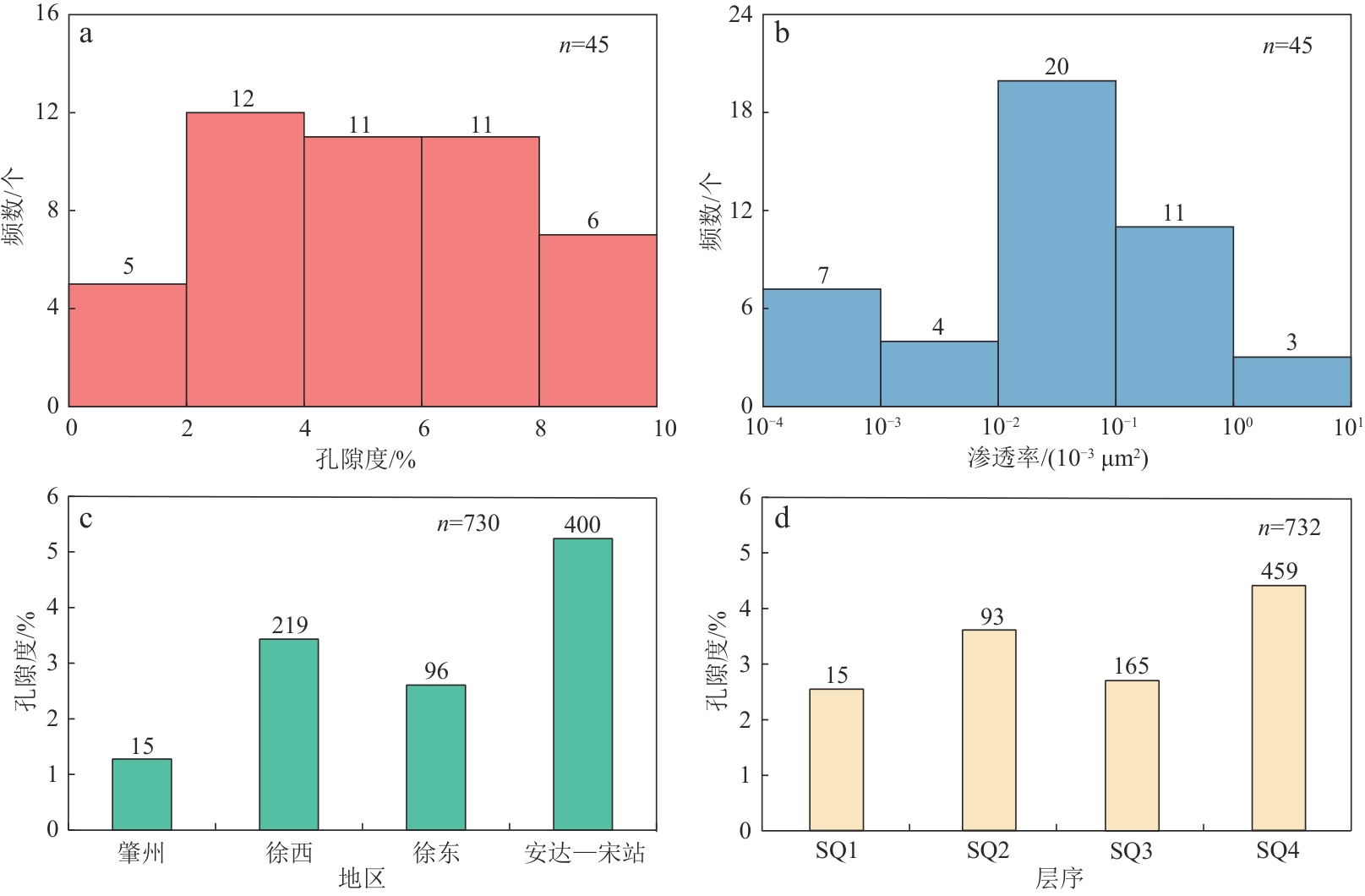
表2
徐家围子断陷沙河子组致密气储层成储参数界限及分级评价标准"
| 储层分级 | 平均孔隙半径/μm | 孔隙度/% | 渗透率/(10-3 μm2) | 成储界限 |
|---|---|---|---|---|
| 常规储层 | > 0.400 | > 9.0 | > 0.100 00 | 物性上限 |
| Ⅰ级致密储层 | 0.100 ~ 0.400 | 8.0 ~ 9.0 | 0.010 00 ~ 0.100 00 | |
| Ⅱ级致密储层 | 0.025 ~ 0.100 | 5.0 ~ 8.0 | 0.001 00 ~ 0.010 00 | 有效渗流下限 成藏下限 理论下限 |
| Ⅲ级致密储层 | 0.010 ~ 0.025 | 3.5 ~ 5.0 | 0.000 20 ~ 0.001 00 | |
| Ⅳ级致密储层 | 0.004 ~ 0.010 | 2.0 ~ 3.5 | 0.000 05 ~ 0.000 20 | |
| 非储层 | ≤ 0.004 | ≤ 2.0 | ≤ 0.000 05 |

图6
徐家围子断陷沙河子组最佳砂/泥比计算中关键参数确定图版a. TOCvs. 烃源岩排气量;b. 储层孔隙度 vs. 游离水孔隙度(TOC为总有机碳含量。)"
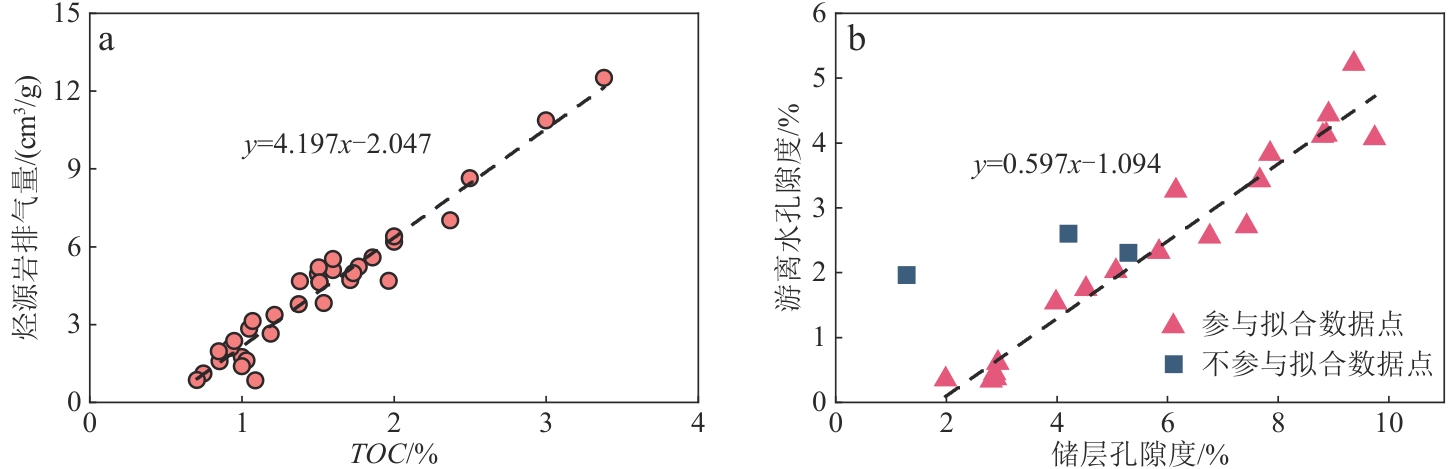

图7
徐家围子断陷沙河子组致密层系气耦合成藏的烃源岩条件、储层条件和源-储耦合匹配三维图TOC.总有机碳含量"

表3
徐家围子断陷沙河子组致密层系气共富耦合成藏特征"
| 气藏类型编号 | 烃源岩级别 | 储层级别 | 是否低于或等于最佳砂/泥比 | 致密气和页岩气耦合关系 | 致密气藏特点 |
|---|---|---|---|---|---|
| 1 | Ⅰ级 | Ⅰ级 | 是 | 致密气和页岩气共富区 | 含气孔隙度高,气层厚度大,不产水 |
| 2 | Ⅰ级 | Ⅰ级 | 否 | 页岩气富集和紧邻烃源岩致密气富集区 | 含气孔隙度高,气层厚度大,产水 |
| 3 | Ⅰ级 | Ⅱ级 | 是 | 致密气和页岩气共富区 | 含气孔隙度低,气层厚度大,不产水 |
| 4 | Ⅰ级 | Ⅱ级 | 否 | 页岩气富集和紧邻烃源岩致密气富集区 | 含气孔隙度低,气层厚度大,产水 |
| 5 | Ⅱ级 | Ⅰ级 | 是 | 致密气和页岩气共富区 | 含气孔隙度高,气层厚度小,不产水 |
| 6 | Ⅱ级 | Ⅰ级 | 否 | 页岩气富集和紧邻烃源岩致密气富集区 | 含气孔隙度高,气层厚度小,产水 |
| 7 | Ⅱ级 | Ⅱ级 | 是 | 致密气和页岩气共富区 | 含气孔隙度高,气层厚度小,不产水 |
| 8 | Ⅱ级 | Ⅱ级 | 否 | 页岩气富集和紧邻烃源岩致密气富集区 | 含气孔隙度高,气层厚度小,产水 |

图8
徐家围子断陷沙河子组致密层系气8种耦合成藏模式(类型1—8分别对应表3中的气藏类型编号。)"
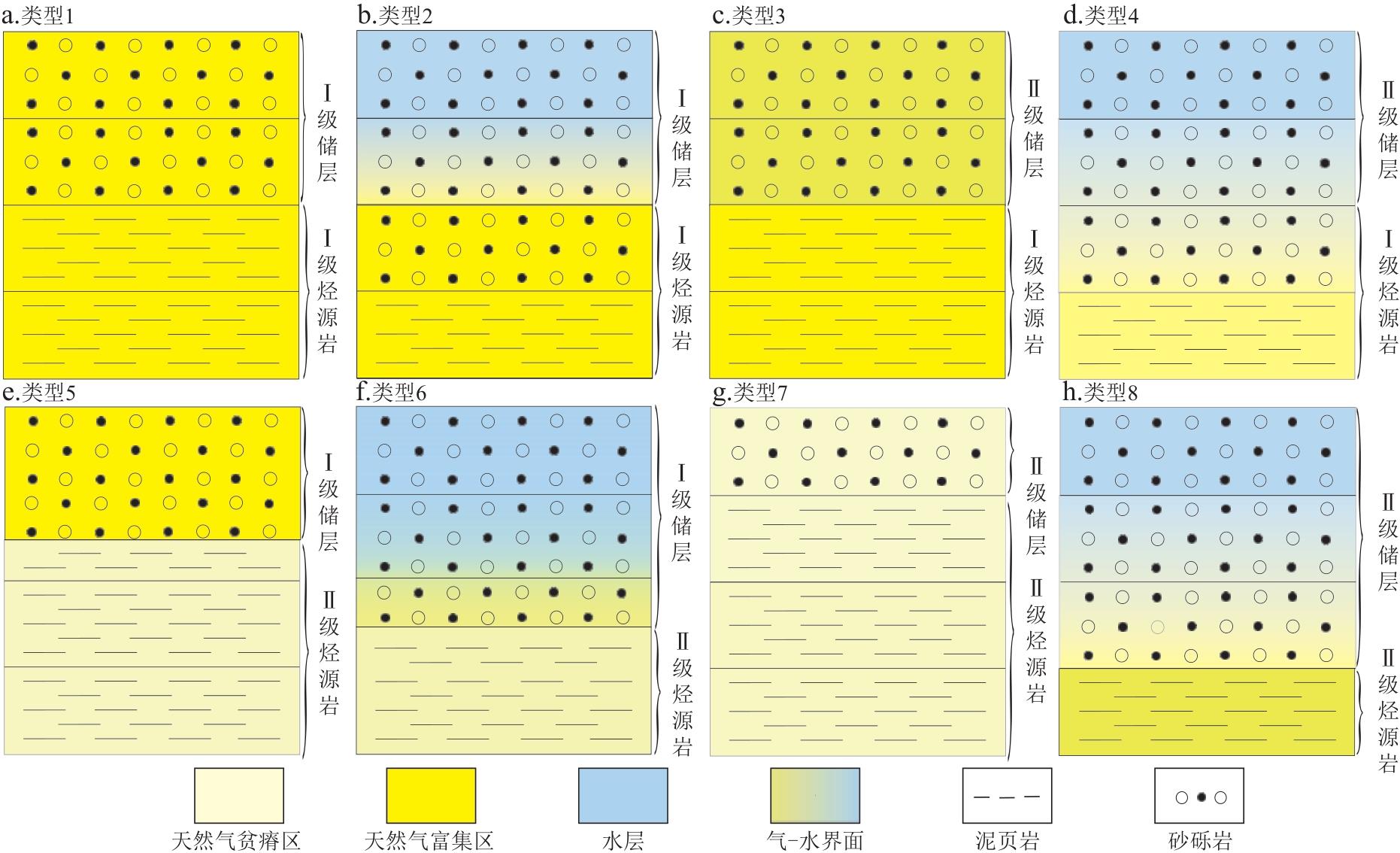

图9
徐家围子断陷不同区域致密层系气综合评价a. 宋站地区宋深3井;b. 徐东地区徐深25井;c. 肇州地区肇深14井"


图10
徐家围子断陷致密层系中页岩气和致密气耦合成藏甜点分布a. 天然气充注的Ⅰ级及Ⅱ级致密砂砾岩储层厚度;b. 页岩气含量等值线图"

| [1] | 贾承造. 论非常规油气对经典石油天然气地质学理论的突破及意义[J]. 石油勘探与开发, 2017, 44(1): 1-11. |
| JIA Chengzao. Breakthrough and significance of unconventional oil and gas to classical petroleum geological theory[J]. Petroleum Exploration and Development, 2017, 44(1): 1-11. | |
| [2] | 贾承造, 庞雄奇, 宋岩. 论非常规油气成藏机理: 油气自封闭作用与分子间作用力[J]. 石油勘探与开发, 2021, 48(3): 437-452. |
| JIA Chengzao, PANG Xiongqi, SONG Yan. The mechanism of unconventional hydrocarbon formation: Hydrocarbon self-containment and intermolecular forces[J]. Petroleum Exploration and Development, 2021, 48(3): 437-452. | |
| [3] | 贾承造, 郑民, 张永峰. 非常规油气地质学重要理论问题[J]. 石油学报, 2014, 35(1): 1-10. |
| JIA Chengzao, ZHENG Min, ZHANG Yongfeng. Four important theoretical issues of unconventional petroleum geology[J]. Acta Petrolei Sinica, 2014, 35(1): 1-10. | |
| [4] | JIA Chengzao, PANG Xiongqi, SONG Yan. Whole petroleum system and ordered distribution pattern of conventional and unconventional oil and gas reservoirs[J]. Petroleum Science, 2023, 20(1): 1-19. |
| [5] | 庞雄奇, 贾承造, 宋岩, 等. 全油气系统定量评价: 方法原理与实际应用[J]. 石油学报, 2022, 43(6): 727-759. |
| PANG Xiongqi, JIA Chengzao, SONG Yan, et al. Quantitative evaluation of whole petroleum system: Principle and application[J]. Acta Petrolei Sinica, 2022, 43(6): 727-759. | |
| [6] | 宋岩, 贾承造, 姜林, 等. 全油气系统内涵与研究思路[J]. 石油勘探与开发, 2024, 51(6): 1199-1210, 1226. |
| SONG Yan, JIA Chengzao, JIANG Lin, et al. Connotation and research strategy of the whole petroleum system[J]. Petroleum Exploration and Development, 2024, 51(6): 1199-1210, 1226. | |
| [7] | 贾承造, 邹才能, 李建忠, 等. 中国致密油评价标准、主要类型、基本特征及资源前景[J]. 石油学报, 2012, 33(3): 343-350. |
| JIA Chengzao, ZOU Caineng, LI Jianzhong, et al. Assessment criteria,main types, basic features and resource prospects of the tight oil in China[J]. Acta Petrolei Sinica, 2012, 33(3): 343-350. | |
| [8] | 赵政璋, 杜金虎, 邹才能, 等. 大油气区地质勘探理论及意义[J]. 石油勘探与开发, 2011, 38(5): 513-522. |
| ZHAO Zhengzhang, DU Jinhu, ZOU Caineng, et al. Geological exploration theory for large oil and gas provinces and its significance[J]. Petroleum Exploration and Development, 2011, 38(5): 513-522. | |
| [9] | 赵靖舟, 曹青, 白玉彬, 等. 油气藏形成与分布:从连续到不连续——兼论油气藏概念及分类[J]. 石油学报, 2016, 37(2): 145-159. |
| ZHAO Jingzhou, CAO Qing, BAI Yubin, et al. Petroleum accumulation from continuous to discontinuous: Concept, classification and distribution[J]. Acta Petrolei Sinica, 2016, 37(2): 145-159. | |
| [10] | 赵靖舟. 非常规油气有关概念、分类及资源潜力[J]. 天然气地球科学, 2012, 23(3): 393-406. |
| ZHAO Jingzhou. Conception, classification and resource potential of unconventional hydrocarbons[J]. Natural Gas Geoscience, 2012, 23(3): 393-406. | |
| [11] | 邹才能, 杨智, 崔景伟, 等. 页岩油形成机制、地质特征及发展对策[J]. 石油勘探与开发, 2013, 40(1): 14-26. |
| ZOU Caineng, YANG Zhi, CUI Jingwei, et al. Formation mechanism, geological characteristics and development strategy of nonmarine shale oil in China[J]. Petroleum Exploration and Development, 2013, 40(1): 14-26. | |
| [12] | 杨华, 李士祥, 刘显阳. 鄂尔多斯盆地致密油、页岩油特征及资源潜力[J]. 石油学报, 2013, 34(1): 1-11. |
| YANG Hua, LI Shixiang, LIU Xianyang. Characteristics and resource prospects of tight oil and shale oil in Ordos Basin[J]. Acta Petrolei Sinica, 2013, 34(1): 1-11. | |
| [13] | 胡素云, 朱如凯, 吴松涛, 等. 中国陆相致密油效益勘探开发[J]. 石油勘探与开发, 2018, 45(4): 737-748. |
| HU Suyun, ZHU Rukai, WU Songtao, et al. Profitable exploration and development of continental tight oil in China[J]. Petroleum Exploration and Development, 2018, 45(4): 737-748. | |
| [14] | 邵曌一, 吴朝东, 张大智, 等. 松辽盆地徐家围子断陷沙河子组储层特征及控制因素[J]. 石油与天然气地质, 2019, 40(1): 101-108. |
| SHAO Zhaoyi, WU Zhaodong, ZHANG Dazhi, et al. Reservoir characteristics and controlling factors of Shahezi Formation in Xujiaweizi Fault Depression, Songliao Basin[J]. Oil & Gas Geology, 2019, 40(1): 101-108. | |
| [15] | 霍秋立. 松辽盆地徐家围子断陷深层天然气来源与成藏研究[D]. 大庆: 东北石油大学, 2007. |
| HUO Qiuli. Study on the origins and accumulation dating of natural gas in Xujiawezi rift depression, Songliao Basin[D]. Daqing: Northeast Petroleum University, 2007. | |
| [16] | 邹才能, 朱如凯, 白斌, 等. 致密油与页岩油内涵、特征、潜力及挑战[J]. 矿物岩石地球化学通报, 2015, 34(1): 3-17, 1-2. |
| ZOU Caineng, ZHU Rukai, BAI Bin, et al. Significance, geologic characteristics, resource potential and future challenges of tight oil and shale oil[J]. Bulletin of Mineralogy, Petrology and Geochemistry, 2015, 34(1): 3-17, 1-2. | |
| [17] | 朱如凯, 邹才能, 吴松涛, 等. 中国陆相致密油形成机理与富集规律[J]. 石油与天然气地质, 2019, 40(6): 1168-1184. |
| ZHU Rukai, ZOU Caineng, WU Songtao, et al. Mechanism for generation and accumulation of continental tight oil in China[J]. Oil & Gas Geology, 2019, 40(6): 1168-1184. | |
| [18] | 胡素云, 陶士振, 王民, 等. 陆相湖盆致密油充注运聚机理与富集主控因素[J]. 石油勘探与开发, 2023, 50(3): 481-490, 529. |
| HU Suyun, TAO Shizhen, WANG Min, et al. Migration and accumulation mechanisms and main controlling factors of tight oil enrichment in a continental lake basin[J]. Petroleum Exploration and Development, 2023, 50(3): 481-490, 529. | |
| [19] | 郭旭升, 胡东风, 文治东, 等. 四川盆地及周缘下古生界海相页岩气富集高产主控因素——以焦石坝地区五峰组—龙马溪组为例[J]. 中国地质, 2014, 41(3): 893-901. |
| GUO Xusheng, HU Dongfeng, WEN Zhidong, et al. Major factors controlling the accumulation and high productivity in marine shale gas in the Lower Paleozoic of Sichuan Basin and its periphery: A case study of the Wufeng-Longmaxi Formation of Jiaoshiba area[J]. Geology in China, 2014, 41(3): 893-901. | |
| [20] | 王志刚. 涪陵页岩气勘探开发重大突破与启示[J]. 石油与天然气地质, 2015, 36(1): 1-6. |
| WANG Zhigang. Breakthrough of Fuling shale gas exploration and development and its inspiration[J]. Oil & Gas Geology, 2015, 36(1): 1-6. | |
| [21] | 金之钧, 胡宗全, 高波, 等. 川东南地区五峰组-龙马溪组页岩气富集与高产控制因素[J]. 地学前缘, 2016, 23(1): 1-10. |
| JIN Zhijun, HU Zongquan, GAO Bo, et al. Controlling factors on the enrichment and high productivity of shale gas in the Wufeng-Longmaxi formations, southeastern Sichuan Basin[J]. Earth Science Frontiers, 2016, 23(1): 1-10. | |
| [22] | CURTIS J B. Fractured shale-gas systems[J]. AAPG Bulletin, 2002, 86(11): 1921-1938. |
| [23] | JARVIE D M, HILL R J, RUBLE T E, et al. Unconventional shale-gas systems: The Mississippian Barnett Shale of north-central Texas as one model for thermogenic shale-gas assessment[J]. AAPG Bulletin, 2007, 91(4): 475-499. |
| [24] | 邹才能, 董大忠, 王社教, 等. 中国页岩气形成机理、地质特征及资源潜力[J]. 石油勘探与开发, 2010, 37(6): 641-653. |
| ZOU Caineng, DONG Dazhong, WANG Shejiao, et al. Geological characteristics, formation mechanism and resource potential of shale gas in China[J]. Petroleum Exploration and Development, 2010, 37(6): 641-653. | |
| [25] | 李伟,申建,李超,等.沁水盆地榆社-武乡区块深部煤层气赋存条件及开发甜点预测[J].大庆石油地质与开发,2023, 218(4):9-19. |
| LI Wei, SHEN Jian, LI Chao,et al.Occurrence conditions and development sweet spots prediction of deep coalbed methane in Yushe-Wuxiang block of Qinshui Basin[J]. 2023,218(4):9-19. | |
| [26] | SANDER R, PAN Zhejun, CONNELL L D, et al. Controls on methane sorption capacity of Mesoproterozoic gas shales from the Beetaloo sub-basin, Australia and global shales[J]. International Journal of Coal Geology, 2018, 199: 65-90. |
| [27] | 邹才能, 董大忠, 熊伟, 等. 中国页岩气新区带、新层系和新类型勘探进展、挑战及对策[J]. 石油与天然气地质, 2024, 45(2): 309-326. |
| ZOU Caineng, DONG Dazhong, XIONG Wei, et al. Advances, challenges, and countermeasures in shale gas exploration of underexplored plays, sequences and new types in China[J]. Oil & Gas Geology, 2024, 45(2): 309-326. | |
| [28] | 包书景, 葛明娜, 赵培荣, 等. 中国页岩气勘探开发现状、潜力与发展建议[J]. 石油与天然气地质, 2025, 46(2): 348-364. |
| BAO Shujing, GE Mingna, ZHAO Peirong, et al. Status-quo, potential, and recommendations on shale gas exploration and exploitation in China[J]. Oil & Gas Geology, 2025, 46(2): 348-364. | |
| [29] | LARSEN J W, AIDA M T. Kerogen chemistry 1. Sorption of water by type II kerogens at room temperature[J]. Energy & Fuels, 2004, 18(5): 1603-1604. |
| [30] | MONTGOMERY S L, JARVIE D M, BOWKER K A, et al. Mississippian Barnett Shale, Fort Worth Basin, north-central Texas: Gas-shale play with multi-trillion cubic foot potential[J]. AAPG Bulletin, 2005, 89(2): 155-175. |
| [31] | POLLASTRO R M. Total petroleum system assessment of undiscovered resources in the giant Barnett Shale continuous (unconventional) gas accumulation, Fort Worth Basin, Texas[J]. AAPG Bulletin, 2007, 91(4): 551-578. |
| [32] | ROSS D J K, BUSTIN R M. Characterizing the shale gas resource potential of Devonian-Mississippian strata in the Western Canada sedimentary basin: Application of an integrated formation evaluation[J]. AAPG Bulletin, 2008, 92(1): 87-125. |
| [33] | 赵文智, 卞从胜, 徐兆辉. 苏里格气田与川中须家河组气田成藏共性与差异[J]. 石油勘探与开发, 2013, 40(4): 400-408. |
| ZHAO Wenzhi, BIAN Congsheng, XU Zhaohui. Similarities and differences between natural gas accumulations in Sulige Gas Field in Ordos Basin and Xujiahe Gas Field in central Sichuan Basin[J]. Petroleum Exploration and Development, 2013, 40(4): 400-408. | |
| [34] | 周能武, 卢双舫, 张鹏飞, 等. 致密气充注聚集机理及数理模型[J]. 石油勘探与开发, 2023, 50(6): 1233-1244. |
| ZHOU Nengwu, LU Shuangfang, ZHANG Pengfei, et al. Tight gas charging and accumulation mechanisms and mathematical model[J]. Petroleum Exploration and Development, 2023, 50(6): 1233-1244. | |
| [35] | 陈海峰, 王凤启, 王民. 徐家围子断陷沙河子组致密砂砾岩气藏特征与资源潜力[J]. 中南大学学报(自然科学版), 2018, 49(1): 141-149. |
| CHEN Haifeng, WANG Fengqi, WANG Min. Characteristic and resource potential of tight sandy conglomerate gas reservoir in Shahezi Formation of Xujiaweizi Depression[J]. Journal of Central South University (Science and Technology), 2018, 49(1): 141-149. | |
| [36] | 刘超. 松辽盆地徐家围子地区沙河子组气烃源岩与致密砂砾岩气资源潜力评价[J]. 天然气地球科学, 2017, 28(3): 429-438. |
| LIU Chao. Source rocks and tight conglomerate gas resource potential evaluation in Shahezi Formation of Xujiaweizi Depression, Songliao Basin[J]. Natural Gas Geoscience, 2017, 28(3): 429-438. | |
| [37] | 徐立恒, 卢双舫, 陈践发, 等. 徐家围子断陷深层烃烃源岩生气评价[J]. 石油学报, 2008, 29(6): 846-852. |
| XU Liheng, LU Shuangfang, CHEN Jianfa, et al. Gas-generation evaluation of deep hydrocarbon source rocks in Xujiaweizi fault depression[J]. Acta Petrolei Sinica, 2008, 29(6): 846-852. | |
| [38] | 戴金星, 邹才能, 陶士振, 等. 中国大气田形成条件和主控因素[J]. 天然气地球科学, 2007, 18(4): 473-484. |
| DAI Jinxing, ZOU Caineng, TAO Shizhen, et al. Formation conditions and main controlling factors of large gas fields in China[J]. Natural Gas Geoscience, 2007, 18(4): 473-484. | |
| [39] | 庞雄奇. 排烃门限控油气理论与应用[M]. 北京: 石油工业出版社, 1995. |
| PANG Xiongqi. Theory and application of hydrocarbon exclusion threshold control for oil and gas[M]. Beijing: Petroleum Industry Press, 1995. | |
| [40] | 白雪峰, 刘家军, 陆加敏, 等. 松辽盆地北部中央古隆起带基岩风化壳气藏富集规律[J]. 吉林大学学报(地球科学版), 2023, 53(2): 343-355. |
| BAI Xuefeng, LIU Jiajun, LU Jiamin,et al. Gas Enrichment in Basement Weathering Crust in the Central Paleouplift Belt in Northern Songliao Basin[J]. Journal of Jilin University (Earth Science Edition), 2023, 53(2): 343-355. | |
| [41] | PEPPER A S. Estimating the petroleum expulsion behaviour of source rocks: A novel quantitative approach[J]. Geological Society, London, Special Publications, 1991, 59(1): 9-31. |
| [42] | LIU Aihua, FU Xuehai, WANG Kexin, et al. Investigation of coalbed methane potential in low-rank coal reservoirs-Free and soluble gas contents[J]. Fuel, 2013, 112: 14-22. |
| [43] | ZHOU Qin, XIAO Xianming, TIAN Hui, et al. Modeling free gas content of the Lower Paleozoic shales in the Weiyuan area of the Sichuan Basin, China[J]. Marine and Petroleum Geology, 2014, 56: 87-96. |
| [44] | ZHOU Nengwu, LU Shuangfang, ZHANG Pengfei, et al. Continental shale gas dynamic enrichment and evolution over geological time[J]. International Journal of Coal Geology, 2022, 251: 103914. |
| [45] | 王军杰, 卢双舫, 林子智, 等. 致密砂砾岩成储界限及分级评价标准——以松辽盆地徐家围子断陷白垩系沙河子组为例[J]. 石油实验地质, 2024, 46(3): 553-564. |
| WANG Junjie, LU Shuangfang, LIN Zizhi, et al. Reservoir limits and grading evaluation criteria of tight glutenite: A case study of Cretaceous Shahezi Formation in Xujiaweizi Fault Depression, Songliao Basin[J]. Petroleum Geology & Experiment, 2024, 46(3): 553-564. |
| [1] | 贾承造, 庞雄奇, 宋岩, 崔新璇, 胡耀, 徐帜, 姜林, 蒲庭玉, 姜福杰, 沈彬. 全油气系统的4种基本类型及其资源开发领域[J]. 石油与天然气地质, 2025, 46(4): 1019-1038. |
| [2] | 庞雄奇, 崔新璇, 贾承造, 鲍李银, 李才俊, 黎茂稳, 徐帜, 肖惠译, 郑定业, 金玉洁, 施砍园, 张思佳. 全油气系统理论在实用中面临的几个问题与解决方法[J]. 石油与天然气地质, 2025, 46(4): 1039-1054. |
| [3] | 刘可禹, 张思佳, 刘建良, 赵振丞, 金玉洁, 张婷, 林昊. 全油气系统:油气地质学研究新方向和油气勘探新范式[J]. 石油与天然气地质, 2025, 46(4): 1055-1070. |
| [4] | 陈君青, 贾承造, 姜林, 庞宏, 火勋港, 陈冬霞, 施砍园, 胡涛, 杨晓斌, 冉钧. 全油气系统非常规油气成藏过程中自封闭作用的主要类型与定量表征[J]. 石油与天然气地质, 2025, 46(4): 1071-1091. |
| [5] | 肖惠译, 庞雄奇, 李才俊, 胡涛, 徐帜, 林孝飞, 胡耀, 王雷, 崔新璇, 施砍园, 蒲庭玉, 鲍李银. 全油气系统形成演化过程中常规与非常规油气藏转化机制及模式[J]. 石油与天然气地质, 2025, 46(4): 1092-1106. |
| [6] | 施砍园, 庞雄奇, 陈君青, 陈掌星, 王雷, 蒲庭玉, 鲍李银, 惠沙沙, 肖惠译, 崔新璇. 全油气系统中储层润湿性与界面张力等关键参数变化特征及其分子动力学模拟[J]. 石油与天然气地质, 2025, 46(4): 1107-1122. |
| [7] | 庞宏, 刘国勇, 贾承造, 姜福杰, 姜林, 王建伟, 马学峰, 陈迪, 陈君青. 陆相断陷盆地全油气系统成藏动力场特征与有序分布模式——以渤海湾盆地南堡凹陷为例[J]. 石油与天然气地质, 2025, 46(4): 1136-1151. |
| [8] | 徐田武, 李素梅, 陈湘飞, 马学峰, 邓硕, 张莹莹. 渤海湾盆地东濮凹陷全油气系统特征及其成藏模式[J]. 石油与天然气地质, 2025, 46(4): 1152-1168. |
| [9] | 胡涛, 熊智明, 肖惠译, 徐田武, 徐云龙, 李素梅, 姜福杰, 黎茂稳, 姜林. 断陷湖盆全油气系统油气藏有序分布特征及差异富集机制——以渤海湾盆地东濮凹陷古近系沙河街组为例[J]. 石油与天然气地质, 2025, 46(4): 1169-1182. |
| [10] | 李素梅, 刘佳, 马学峰, 庞秋菊, 赵知非. 渤海湾盆地辽河坳陷西部凹陷全油气系统特征与勘探潜力[J]. 石油与天然气地质, 2025, 46(4): 1183-1199. |
| [11] | 陈冬霞, 王翘楚, 熊亮, 王小娟, 杨映涛, 雷文智, 张玲, 潘珂, 庞宏. 川西—川中地区陆相层系全油气系统常规和非常规有效储层成因机制与分类评价[J]. 石油与天然气地质, 2025, 46(4): 1215-1232. |
| [12] | 康逊, 谭静强, 胡文瑄, 靳军, 胡瑞璞, 曹剑. 准噶尔盆地玛湖凹陷全油气系统成储机制差异性[J]. 石油与天然气地质, 2025, 46(4): 1250-1266. |
| [13] | 鲍李银, 庞雄奇, 邹亮, 陈宏飞, 林昊, 张婷, 沈彬, 王凯, 王睿. 全油气系统油气成藏动力判别与贡献量评价——以准噶尔盆地玛湖凹陷二叠系风城组为例[J]. 石油与天然气地质, 2025, 46(4): 1267-1280. |
| [14] | 胡耀, 贾承造, 庞雄奇, 宋永, 何文军, 陈宏飞, 鲍李银, 陈玮岩, 赵文, 肖惠译, 李才俊, 徐帜. 远源型致密油气藏运聚动力与成藏模式——以准噶尔盆地玛湖凹陷三叠系百口泉组砂砾岩油藏为例[J]. 石油与天然气地质, 2025, 46(4): 1281-1298. |
| [15] | 曹鹏, 赵振丞, 庞雄奇, 李才俊, 庞宏, 林会喜, 杨海军, 马奎友, 张思佳. 塔里木盆地台盆区下古生界全油气系统碳酸盐岩油气藏改造特征与成因模式[J]. 石油与天然气地质, 2025, 46(4): 1299-1315. |
| 阅读次数 | ||||||
|
全文 |
|
|||||
|
摘要 |
|
|||||
