

石油与天然气地质 ›› 2025, Vol. 46 ›› Issue (4): 1316-1332.doi: 10.11743/ogg20250419
金玉洁1,2( ), 王雷1,2, 庞雄奇1,2, 陈君青1,3, 张现军4, 姜福杰1,2, 陈宝新4
收稿日期:2025-05-12
修回日期:2025-07-14
出版日期:2025-08-30
发布日期:2025-09-06
第一作者简介:金玉洁(1990—),女,博士研究生,油气藏形成与分布。E-mail: jinyjcup@163.com。
基金项目:
Yujie JIN1,2(), Lei WANG1,2, Xiongqi PANG1,2, Junqing CHEN1,3, Xianjun ZHANG4, Fujie JIANG1,2, Baoxin CHEN4
Received:2025-05-12
Revised:2025-07-14
Online:2025-08-30
Published:2025-09-06
摘要:
塔里木盆地西南(塔西南)坳陷地处盆-山过渡带,发育寒武系、奥陶系、石炭系、二叠系和侏罗系等多套优质烃源岩。这些烃源岩层的成因与分布没有关联性,但在多期构造演化与多期成藏作用的过程中形成了多来源油气复合的复杂油气藏。本文在全油气系统理论指导下,综合开展了油气地球化学、储层物性与油气藏产状特征分析,系统剖析了塔西南坳陷“全油气系统多源复合型油气藏”的油气成藏机制和有序分布模式。研究表明,塔西南坳陷多源复合-多期构造叠合-多动力改造耦合形成的复杂油气藏具有4个基本特征:①油气成藏具有寒武系、石炭系、二叠系和侏罗系多源供烃、混源充注以及构造控制的油气运聚特征。②加里东期、晚海西期及印支期—天山期多期构造叠加塑造了多形式的油气运移通道与多动力聚集系统,形成了常规与非常规油气藏的差异聚集和有序分布特征。③系统演化过程中,自由动力场高孔-高渗储层控制常规油气藏的形成与分布,局限动力场低孔-低渗储层控制致密油气藏形成与分布,而束缚动力场源内超致密储层控制页岩油气藏形成与分布。④动力场形成演化过程中受应力和流体改造形成了裂缝型和孔洞型油气藏,导致多来源复合油气藏成因类型更加复杂。
中图分类号:

图1
油气动力场成藏机制及全油气系统中常规和非常规油气藏有序分布模式(据文献[14]修改)"


图2
多源复合全油气系统油气成藏特征与分布规律研究思路与技术路线"
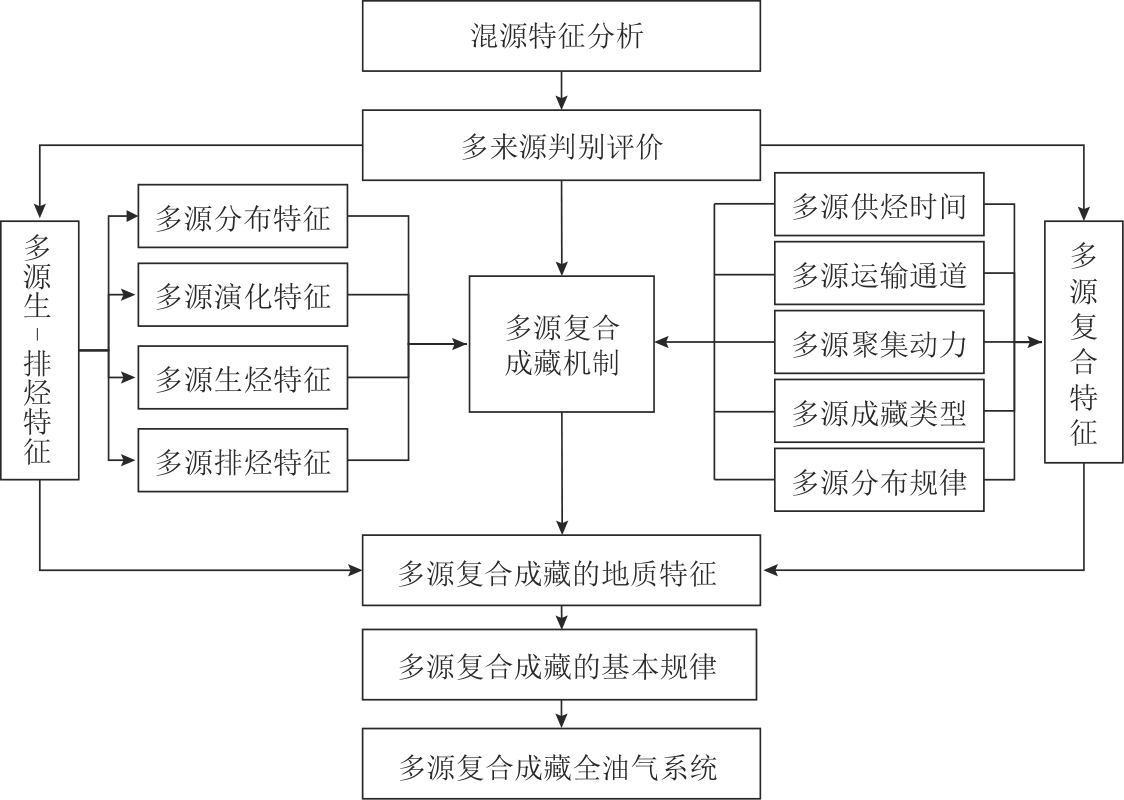
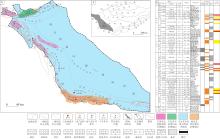
图3
塔里木盆地现今构造格架(a)、塔西南坳陷常规储层与非常规储层分布(b)(修改自[1])和地层综合柱状图(c)[16]"

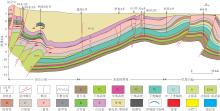
图4
塔里木盆地西南坳陷全油气系统剖面示意图"


图5
塔里木盆地西南坳陷古近系-新近系油气来源文献篇数(N)统计柱状图"
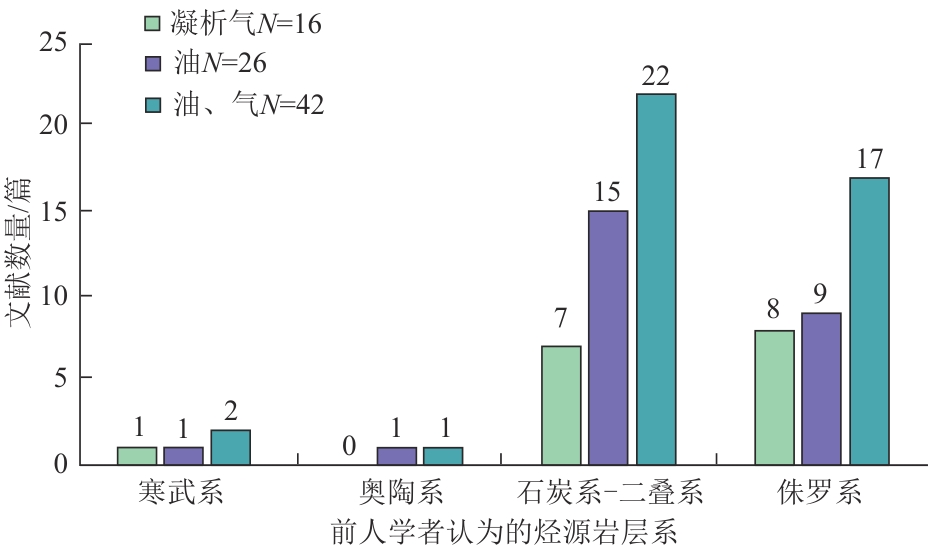

图6
塔里木盆地西南坳陷多来源原油和天然气地球化学特征对比a.天然气成因类型判别图版(碳同位素钟氏图);b.甲烷、乙烷、丙烷、正丁烷与异丁烷的碳同位素变化趋势;c.原油正构烷烃碳同位素特征;d.原油与烃源岩沉积环境判别图版δ13C.碳同位素值;δ13C1.甲烷碳同位素值;δ13C2.乙烷碳同位素值;δ13C3.丙烷碳同位素值;δ13C4.丁烷碳同位素值;n.正构烷烃碳数;A.非海相藻类有机质生成的原油;B.陆相有机质(高等植物)生成的原油"

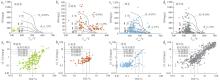
图7
塔里木盆地西南坳陷各套烃源岩有机质类型及生烃潜力a1—d1.分别为寒武系、石炭系、二叠系和侏罗系的有机质类型判别图版;a2—d2.分别为寒武系、石炭系、二叠系和侏罗系的生烃潜力判别图版(HI为氢指数;Tmax为最高热解峰温;S1为游离烃含量;S2为裂解烃含量;S1+S2为生烃潜量;TOC为总有机碳含量。)"

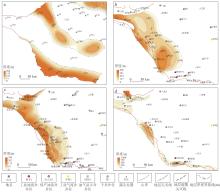
图8
塔里木盆地西南坳陷主要烃源岩厚度分布等值线图a.寒武系玉尔吐斯组;b.石炭系;c.二叠系棋盘组;d.侏罗系"


图9
塔里木盆地西南坳陷烃源岩生烃与排烃强度分布a1—c1.分别为石炭系、二叠系和侏罗系的生烃强度等值线图;a2—c2.分别为石炭系、二叠系和侏罗系的排烃强度等值线图"


图10
塔里木盆地西南坳陷皮山北1井埋藏史与热演化史特征[31]a.埋藏史与热演化史;b.埋藏温度演化曲线"

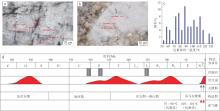
图11
塔里木盆地西南坳陷热史与油气成藏期的耦合关系a.烃类伴生包裹体,KZ106井,卡拉塔尔组,普通薄片镜下照片;b.烃类伴生包裹体,KZ201井,卡拉塔尔组,普通薄片镜下照片;c.卡拉塔尔组盐水包裹体均一温度频率分布直方图;d.热史、构造演化史与成藏期的耦合关系"

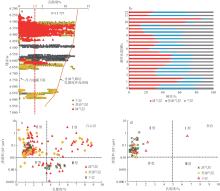
图12
塔里木盆地西南坳陷卡拉塔尔组储层孔隙度和渗透率与含油气性关系a.孔隙度与含油气性随埋深的变化;b.不同孔隙度储层含油气性条形图;c.白云岩段储层孔隙度、渗透率与含油气性关系;d.灰岩段储层孔隙度、渗透率与含油气性关系Ⅰ型.高孔-高渗自由动力场储层浮力成藏;Ⅱ型.低孔-高渗应力改造储层,局限动力场非浮力成藏;Ⅲ型.高孔-低渗溶蚀改造储层,局限动力场非浮力成藏;Ⅳ型.低孔-低渗束缚动力场储层,非浮力成藏"

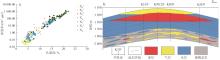
图13
塔里木盆地西南坳陷柯克亚地区西河甫组凝析气田储层物性特征(a)及油-气-水分布特征(b)a.储层孔隙度与渗透率特征;b.油藏剖面示意图"
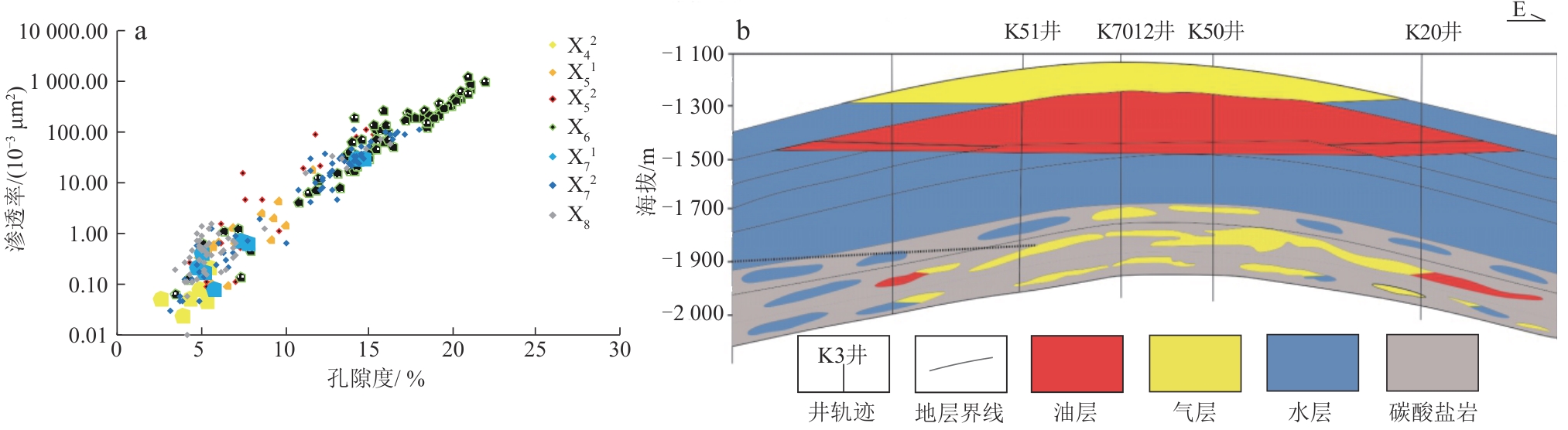

图14
塔里木盆地西南坳陷恰探1井及周缘油气藏分布特征[36]a.油气藏剖面;b.构造等高线图E—Q.古近系—第四系;N.新近系;K.白垩系;C2x—P1k.石炭系小海子组—二叠系克孜里奇曼组"

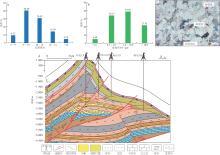
图15
塔里木盆地西南坳陷叶探1井油气藏特征[1]a.孔隙度频率分布直方图;b.渗透率频率分布直方图;c.储层样品铸体薄片显微照片;d.油气藏成藏模式D-S.泥盆系-志留系; P1-3p.二叠系普斯格组;P3d.二叠系杜瓦组;C2—P1.石炭系小海子组—二叠系克孜里奇曼组;J.侏罗系;K.白垩系;E1a.古近系阿尔塔什组;E2-3.古近系巴什布拉克组"


图16
塔里木盆地西南坳陷多源复合全油气系统油气运聚成藏演化模式.寒武系;D+O.泥盆系+奥陶系;C.石炭系;P.二叠系;K.白垩系;E.古近系;N1k.新近系克孜洛依组;N1p+N1a.新近系帕卡布拉克组-安居安组;N2a.新近系阿图什组;Q.第四系"

| [1] | 王清华, 杨海军, 李勇, 等. 塔西南山前地区柯克亚周缘叶探1井油气勘探重大突破及意义[J]. 中国石油勘探, 2024, 29(4): 1-16. |
| WANG Qinghua, YANG Haijun, LI Yong, et al. Major oil and gas discovery and significance of Well Yetan 1 in the peripheral Kekeya area in the piedmont of the southwestern Tarim Basin[J]. China Petroleum Exploration, 2024, 29(4): 1-16. | |
| [2] | 刘军, 田雷, 杨丽莎, 等. 塔里木盆地塔西南坳陷古生界成藏条件特殊性与油气勘探意义[J]. 天然气工业, 2023, 43(9): 61-72. |
| LIU Jun, TIAN Lei, YANG Lisha, et al. Particularity of Paleozoic hydrocarbon accumulation conditions in the southwest Tarim Depression and its implications for petroleum exploration[J]. Natural Gas Industry, 2023, 43(9): 61-72. | |
| [3] | 黄礼, 赵颖, 吕惠贤, 等. 塔里木盆地西南山前坳陷恰探1井二叠系天然气成因和来源[J]. 石油实验地质, 2024, 46(6): 1286-1297. |
| HUANG Li, ZHAO Ying, Huixian LYU, et al. Genesis and source of Permian natural gas in Well Qiatan-1 of piedmont depression, southwestern Tarim Basin[J]. Petroleum Geology and Experiment, 2024, 46(6): 1286-1297. | |
| [4] | 崔海峰, 田雷, 张年春, 等. 塔西南坳陷南华纪—震旦纪裂谷分布及其与下寒武统烃源岩的关系[J]. 石油学报, 2016, 37(4): 430-438. |
| CUI Haifeng, TIAN Lei, ZHANG Nianchun, et al. Nanhua-Sinian rift distribution and its relationship with the development of Lower Cambrian source rocks in the southwest depression of Tarim Basin[J]. Acta Petrolei Sinica, 2016, 37(4): 430-438. | |
| [5] | 侯啓东, 任收麦, 郭天旭, 等. 塔里木盆地西南坳陷二叠系页岩油气地质条件分析[J]. 西北地质, 2020, 53(1): 168-177. |
| HOU Qidong, REN Shoumai, GUO Tianxu, et al. Analysis of geological conditions of Permian shale oil and gas in the southwestern depression of the Tarim Basin, northwest China[J]. Northwestern Geology, 2020, 53(1): 168-177. | |
| [6] | 胡伟, 徐婷, 杨阳, 等. 塔里木盆地超深油气藏流体相行为变化特征[J]. 石油与天然气地质, 2023, 44(4): 1044-1053. |
| HU Wei, XU Ting, YANG Yang, et al. Fluid phases and behaviors in ultra-deep oil and gas reservoirs, Tarim Basin[J]. Oil & Gas Geology, 2023, 44(4): 1044-1053. | |
| [7] | 肖文摇, 吕修祥, 白忠凯, 等. 塔西南坳陷侏罗系泥页岩特征及页岩气潜力分析[J]. 煤炭学报, 2016, 41(): 491-501. |
| XIAO Wenyao, Xiuxiang LYU, BAI Zhongkai, et al. Characteristics of Jurassic shales and potential of shale gas in southwest depression of Tarim Basin[J]. Journal of China Coal Society, 2016, 41(S2): 491-501. | |
| [8] | 崔海峰, 刘江丽, 田雷, 等. 塔西南坳陷震旦纪末古构造格局及其油气意义[J]. 中国石油勘探, 2018, 23(4): 67-75. |
| CUI Haifeng, LIU Jiangli, TIAN Lei, et al. Palaeotectonic pattern at the end of Sinian and its hydrocarbon significance in the southwest depression of Tarim Basin[J]. China Petroleum Exploration, 2018, 23(4): 67-75. | |
| [9] | 崔海峰, 田雷, 刘军, 等. 塔西南坳陷奥陶纪构造活动与油气成藏[J]. 石油地球物理勘探, 2017, 52(4): 834-840, 850. |
| CUI Haifeng, TIAN Lei, LIU Jun, et al. Ordovician tectonic activities and oil and gas accumulation in the Southwest Depression of Tarim Basin[J]. Oil Geophysical Prospecting, 2017, 52(4): 834-840, 850. | |
| [10] | 孙耀玺, 庞雄奇, 成湘, 等. 复杂叠合盆地油气动力场划分及其与勘探的关系——以塔西南坳陷为例[J]. 断块油气田, 2025, 32(2): 185-192. |
| SUN Yaoxi, PANG Xiongqi, CHENG Xiang, et al. Division of hydrocarbon dynamic field in complex superimposed basins and its relationship with exploration: A case study of southwest Tarim Depression[J]. Fault-Block Oil & Gas Field, 2025, 32(2): 185-192. | |
| [11] | 贾承造. 论非常规油气对经典石油天然气地质学理论的突破及意义[J]. 石油勘探与开发, 2017, 44(1): 1-11. |
| JIA Chengzao. Breakthrough and significance of unconventional oil and gas to classical petroleum geological theory[J]. Petroleum Exploration and Development, 2017, 44(1): 1-11. | |
| [12] | 贾承造, 郑民, 张永峰. 非常规油气地质学重要理论问题[J]. 石油学报, 2014, 35(1): 1-10. |
| JIA Chengzao, ZHENG Min, ZHANG Yongfeng. Four important theoretical issues of unconventional petroleum geology[J]. Acta Petrolei Sinica, 2014, 35(1): 1-10. | |
| [13] | 贾承造, 庞雄奇, 郭秋麟, 等. 基于成因法评价油气资源: 全油气系统理论和新一代盆地模拟技术[J]. 石油学报, 2023, 44(9): 1399-1416. |
| JIA Chengzao, PANG Xiongqi, GUO Qiulin, et al. Assessment of oil-gas resources based on genetic method: Whole petroleum system theory and new generation basin modeling technology[J]. Acta Petrolei Sinica, 2023, 44(9): 1399-1416. | |
| [14] | 贾承造, 庞雄奇, 宋岩. 全油气系统理论基本原理[J]. 石油勘探与开发, 2024, 51(4): 679-691. |
| JIA Chengzao, PANG Xiongqi, SONG Yan. Basic principles of the whole petroleum system[J]. Petroleum Exploration and Development, 2024, 51(4): 679-691. | |
| [15] | 宋岩, 贾承造, 姜林, 等. 全油气系统内涵与研究思路[J]. 石油勘探与开发, 2024, 51(6): 1199-1210, 1226. |
| SONG Yan, JIA Chengzao, JIANG Lin, et al. Connotation and research strategy of the whole petroleum system[J]. Petroleum Exploration and Development, 2024, 51(6): 1199-1210, 1226. | |
| [16] | 张蔚. 塔里木盆地西南坳陷油气运聚成藏过程及富集特征[D]. 北京: 中国石油大学(北京), 2020. |
| ZHANG Wei. Hydrocarbon migration and accumulation and its enrichment characteristics in southwest depression of the Tarim Basin, NW China[D]. Beijing: China University of Petroleum (Beijing), 2020. | |
| [17] | 高永进, 尹成明, 刘丽红, 等. 塔里木盆地西北缘寒武系肖尔布拉克组烃源岩特征[J]. 石油与天然气地质, 2024, 45(4): 1064-1078. |
| GAO Yongjin, YIN Chengming, LIU Lihong, et al. Characteristics of source rocks in the Cambrian Xiaoerbulake Formation in the northwestern Tarim Basin[J]. Oil & Gas Geology, 2024, 45(4): 1064-1078. | |
| [18] | 刘得光, 伍致中, 李勇广, 等. 塔里木盆地西南坳陷烃源岩评价[J]. 新疆石油地质, 1997, 18(1): 50-53. |
| LIU Deguang, WU Zhizhong, LI Yongguang, et al. Source rock evaluation in southwest depression of Tarim Basin[J]. Xinjiang Petroleum Geology, 1997, 18(1): 50-53. | |
| [19] | SHEN Weibing, ZHU Xiangkun, XIE Hongzhe, et al. Tectonic–sedimentary evolution during initiation of the Tarim Basin: Insights from late Neoproterozoic sedimentary records in the NW Basin[J]. Precambrian Research, 2022, 371: 106598. |
| [20] | HU Shouzhi, WILKES H, HORSFIELD B, et al. On the origin, mixing and alteration of crude oils in the Tarim Basin[J]. Organic Geochemistry, 2016, 97: 17-34. |
| [21] | HUANG Wenyu, YU Shuang, ZHANG Haizhu, et al. Diamondoid fractionation and implications for the Kekeya condensate field in the southwestern depression of the Tarim Basin, NW China[J]. Marine and Petroleum Geology, 2022, 138: 105551. |
| [22] | 李士超. 塔里木盆地西南地区石炭—二叠系沉积特征与烃源岩评价[D]. 北京: 中国地质大学(北京), 2010. |
| LI Shichao. Carboniferous-Permian’s depositional characteristic and source rock evaluation in southwestern area, Tarim Basin[D]. Beijing: China University of Geosciences (Beijing), 2010. | |
| [23] | PETERS K E, WALTERS C C, MOLDOWAN J M. The biomarker guide: Volume 2: Biomarkers and isotopes in petroleum systems and earth history[M]. 2nd ed. Cambridge: Cambridge University Press, 2013. |
| [24] | 崔海峰, 田雷, 张年春, 等. 塔西南坳陷寒武系玉尔吐斯组烃源岩分布特征[J]. 天然气地球科学, 2016, 27(4): 577-583. |
| CUI Haifeng, TIAN Lei, ZHANG Nianchun, et al. Distribution characteristics of the source rocks from Cambrian Yuertusi Formation in the southwest depression of Tarim Basin[J]. Natural Gas Geoscience, 2016, 27(4): 577-583. | |
| [25] | 何剑, 王振宇, 孙崇浩, 等. 柯克亚地区卡拉塔尔组沉积特征及演化[J]. 断块油气田, 2009, 16(6): 13-16. |
| HE Jian, WANG Zhenyu, SUN Chonghao, et al. Sedimentary characteristics and evolution of Kalataer Formation of Paleogene System in Kekeya area[J]. Fault-Block Oil & Gas Field, 2009, 16(6): 13-16. | |
| [26] | 杨红强, 王振宇, 周成刚, 等. 柯克亚气田古近系卡拉塔尔组碳酸盐岩成岩作用及孔隙形成[J]. 重庆科技大学学报(自然科学版), 2010, 12(3): 14-17. |
| YANG Hongqiang, WANG Zhenyu, ZHOU Chenggang, et al. Carbonate diagenesis and porosity formation of the Kataer Formation (Tertiary) in Kekeya Gas Field, Tarim Basin[J]. Journal of Chongqing University of Science and Technology (Natural Science Edition), 2010, 12(3): 14-17. | |
| [27] | 周杰, 庞雄奇. 一种生、排烃量计算方法探讨与应用[J]. 石油勘探与开发, 2002, 29(1): 24-27. |
| ZHOU Jie, PANG Xiongqi. A method for calculating the quantity of hydrocarbon generation and expulsion[J]. Petroleum Exploration and Development, 2002, 29(1): 24-27. | |
| [28] | 郭旭升, 马晓潇, 黎茂稳, 等. 陆相页岩油富集机理探讨[J]. 石油与天然气地质, 2023, 44(6): 1333-1349. |
| GUO Xusheng, MA Xiaoxiao, LI Maowen, et al. Mechanisms for lacustrine shale oil enrichment in Chinese sedimentary basins[J]. Oil & Gas Geology, 2023, 44(6): 1333-1349. | |
| [29] | 李明, 王民, 张金友, 等. 中国典型盆地陆相页岩油组分评价及意义[J]. 石油与天然气地质, 2023, 44(6): 1479-1498. |
| LI Ming, WANG Min, ZHANG Jinyou, et al. Evaluation of the compositions of lacustrine shale oil in China’s typical basins and its implications[J]. Oil & Gas Geology, 2023, 44(6): 1479-1498. | |
| [30] | HU Yao, JIA Chengzao, CHEN Junqing, et al. Restoration of hydrocarbon generation potential of the highly mature Lower Cambrian Yuertusi Formation source rocks in the Tarim Basin[J]. Petroleum Science, 2025, 22(2): 588-606. |
| [31] | 刘军, 田雷, 张虎权, 等. 塔西南坳陷麦盖提斜坡海西期油气成藏条件与勘探方向[J]. 石油地球物理勘探, 2022, 57(3): 676-685. |
| LIU Jun, TIAN Lei, ZHANG Huquan, et al. Accumulation conditions of Hercynian period in the Maigaiti slope, southwest depression of Tarim Basin and exploration direction[J]. Oil Geophysical Prospecting, 2022, 57(3): 676-685. | |
| [32] | ASCHWANDEN L, DIAMOND L W, ADAMS A. Effects of progressive burial on matrix porosity and permeability of dolostones in the foreland basin of the Alpine Orogen, Switzerland[J]. Marine and Petroleum Geology, 2019, 100: 148-164. |
| [33] | BATALEVA Y V, NOVOSELOV I D, BORZDOV Y M, et al. Experimental modeling of ankerite-pyrite interaction under lithospheric mantle P-T parameters: Implications for graphite formation as a result of ankerite sulfidation[J]. Minerals, 2021, 11(11): 1267. |
| [34] | PANG Xiongqi, SHAO Xinhe, LI Maowen, et al. Correlation and difference between conventional and unconventional reservoirs and their unified genetic classification[J]. Gondwana Research, 2021, 97: 73-100. |
| [35] | 魏秀丽. 柯克亚气藏新近系西河甫组西八段地质建模研究[D]. 成都: 西南石油大学, 2013. |
| WEI Xiuli. Geological modeling of the Xiba member in the Neogene Xihefu Formation of the Kekeya gas reservoir[D]. Chengdu: Southwest Petroleum University, 2013. | |
| [36] | 王清华, 杨海军, 李勇, 等. 塔西南山前地区恰探1井石炭系—二叠系重大突破与勘探前景[J]. 中国石油勘探, 2023, 28(4): 34-45. |
| WANG Qinghua, YANG Haijun, LI Yong, et al. Major breakthrough in the Carboniferous-Permian in Well Qiatan 1 and exploration prospect in the piedmont southwestern Tarim Basin[J]. China Petroleum Exploration, 2023, 28(4): 34-45. |
| [1] | 贾承造, 庞雄奇, 宋岩, 崔新璇, 胡耀, 徐帜, 姜林, 蒲庭玉, 姜福杰, 沈彬. 全油气系统的4种基本类型及其资源开发领域[J]. 石油与天然气地质, 2025, 46(4): 1019-1038. |
| [2] | 曹鹏, 赵振丞, 庞雄奇, 李才俊, 庞宏, 林会喜, 杨海军, 马奎友, 张思佳. 塔里木盆地台盆区下古生界全油气系统碳酸盐岩油气藏改造特征与成因模式[J]. 石油与天然气地质, 2025, 46(4): 1299-1315. |
| [3] | 丁蓉, 庞雄奇, 贾承造, 熊先钺, 邓泽, 田文广, 蒲庭玉, 王飞宇, 林浩, 陈雨萱. 鄂尔多斯盆地石炭纪—二叠纪煤系全油气系统天然气成藏特征与有序分布模式[J]. 石油与天然气地质, 2025, 46(4): 1333-1348. |
| [4] | 薛一帆, 赵海涛, 黄亚浩, 文志刚, 刘宇坤, 张银涛, 乔占峰, 罗涛. 塔里木盆地深层奥陶系走滑断裂区与非走滑断裂区储层流体超压演化差异特征与成藏机制[J]. 石油与天然气地质, 2025, 46(3): 926-943. |
| [5] | 胡伟, 徐婷, 杨阳, 康志江, 伦增珉, 李宗宇, 赵瑞明, 张文学. 超深断控凝析气藏注气提高凝析油采收率实验评价——以塔里木盆地顺北4号断裂带为例[J]. 石油与天然气地质, 2025, 46(2): 586-598. |
| [6] | 云露, 曹自成, 耿锋, 汪洋, 丁勇, 刘永立. 塔里木盆地塔北台盆区奥陶系油气分布有序性[J]. 石油与天然气地质, 2025, 46(1): 15-30. |
| [7] | 何帅, 马安来, 云露, 曹自成, 李贤庆, 黄诚, 张国松, 胡松, 王铁一, 彭威龙, 朱志立, 崔福田. 塔里木盆地顺北地区上奥陶统恰尔巴克组烃源岩有机地球化学特征及勘探意义[J]. 石油与天然气地质, 2025, 46(1): 246-260. |
| [8] | 李凤磊, 林承焰, 任丽华, 张国印, 朱永峰, 张银涛, 关宝珠. 基于地质成因的走滑断裂带岩溶缝洞型储层连通性与剩余油分布模式[J]. 石油与天然气地质, 2025, 46(1): 315-334. |
| [9] | 吕心瑞, 孙建芳, 李红凯, 夏东领, 邬兴威, 韩科龙, 侯加根. 塔里木盆地深层碳酸盐岩缝洞型油藏精细地质建模技术[J]. 石油与天然气地质, 2024, 45(5): 1195-1210. |
| [10] | 邓尚, 邱华标, 刘大卫, 韩俊, 汝智星, 彭威龙, 卞青, 黄诚. 克拉通内走滑断裂成因与控藏机制研究进展[J]. 石油与天然气地质, 2024, 45(5): 1211-1225. |
| [11] | 乔俊程, 常少英, 曾溅辉, 曹鹏, 董科良, 王孟修, 杨冀宁, 刘亚洲, 隆辉, 安廷, 杨睿, 文林. 塔里木盆地北部富满地区超深层走滑断裂带碳酸盐岩油气差异成藏成因探讨[J]. 石油与天然气地质, 2024, 45(5): 1226-1246. |
| [12] | 王正和, 张荣虎, 岳勇, 程锦翔. 盆-山耦合控制下塔里木盆地库车坳陷上三叠统黄山街组层序地层特征[J]. 石油与天然气地质, 2024, 45(5): 1247-1258. |
| [13] | 马海陇, 蒋林, 丁文龙, 韩鹏远, 王震, 张长建, 文欢, 丁立明, 李杰. 塔里木盆地兰尕与和田河断裂带变形特征及成藏演化模式[J]. 石油与天然气地质, 2024, 45(5): 1259-1274. |
| [14] | 高永进, 尹成明, 刘丽红, 徐大融, 杨有星, 张远银, 宋泽章, 甄曼彤. 塔里木盆地西北缘寒武系肖尔布拉克组烃源岩特征[J]. 石油与天然气地质, 2024, 45(4): 1064-1078. |
| [15] | 韩鹏远, 丁文龙, 杨德彬, 张娟, 马海陇, 王生晖. 塔里木盆地塔河油田S80走滑断裂发育特征及其对奥陶系储层的控制作用[J]. 石油与天然气地质, 2024, 45(3): 770-786. |
| 阅读次数 | ||||||
|
全文 |
|
|||||
|
摘要 |
|
|||||
