

石油与天然气地质 ›› 2025, Vol. 46 ›› Issue (4): 1299-1315.doi: 10.11743/ogg20250418
曹鹏1,2,3( ), 赵振丞1,2, 庞雄奇1,2(), 李才俊1,2, 庞宏1,2, 林会喜4, 杨海军5, 马奎友1,2, 张思佳1,2
收稿日期:2025-05-20
修回日期:2025-08-08
出版日期:2025-08-30
发布日期:2025-09-06
通讯作者:
庞雄奇
E-mail:caopeng@cnpcrd.com;pangxq@cup.edu.cn
第一作者简介:曹鹏(1985—),男,高级工程师,碳酸盐岩油藏综合地质描述与成藏、油藏工程。E-mail:caopeng@cnpcrd.com。
基金项目:
Peng CAO1,2,3(), Zhencheng ZHAO1,2, Xiongqi PANG1,2(), Caijun LI1,2, Hong PANG1,2, Huixi LIN4, Haijun YANG5, Kuiyou MA1,2, Sijia ZHANG1,2
Received:2025-05-20
Revised:2025-08-08
Online:2025-08-30
Published:2025-09-06
Contact:
Xiongqi PANG
E-mail:caopeng@cnpcrd.com;pangxq@cup.edu.cn
摘要:
塔里木盆地台盆区深层碳酸盐岩储层是中国重要油气产层,油气资源潜力巨大。受多期构造活动、多期油气充注和调整改造的影响,其油气藏改造特征、成因模式和分布规律尚不完全明确,制约了深层-超深层油气探勘的进展。基于全油气系统理论,系统研究了塔里木盆地台盆区下古生界碳酸盐岩油气藏改造特征与成因模式,研究结果表明:①台盆区碳酸盐岩改造类油气藏油气成藏动力边界和动力场均受到构造破坏;早期油气藏类型由连续致密油气藏转变为常规裂缝型、缝洞型或孔洞型油气藏。呈现叠复连续油气藏特征,形成断溶体油气藏新类型。②台盆区碳酸盐岩改造类油气藏受控于沉积演化、构造运动、成藏期次和保存条件等多因素动态耦合,历经3个演化阶段,油气成藏动力边界在物理化学的作用下被破坏。③改造类油气藏具有“纵向分层、横向分带”的有序分布特征。纵向分层性主要由岩性组合和沉积环境差异决定,横向分带性则受断裂和不整合面发育程度控制。礁滩体油气藏和不整合孔洞类油气藏主要位于自由动力场,断层裂缝类油气藏则位于浮力成藏下限与油气成藏底线之间的局限动力场。
中图分类号:
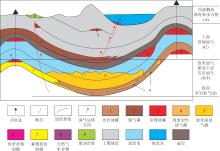
图1
全油气系统内常规和非常规油气藏有序分布基本模式[24]A. 变异改造型油气藏;C. 常规油气藏;S. 页岩油气藏;T. 致密油气藏"


图2
全油气系统内流体动力场及其控制下的油气藏分布模式[5]C1. 常规背斜油气藏;C2. 常规断块油气藏;C3. 常规岩性油气藏;C4. 常规地层油气藏;C5. 常规复合油气藏;U1. 致密常规油气藏;U2. 致密深盆油气藏;U3. 致密连续油气藏;U4. 页岩油气藏;U5. 煤层气藏;R1. 裂缝改造油气藏;R2. 孔洞改造油气藏;R3. 裂缝-孔洞复合改造油气藏;R4. 氧化改造稠油沥青(矿)藏;R5. 高温裂解改造干气藏"
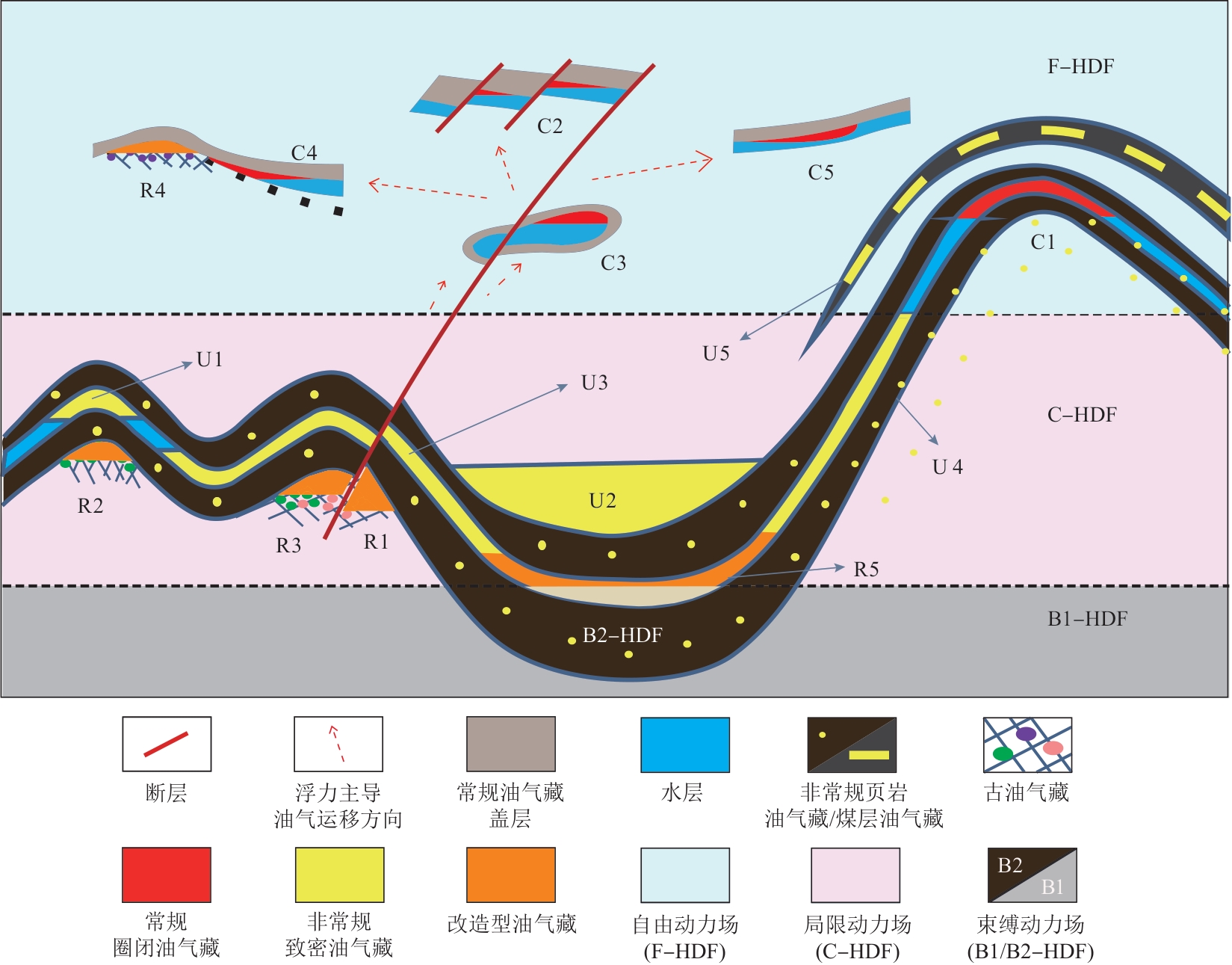
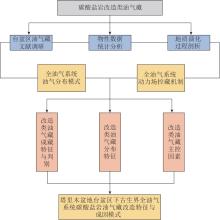
图3
塔里木盆地台盆区碳酸盐岩改造类油气藏特征与成因模式研究技术路线图"

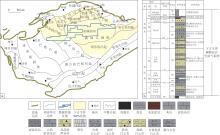
图4
塔里木盆地台盆区下古生界全油气系统(WPS)平面分布(a)和地层柱状图[34](b)"


图5
塔里木盆地台盆区下古生界全油气系统时间分布[42]"


图6
塔里木盆地富满地区油气成藏动力判识以及浮力成藏下限对应埋深变化特征a. 基于浮力下限对应临界条件识别4种动力油气藏; b. 4类成藏动力贡献量评价饼状图;c. 4类动力贡献量随埋深变化条形图Ⅰ. 浮力常规油气藏;Ⅱ. 非浮力致密油气藏; Ⅲ1.应力改造裂缝型油气藏; Ⅲ2.流体改造孔洞型油气藏"


图7
塔里木盆地富满地区油气成藏动力场构造变动破坏"

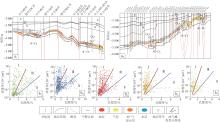
图8
塔里木盆地台盆区油气藏类型分布(a1,a2)[46]及孔-渗散点图(b1—b5)a1. 过中古49井—中古102井剖面; a2. 过中古30井—塔中78井剖面; b1. 良里塔格组1段; b2. 良里塔格组2段; b3. 良里塔格组3段; b4. 鹰山组; b5. 蓬莱坝组Ⅰ. 裂缝型油气藏; Ⅱ. 孔隙型油气藏; Ⅲ. 裂缝-孔隙型油气藏(O3l1为泥质条带灰岩段,O3l2为颗粒灰岩段,O3l3为含泥灰岩段。)"


图9
塔里木盆地富满地区断溶体油气藏发育示意图a. 断溶体油气藏三维雕刻量化;b. 断溶体三维地质模型;c1. 粒间孔、粒间溶孔、微裂缝,埋深7 231.65 m,X井,单偏光,铸体薄片显微照片; c2. 粒内溶孔、铸模孔,埋深7 240.00 m,X井,单偏光,铸体薄片显微照片; c3. 构造溶蚀缝(方解石半充填),埋深7 377.50 m,X井,单偏光,铸体薄片显微照片"


图10
塔里木盆地台盆区改造类油气藏时-空演化模式(据文献[42]修改)a. 寒武纪; b. 奥陶纪剥蚀后; c. 志留纪剥蚀后; d. 二叠纪剥蚀后; e. 现今"

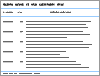
表1
塔里木盆地台盆区碳酸盐岩油气藏类型及特征对比"
| 油气藏成因分类 | 礁滩体油气藏 | 断层裂缝类油气藏 | 不整合孔洞类油气藏 |
|---|---|---|---|
| 成藏动力分类 | 常规类油气藏(原生)、改造类油气藏 | 致密类油气藏(原生)、改造类油气藏 | 常规类油气藏(原生)、改造类油气藏 |
| 动力场类型 | 自由动力场 | 局限动力场 | 自由动力场 |
| 储集空间类型 | 缝洞体(油气藏) | 断溶体(油气藏) | 孔洞体(油气藏) |
| 油气藏主控因素 | 隆起-断裂-礁滩 | 断裂/不整合-低势区 | 潜山-不整合 |
| 油气藏特征 | 常规成藏基础上的后期改造、层状连续、构造高部位 | 致密油气藏经构造改造向常规油气藏过渡、多期改造,沿断裂条带状分布、叠复连续 | 不整合面控制的岩溶改造,常规地层油气藏与改造型溶蚀储层的复合 |

图11
塔里木盆地台盆区下古生界改造类油气藏分布特征(据文献[26]修改)a. 平面分布特征; b. 剖面分布特征"

| [1] | 贾承造. 含油气盆地深层—超深层油气勘探开发的科学技术问题[J]. 中国石油大学学报(自然科学版), 2023, 47(5): 1-12. |
| JIA Chengzao. Key scientific and technological problems of petroleum exploration and development in deep and ultra-deep formation[J]. Journal of China University of Petroleum (Edition of Natural Science), 2023, 47(5): 1-12. | |
| [2] | 马永生, 蔡勋育, 黎茂稳, 等. 深层—超深层海相碳酸盐岩成储成藏机理与油气藏开发方法研究进展[J]. 石油勘探与开发, 2024, 51(4): 692-707. |
| MA Yongsheng, CAI Xunyu, LI Maowen, et al. Research advances on the mechanisms of reservoir formation and hydrocarbon accumulation and the oil and gas development methods of deep and ultra-deep marine carbonates[J]. Petroleum Exploration and Development, 2024, 51(4): 692-707. | |
| [3] | PANG Xiongqi, SHAO Xinhe, LI Maowen, et al. Correlation and difference between conventional and unconventional reservoirs and their unified genetic classification[J]. Gondwana Research, 2021, 97: 73-100. |
| [4] | PANG Xiongqi, ZHOU Xinyuan, LIN Changsong, et al. Classification of complex reservoirs in superimposed basins of western China[J]. Acta Geologica Sinica(English Edition), 2010, 84(5): 1011-1034. |
| [5] | 庞雄奇, 贾承造, 宋岩, 等. 全油气系统定量评价: 方法原理与实际应用[J]. 石油学报, 2022, 43(6): 727-759. |
| PANG Xiongqi, JIA Chengzao, SONG Yan, et al. Quantitative evaluation of whole petroleum system: principle and application[J]. Acta Petrolei Sinica, 2022, 43(6): 727-759. | |
| [6] | 刘池洋, 黄雷, 赵俊峰, 等. 改造型盆地油气赋存-成藏理论体系纲要[J]. 地学前缘, 2022, 29(6): 84-108. |
| LIU Chiyang, HUANG Lei, ZHAO Junfeng, et al. Hydrocarbon occurrence and accumulation processes in reformed basins—theories outline[J]. Earth Science Frontiers, 2022, 29(6): 84-108. | |
| [7] | 王清华, 蔡振忠, 张银涛, 等. 塔里木盆地超深层走滑断控油气藏研究进展与趋势[J]. 新疆石油地质, 2024, 45(4): 379-386. |
| WANG Qinghua, CAI Zhenzhong, ZHANG Yintao, et al. Research progress and trend of ultra-deep strike-slip fault-controlled hydrocarbon reservoirs in Tarim Basin[J]. Xinjiang Petroleum Geology, 2024, 45(4): 379-386. | |
| [8] | 梁鑫鑫, 张银涛, 陈石, 等. 塔里木盆地富满油田走滑断裂多核破碎带地震响应特征[J]. 岩性油气藏, 2025, 37(2): 127-138. |
| LIANG Xinxin, ZHANG Yintao, CHEN Shi, et al. Seismic response characteristics of strike-slip fault multi-core damage zones in Fuman Oilfield, Tarim Basin[J]. Lithologic Reservoirs, 2025, 37(2): 127-138. | |
| [9] | 汪如军, 孙冲, 袁敬一, 等. 基于结构张量的走滑断裂破碎带地震识别——以富满油田超深层碳酸盐岩为例[J]. 新疆石油地质, 2024, 45(4): 475-482. |
| WANG Rujun, SUN Chong, YUAN Jingyi, et al. Seismic identification of strike-slip fault damage zones based on structure tensor analysis: A case study of ultra-deep carbonate rocks in Fuman Oilfield[J]. Xinjiang Petroleum Geology, 2024, 45(4): 475-482. | |
| [10] | 吕心瑞, 孙建芳, 李红凯, 等. 塔里木盆地深层碳酸盐岩缝洞型油藏精细地质建模技术[J]. 石油与天然气地质, 2024, 45(5): 1195-1210. |
| Xinrui LYU, SUN Jianfang, LI Hongkai, et al. Fine geological modelling technology for deep fractured-vuggy carbonate oil reservoirs in the Tarim Basin[J]. Oil & Gas Geology, 2024, 45(5): 1195-1210. | |
| [11] | 陈叔阳, 何云峰, 王立鑫, 等. 塔里木盆地顺北1号断裂带奥陶系碳酸盐岩储层结构表征及三维地质建模[J]. 岩性油气藏, 2024, 36(2): 124-135. |
| CHEN Shuyang, HE Yunfeng, WANG Lixin, et al. Architecture characterization and 3D geological modeling of Ordovician carbonate reservoirs in Shunbei No.1 fault zone, Tarim Basin[J]. Lithologic Reservoirs, 2024, 36(2): 124-135. | |
| [12] | 曹自成, 云露, 漆立新, 等. 塔里木盆地顺北地区顺北84X井超千米含油气重大发现及其意义[J]. 石油与天然气地质, 2024, 45(2): 341-356. |
| CAO Zicheng, YUN Lu, QI Lixin, et al. A major discovery of hydrocarbon-bearing layers over 1,000-meter thick in Well Shunbei 84X, Shunbei area, Tarim Basin and its implications[J]. Oil & Gas Geology, 2024, 45(2): 341-356. | |
| [13] | 宋兴国, 陈石, 杨明慧, 等. 塔里木盆地富满油田FⅠ16断裂发育特征及其对油气分布的影响[J]. 岩性油气藏, 2023, 35(3): 99-109. |
| SONG Xingguo, CHEN Shi, YANG Minghui, et al. Development characteristics of FⅠ16 fault in Fuman Oilfield of Tarim Basin and its influence on oil and gas distribution[J]. Lithologic Reservoirs, 2023, 35(3): 99-109. | |
| [14] | 刘强, 张银涛, 陈石, 等. 塔里木盆地走滑断裂发育演化特征精细解析及其地质意义: 以富满油田FⅠ17断裂为例[J]. 现代地质, 2023, 37(5): 1123-1135. |
| LIU Qiang, ZHANG Yintao, CHEN Shi, et al. Development and evolution characteristics of strike-slip faults in Tarim Basin and its geological significance: A case study of FⅠ17 fault in Fuman Oilfield[J]. Geoscience, 2023, 37(5): 1123-1135. | |
| [15] | 张银涛, 陈石, 刘强, 等. 塔里木盆地富满油田FⅠ19断裂发育特征及演化模式[J]. 现代地质, 2023, 37(2): 283-295. |
| ZHANG Yintao, CHEN Shi, LIU Qiang, et al. Development characteristics and evolution model of FⅠ19 fault in Fuman Oilfield, Tarim Basin[J]. Geoscience, 2023, 37(2): 283-295. | |
| [16] | 宋兴国, 陈石, 谢舟, 等. 塔里木盆地富满油田东部走滑断裂发育特征与油气成藏[J]. 石油与天然气地质, 2023, 44(2): 335-349. |
| SONG Xingguo, CHEN Shi, XIE Zhou, et al. Strike-slip faults and hydrocarbon accumulation in the eastern part of Fuman Oilfield, Tarim Basin[J]. Oil & Gas Geology, 2023, 44(2): 335-349. | |
| [17] | 杨海军, 能源, 邵龙飞, 等. 塔里木盆地台盆区走滑断裂带多层叠加样式及石油地质意义[J]. 新疆石油地质, 2024, 45(4): 387-400. |
| YANG Haijun, NENG Yuan, SHAO Longfei, et al. Multilayer superimposition patterns of strike-slip fault zones and their petroleum geological significance in platform area, Tarim Basin[J]. Xinjiang Petroleum Geology, 2024, 45(4): 387-400. | |
| [18] | BIAN Qing, ZHANG Jibiao, HUANG Cheng. The Middle and Lower Cambrian salt tectonics in the central Tarim Basin, China: A case study based on strike-slip fault characterization[J]. Energy Geoscience, 2024, 5(2): 100254. |
| [19] | 贾承造. 论非常规油气对经典石油天然气地质学理论的突破及意义[J]. 石油勘探与开发, 2017, 44(1): 1-11. |
| JIA Chengzao. Breakthrough and significance of unconventional oil and gas to classical petroleum geological theory[J]. Petroleum Exploration and Development, 2017, 44(1): 1-11. | |
| [20] | 贾承造, 郑民, 张永峰. 非常规油气地质学重要理论问题[J]. 石油学报, 2014, 35(1): 1-10. |
| JIA Chengzao, ZHENG Min, ZHANG Yongfeng. Four important theoretical issues of unconventional petroleum geology[J]. Acta Petrolei Sinica, 2014, 35(1): 1-10. | |
| [21] | JIA Chengzao, PANG Xiongqi, SONG Yan. Whole petroleum system and ordered distribution pattern of conventional and unconventional oil and gas reservoirs[J]. Petroleum Science, 2023, 20(1): 1-19. |
| [22] | 贾承造, 庞雄奇, 宋岩. 全油气系统理论基本原理[J]. 石油勘探与开发, 2024, 51(4): 679-691. |
| JIA Chengzao, PANG Xiongqi, SONG Yan. Basic principles of the whole petroleum system[J]. Petroleum Exploration and Development, 2024, 51(4): 679-691. | |
| [23] | 宋岩, 贾承造, 姜林, 等. 全油气系统内涵与研究思路[J]. 石油勘探与开发, 2024, 51(6): 1199-1210, 1226. |
| SONG Yan, JIA Chengzao, JIANG Lin, et al. Connotation and research strategy of the whole petroleum system[J]. Petroleum Exploration and Development, 2024, 51(6): 1199-1210, 1226. | |
| [24] | 庞雄奇, 贾承造, 郭秋麟, 等. 全油气系统理论用于常规和非常规油气资源评价的盆地模拟技术原理及应用[J]. 石油学报, 2023, 44(9): 1417-1433. |
| PANG Xiongqi, JIA Chengzao, GUO Qiulin, et al. Principle and application of basin modeling technology for evaluation of conventional and unconventional oil-gas resource based on whole petroleum system theory[J]. Acta Petrolei Sinica, 2023, 44(9): 1417-1433. | |
| [25] | 田军. 塔里木盆地油气勘探成果与勘探方向[J]. 新疆石油地质, 2019, 40(1): 1-11. |
| TIAN Jun. Petroleum exploration achievements and future targets of Tarim Basin[J]. Xinjiang Petroleum Geology, 2019, 40(1): 1-11. | |
| [26] | 田军, 杨海军, 朱永峰, 等. 塔里木盆地富满油田成藏地质条件及勘探开发关键技术[J]. 石油学报, 2021, 42(8): 971-985. |
| TIAN Jun, YANG Haijun, ZHU Yongfeng, et al. Geological conditions for hydrocarbon accumulation and key technologies for exploration and development in Fuman Oilfield, Tarim Basin[J]. Acta Petrolei Sinica, 2021, 42(8): 971-985. | |
| [27] | PANG Xiongqi, JIA Chengzao, WANG Wenyang, et al. Buoyance-driven hydrocarbon accumulation depth and its implication for unconventional resource prediction[J]. Geoscience Frontiers, 2021, 12(4): 101133. |
| [28] | PANG Xiongqi, HU Tao, LARTER S, et al. Hydrocarbon accumulation depth limit and implications for potential resources prediction[J]. Gondwana Research, 2022, 103: 389-400. |
| [29] | PANG Xiongqi, JIA Chengzao, ZHANG Kun, et al. The dead line for oil and gas and implication for fossil resource prediction[J]. Earth System Science Data, 2020, 12(1): 577-590. |
| [30] | 庞雄奇, 周新源, 姜振学, 等. 叠合盆地油气藏形成、演化与预测评价[J]. 地质学报, 2012, 86(1): 1-103. |
| PANG Xiongqi, ZHOU Xinyuan, JIANG Zhenxue, et al. Hydrocarbon reservoirs formation, evolution, prediction and evaluation in the superimposed basins[J]. Acta Geologica Sinica, 2012, 86(1): 1-103. | |
| [31] | 庞雄奇, 金之钧, 姜振学, 等. 叠合盆地油气资源评价问题及其研究意义[J]. 石油勘探与开发, 2002, 29(1): 9-13. |
| PANG Xiongqi, JIN Zhijun, JIANG Zhenxue, et al. Evaluation of hydrocarbon resources of superimposed basin and its significance[J]. Petroleum Exploration and Development, 2002, 29(1): 9-13. | |
| [32] | 贾承造. 中国塔里木盆地构造特征与油气[M]. 北京: 石油工业出版社, 1997. |
| JIA Chengzao. Tectonic characteristics and petroleum Tarim Basin China[M]. Beijing: Petroleum Industry Press, 1997. | |
| [33] | 马庆佑, 吕海涛, 蒋华山, 等. 塔里木盆地台盆区构造单元划分方案[J]. 海相油气地质, 2015, 20(1): 1-9. |
| MA Qingyou, Haitao LYU, JIANG Huashan, et al. A division program of structural units in the Paleozoic platform-basin region, Tarim Basin[J]. Marine Origin Petroleum Geology, 2015, 20(1): 1-9. | |
| [34] | 王清华, 徐振平, 张荣虎, 等. 塔里木盆地油气勘探新领域、新类型及资源潜力[J]. 石油学报, 2024, 45(1): 15-32. |
| WANG Qinghua, XU Zhenping, ZHANG Ronghu, et al. New fields, new types of hydrocarbon explorations and their resource potentials in Tarim Basin[J]. Acta Petrolei Sinica, 2024, 45(1): 15-32. | |
| [35] | 乔俊程, 常少英, 曾溅辉, 等. 塔里木盆地北部富满地区超深层走滑断裂带碳酸盐岩油气差异成藏成因探讨[J]. 石油与天然气地质, 2024, 45(5): 1226-1246. |
| QIAO Juncheng, CHANG Shaoying, ZENG Jianhui, et al. Origin of differential hydrocarbon accumulation in ultra-deep carbonate reservoirs along strike-slip fault zones in the Fuman area, northern Tarim Basin[J]. Oil & Gas Geology, 2024, 45(5): 1226-1246. | |
| [36] | 李峰, 朱光有, 吕修祥, 等. 塔里木盆地古生界海相油气来源争议与寒武系主力烃源岩的确定[J]. 石油学报, 2021, 42(11): 1417-1436. |
| LI Feng, ZHU Guangyou, Xiuxiang LYU, et al. The disputes on the source of Paleozoic marine oil and gas and the determination of the Cambrian system as the main source rocks in Tarim Basin[J]. Acta Petrolei Sinica, 2021, 42(11): 1417-1436. | |
| [37] | 郭秋麟, 黄少英, 卢玉红, 等. 塔里木盆地台盆区下古生界油气系统模拟及资源分布预测[J]. 石油学报, 2023, 44(9): 1459-1471. |
| GUO Qiulin, HUANG Shaoying, LU Yuhong, et al. Modeling and resource distribution prediction of the Lower Paleozoic petroleum system in platform area of Tarim Basin[J]. Acta Petrolei Sinica, 2023, 44(9): 1459-1471. | |
| [38] | 何登发, 贾承造, 李德生, 等. 塔里木多旋回叠合盆地的形成与演化[J]. 石油与天然气地质, 2005, 26(1): 64-77. |
| HE Dengfa, JIA Chengzao, LI Desheng, et al. Formation and evolution of polycyclic superimposed Tarim Basin[J]. Oil & Gas Geology, 2005, 26(1): 64-77. | |
| [39] | 徐勤琪, 储呈林, 郭小文, 等. 塔河油田盐下地区原油地球化学特征及不同期次油气成藏贡献[J]. 石油实验地质, 2024, 46(1): 111-123. |
| XU Qinqi, CHU Chenglin, GUO Xiaowen, et al. Geochemical characteristics of crude oil and contributions to hydrocarbon accumulation in multiple stages in Tahe subsalt area[J]. Petroleum Geology and Experiment, 2024, 46(1): 111-123. | |
| [40] | 胡文革, 马龙杰, 汪彦, 等. 关于塔里木盆地深层油气藏高效开发的实践与思考[J]. 油气藏评价与开发, 2024, 14(4): 519-528. |
| HU Wenge, MA Longjie, WANG Yan, et al. Application and reflections on efficient development of deep oil and gas reservoirs in Tarim Basin[J]. Petroleum Reservoir Evaluation and Development, 2024, 14(4): 519-528. | |
| [41] | 薛一帆, 文志刚, 黄亚浩, 等. 深层—超深层走滑断裂带储层流体来源与油气成藏过程研究——以塔里木盆地富满油田为例[J]. 油气藏评价与开发, 2024, 14(4): 549-559. |
| XUE Yifan, WEN Zhigang, HUANG Yahao, et al. Study on reservoir fluid source and hydrocarbon accumulation process in deep to ultra-deep strike-slip fault zone: A case study of Fuman Oilfield, Tarim Basin[J]. Petroleum Reservoir Evaluation and Development, 2024, 14(4): 549-559. | |
| [42] | 喻春花. 富满地区奥陶系超深层天然气地球化学特征、成因和来源[D]. 北京: 中国地质大学(北京), 2023. |
| YU Chunhua. Geochemical characteristics, genesis and source of Ordovician ultra-deep natural gas in Fuman area[D]. Beijing: China University of Geosciences(Beijing), 2023. | |
| [43] | PANG Bo, PANG Xiongqi, LI Caijun, et al. A novel method for quantitatively identifying driving forces and evaluating their contributions to oil and gas accumulation[J]. Geoscience Frontiers, 2024, 15(4): 101801. |
| [44] | PANG Xiongqi. Unified model for oil and gas reservoirs formation[M]//PANG Xiongqi. Quantitative Evaluation of the Whole Petroleum System. Singapore: Springer, 2023: 183-216. |
| [45] | 陈君青, 姜振学, 庞雄奇, 等. 应用新方法剖析钻探井失利原因: 以塔里木盆地台盆区寒武系碳酸盐岩为例[J]. 现代地质, 2013, 27(5): 1161-1172. |
| CHEN Junqing, JIANG Zhenxue, PANG Xiongqi, et al. An new method applied to analyzing the unsuccessful drills: Take the Cambrian in the platform of the Tarim Basin as an example[J]. Geoscience, 2013, 27(5): 1161-1172. | |
| [46] | 王阳洋, 陈践发, 庞雄奇, 等. 塔中地区良里塔格组连续型碳酸盐岩油气藏地质特征与成因机制[J]. 石油学报, 2015, 36(): 60-70. |
| WANG Yangyang, CHEN Jianfa, PANG Xiongqi, et al. Geological features and formation mechanism of successive-type carbonate hydrocarbon reservoirs in Lianglitage Formation of Tazhong area[J]. Acta Petrolei Sinica, 2015, 36(S2): 60-70. | |
| [47] | 成锁, 简世凯, 谭杨, 等. 塔里木盆地奥陶系碳酸盐岩储层孔隙特征刻画[J]. 断块油气田, 2023, 30(5): 816-821. |
| CHENG Suo, JIAN Shikai, TAN Yang, et al. Pore characteristics of Ordovician carbonate reservoir in Tarim Basin[J]. Fault-Block Oil and Gas Field, 2023, 30(5): 816-821. | |
| [48] | 杨新影, 何皓, 晏楠, 等. 基于梯度结构张量的碳酸盐岩缝洞型储层定量预测技术——以塔里木盆地轮古油田奥陶系储层为例[J/OL]. 大庆石油地质与开发: 1-9[2025-07-25]. . |
| YANG Xinying, HE Hao, YAN Nan, et al. Quantitative prediction technology for carbonate fractured-vuggy reservoirs based on gradient-structure tensor: Taking Ordovician reservoirs in Lungu Oilfield of Tarim Basin as an example[J/OL]. Petroleum Geology & Oilfield Development in Daqing: 1-9[2025-07-25]. . | |
| [49] | 庞雄奇, 高剑波, 吕修祥, 等. 塔里木盆地“多元复合——过程叠加”成藏模式及其应用[J]. 石油学报, 2008, 29(2): 159-166, 172. |
| PANG Xiongqi, GAO Jianbo, Xiuxiang LYU, et al. Reservoir accumulation pattern of multi-factor recombination and procession superimposition and its application in Tarim Basin[J]. Acta Petrolei Sinica, 2008, 29(2): 159-166, 172. | |
| [50] | 周兴熙. 复合叠合盆地油气成藏特征——以塔里木盆地为例[J]. 地学前缘, 2000, 7(3): 39-47. |
| ZHOU Xingxi. The petroleum reservoir-forming characteristics of the composite superimposed basin--An example from Tarim Basin[J]. Earth Science Frontiers, 2000, 7(3): 39-47. | |
| [51] | PANG Xiongqi, JIA Chengzao, PANG Hong, et al. Destruction of hydrocarbon reservoirs due to tectonic modifications: Conceptual models and quantitative evaluation on the Tarim Basin, China[J]. Marine and Petroleum Geology, 2018, 91: 401-421. |
| [52] | 庞雄奇, 周新源, 鄢盛华, 等. 中国叠合盆地油气成藏研究进展与发展方向——以塔里木盆地为例[J]. 石油勘探与开发, 2012, 39(6): 649-656. |
| PANG Xiongqi, ZHOU Xinyuan, YAN Shenghua, et al. Research advances and direction of hydrocarbon accumulation in the superimposed basins, China: Take the Tarim Basin as an example[J]. Petroleum Exploration and Development, 2012, 39(6): 649-656. | |
| [53] | 庞雄奇, 姜振学, 黄捍东, 等. 叠复连续油气藏成因机制、发育模式及分布预测[J]. 石油学报, 2014, 35(5): 795-828. |
| PANG Xiongqi, JIANG Zhenxue, HUANG Handong, et al. Formation mechanisms, distribution models, and prediction of superimposed, continuous hydrocarbon reservoirs[J]. Acta Petrolei Sinica, 2014, 35(5): 795-828. | |
| [54] | 鲁新便, 胡文革, 汪彦, 等. 塔河地区碳酸盐岩断溶体油藏特征与开发实践[J]. 石油与天然气地质, 2015, 36(3): 347-355. |
| LU Xinbian, HU Wenge, WANG Yan, et al. Characteristics and development practice of fault-karst carbonate reservoirs in Tahe area, Tarim Basin[J]. Oil & Gas Geology, 2015, 36(3): 347-355. | |
| [55] | 韩剑发, 苏洲, 陈利新, 等. 塔里木盆地台盆区走滑断裂控储控藏作用及勘探潜力[J]. 石油学报, 2019, 40(11): 1296-1310. |
| HAN Jianfa, SU Zhou, CHEN Lixin, et al. Reservoir-controlling and accumulation-controlling of strike-slip faults and exploration potential in the platform of Tarim Basin[J]. Acta Petrolei Sinica, 2019, 40(11): 1296-1310. | |
| [56] | 张艳秋, 陈红汉, 王燮培, 等. 塔里木盆地富满油田走滑断裂带通源性评价[J]. 石油与天然气地质, 2024, 45(3): 787-800. |
| ZHANG Yanqiu, CHEN Honghan, WANG Xiepei, et al. Assessment of connectivity between source rocks and strike-slip fault zone in the Fuman Oilfield, Tarim Basin[J]. Oil & Gas Geology, 2024, 45(3): 787-800. | |
| [57] | 漆立新. 塔里木盆地顺北超深断溶体油藏特征与启示[J]. 中国石油勘探, 2020, 25(1): 102-111. |
| QI Lixin. Characteristics and inspiration of ultra-deep fault-karst reservoir in the Shunbei area of the Tarim Basin[J]. China Petroleum Exploration, 2020, 25(1): 102-111. | |
| [58] | 杨德彬, 鲁新便, 鲍典, 等. 塔里木盆地北部奥陶系海相碳酸盐岩断溶体油藏成因类型及特征再认识[J]. 石油与天然气地质, 2024, 45(2): 357-366. |
| YANG Debin, LU Xinbian, BAO Dian, et al. New insights into the genetic types and characteristics of the Ordovician marine fault-karst carbonate reservoirs in the northern Tarim Basin[J]. Oil & Gas Geology, 2024, 45(2): 357-366. | |
| [59] | 郭春涛, 史江涛, 刘亮, 等. 塔里木盆地塔河地区中下奥陶统沉积特征及其演化模式[J]. 吉林大学学报(地球科学版), 2024, 54(1): 68-82. |
| GUO Chuntao, SHI Jiangtao, LIU Liang, et al. Sedimentary characteristics and evolution model of Middle and Lower Ordovician in Tahe area, Tarim Basin[J]. Journal of Jilin University (Earth Science Edition), 2024, 54(1): 68-82. | |
| [60] | 刘建章, 蔡忠贤, 滕长宇, 等. 塔里木盆地顺北地区克拉通内走滑断裂带中-下奥陶统储集体方解石脉形成及其与油气充注耦合关系[J]. 石油与天然气地质, 2023, 44(1): 125-137. |
| LIU Jianzhang, CAI Zhongxian, TENG Changyu, et al. Coupling relationship between formation of calcite veins and hydrocarbon charging in Middle-Lower Ordovician reservoirs in strike-slip fault zones within craton in Shunbei area, Tarim Basin[J]. Oil & Gas Geology, 2023, 44(1): 125-137. | |
| [61] | 徐勤琪, 张黎, 李斌, 等. 塔河油田下寒武统烃源岩生排烃史差异演化及成藏效应[J]. 特种油气藏, 2024, 31(1): 20-30. |
| XU Qinqi, ZHANG Li, LI Bin, et al. Differential evolutions of hydrocarbon generation and expulsion history of Lower Cambrian source rocks in Tahe Oilfield and accumulation effects[J]. Special Oil & Gas Reservoirs, 2024, 31(1): 20-30. |
| [1] | 贾承造, 庞雄奇, 宋岩, 崔新璇, 胡耀, 徐帜, 姜林, 蒲庭玉, 姜福杰, 沈彬. 全油气系统的4种基本类型及其资源开发领域[J]. 石油与天然气地质, 2025, 46(4): 1019-1038. |
| [2] | 庞雄奇, 崔新璇, 贾承造, 鲍李银, 李才俊, 黎茂稳, 徐帜, 肖惠译, 郑定业, 金玉洁, 施砍园, 张思佳. 全油气系统理论在实用中面临的几个问题与解决方法[J]. 石油与天然气地质, 2025, 46(4): 1039-1054. |
| [3] | 刘可禹, 张思佳, 刘建良, 赵振丞, 金玉洁, 张婷, 林昊. 全油气系统:油气地质学研究新方向和油气勘探新范式[J]. 石油与天然气地质, 2025, 46(4): 1055-1070. |
| [4] | 陈君青, 贾承造, 姜林, 庞宏, 火勋港, 陈冬霞, 施砍园, 胡涛, 杨晓斌, 冉钧. 全油气系统非常规油气成藏过程中自封闭作用的主要类型与定量表征[J]. 石油与天然气地质, 2025, 46(4): 1071-1091. |
| [5] | 肖惠译, 庞雄奇, 李才俊, 胡涛, 徐帜, 林孝飞, 胡耀, 王雷, 崔新璇, 施砍园, 蒲庭玉, 鲍李银. 全油气系统形成演化过程中常规与非常规油气藏转化机制及模式[J]. 石油与天然气地质, 2025, 46(4): 1092-1106. |
| [6] | 施砍园, 庞雄奇, 陈君青, 陈掌星, 王雷, 蒲庭玉, 鲍李银, 惠沙沙, 肖惠译, 崔新璇. 全油气系统中储层润湿性与界面张力等关键参数变化特征及其分子动力学模拟[J]. 石油与天然气地质, 2025, 46(4): 1107-1122. |
| [7] | 庞宏, 刘国勇, 贾承造, 姜福杰, 姜林, 王建伟, 马学峰, 陈迪, 陈君青. 陆相断陷盆地全油气系统成藏动力场特征与有序分布模式——以渤海湾盆地南堡凹陷为例[J]. 石油与天然气地质, 2025, 46(4): 1136-1151. |
| [8] | 徐田武, 李素梅, 陈湘飞, 马学峰, 邓硕, 张莹莹. 渤海湾盆地东濮凹陷全油气系统特征及其成藏模式[J]. 石油与天然气地质, 2025, 46(4): 1152-1168. |
| [9] | 胡涛, 熊智明, 肖惠译, 徐田武, 徐云龙, 李素梅, 姜福杰, 黎茂稳, 姜林. 断陷湖盆全油气系统油气藏有序分布特征及差异富集机制——以渤海湾盆地东濮凹陷古近系沙河街组为例[J]. 石油与天然气地质, 2025, 46(4): 1169-1182. |
| [10] | 李素梅, 刘佳, 马学峰, 庞秋菊, 赵知非. 渤海湾盆地辽河坳陷西部凹陷全油气系统特征与勘探潜力[J]. 石油与天然气地质, 2025, 46(4): 1183-1199. |
| [11] | 周能武, 初众, 卢双舫, 张鹏飞, 王民, 林子智, 王军杰, 姜新雨, 刘阳, 陈国辉, 李文镖. 致密气与页岩气耦合成藏机制及其定量评价——以松辽盆地徐家围子断陷白垩系沙河子组为例[J]. 石油与天然气地质, 2025, 46(4): 1200-1214. |
| [12] | 陈冬霞, 王翘楚, 熊亮, 王小娟, 杨映涛, 雷文智, 张玲, 潘珂, 庞宏. 川西—川中地区陆相层系全油气系统常规和非常规有效储层成因机制与分类评价[J]. 石油与天然气地质, 2025, 46(4): 1215-1232. |
| [13] | 康逊, 谭静强, 胡文瑄, 靳军, 胡瑞璞, 曹剑. 准噶尔盆地玛湖凹陷全油气系统成储机制差异性[J]. 石油与天然气地质, 2025, 46(4): 1250-1266. |
| [14] | 鲍李银, 庞雄奇, 邹亮, 陈宏飞, 林昊, 张婷, 沈彬, 王凯, 王睿. 全油气系统油气成藏动力判别与贡献量评价——以准噶尔盆地玛湖凹陷二叠系风城组为例[J]. 石油与天然气地质, 2025, 46(4): 1267-1280. |
| [15] | 胡耀, 贾承造, 庞雄奇, 宋永, 何文军, 陈宏飞, 鲍李银, 陈玮岩, 赵文, 肖惠译, 李才俊, 徐帜. 远源型致密油气藏运聚动力与成藏模式——以准噶尔盆地玛湖凹陷三叠系百口泉组砂砾岩油藏为例[J]. 石油与天然气地质, 2025, 46(4): 1281-1298. |
| 阅读次数 | ||||||
|
全文 |
|
|||||
|
摘要 |
|
|||||
