

Oil & Gas Geology ›› 2025, Vol. 46 ›› Issue (2): 427-442.doi: 10.11743/ogg20250207
• Petroleum Geology • Previous Articles Next Articles
Guili MA1,2( ), Junqing CHEN1,2(), Changtao YUE1,2, Yue MA1,2, Yuying WANG1,2, Hong PANG3, Fujie JIANG2,3, Xungang HUO1,2
Received:2024-06-29
Revised:2025-01-09
Online:2025-04-30
Published:2025-04-27
Contact:
Junqing CHEN
E-mail:maglgreat@163.com;cjq7745@163.com
CLC Number:
Guili MA, Junqing CHEN, Changtao YUE, Yue MA, Yuying WANG, Hong PANG, Fujie JIANG, Xungang HUO. Molecular structure and hydrocarbon generation characteristics of kerogen in low-maturity shales: A case of the Paleocene Shahejie Formation in Shuguang area, Liaohe Depression, Bohai Bay Basin[J]. Oil & Gas Geology, 2025, 46(2): 427-442.
Add to citation manager EndNote|Reference Manager|ProCite|BibTeX|RefWorks
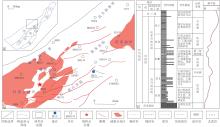
Fig. 1
Geological structure map and composite stratigraphic column of the Shuguang area in the Western Sag, Liaohe Depression[29]"


Fig. 2
Schematic diagram showing the experimental process and analytical methods of this study"

Table 1
Ultimate analysis of kerogen in shales from the Shuguang area, Western Sag, Liaohe Depression"
| 分析项目 | 元素含量/% | 原子量比值 | 干酪根类型 | |||||||
|---|---|---|---|---|---|---|---|---|---|---|
| N | C | H | S | O | H/C | O/C | N/C | S/C | ||
| 分析结果 | 1.939 | 78.223 | 10.915 | 1.023 | 7.900 | 1.660 | 0.080 | 0.020 | 0.005 | Ⅰ型 |

Fig. 3
XPS and peak fitting spectra of kerogen in shales from the Shuguang area, Western Sag, Liaohe Depression"

Table 2
Forms and relative contents of carbon, oxygen, nitrogen, and sulfur in kerogen of shales from the Shuguang area, Western Sag, Liaohe Depression"
| 元素XPS图谱峰 | 官能团 | 归属结构 | 结合能/eV | 相对面积/% |
|---|---|---|---|---|
| C1s | 脂肪族和芳香族碳 | C=C,C—C,C—H | 284.80 | 87.20 |
| 与醚键、羟基相连的碳 | C—O,C—OH | 286.36 | 9.29 | |
| 羰基碳 | O=C | 287.96 | 2.35 | |
| 羧基碳 | O=C—O | 289.26 | 1.16 | |
| O1s | 羰基氧 | C=O | 530.20 | 0.86 |
| 碳-氧单键氧 | C—O | 532.36 | 95.98 | |
| 羧基氧 | COOH | 534.10 | 3.16 | |
| N1s | 吡啶氮 |  | 399.89 | 94.56 |
| 吡咯氮 | 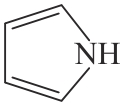 | 401.90 | 5.44 | |
| S2p | 脂肪族硫 | C=S | 161.65 | 24.28 |
| 噻吩硫 | 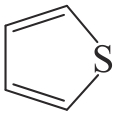 | 163.59 | 14.68 | |
| 亚砜硫 | S=O | 168.74 | 61.04 |

Fig.4
13C NMR-derived peak fitting spectrum of kerogen in shales from the Shuguang area, Western Sag, Liaohe Depression"
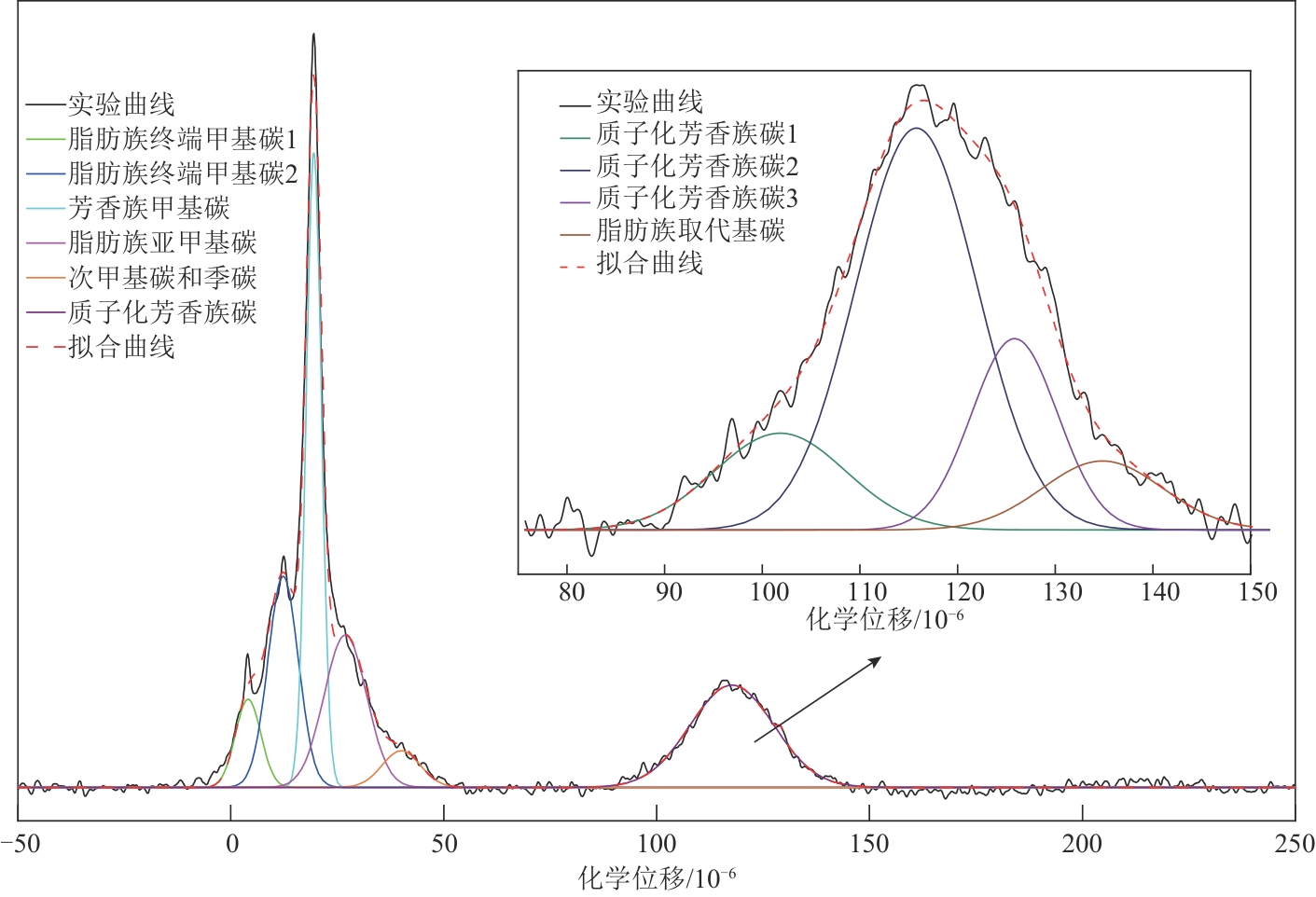
Table 3
Structural assignment and relative contents of carbon atoms with NMR chemical shifts in organic matter of shales from the Shuguang area, Western Sag, Liaohe Depression"
| 碳原子类型 | 化学位移/10-6 | 归属 | 表达式 | 符号 | 相对含量/% |
|---|---|---|---|---|---|
| 脂肪族碳 | 3 ~ 4 | 脂肪族终端甲基碳1 | CH3—CH3 | 6.40 | |
| 14 ~ 16 | 脂肪族终端甲基碳2 | R—CH3 | 18.44 | ||
| 16 ~ 22 | 芳香族甲基碳 | Ar—CH3 | 27.79 | ||
| 22 ~ 36 | 脂肪族亚甲基碳 | CH2—CH3 | 18.58 | ||
| 36 ~ 50 | 次甲基碳和季碳 | CH,C | 3.99 | ||
| 芳香族碳 | 100 ~ 110 | 质子化芳香族碳1 | Ar—H | 3.65 | |
| 111 ~ 118 | 质子化芳香族碳2 | Ar—H | 14.03 | ||
| 123 ~ 129 | 质子化芳香族碳3 | Ar—H | 4.74 | ||
| 137 ~ 148 | 脂肪族取代基碳 | Ar—C | 2.38 |

Fig.5
FTIR and peak fitting spectra of organic matter in shales from the Shuguang area, Western Sag, Liaohe Depression"

Table 4
Structural assignment and relative contents of organic functional groups corresponding to the dominant absorption peaks in FTIR spectra of kerogen in shales from the Shuguang area, Western Sag, Liaohe Depression"
| 所属区域 | 波数范围/cm-1 | 峰位波数/cm-1 | 归属结构 | 峰面积 | 相对含量/% |
|---|---|---|---|---|---|
芳香烃 区域 | 900 ~ 700 | 700.61 | 3H | 5.87 | 10.35 |
| 724.87 | 3H | 27.43 | 48.35 | ||
| 760.65 | 3H | 2.01 | 3.54 | ||
| 826.85 | 2H | 15.94 | 28.08 | ||
| 877.44 | 1H | 5.50 | 9.68 | ||
| 含氧官能团区域 | 1 800 ~ 1 000 | 1 047.50 | 烷基醚C—O | 29.01 | 1.67 |
| 1 130.39 | 醇羟基C—OH | 55.37 | 3.18 | ||
| 1 253.28 | 酚羟基Ar—OH | 412.78 | 23.74 | ||
| 1 311.77 | 芳香醚C—O | 52.43 | 3.01 | ||
| 1 374.85 | 芳香结构上的CH3 | 182.96 | 10.52 | ||
| 1 451.76 | 烷基上的CH,CH2 | 263.83 | 15.17 | ||
| 1 589.21 | 芳香结构C=C | 610.73 | 35.15 | ||
| 1 708.28 | 羧基COOH | 131.46 | 7.56 | ||
脂肪烃 区域 | 3 000 ~ 2 800 | 2 849.38 | 对称的—CH2— | 267.91 | 24.77 |
| 2 871.39 | 对称的—CH3— | 79.33 | 7.33 | ||
| 2 922.15 | 反对称的—CH2— | 631.79 | 58.41 | ||
| 2 963.82 | 反对称的—CH3— | 102.66 | 9.49 | ||
| 羟基区域 | 3 600 ~ 3 100 | 3 338.26 | 醚—OH | 312.46 | 70.07 |
| 3 464.70 | 氢键缔合的—OH(或—NH),酚类 | 133.48 | 29.93 |
Table 5
Consistency between the constructed average molecular structure model of kerogen and actual samples for shales in the Shuguang area, Western Sag, Liaohe Depression"
| 名称 | 原子量比值 | |||
|---|---|---|---|---|
| H/C | O/C | N/C | S/C | |
| 实际样品(—) | 1.662 8 | 0.075 8 | 0.021 3 | 0.004 9 |
| 构建模型(分子式C188H310O14N4S) | 1.648 9 | 0.074 5 | 0.021 2 | 0.005 3 |
| 相对误差/% | -0.833 8 | -1.757 1 | -0.109 9 | 8.554 1 |

Fig. 6
Average molecular structure model (C188H310O14N4S) of kerogen and comparison of 13C NMR-derived spectra between the model and actual samples for shales from the Shuguang area, Western Sag, Liaohe Depression"

Table 6
Comparison of structural parameters between the average molecular structure model of kerogen and the tested shale samples from the Shuguang area, Western Sag, Liaohe Depression"
| 结构参数 | 符号 | 实验值 | 模型值 |
|---|---|---|---|
| 脂碳率/% | 75.20 | 73.40 | |
| 芳碳率/% | 24.80 | 26.60 | |
| 烷链支化度 | 0 | 0 | |
| 亚甲基链碳数 | 4.94 | 5.04 | |
| 桥碳与周碳比 | 0 | 0 |

Fig. 7
Thermogravimetric curves of kerogen in shales from the Shuguang area, Western Sag, Liaohe Depression"


Fig.8
Construction and optimization of the hydrocarbon generation system for kerogen pyrolysis of shales in the Shuguang area, Western Sag, Liaohe Depression"


Fig. 9
Comparison of weight losses derived through ReaxFF MD and thermogravimetric analysis of kerogen in shales from the Shuguang area, Western Sag, Liaohe Depression"


Fig. 10
Schematic diagram showing the reaction pathway for hydrocarbon generation from kerogen pyrolysis of shales in the Shuguang area, Western Sag, Liaohe Depression"


Fig. 11
Hydrocarbon generation model and reactions from kerogen pyrolysis of shales in the Shuguang area, Western Sag, Liaohe Depression"

| 1 | 邹才能, 杨智, 张国生, 等. 非常规油气地质学理论技术及实践[J]. 地球科学, 2023, 48(6): 2376-2397. |
| ZOU Caineng, YANG Zhi, ZHANG Guosheng, et al. Theory, technology and practice of unconventional petroleum geology[J]. Earth Science, 2023, 48(6): 2376-2397. | |
| 2 | 刘翰林, 邹才能, 邱振, 等. 陆相黑色页岩沉积环境及有机质富集机制——以鄂尔多斯盆地长7段为例[J]. 沉积学报, 2023, 41(6): 1810-1829. |
| LIU Hanlin, ZOU Caineng, QIU Zhen, et al. Sedimentary depositional environment and organic matter enrichment mechanism of lacustrine black shales: A case study of the Chang 7 member in the Ordos Basin[J]. Acta Sedimentologica Sinica, 2023, 41(6): 1810-1829. | |
| 3 | 王建, 郭秋麟, 赵晨蕾, 等. 中国主要盆地页岩油气资源潜力及发展前景[J]. 石油学报, 2023, 44(12): 2033-2044. |
| WANG Jian, GUO Qiulin, ZHAO Chenlei, et al. Potentials and prospects of shale oil-gas resources in major basins of China[J]. Acta Petrolei Sinica, 2023, 44(12): 2033-2044. | |
| 4 | ZHAO Wenzhi, HU Suyun, HOU Lianhua, et al. Types and resource potential of continental shale oil in China and its boundary with tight oil[J]. Petroleum Exploration and Development, 2020, 47(1): 1-11. |
| 5 | HU Suyun, ZHAO Wenzhi, HOU Lianhua, et al. Development potential and technical strategy of continental shale oil in China[J]. Petroleum Exploration and Development, 2020, 47(4): 877-887. |
| 6 | 金之钧, 朱如凯, 梁新平, 等. 当前陆相页岩油勘探开发值得关注的几个问题[J]. 石油勘探与开发, 2021, 48(6): 1276-1287. |
| JIN Zhijun, ZHU Rukai, LIANG Xinping, et al. Several issues worthy of attention in current lacustrine shale oil exploration and development[J]. Petroleum Exploration and Development, 2021, 48(6): 1276-1287. | |
| 7 | 郭旭升, 马晓潇, 黎茂稳, 等. 陆相页岩油富集机理探讨[J]. 石油与天然气地质, 2023, 44(6): 1333-1349. |
| GUO Xusheng, MA Xiaoxiao, LI Maowen, et al. Mechanisms for lacustrine shale oil enrichment in Chinese sedimentary basins[J]. Oil & Gas Geology, 2023, 44(6): 1333-1349. | |
| 8 | TONG Jianhui, JIANG Xiumin, HAN Xiangxin, et al. Evaluation of the macromolecular structure of Huadian oil shale Kerogen using molecular modeling[J]. Fuel, 2016, 181: 330-339. |
| 9 | MIKNIS F P, NETZEL D A, SMITH J W, et al. 13C NMR measurements of the genetic potentials of oil shales[J]. Geochimica et Cosmochimica Acta, 1982, 46(6): 977-984. |
| 10 | QIN Kuangzong, CHEN Deyu, LI Zhanguang. A new method to estimate the oil and gas potentials of coals and kerogens by solid state 13C NMR spectroscopy[J]. Organic Geochemistry, 1991, 17(6): 865-872. |
| 11 | BEHAR F, VANDENBROUCKE M. Chemical modelling of kerogens[J]. Organic Geochemistry, 1987, 11(1): 15-24. |
| 12 | LIU Yu, LIU Shimin, ZHANG Rui, et al. The molecular model of Marcellus shale kerogen: Experimental characterization and structure reconstruction[J]. International Journal of Coal Geology, 2021, 246: 103833. |
| 13 | WANG Qing, PAN Shuo, BAI Jingru, et al. Experimental and dynamics simulation studies of the molecular modeling and reactivity of the Yaojie oil shale kerogen[J]. Fuel, 2018, 230: 319-330. |
| 14 | 刘向君, 罗丹序, 熊健, 等. 龙马溪组页岩干酪根平均分子结构模型的构建[J]. 化工进展, 2017, 36(2): 530-537. |
| LIU Xiangjun, LUO Danxu, XIONG Jian, et al. Construction of the average molecular modeling of the kerogen from the Longmaxi Formation[J]. Chemical Industry and Engineering Progress, 2017, 36(2): 530-537. | |
| 15 | SHI Kanyuan, CHEN Junqing, PANG Xiongqi, et al. Average molecular structure model of shale kerogen: Experimental characterization, structural reconstruction, and pyrolysis analysis[J]. Fuel, 2024, 355: 129474. |
| 16 | TISSOT B P, WELTE D H. Mathematical models: A quantitative approach to the evaluation of oil and gas prospects[M]//TISSOT B P, WELTE D H. Petroleum Formation and Occurrence. Berlin: Springer, 1978: 500-521. |
| 17 | 张谦, 金之钧, 朱如凯, 等. 岩石热解方法应用于页岩油气研究需注意的几个问题[J]. 石油与天然气地质, 2023, 44(4): 1020-1032. |
| ZHANG Qian, JIN Zhijun, ZHU Rukai, et al. Remarkable issues of Rock-Eval pyrolysis in the assessment of shale oil/gas[J]. Oil & Gas Geology, 2023, 44(4): 1020-1032. | |
| 18 | TISSOT B P, WELTE D H. Petroleum formation and occurrence[M]. 2nd ed. Berlin: Springer, 1984: 1-554. |
| 19 | SALMON E, VAN DUIN A C T, LORANT F, et al. Early maturation processes in coal. Part 2: Reactive dynamics simulations using the ReaxFF reactive force field on Morwell Brown coal structures[J]. Organic Geochemistry, 2009, 40(12): 1195-1209. |
| 20 | LIU Xiaoping, ZHAN Jinhui, LAI Dengguo, et al. Initial pyrolysis mechanism of oil shale kerogen with reactive molecular dynamics simulation[J]. Energy & Fuels, 2015, 29(5): 2987-2997. |
| 21 | QIAN Yanan, ZHAN Jinhui, LAI Dengguo, et al. Primary understanding of non-isothermal pyrolysis behavior for oil shale kerogen using reactive molecular dynamics simulation[J]. International Journal of Hydrogen Energy, 2016, 41(28): 12093-12100. |
| 22 | ZHONG Qifan, MAO Qiuyun, XIAO Jin, et al. ReaxFF simulations of petroleum coke sulfur removal mechanisms during pyrolysis and combustion[J]. Combustion and Flame, 2018, 198: 146-157. |
| 23 | ZHANG Zhijun, CHAI Jun, ZHANG Hanyu, et al. Structural model of Longkou oil shale Kerogen and the evolution process under steam pyrolysis based on ReaxFF molecular dynamics simulation[J]. Energy Sources, Part A: Recovery, Utilization, and Environmental Effects, 2021, 43(2): 252-265. |
| 24 | HAN Qiuya, LI Meijun, LIU Xiaoqiang, et al. A maturation scale for molecular simulation of Kerogen thermal degradation[J]. Organic Geochemistry, 2023, 175: 104507. |
| 25 | ZHANG Zhijun, GUO Liting, ZHANG Hanyu, et al. Comparing product distribution and desulfurization during direct pyrolysis and hydropyrolysis of Longkou oil shale kerogen using reactive MD simulations[J]. International Journal of Hydrogen Energy, 2019, 44(47): 25335-25346. |
| 26 | UNGERER P, COLLELL J, YIANNOURAKOU M. Molecular modeling of the volumetric and thermodynamic properties of kerogen: Influence of organic type and maturity[J]. Energy & Fuels, 2015, 29(1): 91-105. |
| 27 | WU Ziheng, XU Zhiguo. Experimental and molecular dynamics investigation on the pyrolysis mechanism of Chang 7 type-Ⅱ oil shale kerogen[J]. Journal of Petroleum Science and Engineering, 2022, 209: 109878. |
| 28 | 王民, 余昌琦, 费俊胜, 等. 页岩油在干酪根中吸附行为的分子动力学模拟与启示[J]. 石油与天然气地质, 2023, 44(6): 1442-1452. |
| WANG Min, YU Changqi, FEI Junsheng, et al. Molecular dynamics simulation of shale oil adsorption in kerogen and its implications[J]. Oil & Gas Geology, 2023, 44(6): 1442-1452. | |
| 29 | 宋兵, 王波, 刘兴周, 等. 辽河西部凹陷曙北地区沙四段薄砂层成因类型及分布规律[J]. 地质与资源, 2021, 30(6): 698-706. |
| SONG Bing, WANG Bo, LIU Xingzhou, et al. Genetic types and distribution rules of thin sand layers in the fourth member of Shahejie Formation in Shubei area of the western sag, Liaohe Depression[J]. Geology and Resources, 2021, 30(6): 698-706. | |
| 30 | 李毅, 方石, 孙平昌, 等. 辽河盆地西部凹陷沙河街组古近系页岩气成藏地质条件研究[J]. 地质与资源, 2017, 26(2): 140-146. |
| LI Yi, FANG Shi, SUN Pingchang, et al. Geological conditions of shale gas accumulation of Paleogene Shahejie Formation in the western sag of Liaohe Basin[J]. Geology and Resources, 2017, 26(2): 140-146. | |
| 31 | 黄潇, 张金川, 李晓光, 等. 陆相页岩孔隙类型、特征及油气共聚过程探讨——以辽河坳陷西部凹陷为例[J]. 天然气地球科学, 2015, 26(7): 1422-1432. |
| HUANG Xiao, ZHANG Jinchuan, LI Xiaoguang, et al. Pore types and characteristics of continental shale and discussion on the process of oil and gas accumulation: A case study of the western sag of Liaohe Depression[J]. Natural Gas Geoscience, 2015, 26(7): 1422-1432. | |
| 32 | ZHANG Lanjun, LI Zenghua, HE Wenjing, et al. Study on the change of organic sulfur forms in coal during low-temperature oxidation process[J]. Fuel, 2018, 222: 350-361. |
| 33 | LI Lin, LI Zhihao, MA Chuandong, et al. Molecular dynamics simulations of nonionic surfactant adsorbed on subbituminous coal model surface based on XPS analysis[J]. Molecular Simulation, 2019, 45(9): 736-742. |
| 34 | DING Dianshi, LIU Guijian, FU Biao. Influence of carbon type on carbon isotopic composition of coal from the perspective of solid-state 13C NMR[J]. Fuel, 2019, 245: 174-180. |
| 35 | WANG Qing, YE Jiangbin, YANG Hongyang, et al. Chemical composition and structural characteristics of oil shales and their kerogens using Fourier transform infrared (FTIR) spectroscopy and solid-state 13C nuclear magnetic resonance (NMR)[J]. Energy & Fuels, 2016, 30(8): 6271-6280. |
| 36 | FENG Yesu, LE DOAN T V, POMERANTZ A E. The chemical composition of bitumen in pyrolyzed green river oil shale: Characterization by 13C NMR spectroscopy[J]. Energy & Fuels, 2013, 27(12): 7314-7323. |
| 37 | YANG Fan, HOU Yucui, WU Weize, et al. A new insight into the structure of Huolinhe lignite based on the yields of benzene carboxylic acids[J]. Fuel, 2017, 189: 408-418. |
| 38 | WEI Qiang, TANG Yuegang. 13C-NMR study on structure evolution characteristics of high-organic-sulfur coals from typical Chinese areas[J]. Minerals, 2018, 8(2): 49. |
| 39 | 郑庆荣, 曾凡桂, 张世同. 中变质煤结构演化的FT-IR分析[J]. 煤炭学报, 2011, 36(3): 481-486. |
| ZHENG Qingrong, ZENG Fangui, ZHANG Shitong. FT-IR study on structure evolution of middle maturate coals[J]. Journal of China Coal Society, 2011, 36(3): 481-486. | |
| 40 | IBARRA J V, MOLINER R, BONET A J. FT-i.r. investigation on char formation during the early stages of coal pyrolysis[J]. Fuel, 1994, 73(6): 918-924. |
| 41 | 韩峰, 张衍国, 蒙爱红, 等. 云南褐煤结构的FTIR分析[J]. 煤炭学报, 2014, 39(11): 2293-2299. |
| HAN Feng, ZHANG Yanguo, MENG Aihong, et al. FTIR analysis of Yunnan lignite[J]. Journal of China Coal Society, 2014, 39(11): 2293-2299. | |
| 42 | RU Xin, CHENG Zhiqiang, SONG Lihua, et al. Experimental and computational studies on the average molecular structure of Chinese Huadian oil shale kerogen[J]. Journal of Molecular Structure, 2012, 1030: 10-18. |
| 43 | GOLDENBERG M, VREEMAN G, SUN D J, et al. A material-sparing simplified buoyancy method for determining the true density of solids[J]. International Journal of Pharmaceutics, 2023, 635: 122694. |
| 44 | ZHENG Mo, LI Xiaoxia, LIU Jian, et al. Initial chemical reaction simulation of coal pyrolysis via ReaxFF molecular dynamics[J]. Energy & Fuels, 2013, 27(6): 2942-2951. |
| 45 | XU Fang, LIU Hui, WANG Qing, et al. ReaxFF-based molecular dynamics simulation of the initial pyrolysis mechanism of lignite[J]. Fuel Processing Technology, 2019, 195: 106147. |
| 46 | 李剑, 马卫, 王义凤, 等. 腐泥型烃源岩生排烃模拟实验与全过程生烃演化模式[J]. 石油勘探与开发, 2018, 45(3): 445-454. |
| LI Jian, MA Wei, WANG Yifeng, et al. Modeling of the whole hydrocarbon-generating process of sapropelic source rock[J]. Petroleum Exploration and Development, 2018, 45(3): 445-454. | |
| 47 | 洪智宾, 吴嘉, 方朋, 等. 纳米限域下页岩中可溶有机质的非均质性及页岩油赋存状态[J]. 岩性油气藏, 2024, 36(6): 160-168. |
| HONG Zhibin, WU Jia, FANG Peng, et al. Heterogeneity of soluble organic matter in shale and occurrence state of shale oil under nanoconfinement[J]. Lithologic Reservoirs, 2024, 36(6): 160-168. | |
| 48 | 宋书伶, 杨二龙, 沙明宇. 基于分子模拟的页岩油赋存状态影响因素研究[J]. 油气藏评价与开发, 2023, 13(1): 31-38. |
| SONG Shuling, YANG Erlong, SHA Mingyu. Influencing factors of occurrence state of shale oil based on molecular simulation[J]. Petroleum Reservoir Evaluation and Development, 2023, 13(1): 31-38. | |
| 49 | 郭旭升, 胡东风, 俞凌杰, 等. 页岩自封闭性与页岩气保存的微观机理研究[J]. 石油实验地质, 2023, 45(5): 821-831. |
| GUO Xusheng, HU Dongfeng, YU Lingjie, et al. Study on the micro mechanism of shale self-sealing and shale gas preservation[J]. PETROLEUM GEOLOGY & EXPERIMENT, 2023, 45(5): 821-831. | |
| 50 | SHI Lei, LIU Qingya, GUO Xiaojin, et al. Pyrolysis behavior and bonding information of coal—A TGA study[J]. Fuel Processing Technology, 2013, 108: 125-132. |
| 51 | SHI Lei, LIU Qingya, ZHOU Bin, et al. Interpretation of methane and hydrogen evolution in coal pyrolysis from the bond cleavage perspective[J]. Energy & Fuels, 2017, 31(1): 429-437. |
| Viewed | ||||||
|
Full text |
|
|||||
|
Abstract |
|
|||||
